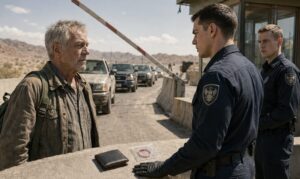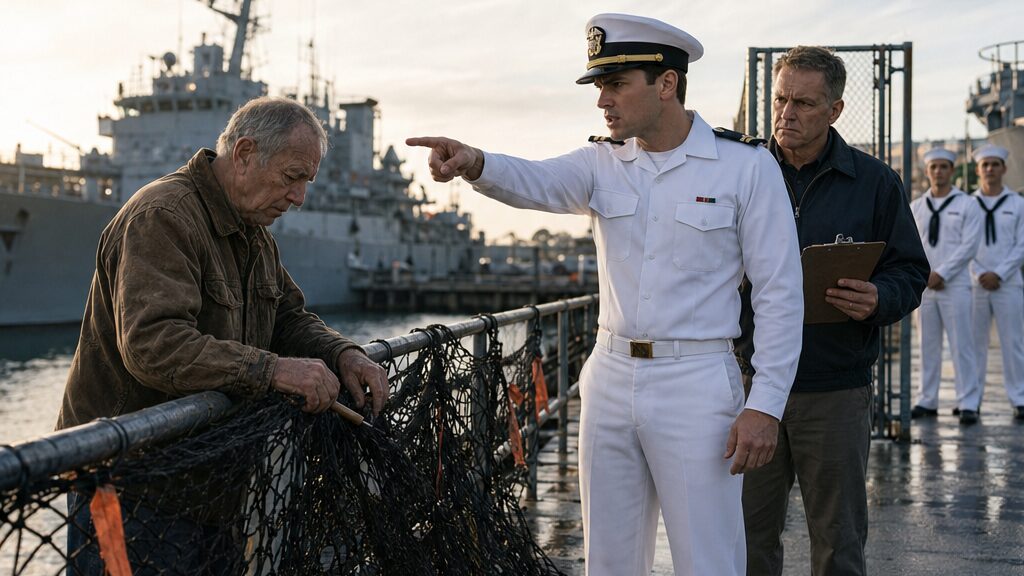
The Sailor Pointed at the Old Man Fixing the Net Before Learning Why He Never Left the Pier
Chapter 1: The Man in the Brown Jacket at the Pier
Dennis Bennett came to the harbor before the gulls got loud.
At that hour, the naval yard had not yet put on its daytime face. The gray vessels sat heavy in the water, their sides catching the first strip of sun. Chains knocked softly against metal posts. Somewhere beyond the fuel dock, a generator coughed and steadied itself. The air tasted of salt, rust, diesel, and wet rope.
Dennis liked it best before voices arrived.
He stood at the south railing of the old rescue pier in a brown canvas jacket gone pale at the elbows. The jacket had once been stiff enough to turn rain. Now it folded around his shoulders like something tired of service. His left hand held the black dock net against the railing. His right hand guided a wooden-handled net needle through a gap where three strands had frayed almost to separation.
The net was older than most of the sailors who crossed the harbor now.
It sagged beneath the railing in a dark, uneven sheet, patched in places with rope that had weathered to different shades. Some knots were thick and ugly. Some were nearly invisible unless a person knew to look. Dennis knew every poor repair by sight. He knew which ones had been done in a hurry, which ones had been done by a man who cared, and which ones had been done by somebody who only wanted to pass an inspection.
He slid the needle through, pulled the line close, and paused to let his fingers remember the turn.
Not too tight.
A knot tied too tight cut itself under strain.
A knot tied too loose lied.
He could hear that sentence in a voice that had been gone a long time, rough with smoke and laughter. He did not let the voice finish. He brought the line under, crossed it, tucked it, then pressed the finished knot with his thumb until it sat flat against the others.
The old pier had an official name now. A laminated sign on the gate called it Harbor Utility Access 4B. Dennis never used that name. In his mind it was still the south rescue pier. Men had run down it in storms. Stretchers had been carried across it. Ropes had burned palms here. Names had been shouted into wind so loud that even God would have had to lean closer.
Now there were yellow safety tags on the posts and a fresh chain across the shore end.
Dennis had stepped over it.
Not because he did not see it. His eyes were old, but they were not useless. He had seen the red letters. RESTRICTED MAINTENANCE ZONE. AUTHORIZED PERSONNEL ONLY. He had also seen the cut line two feet below the sign, where the bottom of the net had started to separate from the lower rail. One hard pull, one bad tide, one careless boot, and the whole section would come away.
He had told the clerk three days ago.
The clerk had looked at him over a computer screen and asked if he had filled out a work request.
Dennis had said no.
The clerk had handed him a form and a pen.
He had left both on the counter.
The net did not need a form. It needed hands.
He worked slowly, because his fingers no longer obeyed the way they once had. The knuckles swelled in the cold. His right thumb sometimes went numb without warning. When it did, he lowered the tool, shook his hand once at his side, and waited for feeling to return. He never cursed at his hands. They had pulled enough weight for him. He owed them patience.
A truck rolled somewhere behind the sheds. A gate clanked. The harbor began to gather itself.
Dennis tucked another length of line through the net. The wooden handle of the needle was dark from years of palm oil and weather. A hairline crack ran down one side. He had meant to replace it more than once. Each time, he put it back in the drawer instead.
A gull landed on the rail ten feet away and watched him with one bright, greedy eye.
“You’re early,” Dennis murmured.
The gull opened its beak but made no sound.
Dennis almost smiled.
Footsteps crossed the pier approach behind him. Two sets at first, quick and young, boots striking the boards with no hesitation. Then another set farther back. Voices came with them, clean and clipped, the kind that belonged to men who had slept well and shaved close.
Dennis did not turn.
He felt the harbor change around him when uniforms appeared. It was not fear. Fear had a different smell. This was awareness, an old habit. Make room. Keep your hands visible. Do not surprise a man who believes he is responsible for everything in sight.
The voices slowed.
“Who’s that?” one of them asked.
Dennis tucked the needle under the next strand.
“Maintenance?” another said.
“No idea.”
The gull flew off.
Dennis drew the line through and tested the section with two fingers. Better, but not finished. The torn part still opened when pressure came from below. He would need to add another cross-line, maybe two. He leaned closer, feeling the pull in his back.
A shadow fell across the net.
“Sir?”
The voice was young. Polite on the surface. Hard underneath.
Dennis held the line in place with his thumb and finished the turn before answering. “Morning.”
“You can’t be here.”
Dennis kept his eyes on the knot. A white uniform stood just inside his left shoulder. Pressed trousers. Polished shoes. Sleeves sharp enough to cut paper. The sailor was tall, or seemed tall because Dennis was bent over the rail.
“This section is restricted,” the young man said.
Dennis snugged the line. “I saw the sign.”
That was the wrong answer. He knew it as soon as it left his mouth.
The sailor shifted, and two others stopped behind him. Dennis heard the quiet little pause men made when they expected trouble and hoped it would entertain them.
“You saw the sign,” the young man repeated.
Dennis lowered the net needle but did not let go of the line.
“What’s your name, sir?”
Dennis looked at the knot, then at the water below, where the net shadow moved with the tide. “Dennis Bennett.”
The young sailor waited, perhaps expecting more. Dennis gave him nothing else.
“Mr. Bennett, I need you to step away from the railing.”
“In a minute.”
“No, sir. Now.”
Dennis heard the effort in the sailor’s voice. Not cruelty. Training. The boy was trying to sound older than he was. Trying to put steel where experience had not yet grown.
Dennis could have made it easier on him.
He could have said he had served here before half the buildings had new roofs. He could have said he knew the old pier better than whoever had ordered that sign printed. He could have said the knot in front of him was not decorative, and the repair crew would tie it wrong if they tied it at all.
Instead he kept his thumb on the line and made one more pass with the needle.
The sailor’s breath sharpened.
Behind them, one of the other men gave a low laugh that he tried to hide as a cough.
Dennis pulled the line through. His fingers shook once. He steadied them against the net.
The young sailor stepped closer.
“Sir, put the tool down.”
Dennis looked at the wooden handle in his hand. Then he looked at the sailor’s polished shoes. There was already salt drying in a pale crescent along one sole.
First week on pier watch, Dennis thought.
Maybe second.
The sailor said, louder now, “Put it down.”
Dennis set the needle on the rail carefully, so it would not roll through the gap and fall into the water. The tool came to rest beside his hand.
The young man glanced toward the other sailors, then back at Dennis.
“What are you doing out here?”
“Fixing what’s torn.”
“That’s not your job.”
Dennis looked at the black net, at the old knots, at the loose section where the tide breathed through the gap.
“No,” he said quietly. “I suppose not.”
The sailor seemed unsure what to do with that. For one second, the morning held still.
Then a radio crackled from the young man’s belt, and another voice called from the shore end of the pier. A civilian in a hard hat came through the gate carrying a clipboard, his jacket zipped halfway and his expression already irritated.
Dennis knew that look too.
The look of a man who had found a problem that could be moved more easily than understood.
The young sailor straightened, grateful for someone else’s authority.
Dennis picked up the needle again before either of them could tell him not to.
He had two more knots to tie before the whole section would hold.
Chapter 2: The Young Sailor Pointed Before He Listened
The civilian with the clipboard was Jack Miller, though Dennis did not know his name yet. He had the compact walk of a man always late for something he had warned other people about. A ring of keys slapped against his thigh with every step.
“What’s going on?” Jack called.
The young sailor turned halfway, keeping Dennis in view. “Unauthorized person inside the maintenance zone.”
Jack stopped beside the chain and looked Dennis over in one quick sweep: brown jacket, gray hair, old hands, net needle, worn boots planted too close to a restricted railing.
His eyes did not stop long enough to see anything.
“For crying out loud,” Jack said. “Sir, you cannot be inside this area.”
Dennis kept the net line pinched between his thumb and forefinger. “This bottom run is separating.”
“We have a crew for that.”
“You have a crew coming today?”
Jack looked at the clipboard as if the answer might be hiding there. “That’s not the point.”
“It is if the tide pulls before they do.”
One of the sailors behind Tyler made a small sound. Not quite a laugh this time. More like surprise.
The young sailor stepped between Dennis and the others. “Sir, step back from the railing.”
Dennis looked at him fully for the first time.
The boy’s face was narrower than his voice. Early twenties, maybe. Clean-shaven. Dark hair tucked under his cover. His uniform was so white it looked almost blue in the morning light. There was a tightness around his mouth that did not belong to arrogance alone. He was afraid of failing in front of witnesses.
Dennis knew that too.
“What’s your name?” Dennis asked.
The young man blinked. “Petty Officer Carter.”
“First name?”
The sailor’s jaw tightened. “Tyler.”
Dennis nodded once, as if receiving a line on a chart. “Tyler.”
“Do not make this personal, sir.”
“It already is,” Dennis said.
Tyler’s cheeks colored. He took that as defiance. Maybe it was. Dennis did not always know anymore where truth ended and stubbornness began.
Jack came closer, stepping over the chain with less trouble than Dennis had. He pointed his pen at the net. “That section is scheduled to come down.”
Dennis’s hand tightened on the line.
“When?”
“Tomorrow morning. We’ve got inspection prep today, removal tomorrow, disposal after that.”
“Disposal,” Dennis repeated.
“It’s deteriorated gear.”
“It’s a rescue net.”
“It’s a liability.”
The words landed harder than Jack meant them to. Dennis felt them in his chest, low and blunt.
A liability.
That was what time did, if people let it. It turned hands into hazards, memory into clutter, promises into paperwork, and anything old into something to be cleared before important people came walking through.
Tyler stepped closer, his patience thinning in front of the other sailors. “Mr. Bennett, this is your last warning. Drop the tool and move away from government property.”
The word drop did it.
Dennis did not move quickly. He could not have, even if anger had asked him to. He slid the needle through the rope, turned the line over itself, and completed the knot before he set the tool down again.
Tyler’s arm came up.
His finger pointed inches from Dennis’s shoulder.
“Sir, I said now.”
The pier went quiet in the way public places do when everyone pretends not to watch while watching everything.
A sailor near the gate shifted his weight. Jack exhaled through his nose. Somewhere behind them, metal rang against metal. The gulls had gone silent.
Dennis looked at the finger first.
Not the face. Not the uniform. The finger.
He remembered another finger years ago, not pointed in accusation but stretched through rain, reaching for rope. He remembered a hand opening and closing against black netting. He remembered shouting a name until his throat tore and the wind took it anyway.
He breathed once.
Then he bent back to the net.
Tyler moved as if to grab his arm.
Dennis’s voice stopped him.
“That knot will fail.”
It was not loud. It did not need to be. Something in the flatness of it made Tyler freeze.
“What?”
Dennis touched the repair already tied farther down the rail, a newer one made with bright synthetic line. “That one. Whoever tied it crossed the standing end wrong. Looks neat. Won’t hold under side pull.”
Tyler glanced despite himself.
Jack frowned. “That repair passed visual.”
“Visual doesn’t pull.”
Dennis picked up the wooden-handled needle. Tyler reached again, but slower this time.
Dennis threaded the line through the damaged section and made the first movement with deliberate care. “Pier teams used to tie this with a double harbor bend and a half-lock facing down-current.”
Jack’s frown deepened. “That’s not what the manual calls it.”
“The manual was rewritten after they renamed the pier.”
Tyler stared at him. “Renamed from what?”
Dennis drew the line through. The rope rasped against itself, dry and intimate.
“South rescue pier.”
No one spoke.
The name did not mean much to the younger sailors. Dennis saw that. To them it was a phrase from before their time, if it was anything. But Jack’s eyes flickered. He had heard it somewhere. Maybe in an old maintenance note. Maybe from a dockhand after coffee. Maybe in the sort of conversation men half-listen to until the speaker dies and the details become impossible to retrieve.
Tyler lowered his pointing hand, but not all the way.
Dennis continued. “You turn the lock down-current because when the tide slams from the channel, the knot tightens into the rail instead of rolling away from it.”
“You expect us to believe you know that by looking?” Tyler asked.
“No.”
Dennis pulled the line firm. “I know it because I’ve watched it fail.”
That changed the air. Not enough to solve anything. Enough to make the men behind Tyler stop pretending this was funny.
Jack recovered first. “Sir, whether you know knots or not, you’re unauthorized. That gear is not to be altered.”
“It was altered when somebody tied it wrong.”
Jack clipped his pen against the board. “I’m not arguing ropework with you.”
“No.”
“You’re leaving.”
Dennis tucked the end through and pressed the knot flat with his thumb. The section held cleaner now. Not perfect. Safer.
Tyler looked at the knot, then at Dennis’s hands. His expression had shifted from command to calculation. He still wanted Dennis gone. But now there was a question in him, and questions made young authority uneasy.
“Mr. Bennett,” Tyler said, quieter but still firm, “how do you know this pier?”
Dennis picked up the needle and rubbed his thumb along the cracked wooden handle.
He could have answered.
He could have said he had stood here when the old tower still had green paint and the floodlights hummed like hornets. He could have said he had run rescue drills from this rail until his calves cramped. He could have said he had carried men off boats here, living and dead, and that the net below them had once held more weight than any of them wanted to imagine.
Instead he looked past Tyler to the gray vessel moored across the water.
“You’re blocking my light,” Dennis said.
The young sailors behind him stiffened, unsure whether to laugh.
Tyler did not laugh. The color came back into his face, but this time it was not embarrassment alone. It was insult, and maybe something more uncomfortable beneath it.
Jack stepped in. “Enough. Petty Officer, escort him off the pier. If he returns, call base security.”
Dennis slowly wrapped the loose tail around the needle.
Jack pointed toward the net with his clipboard. “And I want that whole section tagged for removal by end of day. No more patchwork. Cut it free if you have to.”
Dennis looked at him then.
Not sharply. Not dramatically. Just looked.
Jack’s eyes slid away first.
Tyler moved to Dennis’s side, close enough to guide him without touching. “Sir.”
Dennis tucked the wooden-handled tool into the inside pocket of his brown jacket. His hand lingered there for a second, over his chest, over the small shape of old wood under cloth.
He stepped away from the rail.
The board beneath his right foot dipped slightly. He knew that dip. Third plank from the south cleat. It had dipped for thirty-two years.
As he walked toward the gate, the sailors parted without being told. That small courtesy came too late to be generous, but Dennis accepted it anyway. At the chain, he paused and turned back.
The black net moved in the tide below the railing, patched in one place, torn in another, waiting.
Tyler watched him from the pier, no longer pointing.
Dennis met his eyes.
“Don’t cut the bottom run first,” Dennis said.
Jack let out a humorless breath. “Here we go.”
Dennis kept his gaze on Tyler. “If you cut the bottom first, the weight rolls. Top line snaps sideways. Anyone standing near the cleat will catch it in the knees.”
Tyler glanced toward the cleat.
Jack snapped, “We’ll handle it.”
Dennis nodded, but not as if he agreed. More as if he had done what conscience required and would not beg sense to listen.
He stepped over the chain and walked toward the parking lot, back bent, hands empty.
Behind him, Jack gave orders. The sailors began moving again. The harbor resumed its noise.
But Tyler Carter remained still long enough for the others to notice.
He looked down at the knot Dennis had tied.
Then at the bright synthetic repair below it.
Then at the old sign bolted under the new one, half-covered by paint, where only three faded letters could still be seen beneath the gray:
RES.
Chapter 3: Jessica Wanted Him Away From the Water
By noon, Dennis’s right hand had stiffened around the shape of the net needle in his pocket.
He sat at his kitchen table with a mug of coffee he had not touched and watched the harbor light shift across the wall. He could not see the water from the house, not directly. The roofs between blocked it. But the light told him enough. Harbor light had a brightness that came up from below, thrown back by water and metal hulls, restless even on still days.
His kitchen was small and clean because Jessica kept telling him clutter was how people tripped. She had put rubber mats near the sink, brighter bulbs over the stove, a pill organizer by the microwave. She did these things with the tense care of a daughter who had learned that love could become a checklist when fear did not know where else to go.
Dennis had moved the pill organizer into a drawer twice.
Jessica had moved it back twice.
Now it sat beside the salt shaker like a little plastic argument.
A strand of black net fiber clung to the cuff of his jacket. Dennis noticed it only when he reached for the mug. He pinched it between two fingers. Salt had hardened it. He rolled it once, then laid it flat beside the wooden-handled needle on the table.
The tool looked smaller indoors.
At the pier, it belonged. Here, beneath the yellow kitchen light, it looked like something he had stolen from another life.
The front door opened without a knock.
“Dad?”
Jessica’s voice carried the same note it always did now: love already braced for bad news.
“In here,” Dennis said.
She came in wearing work slacks and a cream sweater under a raincoat she had not needed. Her hair was pulled back, but loose strands had escaped around her face. She stopped when she saw the jacket still on his shoulders.
“You went again.”
Dennis lifted the mug. The coffee had gone lukewarm. “Morning was clear.”
“That’s not what I asked.”
“No,” he said. “It wasn’t.”
Jessica put her keys on the counter more carefully than necessary. “Jack Miller called me.”
Dennis looked at the mug. “Don’t know him.”
“He knows you now.”
“That’s unfortunate.”
“Dad.”
There it was. The single word that had become both plea and warning.
Dennis rubbed his thumb along the handle of the net needle. Jessica’s eyes followed the movement and tightened.
“He said you were inside a restricted area.”
“I was on the pier.”
“Inside a restricted area.”
“There’s a difference.”
“Not to the people who can call security.”
Dennis did not answer. He had learned that silence could be a kindness, but with Jessica it often worked the other way. It made her fill the space with every fear she had been trying not to say.
She pulled out the chair across from him and sat down. “What happens if they arrest you?”
“They won’t.”
“You don’t know that.”
“I know sailors.”
“You knew sailors thirty years ago.”
He looked at her then.
Regret crossed her face immediately, but the words could not be pulled back. They sat between them with the coffee and the fiber and the cracked-handled tool.
Jessica lowered her eyes. “I’m sorry.”
Dennis turned the mug a quarter inch. “You’re not wrong.”
“That doesn’t mean I should have said it.”
He almost smiled. “That’s never stopped a Bennett.”
She gave a small laugh, but it failed before it became sound.
For a moment, he saw the girl she had been, sitting at this same table with schoolbooks spread everywhere, chewing the end of a pencil while pretending not to wait for him to come home from the harbor. Back then, his uniform had hung in the hall. Back then, she had still thought the Navy was something that took him away and brought him back unchanged.
Children believed in returns.
Adults learned better.
Jessica touched the black fiber on the table. “Why are you doing this?”
Dennis slid the fiber away from her fingers before he could stop himself.
Her hand froze.
He saw the hurt and hated himself for it. “It’s dirty.”
“I’m not worried about dirty.”
“You should be. Harbor line carries everything.”
“Dad.”
He leaned back. The chair gave its old wooden complaint. “The net’s coming down tomorrow.”
“Maybe it should.”
The words were soft, but they struck clean.
Dennis looked toward the window. Across the street, a neighbor’s flag rope clicked against its pole in the wind. The sound was small and hollow, nothing like the harbor, and still close enough to call up water.
Jessica folded her hands. “You’ve gone there three times this week. Last month it was twice. Before that, I didn’t even know you still had access.”
“I don’t.”
“That isn’t funny.”
“I wasn’t joking.”
Her face tightened again. “Do you hear yourself?”
Dennis picked up the net needle and set it down, then picked it up again. The wooden handle fit into the groove his palm had made over the years.
Jessica’s voice lowered. “I know that pier means something to you.”
He said nothing.
“I know it has to do with that night.”
The kitchen seemed to shrink around them.
Jessica watched him carefully, as if sudden movement might startle the truth out of him. “Mom used to stop talking whenever someone mentioned the south pier.”
Dennis’s thumb stilled.
“She never told me why,” Jessica said. “You never did either.”
“You were young.”
“I’m not young now.”
No. She was not. There were lines beside her eyes that had not been there when her mother died. There was gray starting near her temples. Life had been moving across her face while he kept looking backward at water.
Dennis placed the needle on the table between them. “Some things don’t improve by being said.”
“Maybe they don’t improve by being carried alone either.”
He looked at her hand, resting inches from the black fiber.
For one dangerous second, he wanted to tell her everything. Not the version printed in old reports. Not the version men told in short sentences at retirements. The real one. Rain like thrown gravel. Floodlights swinging. A young voice calling for his mother. The net snapping hard against the rail. Dennis’s own hand missing another hand by less than a breath.
He swallowed.
Jessica’s eyes softened. “Please stop going back there.”
The plea was worse than anger.
“They’ll remove it,” Dennis said.
“Then let them.”
“I can’t.”
“Why?”
He pressed his palm flat on the table, over the place where the wood grain had darkened from decades of use. “Because they’ll cut it wrong.”
Jessica stared at him.
It was not the answer she wanted. It was not even the answer he meant. But it was the only one that could leave his mouth without breaking something open.
She stood abruptly and carried his untouched coffee to the sink. “That’s not a reason to risk getting hurt.”
“It is if someone else gets hurt because I stayed home.”
She turned on the faucet, then shut it off without rinsing the mug. “You always do that.”
“What?”
“Make it about someone else.”
Dennis looked down.
Jessica gripped the edge of the sink. “I’m not asking you to forget. I’m asking you to live here. With me. Now.”
He heard the tremor she tried to hide.
Outside, a truck passed slowly. Its tires hissed over damp pavement.
Dennis reached into the inner pocket of his jacket and took out a folded paper so old the creases had gone soft. He had not meant to. His fingers had found it before his mind gave permission.
Jessica turned from the sink.
“What is that?”
Dennis looked at the paper in his hand. A harbor map, browned along the edges, with the south pier marked in pencil and one section circled near the lower rail. Beneath the fold, he knew, was a name written in a hand that was not his.
He did not open it.
“Nothing,” he said.
Jessica’s expression changed. Not anger now. Not fear. Something smaller and more wounded.
“Dad.”
He folded the paper once more along the line it already knew and slid it back into his pocket beside the net needle.
“I need to rest,” he said.
For a moment she stood there, caught between pushing and leaving, between daughter and caretaker, between the woman who wanted answers and the child who had learned not to ask for what her father could not give.
At last she picked up her keys.
“Promise me you won’t go back tonight.”
Dennis looked at the table, at the single black fiber lying there like a piece of tide left behind.
He could have lied.
Instead he said, “I won’t go tonight.”
Jessica heard the missing part. Tomorrow. Before removal. Before it was gone.
Her eyes filled, but she turned before tears could make demands of either of them.
The door closed softly behind her.
Dennis sat in the kitchen until the harbor light faded from the wall. Then he took the black fiber, the old map, and the wooden-handled needle, and placed them together on the table.
For a long time, he did not touch them.
When darkness settled fully, he opened the drawer beneath the counter and took out a flashlight.
Chapter 4: The Report Nobody Filed Correctly
Tyler Carter told himself he went to the museum office because procedure required it.
That sounded better than admitting he had spent the rest of the morning looking at knots.
After Dennis Bennett left the pier, the maintenance crew tagged the black net with two strips of orange tape. Jack Miller had walked the length of the railing, talking into his phone about inspection windows and liability language. The other sailors had gone back to their assignments, but not before one of them asked Tyler if he had just been corrected by somebody’s grandfather.
Tyler had answered with a look sharp enough to end the joke.
Still, the question stayed.
He had stood at the rail after everyone moved on, pretending to check the restricted chain while his eyes kept returning to the two knots. The bright synthetic repair looked clean, regulation neat, exactly the kind of knot a person trusted because it appeared orderly. Dennis’s repair looked older, less pretty, but when Tyler pulled gently from the side, the old man’s knot seated tighter into itself. The newer one rolled a fraction under his hand.
Not much.
Enough.
By early afternoon, Tyler had found the maintenance manual on a terminal in the harbor office and searched for rescue net repairs. The manual gave diagrams, approved materials, disposal standards. It did not mention a south rescue pier. It did not mention a double harbor bend. It did not mention why a man with shaking hands would risk being escorted off base to finish one knot.
So Tyler walked to the harbor museum during his break, hat tucked under his arm, irritation folded under discipline.
The museum was housed in a low brick building beside the old signal tower. It smelled of floor wax, paper, brass polish, and the faint dampness of things saved too close to the sea. Glass cases held model ships, faded photographs, signal flags, and a dented ship’s bell children were not supposed to touch. Near the door, a retired dockhand sat asleep behind a volunteer desk with a newspaper open across his chest.
Tyler cleared his throat.
The dockhand did not wake.
A woman’s voice called from the back room. “If you’re here about the eighth-grade tour, you’re early.”
“I’m not.”
A woman with silver hair and a cardigan stepped from behind a row of filing cabinets, carrying a stack of folders against her hip. “Then you’re lost, which is more common.”
“Petty Officer Tyler Carter,” he said. “I’m looking for records on the old south rescue pier.”
The woman’s expression changed before she chose an answer.
“Most people ask for ship models,” she said.
“I’m looking into a maintenance question.”
“That sounds like a way to ask a history question without admitting it.”
Tyler kept his face still. “Are you the archivist?”
“Volunteer,” she said. “Brenda Walker. The actual archivist comes Tuesdays and has stronger opinions about pencils.”
“Do you have records?”
“Too many and not enough.” Brenda set the folders down and studied him. “What kind?”
“Pier naming history. Rescue net installation. Anything about old procedures.”
“Why?”
Tyler hesitated. He did not want to say an old man had unsettled him. He did not want to say he had pointed in someone’s face and now could not stop seeing the man’s thumb pressing down a knot as if it mattered more than being embarrassed.
“We’re removing deteriorated gear,” he said. “A civilian claimed it had historical significance.”
Brenda’s eyes narrowed slightly. “A civilian?”
“That’s what I said.”
“What did he look like?”
Tyler felt his patience tighten. “Older. Brown jacket. Gray hair. Said his name was Dennis Bennett.”
The stack of quiet in the room seemed suddenly heavier.
Brenda took off her glasses, though she had not been wearing them to read. “Dennis came back to the pier?”
“You know him?”
“I know the name.”
“That’s not what I asked.”
“No,” she said, “but it is what I can answer without making a mess of someone else’s story.”
Tyler looked toward the cases, at a photograph of sailors standing shoulder to shoulder in rain gear, young faces blurred by age and bad lighting. “I just need to know if the net is protected.”
“Protected officially?” Brenda asked. “Probably not. Protected by memory? That’s another matter.”
He did not have time for museum riddles. “Ma’am, if there’s a record, I need it.”
Brenda watched him long enough for him to feel younger than he wanted to. Then she turned to the filing cabinets and opened a drawer with a metallic complaint.
“South rescue pier,” she murmured. “Before the harbor renovation, it sat closer to the old channel marker. They changed the access number when they rebuilt the maintenance grid. A lot of names got flattened into numbers.”
She pulled one folder, then another. “You said net installation?”
“Or rescue incident.”
Her hand stopped.
Tyler heard paper shift somewhere deeper in the building. Outside, a truck backed up with three short beeps.
Brenda removed a thin folder tied with cotton tape. The label had faded to a soft brown. She placed it on a table but kept one hand on top.
“There was a storm,” she said. “Late fall. Decades ago.”
Tyler stood straighter.
“The public record calls it a harbor recovery. That’s cleaner. It was not clean.” Brenda untied the tape. “Fishing vessel hit debris near the channel. Navy harbor crew went out with local responders. Lines fouled. Visibility bad. Men in the water.”
She opened the folder.
Inside were photocopied reports, an old newspaper clipping, and a photograph of the south pier before it became Access 4B. The railing was lower then. The net hung darker and newer beneath it. Men in heavy coats stood near the edge, faces turned away from the camera.
Tyler leaned closer despite himself.
Brenda pointed to the typed report. “Most names are here. Some are misspelled. Some titles are wrong. That happened more often than people like to admit.”
Tyler read the first page. Weather conditions. Equipment damage. Rescue attempts. Injured personnel. One line stopped him.
Black recovery net, south railing, strained under load during extraction.
He read it again.
“Recovery net,” he said.
“That’s what they called it after.”
“What was it called before?”
“Catch net. Safety net. Depends who was talking.”
Tyler turned the page. “Dennis Bennett is listed here.”
“Yes.”
“Boatswain’s mate.”
Brenda nodded.
The title sat in Tyler’s mind, rearranging the morning. Not a trespasser. Not confused. Not some old man guessing at rope.
A boatswain’s mate.
He scanned further down, expecting the clean satisfaction of an answer. Instead he found gaps. Smudged copies. A second page that referred to an attached witness statement no longer attached. A handwritten note: family notified. Another name beneath it, partly blurred by copier shadow.
“Who died?” Tyler asked.
Brenda’s mouth tightened. “A young sailor.”
“Name?”
She gently turned the page away from him. “That part is in dispute.”
“How is a name in dispute?”
“It isn’t, morally. It is, on paper.” She tapped the report. “The Navy record used one spelling. The local paper used another. The museum database has a third because someone typed from the newspaper twenty years later. Dennis came in once, years ago, and corrected it. The correction never made it into the system.”
“Why not?”
“Because the person who promised to fix it retired. Because small museums are held together by volunteers, donated printers, and guilt. Because institutions forget in boring ways.”
Tyler looked again at the photograph. One man near the railing had his head turned just enough that he could have been Dennis, younger and broader, but the image was too grainy to be sure.
“He didn’t say any of this,” Tyler said.
“No,” Brenda replied. “He wouldn’t.”
Tyler heard again Dennis’s voice on the pier.
Visual doesn’t pull.
The words had seemed like stubbornness then. Now they sounded like something learned at cost.
Brenda slid another sheet forward. It was a maintenance note from years after the storm. South rescue net retained pending memorial review. No final disposition recorded.
“What happened to the memorial review?” Tyler asked.
Brenda smiled without humor. “You tell me.”
He read the line again. No final disposition recorded.
That phrase carried the same emptiness as the half-painted sign under the new one. A thing not decided, not honored, not properly ended. Just left until somebody came along with orange tape and a disposal order.
Tyler removed his phone, then stopped. Photographing records without permission seemed suddenly disrespectful in a room full of things already mishandled.
“Can I request copies?”
“You can,” Brenda said. “But copies won’t tell you what he was doing there.”
“He was repairing the net.”
“That’s what his hands were doing.”
Tyler looked up.
Brenda retied the folder with care. “Dennis Bennett doesn’t come to the harbor for rope. Not only rope.”
The retired dockhand at the desk stirred in his sleep and muttered at his newspaper.
Tyler placed both hands on the table. “What did the report leave out?”
Brenda held his gaze.
“The part men leave out when surviving feels too close to failing.”
Outside, the wind moved against the old signal tower. The glass in the cases trembled softly.
Tyler looked back at the photograph, at the dark line of net beneath the rail, at the men standing near the water with their faces turned away.
For the first time that day, he imagined Dennis not as he had seen him that morning, bent and stubborn under a brown jacket, but as one of those young men in the rain, hands raw, hearing someone call from below.
He had pointed at those hands.
The thought landed with a weight he had not prepared for.
Brenda gathered the papers. “If you’re asking whether the net is famous, it isn’t.”
Tyler nodded slowly.
“If you’re asking whether it matters,” she said, “you may need to ask the man you ordered away from it.”
Tyler put his cover back under his arm, but he did not leave at once.
On the table, half-hidden beneath the folder flap, he saw a photocopied line in old type:
Bennett advised bottom run not be cut under load.
His stomach tightened.
Tomorrow morning, Jack Miller planned to cut the net down.
And Jack had said he wanted it done fast.
Chapter 5: The Net Was Not the Thing He Could Not Let Go
Dennis waited until the harbor lights came on.
Not the first lights. Those belonged to offices, trucks, men finishing late paperwork. He waited for the second kind, the lights that appeared when the working day had given up pretending it was still in charge. The sodium lamps along the water. The red blink on the channel marker. The pale wash from the vessels, turning the harbor into shapes instead of details.
At home, he moved quietly enough that the house did not object. He left the kitchen light off. He put the old map in his jacket pocket, then the wooden-handled needle. The black fiber stayed on the table. He looked at it for a moment before leaving it there.
Jessica had called twice.
He had let the phone ring.
He told himself he was sparing her worry until there was something worth worrying about. It was a poor excuse, and he knew it. A man could lie to everyone else if he had enough practice, but age made lying to oneself tiresome.
He walked the six blocks to the harbor instead of driving. Driving would mean headlights, a license plate, the gate guard asking questions. Walking let him come by the seawall path, where the fence had an old service gap near the drainage culvert. He had been thinner the last time he used it. Tonight, the jacket caught on a bent wire and held him until he worked himself free with a grunt.
For a minute afterward he stood breathing hard, one hand against the fence post.
“Too old for this,” he muttered.
The harbor answered with the slap of water against pilings.
The rescue pier was partly lit, partly shadowed. Orange removal tags fluttered on the net. A tool cart sat near the gate, locked for morning. Someone had set out a coil of new yellow line, bolt cutters, and a warning cone. Dennis looked at the bolt cutters longer than he meant to.
They were practical things. Necessary things. He had used plenty of them in his life.
Still, seeing them beside the black net felt like seeing a doctor lay out instruments without saying whether the patient would wake.
He stepped over the chain and went to the south railing.
The tide was lower now. The net hung with more of its weight exposed, dark and stiff where old salt had dried into it. His morning repair held. The bright synthetic knot below it had rolled another quarter turn. He touched it and felt anger, not hot, but precise.
“Passed visual,” he said.
His own voice sounded foolish in the empty air.
He took out the wooden-handled needle and began to work.
The first few passes were clumsy. His hands were colder than he expected, and the flashlight tucked under his arm threw more shadow than light. Twice the line slipped. Once his thumb cramped so sharply he had to bend over the rail and breathe through his teeth until it released.
He could stop.
The thought came gently, almost kindly. He could go home. The net had lasted this long. It might last until morning. Tyler Carter might have listened. Jack Miller might cut top first. Someone might read a note. Someone might care.
Dennis pulled the line through.
“Might” had never saved anyone.
The wind shifted off the channel, and memory came with it before he could brace.
Rain had blown sideways that night. Not fallen. Blown. The kind that found the space between collar and skin and ran down the spine like fingers. The tower lights had swung in the storm, white arcs crossing black water. The fishing vessel had struck something near the marker and come in half-sideways, engine dead, men shouting from a deck that kept disappearing behind spray.
He had been younger than Tyler Carter was now.
No. That was wrong. He had been thirty-nine. Old enough to know better. Young enough to believe knowing better mattered.
The youngest among them had been the one laughing before the call came in. A kid with ears too big for his face and a habit of singing under his breath while coiling rope. Dennis had not liked him at first. Too loose with rules. Too quick to joke near danger. Then the kid had stayed two hours past shift to help a civilian boat with a fouled line and refused thanks like it embarrassed him.
That was how men became yours. Not through speeches. Through inconvenient decency.
The kid’s name had been written wrong three different ways by people who had not heard him answer roll call.
Dennis threaded the needle through the lower run.
The storm memory sharpened.
A line snapped. Someone shouted from the water. The black net dropped under weight as two men hit it near the south railing. Dennis and another sailor hauled one over. The second slipped lower, tangled in the torn section, one hand gripping the mesh, eyes wide with disbelief, as if the world had broken a rule.
Dennis had leaned over the rail so far someone hooked a hand in his belt.
“Hold on,” he had shouted.
The kid had tried.
That was the part Dennis could not forgive the world for forgetting. Not the death. Men died. Sea took. Gear failed. Timing betrayed. But the kid had tried. He had held until the knot rolled, until the lower run twisted, until his wet fingers slid through black rope one at a time.
Dennis’s hand had missed his by less than an inch.
Afterward, the report called it loss of grip.
A clean phrase. A dry phrase.
Dennis had stood in a hallway outside a room where the kid’s family waited, unable to make his mouth explain that their son had not simply let go. The mother had looked at him as if he carried the last sound her boy had made. Maybe he did. He remembered promising her that the harbor would keep his name. That what happened at the pier would be written right. That the net would not be forgotten as the thing that failed, but remembered as the thing that held others long enough to live.
People made promises when grief looked at them.
Then years passed, and paper moved desks, and paint covered signs, and the south rescue pier became Access 4B.
Dennis worked the line tighter, then stopped himself.
Not too tight.
He loosened the turn, corrected it, and set the half-lock facing down-current.
His breath fogged faintly in the light. He pressed the knot with his thumb until it flattened.
“Better,” he whispered.
A board creaked behind him.
Dennis did not turn at once. He held the net, listening.
The step came again. Not Jack’s impatient stride. Not Jessica’s lighter one. Boots, cautious now.
“Mr. Bennett?”
Tyler Carter stood inside the chain, white uniform replaced by a dark duty jacket, cover in one hand. Without the bright uniform, he looked younger. Or maybe the darkness took away the borrowed authority.
Dennis looked back at the net. “You’ll wake the gulls.”
Tyler came no closer. “Base security saw movement on the pier. I told them I’d check.”
“That why you’re alone?”
A pause.
“No, sir.”
Dennis almost laughed at the sir. Not because it pleased him. Because it arrived late and unsure, like a man stepping onto a dock he did not know would hold.
Tyler looked at the orange tags. “You shouldn’t be here.”
“No.”
“I don’t think that’s going to stop you.”
“No.”
The wind moved between them. Tyler glanced at the knot Dennis had just finished.
“I went to the museum,” he said.
Dennis’s hand tightened around the needle.
Tyler saw it and stopped talking.
For a while there was only water.
Dennis said, “Then you know enough to leave it.”
“I know the report is incomplete.”
“All reports are.”
“I know you were there.”
Dennis slid the needle into his pocket with care. “A lot of men were there.”
“I know someone died.”
The net moved under Dennis’s hand, soft and heavy. “A lot of men lived.”
Tyler stepped closer, not much. “Brenda Walker said the record got the name wrong.”
Dennis closed his eyes.
There it was. Not the storm. Not the pointed finger. Not Jack’s word liability. The small bureaucratic cruelty that had outlived them all. A name mistyped, recopied, corrected, misplaced, forgotten.
“He was twenty,” Dennis said.
Tyler did not answer.
“He sang when he worked. Badly.”
The corner of Tyler’s mouth moved, but he did not smile.
Dennis looked down at the black net. “His mother asked me if he was scared.”
“What did you say?”
“I lied.”
Tyler’s face changed.
“I said no.” Dennis rubbed the rail with his thumb. Flakes of old paint came away. “He was scared. Of course he was. Only a fool wouldn’t be. But he held. That’s what I should’ve told her. He held as long as any man could.”
Tyler looked at the net, and Dennis knew he was seeing the morning differently. The finger. The order. Drop the tool. Step away. Government property.
Dennis suddenly felt very tired.
“I don’t come here because I think rope is sacred,” he said. “I come because people forget in pieces. First a name. Then a pier. Then why a knot was tied a certain way. Then some boy on a crew thinks the old method is just an old method.”
Tyler swallowed. “I’m sorry.”
Dennis did not look at him. “Don’t spend that too quick.”
The young man took the correction without flinching. That counted for something.
A gust moved through the harbor, stronger than the others. One of the orange tags snapped loose and skittered along the boards. Tyler caught it under his boot.
“They’re still planning removal in the morning,” he said.
“I know.”
“I can try to delay it.”
“Trying is good for children and weather reports.”
Tyler looked toward the maintenance shed. “Then tell me what to do.”
Dennis finally turned.
The young sailor stood with the orange tag under his boot, shoulders squared not in command now but in request. He looked embarrassed by his own sincerity and held still anyway.
Dennis could have sent him away. A proud man might have. A wounded man certainly would have.
But a promise was not pride.
Dennis pointed to the lower run. “Hold that line.”
Tyler moved at once, then stopped. “How?”
Dennis handed him the loose end. Their hands did not touch.
“Not tight,” Dennis said. “Just honest.”
Tyler took the line.
The net shifted between them, old weight in young hands.
Chapter 6: One Knot Tied the Right Way
The wind rose after midnight.
It came first as a warning through the rigging, a thin whistle from masts and antennae, then as a shove against the harbor sheds. Flags cracked in the dark. Water slapped harder against the pilings. The gray vessels strained softly at their moorings, each line answering with its own low complaint.
Dennis felt weather in his knees before it arrived anywhere else.
He stood at the south railing with Tyler braced beside him, both of them holding the bottom run of the black net while the loose section settled into a shape Dennis trusted. Not perfect. Nothing old became new because a man wanted it badly enough. But the lower run no longer rolled away from the rail. The failed bright repair had been cut out and replaced with a knot that did not look neat until pressure came.
Tyler had learned that much quickly.
He listened better in the dark than he had in daylight.
“Under, over, back through,” Dennis said.
Tyler repeated the movement. His first attempt crossed the standing end wrong. He caught it himself before Dennis spoke.
“No,” Tyler said quietly. “It’ll roll.”
Dennis nodded.
The young man undid the line and started again.
A security truck passed on the service road beyond the sheds, headlights sliding over the pier and moving on. Tyler tensed until it was gone. Dennis kept working. He had spent too many years under lights to fear being seen. Shame was heavier when a man hid from what he knew was right.
Near the maintenance gate, the tool cart rattled.
Tyler looked over his shoulder. “That wind’s picking up fast.”
“From the channel.”
“Forecast said gusts after two.”
“Forecast doesn’t work this pier.”
Tyler glanced at him, then back to the line. He had stopped arguing with statements that sounded strange but proved useful.
Dennis guided his hands through the next tie. “Leave a little give.”
“How much?”
“Enough that it can take a hit without breaking its own teeth.”
Tyler frowned, then understood. He eased pressure.
The net dipped and settled.
Dennis’s back burned. His thumb had gone numb again, and the cold had found the places in his hands where old rope burns lived beneath the skin. He flexed his fingers once, hiding the stiffness against his jacket.
Tyler saw anyway. “We can stop for a minute.”
Dennis gave him a look.
“Or not,” Tyler said.
The corner of Dennis’s mouth almost moved.
A sharper gust struck the pier. Something metal crashed near the maintenance shed. Tyler turned fully this time.
The locked tool cart had shifted against its brake. Beside it, the coil of yellow line trembled. The warning cone rolled in a slow circle, then tipped over and slid toward the edge of the pier approach.
“That cart should be secured,” Tyler said.
“It was. For a calm night.”
The cart jerked again. Its front wheel bumped over a warped board.
Tyler swore under his breath, caught himself, and looked at Dennis as if expecting correction.
Dennis only said, “Brake’s not seated.”
Tyler ran toward it.
“Don’t stand downhill of it,” Dennis called.
Tyler shifted his path without question. He reached the cart from the side and grabbed the handle. Another gust hit. The cart slammed sideways, and the coil of yellow line spilled off the lower shelf, unwinding across the boards. The free end whipped toward the railing.
Dennis saw the danger before it became one.
The yellow line caught around the old cleat near the patched net. The cart twisted under the pull, dragging the line taut across the walkway at knee height. If the cart rolled again, it would either snap free or yank the loose gear into whoever tried to stop it. Tyler hauled back on the handle, but the wheels skidded on damp boards.
“Let it go,” Dennis shouted.
Tyler did not.
Of course he did not. He was young, strong, and trained to hold.
The cart lurched, pulling him a step toward the cleat.
Dennis moved faster than he should have been able to.
Pain shot through his hip as he crossed the boards. He caught the yellow line with both hands before it tightened fully, took one wrap around the rail, and let the old black net absorb the first hard pull. The patched section groaned. Tyler’s eyes widened.
“Don’t pull against me,” Dennis said.
“I’ve got the cart.”
“No. You’ve got pride. Let the cart lean.”
Tyler hesitated.
“Now, Carter.”
The command came out before Dennis could soften it. It was not loud, but it carried the old pier in it.
Tyler released one hand from the cart and shifted his weight. The cart rolled six inches, enough to take the worst strain off the yellow line. Dennis fed the line across the net, not fighting the load, redirecting it. The black mesh took pressure, settled, and held.
For three breaths, nothing moved.
Then the cart’s rear wheel lifted.
Tyler grabbed the handle again. “It’s going over.”
“No, it isn’t.” Dennis shoved the yellow line toward him. “Bring that end here.”
Tyler looked from the cart to Dennis. “If I let go—”
“It’ll roll two feet. Let it.”
The young man obeyed.
The cart jerked, struck the rail post, and stopped crooked. A tray of metal fasteners spilled with a bright scatter. Tyler snatched the free line and brought it to Dennis.
Dennis’s hands shook as he looped it around the black net’s lower run.
“This is what you meant,” Tyler said, breathing hard. “Bottom run takes side pull.”
Dennis did not answer. He had no spare breath.
He tucked the line, crossed it, and felt his thumb fail.
The rope slipped.
Tyler caught it before it lost the turn.
Dennis looked at the young man’s hands. They were strong, but strength was not what mattered. Tyler held the line the way he had been taught an hour ago: not tight, not slack. Honest.
“Again,” Tyler said.
Dennis reset the knot.
The wind struck once more, shoving cold air across the pier. The cart scraped against the post but did not break free. The yellow line tightened into the net, and the new knot seated itself against the rail exactly as it was meant to do.
Dennis pressed the half-lock down-current.
“Hold,” he said.
Tyler held.
Dennis pulled the tail through and leaned his weight into the final set. For a moment, the two of them stood joined by rope and weather, old hands guiding, young hands steadying, the black net carrying what neither of them could have carried alone.
The cart settled.
The line stopped singing.
Tyler exhaled, long and shaken.
From the service road came a shout. A security guard was running toward the pier, flashlight bobbing. Behind him, another figure emerged from the shadow near the gate. Jack Miller, jacket half-zipped, face pale with anger or alarm.
“What the hell happened?” Jack shouted.
Tyler looked at Dennis, then at the secured cart, then at the net.
Dennis released the rope slowly. His hands ached down to the bone.
Jack reached them, taking in the spilled fasteners, the yellow line, the old man inside the restricted zone again. His first instinct rose visibly.
“You,” he snapped at Dennis. “I told you—”
“Stop,” Tyler said.
Jack turned on him. “Excuse me?”
Tyler stood between them, not aggressively, but enough. “The cart brake failed under wind load. The line caught the cleat. Mr. Bennett kept it from taking my legs out.”
Jack stared. “What?”
Tyler’s voice steadied. “If he hadn’t known how to set that net, I’d be on the deck or worse.”
The security guard lowered his flashlight a little.
Jack looked at the black net, at the yellow line now held in a clean downward-facing knot, at the old man leaning one hand on the rail as if the rail were the only thing keeping him upright.
“This area was supposed to be clear,” Jack said, but the force had gone out of it.
“It wasn’t clear,” Dennis said.
Jack’s jaw worked. He had been wrong, but not yet ready to know what to do with that.
Tyler bent and picked up the fallen warning cone. It was a small, unnecessary act, but it gave everyone a second to breathe.
The security guard asked, “Anybody hurt?”
“No,” Tyler said.
Dennis looked at his own hands. A thin line of blood had opened across one knuckle. He closed his fingers around it.
Jack noticed the gesture. His mouth tightened.
“This doesn’t change the removal order,” he said.
“No,” Dennis replied.
Tyler turned toward him. “It should.”
Dennis shook his head.
The young man looked confused, almost offended. “But you were right.”
“That’s not the same as being done.”
Wind moved over the pier again, softer now, like the storm had spent its first anger.
Dennis walked back to the rail. The black net held the yellow line, the repaired lower run, the memory of weight. The orange removal tags fluttered against it.
Tyler came beside him, careful not to crowd.
In the dim light, the young sailor’s face had lost the sharp certainty of the morning. What remained was harder to look at: shame without performance.
“Whose name?” Tyler asked.
Dennis did not turn. “What?”
“At the museum,” Tyler said. “Brenda said the record was wrong. You said he was twenty.” He swallowed. “Whose name belongs on the pier record?”
Dennis looked out over the channel.
For decades, the name had lived in his mouth like a fishhook. Too painful to swallow. Too deep to remove.
Behind them, Jack and the guard spoke in low voices near the cart. The harbor lights trembled across the water. The black net creaked softly beneath the rail.
Dennis reached into his jacket and touched the folded map.
He did not take it out yet.
“Not tonight,” he said.
Tyler nodded, but he did not leave.
Together they stood by the repaired knot until the wind passed fully through the harbor.
Chapter 7: The Pier Remembered Without Applause
Dennis woke to Jessica in his kitchen.
She was standing at the sink with both hands on the counter, looking at the black fiber he had left on the table the night before. She had not turned on the overhead light. Morning entered the room in a thin gray sheet, touching the pill organizer, the cold mug, the old wood grain, the small piece of net line like evidence.
Dennis stopped in the doorway.
His jacket was still damp from the harbor. His right hand was wrapped in a strip of gauze Tyler had taken from the security truck’s first-aid kit. He had not meant to fall asleep in the chair by the front window, but his body had made its own decision sometime before dawn.
Jessica turned.
For a moment, she said nothing. Her eyes went first to his hand, then to his face, then to the jacket he had promised without promising not to wear back to the pier.
“You went,” she said.
Dennis looked at the floor. “Yes.”
She closed her eyes, and the anger he expected did not come. That frightened him more than if she had shouted.
“I called the harbor,” she said. “No one would tell me anything except that there was an incident.”
“No one was hurt.”
“That isn’t the same as nothing happened.”
“No.”
Her fingers tightened on the counter. “Were you hurt?”
He lifted his wrapped hand. “Scraped.”
She crossed the kitchen and took his hand before he could lower it. He let her unwrap the gauze. The cut across his knuckle had dried dark and thin. It looked small in daylight, almost foolish, not equal to the worry in her face.
Jessica cleaned it anyway.
Dennis sat at the table while she worked, the way she had sat still for him when she was a child and had fallen on the sidewalk. She dabbed too hard once. He did not flinch. She noticed and became gentler.
“Dad,” she said, looking at the wound, “I can’t keep guessing what I’m supposed to be scared of.”
Dennis looked toward the old map lying beside the net needle. He had brought it home after all. He did not remember deciding to.
“I know.”
The words were plain, but they cost something. Jessica heard it. Her hands slowed.
Before either of them could say more, a knock came at the front door.
Jessica’s shoulders went rigid.
Dennis stood. “It’s all right.”
“You don’t know that.”
He did, somehow.
At the door stood Tyler Carter in a dark jacket, cover held against his side. Behind him, on the curb, Jack Miller waited beside a harbor maintenance truck. Jack did not come up the walk. He kept his hands in his pockets and looked at the house, the sidewalk, the truck, anywhere but directly through the open door.
Tyler’s eyes went to Dennis’s bandaged hand.
“Mr. Bennett,” he said. “May I come in?”
Jessica appeared beside Dennis. Tyler saw her and straightened. “Ma’am.”
She looked him over with the careful hostility of someone deciding whether he was the reason her father had come home hurt.
Dennis stepped back. “Kitchen.”
Tyler entered as if the floor might object to him. He stopped near the table, where the map and tool lay exposed.
Jack remained outside.
Jessica did not sit.
Tyler looked at Dennis, then at her. “I owe you both an apology.”
Dennis said nothing.
Tyler swallowed. “Yesterday morning, I treated your father like he was in the way. I did it in front of other sailors. I was wrong.”
Jessica’s eyes flicked toward Dennis.
Tyler continued, not loudly, not like a man performing correctness. “Last night, he kept a maintenance cart from injuring me because he knew the net and the pier better than anyone there. But that’s not why I’m apologizing.”
Dennis looked at him then.
Tyler’s face had gone pale around the mouth, but he held steady. “I’m apologizing because he shouldn’t have had to save me for me to understand I was disrespectful.”
The kitchen was very quiet.
Dennis looked down at the net needle. The crack in the handle ran almost from top to bottom now.
Jessica spoke first. “What happens to the net?”
Tyler turned slightly toward the door, where Jack was visible through the screen. “That’s partly why we’re here.”
Jack finally came up the walk after Tyler gestured. He stepped inside but stayed near the doorway.
“Mr. Bennett,” Jack said. The name came awkwardly, as if he had rehearsed it and still disliked needing to. “We delayed removal.”
Jessica’s expression sharpened. “Delayed.”
Jack nodded. “The inspection officer agreed the section should be documented before any disposal. Given the incident last night and some records Petty Officer Carter found, we’re transferring a preserved section to the harbor museum.”
Dennis said nothing.
Jack cleared his throat. “If you’re willing, we’d like you to identify the section that should be kept.”
There it was. The sort of offer that could look like respect if a man wanted to mistake it for enough.
Dennis looked at Tyler.
Tyler did not look proud of the arrangement. Good, Dennis thought. Pride would have spoiled it.
“The record,” Dennis said.
Jack shifted. “The museum is reviewing—”
“The name.”
Tyler looked at Brenda’s copied folder tucked under his arm. “That’s being corrected.”
Dennis’s hand moved toward the folded map, then stopped. Jessica saw the motion.
“What name?” she asked quietly.
Dennis sat again. The chair creaked beneath him. For a few seconds, he let the room wait. Not because he wanted power over it. Because once he opened the door, he could not pretend the room was still only a kitchen.
He unfolded the map.
The paper resisted at the creases. A penciled circle marked the south railing. Near it, written in a young hand that had pressed too hard, was a name.
Dennis touched it with one finger.
“He was twenty,” he said. “He used to sing when he coiled rope.”
Jessica came closer.
Dennis did not tell the whole story. Not the whole storm, not every sound, not every inch between hands. Some things were not improved by being emptied onto a kitchen table. But he told enough.
He told how the vessel came in broken. How the crew ran lines from the south rescue pier. How the net caught two men and held long enough for one to be pulled over. How the lower run rolled under side pull. How the young sailor held until his fingers could not.
He did not say the boy’s fear had followed him home for decades.
He did not need to.
Jessica sat down before he finished.
Her eyes were wet, but she did not reach for him. That was mercy. She let him remain upright inside what he had finally given away.
“When his mother came,” Dennis said, “I promised her his name would stay with the pier. The report spelled it wrong. Then the pier got renamed. Then the net was just gear.”
Tyler lowered his eyes.
Jack looked at the map, then at the floor.
Jessica’s voice came small. “Why didn’t you tell me?”
Dennis folded one edge of the map inward, then flattened it again. “Because you were a child. Then because your mother knew. Then because she was gone. After that, I suppose I’d been quiet so long it felt like speaking would be another kind of lie.”
Jessica touched the table beside his hand, not his hand itself.
“It wasn’t the water I was trying to take you from,” she said. “I thought it was only hurting you.”
“It was.”
She looked at him.
He nodded toward the map. “It was also holding something.”
Outside, a gull cried over the street. The sound came thin through the screen door.
Jack took a breath. “Mr. Bennett, the museum can install a small display. Nothing big unless you want that. A section of the net, the tool if you choose, the corrected record, the pier’s old name.”
Dennis looked at the wooden-handled needle.
The thought of giving it up surprised him with its sting. For years it had lived in his pocket like proof that he could still do something about a night already decided. But the handle was cracked nearly through. One hard pull, and it would split.
“What about the rest of the net?” he asked.
Jack did not pretend. “Most of it has to come down.”
Dennis nodded.
Old things did not get to stay just because they had mattered.
Tyler opened Brenda’s folder and removed a clean page. “Brenda drafted wording. She said it needs your approval.”
He placed the page on the table.
Dennis did not read it right away. He knew the trap of official language. It could polish pain until no one recognized it. Finally, he put on the reading glasses Jessica kept trying to make him use and looked down.
The proposed text was short. The south rescue pier. The storm rescue. The harbor crew. The corrected name. A final line: This section of net is preserved in memory of those who held, those who were held, and those who were not forgotten.
Dennis read that line twice.
Jessica read over his shoulder. Her hand came to rest lightly on the back of his chair.
“Is it right?” Tyler asked.
Dennis looked at the map, then at the net fiber, then at the tool.
“It’s close.”
Jack shifted. “What needs changing?”
Dennis took the pencil Jessica kept by the phone. His fingers were stiff, and the pencil looked too small between them. He crossed out one word and wrote another.
Tyler leaned in carefully.
The line now read: This section of net is preserved in memory of those who held, those who were held, and those we must not forget.
Not were.
Must not be.
A thing still owed.
Tyler nodded once. “Yes, sir.”
Dennis did not correct him.
Two days later, the preserved net section hung in a plain case at the harbor museum. No podium stood in front of it. No rows of chairs filled the room. Brenda had offered to arrange something more formal, and Dennis had said no so quickly that she had smiled as if she had expected it.
There were only a few people present when the case was closed: Brenda, Jack, Jessica, Tyler, the retired dockhand from the volunteer desk, and two sailors who happened to come in quietly and stay at the back.
The wooden-handled net needle rested below the black mesh. Without it in his pocket, Dennis felt oddly light and oddly unbalanced.
Brenda had typed the corrected record on cream paper and placed a copy beside the display. The old photograph of the south pier sat above it, newly scanned, cleaned only enough to see the railing and the men near it. The young sailor’s name was spelled correctly.
Dennis stood before the case with his hands clasped behind him.
Jessica stood beside him. Not holding him up. Just standing.
Tyler approached from the side, leaving enough room that Dennis did not feel cornered. “We kept a working section on the pier,” he said. “Not the damaged part. A short run near the rail. Jack approved it for training.”
Dennis glanced at Jack.
The maintenance supervisor gave a stiff shrug. “It has a label now.”
Dennis almost smiled.
Tyler looked down at his own hands. “I’ve been practicing the knot.”
“That so?”
“Yes, sir.”
“Show me.”
Tyler blinked. “Now?”
Dennis nodded toward the door.
They walked together out of the museum and across the short path to the pier. The morning was bright but cold. The harbor moved under a clean wind. At the south railing, the old net was mostly gone. The absence hurt, but less than Dennis had feared. A preserved short run remained near the cleat, newly secured, with a small brass label beneath it.
South Rescue Pier Training Section.
Jack’s compromise. Brenda’s insistence. Tyler’s doing, probably.
Tyler took a length of practice line from the rail hook and began the knot. He moved carefully, lips pressed in concentration. Under. Over. Back through. Half-lock down-current.
Dennis watched without speaking.
The first time Tyler tightened it too much.
Dennis raised one eyebrow.
Tyler sighed, undid it, and began again.
Jessica stood a little way behind them, coat wrapped close, watching the two men at the railing. Jack hovered near the gate, pretending to inspect a post. Brenda had not come outside; she remained at the museum window, visible behind the glass.
Tyler finished the second knot and left just enough give.
Dennis tested it with two fingers.
The knot seated properly.
“Better,” he said.
Tyler’s shoulders lowered, not in triumph, but relief.
For a moment, the old pattern of the harbor returned—not as it had been, never that, but in a shape Dennis could bear. Younger hands learning from older hands. Rope given meaning by use. The water taking light and giving it back.
Tyler looked at him. “Mr. Bennett, about that morning—”
Dennis stopped him with a small lift of his hand.
The apology had already been made. Repeating it would turn it into something Tyler wanted to feel better about. Dennis had no use for that.
Instead he pointed at the knot. “Again.”
Tyler understood. He untied the line.
Jessica came to Dennis’s side. “Are you ready to go home after this?”
Dennis looked out past the railing, past the gray vessels, toward the channel marker blinking in the distance.
For years, leaving the pier had felt like abandoning someone.
Today, the name was inside the museum. The net was not gone. The knot was in another pair of hands. His daughter knew enough to stop guessing in the dark.
“In a minute,” he said.
Jessica nodded.
This time, she did not hear refusal in it.
Tyler finished the knot again. Slower. Cleaner.
Dennis tested it and gave one approving tap with his finger.
Then he stepped back from the railing.
No one saluted. No one clapped. The harbor did not pause to honor him. A truck rattled over a service road. A gull landed on a post and complained at nothing. Jack answered a call. Brenda turned away from the window. The day went on, as days always had, indifferent and generous at once.
Dennis walked toward the gate with Jessica beside him.
At the chain, he paused and looked back.
Tyler was still at the railing, untying the line and tying it again, not for show, not because anyone ordered him to, but because some things had to be practiced before they were needed.
The young sailor crossed the standing end wrong, caught himself, and started over.
Dennis watched until the knot came right.
Then he left the pier without hiding.
The story has ended.