The Young Pilot Saw an Old Man by the Jet Before He Saw the Patch
Chapter 1: The Old Man at the Painted Line
Paul Bennett arrived before the first group of visitors had cleared the badge table.
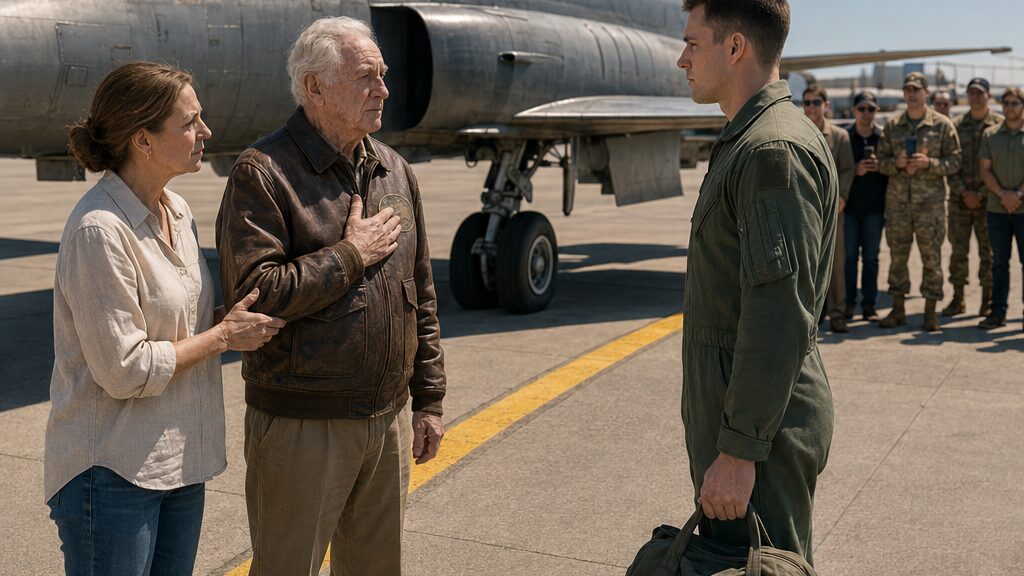
The morning was bright and hard, the kind of light that made every piece of metal on the flight line shine too sharply. Heat already lifted off the concrete in a faint shimmer. Beyond the temporary barriers, beyond the folding tables and rope stanchions and laminated signs, the fighter sat with its nose pointed slightly east, as if it were waiting for clearance it would never receive again.
Paul stopped beside the painted yellow line.
For a moment, no one bothered him.
He stood with both feet planted just outside the boundary, his brown leather jacket hanging heavy from his thin shoulders despite the warmth. The jacket was older than most of the young airmen setting up cones around him. Its cuffs were darkened from years of handling, the zipper had been repaired with a mismatched pull tab, and the left chest carried a faded squadron patch whose thread had gone soft at the edges.
Paul’s fingers rose to it before he realized he had moved.
He pressed two fingers against the patch, not hard, not theatrically. Just enough to feel the raised stitching beneath the pad of his index finger. The old emblem was nearly worn flat now. Once it had been bright enough to catch attention across a room. Now it looked almost brown against brown, something only a person looking closely would notice.
The aircraft had changed less than he expected and more than he could bear.
The paint was newer. The stenciling near the intake had been redone. A panel below the cockpit sat a shade lighter than the rest, proof of replacement work after some maintenance cycle long after he had left. But the line of the wing was the same. The hard rake of the canopy was the same. Even the smell near the wheel assembly—hot rubber, oil, dust, old hydraulic memory—reached him through the clean public-event morning and took thirty years away with one breath.
A volunteer in a reflective vest called to a group near the display tent. Somewhere behind Paul, a child laughed at the echo of his own voice inside a hangar. A loudspeaker cracked, hummed, then settled into a cheerful announcement about safety zones and scheduled demonstrations.
Paul did not turn.
He looked at the left main wheel.
Not at the cockpit. Not first. Not at the nose art or the polished display placard. The wheel.
It was wrong to think of a machine as remembering. He knew that. Metal did not remember hands. Tires did not remember landings. Rivets did not carry names. Men gave objects their burden, and sometimes the objects outlasted the men so long that the burden looked like history.
He took one step closer.
“Sir?”
Paul heard the voice but did not answer right away. The painted yellow line ran in front of his shoes. On the other side of it the aircraft’s shadow cut across the concrete. His right foot hovered for half a second and then settled back.
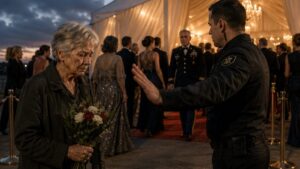
“Sir, you need to stay behind the line.”
The security airman was young enough that his face still held the earnest severity of someone newly trusted with rules. He had a tablet tucked under one arm and one hand lifted, palm out, polite but firm.
Paul turned slowly.
“I’m not trying to get in the way.”
“I understand, sir. But this area is restricted to cleared personnel and scheduled honorees only.”
Paul looked past him toward the jet. “I was told the old squadron aircraft would be here until four.”
“It will be,” the airman said. “You can view it from this side.”
Paul nodded once, as though the answer had been about the weather. “I need one minute by the wheel.”
The airman’s expression tightened. Not anger. Training.
“I can’t allow that.”
Paul’s hand moved again to the patch. The airman’s eyes flicked there and moved away without meaning. A souvenir, his face seemed to decide. One more old man with one more story at an open house built to contain them.
Paul had seen that look before. Not always with cruelty in it. Sometimes impatience was worse because it believed itself harmless.
“My name should be on the list,” Paul said.
The airman shifted the tablet into both hands and tapped the glass. “Name?”
“Paul Bennett.”
The airman searched, waited, searched again. His thumb moved down the screen. Paul watched the tiny reflection of the aircraft wobble across the black glass.
“I’m not seeing it.”
“It may be under the squadron guests.”
“I checked scheduled honorees, veterans’ escort, maintenance alumni, and family access.”
Paul’s mouth became a straight line.
From the hangar side, visitors had started drifting closer. A father lifted a little girl onto his shoulders for a better view. Two junior service members in clean uniforms stood near the placard, watching the exchange with the careful stillness of people not yet senior enough to interfere.
The airman lowered his voice. “Sir, did someone bring you here?”
Paul’s eyes moved back to him.
The question was gentle. That made it worse.
“No,” Paul said.
“Do you have family with you?”
“My daughter is parking.”
“Maybe we can wait for her and sort out—”
“I don’t need sorting out.”
The airman’s cheeks colored. “I didn’t mean it that way.”
Paul knew he hadn’t. He also knew the man had meant exactly that way.
The aircraft sat silent behind them, polished for farewell, surrounded by cones and banners and young hands. Paul felt the old patch under his fingers, its seam loose at the lower corner. He should have repaired it. Mary had offered more than once. He had never let her.
A second figure approached from the far side of the aircraft, walking with the clean impatience of someone whose schedule had already been interrupted. He wore a green flight suit and dark sunglasses. His helmet bag hung from one hand. He was tall, squared in the shoulders, with the fresh crease of present authority on him.
The airman straightened. “Captain Carter.”
The pilot looked from the airman to Paul, then to the painted line, then back to Paul. His face did not change, but his posture did. He took ownership of the space before he spoke.
“What’s the issue?”
The airman kept his voice low. “Gentleman wants access inside the line. Says his name should be on the list.”
The pilot turned fully toward Paul. “Sir, this is a controlled area.”
Paul looked at the aircraft again before answering. “It always was.”
The pilot paused, either because he caught something in the tone or because he did not care for it.
“I’m Captain Justin Carter,” he said. “For everyone’s safety, you need to remain behind the marked boundary.”
Paul nodded. “I heard him.”
“Then I need you to step back.”
“I haven’t crossed it.”
“You were about to.”
Paul’s fingers tightened over the patch. For a breath, the sound of the open house thinned around him. He could see, with painful clarity, another line painted on another strip of concrete, men moving too fast, someone shouting over engine noise, a gloved hand slapping the side of the fuselage twice.
He blinked, and there was only Captain Carter in front of him, young and certain and waiting.
“I came for one minute,” Paul said.
Justin’s jaw moved once. “Then you can take that minute from here.”
The two junior service members near the placard had stopped pretending not to watch. One held a clipboard against her chest. Another stood with his hands behind his back, eyes shifting between the young pilot and the old man.
Paul felt their attention gather on his jacket, his white hair, the uneven way his right hand rested when he let it fall. He knew what he looked like. He had seen himself reflected in store windows and hospital doors: old man, slow man, man who needed chairs brought closer and voices raised louder than necessary.
But the aircraft did not look at him that way.
The aircraft simply stood where it had always stood, asking nothing, remembering nothing, demanding only that Paul keep the promise he had made when he was not yet old.
Justin lifted a hand toward the visitor area. “Sir, I’m going to ask you one more time. Please move back with the public group.”
Paul looked down at the painted line.
He took half a step back.
It was not surrender. He told himself that. It was not surrender if the promise still waited.
But when he raised his eyes, he saw that Captain Carter had not seen restraint. He had seen compliance.
Behind the sunglasses, Justin’s gaze dropped briefly to the patch.
For one impossible second, Paul thought the younger man might recognize it.
Then Justin looked away.
Chapter 2: The Pilot Who Owned the Present
Justin Carter had been awake since four-thirty and responsible for too many things that could go wrong.
The old fighter’s removal ceremony was supposed to be simple. Static display. Two speeches. A controlled photo line. Veterans’ recognition from the stage. Maintenance tow at sixteen hundred. No one crossing the line without clearance. No children under the wing. No former crew members trying to touch panels that had not been inspected for public contact. No delays that would make the base commander glance at Justin with that quiet disappointment senior officers used like a blade.
Simple, if people followed instructions.
The elderly man in the brown jacket did not look dangerous. That was part of the difficulty. Dangerous people were easy to handle because everyone understood the shape of the response. Old men with pale eyes and trembling hands created softer problems, and soft problems were where mistakes got recorded later as poor judgment.
Justin kept his voice even.
“Sir, I appreciate your interest in the aircraft, but we can’t make exceptions on the flight line.”
The old man’s gaze stayed steady. “I’m not interested in it.”
Justin waited.
“I know it,” the man said.
One of the junior airmen behind Justin shifted. The clipboard made a faint sound against a uniform button.
Justin had heard some version of that all morning. Men who had worked on aircraft “just like this.” Men whose brothers had flown one. Men who had a photograph somewhere. Men who knew someone who knew someone. He did not mock them. He respected the impulse. But impulse did not override safety.
“Then you know better than to ask to cross a marked boundary,” Justin said.
The old man absorbed the words without flinching. That unsettled Justin more than argument would have.
The patch on the jacket drew his eye again.
It was old. Not manufactured old, not a gift shop replica faded by design. Real old. The stitching had gone uneven, and the cloth at the edges had thinned where fingers had touched it over years. Justin could not place the emblem at once. Some squadron insignia changed over decades, and the open-house displays had been full of historic markings he had not had time to study.
Still, old patches turned up everywhere. Estate sales. Online auctions. Boxes in garages.
“Were you invited as part of a veterans’ group?” Justin asked.
The old man’s mouth tightened faintly. “I was invited once.”
Justin did not have time for riddles. “Today, sir.”
“No.”
“Then I need to keep you with general visitors.”
The man looked past him, not over him exactly, but through the present arrangement of cones and banners toward something Justin could not see.
“I stood there before there was a line,” he said.
The airman beside Justin stared at the tablet as if the correct answer might appear from embarrassment.
Justin lowered his voice. “Sir, I’m trying to be respectful.”
The old man looked back at him. “Are you?”
The question landed quietly. No accusation. No raised chin. That made it harder to dismiss.
Justin felt the eyes behind him: the junior airmen, the visitors, the security detail, maybe even someone from command watching from the display tent. He could not let a conversation about rules become a debate in front of the public.
He took one step closer, stopping short of intimidation but close enough to be clear.
“This aircraft is under my responsibility today. That means I decide who approaches it.”
The old man’s fingers rose again to the patch.
Not defensively. Not proudly.
Protectively.
Justin noticed the movement and, despite himself, felt irritation flicker. He had known officers who flashed rings, tabs, old unit coins, anything to force a change in tone. He had promised himself years ago that if he ever held command over a space, he would keep procedure clean. Names on lists. Badges visible. No special treatment because someone could tell a good story.
“Captain Carter?”
The voice came from behind him.
Catherine Miller, the civilian historian assigned to the open house, approached with a folder pressed to her side and a lanyard swinging against her blouse. She had spent the morning answering questions near the display boards, her calmness irritating Justin only because she always seemed to know which details mattered five minutes before anyone else did.
“I’m handling it,” Justin said.
“I know,” Catherine replied, though she did not stop looking at the old man’s jacket.
The old man lowered his hand. The patch was fully visible.
Catherine’s expression changed so slightly that Justin might have missed it if he had not been facing her. Her eyes narrowed, not in suspicion, but in recognition of a shape.
“Sir,” she said to Paul, “may I ask your name?”
“Paul Bennett.”
Justin turned his head. “He’s not on the access list.”
Catherine did not answer him. “Mr. Bennett, did you serve with the 416th?”
The air seemed to tighten.
The old man’s eyes went to the aircraft before they returned to her. “A long time ago.”
Catherine’s grip on the folder shifted. “That patch is not the version we reproduced for the event boards.”
“No,” Paul said.
“May I look closer?”
Justin felt control slipping into a place he did not like. “Catherine, we still need to verify—”
“I’m not asking him to cross the line,” she said.
Her tone was mild, but the words stopped him.
Paul did not step forward. Instead he stood still while Catherine approached to the visitor side of the boundary. She did not touch the patch. She leaned only close enough to see the frayed lower edge and the dark thread crossing the winged emblem.
The junior airmen watched openly now.
Catherine’s voice softened. “This is hand-stitched at the bottom.”
Paul looked down. “It was repaired in a hurry.”
“When?”
He did not answer.
Justin removed his sunglasses. He did it because the morning glare had shifted, he told himself, not because he suddenly felt foolish standing behind them.
Catherine glanced toward the display tent. “Captain, the early squadron board has a photograph with this exact patch design. Not similar. Exact.”
“A lot of patches look exact after thirty years,” Justin said.
“Not this one.”
Paul’s hand returned to it. His thumb covered the lower corner as if hiding a wound.
Justin heard the defensive edge in his own voice and disliked it. The old man had not demanded honors. He had not raised his voice. He had asked for one minute at the wheel line, and Justin had spoken to him as if he were a hazard to manage.
But uncertainty was not clearance.
“Mr. Bennett,” Justin said, more carefully now, “even if you served with this unit, I can’t allow access without authorization.”
Paul nodded. “I didn’t ask you to break your rules.”
“You asked to cross the line.”
“I asked for one minute.”
“That’s the same thing today.”
Paul looked at him then, fully. There was no anger in his face, but something older than anger rested there, something Justin had no procedure for.
“No, Captain,” Paul said. “It isn’t.”
A small silence opened between them.
From the loudspeaker came a burst of static, then a cheerful voice announcing that the formal farewell program would begin in ninety minutes. Visitors moved toward the tent. The junior airmen remained frozen.
Catherine opened her folder, though her eyes stayed on Paul. “Captain, give me ten minutes to check the archive binder.”
Justin almost refused. He could feel the schedule pressing against his back. The base commander expected the aircraft cleared and photographed by noon. The tow crew needed a final walkaround. The public affairs team wanted human-interest moments, but not unscripted ones.
“Five,” he said.
Catherine gave him a look that suggested she had never in her life found a useful record in five minutes.
“Ten,” Justin said.
Paul’s face did not change, but his shoulders lowered by the smallest amount.
Justin turned to the security airman. “Mr. Bennett stays outside the line. Nobody crowds him. Understood?”
“Yes, sir.”
Then, because Catherine was still watching him, because the old man’s hand was still on that patch, because the junior service members had heard every word, Justin added, “And bring him a chair if he wants one.”
Paul’s eyes moved to him.
“I don’t,” Paul said.
Justin nodded once. “All right.”
He started to turn away, but Catherine had not moved.
“What?” he asked.
She looked past him to the aircraft, then back to the patch under Paul’s fingers.
“Captain,” she said quietly, “that patch is older than the jet’s current paint.”
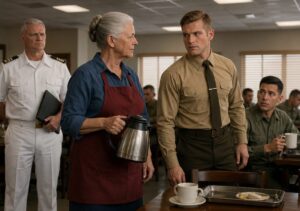
Chapter 3: A Name Missing from the List
Catherine Miller had learned that records could lie without meaning to.
They lied by omission, by water damage, by hurried handwriting, by boxes moved during renovations and labels written by people who thought history was whatever fit in one drawer. They lied when names were misspelled. They lied when wives were listed as guests but not as witnesses, when mechanics appeared in photographs without captions, when flight crews were remembered and ground crews reduced to “support personnel.”
So when Paul Bennett’s name failed to appear on the open-house access list, Catherine did not assume he was nobody.
She assumed a list was doing what lists often did: protecting one version of the truth by leaving out another.
The temporary event office was a narrow room inside the display tent, partitioned by canvas walls and folding tables. Two fans pushed warm air from one side to the other. Stacks of programs, visitor badges, radio chargers, bottled water, and emergency contact sheets crowded the surfaces. Catherine set her folder down, opened the archive binder, and began turning pages too quickly.
Justin stood near the entrance with his arms folded.
“You don’t have to supervise me,” she said.
“I’m not supervising.”
“You’re standing like a locked door.”
He unfolded his arms but did not leave. “We’re behind schedule.”
“We are always behind schedule. History doesn’t care.”
“Flight-line safety does.”
She looked up. “So does dignity.”
That landed more sharply than she intended. Justin’s jaw tightened, but he said nothing.
Catherine turned another page. The event binder held scanned photographs from the squadron’s active years, maintenance notes cleared for public viewing, aircraft transfer summaries, and a few short biographies of invited speakers. There were polished paragraphs about commanders and pilots. There were clean dates, mission counts, official language. She had built some of those displays herself, smoothing the rough edges of history into something families could read between snow cones and recruiting tables.
Paul Bennett was not in the formal honoree section.
She checked again.
Nothing.
Outside the tent, the public announcement repeated safety instructions. Catherine could see Paul through the open flap, still standing where they had left him, refusing the chair the young airman had brought anyway. The chair sat two feet behind him, empty and faintly accusing.
His daughter had arrived. Catherine guessed that was who the woman was: middle-aged, tense, one hand shielding her eyes from the sun as she spoke to him in short, urgent phrases. Paul listened without looking away from the aircraft.
Catherine turned to the older section of the binder.
“These weren’t part of the official program,” she said. “I pulled them from the base historical office because the display looked too clean.”
Justin’s gaze moved to the page. “Too clean?”
“No fingerprints. No mistakes. No people tired enough to be real.”
He did not answer.
The first photograph showed the aircraft in a hangar decades earlier, panels open, ladders against its side. Six men stood beneath the wing, two in flight gear, the rest in coveralls and jackets. The image was grainy, the black-and-white contrast poor. Catherine slid her finger under the caption.
416th Tactical Fighter Squadron, maintenance and flight crew, spring rotation.
No Paul Bennett.
She turned the page.
More aircraft. More men. A formal lineup. A picnic near the hangar. A blurred shot of someone leaning into the cockpit, face hidden by shadow. She slowed as the patch appeared again, clearer on one man’s jacket than it was on Paul’s now.
“There,” she said.
Justin stepped closer despite himself.
The photo was not dramatic. Four men stood beside the same aircraft, or what had been the aircraft before repainting and modification. One had a wrench in his hand. One squinted into the sun. One looked away from the camera as though someone had called his name. The fourth stood near the left main wheel, one hand resting on the tire.
He was young.
Catherine bent closer. Time had changed the face but not the set of the shoulders. Not entirely. The young man in the photo held himself with the same contained stillness Paul Bennett carried outside the tent.
Justin’s voice was low. “Is that him?”
“I think so.”
“Caption?”
Catherine read the typed line beneath the photo.
Crew inspection before final stateside return. Left to right: William Reed, unidentified crewman, Paul Bennet, flight operations.
She stopped.
“Bennett is spelled wrong,” Justin said.
“One t,” Catherine murmured.
“That would explain the list?”
“No. This is an archive caption, not today’s access file.”
“But it’s him.”
“It looks like him.”
Justin leaned over the binder. “Who’s the unidentified crewman?”
Catherine looked at the man standing beside young Paul. He wore the same patch.
No, not the same.
The original.
The patch on the unidentified man’s jacket was dark and sharp in the photograph, its stitching intact, its lower edge clean. Young Paul in the photo wore no patch at all.
Catherine felt a small chill despite the heat.
Outside, Paul’s daughter touched his sleeve. He shook his head once. The movement was gentle but final.
Catherine took the binder and moved to another box under the table. “There should be a personnel cross-reference.”
Justin checked his watch. “Catherine.”
“Don’t.”
“The ceremony starts in an hour.”
“Then you have an hour to decide whether you want to be right or careful.”
He exhaled through his nose. “I’m trying to keep an eighty-year-old man from walking into a restricted aircraft zone.”
“No,” Catherine said, flipping through folders. “You’re trying to keep a problem from becoming your problem.”
He looked away.
She regretted the sharpness, but not enough to take it back.
The cross-reference folder had been copied poorly. Some pages were slanted. Others had black bands along the edges. She found Reed, William under maintenance crew. She found Carter, a different Carter from another decade. She found Bennett with two t’s in a handwritten note attached to a transfer manifest.
Paul Bennett — flight operations liaison / temporary attachment / return flight support.
The entry was thin. Too thin for the weight Paul seemed to carry.
Justin read over her shoulder. “That doesn’t give him access today.”
“No,” Catherine said. “But it means he didn’t wander in because he liked the view.”
She pulled the photograph free from its sleeve and placed it beside the manifest copy. Young Paul’s hand rested on the aircraft tire. Outside, old Paul stood just behind the painted line, staring at the same wheel.
The image made the years collapse in a way Catherine had not expected. She had spent her career handling old photographs. Most stayed old. This one had reached out of the binder and touched the morning.
Justin’s voice changed. “Why wasn’t he invited?”
Catherine looked at the polished honoree list again. Commanders. Decorated pilots. One former base leader. Donors. Family representatives. Names chosen cleanly, confidently, incompletely.
“Because somebody searched the obvious names,” she said. “And because he probably never asked.”
Justin watched Paul through the tent flap.
Mary had stopped arguing. She stood beside her father now, arms folded, face pinched with worry. The empty chair remained behind them. The security airman kept visitors from drifting too close.
Catherine looked back at the photograph. Her attention moved again to the man beside young Paul, the unidentified crewman with the clean patch.
She tapped the image lightly. “This is what bothers me.”
“What?”
“In the photograph, the patch is on him.”
Justin frowned. “So?”
Catherine looked outside at Paul Bennett’s fingers pressed over the faded emblem on his own jacket.
“So how did Mr. Bennett end up wearing it?”
Chapter 4: Mary Wanted Him to Leave
Mary Bennett found her father standing in the sun with an empty chair behind him.
That was what made her angry first.
Not the young pilot. Not the security airman hovering nearby. Not even the fact that her father had called three times the night before to ask whether she had printed the parking pass, then refused to let her drive all the way to the visitor gate because he did not want to “be delivered like freight.”
It was the chair.
Someone had brought it for him, placed it just close enough to be helpful and just far enough to make him look stubborn for not using it. Her father stood in front of it with his shoulders squared beneath that heavy brown jacket, staring at the aircraft as though sitting would be a kind of betrayal.
Mary walked faster across the hot concrete.
“Dad.”
He did not turn at once. She saw his hand at his chest, two fingers over the old patch. That gesture had lived in her childhood the way some people remembered a parent rubbing a wedding band or tapping a cigarette against an ashtray. Her father touched the patch when a helicopter passed too low, when the news showed aircraft carriers, when Veterans Day displays appeared in grocery store windows, when someone asked too casually whether he had “seen combat.”
“Dad,” she said again, softer now that she was close.
Paul looked at her. “You found parking.”
“That is not what we’re talking about.”
The security airman took one step closer. “Ma’am, if he’s with you—”
“He’s my father,” Mary said, sharper than she intended.
The airman stopped.
Paul’s eyes flicked toward her, not reproachful, but enough to remind her that he disliked being claimed as a problem. She took a breath through her nose.
“I’m sorry,” she said to the airman. “We’re fine.”
The airman nodded, relieved to have a smaller role, and drifted back toward the barrier.
Mary turned to Paul. “What happened?”
“Paperwork.”
“Paperwork doesn’t make people gather around you like you stole something.”
“I didn’t steal anything.”
“I know that.”
He looked back at the jet.
Mary followed his gaze. She had seen aircraft before. Her father’s life had made them ordinary and untouchable at the same time. There had been air shows when she was a girl, evenings when he stood in the yard long after a distant engine faded, museum trips where he read small placards too slowly while other families moved around them. But this aircraft had a different effect on him. He did not look interested. He looked bound.
“They won’t let you closer?” she asked.
“Not yet.”
“Not yet,” she repeated. “Dad.”
He did not answer.
“You said we were coming to see it. You said you wanted to be here before they moved it. You did not say you were going to try to get onto a restricted flight line.”
“I’m not trying to get onto anything.”
“You asked them.”
“I asked for one minute.”
Mary pressed her lips together. She had promised herself in the car that she would not talk to him like a nurse, like a clerk, like every person who raised their voice and shortened their sentences when they saw his cane folded in the back seat. Yet fear had its own voice, and it often sounded like impatience.
“You’re standing in ninety-degree sun in a leather jacket,” she said. “You took your blood pressure pill without breakfast. You already look tired.”
“I am tired.”
“Then sit.”
“No.”
The word was not loud. It carried anyway.
Mary looked at the empty chair. “Why not?”
Paul’s jaw worked faintly. “Because I didn’t come here to wait.”
She wanted to say that everyone waited now. At doctors’ offices. At pharmacies. At crosswalks. On hold with insurance. In rooms where people asked him to confirm his birth date before they would tell him what he already knew. She wanted to say waiting was not defeat. But his eyes stayed on the aircraft’s left wheel, and the words thinned before reaching her mouth.
A gust moved across the open concrete, stirring the event banners. The aircraft’s shadow lay beyond the painted line, dark and clean. Paul watched it as if it marked the border between two versions of himself.
“Maybe we should go,” Mary said.
His hand tightened over the patch.
“They embarrassed you,” she said. “They didn’t mean to, maybe, but they did. We can leave before it gets worse.”
“It already got worse.”
“Then why stay?”
He looked at her then, and for a second she saw how old he was, not in the way strangers saw it, but in the private way age had been collecting him piece by piece. The skin at his throat. The careful set of his feet. The shallow breath he tried to hide when he stood too long. He had once lifted her asleep from the back seat with one arm and carried groceries with the other. Now she watched him calculate curbs.
“I told you not to come if this was too much,” she said, and hated herself as soon as the words were out.
Paul’s face closed.
Mary looked away, blinking hard. “I didn’t mean that.”
“Yes, you did.”
“No. I meant—”
“You meant you’re afraid I’ll make a scene.”
“I’m afraid someone else already did.”
He turned his body slightly away from the crowd, giving them a pocket of privacy near the barrier. “Your mother used to say the same thing when I stood too long at memorial walls.”
“She worried about you.”
“She did.”
“So do I.”
“I know.”
The tenderness of that answer nearly undid her.
Mary reached toward the patch, not touching it at first, just meaning to smooth the lower edge where it had curled away from the leather. “It’s coming loose again.”
Paul caught her wrist gently.
Not hard. Never hard. But quickly enough that she froze.
His fingers were cold despite the heat.
“Don’t,” he said.
Mary lowered her hand. “I can fix it. I’ve offered a hundred times.”
“I know.”
“You let the cuffs get repaired. You let me replace the lining.”
“Not that.”
She looked at the patch more carefully. The faded emblem had always seemed to her like one more remnant of his service, no different from old photos in shoeboxes or unit coins in a drawer. But now she saw the uneven bottom seam Catherine must have noticed. The thread there did not match the rest. It crossed the fabric with crude little stitches, as if someone had sewn it while moving, or in dim light, or with hands that could not stop shaking.
“It isn’t yours,” she said.
Paul’s eyes moved back to the aircraft.
The answer was in the silence.
Mary felt the heat, the noise, the visitors behind them, the absurd cheer of the loudspeaker announcing commemorative programs at the information booth. She heard herself swallow.
“Whose was it?”
Paul did not answer.
“Dad.”
He took a slow breath. “I left once without him.”
Mary waited, but his mouth had tightened again.
The aircraft sat just beyond reach. Its tire was turned slightly inward, black rubber clean enough for photographs, old enough to hold ghosts if anyone believed in such things. Her father’s attention returned to it with a force she could not compete with.
“I won’t do it twice,” he said.
Mary looked from the patch to the wheel line, from the wheel line to the young pilot now standing near the tent entrance, watching them with his sunglasses in his hand.
For the first time that morning, she stopped wanting only to take her father home.
Chapter 5: The Crew Chief Remembered the Patch
William Reed arrived in a maintenance cart that made more noise than dignity allowed.
It rattled along the service lane behind the hangar, its faded white body marked with old decals and new scratches, one loose panel buzzing every time the tires crossed a seam in the concrete. He drove with one hand on the wheel and the other gripping the roof support, as if he did not trust the cart, the pavement, or the day itself.
Justin saw him before Catherine waved.
“That him?” Justin asked.
“That’s William Reed,” Catherine said. “Former crew chief. He still consults with the historical office when we need someone to tell us which official caption is wrong.”
The cart jerked to a stop beside the hangar shade. William shut it off, and the sudden quiet made him seem larger than he was. He climbed down slowly, a thick-shouldered man in his late seventies with a ball cap pulled low and a maintenance badge clipped to his pocket. His walk had a mechanic’s economy: no wasted motion, no concession to anyone watching.
His eyes went first to the aircraft.
Then to Paul.
He did not call out. He stood still for several seconds with his hands at his sides, and the look that crossed his face was not surprise exactly. It was the expression of a man seeing a door he thought had been sealed.
Catherine carried the archive photograph toward him. “Mr. Reed, thank you for coming over.”
William’s mouth twitched. “You said somebody found a ghost.”
“I said we had a question about a patch.”
“That’s usually where ghosts start.”
Justin waited through the exchange, aware of the schedule, the aircraft, the gathering visitors, the commander somewhere expecting everything to remain smooth. The morning had already become something he could not brief cleanly. An old man without clearance. An authentic patch. A misspelled archive caption. A former crew chief arriving like a witness.
Catherine handed William the photograph.
He held it at arm’s length, squinted, then reached into his shirt pocket for glasses. The moment he put them on, the rough humor drained from his face.
“Well,” he said.
“You recognize it?” Catherine asked.
William looked toward Paul again. Paul had not moved from the painted line, though Mary now stood beside him instead of in front of him. The empty chair remained unused.
“I recognize all of it,” William said.
Justin stepped closer. “Sir, we need to verify whether Mr. Bennett has any official connection to this aircraft.”
William gave him a brief look. “Official.”
“Yes.”
“That word do a lot for you?”
Justin held his temper. “Today, it keeps people safe.”
William studied him a moment longer, then nodded as if the answer, while insufficient, was not foolish. “Fair.”
He tapped the photograph. “This is Paul Bennett. Two t’s, no matter what that caption says. Flight operations liaison, though that title never covered half of what he did. This ugly kid here is me.”
Catherine leaned closer. “And the unidentified crewman?”
William’s thumb stopped on the man beside young Paul.
The patch was clear on the man’s jacket. Clean. Dark. Whole.
William did not answer quickly.
“That,” he said at last, “was Christopher Hayes.”
The name changed the air around the photograph. Until then the unidentified man had been evidence. With a name, he became someone who had stood in sunlight.
Justin looked out toward Paul’s jacket. “The patch belonged to him?”
“Yes.”
“How did Mr. Bennett get it?”
William removed his glasses and cleaned them with the hem of his shirt, though they were not dirty. “That’s not my story to tell.”
Catherine’s voice softened. “We only need enough to understand why he came.”
“No,” William said. “You need enough to stop treating him like a loose visitor badge.”
Justin felt heat rise behind his collar. “I’m standing right here.”
“I noticed.”
Catherine intervened quietly. “Mr. Reed.”
William looked toward the aircraft again. The maintenance crew had begun preparing the tow bar near the nose gear. Visitors took photographs from behind the ropes, smiling in front of a machine none of them fully knew. The event schedule moved on, indifferent and bright.
William’s voice lowered. “Christopher was crew. Not glamorous. Not a man people put in speeches. He could hear a bad bearing before the gauge knew it. Could stitch a patch better than supply could issue one. That one on Paul’s jacket, he made it sit straight himself because the original batch came crooked.”
Justin looked at the archive photo. “And something happened on a mission.”
William gave him a flat look. “Something always happened on missions. That’s why old men stare at airplanes like they’re waiting for an apology.”
No one spoke.
From outside came the faint murmur of Mary’s voice. Paul answered briefly. The words did not carry.
William folded the photograph carefully, then seemed to think better of it and smoothed it flat again. “Paul was not the kind to talk. Even then. He could sit in a room full of noise and make silence look like discipline. Christopher was the opposite. If he liked you, you knew it. If he didn’t, you knew it faster.”
Catherine asked, “Were they close?”
William almost smiled. “Christopher decided they were. Paul tolerated it until he didn’t have to pretend anymore.”
Justin glanced toward the aircraft’s left wheel. “Mr. Bennett asked for one minute by the wheel line.”
William’s eyes narrowed. “He said wheel line?”
“Yes.”
“Not cockpit?”
“No.”
“Not a photo?”
“No.”
William looked down.
The cart’s cooling engine ticked softly.
“That’s where Christopher stood before launch,” he said. “Every time. Left main. Hand on the tire. Had a superstition about it. Said if a bird was going to bring men home, somebody ought to remind it.”
Catherine’s eyes moved to the photograph again. There was Christopher’s hand, resting on the tire. Beside him, young Paul stood with his arms at his sides, looking away from the camera.
Justin felt the morning rearrange itself around that detail.
He had thought the old man wanted access to an aircraft. Now he understood he had asked for a place.
“Did Christopher die in this aircraft?” Justin asked.
William’s face closed.
Catherine looked at Justin sharply.
The question had come out too direct, too official, too hungry for the missing line in the report. Justin knew it as soon as he heard himself. But William did not reprimand him. He only looked toward Paul.
“Ask him like that,” William said, “and he’ll leave.”
Justin stared at the photograph.
“What should I ask?”
William handed it back to Catherine. “First? Nothing.”
“That’s not helpful.”
“It is if you’re used to filling silence with rank.”
Justin looked at him.
William’s voice was not unkind, which somehow made it worse. “You want to fix what happened this morning?”
“I want to keep the event under control.”
“No, you want both. That’s why you’re still here instead of sending him to the parking lot.”
Justin said nothing.
William nodded toward Paul. “Walk over there without your sunglasses. Stand where he can see your eyes. Tell him what you know, which isn’t much. Tell him what you don’t know, which is the important part. Then ask if there’s a way to honor the line without breaking your rules.”
Justin looked at the painted boundary. “There may not be.”
“There usually isn’t until someone decides rules are supposed to guard people, not erase them.”
Catherine closed the folder. “The formal program starts soon. If we’re going to adjust anything, we need to tell command.”
Justin watched a child pose near the rope with one hand raised in a pretend salute while his mother laughed and took the picture. Behind them Paul stood in the heat, still refusing the chair, still carrying a name nobody had printed on the program.
“What exactly happened to Christopher?” Justin asked.
William put his glasses back into his pocket. “Enough that Paul came home with his patch and not his peace.”
He started toward the flight line, then stopped beside Justin.
“One more thing, Captain.”
Justin turned.
William’s eyes were steady beneath the brim of his cap. “If you ask him like an officer, he’ll answer like one. If you ask him like a man, he might tell you the truth.”
Chapter 6: Permission Before the Wheel Line
Paul saw the young pilot coming back without his sunglasses.
It was a small thing. It should not have mattered. Men had looked him in the eye before and lied. Men had lowered their voices and still taken what they wanted. But on a flight line, small things had weight. A hand signal. A nod. A thumb raised from a cockpit. A mechanic stepping back from a wheel before the engine turned.
Captain Carter walked slower this time.
Mary noticed it too. Her hand hovered near Paul’s elbow, not touching, ready in case he swayed or in case she needed to stop herself from stepping between them.
The pilot stopped outside the painted line, on the visitor side.
That, too, Paul noticed.
“Mr. Bennett,” Justin said.
Paul waited.
“I owe you a clearer answer than I gave you.”
The security airman looked over from near the barrier. The two junior service members had drifted closer again, trying to appear useful beside the placard. Catherine stood near the tent with the archive binder held against her chest. William Reed remained in the hangar shade, arms folded, watching like a man who trusted nothing until it happened.
Paul looked at the aircraft because looking at Justin was suddenly harder.
“I’m listening,” he said.
Justin took a breath. “We found an old photograph. Your name was misspelled in the caption. That may be part of why you weren’t identified for today’s access list.”
Paul’s mouth moved faintly, not quite a smile. “One t?”
“Yes.”
“Happened more than once.”
“I’m sorry.”
Paul heard the apology. He heard its limits. It was for paperwork, not yet for the morning. Maybe the younger man did not know that. Maybe he did.
Justin continued, careful now. “Catherine also confirmed the patch design. Mr. Reed confirmed you served with the unit.”
The old name moved through Paul’s chest before William’s did. Christopher Hayes. He had not heard it spoken by another person yet that day, but he felt it waiting nearby, as if the air had begun arranging itself to make room.
Justin glanced at the patch, then back to Paul’s face. “He said the wheel line mattered.”
Mary’s hand closed lightly around Paul’s sleeve.
Paul’s fingers rose to the patch. The lower seam scratched his fingertips. For one wild second he was twenty-eight again and angry at a needle because his hands were too unsteady to make the stitch lie flat.
“It mattered to Christopher,” Paul said.
Justin did not ask who Christopher was. That told Paul someone had warned him, or else he had learned something since morning.
A loudspeaker announced that the formal farewell program would begin in fifteen minutes. Visitors began gathering near the folding chairs facing the temporary stage. The base commander had taken position near the front row, speaking to public affairs staff. The aircraft waited under the sun, tow bar ready, its left wheel half in shadow.
“I can’t open the flight line freely,” Justin said. “But I can request a controlled escort inside the boundary. No public crowding. No photographs unless you agree. One person beside you. Medical volunteer nearby but not hovering. We can do it before the program starts.”
Paul looked at him for a long moment.
“That what you came to say?”
“Yes, sir.”
The sir was quiet. Not automatic. Not decorative.
Paul disliked how much it hurt.
Mary whispered, “Dad?”
He did not answer her. He looked at Justin’s hands. They were still, held loosely at his sides. No pointing now. No managing gesture. No palm raised to stop him.
“Why?” Paul asked.
Justin’s face changed.
It would have been easier if he had said because you served, or because Mr. Reed told me, or because command approved it. Those answers would have fit cleanly into the morning and left both men protected.
Instead, Justin said, “Because I spoke to you like the line mattered and you didn’t.”
Paul felt Mary’s fingers tighten on his sleeve.
Justin swallowed once. “I was wrong.”
The words did not fix anything. Paul had lived too long to believe words could repair what behavior had broken. But they opened a door. Not wide. Enough.
Paul looked toward the wheel.
“I don’t want a ceremony.”
“You won’t get one.”
“I don’t want a microphone.”
“No.”
“I don’t want someone telling people I was brave.”
Justin’s eyes did not move. “Understood.”
Paul’s hand came away from the patch. The fabric felt exposed without it.
Mary’s voice trembled slightly. “What do you want, Dad?”
He looked at her. In her face he saw her mother’s worry and her own anger and all the years he had made his silence into a wall she was expected to respect without understanding. He had thought that was kindness. Some days it had been. Some days it had only been fear wearing a better uniform.
“I want to finish saying goodbye,” he said.
Mary’s mouth pressed closed.
Justin turned to the security airman. “Clear the left side. No visitors inside the rope. Ask the maintenance crew to hold movement for five minutes.”
The airman glanced toward the stage. “Captain, the commander—”
“I’ll tell the commander.”
“Yes, sir.”
The junior service members moved too quickly at first, then slowed when Justin gave them a look. The space around the left main wheel opened. Visitors noticed, of course. People always noticed when a boundary moved. A few phones lifted, then lowered when Catherine stepped between them and shook her head.
Justin did not cross the line first.
He stood beside it and looked at Paul.
“May I walk with you?”
Paul stared at him.
The question reached some place in him that orders never had. He remembered young men shouting over engines, remembered hands hauling him away from heat, remembered being told to keep moving when every part of him had wanted to turn back. Permission had been rare in those days. Survival did not ask.
Paul nodded.
“Yes.”
Mary released his sleeve slowly. “I’m coming too.”
Paul almost refused. Then he saw her face.
“All right,” he said.
The security airman unclipped the temporary rope. Justin crossed only after Paul did, staying half a step back, not guiding until Paul’s right foot dragged slightly on the painted line. Then he offered an arm without grabbing.
Paul did not take it.
Not yet.
The concrete inside the boundary looked the same as the concrete outside. That was the foolishness of lines. They changed nothing until people agreed they did.
The aircraft grew larger with each step.
Paul smelled oil.
Not much. The jet had been cleaned for display, stripped of the old working smells, polished into a public memory. But near the wheel, beneath the heat and dust, something remained. Rubber. Hydraulic fluid. Metal warmed by sun. His lungs knew it before his mind did.
He stopped beside the left main tire.
For several seconds he could not lift his hand.
The tire was not the same tire. He knew that. It had probably been changed more times than any man cared to count. The aircraft itself was a collection of replacements wearing one identity, no different from the men who had survived long enough to grow old.
Paul reached into the inside of his jacket.
Mary made a small sound, not alarmed, only surprised.
He drew out a folded square of cloth, wrapped in wax paper that had softened with years of handling. He opened it carefully. Inside was a short length of dark thread and a small broken button, dull and ordinary.
Justin said nothing.
Mary stared at it. “Dad?”
Paul looked at the patch on his chest.
“Christopher sewed this crooked edge back on while we were waiting for a weather hold,” he said. “Complained the whole time. Said a man should either wear a patch right or not wear it where people could see.”
His voice stayed level. That took most of his strength.
“He stood here before launch,” Paul continued. “Every time. Hand on the tire. Told the aircraft to bring us home. I told him machines didn’t listen.”
The shadow of the wing cut across Justin’s boots. No one moved.
“That day,” Paul said, “it brought some of us home.”
Mary’s eyes shone, but she did not interrupt.
Paul placed the broken button back into the wax paper. “I came home with this jacket because he threw it at me when mine tore. I came home with his patch because there wasn’t enough of his left to send home with it.”
Mary covered her mouth.
Justin’s face tightened, but he did not look away.
Paul folded the wax paper again. “I promised him I’d stand here when they retired her. Not for speeches. Not for anyone to clap. Just so somebody who remembered his name could tell the old bird she’d done enough.”
For the first time all day, Paul touched the aircraft.
His palm rested on the metal just above the wheel assembly, not the tire, not exactly where Christopher’s hand had been, but close. The metal was warm. Too warm. Alive only because the sun had touched it.
He closed his eyes.
“Christopher Hayes,” he said.
The name came out rough, but complete.
Beside him, Justin stood straighter.
Paul heard the movement, the subtle shift of boots on concrete. When he opened his eyes, the young pilot was not saluting. Not yet. He was facing the aircraft with his head slightly bowed, giving the name the room it deserved.
Behind them, one of the junior service members whispered something. Another visitor’s phone rose.
Justin turned, his voice low but carrying.
“Give Mr. Bennett room.”
The phone lowered.
The security airman stepped back. The junior service members straightened. Catherine held the binder against her chest with both arms. William Reed removed his cap in the hangar shade.
Paul’s hand remained on the aircraft.
The promise, after all those years, did not leave him. It changed weight.
Justin looked at him, not as a problem now, not as a line item, not as a fragile old man who had wandered too close to something dangerous.
“Mr. Bennett,” he said, “would you like his name included before the tow?”
Paul did not trust himself to answer quickly.
Mary slipped her hand into the crook of his arm. This time he let her.
“Yes,” Paul said at last. “But spell it right.”
Chapter 7: The Patch Was Not the Whole Man
By the time the tow crew moved the aircraft, the sun had dropped low enough to turn the concrete gold.
Paul watched from the quiet edge of the flight line with Mary’s hand tucked through his arm. He had refused the chair again, but this time no one mistook it for stubbornness. The medical volunteer stayed far enough away to be invisible unless needed. The security airman kept visitors back without making a show of it. The junior service members stood near the rope line, no longer pretending not to look.
The aircraft did not roar. That was the strange part.
For most of Paul’s life, aircraft had announced themselves through force. Engines shook ribs. Exhaust blurred the world behind them. Voices became gestures. Men became silhouettes moving through heat and noise.
This farewell happened in near quiet. A tow vehicle pulled slow and steady. A maintenance crewman walked near the wingtip. The old fighter rolled forward with the heavy patience of something that had outlasted its own purpose.
Before it moved, Justin had spoken to the base commander.
Paul had watched the conversation from a distance. He could not hear the words, only see the shape of them: Justin standing straight, not defensive; Catherine opening the binder; the commander looking from the photograph to Paul; William Reed adding one sentence that made the commander’s expression change.
Then the printed program changed, not with ceremony, but with a pen.
A public affairs airman crossed out one line on the display card and wrote a new one on a clean temporary insert. Catherine made him do it twice because he spelled the name wrong the first time.
Christopher Hayes.
Not “unidentified crewman.” Not “support personnel.” Not a blank under a photograph.
A name.
Paul had stood beside Catherine while she slid the corrected insert into the display holder. She did not ask him to approve it with a speech or a quote. She simply turned the card so he could see.
“Is that right?” she asked.
Paul looked at the letters until they blurred.
“Yes,” he said. “That’s right.”
Now the aircraft rolled past that same display, past the folding chairs and the visitors who had come for an event and found themselves quieter than they expected to be. No one clapped. No one called out. The commander had made his remarks shorter than planned. He mentioned service, maintenance, crews seen and unseen, and the responsibility of remembering names correctly. He did not point Paul out.
Paul was grateful for that.
Justin stood near the painted line, his flight suit sleeves neat, his sunglasses tucked away. When the tow vehicle began moving, he did not salute the aircraft as if performing for a camera. He stood still, shoulders back, hands at his sides, eyes on the old machine until it passed.
Only when it crossed the far edge of the apron did he turn toward Paul.
Mary felt the movement before Paul did. Her hand tightened gently.
“Dad.”
“I see him.”
Justin walked over slowly, stopping a respectful distance away. He looked younger now, or perhaps only less armored. The afternoon had taken some of the sharpness out of his face.
“Mr. Bennett,” he said, “the historical office will update the permanent file. Catherine said she’ll send your family a copy when it’s done.”
Paul nodded. “Good.”
“And the display card will stay with the aircraft during transfer.”
“Good,” Paul said again.
Justin accepted the smallness of the answer. That mattered.
For a while, the three of them stood without speaking. The aircraft was nearly gone now, its tail moving behind the hangar, its shadow sliding away from the place where Paul had touched the metal.
Justin looked toward the painted line. “I should have asked your name before I asked you to move.”
Paul considered that.
“Yes,” he said.
Mary looked at him, startled by the plainness.
Justin did not flinch. “I’ll remember that.”
“You’ll forget sometimes,” Paul said.
Justin blinked.
Paul’s thumb brushed the patch. “Everybody does. That’s why you make habits. Names first. Orders second when you can manage it.”
A faint, rueful smile touched Justin’s face. “That sounds like something I should write down.”
“No,” Paul said. “Sounds like something you should do.”
The young pilot lowered his eyes briefly, not from shame exactly, but from taking the words in. When he looked back up, his posture had changed again. Not softer. Truer.
“Yes, sir.”
The sir did not sting this time.
Mary shifted beside Paul. “Thank you for letting him go out there.”
Justin looked at her. “He didn’t need letting. He needed someone to stop blocking the wrong thing.”
Mary’s mouth trembled. She nodded but did not speak.
Across the apron, Catherine was packing the archive binder into a hard case. William Reed stood beside her, his cap back on, pretending to complain about how the display card still used the wrong aircraft block number. Catherine listened with a patience that suggested she was writing down every correction.
Paul watched them and felt something inside him unclench by inches.
Not peace. He distrusted that word. People used it when they wanted grief to behave. What he felt was smaller and more usable. A strap loosened. A breath completed. A name set down where someone else could carry it for a while.
Mary leaned her head lightly against his shoulder.
“I didn’t know,” she said.
“I know.”
“I wish you’d told me.”
He looked at the place where the aircraft had been. The concrete under it was darker in patches, marked by tire shadows and old stains that would fade by next week.
“I didn’t know how to tell you without making you responsible for it.”
“I’m your daughter.”
“That’s why.”
She pulled back enough to look at him. There were lines beside her eyes he had not earned the right to ignore. Years of appointments, phone calls, groceries, bills, and careful questions he had answered with half-truths because silence had once saved him and he had forgotten silence could wound other people.
“I’m sorry,” he said.
Mary’s face changed more at that than it had when he spoke Christopher’s name.
“For what?”
“For making you stand outside things I should have let you into.”
She shook her head once, but tears had already gathered. “You don’t have to give me all of it.”
“I know.”
“But some.”
Paul nodded.
The patch rested against his chest between them. Mary looked at it for a long moment.
“Can I fix the loose corner now?”
His first answer rose automatically. No. Not that. Not ever.
Then he looked at the display tent where Christopher’s name had been corrected by a hand that was not his. He looked at Justin, now speaking quietly to the security airman, showing him something on the visitor list, not scolding, teaching. He looked at the painted line, no longer guarded, just paint.
“Not today,” Paul said.
Mary accepted it, but he was not finished.
“Tomorrow,” he added. “You can sit with me while I do it.”
She breathed out a small laugh that broke in the middle. “You’re still not letting me sew it?”
“I didn’t say that.”
She smiled through the tears. “That’s exactly what you said.”
He looked down at the patch. The crooked lower edge had held for decades with thread pulled through in shock and bad light. It had done its duty. Maybe mending it did not mean changing what Christopher had touched. Maybe it meant keeping it from falling away.
“We’ll see,” Paul said.
Mary wiped her cheek with the back of her hand. “That means no.”
“It means we’ll see.”
Justin returned with a folded paper in his hand. “Mr. Bennett, Catherine asked me to give you this before you leave.”
Paul took it.
It was a copy of the corrected display text, temporary and imperfect, printed on base letterhead because Catherine had apparently decided temporary things could still be official enough to matter.
The photograph was small in the corner: William Reed, Christopher Hayes, Paul Bennett, and the aircraft before age, repainting, transfer orders, and public ceremonies had touched any of them.
Under it were four names.
All spelled correctly.
Paul folded the paper once, carefully, and slipped it inside his jacket, opposite the patch.
“Tell her thank you,” he said.
“I will.”
Justin hesitated.
Paul saw the question before it came. The young pilot wanted to salute. Not for the crowd. There was hardly any crowd left. Not because a program called for it. Because something in him needed a shape for respect, and salutes were one of the shapes he had been given.
Paul could have stopped him.
Instead he straightened as much as his back allowed.
Justin brought his hand up, clean and restrained.
Paul returned it slowly.
His fingers were not as sharp as they had once been. His shoulder pulled. The old jacket creaked at the seam. But the motion found its way through him, worn but intact.
Then Justin lowered his hand and did something Paul valued more.
He stepped aside first, clearing the path to Mary’s car without making Paul ask for room.
Mary took Paul’s arm again. They walked across the cooling concrete, past the empty chair, past the rope line, past a little boy who stared at the patch but said nothing because his mother’s hand rested gently on his shoulder.
At the edge of the parking area, Paul stopped and looked back.
The flight line seemed larger without the aircraft, emptier and more ordinary. Men and women moved through cleanup tasks. Banners came down. Cones were stacked. The day was becoming work again.
Justin stood near the painted line, speaking to the two junior service members. Paul could not hear him, but he saw the young pilot point not at the place Paul had crossed, but at the visitor list, then at the display tent, then at the open space where the aircraft had been. The security airman listened with his chin tucked, serious and red-eared.
Mary unlocked the car.
Paul did not move.
“You all right?” she asked.
He thought about the question. His feet hurt. His chest felt hollowed and filled at the same time. He was tired in a way sleep would not repair. Inside his jacket, the corrected paper rested against one side of him and the old patch against the other.
“No,” he said.
Mary waited.
Then Paul looked at her. “But I’m ready to go home.”
She opened the passenger door. He lowered himself carefully into the seat, accepting her hand only at the last second, and not pretending he had not needed it.
Before she closed the door, he touched the patch once.
Not to hide it.
Not to hold it together.
Just once, as a man might touch the shoulder of someone walking beside him.
Mary drove slowly past the flight line exit. Paul watched through the window as Justin remained at the painted line long after the aircraft was gone, standing in the place where he had first told an old man to step back.
This time, he was listening.
The story has ended.