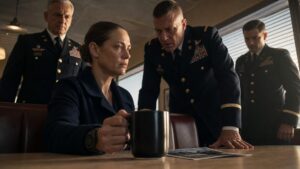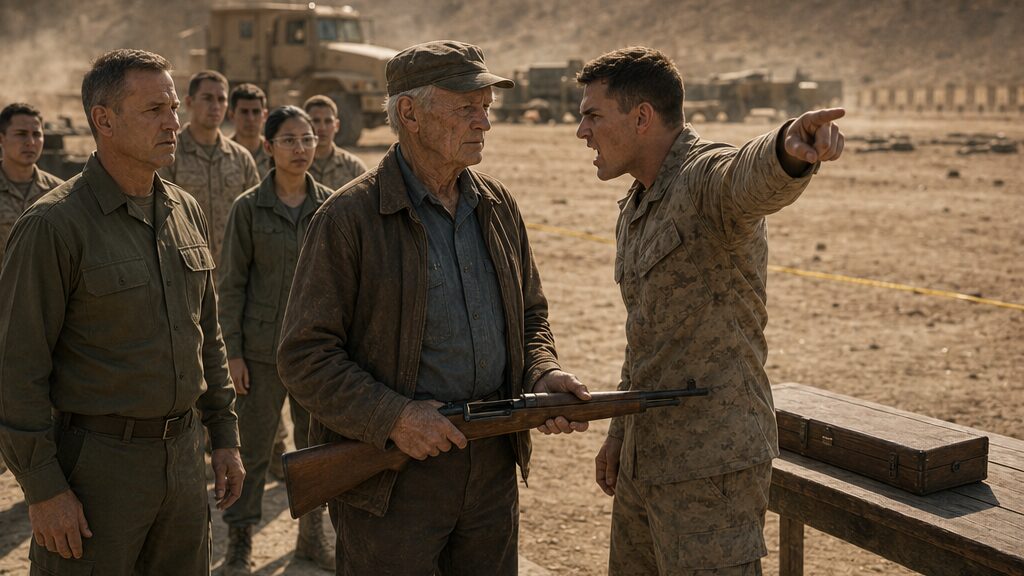
The Young Soldier Mocked The Old Man’s Rifle Before The Desert Target Came Back Silent
Chapter 1: The Old Rifle Case In The Desert Dust
The first thing Daniel White saw was the rifle case.
Not the old man’s face. Not the faded blue shirt stuck damp against narrow shoulders. Not the slow, careful way he stepped down from the shuttle van while dust rolled over his boots.
The case.
Long, wooden, scratched pale at the corners, with a leather handle that looked older than half the soldiers standing on the desert range. It rested in John Allen’s hand like something too familiar to need looking at.
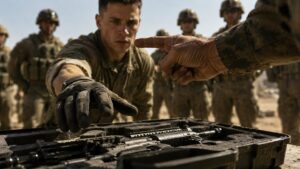
A line of trainees stood near the staging tables under the white glare of morning. Beyond them, rifle lanes stretched toward brown hills blurred by heat. Tripods stood like thin-legged insects in the sand. Targets waited far downrange. A vehicle crew moved behind a row of military trucks, their tires stirring dust that hung in the air before drifting slowly away.
John paused beside the shuttle, letting the younger people move around him.
He had learned long ago that a range told on people before people told on themselves. Who checked muzzles first. Who watched the wind. Who laughed too loudly. Who touched equipment before listening.
He saw all of it before he took three steps.
A folding table near the check-in tent held clipboards, water bottles, ear protection, and a cardboard sign that read MEMORIAL QUALIFICATION DAY. Patricia Lee stood behind it with a tablet in one hand, trying to make order out of dust and late arrivals. She looked up at John, smiled quickly, then glanced at the case.
“You’re here for the charity qualification?” she asked.
“Yes, ma’am.”
His voice was dry but clear.
“Name?”
“John Allen.”
Patricia tapped the tablet. Her eyes moved once, twice. “I don’t see you under the trainee list.”
“I’m not a trainee.”
That made one of the young soldiers near the table look over.
John laid the case gently across two empty chairs, not on the ground. The movement exposed a folded range card tucked beneath the old leather strap. Its edges were soft from years of handling. He adjusted the strap before the breeze could lift it.
“I’m here for Emily Perez,” he said.
Patricia scanned again. “Emily is registered. Sponsor?”
“Something like that.”
A sharp voice came from John’s right.
“That case better be empty.”
John turned slowly.
Daniel White was coming toward him from the firing line with a clipboard tucked under one arm and dark glasses pushed up on his head. He was young, broad-shouldered, clean, and already carrying the impatient authority of someone who liked being watched. Dust clung to his boots but not to the polished confidence in his stride.
John waited.
Daniel stopped too close. “Sir, all firearms stay cleared, flagged, and inspected before they touch my range.”
John looked past him to the red safety flag hanging beside the line, then back to Daniel. “That is the first sensible thing I’ve heard this morning.”
A few trainees nearby smiled.
Daniel did not.
“I’m not joking.”
“Neither am I.”
Patricia stepped in lightly. “Sergeant White, Mr. Allen is with Emily Perez.”
Daniel’s gaze dropped again to the case. “That doesn’t answer what’s inside.”
“A rifle,” John said.
The word changed the small space around them. Two trainees turned their heads. Someone at the water cooler stopped pouring.
Daniel gave a short laugh. “I figured it wasn’t a violin.”
John said nothing.
Daniel pointed at the case. “You planning to shoot today?”
“No.”
“Then why bring it?”
John rested his hand on the worn leather handle. His fingers looked thin in the hard light. The knuckles were enlarged with age. There was a tremor in the left thumb, faint but visible when the wind pushed against him.
Daniel saw it. John saw him see it.
“I brought it because I was asked to,” John said.
“By who?”
John’s eyes shifted across the range.
Near the far shade tent, a young woman stood apart from a group of trainees adjusting their gear. Emily Perez wore a plain range jacket too big in the sleeves. Her dark hair was tied back, and she kept checking the line as if the targets might change while she looked away. She had her father’s habit of pressing her lips together when nervous.
John had not seen her in nine years.
But he recognized that.
“By someone who needed it,” he said.
Daniel followed his glance. “Emily’s a registered shooter. She has issued equipment. She doesn’t need Grandpa’s museum piece.”
The words landed in the dust between them.
Patricia’s expression tightened. One of the trainees looked down at his boots.
John did not move.
A gust crossed the range and pushed grit against his trousers. He blinked once, slow and calm. His hand remained on the case, not gripping, simply resting there.
Daniel leaned closer. “Listen, sir. This is not a county fair booth. This is a controlled military range. We’ve got young shooters qualifying for a scholarship event, live fire after noon, and enough liability to bury everyone here in paperwork. I can’t have some old-timer wandering onto my line because he remembers how things worked forty years ago.”
John looked at Daniel’s badge, then at the firing lanes behind him.
“Your line?”
Daniel’s jaw flexed. “Today, yes.”
“That’s a heavy thing to claim.”
The softness of the reply irritated Daniel more than anger would have.
He reached toward the case. “Open it.”
John’s right hand moved, not fast, but precise enough that Daniel stopped before touching the latch.
“I will open it,” John said. “After you clear this table and point that muzzle rack away from the foot traffic.”
Daniel frowned and turned.
At the nearby equipment rack, three training rifles rested on stands. They were secured, actions open, but the rack had been angled carelessly toward the check-in path where volunteers and trainees kept passing.
It was not a disaster. Not yet. But it was wrong.
Daniel’s face changed for a fraction of a second.
John let him have that second.
Then Daniel snapped toward a nearby trainee. “Move that rack ten degrees left.”
The trainee obeyed quickly.
John opened the case only after the rack was moved.
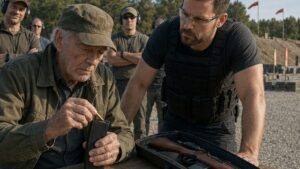
Inside lay an old bolt-action rifle, plain, clean, and oiled without shine. No decorative engraving. No flashy scope. No expensive rail system. Beside it were a chamber flag, a cloth, and the folded card partly hidden under a small tin of patches.
Daniel stared down at the rifle.
“That’s what you brought?”
“Yes.”
“You know we have modern platforms here?”
“I noticed.”
Daniel looked at Patricia as if inviting her to share the joke. She did not.
The old man lifted the rifle with the muzzle angled safely downrange. He opened the bolt, showed the empty chamber, inserted the flag, and set the rifle on the inspection mat with a care so exact that even Daniel had no immediate correction to make.
That silence lasted only a moment.
Daniel picked up the rifle, checked it, then set it down with less gentleness than John liked.
“It clears,” Daniel said. “Doesn’t mean it belongs.”
John closed the case but left the rifle out as instructed. The folded card remained inside, pressed beneath the strap.
Patricia gave John a visitor badge. “Mr. Allen, you can stay behind the yellow line until your trainee is called.”
“Thank you.”
Daniel blocked him before he could move toward Emily.
“One more thing.” His voice rose enough for the nearby group to hear. “You don’t coach unless assigned. You don’t step onto the firing line unless cleared. You don’t handle anything unless I say so. And if that old rifle causes even one delay, it goes back in the van.”
John nodded.
Daniel seemed unsatisfied by the lack of resistance.
“And if you’re thinking about proving something today,” he added, “don’t. We’ve got standards here.”
John looked out toward the targets.
Dust lifted beyond the far berm, thin and pale, then settled.
“I remember standards,” he said.
A couple of trainees exchanged glances. Daniel heard the quiet challenge in it and smiled without warmth.
“Good. Then prove you belong here,” he said. “Or leave before the line goes hot.”
John turned his visitor badge over once in his fingers.
Then he walked toward the yellow line without another word.
Chapter 2: The Young Soldier Raised His Voice First
Emily Perez did not run to John.
That told him how nervous she was.
When she saw him crossing the packed dirt behind the yellow line, her shoulders lifted and fell as if she had been holding a breath too long. She took two steps, stopped, glanced at the other trainees, then came the rest of the way with controlled dignity she had probably practiced in a mirror.
“You came,” she said.
“I said I would.”
“I thought maybe the heat—”
“The heat was here first.”
That almost made her smile.
Up close, she looked younger than her registration number had made her seem. Eighteen, maybe nineteen, with tired eyes that had learned to be careful around uniforms and ceremonies. She wore standard ear protection around her neck. Her hands were clean, nails short, fingers opening and closing against her sleeves.
John looked at her hands, then away.
“You eating?”
“A little.”
“That means no.”
“I had coffee.”
“That means worse than no.”
She lowered her eyes. “I didn’t want to feel heavy.”
“You don’t shoot better hungry. You just shake with an excuse.”
Her mouth tightened. Not offended. Remembering.
“My dad used to say things like that.”
“He said them because I said them to him.”
The words slipped out more directly than John intended.
Emily looked toward the old case across the staging area. “Is that his?”
“No.” John paused. “He learned on it once.”
The range loudspeaker crackled before she could ask more. Patricia announced the first orientation group. Trainees began forming in loose lines, adjusting belts and glasses, trying to appear more confident than they felt.
Daniel moved among them, correcting posture with quick gestures and quicker judgments. He had a voice built to carry across sand.
“Magazines empty until command. Eyes and ears on before the line. If you don’t know, ask. If you think you know, ask anyway.”
Those were good words. John gave him credit for that.
Then Daniel reached Emily.
“Perez,” he said, checking his clipboard. “You’re in lane six for preliminary. Issued rifle.”
Emily nodded.
Daniel glanced behind her at John. “And your guest stays back.”
John said nothing.
“He knows,” Emily said quietly.
Daniel’s smile thinned. “Does he? Because he already brought an antique to a modern qualification.”
A few trainees looked over again. They were young enough that curiosity still moved their heads before manners could stop them.
Emily’s cheeks colored. “He’s here to help me.”
“Help you what? Carry memories?”
John felt the words pass through Emily before she could hide them.
His thumb pressed once against the folded visitor badge.
Daniel was not finished. “This scholarship is competitive. Charity doesn’t mean easy. Nobody qualifies because their granddad brought a dusty rifle and a sad story.”
John looked at him then.
“Careful,” he said.
It was not loud.
The staging area seemed to catch it anyway.
Daniel turned fully. “Excuse me?”
“Careful around stories you haven’t heard.”
A trainee behind Daniel coughed into his sleeve. Patricia, from the registration table, looked up again.
Daniel stepped closer, just as he had at check-in. It seemed to be his habit when challenged. Take space. Fill it. Make the other person step back.
John did not.
“You got something to say, Mr. Allen?”
“No.”
“Then don’t correct me in front of my shooters.”
John’s eyes moved over Daniel’s shoulder, downrange, where the flags hung limp for the moment.
“I corrected your words,” he said. “Not you.”
Daniel laughed once. “That’s adorable.”
Emily looked at John quickly, silently begging him not to make it worse.
He gave her the smallest nod.
Daniel noticed. “You two got signals now?”
John turned to Emily. “You remember the first rule?”
She swallowed. “Respect.”
“The second?”
“Safety.”
“The third?”
She hesitated.
Daniel folded his arms. “This should be good.”
Emily said, “The target doesn’t care how you feel.”
John’s face softened by a shade. “Good.”
Daniel clapped once, sharp and sarcastic. “Wonderful. Poetry hour is over. Perez, gear up. Mr. Allen, behind the yellow line.”
Emily moved toward the equipment table. John followed only to the boundary and stopped there.
A young trainee at the table was trying to lock a sling with fingers stiff from nerves. Emily reached for a rifle but paused as Daniel assigned it to her. Her hands trembled slightly when she checked the chamber.
Daniel saw that too.
“Relax,” he said, not unkindly but too loudly. “It’s a qualification, not a funeral.”
Emily went still.
John closed his eyes for half a second.
When he opened them, the desert had sharpened. The white glare on the tables. The grit caught in the canvas shade. The old smell of oil, dust, and sun-warmed metal. The way grief sometimes stepped onto a range dressed like obedience.
Daniel did not know. That mattered. But not enough to excuse carelessness.
John kept his voice low. “Breathe out before you answer him.”
Emily did.
Daniel snapped around. “I said no coaching.”
John lifted both hands slightly, empty palms forward.
Daniel pointed toward the visitor area. “Back.”
John stepped back.
Not because Daniel was right about everything, but because a range with bruised authority was still a range. Discipline mattered more than pride, especially when pride belonged to someone else.
Emily moved into the orientation group.
For the next half hour, John watched.
Daniel was competent. That bothered John more than if he had been a fool. A fool could be dismissed. Daniel was trained, sharp, observant, and insecure in the places he should have been patient. He corrected muzzle awareness properly. He enforced eye protection. He checked chambers twice. Then, between those good habits, he cut people down just enough to make them afraid of making mistakes.
Fear made slow hands clumsy.
Emily’s first dry-fire sequence broke early. Her trigger press jerked. Daniel stepped behind her.
“You anticipating recoil on an empty chamber?” he said. “That’s impressive.”
A couple of trainees laughed before they thought.
Emily lowered the rifle.
John’s hand drifted toward his shirt pocket where the old range card was not. It was still in the case, tucked beneath leather and dust. He wished he had left it at home. He wished he had never promised a dying man anything on a hospital porch with helicopters thudding in the dark.
But Emily glanced back.
Not for rescue.
For steadiness.
John gave her only what he could from behind the line: one slow breath in, one slow breath out.
She saw it. Her shoulders eased.
Daniel saw it too.
He strode over, anger sharpened by embarrassment. “Mr. Allen, maybe you didn’t understand me.”
“I understood.”
“Then stop interfering.”
“She looked at me.”
“And you answered.”
“With air.”
“With attitude.”
John said nothing.
That made Daniel raise his voice further. “Everybody wants to be an expert from the back row. Especially the ones who haven’t had to qualify in decades.”
The trainees were fully watching now. Even Patricia had stopped pretending to sort forms.
Daniel pointed toward the old rifle case on the inspection table. “You bring that relic in here, stand around in that faded shirt, whisper little range sayings, and expect these shooters to think you know something. But this is not nostalgia day. This is my firing line.”
John glanced at Emily. Her face had gone pale with humiliation that was not even aimed at her.
Daniel followed the glance and misread it.
“You want to help her? Let her learn from people still current.”
The desert wind moved between them.
Then a new voice spoke behind Daniel.
“Current is a useful word, Sergeant White. Not always the same as correct.”
Daniel turned.
Gregory Hall had arrived without announcement, walking from the command trailer with his cap low and his sleeves rolled with old precision. He was in his forties or fifties, close-cropped hair graying at the temples, expression calm enough to make loud men notice their volume.
Daniel straightened. “Sir.”
Gregory nodded once, then looked at John.
For a moment, his gaze passed over the faded shirt, the weathered face, the visitor badge, and the hands resting loose at John’s sides.
Then it stopped.
Not on the rifle case.
On John’s right hand.
The index finger rested along the seam of his trousers, naturally straight, never curled, never careless. Even empty-handed, the finger remembered where not to be.
Gregory’s eyes narrowed slightly.
John saw recognition begin before the man had a name for it.
Daniel saw only that his superior had gone quiet.
“Problem here?” Gregory asked.
Daniel said, “No problem, sir. Just keeping the line clean.”
Gregory kept looking at John’s hand.
“Are you?” he said.
Chapter 3: The Rule Everyone Forgot To Respect
The first unsafe moment came from a boy trying too hard not to look afraid.
He stood two lanes down from Emily, tall and narrow-shouldered, with borrowed confidence sitting badly on him. During the transition from dry practice to live preparation, he turned to answer a joke from the trainee beside him. The rifle in his hands moved with him.
Not far.
Not wildly.
Just enough.
John saw the muzzle begin to drift across the line before anyone else reacted.
“Freeze.”
His voice did not rise. It cut.
The trainee froze.
So did the line.
Daniel spun from the lane board. “Who gave that command?”
John had already stepped one pace forward, stopping short of the yellow line. His hand was out, palm down, not touching anyone, not pointing, not dramatic.
“Muzzle,” he said.
The boy’s eyes dropped. His face drained.
Daniel saw it then. The rifle was angled wrong, not at a person but away from its safe direction. A small mistake. The kind that became large only when pride defended it.
“Correct it,” John said.
The boy carefully turned the rifle downrange.
Only then did John lower his hand.
Daniel came at him fast. “You do not call commands on my line.”
John looked at the boy instead of Daniel. “You all right?”
The trainee nodded too quickly.
“Good. Remember that feeling. It teaches better than being yelled at.”
Daniel planted himself between John and the line. “I handle safety here.”
“You were looking at the board.”
“I had it.”
“No,” John said. “You had the board.”
The quiet answer moved through the line harder than a shout would have.
Daniel’s face tightened. “Step back.”
John did.
Gregory Hall had been standing under the shade net with Patricia, reviewing the lane schedule. Now he walked toward them, slower than Daniel had, but with more weight.
“What happened?” Gregory asked.
Daniel answered first. “Visitor interfered with range command.”
John did not argue.
Gregory looked at the trainee. “Did your muzzle leave the safe direction?”
The boy swallowed. “Yes, sir.”
“Did Mr. Allen touch you?”
“No, sir.”
“Did he step onto the firing line?”
“No, sir.”
“Did his command prevent a worse correction later?”
The boy hesitated, then said, “Yes, sir.”
Gregory turned to Daniel.
Daniel’s jaw worked once. “I would have caught it.”
“Maybe,” Gregory said. “But he did.”
A hot gust pushed dust across the concrete pad. It skated around boots and settled in the cracks. John watched it because he did not want to watch Daniel decide whether to learn or resent.
Daniel chose resentment.
“With respect, sir,” he said, the phrase carrying very little respect, “this is exactly why visitors should not hover over trainees. They make them nervous. They insert themselves. They undermine instruction.”
Patricia stepped closer. “Sergeant, the safety correction was valid.”
Daniel looked at her, then back at Gregory. “I’m not saying it wasn’t. I’m saying there’s a process.”
John spoke before Gregory could answer. “Safety is the process.”
The line went quiet again.
Daniel turned slowly. “You always have a little saying ready?”
“No.”
“Then why does it feel like it?”
John’s gaze stayed steady. “Because you keep forgetting simple things.”
A few heads turned away, hiding reactions. Emily stared at the ground, but John could see her shoulders shift. Not with laughter. With fear that Daniel would punish her for knowing him.
Gregory noticed that too.
He moved between Daniel and John, not dramatically, just enough to reset the shape of the space. “Sergeant White, take five. Hydrate. Review lanes four through eight.”
“Sir, I don’t need—”
“That was not a medical suggestion.”
Daniel stopped. “Yes, sir.”
He walked toward the water table, stiff-backed, anger contained only because command required it. The trainees pretended not to watch him go.
Gregory faced John. “Mr. Allen.”
“Sir.”
“You military?”
“Once.”
“Branch?”
John looked toward the targets. “Army.”
Gregory waited, expecting more.
John gave him none.
A corner of Gregory’s mouth moved, not quite a smile. “You still remember range commands.”
“Some things stay because forgetting them gets people hurt.”
Gregory’s eyes dropped again to John’s hand. “You teach?”
“Once.”
“That answer doing a lot of work.”
John said nothing.
Patricia checked her tablet with more tension than necessary. “We’re behind schedule. If we delay the first live relay, the afternoon long-distance block gets cut.”
Daniel returned from the water table in time to hear that. “All the more reason to keep distractions off the line.”
His voice was lower now, but the edge remained. John knew that edge. A young man embarrassed in front of people he wanted to impress. Dangerous, not because he was cruel, but because he needed the next moment to prove the last moment had not wounded him.
Gregory looked over the trainees. “We’ll proceed.”
Daniel nodded sharply. “Good.”
“With one adjustment,” Gregory added.
Daniel paused.
Gregory pointed toward the far end of the firing line. “Lane nine is empty.”
“That lane’s uneven,” Daniel said.
“It’s serviceable.”
“It pulls dust on the wind shift.”
“Then whoever uses it will need patience.”
Daniel’s eyes flicked to John. “Sir, you can’t be serious.”
Gregory’s voice stayed even. “I am considering letting Mr. Allen demonstrate a controlled safety sequence before the next relay.”
Daniel gave a short laugh before he could stop himself. “With that old rifle?”
John felt the line turn toward the case again.
Patricia’s brows lifted. “Is that necessary?”
“No,” John said.
Everyone looked at him.
He meant it. He had come for Emily, not for Daniel, not for Patricia’s schedule, not for the crowd gathering behind the barricade. He had not driven through desert heat to turn an old promise into a performance.
Emily watched him from lane six.
Her hands were calmer now, but her eyes were not. She had just seen Daniel humiliated. She knew, as young people often know before adults admit it, that embarrassment looks for somewhere to go.
If John refused, Daniel would keep the line. He would keep his pride. And Emily would shoot under the weight of it.
Gregory seemed to understand the decision forming in John before John wanted him to.
“Your call,” Gregory said.
Daniel folded his arms. “No offense, sir, but if we let every visitor with a war story take a lane, we might as well turn the event into open mic night.”
John looked at Daniel.
There it was. Not the worst insult. Not unforgivable. Just loud enough, public enough, careless enough to tell every young shooter on the line what Daniel valued.
Image. Speed. Current badges. Smooth gear. Youth that did not shake.
John walked to the old case.
The range watched.
He opened it with the same care as before. The hinges gave a dry wooden sigh. The rifle lay where he had left it, chamber flagged, bolt open, plain as a fence post. The folded range card shifted in the wind. John pressed it down with two fingers before it could lift.
For a moment, Gregory saw the faded ink at the top.
His expression changed.
Not recognition fully. Not yet.
But the beginning of memory.
John lifted the rifle, checked the chamber, checked it again, and kept the muzzle downrange. He did not look at Daniel. He did not look at the crowd. He looked at Emily.
“The first rule?” he asked.
Her voice was small but clear. “Respect.”
“The second?”
“Safety.”
John nodded.
Daniel muttered, “And the third?”
John turned toward lane nine.
“The target will tell you,” he said.
Gregory looked at Daniel. “Put him on lane nine.”
Daniel stared at his superior, then at the old man in the faded blue shirt.
“Yes, sir,” he said.
But the words came out like a challenge instead of obedience.
Chapter 4: When The Target Came Back Silent
Lane nine sat at the far edge of the firing line where the concrete pad dipped slightly and the wind came sideways across the berm.
Daniel made sure everyone noticed.
He walked ahead of John with the lane clipboard held flat against his thigh, calling instructions louder than necessary. “Lane nine is active by order of the range officer. All shooters remain behind the yellow line until command. No one moves forward. No one touches equipment until cleared.”
The words were correct.
The performance was not.
John followed with the rifle held safely, bolt open, chamber flag visible. He did not hurry. The old case remained on the staging table behind him, its lid closed now, though he had checked twice that the folded card was tucked under the strap. He could feel its absence the way a man feels a missing tooth. A small empty place where memory usually rested.
The trainees gathered behind the line. Soldiers drifted over from the vehicle shade. Patricia stood near the lane board with her tablet lowered. Gregory Hall remained off John’s left shoulder, close enough to see everything, far enough not to interfere.
Emily watched from lane six, hands folded around her ear protection.
Daniel stopped at lane nine and looked downrange. The target frame stood at distance, a pale square trembling slightly in the heat shimmer. Dust moved in thin strips across the ground between them and the berm.
“This lane pulls wind,” Daniel said. “Just so everyone understands.”
John set the rifle on the bench with the muzzle downrange.
Daniel looked at the rifle, then at the spectators. “And since we’re making exceptions today, Mr. Allen here will demonstrate with his personal equipment. Old-school bolt-action. No modern optic. No range assistant. No excuses.”
Gregory’s voice cut in. “No commentary either, Sergeant.”
Daniel’s mouth closed.
John appreciated that, but not enough to look back. His attention had gone to the lane.
He checked the chamber again. Open. Empty. Flag in place. He inspected the bench, the sandbags, the line of fire, the position of the target, the flags near the berm. The left flag lifted, dropped, then lifted again. The dust disagreed with the flag by a breath.
That was the desert. It told the truth in more than one language.
Daniel stood with his arms crossed. “You need help getting down?”
John looked at the ground beside the bench.
“No.”
The silence after the answer was not generous. It waited for him to fail.
John removed the chamber flag and placed it where it could be seen. He worked slowly, not because his body could not move faster, but because haste was contagious on a firing line. He loaded only when Gregory gave the command. One round. Bolt forward. Finger straight. Breath steady.
He did not think of Daniel.
He did not think of the watching soldiers.
He thought of Emily’s father at nineteen, all elbows and questions, asking why old instructors cared so much about breathing when bullets moved faster than breath.
Because the bullet leaves after the breath decides, John had said.
The memory crossed and was gone.
John lowered himself into position.
His knee complained first, then his back. Pain spoke in familiar tones, but it did not command. He settled behind the rifle, cheek to stock, shoulder firm, left hand relaxed. He let the sight picture appear instead of chasing it.
Behind him someone whispered.
Daniel said nothing, but John could feel his expectation: a shake, a flinch, a miss large enough to laugh about.
John’s right hand looked old on the rifle.
That was true.
The target did not care.
He waited while the dust dragged left across the lane. Waited again when the flag twitched late. The whole range seemed to become heat, breath, and distance.
“Taking a while,” Daniel muttered.
Gregory turned his head slightly.
John let half a breath out.
The shot cracked.
Not loud in the way people imagined. Clean. Contained. Absorbed by sand and distance.
John lifted the bolt, caught the brass, placed it on the bench. He did not look back.
Second round.
He waited longer.
Shot.
Third.
The wind softened, then slipped right.
John adjusted without touching the sight.
Shot.
By the fifth round, the line had changed. The little movements behind him had stopped. No boots scuffed. No jokes leaked out. Even Daniel’s silence had become less certain.
John cleared the rifle when finished, opened the bolt, inserted the chamber flag, and placed both hands flat on the bench.
“Line clear,” Gregory said after inspection.
Daniel walked to the return control. His expression carried the tight satisfaction of a man still hoping distance had protected his pride. He pressed the switch.
The target began to move back.
It came slowly along the cable, swinging slightly in the wind. From far away, the paper showed only a dark mark near center.
Daniel smiled. “Well, at least he hit paper.”
No one answered.
The target came closer.
The dark mark became smaller, not larger. That was the first thing the trainees noticed. It was not a scatter. Not a pattern spread across white paper. It was one ragged hole just off perfect center, small enough that the five shots seemed to have argued over the same space.
The cable clicked to a stop.
Daniel reached for the paper, then stopped.
He looked at it without speaking.
The silence moved outward from him. It touched the trainees first, then Patricia, then the soldiers near the trucks. A vehicle engine coughed somewhere behind them and sounded too loud.
Emily stepped forward until the yellow line stopped her.
John rose carefully from the firing position. His knee made him pay for it. He accepted the pain without bargaining and kept one hand on the bench until he was steady.
Daniel took the target down.
He checked the back as if the other side might tell a different story.
Then he held it up because Gregory had not told him to, because everyone had already seen, because there was no graceful way to hide paper.
Five shots. One torn center.
No applause came.
That was better.
Applause would have turned the moment into a show. Silence kept it honest.
Gregory walked to the target and studied it. His face did not brighten. It settled.
“Wind call?” he asked.
John looked toward the berm. “Dust was earlier than the flag.”
Gregory nodded slowly.
Daniel lowered the paper. “Could be luck.”
John turned to him for the first time since taking the lane.
“It could.”
The answer unsettled Daniel more than denial would have.
John began clearing his equipment. He checked the rifle again, though everyone had watched him clear it already. He placed the chamber flag where it belonged. He did not reach for the target. He did not ask who had seen. He did not look at Emily until the rifle was safe on the bench.
When he did, she was staring at the paper with her lips parted, not in triumph, but confusion.
Why had he let them speak to him that way?
John knew the question. It had followed him through more years than she had been alive.
Daniel found his voice. “That doesn’t make him qualified to coach.”
“No,” John said. “Safety does.”
Gregory looked at John then, sharper than before.
Daniel’s face flushed. “Sir, with respect, we don’t even know who he is.”
Gregory’s gaze dropped past John toward the staging area, toward the old wooden case.
“That may be changing,” he said.
John picked up the rifle and carried it back with the same care he had carried it out. The crowd parted without being asked. Not much. Just enough. A small correction in the world.
At the table, he opened the case and laid the rifle inside.
The folded range card shifted loose from under the strap and slid half an inch into sunlight.
Gregory stopped beside him.
He looked down at the faded card.
The ink at the top had nearly worn away, but one line still held.
RANGE INSTRUCTOR CERTIFICATION.
Below it, in a younger hand, was a signature Gregory had seen in old training files, on yellowing standards sheets, on the wall of the command trailer where history had faded into decoration.
Gregory’s voice changed.
“Mr. Allen,” he said quietly, “where did you get that card?”
Chapter 5: The Name Written Behind The Card
John closed his hand over the range card before the wind could take it.
For a moment, no one moved.
The old card was soft from years in the case, creased down the middle, its corners rounded by pockets and weather. It had once been white. Now it carried the color of dust and old paper. John had not meant for anyone to see it. Not yet. Maybe not at all.
Gregory stood beside the table, waiting.
Daniel hovered a few steps away with the target still in his hand, no longer holding it high. The trainees watched from the line, held there by curiosity and command. Patricia came closer, her tablet pressed against her chest.
John looked down at the card.
“Long time ago,” he said.
Gregory did not smile. “That signature is yours.”
John slid the card back under the strap. “Was.”
“John Allen,” Gregory said, as if testing the name against memory. “Fort Carson mobile marksmanship program. Desert rotation standards. Wind reading block.”
Daniel’s eyes flicked between them. “Sir?”
Gregory ignored him. “There were old lesson sheets in the command trailer when I came through as a lieutenant. Half the instructors said nobody taught range discipline like the man who wrote them.”
John shut the rifle case.
Wood met wood with a small, final sound.
“Paper lasts too long,” he said.
Gregory studied him. “You trained Gregory Hall once.”
That made John look up.
He had been careful with faces all day. Age changed men. Rank changed them more. But now, beneath the controlled officer’s expression, he found a younger soldier with dust on his chin and a habit of asking questions after class.
“Hall,” John said.
Gregory nodded. “You told me I was rushing the wind.”
“You were.”
“I thought you hated me.”
“I didn’t know you well enough for that.”
A faint smile touched Gregory’s face and vanished.
Daniel looked as if something had shifted under his boots. “You know him?”
Gregory turned. “Sergeant White, Mr. Allen helped write portions of the safety standards this range still uses.”
The words reached the line.
A murmur passed among the trainees. Emily’s eyes moved from Gregory to John. Not proud yet. Hurt, maybe, because the truth had been near her all morning and he had kept it covered.
John felt that more sharply than Daniel’s insults.
Patricia stepped in with professional caution. “Mr. Allen, if that’s true, we should have known before today.”
“No,” John said.
She blinked. “No?”
“I didn’t come as a guest of honor.”
Gregory’s gaze softened. “Then why did you come?”
John looked toward Emily.
She stood very still.
The range around them held its breath in the heat.
John had promised himself he would tell her privately. Not here, not with Daniel listening, not with soldiers and trainees turning grief into a spectacle. But the day had already taken quiet things and dragged them into sunlight.
He picked up the old card again and opened it.
On the back, written in a younger man’s block letters, was a name and a date. The ink had faded, but John could still see the pressure of the pen.
PEREZ — FIRST CLEAN GROUP, 300 YARDS.
Emily crossed the space before anyone stopped her.
John handed her the card.
She took it with both hands.
“My dad?” she whispered.
John nodded.
Emily stared at the writing. “He never told me about this.”
“He talked more after he learned to shoot less.”
That made her laugh once, unexpectedly, and then cover her mouth as her eyes filled.
John looked away to give her the little privacy a public place could offer.
“Your father came through this range before it looked like this,” he said. “He was too fast, too proud, and too sure the rifle should obey him because he wanted it to. Took him three weeks to learn the target didn’t owe him anything.”
Emily touched the faded name. “Why did you keep it?”
“He gave it back to me before his last deployment. Told me if he ever had a child who wanted to shoot, I should make sure they learned the first two rules before they learned to hit anything.”
Respect. Safety.
Emily closed her eyes.
Daniel shifted, uncomfortable now, but not enough to be quiet. “I didn’t know.”
John looked at him. “Most people don’t. That’s why careful words matter.”
Daniel’s mouth tightened.
Gregory stepped closer to John. “You could have told us at check-in.”
“I could have.”
“Why didn’t you?”
John glanced toward the target still in Daniel’s hand. “Because the day isn’t mine.”
Patricia exhaled slowly. Her face had changed from administrative concern to something more human and more complicated. “Emily is applying for the memorial scholarship.”
“Yes.”
“And you’re her sponsor?”
“If she wants me to be.”
Emily looked up from the card. “I do.”
The answer came quickly enough to make John’s throat tighten.
He nodded once.
Daniel stared at the dust near his boots. The paper target hung from his hand, curling in the heat. For the first time all morning, he looked young.
Gregory took the target from him and placed it on the table beside the old case. “Then we proceed accordingly.”
John shook his head. “No special treatment.”
“I wasn’t offering any.”
“Good.”
Patricia checked the schedule. “Emily’s preliminary relay is still active. If she shoots now, she can remain eligible for the long-distance round.”
Emily wiped her eyes with the heel of her hand. “I can shoot.”
John studied her face. “Can and should are different.”
“I can.”
He believed her, mostly.
Daniel looked up. Some of his confidence had returned, but it came now mixed with embarrassment. “If we’re talking fairness, then let’s be fair.”
Gregory turned slowly. “Meaning?”
Daniel pointed at the target. “Mr. Allen just took lane nine. Everyone saw it. Impressive. But it wasn’t part of the event. If his reputation is going to influence a scholarship qualification, then there should be a formal round. Same conditions. Long-distance block. No nostalgia, no whispers, no special credit.”
Patricia frowned. “Sergeant White.”
Daniel’s voice tightened. “I’m not wrong. If anything, I’m protecting the integrity of the event.”
John watched him carefully.
There it was again: pride wearing a uniform of principle. But not entirely false. That was what made it dangerous. Daniel did care about standards. He simply cared too much about being seen as their guardian.
Gregory said, “Are you challenging Mr. Allen?”
Daniel hesitated.
The crowd sensed it and leaned in without moving.
Daniel looked at John. “I’m saying if he’s going to stand behind Perez, he should show he can still do it under the same final conditions as everyone else.”
Emily stepped forward. “He doesn’t have to—”
John raised one hand gently.
She stopped.
He looked at Daniel. “What would that settle?”
Daniel swallowed. “Whether today is about skill or sentiment.”
John let the words sit.
The desert wind lifted the edge of the old card in Emily’s hand.
John reached over and pressed it flat with two fingers, the same way he had pressed it in the case.
Then he said, “All right.”
Gregory’s eyes narrowed. “John.”
“One formal round,” John said. “Same safety rules. Same commands. Same wind.”
Daniel straightened, relief and anxiety crossing his face together.
John looked at him, not unkindly.
“But it will not be to settle my name,” he said. “It will be to settle yours.”
Chapter 6: Slow Is Smooth In A Crosswind
By evening, the desert had begun to move.
All morning the heat had pressed straight down, white and hard, but now wind came over the low hills and dragged dust across the long-distance range in restless sheets. It pulled at sleeves, snapped the lane flags, and turned every pause into a calculation.
The final block used the far targets.
Fewer trainees qualified for it. Those who did stood quieter than they had in the morning, humbled by heat, recoil, and the slow discovery that confidence did not tighten groups by itself. Emily was among them. Her preliminary shots had not been perfect, but they had been disciplined. She had earned her lane without John saying a word.
That mattered to him.
The long-distance line sat beyond the main bays, where the ground sloped toward a wide berm and the targets looked small enough to belong to another world. Spotting scopes stood on tripods. Range flags lifted and fell at different angles, telling different stories. Dust slid low across the lane, honest and early.
Daniel had changed gear.
He wore a clean shooting jacket now, tight at the shoulder, and had borrowed a modern precision rifle from the event rack. The equipment was good. John had no complaint with good equipment. Only with the belief that it could forgive impatience.
John laid his old rifle on the bench at lane nine.
Daniel took lane eight.
Gregory stood behind them as range officer. Patricia kept the score sheet. Emily waited behind the line, holding the old card inside a clear sleeve Patricia had found in the registration tent. She held it as if it might bruise.
Gregory’s voice carried over the wind. “This is a formal demonstration round conducted under event safety standards. Five shots each. Shooters will fire only on command. Bolts open until instructed. Chamber flags visible.”
John checked his flag.
Daniel checked his.
Good.
John noticed Daniel’s hands. Steady, but too tight. Anger had left him; something worse had replaced it. Need.
Need made men squeeze triggers like they were closing doors.
Gregory continued. “This round determines no personal rank, no title, and no award. It will inform final scholarship lane assignments at the discretion of the event staff.”
Daniel’s jaw tightened.
John almost smiled. Gregory had taken the trophy away before the contest began. Wise.
“Shooters ready.”
Daniel settled quickly.
John did not.
He watched the dust move. Close dust, mid-lane dust, berm dust. Three winds, not one. The flags lagged behind the ground. The setting sun put glare along the right edge of the sight picture.
He heard Daniel shift.
“Load one round.”
John loaded.
Daniel loaded.
“Commence fire when ready.”
Daniel fired first.
A clean shot. Too soon for the wind, but not wild. A spotter called the impact. Outer scoring ring, right side.
Daniel muttered under his breath.
John waited.
The wind dropped near the bench but kept moving downrange. That trick had fooled better shooters than Daniel. John let the rifle rest. His cheek touched the stock. Breath entered, left, paused.
He fired.
The spotter called center.
No one reacted loudly. They had learned by now that noise did not help.
Daniel fired again faster.
The impact landed low right.
His shoulder stiffened. He worked the bolt too sharply. The muzzle remained downrange, but the movement carried frustration. John saw his finger come back toward the trigger before his breathing had settled.
“Stop,” John said.
Gregory did not repeat it. He saw it too. “Cease fire. Bolts open.”
Daniel froze, then opened his bolt. “What now?”
John kept his own rifle safe and open. “Your finger.”
“It was indexed.”
“It was traveling.”
Daniel’s face reddened. “I know trigger discipline.”
“I know you do,” John said. “That’s why I’m telling you before pride makes you forget it.”
The words landed differently this time.
Not as public correction. As a hand against a door before it slammed.
Daniel looked down at his own hand. The wind moved around him. His shoulders rose once, then fell.
Gregory inspected both rifles. “Line remains safe.”
Daniel did not look at John. “I’m fine.”
“No,” John said. “You’re trying to erase this morning with five shots.”
Daniel’s head turned.
John’s voice stayed low, but the nearest trainees heard it. “That is too much weight for a trigger.”
For a moment Daniel looked ready to answer with the old sharpness. Then his eyes flicked to Emily, to Gregory, to the paper target still clipped near the scoring table from John’s earlier group.
He swallowed.
“What do you suggest?”
It was not an apology. Not yet.
It was better. It was a question.
John closed his bolt only after Gregory gave the nod to continue. “Start with your feet.”
Daniel looked annoyed despite himself. “My feet?”
“The rifle begins at the ground.”
Gregory did not interrupt.
John nodded toward Daniel’s stance. “You’re blading too hard against the wind. Fighting it. Square a little. Let the jacket work. Don’t muscle the stock.”
Daniel adjusted, stiffly at first.
“Grip less,” John said.
Daniel loosened his hand.
“Less than that.”
A trainee behind the line smiled and quickly hid it.
Daniel loosened more.
John watched the flags. “Now wait for what the dust tells you, not what you want the flag to say.”
The wind crossed. Daniel waited through it. For the first time all day, his stillness did not look like posing.
“Now,” John said.
Daniel fired.
The spotter called a better hit.
Not center. But honest.
Daniel stayed behind the rifle, breathing.
John returned to his own lane.
The round continued.
Shot by shot, the range changed its attention. At first they watched to see whether the old man would defeat the young one. Then, slowly, they watched something quieter: an old instructor giving away the very advantage that might have made the defeat cleaner.
John corrected Daniel once more on breathing. Daniel accepted it with a tight nod. Emily watched without blinking.
By the final shot, Daniel had three respectable hits and one poor one. John had four near center.
One round remained for each.
The wind rose suddenly, pushing dust hard across the range. The flags snapped late. A loose sheet on Patricia’s clipboard tore free and slapped against her leg.
Gregory waited. “Shooters may hold.”
Daniel looked over at John.
This time there was no smirk.
“How long?” he asked.
“As long as it takes,” John said.
“Event clock’s running.”
“The wind does not care.”
Daniel almost laughed. Not because it was funny. Because he finally understood why the old sayings survived.
He waited.
The dust thinned.
Daniel fired first.
The spotter leaned into the scope. “Center ring. Slight left.”
A murmur passed through the line. Good shot. Best he had fired all day.
Daniel opened his bolt and sat back. The relief on his face was painful to see.
John still had one round.
Emily’s scholarship lane would depend on the final assignment Gregory made after this demonstration. Daniel’s challenge had put attention on her, but it had also created an opening. If John fired poorly now, Patricia could still proceed cautiously and keep Emily from the stronger lane. If he fired well, Gregory could justify placing her under his sponsorship for the final youth round.
John looked at Emily.
She was not pleading. She stood with the card held flat against her chest, her father’s faded name under her fingers.
John loaded his last round.
The wind shifted twice before he closed the bolt.
His old hands ached. His left thumb trembled. His knee pulsed from kneeling earlier. The sun glared along the sight. All of it was true.
None of it was the shot.
He breathed in.
Out.
Held only what needed holding.
The rifle cracked.
Dust moved across the target before anyone could see where the bullet had gone.
The spotter bent closer to the scope and did not speak.
Gregory turned his head. “Call it.”
The spotter looked up, eyes wide.
“Dead center,” the spotter said. “Same hole as his best.”
The range went still again, but this silence was different from the first.
Daniel lowered his head.
John opened the bolt, cleared the rifle, and set the chamber flag.
He did not look at the target.
He looked at Gregory.
Gregory looked at Patricia’s score sheet, then at Emily.
“Final scholarship lane assignment,” Gregory said. “Emily Perez will shoot under Mr. Allen’s sponsorship.”
Emily covered her mouth with the old range card.
Daniel stood very still beside lane eight, his modern rifle cleared and safe on the bench. For once, he seemed to have nothing ready to say.
Chapter 7: The Lesson Was Never The Shot
Daniel found John at the range wall after the last relay ended.
The sun had dropped low enough to turn the desert copper. Long shadows stretched from the tripods and rifle stands. The vehicles that had growled and kicked dust all morning now sat cooling in the distance, their engines ticking softly. Trainees moved in tired clusters toward the shuttle vans, carrying gear, score sheets, and the private weight of what they had learned.
John stood alone beside the command trailer, the old rifle case resting at his feet.
On the wall in front of him hung framed photographs, faded standards sheets, old range notices, and yellowed names of instructors who had passed through before the range had grown into what it was now. Some papers had curled at the edges. Some names had gone pale under years of desert light.
Gregory Hall stood on a small step stool, pinning John’s old range card behind a clear cover near the older standards sheets.
John had objected once.
Gregory had ignored him once.
That had been enough for both men.
Emily stood beside Patricia near the scoring table, still holding the clear sleeve that had protected the card until Gregory asked for it. She had completed her final scholarship lane with careful, honest shots. Not perfect. Not dramatic. Good enough to earn advancement. Better, she had known why each miss happened.
John valued that more than the hits.
Daniel stopped a few paces away.
For a while, he said nothing.
John did not help him.
The old habit rose in him: make silence easy for a young man who had walked himself into a hard lesson. But today, silence needed to do its own work.
Daniel removed his cap and held it against his thigh. His hair was damp with sweat, his face marked by dust where his glasses had been.
“Mr. Allen.”
John turned.
Daniel’s eyes did not lift immediately. When they did, the morning’s sharpness was gone. Not erased, but worn down into something more useful.
“I owe you an apology.”
John waited.
Daniel looked toward the firing line, now empty and orange in the low sun. “I talked to you like you were a problem before I knew why you were here. I made assumptions about your age, your rifle, your clothes.” His grip tightened on the cap. “And I did it in front of people I was supposed to lead.”
John glanced toward Emily, making sure she was not close enough to be turned into the audience for Daniel’s apology. She was speaking quietly with Patricia, not listening.
Good.
“You did,” John said.
Daniel nodded, swallowing the answer. “I’m sorry.”
The words came without performance. That mattered.
John studied him for a moment. “You know what bothered me most?”
Daniel looked prepared for almost anything.
John said, “You were good enough to know better.”
That struck harder than insult would have.
Daniel’s eyes dropped. “Yes, sir.”
“Don’t call me sir because you’re ashamed.”
Daniel looked up.
“Call the line right. Watch the quiet ones. Don’t make nervous shooters carry your pride. That will do.”
Daniel nodded slowly. “I can do that.”
“No,” John said. “You can start doing that.”
For the first time all day, Daniel almost smiled without using it as armor.
Gregory stepped down from the stool. The old range card now rested under clear plastic, flattened against the wall. The front showed John’s faded instructor certification. The back, placed beside it in a copied enlargement Patricia had made, showed the line Emily had touched with trembling fingers.
PEREZ — FIRST CLEAN GROUP, 300 YARDS.
Emily approached then.
She looked at the wall for a long time. John watched her see her father’s name not as a private ache in her hand, but as part of the range itself. Something that belonged not to loss alone, but to practice, dust, patience, and the people who had taught one another how to be careful.
“He was really here,” she said.
John nodded. “He was.”
“Was he good?”
John considered lying kindly, then chose better.
“He became good.”
Emily breathed out, and the answer seemed to settle her.
Gregory looked at her score sheet. “You earned your advancement today.”
Emily held the paper as if she did not trust it yet. “Because of him.”
John shook his head. “No.”
She turned to him.
“I gave you reminders,” he said. “You fired the shots.”
“But you got me the lane.”
“I opened a door. You still had to walk through without pointing anything at your feet.”
That made Patricia laugh softly. Even Daniel looked down with a small, humbled smile.
Emily wiped at one eye with the back of her wrist. “What happens now?”
“Now?” John picked up the old rifle case. “You eat something before you fall over.”
“I meant after that.”
“After that, you practice dry until your hands learn not to argue with your head. You listen to range commands. You clean what you use. You miss honestly. You don’t chase center when your breathing is wrong. And you never let anybody make you hurry safety.”
Emily nodded as if each sentence needed a place to go inside her.
“Will you teach me?” she asked.
The question was quiet. It carried no crowd, no challenge, no proof. Just a young person standing in desert light with her father’s name on a wall and an old man she barely knew holding the case that had somehow carried both of them here.
John looked toward the empty lanes.
All day he had told himself this was a promise being completed. Bring the rifle. Stand behind the line. Make sure she got a fair chance. Then leave before memory asked for more than he could give.
But promises were dangerous that way. Sometimes keeping one opened another.
His hand tightened around the case handle.
“I’m slower than I used to be,” he said.
Emily glanced at the target from his demonstration, still lying on the table because no one had wanted to throw it away. One small torn hole. A silence made visible.
“I noticed,” she said.
John looked at her.
There was something of her father in the answer after all.
He nodded once. “Saturday mornings. Early. No coffee instead of breakfast.”
She smiled through what remained of her tears. “Yes, sir.”
“Don’t call me sir because you’re grateful.”
Her smile widened a little. “What should I call you?”
“On the range, Mr. Allen will do.”
Daniel cleared his throat. “Mr. Allen?”
John turned.
Daniel held out the earlier target, the one with the five-shot group from lane nine. It had been placed in a protective folder now, though no one had asked John’s permission.
“I thought you might want this.”
John looked at it.
The paper had done its work. It had answered Daniel. It had turned a crowd quiet. It had opened Emily’s lane. But he did not need to carry it home.
He took the folder, then handed it to Emily.
“Keep it with the card copy,” he said.
Emily stared. “This is yours.”
“No. The lesson was never the shot.”
She held the folder against her chest beside her score sheet.
Gregory watched John with the same expression he had worn at the firing line, part officer, part former student, part man remembering how much of himself had been built by corrections he once resented.
“We’ll keep the original card here,” Gregory said. “If that’s still all right.”
John looked at the wall.
His name seemed strange there. Too formal. Too flat. But beside it was Perez, written by a young man who had once learned to slow down, then gone on to leave a daughter who needed the same lesson.
“Yes,” John said. “Let it work.”
Patricia began gathering the last of the forms. The range medic folded a tent flap. Soldiers carried empty water coolers toward a truck. The day was ending without ceremony, which suited John.
Daniel stepped aside as John lifted the rifle case.
This time he did not make room with embarrassment. He made it with respect.
John walked toward the parking area. Emily fell into step beside him for a few yards, then stopped when Patricia called her back to sign a final document. Gregory remained by the wall. Daniel returned to the firing line, where a trainee had left a chamber flag on the bench, and picked it up carefully.
John saw that.
He kept walking.
The desert wind moved low over the range, lifting dust from the lanes where young shooters had stood and where an old man had knelt. For a moment the dust crossed the sunset and turned gold, then thinned, then settled.
John reached the shuttle van and set the rifle case down gently before climbing in.
His hands ached. His knee hurt. His shirt was stiff with salt and dust.
Behind him, Emily laughed at something Patricia said, small but real.
John looked once more toward the range wall, where the old card now caught the last light.
Then he picked up the case, stepped into the van, and sat quietly by the window as the desert began to cool.
The story has ended.