The Young Soldier Mocked The Old Veteran’s Hands, Then The Desert Target Came Back Silent
Chapter 1: The Old Man At The Desert Firing Line
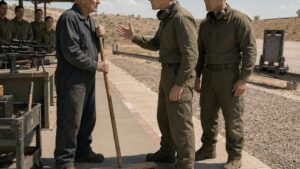
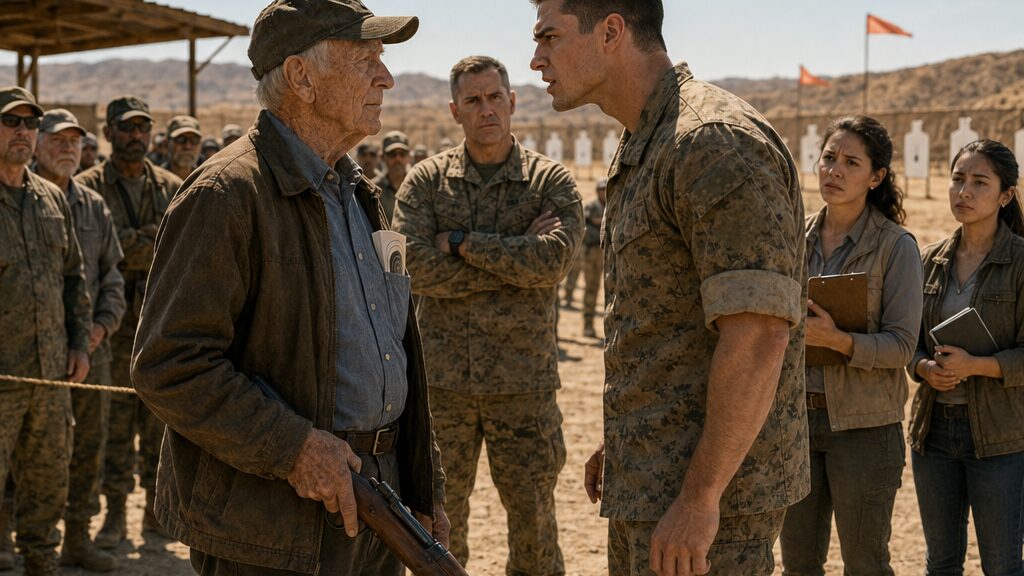
The young soldier stepped in front of Jack Miller with one hand lifted toward the rifle and the other resting hard against his own belt.
“Sir, stop right there.”
Jack stopped.
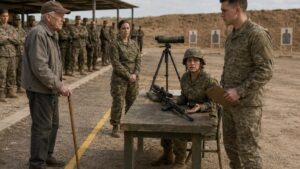
The desert wind moved around him in thin, dry sheets, carrying dust across the concrete apron of the range and snapping the red safety flags above the firing lanes. Beyond the covered line, tan hills rose under a pale morning sky. Targets stood far out in the glare, small white squares against berms of packed earth.
Jack held the long rifle pointed down, muzzle safe, bolt open, chamber empty. His hands were knotted and brown with age, the veins raised beneath paper-thin skin. The faded blue shirt he wore had been washed until the collar had softened. One breast pocket sagged slightly with the shape of a folded card tucked inside.
The soldier looked at the rifle, then at Jack’s face, then at the slow way Jack’s shoulders moved when he breathed.
“This is a controlled military range,” the soldier said. His voice was loud enough for the nearby volunteers to hear. “You can’t just wander onto the firing line with a weapon.”
Jack glanced past him toward the registration table. A banner had been tied between two poles there, its edges popping in the wind.
MEMORIAL CHARITY QUALIFICATION SHOOT
Below the words was a photograph of a man in uniform, smiling in the sun with shooting glasses pushed up on his forehead.
Jack looked at the photograph for one breath too long.
“I’m registered,” he said.
The soldier’s jaw tightened. His name tape read WALKER. He was young, broad through the chest, clean and sharp in a way that made the morning seem dustier around him. His sleeves were rolled perfectly. His sunglasses were hooked at his collar. Everything about him said he knew people were watching.
“Registration is back there,” Brandon Walker said, pointing without looking. “Participants wait until they’re called. They don’t approach the line alone.”
“I heard the line was cold.”
“It is cold. That doesn’t mean you belong on it.”
A couple of soldiers near the ammo table turned their heads. One veteran sitting beneath the shade awning lowered his paper cup. Catherine Lopez, the charity coordinator, stood with a clipboard pressed to her chest, watching the exchange with concern she was trying not to show.
Jack did not move closer to the line. He did not argue. He simply shifted the rifle a fraction so its muzzle angled farther toward the packed ground.
“I was checking the wind flags,” he said.
Brandon gave a short laugh.
“The wind flags?”
Jack looked toward the nearest strip of orange fabric, whipping left, then hesitating, then snapping back in a twitchy quartering gust.
“They’re talking this morning.”
“Sir, with respect, you’re not here to inspect our range.” Brandon lowered his voice, but only enough to make the words sharper. “You’re here for a charity event. There are rules. There’s liability. And frankly, you look like you need someone helping you walk before you start worrying about wind calls.”
The words did not strike Jack’s face. They landed somewhere quieter.
He could feel the folded target card against his chest. Not heavy. Not even stiff anymore. Just old paper softened by years of being opened, closed, carried, forgotten, and carried again. He had almost left it in the truck. Then he had seen the memorial banner from the parking lot and put it in his pocket with two fingers.
A range medic pretending to check supplies looked up.
Brandon noticed the attention and stood straighter.
“What’s your name?”
“Jack Miller.”
Brandon glanced at the clipboard in Catherine’s hands. “You got him?”
Catherine flipped through pages quickly. Her lips tightened, then relaxed. “Jack Miller. Lane assignment pending. Veteran participant.”
Brandon turned back. “Veteran participant doesn’t mean line authority.”
“No,” Jack said. “It doesn’t.”
Something about the answer bothered Brandon more than an argument would have.
He looked down at Jack’s hands. The left one had a slight tremor when Jack relaxed it near the rifle stock. It was small, more visible because the sun was hard and the air was bright. Brandon’s gaze caught it.
“You sure you’re up for this?”
Jack closed his fingers lightly and the tremor disappeared.
“For standing here?” he asked.
“For shooting.”
Jack looked again toward the targets.
The far berm was washed in light. Wind curled dust at ground level and left the upper flags restless. Far away, the stapled white paper targets looked clean and untouched, waiting for names to be called and pride to be measured.
“I didn’t come to make noise,” Jack said.
Brandon frowned. “That’s not an answer.”
“It’s the only one I’ve got.”
A few people smiled at that, not unkindly, but Brandon heard it as laughter at his expense. His face reddened just enough for Jack to see it.
“Listen,” Brandon said, stepping closer. “This event is in honor of a real instructor. Men like him built standards. We don’t need someone walking in here with an old rifle trying to relive something.”
Jack’s eyes moved from Brandon to the memorial photograph.
The man in the picture had been younger there than Jack remembered him at the end. Everyone stayed young in photographs if people chose the right one.
“I’m aware of who it honors,” Jack said.
Brandon gave him a look that said he doubted that.
Catherine stepped forward. “Specialist Walker, maybe we can just get Mr. Miller checked in and—”
“I’ve got it, ma’am.” Brandon did not take his eyes off Jack. “Sir, I need you to clear that rifle for inspection.”
Jack turned the rifle slightly, not toward Brandon but toward the safe direction, and held it where the open bolt and empty chamber could be seen without anyone reaching across the muzzle.
Brandon blinked once.
Jack waited.
There had been a time when waiting was most of the work. Waiting for breath to settle. Waiting for a gust to show itself. Waiting for a young man’s fear to become something teachable before it became a mistake. Waiting was not weakness. It was discipline without an audience.
Brandon leaned in, checked the chamber, then stepped back.
“At least you know that much,” he said.
The line of Jack’s mouth did not change.
A soldier behind Brandon shifted his weight. Catherine lowered her clipboard slightly. The old veteran beneath the awning coughed into his cup.
Jack turned to go back toward registration.
Brandon stopped him with a palm raised again.
“Until I say otherwise,” he said, louder now, “you will not fire on my range.”
The wind snapped the nearest flag straight out, then let it fall.
Jack looked at the young soldier’s hand held between him and the firing line. Then he looked past him, to the targets, the berm, the empty distance.
“All right,” Jack said.
Brandon seemed to expect more. Anger, maybe. Pride. A complaint. Jack gave him none of it.
He walked back toward the registration table with slow, even steps, the rifle low and safe in his right hand, the folded target card pressing lightly against his heart.
Chapter 2: The Young Soldier With The Loudest Voice
By late morning, the range had filled with voices trying to sound calm.
Veterans stood in loose groups under the shade screens, some wearing ball caps with unit patches, some in plain shirts like Jack’s. Younger soldiers moved between tables, checking ammunition logs, stapling fresh targets, carrying spotting scopes and bottled water. A few civilian donors had come out from town and stood near the barrier ropes, squinting through sunglasses at the distant berms.
Jack stayed near the end of the registration table, where the shade barely reached.
Catherine Lopez checked his paperwork twice.
“I’m sorry about earlier,” she said quietly.
Jack rested the rifle case beside his boot. “Nothing to be sorry for.”
“He’s intense,” Catherine said, then seemed dissatisfied with the word. “Specialist Walker helped organize the firing schedule. He wants everything perfect.”
“Perfect makes some men nervous.”
She looked up, unsure whether that was criticism or mercy.
Jack signed where she pointed. His signature came slowly, but each letter was legible. When he slid the pen back, Catherine’s gaze fell briefly to his shirt pocket. The folded card showed at the top, yellowed at the crease.
“Is that part of your registration packet?” she asked.
Jack touched the pocket with two fingers.
“No.”
He did not explain.
From the firing lanes, Brandon’s voice cut through the noise.
“Participants listen for lane assignment. Do not touch equipment unless directed. We’re not running a county fair booth today.”
A few soldiers laughed. Brandon smiled just enough to accept it without appearing to.
Jack watched him from under the brim of his old cap. Brandon was not careless. That was the trouble. A careless man announced himself plainly. Brandon checked the line. He watched muzzles. He corrected small errors. He knew rules and liked the weight of being seen enforcing them.
But he wore authority like a new pair of boots, still stiff and loud on the floor.
Catherine handed Jack a paper badge with his name printed in black marker.
“You’ll be in the senior veteran bracket,” she said. “It’s mostly ceremonial. Three qualification strings, then the open memorial round if you want to continue.”
Jack pinned the badge to his shirt.
Across the range, someone read a short dedication over a speaker. The wind tugged at the sound, breaking the words into fragments.
Instructor. Service. Patience. Standard. Remembered.
Jack lowered his eyes.
The man in the memorial photograph had once been a nineteen-year-old who thought speed could outrun consequence. Jack had stood behind him on a training line thirty-seven years earlier, watching that same impatience crawl up his shoulders. Back then, Jack had tapped two fingers between the boy’s shoulder blades and said, Slow does not mean late.
The boy had listened.
Most days.
Jack felt the target card in his pocket again, then let his hand fall.
“Mr. Miller?”
He turned.
Angela Scott stood a few feet away with a junior cadet badge pinned crookedly to her range vest. She was young, serious-eyed, and holding a notebook against her chest as though someone might grade how she stood.
“Ma’am,” Jack said.
She flushed at the formality. “I just wanted to say I saw how you cleared your rifle earlier. The way you turned it without letting anyone cross the muzzle.”
Jack waited.
“Our instructor says safety is supposed to look boring when it’s done right.”
“That’s a good instructor.”
“He was.” Angela’s eyes flicked toward the memorial banner. “I mean, I never met him. But that’s what they say.”
Jack looked back to the photograph.
“He must have learned it from somebody,” she added.
Jack said nothing.
Brandon arrived before the silence could settle gently.
“Cadet Scott,” he said, “participants don’t need interviews before they qualify.”
“I was just—”
“Get your gear checked.”
Angela nodded quickly and stepped away.
Brandon turned to Jack with a look of practiced patience. “You attracting students now?”
“She asked a question.”
“She’s here to learn current standards.”
Jack’s gaze moved to the range flags again. “Standards don’t get old if they’re right.”
Brandon smiled. It was not a kind smile.
“That sounds good on a plaque,” he said. “Out here, we run timed strings, modern optics, current qualification rules. It’s not about old sayings.”
“No,” Jack said. “It’s about the target.”
Brandon glanced toward the rifle case at Jack’s feet. “What are you shooting?”
Jack nudged the case open with care. Inside lay a plain, well-kept rifle, old enough to look unimpressive beside the sleek competition rigs on nearby benches. The stock showed honest wear, not neglect. The sling had been mended once. The metal was clean.
Brandon gave a low whistle.
“That yours?”
“Yes.”
“You bring that out of a museum?”
One of the younger soldiers laughed before catching himself.
Jack lifted the rifle with both hands, checked it again by habit, and set it across the table with the muzzle safe.
Brandon leaned closer. “No modern glass, no adjustable chassis, no bipod worth mentioning. You planning to aim with memories?”
Jack looked at the rifle, then at Brandon.
“Memories don’t help much if your breathing’s wrong.”
The laugh that followed came from somewhere behind Brandon, and this time more than one person joined it. Brandon’s smile thinned.
Catherine stepped between them with a stack of lane cards. “Mr. Miller’s equipment passed safety inspection?”
Brandon picked up one of the cards, glanced down, and his expression changed as if an idea had just presented itself.
“He’ll need a range-issued rifle for the first string,” Brandon said.
Catherine frowned. “That isn’t required.”
“It is if I say his equipment needs additional inspection.”
Jack watched the lie form in the open air. It was small, official-sounding, and easy to defend.
Brandon looked toward a rack near the supply table. “Lane twelve has the older training rifle. Iron sights. Standard sling. If Mr. Miller believes standards don’t get old, he should feel right at home.”
Catherine’s eyes sharpened. “Specialist Walker—”
“It’s safe, ma’am.” Brandon’s voice rose enough for surrounding people to hear. “Unless he’s worried about using basic equipment.”
The range quieted by degrees.
Jack could feel eyes turning. Some curious, some embarrassed for him, some waiting to see whether the old man would finally object.
He reached into his shirt pocket and touched the folded target card.
Not yet.
He let the card stay where it was.
“Lane twelve,” Jack said.
Brandon handed him the lane card as if granting permission to a child.
“It’s the far end,” he said. “More walking. You want assistance?”
Jack took the card.
“No.”
Brandon leaned closer and lowered his voice, though not enough to keep it private.
“Don’t make me regret letting you try.”
Jack looked toward lane twelve. Dust skated over the concrete there. The wind flag beyond it twitched, paused, and bent left.
“I won’t,” Jack said.
Chapter 3: The Safety Rule Everyone Forgot
Lane twelve sat at the edge of the covered firing line where the shade ended early and the wind had room to misbehave.
Jack set the range-issued rifle on the bench and studied it without touching the trigger. It was old but serviceable, the sort of rifle used to teach fundamentals before equipment began helping too much. Its sling was stiff. The stock had a dent near the comb. The front sight was slightly darkened with years of oil and dust, but the bore looked clean when Jack checked it.
Not perfect. Enough.
He adjusted nothing at first. He only stood there and listened.
The desert had a sound when a range went cold: paper shifting on target frames, boots grinding grit into concrete, water bottles crackling in hands, a distant truck door slamming, wind dragging itself along the roof supports. Jack had missed that sound more than he liked admitting.
Brandon moved from lane to lane, louder than necessary.
“Remember, this is a familiarization string. Three rounds. Safe handling matters. If you don’t understand a command, ask before moving.”
Jack watched him pause beside a veteran participant whose hearing aids squealed faintly. Brandon repeated himself, impatient but clear. Then he moved on.
Angela stood two lanes away, checking her gear with care. Her notebook lay closed beside her shooting mat. She glanced once toward Jack’s rifle, then quickly away.
Jack lowered himself onto the stool behind the bench. His knees complained in a dry, private language. He ignored them. Pain was information. Not command.
The folded card in his pocket pressed against his chest when he bent forward.
“Shooters to the line,” Brandon called.
Bodies shifted into position. The line came alive with small movements: elbows settling, bags sliding, bolts checked, shoulders squared. Jack remained standing a moment longer than the others, eyes on the wind flag.
Left. Quartering. Falling. Left again.
“Mr. Miller,” Brandon called from three lanes down. “The line is this direction.”
Jack turned his head slowly.
“I know.”
“Then join it.”
Jack stepped into position behind lane twelve.
Brandon came closer, arms crossed. “You need me to explain the sequence?”
“No.”
“Because once we go hot, I don’t want confusion.”
“There won’t be.”
Brandon looked down at Jack’s hands. The small tremor had returned while Jack rested them loosely at his sides. Brandon’s mouth twitched.
“Keep those hands under control.”
Jack looked at him for the first time with something colder than irritation.
“They are.”
The range officer at the center raised a red paddle.
“Eyes and ears.”
Muffs settled over heads. Plugs were pressed in. The world dropped into a muffled hush.
Jack put on his old ear protection, then his glasses. The lenses were scratched at the edges. Through them, the range looked slightly yellowed, like memory.
“Load one magazine, three rounds only,” the command came.
Jack did not move immediately. He watched the rifles to his left.
A young participant at lane ten picked up his rifle, laughing at something a soldier said behind him. The muzzle drifted sideways for half a second—only half—but enough to cover the edge of lane eleven’s bench.
Jack’s voice cut through the muffled air before Brandon’s did.
“Cease movement.”
It was not shouted. It carried anyway.
Several people froze.
The young participant blinked. Brandon spun toward Jack, anger already rising.
“What did you say?”
Jack did not look at Brandon. His eyes stayed on lane ten.
“Muzzle is crossing the line.”
The young participant looked down, saw where the rifle pointed, and went pale. He corrected it at once, setting it down with both hands visible.
For one second, nobody spoke.
Then Brandon strode toward lane ten. “Weapon down. Step back.”
The participant obeyed, shaken.
Brandon turned on Jack. “You don’t call my line.”
Jack removed one side of his hearing protection.
“No,” he said. “I called a muzzle.”
“That’s not your authority.”
“It was everyone’s safety.”
The words hung there, plain and hard.
Catherine had risen from behind the registration table. One of the range medics watched without pretending otherwise. Angela’s eyes were fixed on Jack.
Brandon’s face tightened. He knew Jack was right. Worse, everyone else knew it too.
“I had it,” Brandon said.
Jack slid his hearing protection back over his ear.
“Then we both saw it.”
That did not give Brandon anything to strike against.
The central range officer cleared his throat into the microphone. “Reset. Maintain muzzle discipline. Await command.”
The line resumed, but differently now. Quieter. More careful.
Jack loaded three rounds into the magazine. His fingers moved slowly, but each motion had a place. Cartridge seated. Magazine checked. Rifle still safe. Bolt open until command.
He could feel Brandon watching him.
The command came again.
“Load.”
Jack inserted the magazine and left the bolt back.
“Make ready.”
He closed the bolt with controlled pressure.
“Fire when ready.”
Shots began cracking down the line, one by one, then overlapping. Dust jumped on the berms. Paper targets snapped and trembled. Angela fired with concentration, a little rushed on her second shot. Brandon leaned behind another shooter, correcting stance, his voice clipped.
Jack did not fire.
He breathed.
The front sight moved with the pulse in his hand, rose slightly, settled, rose again. He did not chase stillness. Chasing made a man snatch at the moment and call it control. He waited until the movement had rhythm.
The wind flag fell.
Jack exhaled halfway and pressed.
The rifle cracked.
He opened the bolt, caught the brass before it hit the bench, and set it in a neat row.
Again, he waited.
Left gust. Pause. Breath. Press.
The second shot broke.
By the third, Brandon had stopped pretending not to watch. Jack could feel him behind the left shoulder, too close but not unsafe. The young man expected shaking, fumbling, some proof that the morning’s warning had been justified.
Jack gave him only procedure.
When the string ended, Jack opened the bolt, removed the magazine, locked the action open, and stepped back with hands visible.
“Lane twelve clear,” he said.
Brandon stared at the rifle, then downrange, where the target was too far to read without glass.
“You always talk like a manual?” he asked.
Jack removed his hearing protection.
“Only when people forget the manual was written in blood.”
The words were quiet.
Not dramatic. Not cruel.
But something in them moved through the line.
Brandon’s answer did not come.
A vehicle rolled up behind the command tent, tires crunching on gravel. Doors opened. A senior officer stepped out, tall, controlled, sunglasses in one hand. Conversations near the tent lowered as people recognized authority before rank was even visible.
Michael Anderson walked toward the firing line with Catherine at his side.
Jack saw him before Michael saw Jack.
For a moment, the years between them folded strangely. Jack remembered a younger officer standing in rain on another range, jaw clenched, trying to hide how badly he wanted to be good. Jack had corrected his grip with two fingers and told him the same thing he had told every impatient shooter worth saving.
Michael stopped near lane twelve.
His eyes moved from Brandon, to the open rifle, to Jack’s face.
Then Michael Anderson looked at the old man’s hands and went still.
“Slow is smooth,” Jack said softly, almost to himself.
Michael’s expression changed.
“And smooth is accurate,” Michael finished.
Chapter 4: The Commander Stopped When He Saw The Card
For a moment, nobody on lane twelve moved.
Michael Anderson stood with the sun behind him and the wind at his back, his eyes fixed on Jack as if the desert had reached up and placed an old memory in front of him without warning. Catherine stopped beside him, clipboard angled against her hip. Brandon looked from the commander to Jack, irritation giving way to uncertainty.
Jack took off his hearing protection and set it on the bench.
“Commander,” he said.
Michael’s mouth opened slightly, then closed.
There had been a time when he would have answered with a joke. Jack remembered that about him now. Young Anderson had been all elbows and ambition, always trying to hide nerves under humor. He had hated missing. Hated being corrected. Hated needing the same lesson twice. Then, one winter morning in cold rain, Jack had watched him slow down long enough to hit what he meant to hit, and something in the young officer had settled.
Now Michael had gray at the temples and command in his shoulders.
“Mr. Miller,” Michael said at last.
Brandon heard the formality. So did Catherine. So did the soldiers nearest the lane.
“You two know each other?” Brandon asked.
Michael did not answer him immediately. His eyes moved to the rifle on the bench, open and clear, then to the neat row of spent brass Jack had laid out beside it.
“I knew a Staff Sergeant Miller,” Michael said. “A long time ago.”
Jack looked toward the berm. “A lot of Millers wore uniforms.”
“Not many said that phrase exactly that way.”
Jack’s face remained still, but the folded card in his pocket seemed suddenly heavier.
Brandon shifted his feet. “Sir, Mr. Miller was removed from the line earlier for approaching without clearance. Then he called a command during a live sequence.”
“He called a muzzle,” Michael said.
Brandon’s jaw tightened. “I was handling it.”
Michael turned to him then. “Was the muzzle crossing?”
Brandon hesitated.
“Yes, sir. Briefly.”
“Then he was handling it too.”
The words landed softly, which made them worse.
Brandon looked away toward lane ten, where the young participant stood pale and silent behind the safety line. Around them, the range had grown watchful. Nobody was laughing anymore, but nobody had forgotten the earlier laughter either.
Catherine stepped in carefully. “Commander Anderson, Mr. Miller is registered for the senior veteran bracket. There’s been some confusion about equipment inspection.”
Michael’s eyes flicked toward the old training rifle at lane twelve. “Confusion?”
Brandon answered too quickly. “His personal rifle needs additional inspection, sir. I assigned him range equipment.”
Jack said nothing.
The wind moved across the line, carrying grit against the legs of the benches. Michael looked at Jack’s own rifle case leaning near the table. The case was old, but not neglected. Its hinges had been oiled. The latches were worn smooth by hands that knew exactly how much pressure they needed.
“Did his rifle fail inspection?” Michael asked.
“No, sir. I determined—”
“Did it fail inspection?”
Brandon swallowed. “No, sir.”
Michael let the silence remain long enough for Brandon to feel its shape.
Catherine’s grip tightened on the clipboard. Jack saw sympathy in her eyes and wished she would not spend it on him. Sympathy made a man visible in ways pride could not.
“It doesn’t matter,” Jack said.
Michael turned back to him.
“It matters if the line is being used to make a point.”
Jack looked at Brandon, then at the waiting range, the veterans, the cadets, the memorial banner snapping in the wind.
“This day isn’t about points,” Jack said.
The answer quieted Michael more than any complaint would have.
Catherine glanced toward the banner. “The opening memorial round begins in forty minutes. We’re already behind.”
Michael removed his sunglasses and rubbed one thumb along the bridge of his nose. “We’ll keep moving.”
Brandon seized the opening. “Sir, with respect, if Mr. Miller wants to continue, I suggest he qualify under observation. I’m not comfortable with—”
“With what?” Michael asked.
Brandon looked at Jack’s hands again. “His stability.”
There it was, plain now.
Jack lowered his eyes to his fingers. The tremor had returned while his hands rested empty. Age made traitors of small things. He had learned not to hate that. A hand could shake at rest and still remember discipline under pressure. A body could ache and still obey when it mattered. But he knew what others saw first.
Michael saw it too.
Before he could speak, Jack reached for the rifle, checked the chamber again, and laid it down safe. The movement was slow enough for everyone to follow. He did not hide the tremor. He did not perform steadiness. He simply completed the task correctly.
Then, as he straightened, the folded card in his shirt pocket slipped upward with the motion and fell to the concrete.
It landed face down near his boot.
Jack looked at it.
For the first time that day, something like alarm touched his face.
He bent carefully, but Michael was closer. The commander stepped forward and picked up the card before the wind could take it. He turned it over.
Jack saw the moment recognition opened across him.
The card was yellowed, creased down the middle, and soft at the edges. Across its face were five old bullet holes grouped so tightly they had torn one ragged center through the faded scoring rings. At the bottom, in handwriting that had browned with age, was a date, a range number, and three initials Jack had not looked at closely in years.
Michael’s thumb stopped beneath them.
J.M.
Michael stared at the card, then at Jack.
Brandon craned his neck but could not read it.
“Sir?” he asked.
Michael folded the card along its old crease and held it out to Jack with more care than the paper seemed to deserve.
Jack took it and placed it back in his pocket.
“That’s private,” he said.
Michael nodded once. “Understood.”
Brandon’s frustration sharpened. “What was it?”
“A target card,” Michael said.
“From today?”
“No.”
Brandon waited for more. Michael gave him nothing.
Jack looked at the commander. He knew that look. Michael was deciding whether old debts gave him the right to speak. Jack hoped he would decide no.
The commander turned toward the firing line. “Mr. Miller remains registered. He’ll shoot if he chooses.”
Brandon’s face changed. “Sir, I still have concerns.”
“Then observe.”
“With all respect, sir, we’re running a standards event. If he wants to be treated like any other shooter, he should shoot the same course.”
Jack could feel the challenge forming before Brandon finished speaking. The young soldier needed ground back beneath his boots. He needed the crowd to believe his doubt had been professional, not personal.
Michael heard it too. His expression hardened.
But Jack spoke first.
“The same course is fine.”
Michael turned sharply. “Mr. Miller.”
Jack did not look away from Brandon. “Same course. Same rifle he assigned.”
A small stir moved through the range.
Brandon lifted his chin. “Main memorial round, then. No senior bracket adjustment. No special rest. Kneeling string included.”
Catherine frowned. “That is not necessary.”
“No,” Jack said. “But it is clear.”
Michael studied him for a long moment.
Jack knew what the commander wanted to do. Stop it. Protect him. Protect the memory of who he had been from the risk of what age might show. But Jack had not returned to be protected. And if the range had let pride dress itself as safety, then the range needed correction more than Jack needed comfort.
Michael’s voice lowered. “You don’t owe anyone proof.”
Jack looked past him toward the memorial photograph moving in the wind.
“I owe him a clean line,” Jack said.
Michael followed his gaze, and his face changed again, more slowly this time.
Brandon did not understand the exchange. That was plain. He only saw that the commander did not stop the challenge.
Michael put his sunglasses back on.
“Fine,” he said. “The course stands. Specialist Walker, you will run it by the book. Nothing more. Nothing less.”
“Yes, sir.”
“And if Mr. Miller shoots, the target will be scored by the competition scorer, not by you.”
Brandon’s mouth tightened. “Understood.”
Jack picked up the old training rifle and checked it again, not because anyone needed to see it, but because the rifle deserved the habit.
Michael stepped aside as Jack moved back from lane twelve.
The commander’s voice followed him, quiet enough that only Jack heard.
“I never forgot what you taught us.”
Jack paused.
The wind touched the card in his pocket.
“Then don’t start today,” he said.
Chapter 5: The Target Will Tell You
By afternoon, the desert had hardened into white light.
Heat shimmered above the berms. The shade roof over the firing line had stopped feeling like shade and had become only a thinner version of the sun. Water bottles stood half-empty along the benches. Dust clung to boot leather, rifle cases, cuffs, elbows, everything that stayed still long enough for the wind to find it.
The main memorial round drew everyone closer.
Veterans who had already finished their strings gathered behind the rope. Soldiers stood with arms folded, pretending they were not waiting for lane twelve. Civilian donors stopped their quiet conversations. Angela Scott stood near Catherine with her notebook closed and both hands wrapped around it.
Jack sat on the stool at the end lane with the old training rifle across the bench.
He had cleaned dust from the front sight with the corner of a cloth. He had checked the sling. He had dry-settled the rifle into position once, then stopped. There was no use spending strength before the command. Strength had to be budgeted the way ammunition did.
Brandon walked the line with the course sheet in his hand.
“Memorial round,” he called. “Five shots. Timed. Standard target. Shooters will fire from kneeling. No supported bench. No optical assistance beyond issued equipment. Safe handling violations remove you from the round.”
His voice did not break, but it had lost some of the easy swagger it carried that morning.
Jack listened without looking at him.
The kneeling string had not been chosen for kindness. Kneeling punished old knees, stiff backs, uncertain balance. It also punished impatience. Done poorly, it became a fight against one’s own body. Done properly, it was a structure. Bone under weight. Sling under tension. Breath under command.
Brandon stopped at lane twelve.
“You understand the course?”
Jack nodded.
“You’ll be timed.”
“Yes.”
“You’ll use that rifle.”
“Yes.”
“You miss, the target tells that too.”
Jack looked up then.
Brandon’s face held challenge, but beneath it something less steady had begun to show. Not regret. Not yet. The fear of being wrong.
Jack lifted the rifle gently. “The target always tells.”
Catherine’s eyes moved between them. Michael Anderson stood behind the line with his arms at his sides, silent, unreadable. He had said nothing since giving his order. That silence weighed more than command.
The competition scorer went downrange with the last set of fresh targets before the line went hot. Jack watched the paper stapled into place. Lane twelve’s target fluttered in the shifting wind, a small white square at distance, bright enough to hurt the eyes.
He touched his shirt pocket.
The old card was there.
For a breath, he was not at this range.
He was on another one, years back, with younger voices, colder air, and a soldier who could not wait to be fast. The young man in the memorial photograph had once fired before the wind settled and cursed the target as if paper had betrayed him. Jack had made him unload, step back, and stand quietly until the anger burned out of him.
A rifle does not care what you meant to do, Jack had told him.
The young man had hated that lesson.
Then he had learned it.
“Shooters to the line.”
Jack opened his eyes fully to the present.
He moved slowly to the mat behind lane twelve. The old training rifle came with him, muzzle safe, bolt open. The walk felt longer than it was. He could hear, even through gathering concentration, the small hush that followed him.
Brandon watched from a few feet back.
Jack set the rifle down. He checked the chamber. Checked the magazine. Checked the sling swivel. Then he lowered himself.
His right knee touched the mat first.
Pain climbed through the joint, sharp and clean. He let it pass. His left foot planted. His body settled back, finding a shape it had not used in years under so many eyes. For a moment, the tremor in his left hand worsened.
Someone behind the rope whispered.
Jack heard it and let it go.
The sling came around his arm. He tightened it with small, practiced movements until the rifle and body began to speak the same language. He leaned forward slightly. The old position returned piece by piece, not as youth, not as strength, but as memory disciplined by need.
Brandon’s shadow fell across the edge of the mat.
“You need to withdraw?” he asked.
Jack adjusted his elbow.
“No.”
“You’re shaking.”
Jack looked at the target.
“I’m breathing.”
The words passed down the line like wind through dry grass.
Brandon stepped back.
“Eyes and ears,” the central range officer called.
The world became muffled again.
“Load.”
Jack loaded five rounds.
“Make ready.”
He closed the bolt.
For the first time since kneeling, he looked at the wind flag.
It snapped left, then dipped, then rose weakly. Ground wind crawled right to left. Higher wind lagged, then shifted. The target paper trembled at the corner, then lay flat for half a second.
Not yet.
Other rifles cracked.
One shot. Two. Three. A casing bounced near lane eight. Someone down the line exhaled hard after firing. Brandon glanced at his timer, then at Jack.
Jack had not fired.
The front sight rested below the target, then rose, then settled. The old rifle’s stock pressed into his shoulder. The sling bit into his upper arm. His heartbeat moved the sight picture slightly, but rhythm was not enemy. Panic was.
Wind left.
Pause.
Breath halfway out.
Press.
The rifle fired.
Jack cycled the bolt with no wasted motion. Brass lifted and fell into his palm. He set it down beside the mat without looking.
Brandon’s face shifted.
Jack waited.
Not for drama. For truth.
The flag snapped hard. He let it pass.
Down the line, the last of the other shooters finished. Their bolts opened. Their rifles went clear. Jack remained in position with four rounds unfired and half the range watching his back.
The timer continued.
Brandon said, loud enough through hearing protection to carry, “Time is running, Mr. Miller.”
Jack’s cheek stayed against the stock.
“The wind knows.”
Michael lowered his head slightly, almost a bow, almost a memory.
The flag dipped.
Second shot.
Cycle.
The third came after a longer wait. The fourth after a shorter one. Each shot sounded like the same decision made again, not a burst of luck, not a performance, not a rush. By the fifth round, even Brandon had stopped looking at the timer.
Jack held the sight picture a moment after the last shot broke.
Then he opened the bolt, removed the magazine, locked the action open, and placed the rifle down safe. Only after that did he let his body come out of the position.
Getting up hurt more than kneeling had.
He did not hide that either.
His hand pressed once against the mat. His knee objected. He rose slowly, rifle clear on the ground, one palm on the bench edge. For a moment, the tremor came back hard enough that Angela saw it from behind the rope.
Jack stood.
“Lane twelve clear,” he said.
The range officer repeated it.
Brandon looked downrange. The target was too far to read.
A young soldier near the spotting scope leaned in, then hesitated. He adjusted the focus, looked again, and frowned.
“What?” Brandon snapped.
The soldier stepped away from the scope. “Can’t tell, Specialist.”
“You can’t tell if he hit paper?”
“No. I mean…” The soldier looked toward Michael, not Brandon. “It looks like one mark.”
A sound moved through the spectators, not quite a murmur.
Brandon strode to the scope himself. He bent behind it sharply, one hand on the tripod. Jack watched his shoulders.
The young soldier stayed there longer than he needed to.
Then he straightened.
“It’s a tear,” Brandon said. “Could be one hit.”
The words were too quick.
Michael’s voice carried from behind him. “Targets will be retrieved and scored.”
The competition scorer started downrange with two soldiers once the line was declared cold. The walk out seemed to take longer than the shooting had. Dust rose around their boots. The white targets waited on their frames, little scraps of judgment in a wide, indifferent desert.
Jack removed his hearing protection.
Sweat ran down behind his ear. His knee pulsed. His left hand shook lightly at his side now that the work was over. He let it.
Angela was still looking at that hand.
Brandon noticed too.
“Hard to know from here,” he said, as though speaking to everyone and no one. “Old rifle. Iron sights. Desert wind. Sometimes paper tears strange.”
Jack picked up the five spent cases and placed them in a straight line on the bench.
Catherine approached slowly. “Mr. Miller, are you all right?”
“Yes.”
“Your knee—”
“It’s old.”
She almost smiled. “I gathered.”
Jack looked toward the scorers, who had reached the targets.
For the first time that day, he felt uncertainty move under his ribs. Not about the shots. About what would happen after them. Proof had a way of becoming noise in other people’s hands. He had spent years teaching men that the target was not an excuse to become proud. The paper only told what happened. It did not tell you who you were allowed to become.
The scorer removed lane twelve’s target from the frame.
He looked at it.
Then he looked back toward the firing line.
One of the soldiers beside him leaned over the paper and went still.
The walk back began.
No one spoke.
Brandon stood with his arms folded, but his fingers had tightened against his sleeves. Michael watched the approaching paper without expression. Catherine lowered her clipboard until it hung at her side.
The scorer came beneath the shade roof holding the target flat with both hands.
He stopped in front of Michael first out of habit, then seemed to remember the target belonged to lane twelve.
His mouth opened.
No sound came out.
Chapter 6: One Ragged Hole In The Paper
The target paper trembled in the scorer’s hands.
Not from the wind. From him.
He turned it toward the firing line, and the white square became the only thing anyone could see. At its center, where five separate shots should have made five separate declarations, there was one ragged hole no wider than a man’s thumb. The edges were torn into a dark clover shape, tight inside the scoring ring, too clean in its violence to be luck and too plain to be argued with.
No one cheered.
That was what Jack noticed first.
The range went silent in the way a chapel goes silent when someone opens a door at the wrong moment. Not empty. Full. Breathing, watching, measuring itself.
Brandon took one step forward.
The scorer held the paper out. “Five rounds confirmed. We checked the backing.”
Brandon reached for the target, then stopped as if touching it might make the truth more permanent.
“Let me see.”
The scorer handed it over.
Brandon looked at the front. Turned it over. Held it up to the light. Checked the target number. Checked the lane mark. His face had gone flat with effort.
“There could have been overlap from another lane.”
Michael’s voice was calm. “The backing?”
The scorer lifted a second piece of cardboard. “Same group. Same angle. Lane twelve.”
Brandon’s throat moved.
The young soldier who had looked through the spotting scope stared at Jack with open disbelief. The veteran under the awning removed his cap. Catherine covered her mouth with the back of her fingers, then lowered her hand as if afraid Jack would see pity where respect belonged.
Jack looked at the target once, then away.
The paper had done what paper did. It had told the truth and left people to decide whether they could bear it.
Michael stepped toward Brandon.
“Score it,” he said.
Brandon did not answer.
“Specialist.”
Brandon looked up. “Yes, sir.”
He handed the target back to the scorer with care he had not shown the old rifle.
The scorer wrote the result on the sheet. His pen scratched loudly in the silence.
Angela moved closer to the rope, notebook forgotten at her side. Her eyes were not on the hole in the paper anymore. They were on Jack’s hands, which trembled now that they had nothing to do.
Jack saw her looking and slid them into his pockets.
His fingers touched the folded card.
Michael saw the motion.
“Mr. Miller,” he said softly.
Jack shook his head once.
Not here.
But the day had already shifted beyond his keeping.
The scorer carried the new target to the scoring table near the command tent. People followed in a loose drift, as if the paper had gravity. Brandon stayed where he was for three breaths, then followed because not following would have looked worse.
Jack walked last.
His knee had stiffened. Each step tugged pain upward through his leg, but he kept his pace even. He had never liked walking toward attention. The only useful place for attention was on the front sight, on the wind, on the rule that kept a careless second from becoming a lifetime. Attention on a man made him either hungry or ashamed, and neither helped much.
At the scoring table, the new target was laid flat beneath two clips.
Catherine stood beside it, eyes bright. “I don’t think I’ve ever seen that at this distance.”
“You have now,” Jack said.
It came out drier than he intended. Catherine’s mouth curved despite herself.
Michael stood across from Jack. “May I ask one question?”
Jack looked at him.
“Did he know you were coming?”
Jack did not ask who he meant.
“No.”
The memorial photograph moved on the banner behind Michael. The smiling man seemed to look past them toward the range, young forever, forgiven by paper and ink for every hard lesson he had needed.
“I almost didn’t,” Jack said.
Catherine heard the change in his voice and lowered her clipboard fully.
Michael’s eyes went to Jack’s pocket again. “That card.”
Jack took it out slowly.
The old target card looked smaller beside the fresh one. Older, yellower, more fragile. He unfolded it along the crease and placed it on the table. The paper tried to curl at the corners.
The two targets lay side by side.
Decades apart, same discipline.
The old one bore five holes through one center, the group slightly lower than today’s, the scoring rings faded almost to brown. At the bottom were the initials J.M., a date, and beneath that, in younger handwriting not Jack’s, three words:
Do it slower.
Catherine leaned closer. “Who wrote that?”
Jack kept his eyes on the card. “A student.”
Michael’s voice was quieter now. “The instructor we honored today?”
Jack nodded.
A sound moved through the people near the table, softer than surprise. Recognition carried grief differently than victory did.
Brandon looked from the card to the banner.
“You trained him?” he asked.
Jack folded the old card halfway, then stopped. “For a while.”
Michael took off his sunglasses.
“For more than a while,” he said. “He talked about you every time he taught breath control. He never used your name around the younger soldiers. Just said he had an old instructor who cured him of rushing.”
Jack looked toward the berm.
“He was never cured.”
Michael almost smiled. “No?”
“He learned to notice it.”
The commander’s smile faded into something more honest.
Brandon stood stiffly at the end of the table. The target had humbled him, but humility had not yet found a place to land. He looked young now in a way he had not that morning. Not weak. Just young.
“I didn’t know,” he said.
Jack folded the old card once. “Most people don’t.”
Brandon’s eyes lifted. “I mean, I didn’t know who you were.”
“That was never the problem.”
The words were not loud. They did not cut. They simply left Brandon with nowhere to hide.
His face reddened, but he did not look away.
“What was the problem?”
Jack glanced toward the firing line, where rifles sat open and safe on benches, where young shooters had begun checking chambers twice without being told, where Angela stood listening as if the air itself had become instruction.
“You thought you had to know who I was before you decided how much respect to give me.”
Brandon absorbed it in silence.
Michael did not rescue him. Catherine did not soften it. The crowd had no applause to cover him.
At last Brandon looked down at the target.
“Yes, sir,” he said.
Jack did not answer at once. Sir sat uneasily on him when it came too late, but he did not reject it. A man learning to lower his voice should not be punished for the first attempt.
The competition scorer cleared his throat. “Mr. Miller takes the memorial round.”
A few people began to clap, uncertainly.
Jack lifted one hand.
The clapping stopped almost before it started.
He looked at the fresh target, then at the old one in his hand. “This wasn’t a contest.”
Brandon’s expression tightened with confusion.
Jack turned slightly toward the banner. “Not for me.”
The wind moved through the range again. The memorial photograph snapped against its ties. For a moment, Jack saw the young student as he had been after that old target, angry and embarrassed because Jack had made him shoot slower than everyone else. Then later, grinning despite himself, holding the card up and saying the words he had written at the bottom were for both of them.
Do it slower.
Jack folded the card carefully.
Angela stepped closer to the rope.
“Mr. Miller?”
He turned.
Her voice was small but steady. “Can old hands teach new ones?”
The question struck him more deeply than the insult had.
He looked at her notebook, at the crooked badge on her vest, at the way she waited without demanding. Behind her, Brandon stood silent, and Michael watched without command, and Catherine held the new target at the edges as though it might tear if handled carelessly.
Jack’s first instinct was to say no.
He had come to remember, not to begin again. He had come to stand under a hot desert sky, watch a memorial shoot, and carry an old card home with grief no louder than when he arrived.
But the range was quiet.
And the girl had asked the right question.
Jack looked once more at the target on the table.
Then he looked at his own hands.
“They can,” he said. “If the new ones are willing to slow down.”
Chapter 7: The Lesson Was Never The Shot
By sunset, the desert range was almost empty.
The loud parts of the day had been packed away first. Rifles cleared, checked, cased, and logged. Tables folded. Water bottles gathered. Brass swept into buckets that clinked softly when carried toward the supply truck. The memorial banner still hung between its poles, but the wind had calmed enough that the photograph on it no longer snapped and fought. It only shifted now and then, as if breathing.
Jack sat alone at lane twelve.
The old training rifle had been returned to the rack. His own rifle lay in its case at his feet, closed and latched. The fresh target from the memorial round rested on the bench beside him, held down by an empty box so the evening wind would not take it.
He had not looked at it again.
The range looked different in the lower light. The berms had turned copper. The white target frames downrange had become gray outlines. Heat still rose from the concrete, but the air had softened at the edges.
Jack unfolded the old target card one more time.
The paper had nearly given up being paper. The crease was pale and thin. The old holes were dark at the edges. The words at the bottom still remained.
Do it slower.
He ran one thumb beneath them without touching the ink.
For years he had told himself he carried the card because it reminded him of a student who learned. That was true enough to be useful and incomplete enough to hurt. He carried it because it reminded him of the ones who had needed more time than war, training, pride, or command had given them. He carried it because one perfect group on paper had not made any man safe forever.
A shadow stopped beside the bench.
Jack folded the card halfway before looking up.
Brandon Walker stood without sunglasses, cap in his hands.
For a few seconds he said nothing. The silence fit him badly but honestly, like boots not yet broken in.
“Mr. Miller,” he said.
Jack waited.
“I owe you an apology.”
The range behind him was nearly empty. Catherine stood near the command tent, pretending to arrange paperwork. Michael Anderson was by the memorial banner with the scorer, speaking quietly. Angela waited several yards away, notebook held against her vest.
Jack looked back at Brandon. “For what?”
Brandon’s eyes dropped. “For how I spoke to you. For assigning the rifle. For making it about proving something.”
Jack did not help him through it.
Brandon took a breath. “And for thinking I had to know who you were before I treated you right.”
The words were plain. Not polished. Better for that.
Jack set the folded card on the bench.
“You were protecting your range,” he said.
“I was protecting my pride.”
Jack looked out past the firing line. The last orange flag moved once, then settled.
“That’s harder to guard safely.”
Brandon gave a small, humorless nod. “Yes, sir.”
Jack let the sir pass.
Brandon glanced toward the target on the bench. “How long did it take to learn that?”
“The shooting?”
“All of it.”
Jack considered the question. The young man’s face had lost the hard brightness from morning. Without it, he looked tired. Maybe embarrassed. Maybe relieved the embarrassment had finally become something he could name.
“Longer than I wanted,” Jack said.
Brandon nodded again. “I thought being loud kept people careful.”
“Sometimes.”
Jack picked up the old target card.
“Sometimes it keeps them listening to you instead of watching what matters.”
Brandon’s gaze moved to the card. “The instructor on the banner wrote that?”
Jack looked at the words. “After missing for two weeks because he kept trying to beat the wind before he understood it.”
“Was he good?”
“He became good.”
That answer seemed to matter to Brandon.
Jack folded the card and slid it into his pocket, then placed his palm on the fresh target to keep it from lifting. “He was like you in some ways.”
Brandon’s face tightened, expecting judgment.
Jack gave him none.
“Wanted to be worthy before he was patient,” Jack said.
Brandon looked toward the banner. “Did he ever stop rushing?”
“No.”
The young soldier blinked.
Jack’s mouth moved almost into a smile. “He learned to notice when he was doing it.”
Brandon absorbed that quietly.
Angela took one careful step closer, then stopped, as if afraid to intrude. Jack saw her and lifted two fingers, inviting her in.
She approached with the seriousness of someone entering a room where fragile things were kept.
“You asked a question,” Jack said.
Angela straightened. “Yes, sir.”
“Ask it again.”
She swallowed. “Can old hands teach new ones?”
Jack looked at her hands. They were clean, young, tense around the notebook.
“They can’t make new hands old,” he said. “And they shouldn’t try.”
Angela frowned slightly, listening hard.
“They can show them where to slow down.”
He picked up the fresh target and held it out to her. She looked startled and did not take it.
“That belongs to you,” she said.
“No. It belongs to today.”
Catherine had come closer now. Michael too, though he stayed a few steps back. Brandon watched the target as if it were no longer proof against him but evidence he was being allowed to learn from.
Jack looked toward Catherine. “Put this one with the event records.”
Catherine nodded. “Of course.”
Then Jack took the old card from his pocket.
Angela’s eyes widened. “Mr. Miller, I didn’t mean—”
“I know.”
He held the folded card between two fingers, not yet offering it.
“This isn’t a trophy,” he said. “It’s a warning.”
Angela’s face grew still.
“The group doesn’t matter if you forget how you got it. The shot doesn’t matter if safety came second. Skill doesn’t excuse pride. Ever.”
Brandon lowered his head slightly.
Jack placed the card in Angela’s hand.
She held it as though it weighed more than paper.
“What should I do with it?” she asked.
“Read the bottom when you get impatient.”
Angela unfolded it carefully. Her eyes moved over the old holes, then to the words.
“Do it slower,” she read.
Jack nodded.
Michael stepped closer then. The commander’s voice was roughened by the long day. “I can have the range make a proper display for it. With your name.”
Jack shook his head.
“No.”
Michael stopped.
Jack looked at the memorial banner. “Put his name where names belong. Let the lesson stay loose enough to travel.”
Catherine’s eyes softened. “Then we’ll make a copy for the memorial wall. The original stays with Angela.”
Angela looked up quickly, overwhelmed.
Jack studied her. “Only if she earns keeping it.”
“I will,” she said.
“Start now.”
She straightened.
Jack looked at the empty lane twelve, then at Brandon. “Tell her the first rule.”
Brandon looked surprised. The old morning version of him might have answered quickly, loudly, eager to prove he knew. This Brandon took a breath first.
“Respect,” he said.
Jack waited.
Brandon corrected himself. “Safety.”
Jack held his gaze.
Brandon looked at Angela. “Safety first. Respect is how you remember safety applies to everyone.”
Jack gave the smallest nod.
Angela wrote it down.
The sun lowered until the range flags became dark strips against gold sky. Catherine gathered the fresh target with both hands. Michael stood beside Jack without crowding him. Brandon remained near lane twelve, quiet now, watching the empty berm as if seeing it for the first time.
Jack bent slowly and lifted his rifle case.
His knee resisted. His hand trembled. He let both truths remain visible.
Brandon stepped forward, then stopped himself before offering help that had not been asked for.
Jack noticed.
That was something.
He settled the case in his right hand and looked once more downrange. The targets were gone. The day had spent itself. What remained was dust, silence, and a few people holding themselves more carefully than they had that morning.
Michael extended a hand.
Jack looked at it for a moment before taking it.
“Thank you,” Michael said.
Jack’s grip was dry and light. “Keep a clean line.”
“I will.”
Catherine nodded to him, unable to make words fit. Angela held the old card against her notebook. Brandon stood at attention without being ordered to.
Jack walked toward the parking area with the same slow steps he had taken when Brandon first stopped him. The difference was not in Jack. It was in the eyes that followed him.
Behind him, he heard Brandon’s voice, quieter than it had been all day.
“Cadet Scott, before anything else, check the chamber.”
A pause.
“Then check it again.”
Jack did not turn around.
The desert wind moved gently across his back, and for the first time all day, the range sounded almost peaceful.
The story has ended.