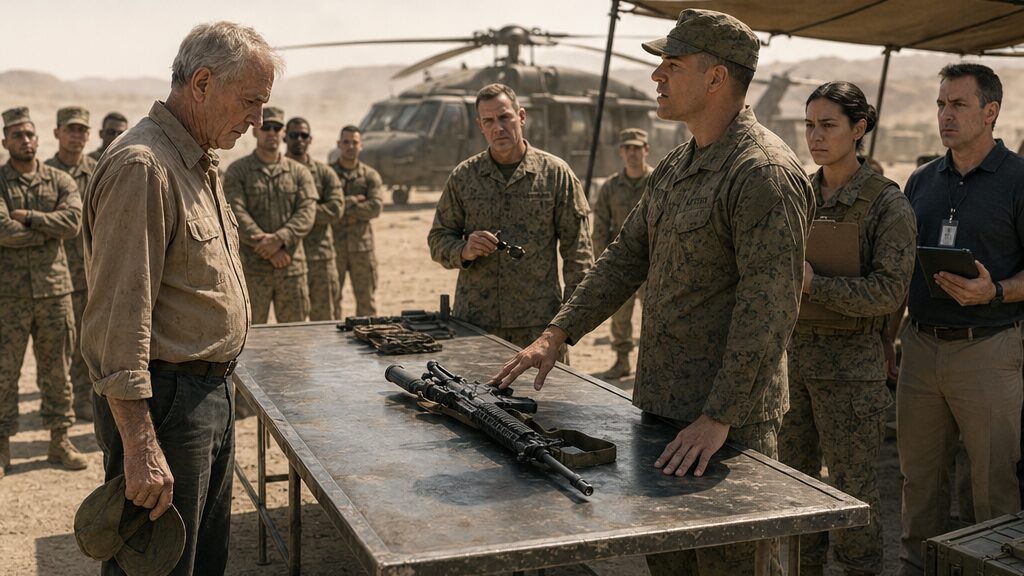
They Laughed When the Old Veteran Touched the Rifle, Until His Quiet Warning Saved the Range
Chapter 1: The Warning Everyone Heard and Nobody Respected
Brian Perez
Cannot use ‘in’ operator to search for ‘type’ in laughed when Donald Carter said, “That one didn’t answer back.”
The laugh carried farther than
Thử lại
They Laughed When the Old Veteran Touched the Rifle, Until His Quiet Warning Saved the Range
Chapter 1: The Warning Everyone Heard and Nobody Respected
Brian Perez laughed before Donald Carter had finished the sentence.
“That one didn’t answer back,” Donald said, his voice low enough that only the first row of soldiers should have heard it.
But Brian made sure everyone did.
“It didn’t answer back,” he repeated, turning toward the young recruits gathered beside the metal weapons table. “You hear that? We’re checking rifles now by whether they talk to us.”
A few soldiers looked down. One gave a short nervous laugh and stopped when Donald’s eyes moved toward him.
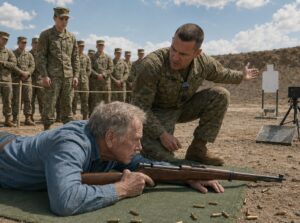
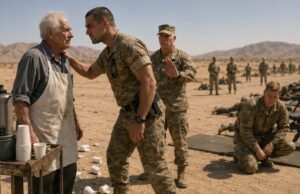
Donald did not smile. He stood in a plain tan work shirt, sleeves buttoned at the wrists despite the heat, his gray hair flattened by the brim of an old cap he had taken off when he stepped onto the range. Dust clung to the cuffs of his trousers. Nothing about him looked official. Nothing about him looked important enough to slow a certification morning on a military base.
The rifle lay on the metal table between them, dark against sun-glare, its surface cleared and tagged with a strip of tape. Behind the group, a helicopter sat still on the hard-packed dirt, its blades tied down, its shadow thin and broken across the ground.
Donald kept his fingers curled lightly at his sides.
Brian tapped the table with two knuckles. “Mr. Carter, this lane has already been inspected.”
Donald watched the rifle, not Brian. “I heard one click.”
“That is generally what metal does.” Brian’s tone stayed bright, easy, performative. “It clicks.”
The recruits shifted. A female logistics specialist stood three steps behind Brian with a clipboard tucked against her vest. Her name tape read Green. Lisa Green. Donald had noticed her earlier because she wrote carefully, pressing each mark into the paper as if neatness could make a morning safer.
She had her pen raised now, paused over a box.
Donald looked at her hand, then back at the rifle.
“There should have been another confirmation,” he said.
Brian’s jaw tightened, but his smile stayed in place. “Confirmation?”
Donald nodded once.
Brian leaned closer, lowering his voice just enough to pretend respect while keeping every word audible. “Sir, with all due respect, modern range procedure does not depend on old habits from whoever taught you back in the day.”
The words landed harder than the laughter.
Donald felt the old, familiar thing in his chest: not anger, not exactly. A tightening. The body’s wish to step back before a room decided what it had already decided. He had spent too many years learning when not to speak. The Army had taught him that silence could be discipline. Age had taught him that people often mistook it for surrender.
He did not correct Brian’s tone. He did not say how many rifles he had checked in forty years, or how many young soldiers he had trained to slow their breathing before touching one. He did not say that sound was not superstition when a man knew what he was listening for.
Instead, he glanced at the rifle again.
“Set it aside,” Donald said. “Check it again away from the line.”
Brian’s smile vanished. “We are not setting aside certified equipment because a civilian observer doesn’t like the sound it made.”
A few heads turned at the words civilian observer.
Donald saw the label settle over him. It was convenient. It fit his wrinkled shirt and scuffed boots. It fit the way he stood outside the formation, outside the day’s chain of command, outside the clean rhythm of checklists and shouted instructions.
Lisa’s pen touched the clipboard.
She looked at Donald first.
It was only a half second, maybe less, but he saw it: uncertainty. Her pen hovered above the box for the rifle on the table. Brian had already moved on, gesturing toward the next recruit to step forward. Jonathan Williams, the range officer, stood near the open shade of a canvas canopy, looking between a schedule sheet and the gathering delay.
Donald met Lisa’s eyes. He did not shake his head. He did not ask her to disobey. He only looked at the rifle.
Lisa marked the box.
Cleared.
The small scratch of her pen felt louder to Donald than Brian’s laugh.
Jonathan came over with his sunglasses in one hand and a folded schedule in the other. He had the composed face of a man who had learned to make pressure look like organization.
“What’s the delay?” he asked.
Brian straightened. “No delay, sir. Mr. Carter had a concern. We handled it.”
Donald looked at Jonathan. “It should be rechecked.”
Jonathan did not dismiss him outright. That was something. His eyes moved to the rifle, then to the row of recruits, then to the helicopter beyond them, then back to his schedule.
“Specific concern?” Jonathan asked.
Donald could have said more. He could have asked for a quiet space, a table away from the staring recruits. He could have asked Lisa to read back the entry. He could have put his hand on the rifle and shown them.
But Brian was watching him with that tight public smile, and the recruits were watching Brian, and Donald heard a voice from years ago in a different range house: Don’t make a scene unless you’re ready to own the whole scene.
He had not owned it then.
The memory rose and vanished before it formed fully.
“One confirmation missing,” Donald said.
Brian exhaled through his nose. “Sir, we are not failing an inspection over poetry.”
Jonathan’s mouth tightened. “Perez, keep the line moving. Carter, stay close if you see something repeatable.”
Repeatable.
The word stayed with Donald.
Brian turned away immediately. “Next rifle.”
The next recruit stepped forward. Lisa flipped the page on her clipboard. Dust moved in a thin sheet over the toe of Donald’s boot.
He stayed where he was, slightly behind the table now, no longer part of the exchange. Brian gave instructions with clipped confidence. A rifle was placed down, cleared, checked, tagged. One click. Then movement, voices, the rhythm of a morning trying to recover from interruption.
Donald’s head tilted.
There it was again.
Not the same rifle. Not the same pair of hands. But the same absence, the same empty space after the first sound where the second should have lived. Not always loud. Never theatrical. Just a small mechanical answer that, to him, meant the difference between assumed and known.
His fingers twitched once at his side.
He could hear his late mentor’s voice from decades earlier, dry as gravel: Don’t trust a thing because it looks done. Let it tell you.
Brian caught the movement. “Something else, Mr. Carter?”
Donald looked at the second rifle on the table.
“Same thing,” he said.
This time no one laughed quickly. The recruits were unsure whether they were allowed.
Brian was not.
He turned toward them with both hands lifted slightly, as if presenting a lesson. “This is why we moved beyond folklore. We have procedures, we have maintenance logs, and we have qualified personnel.”
The word qualified did the work he wanted it to do.
Donald felt heat climb up the back of his neck. His hearing was not what it had been. His right hand shook some mornings before coffee. He had walked slower from the parking area than he wanted anyone to notice. All of that was true.
None of it changed the sound.
Lisa marked another box.
Cleared.
Donald watched her page as she lowered the clipboard. Two entries sat near the top with the same small shorthand mark beside them, a slanted check with a short tail. Not the ordinary checkmark she used on the line above. A different mark. Quick, efficient, repeated.
A third rifle came down.
Brian spoke louder now, using the rhythm of instruction to cover irritation. “Inspection is not a debate. It is a sequence. You follow the sequence, you document the sequence, you move on.”
Donald listened.
One click.
A pause that should not have been empty.
Lisa’s pen moved.
The same slanted mark appeared again.
Donald said nothing this time. The humiliation had thinned into something colder and more useful. Concern settled in its place.
The first rifle might have been bad handling. The second might have been chance.
But three rifles with the same missing answer and the same mark on Lisa Green’s clipboard were no longer a joke.
Donald leaned just enough to see the page before Lisa tucked it against her vest.
Three rifles.
Same batch.
Same mark.
Same silence after the click.
Chapter 2: The Rifle Rose Above the Table
Brian slid the rifle across the metal table so hard the sling hook snapped against the edge.
“Show us,” he said.
The recruits went still. Lisa Green’s pen stopped halfway to the clipboard. Even Jonathan Williams, halfway back to the shade canopy, turned when he heard Brian’s voice sharpen.
Donald looked at the rifle where it had stopped in front of him.
It was the first one. The one he had told them to set aside. Brian had brought it back like a dare.
“Go ahead,” Brian said. “You keep hearing something nobody else hears. Show us what the rifle forgot to tell you.”
Donald did not reach for it right away.
His right hand had started shaking again. Not badly. Just enough that if he lifted it now, Brian would see. The recruits would see. They would not see age and nerves and old scar tissue. They would see proof that the civilian observer had no business standing beside their table.
Donald folded that hand lightly against his left palm and waited.
Brian’s eyes flicked down to the tremor. A small satisfaction crossed his face before he hid it.
“You don’t have to,” Brian said, but the softness was worse than the challenge. “We can keep moving.”
Donald stepped closer to the table.
The metal was hot enough that he could feel heat against his knuckles before touching it. He took the rifle with both hands, carefully, respectfully, as if the object deserved more honesty than the people around it had given. His fingers trembled once along the stock.
Then they settled.
The range seemed to narrow around that stillness.
Donald did not perform. He did not spin the rifle or snap parts open with dramatic speed. He held it upright, muzzle safe, body balanced, elbows close in the old economy of movement that training had cut into him so long ago it no longer felt like memory.
A recruit in the front row stopped chewing gum.
Brian’s expression changed first at the hands. Not much. A slight tightening near the eyes. A recognition of practiced handling before pride came in to smother it.
Donald worked slowly enough that no one could accuse him of tricking the room. He paused at each point, letting the rifle give the sounds it was willing to give.
Click.
He waited.
Nothing.
Donald did not look up.
He repeated the check, adjusted his grip, and listened again.
Click.
Still no second answer.
“There,” Donald said.
Brian gave a short laugh, but it had no audience now. “There what?”
Donald lowered the rifle slightly, then shifted to the second rifle on the table. “May I?”
Brian’s hand moved as if to stop him. Jonathan’s voice cut in from behind.
“Let him.”
Donald took the second rifle. Same careful lift. Same pause. Same first sound. Same missing reply. He set it down beside the first, parallel, not touching.
“Two different rifles,” Donald said. “Same silence.”
Brian stepped closer. “That is not an inspection category.”
“No,” Donald said. “It’s what tells you which category to look in.”
That drew the first real reaction from the soldiers. A few exchanged glances, not mocking now. Measuring. Lisa’s eyes moved from Donald’s hands to the marks on her own clipboard.
Brian felt the shift and pushed against it.
“Mr. Carter, unless you are assigned as an armorer on this range, you are advising outside your lane.”
Donald looked at him then. His face remained calm, but his eyes had lost the softness that made younger men comfortable.
“I know.”
The answer was so plain that Brian blinked.
Donald set the second rifle down. He did not add credentials. He did not rescue his pride. That silence seemed to irritate Brian more than an argument would have.
A man in a contractor polo stepped out from near the supply truck, wiping dust from a tablet screen. Steven Campbell had been close enough to hear, far enough to avoid being part of the first exchange.
“Everything on that table passed maintenance verification,” Steven said. “If there’s a sound difference, it’s cosmetic or break-in variance. We see it all the time.”
Donald turned slightly. “You checked this batch yourself?”
Steven lifted his tablet. “My team verified the batch. Tagged, logged, cleared.”
“Physical check on each?”
Steven’s polite smile hardened. “Verification means verification.”
It was not an answer. Donald noticed Lisa notice that too.
Brian seized on Steven’s confidence. “There you go. Contractor cleared. Range cleared. We’re not building a mystery out of a noise.”
Donald looked back at the first rifle.
A noise.
He had known men who called smoke a little haze and a loose step just old wood and a nervous private just jumpy. Small words made danger easier to carry until it got heavy enough to crush someone.
Jonathan came to the table. “Carter, tell me what you recommend.”
The use of his name without Mister changed the air slightly. Brian heard it and stiffened.
Donald kept his answer narrow. “Pull these two. Check the batch away from recruits. Compare the entries. Don’t run them on a live lane until you know why they sound the same.”
Steven shook his head. “That would delay the entire afternoon demonstration.”
“Then delay it.”
Brian’s face flushed. “You don’t get to walk onto my range and shut down training because you like the way one sound used to be.”
Donald’s jaw tightened once. The old instinct moved through him: step back, let command decide, let the uniformed man own his lane. He had lived long enough to know that pride sometimes needed a door, not a wall.
But his eyes dropped to Lisa’s clipboard again.
The slanted mark was there.
He pointed, not at Brian, but at the page.
“What does that mark mean?”
Lisa looked down as if she had forgotten she was holding it. “Batch note.”
“Read it.”
Brian snapped, “Specialist.”
Lisa’s mouth closed.
Jonathan noticed.
“Read it,” he said.
Lisa swallowed. “Same maintenance group. Same intake time. Same quick-clear notation.”
Steven stepped forward. “Quick-clear means the intake inspection matched prior documentation. It does not mean skipped.”
“No one said skipped,” Donald said.
Steven looked at him sharply.
Donald let the words hang.
The recruits were silent now. Even the helicopter crew beyond the table seemed to have slowed their work. The rifle stood between Donald and Brian like a question neither of them could put away.
Brian reached for it. “Fine. We’ll pull this one.”
“These two,” Donald said.
Brian’s hand paused.
“And the others with that mark.”
Steven laughed under his breath. “That’s half the afternoon line.”
Donald said nothing.
Jonathan looked from Donald to Lisa. “How many?”
Lisa turned the page. “I’d need to count.”
Brian took the first rifle and laid it aside with more force than needed. “This one gets pulled. The second one gets a spot check after lunch. The rest stay in rotation unless command says otherwise.”
Donald looked at Jonathan.
Jonathan’s face revealed nothing. The schedule in his hand bent slightly under his grip.
“Pull the first,” Jonathan said. “Continue current lane. I’ll review the batch note during break.”
Brian nodded as if the decision had vindicated him.
Steven looked relieved.
Donald did not move for a moment. He had shown enough to change the room, but not enough to change the day. That was the dangerous middle ground. People had become uneasy, not convinced. Uneasy people often reached harder for the paperwork that let them continue.
Brian turned back to the recruits. “All right. Lesson over. We do not dramatize equipment. We document, we verify, we move.”
The rhythm resumed, but it no longer sounded clean.
Donald watched the first rifle carried to the side table. The second stayed where it was. The rest of the batch waited in neat order under their tags, all looking equally harmless in the sun.
Lisa lowered her clipboard to her side as Brian called the next recruit forward.
Donald saw her thumb slide under the page, holding her place where the batch marks continued.
She had counted something.
She had not said it yet.
Brian lifted his voice. “Next rifle.”
The line moved on.
Chapter 3: The Clipboard Said Cleared
Lisa found Donald’s name on the visitor sheet under a category that made her stomach sink.
Civilian observer.
No rank. No specialty. No note explaining why Jonathan Williams had asked the old man to stand beside a weapons table on certification morning. Just Donald Carter, printed in blue ink, clipped to the corner of a folder that otherwise treated him like a delivery driver or a base tour guest.
She glanced through the open flap of the supply tent.
Donald stood outside in the strip of shade cast by a stack of crates, his cap held in both hands. Brian was back at the table, louder than before, as if volume could erase the pause Donald had created. Steven Campbell had disappeared toward the contractor truck with his tablet pressed to one ear.
Lisa looked down again.
Civilian observer.
But Donald Carter had not touched that rifle like a visitor.
“Specialist Green.”
She snapped the folder shut. Jonathan Williams stood at the tent entrance, one hand on the canvas pole.
“Yes, sir.”
“Bring the morning sheets.”
Lisa gathered the clipboard and followed him into the small range office, a portable structure with a humming air unit that barely fought the heat. Donald was already inside when she entered. He stood near the wall instead of taking a chair.
Brian was not there.
That absence made the room feel less public and more dangerous.
Jonathan set his schedule on the desk. “We have twenty-eight minutes before the lunch break ends. I want facts, not guesses.”
Donald nodded.
Lisa placed the clipboard on the desk and opened to the morning equipment page. “The pulled rifle is logged here. The second one Mr. Carter questioned is here.”
Jonathan glanced at the page. “Both cleared.”
“Yes, sir.”
Donald leaned over, but not too far. He seemed careful not to crowd her. “May I see the previous line?”
Lisa turned the page back.
His finger hovered above the paper without touching it. “That mark.”
“The quick-clear notation?”
“Yes.”
“It means maintenance intake matched the prior documentation.”
“Who wrote it?”
Lisa hesitated. “I copied it from the contractor intake sheet.”
Jonathan looked at her. “Copied or verified?”
Her face warmed. “Copied, sir. The physical verification was already marked complete before it came to my station.”
Donald’s eyes stayed on the page. He did not pounce on the answer. That made it worse somehow. If Brian had been there, he would have filled the room with defense. Donald let the truth sit bare.
Jonathan rubbed the bridge of his nose. “Carter, before this gets bigger than it is, I need to know exactly why I brought you here.”
Lisa looked up.
Donald did not.
Jonathan continued, voice lower. “Two unexplained stoppages in the last month. No injuries. No formal equipment failure. Just enough irregularity that I wanted old eyes on the process.”
Old eyes.
Lisa waited for Donald to react to the phrase. He did not.
“Mr. Carter was an armorer?” she asked before she could stop herself.
Donald turned toward her. “A long time ago.”
Jonathan answered more fully. “Retired Army. Range safety. Weapons maintenance. Training oversight. He knows what a rushed line sounds like.”
Lisa looked at the visitor sheet in the folder. Civilian observer now seemed less like a title and more like a hiding place.
“Why didn’t it say that?” she asked.
Jonathan’s face tightened. “Because I didn’t want the unit performing for him. I wanted him watching the ordinary process.”
Donald gave a faint nod, as if that had been acceptable.
Lisa was not sure it had been. If Brian had known who Donald was, he might not have laughed. Or maybe he would have laughed differently, which was not the same as listening.
Donald pointed again, still not touching the clipboard. “How many rifles share that notation?”
Lisa turned through the pages. “Morning lane had three.”
“We saw three.”
She nodded. “Afternoon lane has…” She stopped counting aloud.
Jonathan leaned forward. “How many?”
Lisa felt her throat tighten. “More than three.”
Donald looked at her.
She went back to the top of the afternoon sheet, careful now, no longer trusting the neatness of her own marks. There was the slanted check with the small tail. Again. Again. Again. Beside serial entries assigned to the afternoon demonstration lane.
The air unit rattled.
Jonathan’s radio clicked once on his belt, then went silent.
Lisa said, “This notation appears on all rifles assigned to Lane Two after lunch.”
Jonathan took the clipboard.
Donald turned his face toward the narrow window. Through it, the range looked orderly. Soldiers in formation. Tables aligned. Tags secured. Brian walking along the line with the restless energy of a man trying to get time back.
“Lane Two is the demonstration lane,” Jonathan said.
Lisa nodded. “Yes, sir.”
Donald’s hands closed around the brim of his cap.
Jonathan set the clipboard down carefully. “This does not prove a fault.”
“No,” Donald said.
“It proves a notation pattern.”
“Yes.”
Jonathan looked annoyed that Donald would not make the conclusion easier. “And your recommendation?”
“Pull the Lane Two batch until someone knows what that mark actually means.”
Lisa watched Jonathan’s eyes move to the schedule. Certification observers were due after lunch. The demonstration window was fixed. The helicopter crew had a flight block tied to the same timetable. Pulling a lane would not be a small inconvenience. It would ripple outward into reports, calls, explanations.
Jonathan looked back at Donald. “If I pull half the lane on a sound and a notation, I need more than instinct.”
Donald’s face changed then, not with anger, but with something older and more tired. “Instinct is what people call experience when they don’t like where it points.”
Lisa lowered her eyes to the clipboard.
Jonathan did not answer immediately.
Outside, Brian’s voice carried through the wall. “Reset the table. Lunch break does not mean we lose discipline.”
Jonathan picked up the schedule. “I will speak with Perez and Campbell. Until then, Carter, do not undermine Brian in front of recruits.”
Donald’s mouth tightened. It was the first visible sign that the words had struck.
“I didn’t come here to undermine him.”
“I know. But if those recruits lose confidence in their range NCO, that creates its own safety problem.”
Donald looked toward the window again. Brian was standing at the table, one hand on the rifle line, recruits watching him as if certainty could be borrowed.
“Confidence built on not checking,” Donald said, “isn’t confidence.”
Jonathan opened the door. “And panic built on partial information isn’t safety. Stay close. Say nothing publicly unless I ask.”
Donald accepted it with a small nod.
Lisa wanted to speak before the moment passed, but training held her quiet until Jonathan stepped out. Then she looked at the page again.
There was one more detail she had missed.
The quick-clear notation on the afternoon lane was not only repeated. It was written in the same pressure pattern each time, heavy at the start, lighter at the tail, as if copied fast by one hand from a stack instead of marked during separate checks.
Donald noticed her staring.
“What is it?” he asked.
Lisa turned the clipboard toward him.
“The same mark appears on every rifle assigned to the afternoon lane,” she said. “Not just the same notation. The same hand.”
Chapter 4: A Clean Report Can Hide a Dirty Fear
Brian heard one of the recruits whisper, “Maybe it didn’t answer back,” and the other one laughed into his sleeve.
He stopped walking.
The two recruits straightened so fast their boots scraped dust. One stared over Brian’s shoulder at the helicopter pad. The other looked down at the rifle rack as if he had discovered something deeply interesting about the serial tags.
Brian said nothing at first. Silence could be useful when it came from the right person.
The problem was that Donald Carter’s silence had already done more damage than a lecture.
All morning, Brian had felt the range shifting under his feet. Not physically. The tables were still aligned, the weapons were still tagged, the recruits still moved when ordered. But their attention had changed. They glanced toward the old man in the tan shirt before they looked at Brian. They watched Lisa Green’s clipboard as though a piece of paper might suddenly confess something. They listened between sounds now, waiting for an absence Brian had publicly called nonsense.
That was what angered him most.
Not Donald’s warning.
The waiting.
Brian stepped closer to the recruits. “If you have a question about safety procedure, you ask it loud enough to be useful.”
The recruit who had whispered swallowed. “No question, Sergeant.”
“Good. Then don’t turn the range into a rumor mill.”
“Yes, Sergeant.”
Brian walked away before the heat in his face showed. His boots carried him toward the side of the range office, where the shade from the helicopter pad fencing made a narrow strip across the dirt. He stopped there and looked back at the weapons table.
Donald stood beside the supply tent with his cap in his hands. He was not speaking to anyone. That made him look harmless from a distance, almost gentle. An old man waiting to be told where to stand.
Brian knew better now.
The way Donald had lifted the rifle still bothered him. Not because it had been dramatic. Because it had not been. The old man’s hands had trembled, then steadied, and the weapon had risen with a care that made Brian’s own movements feel loud in memory.
Brian hated that feeling.
He had spent the last eight months earning the table he stood behind. He had inherited sloppy habits, late paperwork, recruits who thought safety was a set of shouted words instead of a discipline. He had stayed after hours to realign logs no one thanked him for correcting. He had taken every reminder from Jonathan Williams without flinching because flinching looked like guilt.
Today was supposed to prove the lane could run under him.
Instead, every recruit was whispering about a second click.
The range office door opened. Jonathan stepped out with Lisa behind him and Donald slower after her. Lisa held the clipboard against her chest, not at her side. Brian noticed that first. When a soldier held paperwork close, it usually meant the paper had become heavier.
Jonathan looked at him. “Perez. Shade. Now.”
Brian crossed over, keeping his pace even.
Steven Campbell arrived from the contractor truck at the same time, tablet in hand, badge swinging from his belt. “I pulled the return packet,” Steven said. “Everything matches.”
“Let’s see it,” Jonathan said.
They gathered under the shade beside the helicopter pad, where the tied-down blades threw broken shadows over the ground. The helicopter crew moved around them, checking straps and covers. The machine sat silent but present, a reminder that the afternoon demonstration had more than one schedule attached to it.
Steven opened the packet on his tablet and turned it toward Jonathan. “Batch return. Intake verified. Documentation matched. No defect flags. No functional holds. All within return criteria.”
Brian felt relief move through him so sharply it almost showed.
He looked at Donald. “There.”
Donald did not take the bait. He watched Steven’s finger scroll through the tablet.
Jonathan asked, “Does that report confirm a physical check on each rifle?”
Steven’s thumb stopped.
“It confirms the batch return process,” he said.
“That wasn’t my question.”
Brian’s relief thinned.
Steven shifted his weight. “The batch came from a maintenance cycle that had already been cleared at the prior level. Return intake verifies condition, tags, and documentation. If there had been a visible issue, it would have been flagged.”
Donald spoke quietly. “Visible isn’t always early.”
Brian looked at him. “And invisible isn’t always real.”
Donald’s eyes moved to Brian. Not accusing. That almost made it worse.
Jonathan held up one hand before either of them continued. “We need a decision before thirteen hundred. Steven, can you certify that Lane Two’s batch was physically checked rifle by rifle after return?”
Steven’s mouth tightened. “I can certify that it was processed according to the current return procedure.”
“That is not the same sentence,” Lisa said.
Everyone looked at her.
She seemed to regret saying it, but she did not take it back. Her fingers pressed into the clipboard edge until her knuckles paled.
Brian felt a fresh sting, not just from her words but from whom she had said them near. Donald. Jonathan. The contractor. Helicopter crew close enough to hear if they wanted.
He turned to her. “Specialist, you are not the maintenance authority.”
“No, Sergeant.”
“Then don’t imply one failed.”
Her face closed, but something in her eyes stayed open.
Donald’s voice came from beside the fence. “She didn’t imply failure. She heard two different answers.”
Brian stepped toward him. “You keep doing that.”
“Doing what?”
“Turning uncertainty into proof.”
Donald looked past him toward the table. “No. I’m trying to keep uncertainty from becoming permission.”
The words landed in a place Brian did not want touched.
Jonathan folded his arms. “Perez, what’s your read?”
Brian forced himself to breathe once before answering. “We pulled the rifle Mr. Carter demonstrated on. We can spot-check another before the demonstration. If it repeats, we pull more. If not, we continue. That keeps the schedule and addresses the concern.”
“It addresses the appearance of the concern,” Donald said.
Brian rounded on him. “You don’t lose authority when you check twice, right? That was your line?”
Donald looked at him steadily. “Yes.”
“You also lose authority when you teach recruits that their NCO doesn’t know his own table.”
For the first time, Donald’s face changed. Not much. A flicker of pain, maybe. Or recognition.
Brian regretted saying it and resented him for making him regret it.
Donald stepped closer, lowering his voice so the recruits could not hear. “I’m not trying to take your table.”
“It looked like it.”
“That’s because you made it a stage.”
Brian looked away.
The helicopter crew had begun preparing for the afternoon cycle. One of them untied a blade strap and carried it folded over his shoulder. Time was moving whether they were ready or not.
Jonathan took the clipboard from Lisa and compared it to Steven’s tablet. “Same notation across Lane Two.”
“Copied from the return sheet,” Lisa said.
Steven’s face tightened again. “That notation only means they were cleared under the same intake group. There’s no defect hidden in two letters and a slash.”
“Then we should be able to verify that quickly,” Donald said.
Steven gave a short laugh. “Quickly? You want to stop a scheduled certification lane, pull half a batch, and run hand checks because a retiree doesn’t like my notation?”
“Your notation?” Lisa asked.
Steven looked at her.
Brian saw it then. A small thing. Too small to be guilt, maybe. Irritation. Surprise. The look of a man who had not meant to own the mark aloud.
Jonathan heard it too. “You made the notation?”
Steven recovered. “My team uses shorthand during intake. It’s normal.”
“Is it in the return guide?”
Steven did not answer immediately. “It’s an internal efficiency mark.”
Brian wanted to grab that phrase and make it enough. Internal efficiency mark. Not failure. Not danger. Just process.
But Donald’s warning sat under it like a stone.
Jonathan handed Lisa back the clipboard. “Here’s what we’ll do. The pulled rifle stays out. Perez will spot-check one additional rifle from Lane Two before the demonstration. Steven, you’ll provide the full return sheet. If the second rifle gives us the same concern, we pause and reevaluate.”
Donald’s jaw tightened.
Brian felt both saved and exposed.
“Sir,” Donald said, “if the mark runs across the lane, one spot check only tells you whether you got lucky.”
Jonathan’s tone hardened. “And pulling the whole lane without confirmed defect tells command I shut down certification on speculation.”
Donald held his gaze for a long moment, then nodded once.
Brian expected satisfaction. Instead, he felt a tightness behind his ribs.
Jonathan looked at Brian. “You will make the spot check clean and slow. No audience.”
“Yes, sir.”
Donald turned to Brian before the others moved. “You don’t have to prove me wrong.”
Brian almost snapped back.
But the old man’s voice held no insult. That was the worst of it. It offered him a door.
Brian looked toward the recruits, toward the table, toward the line that was supposed to prove he could run a safe, efficient range under observation. He thought of the evaluation notes Jonathan would write. He thought of the promotion board that had already asked whether he was too new for this slot. He thought of his soldiers repeating, didn’t answer back, like a joke they would never forget.
He shut the door.
“I have to prove the lane works,” Brian said.
Donald’s eyes lowered for half a second. “Those aren’t always the same thing.”
The lunch horn sounded from the far side of the range.
Jonathan checked his watch, already moving back into command rhythm. “Afternoon demonstration remains scheduled. Lane Two begins setup at twelve forty-five.”
Brian nodded.
Lisa looked at Donald, then down at the clipboard, where the same quick-clear mark ran beside rifle after rifle in a line too neat to ignore.
Donald said nothing.
Brian told himself that meant the old man had no more proof.
Chapter 5: The Old Habit Came from an Old Failure
“It’s cleared, right?” the young recruit asked.
Donald froze with his hand halfway toward the rifle rack.
The recruit was barely past twenty, cheeks still soft beneath the dust, helmet strap loose until Lisa reached over and corrected it without looking up from her clipboard. He had asked the question casually, maybe because Donald was closest, maybe because old men looked safe to ask. The rifle in the rack had a tag hanging from it and a slanted mark on the sheet.
Cleared.
Donald’s mouth opened.
For a second, he was not in the maintenance bay.
He was in a range house years earlier with rain hammering the roof and a young soldier grinning because everyone else was grinning. A superior in a hurry. A table too crowded. A sound that had not finished. Donald younger, stronger, sharper, angry enough to know he was right and tired enough to let rank decide.
It’s cleared, right?
He had heard that then too.
The memory did not come as a full picture. It never did. Just pieces. A wet sleeve. A metal table. A shout cut short. The smell of antiseptic afterward. His own hand gripping a report he had signed because the formal cause had been easier to name than the human one: rushed procedure, incomplete confirmation, failure to halt.
Failure to halt.
“Sir?” the recruit said.
Donald looked at him.
The young man’s smile faded. “I just meant—”
“Don’t take cleared as a feeling,” Donald said.
The recruit straightened, unsure whether he had been corrected. “Yes, sir.”
Donald’s hand dropped from the rack.
Lisa watched him from the folding table where she had spread the afternoon sheets. The quiet maintenance bay sat behind the supply tent, half shade, half harsh light. The pulled rifle lay on a separate bench under a paper tag. The fan in the corner clicked with each turn, making a poor imitation of the sound Donald had been listening for all morning.
“Take your break,” Lisa told the recruit.
He left quickly, relieved.
Donald turned toward the pulled rifle but did not touch it.
His right hand was shaking worse now. Not the small morning tremor he could hide by changing grip. This one traveled into the wrist. He closed his hand and pressed it lightly against his thigh.
Lisa noticed anyway.
“You should sit,” she said.
“I’m standing fine.”
“That wasn’t what I said.”
He looked at her then, and something in her expression stopped the sharp answer before he gave it. She was not pitying him. She was measuring whether the range had placed too much weight on a man who had not asked to carry it.
He sat on the edge of a crate.
Lisa came over with the clipboard. “Why didn’t you tell them who you were?”
Donald let out a breath through his nose. “People hear a title and stop hearing the thing.”
“Sometimes they hear nothing without one.”
“That too.”
“So why hide it?”
He looked toward the open bay door, where Brian’s voice rose outside over the lunch movement. “Because I didn’t come here to be right in front of them.”
Lisa waited.
Donald rubbed his thumb over the side of his cap. The fabric had worn smooth where his hand had worried it over the years.
“I trained soldiers for a long time,” he said. “Some listened because they trusted me. Some listened because they were afraid not to. The second kind makes a man lazy if he lets it.”
“You don’t seem lazy.”
“No. I was proud.”
The admission surprised her. He could see it.
He looked at the pulled rifle. “There was a day I caught something late. Not too late to speak. Late enough to need force behind it. I thought I had said enough. I had not.”
Lisa’s face softened, but she did not interrupt.
Donald’s voice stayed level because he had spent years keeping it level. “A superior wanted the line moving. I wanted him to know I saw the problem. That was pride too. I gave him room to overrule me because I did not want to make the room choose. A young soldier paid for that room.”
The fan clicked.
Once.
Again.
Not the right sound. A cheap, empty little noise.
Lisa lowered herself onto the crate opposite him. “Was he killed?”
Donald shook his head. “No.”
Relief moved across her face before she could hide it.
Donald understood. People wanted guilt to have clean categories. Killed. Not killed. Ruined. Not ruined. But harm lived in the spaces between those words. A hand that never worked the same. A career ended. A family learning new routines because a range had wanted twelve more minutes of schedule.
“He lost enough,” Donald said.
Lisa looked down at the afternoon sheets. “And you think this is the same?”
“No.” Donald’s eyes stayed on the rifle. “That’s what scares me. Nothing is ever the same. So a man tells himself he might be seeing ghosts.”
“Are you?”
“I don’t know yet.”
The answer seemed to trouble her more than certainty would have. Good, Donald thought. Certainty had already done too much today.
Outside, a vehicle door slammed. Steven Campbell’s voice rose near the supply truck, clipped and annoyed. Jonathan answered him in a lower tone. Brian said something Donald could not catch.
Lisa stood and brought the afternoon list closer. “The mark is beside every Lane Two rifle. I checked the handwriting against the contractor return sheet. Same pressure, same slant. But the return sheet doesn’t list individual physical checks. It just carries the batch status forward.”
Donald took the page.
His thumb shook against the margin.
Lisa pretended not to see this time.
“You should tell Jonathan that,” he said.
“I did.”
“And?”
“He said it strengthens the reason for the spot check.”
Donald’s mouth tightened. “One rifle.”
“One rifle before the demonstration.”
Donald closed his eyes briefly.
There it was again. The clean, narrow decision that let everyone say they had responded. Pull one. Check one. Keep the line. Protect the day. Protect Brian. Protect the report. Each choice reasonable enough alone, dangerous together.
Lisa sat back. “Sergeant Perez isn’t only being arrogant.”
Donald opened his eyes.
“I know,” he said.
“He’s been preparing for this for weeks. People already think he moved into the role too soon. If the lane stops today, it won’t just be about equipment. It’ll be about him.”
“That’s why he should stop it himself.”
“He may not know how.”
Donald looked at her sharply.
Lisa held his gaze. “Some people don’t know the difference between admitting uncertainty and losing authority until someone shows them.”
The words had the shape of a challenge, though she did not say them that way.
Donald looked at his right hand. It had settled some, but not enough. He flexed the fingers and felt the stiffness in the knuckles, the age he could not discipline away.
“Mr. Carter,” Lisa said, quieter, “if they dismiss you again because your hand shakes, what will you do?”
He did not answer.
Because he knew what he wanted to do. Step back. Let Jonathan own it. Let the Army remain the Army and Donald Carter remain a visitor with an old cap and a memory no one had asked for. He had built a life around not demanding space in rooms that had already moved on without him.
But the recruit’s question still hung in the bay.
It’s cleared, right?
Lisa placed another sheet in front of him. “I pulled the demonstration sequence.”
Donald looked down.
The list named the rifle assigned to Brian for the afternoon demonstration. A clean serial line. A check box. A lane assignment. And beside it, in the same rushed hand, the same slanted quick-clear mark.
Donald felt the old range house come back so sharply he had to grip the edge of the crate.
Lisa saw his face change.
“What is it?”
Donald touched the line with one shaking finger.
“That one,” he said. “That’s the rifle Brian is going to put in his own hands.”
Chapter 6: The Demonstration Started Before the Truth Was Ready
The helicopter started turning just as Brian lifted the demonstration rifle from the Lane Two rack.
At first the blades moved slowly, chopping sunlight into broad, lazy pieces across the range. Then the engine deepened, and the air around the demonstration lane filled with dust, vibration, and the kind of noise that made small sounds disappear.
Donald stood behind the safety line with Lisa on his left and the clipboard between them.
He watched Brian’s hands.
Not his face. Not the show he was giving the certification observers gathering under the shade canopy. Hands told the truth earlier than mouths did. Brian’s grip was controlled, but too tight. His shoulders were square, but his thumbs moved with a fraction of hesitation when he reached the same point in the check Donald had questioned all morning.
The rifle gave its first click.
The helicopter swallowed everything after it.
Donald leaned forward.
Lisa did too, instinctively, then caught herself.
Brian looked over once. His eyes found Donald’s, and for a brief moment the public mask slipped. There was anger there, yes, but something else beneath it. A question he would not let himself ask aloud.
Then he turned back to the observers.
“Lane Two equipment has completed table inspection,” Brian called. “Demonstration will proceed on command.”
Donald could not hear the second click.
He could not say whether it had happened and been buried under the rotor wash, or whether it had never come. His hearing had betrayed him before in crowded rooms, in restaurants, in parking lots when someone called his name from behind. Age took certain things and left a man deciding which losses mattered.
His eyes moved to the rifle.
He tried to read what sound could not give him. The slight position after movement. The way Brian’s left hand settled. The tiny adjustment that came too late. Not proof. Not enough for a courtroom, not enough for a clean report.
Enough for a range.
Lisa shifted beside him. “Same mark,” she said.
She held the clipboard low, angled so only Donald could see. Her finger rested beside Brian’s demonstration rifle.
Donald nodded.
“I know.”
“No,” she said. “Look.”
He looked closer.
Under the copied notation was another small mark, one Lisa had made herself. A dot in the margin beside every rifle she had personally watched Brian rush after the first confrontation. Small, discreet, unofficial.
Three dots.
Then two more.
Then the demonstration rifle.
Donald looked at her.
Lisa’s face had gone pale under the dust. “I marked the ones where I couldn’t verify the second sound. I didn’t want to make an accusation without—”
“Good,” Donald said.
The word stopped her.
She had expected correction. Maybe she deserved some. But the mark meant she had noticed. Late, quietly, imperfectly. Still noticed.
A radio crackled near Jonathan. He stood between the observers and the firing lane, jaw tight, hearing reports from three directions at once. Steven Campbell was at his shoulder, tablet open, repeating something about return criteria and documentation match. Brian waited at the front of the lane with the rifle held safely down, eyes forward.
Everything looked controlled.
That was what frightened Donald most.
A chaotic range announced itself. A controlled range made people trust the shape of it.
Jonathan crossed toward Donald, stopping just inside speaking distance. “Carter.”
Donald kept his eyes on Brian. “The demonstration rifle has the mark.”
“We know.”
“Lisa has additional observation marks.”
Jonathan glanced at the clipboard. “Unofficial marks are not grounds to stop a live demonstration.”
“Then make them official.”
Jonathan’s voice lowered. “Do you understand what happens if you interrupt this lane now? Certification observers are present. The helicopter window is active. I have a contractor disputing fault and an NCO whose authority is already compromised.”
Donald looked at him. “I understand all of that.”
“Do you understand you may be wrong?”
The question cut cleanly because it was fair.
Donald looked down at his right hand. It shook in the rotor wind and from something beneath it. Fear, age, memory. Maybe all three. He had been wrong before. Not often about weapons, but often enough about people. Wrong about how much time he had to speak. Wrong about how reasonable silence looked from the outside. Wrong about whether a superior would choose caution if given room.
He could be wrong about the rifle.
But he had been wrong once by staying almost quiet.
Brian lifted his voice again. “Awaiting command.”
Jonathan turned halfway. The observers watched. The recruits watched. Steven watched Donald with open frustration now, as if the old man had become a financial instrument pointed at his chest.
“Give me one more check,” Donald said.
Jonathan shook his head. “We already agreed to a spot check.”
“That rifle is the spot.”
“Brian checked it.”
“Brian is the one under pressure to hear what he needs to hear.”
Jonathan’s face hardened. “Careful.”
Donald accepted the warning. He had earned it.
At the lane, Brian began the final preparation sequence. His movements were correct from a distance. Correct enough for observers. Correct enough for a report. Donald saw the moment where a man who wanted certainty chose rhythm instead.
The helicopter grew louder.
Dust moved across the safety line, striking Donald’s trousers. His eyes watered. He blinked and the range blurred, then sharpened.
For one second, he was back in the old range house again. Rain instead of dust. A younger voice asking if cleared meant safe. A superior impatient. Donald’s own hand resting on a table, not raised high enough to stop anyone.
Not again, he thought.
The words did not feel heroic. They felt overdue.
He stepped forward.
Lisa said, “Mr. Carter.”
He crossed the safety line.
Jonathan’s voice cracked through the rotor noise. “Carter!”
Brian turned, anger flashing first, then alarm. The observers shifted. One recruit took a step back. Steven lifted both hands as if distance could protect him from responsibility.
Donald raised his left hand, palm open. Not dramatic. Not panicked. A range signal older than many of the people watching.
“Halt the lane,” he called.
The helicopter noise tore at his voice, but enough people heard. More important, they saw the hand. The open palm. The old man past the line where observers did not belong.
Brian froze with the rifle held downrange.
Jonathan strode toward him. “Step back behind the line.”
Donald did not move.
He felt every eye on him now. The same public space that had made him swallow his warning in the morning had returned, larger and harsher. His hand trembled in the air. He knew they could see it.
He kept it raised.
“Halt the lane,” Donald said again. “Formal safety halt.”
Chapter 7: The Halt Nobody Wanted Became the Lesson Nobody Forgot
Jonathan did not ask Donald to lower his hand.
He asked something worse.
“In front of this lane,” Jonathan said, voice hard enough to cut through the fading rotor wash, “are you willing to put your name on that halt?”
The question reached everyone. The recruits near the shade net. The certification observers under the canopy. Steven Campbell with his tablet clutched against his chest. Lisa Green standing behind the safety line with the clipboard pressed flat to her vest. Brian Perez still frozen at the lane with the rifle pointed safely downrange, his face tight with humiliation and fury.
Donald’s left hand remained raised.
His right hand shook at his side.
A formal safety halt was not a suggestion. It was not an old man’s concern, not a quiet note in the margin, not something command could pretend had been a misunderstanding. It entered records. It created explanations. It slowed people who had already built their day around not being slowed.
Donald looked at Brian first.
The younger man’s eyes were fixed on him. Not laughing now. Not even openly angry. Waiting.
Donald had seen that look in mirrors years ago. The look of a man trapped between what he had defended and what he had begun to fear.
“Yes,” Donald said.
Jonathan took one step closer. “Say it clearly.”
Donald lowered his raised hand, but he did not step back behind the safety line. “Formal safety halt. Lane Two. Demonstration rifle and associated batch to be held for secondary inspection before use.”
The range changed all at once.
A soldier near the table repeated the halt down the line. Another echoed it. The helicopter crew cut movement to a waiting idle. The observers under the canopy leaned toward one another, not speaking loudly enough to be heard. Steven’s face hardened into the expression of a man already drafting an objection.
Brian’s fingers tightened on the rifle.
Jonathan turned to him. “Perez. Table it.”
For a fraction of a second, Brian did not move.
Then training won. He brought the rifle back to the weapons table with controlled steps and laid it down as though the whole range were watching his hands, because they were.
Donald stepped back behind the line only after the rifle was on the table.
Jonathan held out his hand toward Lisa. “Halt form.”
Lisa moved quickly to the range office case near the canopy and pulled a thin packet from inside. Her pen was already clipped to the top. She brought it to Jonathan, but he did not take it.
He handed it to Donald.
The paper looked too light for what it had stopped.
Donald took the pen. His right hand would not cooperate. The tremor pushed the tip against the paper in small uneven taps, leaving dots before he formed the first letter. He could feel the recruits seeing it. The observers too. Brian, certainly.
He almost switched hands.
Then he did not.
Let them see.
He signed Donald Carter in a slow, rough line.
Lisa took the form from beneath his hand before the wind could lift it. Her eyes touched the signature, then his face. She said nothing, but her shoulders changed. It was not relief. Not yet. It was the look of someone who had seen a person choose the cost instead of only naming the risk.
Steven stepped forward. “This is excessive. There is no confirmed defect.”
Donald turned to him. “Then confirming that should be easy.”
Steven’s jaw moved. “You are implying my team skipped physical checks.”
“No,” Donald said. “I’m saying the process gave people a way to believe a check happened without hearing it happen.”
“That’s wordplay.”
Donald looked at the metal table. “So was quick-clear.”
The words hit Steven harder than accusation would have. He looked at Lisa’s clipboard, then away.
Jonathan placed the signed halt form beside the rifle, holding it down with a flat metal weight from the table. “Carter, demonstrate the concern. Not a lecture. Not a class. Show me enough to justify the halt.”
Donald nodded.
He approached the table slowly. Every step felt heavier now that he had forced the range to stop. When he had warned quietly, he had wanted belief without consequence. Now consequence had arrived, and belief still had to be earned.
Brian stood across from him, close enough that Donald could hear his breathing.
Donald looked at him. “You should do the first check.”
Brian’s eyes narrowed.
Jonathan said, “Perez.”
Brian picked up the rifle. He did it well. Donald gave him that silently. The young man’s muzzle awareness was clean. His hands knew procedure. He was not careless. That had never been the point.
Brian performed the check.
Click.
The helicopter had quieted enough that the sound reached the front row clearly.
Then there was nothing.
Brian’s face did not move.
Donald waited.
Somewhere behind them, a recruit shifted in the dirt and stopped. Lisa’s pen hovered over the clipboard.
“Again,” Donald said.
Brian’s jaw flexed. He repeated the sequence. His movement was slower now. Less performance. More listening.
Click.
A faint drag.
No second answer.
Brian’s throat worked.
Donald did not say I told you. He did not look at the observers. He did not let the silence turn into a public hanging.
“May I?” he asked.
Brian handed him the rifle.
The transfer was careful. That alone changed the room.
Donald held the rifle upright above the table, the same way he had earlier, but this time no one laughed. He repeated the check and stopped at the point where Brian had been moving past the feeling instead of through it.
“You can force a motion to look complete,” Donald said. “But you cannot force it to confirm without listening.”
He adjusted his grip, not dramatically, and repeated it.
Click.
A pause.
A second, softer click followed.
It was small, almost delicate, and because the range had gone quiet for it, everyone heard.
Brian’s eyes dropped to the rifle.
Donald set it down. “That second sound does not prove the rifle is safe by itself. It proves the first check did not finish telling you everything.”
Jonathan moved closer. “Can the condition repeat across the batch?”
“Yes,” Donald said. “If the same return step let the same incomplete confirmation pass.”
Steven said, “You cannot prove that from a sound.”
Donald looked at him. “No. That’s why we inspect the batch.”
Steven opened his mouth, but Jonathan cut him off.
“Lane Two batch is held. Full secondary inspection. Contractor return sheet attached to the halt. Green, document the observed pattern and your marks.”
Lisa answered, “Yes, sir,” and for the first time all day her pen moved without hesitation.
Brian stood very still.
Donald saw the damage in his face. Not the damage of being corrected. The damage of having corrected others loudly, then finding his own uncertainty written across the same table.
Donald knew that wound. Pride had a way of making men cruelest when they were most afraid.
He stepped closer to Brian and lowered his voice. “This is not all yours.”
Brian’s eyes flicked up.
Donald continued, quiet enough that only those near the table heard. “A rushed process reached your hands before you touched that rifle. But after it reached your hands, you had a choice.”
Brian looked away.
Jonathan heard enough to say, “Perez will account for his lane decisions.”
Donald turned toward Jonathan. “So will the process.”
Steven gave a humorless breath. “Convenient.”
Donald faced him. “Not convenient. Necessary.”
The old range house came back then, not as a flash but as weight. Rain on the roof. A young soldier flexing fingers that would never close quite the same again. Donald standing in a doorway with a report in his hand, furious at a superior and unable to admit the smaller shame beneath it: he had known enough to push harder and had chosen not to make the room uncomfortable.
He looked at the recruits.
“When I was younger,” Donald said, “I thought being right quietly was enough. It wasn’t. A range does not care who outranks who. It does not care who is embarrassed. It only remembers what people allowed.”
No one spoke.
He had not meant to say that much. The words left him feeling exposed, but not emptied. There was a difference.
Brian looked at the rifle again.
Jonathan lifted the signed halt form, checked Donald’s uneven signature, and placed it back beside the weapon. “Full hold remains.”
The observers under the canopy began making notes. Steven stepped aside to call someone from the contractor truck, voice low and controlled. Lisa separated the clipboard pages, marking the batch entries with clean official lines now, not hidden dots.
The range no longer moved around the problem.
It had stopped to face it.
Brian remained at the table after everyone else shifted into tasks. Donald saw his hands open and close once, as if releasing an argument he no longer had strength to carry.
At last Brian looked up.
His voice was low, rough, and stripped of command.
“Show me the check again.”
Chapter 8: Respect Was Quieter Than Applause
The weapons table was almost empty by evening.
Only one rifle remained on it, held for instruction, its tag curled at the edge from a long day of hands and heat. Beside it lay Donald’s signed halt form, weighted flat under the same metal block Jonathan had used when the range was still full of witnesses. The ink of Donald’s signature had dried in a shaky line.
Most of the recruits had been released to cleanup. The helicopter was quiet again, blades tied down, its shadow stretched long across the hard-packed ground. Dust had settled over the boot prints around Lane Two, softening the evidence of how many people had stood there pretending not to watch an old man decide whether to make himself impossible to ignore.
Donald stood at the table with his cap back on.
His hand ached.
That seemed right.
Across from him, Brian Perez performed the check for the third time since the halt. Not because anyone had ordered him to. Because he had asked.
Click.
He waited.
The second click came soft and clear.
Brian did not look up immediately. “Again?”
Donald nodded.
Brian repeated it. Slower. Better. Not timid. Careful.
Click.
Pause.
Second click.
The sound reached Donald without strain now. Not because it was louder, but because everyone around it had finally stopped trying to outrun it.
Lisa stood a few feet away with fresh forms clipped to her board. The unofficial dots had become official notes. The quick-clear notation had been circled, referenced, attached to the hold order. Jonathan had already radioed the senior safety inspector and locked the Lane Two batch pending full secondary review. Steven Campbell had objected twice, then gone quiet when the return sheet failed to show individual physical verification after the prior maintenance level.
No one had been dragged away. No one had shouted. No one had won cleanly.
That was closer to truth than most endings Donald had known.
Brian set the rifle down. “I heard it that time.”
Donald said, “Good.”
Brian’s mouth tightened. “I heard it before too.”
Donald looked at him.
Brian kept his eyes on the table. “Once. During the spot check. I thought maybe I was hearing it because you’d put it in my head. Then I thought maybe I hadn’t heard it because I didn’t want to.” He swallowed. “Then I decided both of those made me look weak.”
Donald rested his left hand on the edge of the table. The metal was cooling now.
“And did continuing make you look strong?”
Brian gave a short, humorless breath. “No.”
The answer stood between them without defense.
Lisa quietly gathered the completed sheets and walked toward the range office, leaving them enough privacy to matter but not enough distance to pretend the day had not happened.
Brian touched the corner of the halt form. “I apologize for what I said this morning.”
Donald watched his finger near the uneven signature.
Brian added, “Not because command will expect it. Not because Specialist Green is writing everything down. I apologize because I made them laugh before I checked.”
Donald let the words settle.
He had received apologies before from men who wanted forgiveness to erase the need for change. This one felt different. Not grander. Smaller. Specific.
“That part matters,” Donald said.
Brian nodded. “I know.”
“Do you?”
Brian lifted his eyes then, and for once there was no performance in them. “I’m starting to.”
Donald believed him enough not to punish him with doubt.
Jonathan came out of the range office with a folder in one hand. He looked tired, the kind of tired that came after a day survived but not escaped. He stopped beside Lisa, signed one more line, then walked to the table.
“Senior safety inspector will be here at oh-eight-hundred,” Jonathan said. “Lane Two batch stays locked. Contractor return process gets reviewed with command.”
Steven, near the truck, heard but did not turn around.
Jonathan looked at Brian. “You’ll submit a statement.”
“Yes, sir.”
“You’ll include your decision to continue after the first concern.”
Brian’s shoulders tightened, then steadied. “Yes, sir.”
Jonathan looked at Donald. “Your name stays on the halt.”
Donald glanced at the paper. “It should.”
For a moment, Jonathan seemed to want to say something more formal. Appreciation, maybe. Regret. Instead he gave a small nod, which Donald accepted more easily than a speech.
“Carter,” Jonathan said, “I should have listed you properly.”
Donald’s mouth moved almost into a smile. “Would that have made them listen?”
“It might have made Perez less stupid.”
Brian looked down.
Donald shook his head. “No. It might have made him quieter. Not the same.”
Jonathan absorbed that.
Brian did too.
A group of young recruits approached hesitantly from the shade net, carrying cleaning rags and empty cases. When they saw the three men at the table, they slowed.
Brian turned before Donald could step back.
“Bring that case here,” Brian said.
The nearest recruit hurried forward and set it down.
Brian picked up the rifle, then paused. “Watch the check. Don’t watch me. Watch the rifle.”
Donald looked at him sharply.
Brian kept his eyes on the recruits. “If you’re too busy trusting the person at the table, you’ll miss what the equipment is telling you.”
The words were not Donald’s. That made them better.
Brian performed the check.
Click.
He waited.
Second click.
The recruits heard it. Donald could tell by their faces. Not all understood yet, but they had heard the difference between motion and confirmation. That was enough for one evening.
Brian handed the rifle to the nearest recruit under supervision. “You try. Slow enough to know. Not slow enough to show off.”
Donald stepped back then.
His boot nudged the old range bag he had brought in the morning, sitting beside the table where Lisa must have moved it out of the dust. He bent to pick it up and felt the day catch in his lower back. He paused, one hand on his knee.
Brian saw.
So did Donald.
For a second, pride rose in him out of old habit. He could lift his own bag. He had carried heavier things through worse heat with younger legs and less patience. He could still manage.
Brian did not reach for it quickly. That mattered. He waited, giving Donald the dignity of deciding whether help was an insult.
Donald looked at the bag, then at the rifle, then at the recruits listening for the second click.
“Handle,” Donald said.
Brian picked up the bag by the handle and held it out.
Donald took the shoulder strap and let Brian carry some of the weight until he had it settled. Not all of it. Some.
Lisa returned from the office and watched without writing it down.
The sun had dropped low enough to turn the metal table bronze at the edges. Donald put on his cap and began walking toward the parking area. His steps were slow. He no longer tried to make them otherwise.
Behind him, Brian’s voice carried across the evening range.
“Again,” he told the recruit. “Don’t rush past the answer.”
Donald stopped once near the edge of the helicopter pad.
He did not turn fully around. He only listened.
Click.
A pause.
Second click.
Then Brian, quieter this time: “That’s it. Wait for what matters.”
Donald adj