They Called Him Confused Until His Folded VA Paper Showed What He Was Carrying
Chapter 1: The Number Beeped Before He Could Stand
The number flashed before Thomas Ramirez could get his cane clear of the chair leg.
B-42 glowed in red on the screen above the reception window, followed by a small electronic beep that sounded too sharp for the quiet room. Thomas had been watching for it. He had been watching for it so carefully that the numbers before it had begun to blur together, each one rising and disappearing like a command he was too slow to obey.
He set one hand on the arm of the plastic chair. The chair was lower than it looked. His right knee complained first, then his hip, then the stiff line across his back that always tightened when he had to stand while people waited.
His cane caught under the metal rung of the chair.
The beep came again.
“B-42,” the receptionist called.
Thomas freed the cane with a soft scrape and pushed himself upright. His worn service cap rested against his chest in the crook of his left arm. In that same hand, folded twice along careful lines, was the appointment paper he had taken from the printer at the public library two days earlier. He had not trusted the phone message. He had not trusted the automated voice that told him to press one, then three, then enter his birth date, then wait.
Paper could be held.
Paper could be checked.
He had checked it at breakfast, on the bus, outside the clinic doors, and three times since sitting beneath the wall clock with the loose minute hand. The ink was already smudged where his thumb had rested over his name.
Thomas Ramirez.
9:20 a.m.
He stepped into the aisle.
The red number changed.
B-43.
“Next,” said a man behind the reception window.
A woman two rows over exhaled through her nose. Thomas heard it because the room had gone still in that way public rooms went still when everyone decided not to look directly at the same thing.
He took another step.
The clinic smelled of hand sanitizer, old coffee, damp coats, and something metallic from the vents. Plastic chairs lined the walls. A television mounted in one corner ran captions under a morning show nobody watched. On the far side of the room, a man in a wheelchair stared at his own ticket. Near the check-in kiosk, a young veteran with a sleeve tattoo tapped one boot against the floor.
Thomas lifted the paper slightly.
“That was mine,” he said.
He did not raise his voice. He had learned a long time ago that a lowered voice made some men lean closer and other men reveal they had never intended to listen.
Behind the glass, the receptionist glanced at him, then at the supervisor standing beside the printer. The supervisor was younger than Thomas by decades, square-shouldered, clean shirt tucked too tightly, badge clipped high. His name tag read Michael Baker.
Michael looked at the screen as if the screen might save him from the old man in the aisle.
“Sir, B-42 already passed,” Michael said.
“I was standing.”
“Your number was called.”
“I know.”
A few heads turned. Not all the way. Just enough. The partial attention of strangers was sometimes worse than a stare. It gave a man the feeling of being measured and denied at the same time.
Thomas held the folded paper steadier. He could feel the edge of it pressing into his palm.
“I was here early,” he said.
Michael came around from behind the reception area through a side door that clicked loudly when it shut. He carried a tablet in one hand and a stack of forms in the other. His shoes moved quickly, like someone who believed speed was the same thing as order.
“Sir, we have a full morning,” Michael said. “If you missed your number, you need to take another ticket or wait until we can fit you in.”
“I didn’t miss it.”
The words were still calm, but Thomas felt the room tighten around them. A nurse in blue scrubs paused near the hallway with a clipboard against her chest. A receptionist lowered her eyes to her keyboard. The tattooed veteran stopped tapping his boot.
Thomas knew that kind of pause. He had seen men pause before bad news. He had seen men pause before deciding whether a stranger’s trouble belonged to them.
This trouble, he understood, looked small.
An old man slow to stand.
A number already changed.
A waiting room full of people who had their own pain, their own paperwork, their own reasons not to care.
Michael checked the tablet. “The system moved on. You’ll have to sit down.”
Thomas looked at the screen. B-43 blinked. The person with B-43 had already stepped to the window, a thin man clutching a folder under one arm. He looked embarrassed to be there and unwilling to surrender the place he had just received.
Thomas did not blame him.
He tightened his hand around the cane and shifted his weight back. The movement sent a small pulse of pain through his hip. He let it pass without showing it. Pain did not require an audience.
“I have an appointment,” Thomas said.
“Everyone here has an appointment.”
A woman in a maroon sweater, seated near the aisle, gave a small laugh that was not quite a laugh. She had a purse on her lap and one hand pressed against her side. Her face was pale with discomfort and impatience.
“Some people should bring help if they can’t move fast enough,” she murmured.
The words were not loud. They did not have to be. The waiting room carried them easily.
Thomas turned his head just enough to see her. She looked away at once, then opened her purse and pretended to search for something.
His fingers, still resting on the folded paper, twitched once.
He thought of saying that he had arrived before the front doors opened. He thought of saying that he had stood when the first beep sounded, not the second. He thought of saying that he had spent three days making sure this appointment existed because he had almost canceled it twice.
Instead, he breathed in through his nose and looked back at Michael.
“That number was mine,” he said again.
Michael’s jaw moved slightly. Not anger, not yet. Something closer to embarrassment. The kind that turned sharp when other people were watching.
“Sir,” he said, and now the word had lost all politeness. “I’m trying to help you, but I need you to follow the process.”
Thomas looked down at his appointment paper. It was still folded, still clean except where his thumb had worried the ink. The paper seemed suddenly foolish in his hand, a small white square against a system of screens and badges and locked doors.
He smoothed it with his thumb anyway.
“My name is on this,” he said.
Michael glanced at it but did not take it. “The ticket number is what we’re using.”
“The appointment is mine.”
“You may be at the wrong window.”
“I am not.”
The words came quicker than Thomas intended. Not loud. But sharp enough that the nurse in blue scrubs looked up again.
Michael noticed.
The supervisor straightened, not much, but enough to become taller inside his own authority. “Sir, I’m going to ask you one more time to take a seat.”
Thomas did not move.
His cane stood planted on the clinic tile between them. His service cap remained tucked against his chest, its brim softened from years of handling. The faded lettering on the front had nearly disappeared, and the small pin near the seam had dulled until it looked like any old bit of metal.
He had almost left the cap at home.
He had put it on the kitchen table, then picked it up, then put it down again beside the appointment paper. In the end, he had carried it instead of wearing it. That had felt safer. Less like asking to be seen.
Now it felt like a mistake.
“Mr. Baker,” the receptionist said from behind the glass, softly.
Michael did not turn. “One second.”
“The file might—”
“One second,” he repeated, sharper.
The receptionist’s mouth closed.
Thomas saw that. He saw the small retreat, the way she pulled her hands back from the keyboard as if she had touched something hot. A room did not become cruel all at once. It adjusted by inches. One person spoke too loudly. Another person stayed quiet. Someone else looked down. A man with authority mistook silence for agreement.
Thomas had stayed quiet in too many rooms.
His grip tightened on the folded appointment paper until the crease bent.
Michael extended his hand.
“Let me see what you think this says.”
Chapter 2: The Paper With His Name On It
Michael Baker looked at the top line and missed the only part that mattered.
Thomas watched his eyes move across the appointment paper too fast, catching the time, the clinic code, the printed instructions about arriving fifteen minutes early. Michael held the paper with two fingers, as if it had already been proven unreliable by belonging to the old man in front of him.
“Your appointment says nine-twenty,” Michael said.
“I know what it says.”
“It is now nine twenty-six.”
“I was here at eight fifty-eight.”
Michael’s mouth tightened. He turned the paper toward the reception window. “You checked in?”
“Yes.”
“With the kiosk?”
“With the clerk.”
The receptionist behind the glass shifted in her chair. She was younger than Michael and looked tired in the way people looked tired before noon when they knew the afternoon would be worse. Her fingers hovered over the keyboard.
“I remember him,” she said quietly. “He came in early. The kiosk was frozen for a few minutes, so I entered—”
Michael lifted one hand without looking at her. “We’ll sort it out.”
Thomas did not miss the flush rising in the receptionist’s face.
Around them, the waiting room pretended to return to itself. A magazine page turned. A phone buzzed. Somewhere down the hallway, someone laughed too loudly and then stopped. But the attention remained, thin and stretched, tied to Thomas’s back.
Michael unfolded the paper fully. One crease resisted, and he forced it flat with his thumb, making a small white break in the fold Thomas had kept so carefully. The sound was slight. It still landed in Thomas’s chest.
“You don’t need to do that,” Thomas said.
Michael looked up. “Do what?”
“Pull it apart.”
“It’s a piece of paper, sir.”
Thomas had no answer that would not sound ridiculous to the room. It was a piece of paper. It was also the thing he had placed under the sugar bowl the night before so he would not forget it. It was the thing he had touched at 3:10 in the morning when he woke and considered tearing it in half. It was the thing he had carried in his coat pocket all the way to the bus stop while telling himself he only had to get through the doors.
Michael scanned the page again. “The system shows your number was called and expired.”
“That doesn’t change my name.”
“The system is what runs the queue.”
“The appointment paper has my name.”
Michael gave a brief breath through his nose. Not quite a laugh. Worse, because it asked the room to join him without making the invitation obvious.
“Mr. Ramirez, lots of people print things and misunderstand them.”
Thomas felt the old heat rise behind his ribs.
He had been misunderstood before, but usually not about simple things. Not about ink. Not about a number. Not about the fact that he had stood when called.
The woman in the maroon sweater watched him now. Her purse was still open, but her hand rested motionless inside it. Thomas saw the strain around her mouth, the discomfort in her body. He saw, too, that she was waiting for him to either become smaller or make himself a problem.
“I understand the paper,” he said.
Michael glanced at the waiting room. That was when Thomas knew the conversation had changed. It was no longer between the two of them. It had become a performance Michael thought he needed to win.
“We can’t hold up everyone because you’re confused,” Michael said.
The sentence moved through the room like a door closing.
Thomas did not step back. He wanted to. His body wanted it before his pride did. The chair behind him offered the old bargain: sit down, fold the paper, let the room forget you.
But the word confused remained in the air.
He had seen confusion. Real confusion. Men staring at maps they no longer understood. Men waking in hospital beds and calling for people twenty years gone. Men trying to button shirts with hands that had once held steady under fire.
He was old. He was sore. Some mornings he searched for the word he wanted and found only its outline. But he knew why he was here, and he knew what time he had arrived, and he knew that if he sat down now, he might not stand again before courage left him.
“My appointment was not honored,” Thomas said.
Michael’s eyes flicked to the receptionist again, then away. “Nobody dishonored anything. You missed a ticket number.”
“I stood when it beeped.”
“After it beeped.”
“When it beeped.”
“Sir.”
There it was again, that polished word used like a hand on the chest.
The nurse in blue scrubs took one step closer from the hallway. Her badge swung slightly. Christine Miller, the badge read. She was not young, not old, with silver beginning at her temples and a calmness that seemed less like softness than practice.
“Michael,” she said, “what type of appointment is it?”
Michael did not answer her. He looked back down at the paper as if it had become an enemy. “Primary check-in problem,” he said. “We’ll print a new number.”
Christine’s eyes narrowed, not in anger, but attention.
Thomas reached for the paper. “May I have it back?”
“One moment.”
“It belongs to me.”
“I said one moment.”
The receptionist spoke again, barely above a whisper. “There’s a manual override note in his file. It says arrived before nine, assisted check-in due to kiosk outage.”
Michael’s face changed so quickly that Thomas might have missed it if he had not been watching men deny bad information his entire life. A flicker. A tightening under the eyes. The knowledge that he had been wrong arriving before the willingness to admit it.
“Not now,” Michael said.
The receptionist looked down.
Thomas turned his gaze from her to Michael. “She is trying to tell you something.”
Michael lowered the tablet to his side. “And I am trying to keep thirty-seven patients from being delayed because every time the system hiccups, someone wants a personal exception.”
His voice had risen. Not a shout, but enough to reach the back row. The tattooed veteran looked up fully now. An older man near the water fountain stopped unwrapping a cough drop. Pamela Roberts in the maroon sweater pressed her lips together and looked at the floor.
Thomas thought of the bus ride that morning. The driver lowering the ramp though Thomas had not asked. The small embarrassment of gratitude. The young mother moving her child’s backpack from the priority seat. The way Thomas had thanked her twice because he hated needing the space.
Need gathered around a man by degrees.
“You have my paper,” Thomas said.
Michael held it up. “This paper does not override the live queue.”
“It has my name.”
“And an old printout doesn’t change what is in the system.”
Thomas felt the sentence strike harder than Michael could have known.
Old printout.
Old man.
Old story.
The paper trembled once, but not because Michael shook it. The tremor began in Thomas’s hand, waiting empty where the paper had been. He closed his fingers around nothing and forced them still.
Christine stepped closer. “Michael, read the note line.”
“I have it under control.”
“No,” Thomas said.
The word surprised even him.
Michael looked at him.
Thomas stood with his cane planted and his cap pressed to his coat. His heart was beating too hard for a room with fluorescent lights and a silent television. He knew people were staring now. He could feel their curiosity shifting toward discomfort. He did not want them. He did not want their sympathy, their judgment, their sudden interest in the old man who would not sit.
But he wanted his name back.
“No,” he repeated, quieter. “You do not.”
Michael’s expression hardened. “Mr. Ramirez, I need that tone to come down.”
Thomas extended his hand. “Give me my appointment paper.”
Michael drew the paper slightly back, not far, just enough to deny him. It was the quick movement of someone used to controlling counters, lines, forms, time.
Thomas reached anyway.
His fingers brushed the bottom edge of the paper. Michael pulled it away.
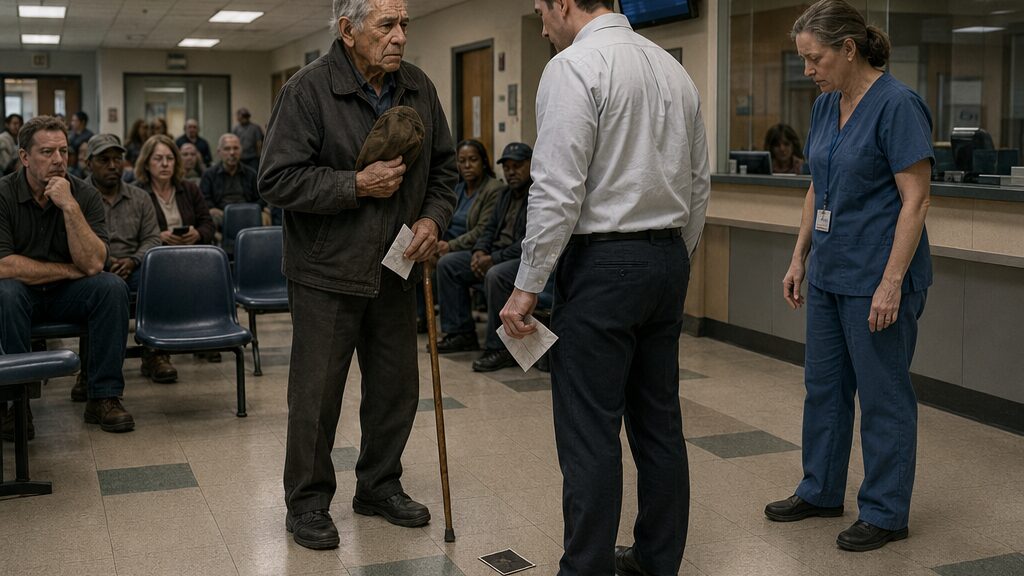
The service cap slipped from under Thomas’s arm. He caught for it, missed, and the worn leather wallet tucked beside it slid free from his coat pocket. It struck the tile, opened at the seam, and a small, faded photograph skidded out face down between Michael’s shoes.
Thomas’s breath stopped.
Chapter 3: The Photograph Face Down On The Floor
“Please don’t step on that.”
Thomas heard his own voice before he felt the room around him. It came out sharper than anything he had said all morning, sharp enough that Michael froze with one foot half shifted, the sole hovering inches from the small rectangle on the floor.
The photograph lay face down on the gray tile.
Not torn. Not yet. Not touched by a shoe.
Thomas lowered himself too fast, and pain fired up his leg. His cane wobbled. Christine moved instinctively, one hand out, but Thomas lifted his palm before she reached him.
“I can get it,” he said.
He could not, not easily. His knee would not bend enough. The service cap lay on its side near the leg of a plastic chair, its faded brim touching a black scuff mark. The appointment paper remained in Michael’s hand, unfolded and creased in the wrong places.
For a moment, Thomas saw all of it from somewhere far away: the cap, the cane, the paper, the photograph. The pieces of an old man scattered because a younger man had decided he was a delay.
Michael looked down at the photograph. “Sir, don’t—”
“Don’t step on it,” Thomas said again.
This time the room heard the plea underneath.
Christine crouched before anyone else moved. She did not snatch the photograph. She picked it up carefully by the edges, as if Thomas had already told her what it was worth. When she turned it over, her eyes changed.
Thomas knew the image without seeing it.
Three young men stood in sun so bright it had bleached the background nearly white. Their uniforms were pressed badly, their smiles too large, their shoulders touching as if they believed the world could not separate men who had decided otherwise. Thomas stood on the left, lean-faced and darker-haired, one hand lifted halfway as though someone had called his name. In the center stood Robert, laughing at something outside the frame. On the right stood Joseph King.
Joseph’s face had been circled in faded blue ink.
Thomas had not meant to circle it. Not at first. Years ago, he had only meant to mark the back with the date. Then his hand had moved. A ring around the last face still asking him a question.
Christine’s thumb hovered near the ink without touching it.
Michael cleared his throat. “I didn’t mean for anything to fall.”
No one answered him.
The television kept running captions above a commercial for allergy medicine. The ticket screen changed to B-44, but no beep sounded. The receptionist had stopped the call button. That small mercy did more to unsettle Thomas than the staring.
He reached for the photograph. Christine placed it in his hand face down, giving him the choice not to show it. He appreciated that. He also hated that appreciation.
“Thank you,” he said.
His fingers closed around the photograph, but the old paper had gone soft with age, and he did not trust his grip. He held it against his chest under the cap.
Christine’s eyes moved from him to the appointment paper in Michael’s hand.
“May I see that?” she asked.
Michael hesitated.
It was not a long hesitation. But it was enough for everyone to see that the paper had become more dangerous than the old man.
“Christine,” Michael said under his breath.
“May I see it?”
“This is a front desk issue.”
“It became a patient care issue when his belongings hit the floor.”
A few people shifted. Someone coughed. Pamela Roberts leaned forward, her face pale and tight.
Michael handed Christine the appointment paper.
Thomas watched her read it properly. Not the way Michael had read it, hunting for a reason to be done, but line by line. Her eyes paused where Thomas knew they would pause. Appointment type. Counselor name. Note field. Manual override.
She looked up at him once, then down again, and whatever she saw on the page made her voice gentler but no less clear.
“Mr. Ramirez,” she said, “this is for survivor counseling.”
The words did not echo. Rooms in clinics were not built for echoes. They were built to flatten sound, to swallow coughs, complaints, instructions, names. But somehow those words found every chair.
Thomas looked at the floor.
He did not want the room to have them. Survivor counseling. The phrase had been hard enough to read alone at his kitchen table. It was an ugly little doorway of a phrase. Too official for grief, too soft for the dead.
Michael’s face changed again. This time the change stayed.
“I didn’t see that,” he said.
“No,” Christine replied, not unkindly. “You didn’t.”
Thomas tucked the photograph behind the service cap, hiding the circled face against the fabric. “I would like my paper back.”
Christine held it out to him.
Michael reached at the same time, perhaps intending to take it, perhaps intending to fix what he had broken by controlling it again. Christine did not let go until Thomas’s hand was on the page.
The paper came back warmer than before, from other hands.
Thomas folded it once along the old crease. The new crease Michael had made cut across the printed text. Thomas tried not to look at it.
“Mr. Ramirez,” Michael said.
Thomas did not answer.
The supervisor lowered his voice. “I apologize for the confusion.”
There was that word again, dressed differently.
Thomas looked at him then.
Michael seemed to understand a second too late. He opened his mouth, closed it, then glanced toward the waiting room as if searching for the correct version of himself. The version who could repair this without admitting too much. The version who could make it procedural.
Pamela Roberts shifted in her chair. “I didn’t know,” she said quietly.
Thomas turned his head. He had not expected her to speak. Neither had she, judging by the way her hand went to her mouth afterward.
He could have said many things.
You did not ask.
You did not need to know to be kind.
Neither did I, when I was young.
Instead he bent slowly, retrieved his service cap with a hand that would not stop shaking, and settled it against his chest again. The cane tap that followed sounded louder than before when he straightened.
Christine stepped closer, shielding him slightly from the room without making a show of it.
“Your counselor can still see you,” she said. “Let me check the room.”
“I don’t need special handling,” Thomas said.
“I know.”
He looked at her, suspicious of gentleness. Gentleness could become pity if a person was not careful.
Christine did not smile. That helped.
Michael held the tablet against his side. “We’ll restore the slot.”
Thomas’s mouth felt dry. “Restore?”
“The appointment,” Michael said. “I’ll see what happened.”
“You saw what happened.”
The words came out before Thomas could stop them.
Michael’s cheeks colored.
The waiting room went still again, but differently this time. Not hungry for conflict. Waiting for damage.
Thomas felt the photograph under his palm. Joseph’s circled face seemed to burn through the cap fabric. He had not come here to accuse anyone. He had not even come here with confidence that he would stay. The appointment paper had been folded so small because part of him had wanted it easy to hide.
Michael took a breath. “I mishandled this.”
Thomas heard effort in the sentence. Not enough. But effort.
Christine looked toward the hallway. “Mr. Ramirez, there’s a quieter space just past the door.”
The door she indicated stood beside a wall of pamphlets: grief support, sleep trouble, caregiver resources, benefits assistance. Thomas had avoided looking at that wall when he entered. The words on those pamphlets asked too much.
He glanced at the exit.
Beyond the glass doors, morning light lay flat across the parking lot. The bus stop was across two lanes and a strip of struggling grass. If he left now, he could be home before lunch. He could put the appointment paper under the sugar bowl again or throw it away. He could place the photograph back in the wallet and Joseph would remain where Joseph had been for years: circled, silent, unanswered.
Christine waited.
Michael waited.
The room waited.
Thomas slipped the photograph into his wallet but did not close it right away. His thumb rested over the circled face. The blue ink was faded almost gray now.
“He asked once,” Thomas said.
The sentence surprised him with its smallness.
Christine’s voice stayed low. “Who did?”
Thomas closed the wallet, slowly, as if fastening a door he had opened by mistake.
He looked at the appointment paper in his hand, then at the hallway he did not want, then at the exit he understood too well.
“He asked once,” Thomas said again. “I didn’t answer.”
Chapter 4: The Letter He Never Opened Twice
Thomas stepped out of the waiting room and turned toward the exit instead of the counseling door.
The hallway beyond reception was quieter, but not private. Nothing in a clinic was truly private. Doors stood half-open. Phones rang behind counters. Shoes passed, paused, moved on. A wall of pamphlets leaned in metal racks beside him, all of them offering names for things he had spent years refusing to name.
Grief support.
Sleep concerns.
Survivor guilt.
He stopped in front of those words and wished he had kept walking.
Christine Miller came through the side door behind him, not close enough to crowd him, not far enough to pretend she had not followed. She still had the posture of a nurse even out here, one hand resting lightly against the folder she carried, eyes checking his color, his breath, the way his fingers gripped the cane.
“You don’t have to stand in the hallway,” she said.
“I don’t have to be here at all.”
“No.”
That answer made him look at her.
Most people rushed to tell him what he had to do. Stay. Sit. Wait. Sign. Explain. Calm down. Christine gave him the opposite, and it unsettled him more than any order.
Thomas folded the appointment paper along its oldest crease. His thumb found the break Michael had made through the middle and pressed it flat, though it would not disappear. The print showed through where the paper bent: survivor counseling, 9:20 a.m., counselor office C.
He folded it again.
Smaller.
He could put it into his pocket now. He could walk out. The bus would come in thirty-two minutes if the schedule had not changed. At home there would be the brown kitchen table, the sugar bowl, the quiet clock, the envelope in the drawer he opened only on bad nights and anniversaries.
Christine watched the paper vanish into his palm.
“I can tell them the clinic made an error,” she said.
Thomas almost laughed, but it came out as a tired breath. “The clinic made an error.”
“Yes.”
“He made one.”
“Yes.”
“So did I.”
Christine did not answer quickly. He appreciated that too, though he wished she would stop giving him things to appreciate.
From behind them came the muffled beep of another ticket number. Life in the waiting room had restarted. That felt wrong. He had expected the room to remain changed because he felt changed, but rooms were practical things. They recovered from other people’s pain faster than people did.
Christine nodded toward a small alcove between two office doors. There were two chairs there, a low table with outdated magazines, and a framed print of a mountain lake. “You can sit there for a minute. No one will bother you.”
Thomas looked at the chairs. One had arms. He chose that one because pride had limits when hips were involved.
Lowering himself took longer than he wanted. Christine did not help. She only stayed near enough that if he fell, she would be there before he hit the floor. That balance, too, had to be learned.
Once seated, Thomas placed the cane between his knees and set his service cap on his lap. The wallet lay inside his coat pocket, heavier now because he knew the photograph was in it. It had been there all morning, but being seen had added weight.
Christine sat in the chair across from him.
“Who asked?” she said.
Thomas looked at the lake print. The water in it was too blue. “A man.”
She waited.
“Joseph King.”
“The man in the photograph?”
Thomas’s hand moved once over the cap. “On the right.”
“With the circle?”
He closed his eyes briefly. “Yes.”
The hallway air seemed colder here. He could hear a printer somewhere, the fast mechanical cough of paper being made official. He had spent years trusting paper more than voices. But paper could arrive too late. Paper could sit in a drawer. Paper could ask a question after the man who wrote it was gone.
“He wrote me,” Thomas said.
Christine stayed still.
“After Robert died.” The name came out rougher than he expected. He had not planned to say it. Robert had stood in the center of the photograph, laughing, one shoulder pressed against Thomas, the other against Joseph. Robert had been the first to go after they came home, not in uniform, not in any way a person could fold into ceremony. A heart in a grocery store parking lot. A phone call from Joseph at 7:40 on a Tuesday night.
Thomas had not answered that call either.
He looked down at the appointment paper in his hand.
“Joseph sent a letter,” Thomas said. “Said he couldn’t sleep. Said he kept hearing Robert laugh. Said maybe I did too.”
Christine’s voice was low. “Did you?”
Thomas’s jaw tightened.
The question was too gentle. It was also too accurate.
He had heard Robert laugh in the kitchen, on buses, once in the canned goods aisle when a jar rolled off a shelf and shattered near his shoes. He had heard Joseph’s voice in the phone message he deleted without listening twice. He had heard men in dreams and woken angry at them for being dead and angrier at himself for being alive to resent it.
“I put the letter in a drawer,” Thomas said. “Told myself I’d answer when I had words.”
He rubbed his thumb along the paper’s edge.
“Then?”
“Then he died.”
Christine looked down.
Thomas hated that he had made her do it. Hated how quickly grief taught strangers the correct angle for their eyes.
“It wasn’t my fault,” he said, because people always said that before he could. He wanted to get it out of the way. “He had a bad heart. That’s what his daughter said in the obituary.”
He had read the obituary six times. He had clipped it out, folded it, placed it with the letter. Then he had closed the drawer and let years collect around it.
“But he asked,” Christine said.
Thomas looked at her sharply.
She did not flinch.
“He asked,” she repeated, softer. “And you didn’t answer.”
The words should have been cruel. They were not. They were the shape of the thing without decoration.
Thomas’s fingers tightened around the cane handle. “You sound like that paper.”
“What paper?”
He lifted the appointment sheet slightly. “Plain. No room for hiding.”
Before Christine could answer, footsteps came toward the alcove.
Michael Baker appeared at the end of the hallway with the tablet tucked under his arm and an apology already arranged on his face. It was a careful expression, polished and temporary. Thomas recognized it immediately.
“Mr. Ramirez,” Michael said, stopping a few feet away. “I want to apologize for the confusion at check-in.”
Thomas looked at him until the hallway noise seemed to thin.
Michael swallowed. “For the situation.”
Christine stood. “Michael.”
“I’m trying,” he said, a flash of irritation cutting through the polish.
Thomas believed that. It made the apology worse. Trying was not the same as seeing.
Michael shifted the tablet to his other hand. “I reviewed the file. There was a kiosk outage. You were manually checked in. The queue did not attach properly to your appointment.”
Thomas said nothing.
“So we’re going to work on restoring the slot,” Michael continued. “I’ll speak with the counselor’s office and see what can be done.”
“See what can be done,” Thomas repeated.
Michael’s face reddened. “Yes.”
Thomas unfolded the paper once. The crease broke open under his thumb. “This date was not an accident.”
Michael blinked.
Christine did not.
Thomas looked at the printed date. He had avoided seeing it all morning as anything other than a schedule line. But there it was. Month. Day. Year. An anniversary made ordinary by ink.
“Joseph’s letter came eight years ago today,” Thomas said. “I didn’t choose this appointment because it was convenient. I chose it because I thought if I came today, I might not put it back in the drawer.”
The sentence left him tired.
Michael lowered his eyes to the appointment paper, though he was too far away to read it. His procedural expression cracked at the edges. Not enough to absolve him. Enough to show he understood there were costs outside the queue.
The phone clipped to Michael’s belt vibrated, then rang.
He looked at it, hesitated, and answered with his body half turned away. “Baker.”
Thomas watched his face change.
“What do you mean reassigned?” Michael said.
Christine’s shoulders stiffened.
The hallway seemed to grow smaller.
Michael listened, eyes fixed on the floor. “No. Hold it. Don’t—” He stopped, jaw tight. “All right. I’m coming.”
He ended the call.
Thomas knew before anyone said it. The knowledge settled in him with a strange, almost peaceful weight. Of course. A man could take eight years to enter a building and still be five minutes too late.
Michael looked at Christine first, then at Thomas.
“Mr. Ramirez,” he said, and this time there was no polish left in his voice. “Your appointment slot has been given to another patient.”
Chapter 5: The Slot Was Given Away Quietly
“The appointment isn’t there anymore,” the receptionist said, though Thomas was holding the paper that said it should be.
She did not say it unkindly. That made it worse in a way. Her eyes kept moving between the monitor and Thomas’s face, as if she hoped one of them would change first. Behind her, the printer hummed. The waiting room had resumed its careful restlessness, but conversation faded as Michael brought Thomas back toward the reception desk.
Christine stayed close to Thomas’s left side. Michael walked ahead, then slowed, then seemed to realize that slowing now did not repair having rushed him earlier.
Thomas stood with the appointment paper unfolded in his hand.
9:20 a.m.
Counselor office C.
Thomas Ramirez.
The words had not changed. Only their power had.
Michael leaned toward the reception window. “Check the manual override again.”
“I did,” the receptionist said. “It detached from the appointment when the queue expired. The counselor’s office marked him as no-show at nine twenty-five. The slot got filled from the wait list.”
“He was not a no-show.”
The receptionist’s eyes flicked toward Thomas, then back to Michael. “I know.”
Michael heard the accusation inside those two words. So did Thomas.
The waiting room heard enough. Pamela Roberts, still in the maroon sweater, sat forward with her purse clutched shut now. The tattooed veteran watched without pretending not to. A man near the water fountain shook his head once, not loudly enough to become involved.
Thomas folded the paper. Then unfolded it again. He did not know what to do with his hands.
Michael tapped the counter. “Call office C.”
“They’re with the next patient.”
“Ask if they can pause.”
The receptionist stared at him. “You want me to interrupt a counseling appointment?”
Michael closed his mouth.
For the first time that morning, the rule he wanted to use did not point in a comfortable direction.
Thomas slipped the paper under his thumb, aligning its edges. He felt tired in a way sleep would not touch. “It’s all right.”
Christine turned toward him. “Mr. Ramirez—”
“It is all right.”
“No,” Michael said.
Thomas looked at him.
The word had come too quickly, and Michael seemed surprised by his own voice. He glanced around, aware again of the room, but this time the watching did not stiffen him into authority. It exposed him.
“No,” Michael repeated, lower. “It isn’t.”
The receptionist typed something. “There’s a note here. Two confirmation calls.”
Thomas’s hand tightened on the paper.
Michael leaned in. “What does it say?”
“That he called twice this week to confirm the appointment. First call was routed through the automated line. Second call got transferred to scheduling. Note says patient had difficulty with prompts and requested printed confirmation.”
The words sat between them.
Thomas looked down.
Difficulty with prompts. The phrase was accurate and humiliating in the way accurate things could be. He remembered standing at his kitchen counter with the phone pressed too hard to his ear while the automated voice repeated options that seemed to change each time he listened. He had pressed the wrong number once and reached pharmacy refills. The second time, he had waited twenty-six minutes before a scheduler answered. When she offered to email confirmation, he told her he did not use email. When she said he could view it online, he told her no. At last she told him he could print it from the public access portal at the library if he had help.
He had nearly hung up then.
Instead he had gone to the library and asked the clerk how to print one page.
Michael looked at him. “Why didn’t you say that?”
Thomas laughed once without humor. “Which part?”
“That you called. That there was a note. That you had trouble with the system.”
Thomas folded the paper slowly. “You had the system.”
Michael flinched.
Pamela stood suddenly from her chair. The movement made her wince, one hand going to her side. She took two steps toward them, then stopped as if she had come farther than intended.
“I heard him,” she said.
No one answered.
She swallowed. Her face had gone blotchy with embarrassment. “When the number changed. I heard him say it was his. I thought…” She looked at Thomas, then away. “I thought if he kept talking, we’d all be here longer.”
Thomas looked at her hand pressed against her side, at the strain in her shoulders. Pain made people narrow. He knew that. Fear did too.
“You had somewhere to be,” he said.
Pamela gave a small shake of her head. “I had a scan. I was scared they’d bump me.”
It was not an excuse. Not quite an apology either. It was something in between, the truth arriving without enough courage to dress itself properly.
Thomas nodded once.
That seemed to make Pamela more ashamed, not less. She looked toward Michael. “But he did say it. Before you told him to sit down.”
Michael rubbed one hand over his mouth.
The waiting room shifted again. The harm no longer belonged neatly to one man. It spread into the chairs, the silence, the impatience everyone had mistaken for innocence.
Christine placed the old photograph, now safely returned, in Thomas’s coat pocket after he had fumbled with the wallet flap. She did it only when he let her. That mattered.
Michael turned back to the receptionist. “Is there any opening later today?”
She typed. “Not with the survivor counselor. Next available is six weeks.”
Thomas’s fingers went still.
Six weeks was nothing in a system. Six weeks was a blink to a schedule. But Thomas saw the drawer in his kitchen. He saw the envelope waiting in the dark. He saw himself returning home with the folded paper, placing it under the sugar bowl again because throwing it away would be too honest.
Six weeks was enough time to become a man who did not come back.
Christine’s voice sharpened. “There has to be a way.”
The receptionist looked helplessly at Michael. “Only if office C agrees to add him back and someone authorizes the delay.”
Michael stared at the monitor.
Thomas could see the calculation happen. Not numbers. Consequences. A counselor interrupted. A waiting room delayed. A report, perhaps. A supervisor explaining why the morning fell behind after a man had already been marked no-show. Every kind thing in a building like this required someone to sign for the inconvenience.
Michael said, “I’ll talk to the counselor.”
Thomas lifted his head. “No.”
Michael turned. “Mr. Ramirez—”
“No.”
Christine looked at him. “You don’t want the appointment restored?”
“I didn’t say that.”
“Then what?”
Thomas looked toward the waiting room. People were openly watching now. Not all unkindly. That did not make it better. Pity had its own appetite. He had felt the room consume his photograph. He would not let it consume the rest.
“If fixing it means you go in there and tell every person why I’m here,” Thomas said, “then no.”
Michael’s expression tightened with frustration. “I can’t fix it without explaining something.”
“You can explain the clinic mistake.”
“That may not be enough.”
“Then leave it.”
Christine said his name softly.
Thomas did not look at her. If he did, he might let gentleness persuade him into exposure. He had spent the morning fighting to be heard and now found himself guarding the silence that had nearly cost him everything.
Michael’s voice lowered. “You shouldn’t lose care because I handled this badly.”
Thomas met his eyes. “And I should not have to pay for your apology with the rest of my story.”
The words landed cleanly.
Michael looked away first.
Behind him, the ticket screen flashed another number, but no one moved at once. Even the beep seemed smaller.
The receptionist folded her hands near the keyboard. Pamela sat back down slowly, her face wet though she wiped it quickly enough that no one mentioned it. Christine stood between Thomas and the hallway, holding space without sealing him inside it.
Michael looked at the appointment paper in Thomas’s hand.
For once, he did not reach for it.
“What do you want me to do?” he asked.
Thomas looked at the paper, at the crease that did not belong, at the ink of his own name.
“Do not put on a show,” he said. “If you can fix it, fix what happened. Not me.”
Chapter 6: No Applause In The Waiting Room
Michael Baker walked back into the waiting room holding Thomas’s appointment paper at chest level, no longer waving it like proof against him.
He had asked for it properly this time. Thomas had handed it over after a pause long enough to make the question matter. Michael had taken it with both hands and smoothed the crease against the counter before turning toward the rows of plastic chairs.
No one had called the next number.
The screen glowed silently above the reception window. B-46 waited there, red and patient, while the people beneath it watched a supervisor try to decide what kind of man he was going to be in public.
Thomas stood near the side hallway with Christine beside him. His cane tip rested on the tile. His service cap was tucked against his coat. He had placed the photograph back in his wallet, but he could still feel the circled face as if paper could press through cloth and bone.
Michael stopped near the middle of the room.
He began the wrong way.
“We had a procedural issue this morning involving an assisted check-in and an expired queue marker, and due to some confusion in the system—”
“Just say what happened,” Thomas said.
The sentence was not loud, but it cut through the room.
Michael turned.
For a second, anger rose in his face by habit. Then he saw Thomas. Not the old man in the way. Not the delay. Not the complaint he feared. Thomas saw the struggle happen, saw the older reflex lose.
Michael looked down at the paper, then back at the waiting room.
“The clinic made an error,” he said.
The room held still.
Michael swallowed. “Mr. Ramirez checked in early. His ticket detached from his appointment because of a system problem. When he tried to correct it, I did not listen carefully enough. I said he had missed his number. He had not.”
The receptionist stared at her keyboard. The tattooed veteran’s boot stopped moving again. Pamela Roberts pressed one hand to her mouth.
Thomas felt no triumph.
He had expected, perhaps, a small satisfaction from hearing the truth cross the room. Instead he felt the ache of how little truth could repair once spoken late. The words restored the facts. They did not pick up the photograph before it fell. They did not uncrease the paper. They did not call Joseph back from the drawer.
Michael turned slightly toward Thomas.
“I’m sorry, Mr. Ramirez.”
Thomas nodded once.
Michael seemed to expect more, then realized expecting anything from Thomas now was another way of asking.
He continued, “I am going to speak to the counselor’s office. I’ll explain the scheduling error and ask them to restore the appointment without disclosing anything private.”
The last words were for Thomas, not the room.
Thomas heard them and looked away first.
Christine touched the edge of the pamphlet rack, a small movement that seemed to steady her as much as him. “That is the right ask,” she said.
Michael nodded, then moved toward the hallway.
Halfway there, his phone rang again. He looked at the screen, stopped, and did not answer. Instead he pressed the side button until it went quiet.
For some reason, that small refusal mattered to Thomas.
Michael disappeared through the door marked Staff Only. Through the narrow pane of glass, Thomas saw him speaking to someone out of view. His shoulders were no longer squared for command. He held the appointment paper open with one hand and touched the crease with the other.
Pamela rose again, slower this time. Her purse hung from one elbow. She approached Thomas but stopped a respectful distance away.
“I’m sorry,” she said.
Thomas kept his gaze on the staff door.
Pamela waited, then added, “I should have spoken when I heard you.”
Thomas looked at her. Up close, her pain was visible in the gray cast around her mouth. She was younger than he had first thought, maybe late sixties, but illness had pulled at her. Fear had made her sharp; shame had made her smaller.
“You were afraid of losing your place,” he said.
She nodded. “Yes.”
“So was I.”
The answer surprised them both.
Pamela looked down. Near Thomas’s shoe, the service cap had slipped from his coat again, not all the way to the floor but enough that the brim hung loose. She bent with difficulty, retrieved it before it dropped, and held it out with both hands.
No one clapped. No one spoke. The gesture was small enough to survive.
Thomas took the cap. “Thank you, Mrs. Roberts.”
She blinked at being remembered. “Pamela.”
He nodded again. “Pamela.”
The staff door opened.
Michael came back with the paper in one hand and something else in his face that Thomas did not immediately know how to read. Not relief. Not exactly.
“They’ll see you,” Michael said. “The counselor agreed to adjust. There may be a wait of a few minutes while they transition.”
Christine exhaled quietly.
Thomas held his cap against his chest. “You told them the clinic made the error?”
“Yes.”
“Nothing else?”
“Nothing else.”
Thomas believed him. He did not know why. Perhaps because Michael looked too tired to be performing now.
The receptionist printed a new slip. Michael took it, glanced at it, then handed it to Thomas along with the original appointment paper. He did not hold the pages out by the corner. He presented them flat, both hands underneath, as if returning something borrowed from a better man.
Thomas accepted them.
The new slip had no history. Just an updated note and an office number. The old appointment paper, with its damaged crease, lay beneath it like a witness.
Michael lowered his voice. “My father used to come here.”
Thomas looked up.
Michael seemed to regret speaking, but continued because stopping would have been easier. “Different clinic then. He hated waiting. Hated forms. Hated being told to talk to someone. I used to think if the staff had pushed harder, maybe he would’ve…” He stopped. The waiting room was still close enough to hear if he said too much.
Thomas did not rescue him.
Michael’s jaw worked. “When older patients argue with the system, I hear him. I don’t mean to. But I do.”
The admission did not excuse anything. Thomas could feel that Michael knew it. That was why the words were bearable.
“Your father was a veteran?” Thomas asked.
Michael nodded.
“Did he get help?”
Michael looked toward the screen above the reception window. “Not in time.”
Thomas folded the new slip behind the old appointment paper. The paper stack was thicker now, less easy to hide.
“You thought speed was help,” Thomas said.
Michael’s mouth tightened. “Sometimes I still do.”
“That is your mistake.”
“Yes.”
The directness hung between them, clean as a cut.
Christine stepped forward. “Office C is ready when you are.”
The hallway beyond her seemed longer than before. Thomas looked toward it and felt his body choose the exit again out of habit. A man could be vindicated and still want to run. Maybe especially then. The room had turned kinder, but kindness could still watch.
He looked at the waiting patients.
Not all of them had been cruel. Not all had been brave. Most had been tired and hurting and grateful the trouble belonged to someone else. He understood them better than he wanted to.
Michael spoke quietly. “You don’t have to tell them anything else.”
Thomas looked at the old appointment paper.
There were words on it that the room had heard and words it had not. Survivor counseling had escaped into the air, but Joseph had not. The letter had not. The drawer in the kitchen had not. Thomas could keep those. He could also stop acting as if privacy required disappearance.
He turned slightly toward the waiting room, not enough to make a speech, only enough to be heard.
“I came for the appointment printed there,” he said. “I knew where I was. I knew my number. I knew my name.”
No one moved.
Thomas held Michael’s gaze for the last sentence. “That is all this room needs.”
Michael nodded. “Yes, sir.”
This time the word did not press him down.
Christine opened the hallway door. Beyond it, a smaller corridor led to offices with frosted windows and nameplates. The air was quieter there. Too quiet, perhaps.
At the threshold, Thomas paused.
The old fear rose with surprising strength. It did not care that Michael had apologized, or Pamela had offered the cap, or the appointment had been restored. It spoke in the practical voice he trusted most: You have done enough. You corrected the record. Go home before they ask what you cannot say.
Christine did not touch him.
“Mr. Ramirez,” she said, “only if you still want to come in.”
Chapter 7: One Steady Tap Through The Door
Thomas paused at the counseling doorway with one hand on the photograph in his wallet.
The hall behind him was quiet now, but not empty. He could still feel the waiting room through the wall: plastic chairs, ticket numbers, people pretending not to listen. Ahead of him, office C stood open. A small lamp glowed inside beside two chairs angled toward each other, not across from each other. No reception glass. No screen. No number.
That made it harder.
A number could be missed. A paper could be argued over. A door like this asked for a different kind of courage.
Christine held the door but did not step through. “Only if you still want to come in,” she repeated.
Thomas looked at the appointment paper in his hand. Michael had smoothed it, but the damaged crease remained. The new slip rested behind it. Proof and correction. Error and repair. None of it could tell him what to do now.
His fingers slipped into his coat pocket and touched the wallet.
The photograph was inside. So was the folded obituary clipping. And behind that, smaller than both, was a copy of the last line from Joseph King’s letter. Thomas had not brought the whole letter. That had stayed in the drawer at home, under the handkerchiefs, in the envelope gone soft at the corners.
But this one sentence he had copied years ago onto the back of an old receipt and never thrown away.
He had not known why he carried it.
Now he did.
Michael stood several steps behind him, close enough to help, far enough not to claim the moment. His badge caught the fluorescent light when he shifted.
“If you’re not ready,” Michael said quietly, “I can reschedule it myself. I’ll make sure it’s handled right this time.”
There it was: a painless exit, offered with good intentions.
Thomas looked down the hallway toward the reception area. He imagined taking the offer. He could nod once, keep his dignity intact, walk out before the counselor asked him anything. Michael would feel useful. Christine would understand. Pamela might watch him leave and think he had chosen privacy.
By afternoon, Thomas would be back at the kitchen table.
The sugar bowl would be there. The drawer would still close. The letter would still wait.
And in six weeks, if he came again, the same doorway would ask the same question.
Thomas drew the wallet from his pocket.
His hands were clumsy with it. The snap resisted. For a moment he felt anger at the small failure, at leather and metal and age making every private act public if enough people waited. Then Christine gently turned her gaze away, and Michael did the same.
That was how Thomas knew they were learning.
He opened the wallet and removed the photograph. The three young men looked out from the faded paper, sun-struck and unwarned. Robert laughing in the center. Joseph on the right, circled in blue. Thomas himself on the left, still young enough to believe unanswered things stayed where a man put them.
Behind the photograph, the old receipt slipped loose.
Thomas caught it before it fell.
The paper was thin, the ink faded, his own handwriting uneven from the night he copied it. He did not need to read it, but he read it anyway.
Don’t disappear on me too, Tom.
Joseph had never called him Thomas. Not once after they became friends. Tom, always. Short, plain, impossible to salute.
For years, Thomas had remembered that sentence as an accusation. He had heard it in the dark as blame. Don’t disappear. You did. Don’t disappear. Too late. Don’t disappear. Coward.
But standing at the doorway, with Michael silent behind him and Christine holding a door she would not pull him through, the words changed shape.
Joseph had not written, Don’t fail me.
He had not written, Save me.
He had written, Don’t disappear on me too.
Not a command from the dead.
A hand reaching across the same dark.
Thomas folded the receipt once, along a crease already there, and placed it behind the photograph. Then he set the appointment paper with them, not crumpled, not hidden, just folded carefully enough to fit. The paper was no longer a shield against the clinic. It was an answer he had finally brought to the right door.
Michael watched the motion and looked away before it became too much.
“Mr. Baker,” Thomas said.
Michael straightened. “Yes, sir?”
Thomas held the wallet open for another second, looking at the circled face. “Do not make old men argue with machines when they already came through the door.”
Michael’s throat moved. “I won’t.”
“You will forget.”
Michael looked wounded by that, then seemed to understand Thomas was not insulting him. He was warning him about being human.
Thomas closed the wallet.
“Then remember again,” he said.
Michael nodded once, slowly. “I will.”
Christine’s hand remained on the door. Her expression had not softened into pity. If anything, it had become more respectful, almost formal.
“The counselor’s inside,” she said. “I can stay nearby, or I can leave you to it.”
Thomas looked at the two chairs inside the room.
“What do people say first?” he asked.
Christine’s answer came without decoration. “Sometimes their name.”
He almost smiled.
His name had survived the morning. Not because the system protected it. Not because the paper proved it quickly enough. Because at last he had insisted on it.
“Thomas Ramirez,” he said, testing the sound.
Christine nodded. “That is enough to start.”
From the waiting room, the ticket machine beeped again. A normal sound. A small sound. For a moment, Thomas felt his body respond as it had before—shoulders tightening, breath held, ready to be rushed past.
Then his cane touched the floor.
One tap.
He stepped over the threshold.
The counselor inside stood but did not reach for him. She indicated the chair with arms as if she had noticed without making him ask. Thomas crossed to it slowly. The room did not hurry him. No one filled the silence with instructions. No screen changed before he sat.
He lowered himself carefully, placed the cane against the chair, and set his service cap on his knee.
The appointment paper rested inside his wallet now, against Joseph’s photograph and the copied line from the letter. Thomas touched the pocket once to be sure it was there.
The counselor sat across from him.
“What brought you in today, Mr. Ramirez?”
For a long moment, Thomas said nothing.
The old habit rose. Fold it. Pocket it. Leave it. Let the dead keep their own counsel and let the living mistake silence for strength.
Then he looked at the service cap on his knee. Faded cloth. Soft brim. A thing that had lasted because he had kept picking it up.
“Joseph asked me a question,” Thomas said.
His voice was rough, but it did not break.
Christine, still outside, let the door close most of the way. Before it shut, Thomas saw Michael standing in the hall with his head lowered, not in shame exactly, but attention. Beyond him, the waiting room moved again. Numbers changed. Chairs scraped. Lives resumed.
The door clicked softly.
Inside, Thomas lifted his service cap and placed it on his head.
When he shifted the cane beside him, its rubber tip touched the floor once.
One steady tap sounded beyond the door.
The story has ended.