The Quiet Recruit Picked Up Her Fallen Book After Breaking the Bully’s Claim to Power
Chapter 1: The Score That Silenced the Training Field
Kevin Hill crossed the finish line with half the training field shouting his name.
He struck the timing pad with his palm, staggered three steps, then turned toward the digital board as if he already knew what it would say. Sweat darkened his shirt from collar to waist. Dust coated his knees. The temporary leadership tab on his chest rose and fell with each breath.
The red numbers stopped.
The trainees around the lane erupted again.
Kevin bent at the waist, laughing, and pointed toward the board. “That’s the number you’re chasing.”
No one answered. Several recruits glanced at one another, then clapped because everyone else was clapping.
Emily Taylor sat on an equipment crate beyond the boundary rope with a battered paperback open across one knee.
She did not look up until an instructor called her name.
“Taylor. Final run.”
She marked her place with a narrow scrap of paper, closed the book, and stood.
Kevin straightened.
For the first time since finishing, his smile changed.
It did not vanish. It tightened.
Emily placed the book on the crate and walked to the starting line. She was smaller than most of the trainees around her, with narrow shoulders and a stillness people often mistook for uncertainty. She checked the laces on one shoe, flexed her fingers once, and waited for the signal.
Kevin moved closer to the timing board.
“You need someone to explain the course again?” he asked.
Emily faced forward. “No.”
A few recruits laughed, though there was nothing in her answer to laugh at.
The instructor lifted a whistle. “Full effort this time, Taylor.”
Emily’s head turned slightly.
“This time?” Kevin repeated.
The instructor ignored him. “You have been pacing every assessed run. That ends now.”
A murmur traveled along the rope.
Emily looked down the course: low wall, weighted carry, crawl lane, balance beam, final sprint. Nothing difficult by itself. The test punished wasted motion more than weakness.
She drew one breath.
The whistle cut the air.
Emily moved.
She did not explode from the line the way Kevin had. There was no violent spray of dirt, no grunt meant for an audience. Her first steps were compact and measured. At the low wall she planted once, rose cleanly, and passed over without striking the top.
Kevin stopped smiling.
She lifted the weighted carrier without adjusting her grip. Her back stayed straight. Her stride shortened only enough to keep the load from swinging. At the crawl lane she dropped before reaching the rope, slid beneath it, and came out already turning toward the beam.
The shouting faded.
Emily crossed the beam with her arms low at her sides. She did not test each step. She seemed to know where her weight would settle before her foot landed.
By the final sprint, the field had gone almost silent.
Kevin glanced from her to the red numbers still glowing beside his name.
Emily reached the timing pad and touched it.
The board flickered.
Her time appeared one line below Kevin’s.
For half a second, nobody reacted.
Then the instructor at the board removed Kevin’s score card from the top slot and placed Emily’s above it.
Someone near the rope gave a startled laugh.
Kevin turned toward the sound so quickly that the trainee lowered his eyes.
Emily stood with her hands on her hips, breathing through her nose. She was tired. Kevin could see that. But she was not exhausted. There was no tremor in her legs, no desperate pull for air.
She had not reached the edge of what she could do.
Captain Margaret Jones crossed the field from the observation table. Her expression revealed nothing as she checked the timer, then the handwritten record.
“Valid run,” she said.
Kevin stepped forward. “Captain, she missed the weight marker.”
“The marker was observed.”
“She dropped early at the crawl.”
“She entered inside the line.”
Kevin looked toward the instructors, waiting for one of them to support him. None did.
Margaret turned so the nearby trainees could hear her without raising her voice. “Today’s scores will be included in the leadership evaluation.”
The temporary tab on Kevin’s chest suddenly looked brighter than anything else on the field.
He touched it with two fingers.
“Captain,” he said, “one fast course doesn’t make someone a leader.”
“No,” Margaret replied. “Neither does one slow one.”
Several recruits looked away to hide their reactions.
Emily walked back to the equipment crate. A trainee struggling with the low wall had knocked two foam markers loose. She set her book down and carried the markers back into position.
“You beat him,” the trainee said quietly.
Emily aligned one marker with the painted line. “I finished the course.”
“You beat everybody.”
Emily picked up the second marker. “The board already says that.”
The trainee stared at her, uncertain whether she was joking.
She was not.
When Emily returned to the crate, her score card lay beside the book. She copied the time onto the scrap she had used as a bookmark, folded it once, and slid it between the pages.
Across the lane, Kevin was helping collect the weighted carriers.
He worked hard. No one could deny that. He knew where every piece belonged, which trainees had failed which portions, and how long remained before evening formation. When an instructor asked for volunteers to reset the course, Kevin had three recruits moving before the request was finished.
But his eyes kept returning to Emily.
He noticed she did not show her score to anyone. He noticed she had stopped breathing hard before he had. He noticed the way she lifted the equipment markers—not with effort, but with care, as though deciding exactly how much force each object required.
James Green approached Kevin carrying a coil of boundary rope.
Kevin took one end from him and spoke without looking in his direction.
“Taylor uses the east corridor to formation?”
James hesitated. “Usually.”
“Not tonight.”
James lowered the rope. “What do you mean?”
Kevin’s hands stopped moving.
James immediately looked down.
Kevin resumed winding the rope around his forearm. “Smoke pit cuts five minutes off the walk. Make sure she knows.”
“She doesn’t smoke.”
“Neither do you.”
James’s mouth tightened.
On the other side of the field, Emily opened her book. For a moment, Kevin watched her eyes travel down the page, calm and untouched by the attention around her.
He had spent months making certain every trainee knew where he stood.
She had changed it in less than two minutes and acted as if nothing had happened.
Kevin handed James the coil.
“Before evening formation,” he said. “Bring her through the smoke pit.”
Chapter 2: The Leadership Tab Kevin Could Not Lose
Emily knew someone had opened her locker before she touched the door.
The latch had been left turned a fraction too far, and the bottom corner did not sit flush with the frame. Inside, her uniform remained folded. Her notebook was where she had placed it. Nothing appeared stolen.
Her training shoes had been moved from the lower shelf to the top.
They sat side by side with their toes pointing outward, too carefully arranged to be an accident.
Emily stared at them.
A warning disguised as a joke. Something small enough to deny.
She reached up, removed the shoes, and checked them before putting them back. The laces were intact. Nothing had been pushed into the soles.
Behind her, the barracks corridor filled with the sounds of trainees changing for formation—locker doors striking metal, running water, clipped arguments over missing equipment.
James Green passed her once without slowing.
A minute later, he came back.
He stopped at the drinking fountain across from her locker and pressed the lever. The stream rose, though he did not drink.
“Don’t go through recreation,” he said.
Emily closed her locker.
James kept his face near the fountain. “Use the long corridor.”
“Why?”
“He wants everybody there.”
“Kevin?”
James released the lever. “I didn’t say that.”
“You didn’t need to.”
Footsteps approached from the washroom. Another trainee entered the corridor carrying a towel.
James straightened immediately.
Emily watched the change pass through him—the shoulders drawn back, expression emptied, hands suddenly occupied with adjusting his belt.
“Did you tell me not to go through recreation?” she asked.
James looked directly at her. “No.”
The other trainee slowed.
James gave a small laugh. “Why would I care which way you walk?”
He left before Emily answered.
She took her book from the locker and slipped the folded score beside the marked page. The spine was worn pale along one edge. A strip of old tape had begun lifting from the back cover.
She had carried it through three moves, two training centers, and more waiting rooms than she could remember. Reading gave people a reason not to speak to her. More importantly, it gave her somewhere to look when she did not want them studying her.
She stepped into the corridor and opened it as she walked.
At the first junction, the long route to formation continued left.
The recreation exit stood ahead.
Emily stopped reading.
She could turn left, find an instructor, and report the locker. She could repeat James’s warning. She could say Kevin had watched her after the test with a look that had nothing to do with competition.
But James had already denied speaking to her.
The locker had not been damaged. Her shoes had not been harmed. Kevin had made no direct threat.
She could hear how the report would sound before she gave it: a new recruit interpreting every inconvenience as intimidation after unexpectedly taking the highest score.
Her fingers tightened around the book.
That reasoning was clean, orderly, and familiar.
It was also incomplete.
If she took the long corridor, Kevin would know James had warned her. James knew it too. His denial had not been contempt. It had been fear arriving on schedule.
Emily walked toward recreation.
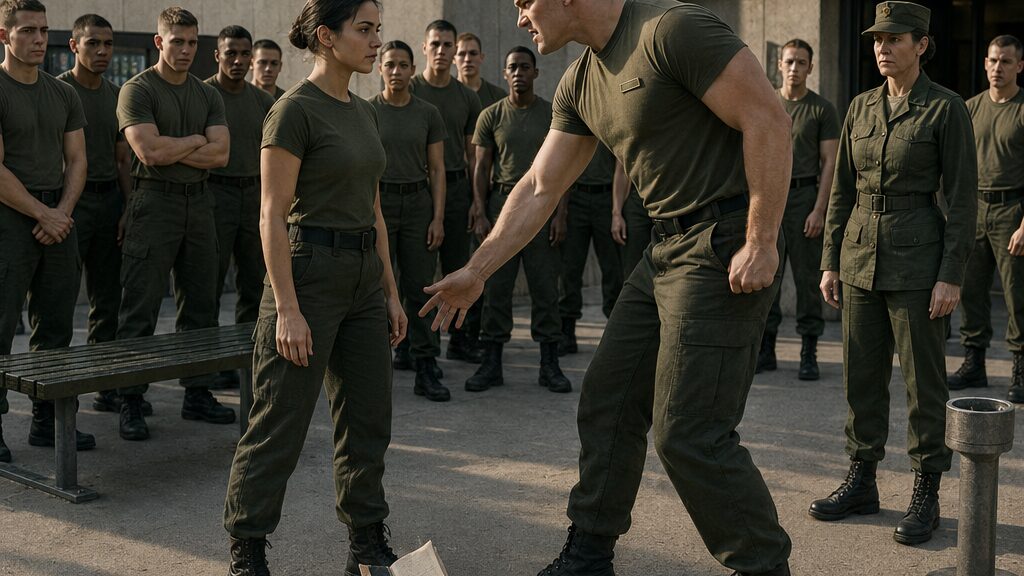
The smoke pit sat in a concrete recess between the barracks wall and a row of vending machines. Metal benches formed a rough square around two standing ashtrays. It was officially a break area, but Kevin had turned it into something closer to a checkpoint.
He decided who occupied the benches. He sent newer trainees for drinks. He kept a list of who traded duties and who owed favors. None of it appeared in writing, and none of it was important enough to challenge alone.
Together, it gave him control of every informal minute the instructors did not see.
Tonight the area was crowded.
Too crowded.
Several trainees who did not smoke stood along the wall with unopened cans in their hands. Others had positioned themselves near the exit without quite blocking it.
Emily lowered her book.
James stood beside a vending machine. He did not meet her eyes.
Kevin occupied the center bench, elbows on his knees. The temporary leadership tab remained fastened above his chest pocket. Two trainees stood behind him, leaving the opposite side of the concrete square conspicuously empty.
This was not a gathering.
It was an audience arranged to resemble one.
Kevin looked up as Emily entered.
“There she is.”
No one answered.
Emily kept walking toward the barracks door on the far side of the pit.
Kevin rose.
He was broad enough that the movement changed the shape of the space. He stepped into her path without touching her, forcing her either to stop or collide with him.
She stopped.
He looked at the book in her hands.
“You read while you walk?”
“When the path is clear.”
A few trainees shifted. Kevin’s mouth bent into a smile.
“You think you’re clever now.”
Emily glanced at the door behind him. “Move.”
“Temporary leadership means I can hold trainees for correction.”
“It doesn’t mean you can block an exit.”
“It means I can correct problems before they become unit problems.”
He tapped the tab with one finger.
The gesture was casual, but Emily saw how carefully he made it. That small strip of material was more than temporary authority to him. It was the visible proof that months of obedience, favors, and fear had built something permanent.
Her score had loosened it.
Kevin stepped closer. “Do you know why this unit runs better when I’m in charge?”
Emily said nothing.
“Because people understand expectations. They know who sets the pace. They know what happens when they make the group look weak.”
James stared at the floor.
Kevin noticed.
“Green,” he said, “didn’t Taylor ask for the shortcut?”
James’s jaw worked once. “I told her recreation was open.”
It was not quite a lie and not close to the truth.
Kevin nodded as if satisfied.
Emily looked at James. He raised his eyes for less than a second, and she understood the full shape of what he wanted from her.
Not rescue. Not confrontation.
He wanted her to submit enough that Kevin would stop looking for betrayal.
Kevin spread his hands toward the witnesses. “See? Nobody brought you here.”
“You told him to.”
James flinched.
Kevin’s expression hardened, then smoothed. “You always accuse senior trainees when you don’t get your way?”
“I didn’t ask for anything.”
“You took something.”
Emily looked at the tab again. “A score?”
“A position.”
“The position hasn’t been assigned.”
“It was being earned.”
“Then keep earning it.”
The silence that followed felt different.
Kevin had expected fear, apology, perhaps defiance loud enough to punish. Emily had given him none of those. Her voice remained level, and that made every watching face dangerous to him.
He moved closer until the edge of her book pressed lightly against his shirt.
“You came through here after making me look weak in front of the whole field,” he said. “So tell them what really happened.”
Emily waited.
“Tell them the course was luck.”
“No.”
“Tell them you had a cleaner lane.”
“No.”
“Tell them I’m still the person they follow.”
“That isn’t mine to decide.”
Kevin’s eyes dropped to the book between them.
Emily understood then that he did not need her to believe any of it.
He needed the others to watch her surrender.
She shifted one step sideways.
Kevin matched it.
“I have formation,” she said.
“So do we.”
“Then you should move.”
His smile disappeared.
Behind him, the barracks door remained shut.
Kevin leaned nearer. “You came here to apologize for making me look weak.”
Emily met his eyes.
“No,” she said. “I came because you were going to punish someone else if I didn’t.”
Chapter 3: The Book Struck the Concrete First
Kevin struck the book from Emily’s hands before she finished speaking.
It hit the concrete flat, bounced against the leg of the metal bench, and landed open with several pages folded beneath the cover.
The sound emptied the smoke pit.
Kevin looked down at it.
“So pick it up.”
Emily did not move at first.
The old tape along the back cover had split. The spine showed a narrow white tear where the binding had separated.
Something tightened low in her chest.
Not anger.
Recognition.
There had always been a moment before violence when the world grew unnaturally precise. Edges sharpened. Distance became measurable. The body standing across from her stopped being a person and became angles, balance, reach.
She had spent years teaching herself not to enter that moment unless she had no other choice.
Kevin spread his arms toward the watching trainees. “You heard her. She thinks she came here to protect Green.”
James looked stricken.
Emily bent and lifted the book.
Kevin could have stopped her. He did not. Letting her crouch was part of the display.
She unfolded the bent pages carefully.
A laugh came from somewhere behind Kevin. It died when he turned his head.
Emily pressed the cover closed. “We’re done.”
“We’re done when you tell them the test meant nothing.”
“It meant I finished faster.”
“You think that makes you better than me?”
“No.”
The answer unsettled him more than an insult would have.
Kevin pointed toward the trainees around them. “I’ve carried half these people through inspections. I’ve covered shifts. I’ve fixed mistakes before instructors saw them. This place would be chaos if everyone acted like you.”
Emily held the damaged book against her side. “Like me?”
“Like rules don’t apply because you can run fast.”
“You brought people here to watch you threaten me.”
“I brought people here so they could see the truth.”
One of the vending machines hummed behind him. A can dropped inside with a metallic thud, though no one had pressed a button.
Kevin took another step.
Emily’s attention lowered despite her effort to keep it on his face.
His right foot was slightly forward. Too much weight over the heel. Left shoulder rigid. Hands loose only because he believed he did not need to guard himself.
She could see the turn.
Step outside. Break posture. Take the arm. Rotate.
The sequence arrived whole, unwanted and exact.
Emily lifted her gaze.
Kevin saw only the downward glance and smiled.
“You are scared.”
She remembered another voice saying the same thing years earlier.
That time, she had been scared.
She had frozen long enough to feel a hand close around her wrist and another strike the side of her face. Then fear had broken open into movement. By the time she understood what she was doing, the attacker was on the ground and she was still applying pressure.
Someone had shouted her name three times before she released him.
Afterward, everyone had asked why she had not stopped.
No one had understood that she had not known how to begin.
Kevin reached out and tapped the top edge of the book.
Emily stepped back.
The movement drew a low murmur from the trainees.
Kevin’s confidence returned at once.
“That’s what I thought.”
Emily turned toward the barracks door.
He shifted in front of her again.
“You don’t get to walk away.”
“I already did once.”
“And that proves what?”
“That I don’t want this.”
Kevin glanced at the crowd. “No. It proves you cheated, and now you’re afraid someone will find out.”
Emily looked past him at James.
James’s face had gone pale. He had not moved from the vending machine, but his hands were clenched so tightly around the unopened can that the aluminum had begun to dent.
Emily understood the trap Kevin had built.
If she apologized, he kept his authority.
If she argued, he could call her unstable.
If she pushed past him, he could claim she initiated contact.
He had staged every outcome except the one he believed impossible.
That she would refuse to participate.
Emily tucked the book beneath her arm.
“You can tell the captain whatever you want,” she said. “I’ll give my own account.”
Kevin’s jaw flexed. “You think Jones cares what a rookie says?”
“I think she can read a timer.”
A few faces changed.
Not laughter. Something worse for Kevin.
Agreement.
His head turned slowly, taking in the trainees who suddenly found the concrete interesting. The authority he had built remained around him, but it no longer felt solid. Emily could see him measuring it, searching for the point where it had begun to fail.
His hand closed around her upper arm.
The grip was hard enough to bruise.
Every sound in the smoke pit narrowed to the friction of his sleeve against hers.
Emily looked at his hand.
“Let go.”
Kevin pulled her half a step toward him. “Make me.”
Her body offered solutions.
Turn the wrist. Strike the joint. Drive the heel down. Collapse the knee.
She rejected each one.
“Let go,” she repeated.
He did.
For an instant, relief passed through her.
Then he shoved her shoulder.
Emily absorbed the force and stepped back instead of falling. The book slipped under her arm, but she caught it before it dropped.
Kevin laughed.
“There. Not so dangerous.”
Emily’s pulse remained steady. That frightened her more than panic would have.
She could feel the old clarity settling into place.
His feet.
His shoulders.
The distance between them.
The hard concrete behind his right heel.
“Do not touch me again,” she said.
The words were quiet, but the entire pit heard them.
James pushed away from the vending machine. “Kevin, leave it.”
Kevin looked at him.
James stopped.
That small victory restored something in Kevin’s face. He straightened and rolled his shoulders as though preparing for an audience he finally understood.
“You all heard her threaten me.”
“She warned you,” James said.
It was barely audible.
Kevin’s eyes sharpened. “What?”
James swallowed. “Nothing.”
Emily started toward the side exit.
Kevin moved with her, no longer pretending this was correction or leadership. His humiliation had become visible, and visibility demanded an answer.
“You don’t walk away from me.”
Emily stopped.
“Why?” she asked.
The question caught him without a prepared response.
She continued, “Because I finished faster? Because they saw it? Or because you need them to believe no one can?”
Kevin’s face flushed.
Emily regretted the words as soon as they left her. Not because they were false. Because they struck exactly where he was weakest, and some part of her had known they would.
His right hand closed.
She saw the fist form.
She could still step away. She could call for an instructor. She could raise her voice and force witnesses to become participants.
Instead, she stayed where she was.
Perhaps because she believed he would stop at the edge.
Perhaps because she wanted to prove that her warning was enough.
It was the same mistake in a different form: trusting silence to carry a responsibility it could not bear.
Kevin smiled.
There was no humor in it now.
He shifted his right foot, drew his shoulder back, and threw the hook directly at her face.
Chapter 4: One Throw and the Yard Went Silent
Kevin’s fist passed through the space where Emily’s face had been less than a heartbeat earlier.
She lowered beneath the hook before thought could become fear. Her left hand caught his wrist. Her right arm rose under his shoulder. One step carried her inside his reach, close enough that his size stopped helping him.
Kevin’s momentum continued after his certainty disappeared.
Emily turned.
His boots left the concrete.
For one suspended instant, his weight rested across her back and shoulder, heavy but perfectly placed. The old sequence moved through her body without hesitation: break the balance, load the center, rotate the hips.
The landing point opened behind her.
Concrete. Bench leg. Ashtray base.
Too many ways for the fall to become something she could not take back.
Emily pulled his arm across her body and shifted the last degree of the turn.
Kevin struck the ground with a flat, explosive impact that shook the nearest metal bench.
Air burst from him.
The smoke pit went silent.
Emily followed him down, one knee beside his ribs, his right wrist still trapped against her chest. Her grip had become a lock without her deciding to make one. A small downward turn would take the joint beyond resistance.
She felt the point where resistance ended.
Her hand began to tighten.
A different floor flashed beneath her—a dim hallway, an older man’s arm pinned beneath her, someone shouting her name while she pressed harder because she could no longer hear anything except blood in her ears.
Emily released the pressure.
Not the arm. Not yet.
Kevin’s eyes were open, but shock had emptied them. He tried to inhale and managed only a broken rasp.
“Breathe,” she said.
He stared at her.
“Slowly.”
His chest rose. Stopped. Rose again.
Emily checked the line of his neck, the position of his shoulders, the way his legs lay. He had taken the impact hard, but not across the back of his head. She had changed the angle in time.
Around them, no one laughed.
James stood with the crushed can still in his hand. One of the trainees behind Kevin had backed into the vending machine and remained there, shoulders pressed against the glass.
Emily loosened her hold.
Kevin’s arm was his again.
He snatched it toward his chest and rolled onto one side, coughing.
Emily stood.
The motion made several trainees flinch.
She looked down at him, not with triumph but assessment. He was hurt. He was breathing. He was no longer attacking.
That should have been the end.
Kevin dragged one knee under himself.
“She set me up.”
His voice came out thin. He swallowed and tried again.
“She wanted that.”
No one answered.
Kevin pointed at Emily with his left hand. His right remained cradled against his body.
“She trained for it. You saw how fast she moved. She came here looking for a reason.”
Emily’s book lay open beside the bench.
The folded score had slipped from between the pages and rested on the concrete. Dust marked the torn spine. One page fluttered in the warm air from the vending-machine exhaust.
She walked toward it.
Kevin twisted around to follow her. “Don’t turn your back on me.”
Emily crouched and picked up the score first.
The time written on it remained legible.
She folded it along the same crease, placed it back inside the book, then lifted the book with both hands. She brushed dust from the cover. Her thumb found the split in the binding and held it closed.
Behind her, Kevin forced himself upright against the bench.
“She used prohibited force,” he said. “I barely touched her.”
James looked at him.
The movement was small, but Kevin saw it.
“What?” Kevin demanded.
James’s mouth opened.
Nothing came out.
Kevin pushed away from the bench. His knees failed to hold him, and he dropped back against the metal with a harsh scrape.
Emily turned then.
There was no satisfaction in seeing him diminished. Only a cold awareness of how quickly a person could move from dangerous to helpless—and how easy it would have been to add one more motion after the danger ended.
Kevin mistook her silence for uncertainty.
“You know what happens now,” he said. “Assaulting a senior trainee. Concealing combat training. You think that score matters after this?”
Emily pressed the damaged spine together.
“I warned you.”
“You threatened me.”
“You grabbed me.”
“You were insubordinate.”
“You punched at my face.”
Kevin looked around the circle. “Did anyone see that?”
His voice carried the old expectation. Not that they would believe him. That they would understand what answer preserved their place.
Several trainees lowered their eyes.
James did not.
Kevin noticed.
“Green.”
James stared at the dented can.
“Tell her,” Kevin said. “Tell everyone who started this.”
James’s throat moved. “You hit the book.”
“That isn’t what I asked.”
“You grabbed her.”
Kevin’s expression shifted from disbelief to warning. “Be careful.”
James looked at Emily. Then at Kevin’s temporary leadership tab.
“You threw the punch.”
The words were quiet, but they broke something larger than the silence.
A trainee near the wall nodded once.
Another said, “He did.”
Kevin turned toward the second voice. “You think this is a vote?”
“No,” a woman beside the door said. “It’s what happened.”
Kevin gripped the edge of the bench and pulled himself higher. “You all stood here. None of you stopped it.”
Emily felt the accusation land because part of it was true.
They had watched.
So had she, in her own way. She had seen the fist forming before it moved. She had stayed because she believed she could control the edge.
The barracks door opened.
Every trainee in the smoke pit straightened except Kevin.
Captain Margaret Jones stepped outside.
She had no escort and carried no clipboard. Her gaze moved first to Kevin’s guarded arm, then to Emily’s bruising upper arm, then to the book held shut beneath Emily’s thumb.
Finally, she looked at the concrete between them.
“Captain,” Kevin said quickly. “Taylor attacked me.”
Margaret walked toward him.
Kevin forced himself to stand. Pain bent him at the waist, but he straightened when she stopped in front of him.
“She has advanced training she never disclosed,” he continued. “She baited me in front of the unit and used a combat throw on hard ground.”
Margaret’s eyes settled on the temporary leadership tab above his pocket.
“You were instructed to maintain order among trainees,” she said.
“I was correcting insubordination.”
“With a right hook?”
Kevin went still.
No one else moved.
Margaret reached up, released the fastener, and removed the tab from his uniform.
The sound was soft.
It seemed louder than his impact against the ground.
“Captain—”
“You initiated unauthorized violence in a common area.”
“She challenged my authority.”
“You had temporary responsibility, not ownership.”
Margaret looked toward Emily. “Taylor, remain here.”
Then she turned to James. “Green, medical station. Bring personnel back for Hill. Do not discuss what you witnessed on the way.”
James set the damaged can on the vending machine and left through the door.
Kevin stared at the bare place on his chest.
Margaret held the tab between two fingers.
“The leadership evaluation is suspended pending review,” she said. “Your temporary authority is revoked now.”
Kevin looked past her at the trainees. The audience he had arranged remained exactly where he had placed it, but no one looked to him for permission anymore.
He pointed toward Emily. “She could have broken my arm.”
Emily’s hand tightened around the book.
Margaret turned toward her.
“Could you?”
Emily answered after a moment. “Yes.”
A murmur moved through the circle.
Margaret’s expression did not change. “Why didn’t you?”
“Because he couldn’t continue.”
“And the fall?”
“I redirected it.”
“You still drove him into concrete.”
“He was committed to the punch.”
Margaret studied her, weighing each answer rather than accepting the shape they made together.
Emily felt the old fear return—not of punishment, but of recognition. Margaret had seen the movement. She knew now that it had not been luck or instinct gathered in one desperate second.
She would want to know where it came from.
Kevin pressed a hand to his ribs. “She’s dangerous.”
Emily looked down at the torn book in her hands.
Margaret stepped between them.
“I witnessed the first punch,” she said. “That answers who initiated the violence.”
Her gaze remained on Emily.
“It does not answer everything else.”
Chapter 5: The Statement Emily Refused to Soften
“The impact should have fractured something.”
The medical officer stood in the corridor outside the examination room with Kevin’s chart in hand. Through the closed door came the faint scrape of movement, followed by a sharp breath.
Captain Margaret Jones glanced at the report. “But it didn’t.”
“Deep bruising along the back and shoulder. Strained wrist. No fracture, no dislocation, no head injury.” The officer looked at Emily. “His body was turned before contact. The force spread across the upper back instead of the neck.”
Emily sat beneath the corridor light with her damaged book on her knees.
She had found clear tape at the administration desk and was pressing a strip along the torn spine. The tape wrinkled near the bottom. She lifted it and started again.
The medical officer watched her hands.
“You made that adjustment during the throw?”
Emily smoothed the tape with her thumbnail. “Yes.”
“On concrete?”
“Yes.”
Kevin struck the inside of the examination-room door with something hard. “I can hear you.”
The officer ignored him.
Margaret did not. “Hill, remain seated until you are released.”
“I want my statement taken.”
“It will be.”
“Before hers.”
Margaret turned away from the door. “No.”
Silence followed.
The officer handed her the chart and left. Emily pressed the last section of tape into place.
Margaret looked at the repaired spine. “Does it still open?”
Emily tested the cover. “It will.”
“That wasn’t my question.”
Emily raised her eyes.
Margaret held the chart against her side. “Come with me.”
The interview room contained a metal table, three chairs, and a wall clock loud enough to make pauses feel official. Margaret placed Kevin’s medical report at one end and set a blank statement form in front of Emily.
“You may give a narrow account,” she said. “The confrontation only. From the moment Hill blocked your exit.”
Emily looked at the empty lines.
“That would be enough?”
“To establish that he initiated the attack. With my observation and the medical findings, yes.”
“And before that?”
Margaret pulled out the opposite chair. “Before that is more complicated.”
“How?”
“Because I received informal concerns about Hill over the last month. No signed statements. No complete accounts. Nothing that survived when the trainees involved were questioned.”
Emily thought of James at the vending machine, denying words he had spoken seconds earlier.
Margaret continued. “One recruit claimed Hill forced him to trade duty assignments. Then withdrew the complaint. Another said recreation access was being controlled. He later called it a misunderstanding.”
“You believed them.”
“I suspected there was truth in what they said.”
“But you left him in charge.”
Margaret’s jaw tightened slightly. “I left temporary authority in place while I looked for evidence strong enough to support removing it.”
Emily glanced at the statement form.
“And he used that authority to make sure no one would give you evidence.”
“Yes.”
The answer came without defense.
That made it heavier.
Margaret folded her hands on the table. “You can describe tonight and protect yourself. Or you can describe what happened before tonight, including anything you chose not to report.”
Emily’s thumb moved over the tape on the book’s spine.
“What happens if I do?”
“That depends on what you say.”
It was not reassurance. Emily respected her more for refusing to offer it.
She picked up the pen.
“At the testing field, he told James to bring me through recreation.”
“You heard him?”
“No.”
Margaret waited.
“I inferred it after James warned me.”
“Did Green identify Hill?”
“No. He denied warning me when someone approached.”
“Did you report the warning?”
“No.”
“Why?”
Emily looked toward the clock.
Because the locker had not been damaged. Because the threat had not been spoken plainly. Because silence had always seemed cleaner than explaining what people might force her to reveal.
“Because I thought I could avoid the situation.”
“But you went through the smoke pit.”
“Yes.”
“Why?”
“I believed Hill would punish James if I took another route.”
Margaret’s gaze sharpened. “So you knowingly entered a staged confrontation.”
“Yes.”
“That is not the same as provoking violence.”
“No.”
“But it matters.”
“Yes.”
Emily wrote the facts in order. The test. The locker. James’s warning. Her choice of route. Kevin blocking the exit. The book striking concrete. His grip on her arm. The shove. Her warning.
When she reached the punch, the pen slowed.
Margaret noticed. “Where did you learn the throw?”
“Judo.”
“How long?”
“Since I was eight.”
“What level?”
Emily named it.
Margaret leaned back.
The wall clock made three loud movements.
“That is not casual training.”
“No.”
“Why was it absent from your personal-skills declaration?”
“The form asked for current competitive activity.”
“It also asked for advanced physical training.”
Emily looked down.
Margaret’s voice remained controlled. “You did not misunderstand the form.”
“No.”
“Then why conceal it?”
Emily’s fingers tightened around the pen until the plastic flexed.
“There was an assault before I enlisted.”
Margaret said nothing.
“I froze,” Emily continued. “Long enough for him to hit me. Then I stopped freezing.”
The book lay beside her hand, the tape still bright and new.
“He went down,” she said. “I had his arm. People were shouting, but I didn’t stop when he stopped fighting.”
“How badly was he hurt?”
“Dislocated shoulder. Torn ligaments.”
“And tonight?”
“I felt the same lock.”
Margaret’s eyes went to Emily’s hands.
“I released it.”
“Why?”
“Because Kevin couldn’t continue.”
Margaret studied her for a long moment. “You concealed the training because you feared losing control?”
“I concealed it because once people know, they wait for you to prove it.”
“And if you refuse?”
“They think you’re hiding something.”
“You were.”
Emily met her gaze. “Yes.”
The answer changed the room.
Margaret drew the blank statement closer, but Emily placed her hand over it.
“I’m not using the narrow version.”
“You understand that a complete statement may expose your own failures to report threats and disclose training.”
“Yes.”
“It may lead to formal action.”
“Yes.”
Emily turned back to the line where she had stopped and continued writing.
When she finished, Margaret read the account without comment.
At the bottom, Emily had included one sentence about remaining in place after seeing Kevin form his fist.
Margaret tapped it. “Why include this?”
“Because I could have called for help.”
“Could you have escaped the punch?”
“Yes.”
“Then why didn’t you?”
Emily looked at the repaired book.
“I thought I could control what happened.”
Margaret set the paper down. “That belief is dangerous in a different way than Hill’s, but it is still dangerous.”
Emily nodded.
A knock sounded at the door.
An administrator opened it halfway. “Captain, Green is outside.”
“Send him in.”
“He says he won’t enter unless he speaks to you alone first.”
Margaret rose.
Before she reached the door, James appeared behind the administrator. He looked as though he had not changed since the smoke pit. His uniform was still creased at the elbows. His face had gone gray with fatigue.
He held his phone in both hands.
Kevin’s voice sounded from the far corridor, demanding to know why no one had taken his statement yet.
James flinched but did not leave.
He looked at Emily, then at Margaret.
“I helped bring them there,” he said.
His thumb rested over an open message thread.
“And I have the messages.”
Chapter 6: The Witness Who Had Laughed Along
Kevin entered the review room without his leadership tab and still tried to give an order.
“Green, don’t say anything until they ask you directly.”
James stopped beside the table.
Captain Margaret Jones closed the door behind Kevin. “Sit down.”
Kevin lowered himself carefully into the chair opposite Emily. The bruising had stiffened him overnight. One arm remained supported in a sling, though the medical officer had said the wrist was only strained.
His empty chest pocket drew the eye more than the tab ever had.
James took the chair at the end.
Emily placed her repaired book on the table instead of keeping it on her lap. The strip of clear tape caught the overhead light.
Kevin noticed.
“That’s what this is about?” he asked. “A book?”
“No,” Margaret said. “It is about conduct under authority.”
She laid printed copies of the message thread between them.
Kevin glanced down. “Private trainee coordination.”
James stared at his hands.
Margaret read one line aloud. “‘Get everyone outside. She needs to understand the board didn’t change anything.’”
Kevin shifted. “That doesn’t instruct violence.”
“No,” Margaret said. “It establishes that the gathering was planned.”
“It was a correction.”
“You were not authorized to conduct one.”
“I was expected to maintain standards.”
Margaret turned to James. “Explain what ‘everyone’ meant.”
James swallowed. “People who usually stayed in recreation when Kevin was there.”
“Why those people?”
“So they would see.”
“See what?”
James looked at Kevin.
Kevin’s voice stayed low. “Answer carefully.”
Margaret leaned forward. “That was your final instruction to him.”
Kevin looked at her.
“Any further attempt to direct a witness will be entered into the review,” she said.
James exhaled through his nose. “He wanted Emily to say the test was luck. He said if she did it in front of everyone, the score wouldn’t matter.”
“And if she refused?”
“He said he’d find out how brave she was without instructors around.”
Kevin laughed once. “That is not a threat.”
James’s shoulders tightened.
Emily recognized the movement. He was preparing to retreat.
Margaret did too. “Tell us what happened before Taylor arrived.”
James rubbed his palms against his trousers. “We moved people into the smoke pit. I told two recruits there was a meeting. Someone else was told Kevin had drinks. We made it look normal.”
“Was this the first time?”
James did not answer.
Kevin stared at him.
“No,” James said.
The word came out almost soundless.
Margaret waited.
James looked at Emily’s book. “Kevin said readers and loners were easiest because they never had anyone beside them when something happened.”
Emily’s fingers went still.
“He told me to move her shoes,” James continued. “Not damage them. Just move them so she’d know someone had been in her locker.”
“You did that?” Emily asked.
“Yes.”
His shame did not make him look away this time.
“Why the book?” Margaret asked.
James’s mouth twisted. “He said if she kept reading while he talked, knock it down. Make her look up.”
Kevin leaned forward despite the pain. “You’re making it sound worse because you’re scared.”
“I am scared.”
“Of what? Your own part?”
“Yes.”
That answer stopped Kevin.
James looked at Margaret. “I laughed when he mocked people. I carried messages. I told recruits which benches they couldn’t use. I traded duties he had no right to trade.”
Margaret’s expression hardened. “Why?”
“At first because he helped me.”
Kevin’s face changed.
James turned toward him. “You remember the first week?”
Kevin said nothing.
“A trainee kept taking my equipment before inspection,” James told Margaret. “Kevin stopped him. Made him return everything. Stayed up helping me reset my locker so I wouldn’t fail.”
Emily looked at Kevin.
For the first time, the man at the smoke pit and the trainee others had once chosen to follow occupied the same body.
“He was good at things,” James said. “He knew schedules. He could get everyone moving. If someone was falling behind, he noticed.”
Kevin’s jaw loosened slightly.
“Then people started doing what he said before he asked,” James continued. “He liked that better.”
“I kept the group functioning,” Kevin said.
“You made people afraid to be the one who slowed it.”
“Because slowing the group has consequences.”
“So does lying about inspections. So does making someone surrender weekend calls because they missed a pace.”
Kevin’s eyes flashed. “I never took anyone’s calls.”
“You decided who got coverage.”
“I organized trades.”
“You punished people who wouldn’t trade.”
Margaret lifted one hand. The room settled.
She turned to Kevin. “Did you believe these methods were justified?”
Kevin looked from her to the printed messages.
“I believed results mattered.”
“That was not the question.”
He shifted in the chair, protecting his injured side. “The instructors wanted order. They wanted someone who could produce it without needing supervision every minute. I produced it.”
“Through intimidation.”
“Through consequences.”
“You arranged a public confrontation over a physical-test score.”
“Because the score changed how people acted.”
Emily spoke for the first time since the review began. “They stopped pretending you were untouchable.”
Kevin looked at her.
“You could have left it alone,” he said. “You didn’t even want the position.”
“That didn’t make the score yours.”
“You have no idea what I put into earning that tab.”
“No,” Emily said. “But I know what you did to keep it.”
His face tightened. “And you think you’re different because you waited for me to swing first?”
The question landed harder than she expected.
Kevin saw it.
“You came through recreation knowing there was a confrontation,” he continued. “You knew you could put me down. You stayed because some part of you wanted the chance.”
Emily looked at the book.
The tape held the spine together, but the tear remained visible beneath it.
“I stayed because I thought I could control the situation,” she said.
Kevin gave a bitter smile. “There it is.”
“I should have reported the warning.”
James looked at her.
“I should have told Captain Jones about the locker,” Emily continued. “I should have called for an instructor when you blocked the exit. I didn’t.”
Margaret’s eyes remained on Emily.
“Why admit that?” Kevin asked.
“Because your choices don’t erase mine.”
The room became quiet.
James looked down at the messages. “If she’d reported it, I would have denied warning her.”
Emily turned toward him.
“I was going to deny everything,” he said. “Even after the fight. Then she wrote down that she had stayed when she could have called for help.”
“How do you know what she wrote?” Kevin asked.
“I didn’t. Captain Jones said Taylor’s statement included her own mistakes before she asked whether I was ready to include mine.”
Margaret did not deny it.
Kevin sat back, breathing shallowly. His anger had nowhere clean to go. Emily had not claimed perfection. James had not claimed innocence. Their admissions left him without the easy defense that everyone else was protecting themselves at his expense.
Margaret gathered the printed messages.
“I delayed removing temporary authority,” she said, “because I wanted direct evidence that would withstand review.”
Kevin looked up.
“That caution allowed an informal system of intimidation to continue,” she said. “That failure belongs to command.”
No one spoke.
Margaret turned to James. “Your cooperation does not erase your participation.”
“I know.”
“To Hill, assistance became permission. Gratitude became obedience. You helped isolate trainees.”
“Yes.”
She looked at Kevin. “Your early competence explains why people trusted you. It does not excuse what you chose to do with that trust.”
Kevin’s mouth opened, but no answer came.
Finally, Margaret faced Emily.
“Your restraint during the throw prevented a more serious injury. Your complete statement helped expose conduct beyond the assault.”
Emily waited.
“But you deliberately concealed advanced combat training. You ignored a credible warning. You entered a staged confrontation without reporting it. You remained after recognizing that Hill intended violence because you believed you could control the outcome.”
Emily felt every person in the room listening.
Margaret placed one hand on the repaired book.
“Tell me, Taylor,” she said, “why should this unit trust someone who hides that much power until another trainee is already falling?”
Chapter 7: What Real Control Looked Like Afterward
The empty place where Kevin’s leadership tab had been was visible from the back rank.
Two days after the fight, the trainees stood in formation beside the physical-testing field. Kevin occupied the far end of the second row, his right arm held close to his body. The bruising along his neck had darkened. He kept his eyes forward.
Captain Margaret Jones faced the unit with a folder tucked beneath one arm.
“The trainee leadership selection is suspended,” she said. “The temporary appointment previously held by Hill has been revoked. He is permanently removed from consideration for that position.”
No one turned toward Kevin.
That restraint felt less merciful than staring.
Margaret continued. “The review confirmed unauthorized use of temporary authority, coercion of other trainees, interference with personal equipment, manipulation of duty arrangements, and initiation of physical violence.”
Kevin’s jaw tightened.
“The review also identified failures by trainees who participated, remained silent, or chose informal solutions over proper reporting.”
Emily felt the words reach her before Margaret looked in her direction.
“There will be no discussion of winners,” Margaret said. “There was no sanctioned contest. There was an assault, a defensive response, and a chain of decisions that allowed the confrontation to occur.”
The field remained quiet except for the faint snap of a boundary rope against its post.
James stood three places from Emily. His statement had cost him recreation privileges and assigned him additional duties under supervision. He had accepted both without argument. Since the review, he had not tried to apologize again.
His first apology had come in the corridor outside the interview room.
Emily had told him she believed he was sorry.
She had not told him that belief repaired anything.
Margaret dismissed the formation by rows. Kevin’s row moved first.
He passed Emily without looking at her. For one moment, she saw the effort required to keep his posture straight. He had lost the position, the audience, and the certainty that effort alone entitled him to authority.
He had not lost his ability to work.
What he did with that difference would belong to him.
“Taylor,” Margaret called. “Remain.”
The rest of the trainees moved toward the equipment station. James glanced back once, then continued walking.
Emily approached Margaret with her repaired book tucked beneath her arm.
Margaret held out a single-page document.
“Formal warning,” she said.
Emily read the listed findings: failure to disclose advanced physical training, failure to report credible intimidation, and poor judgment in entering a confrontation without seeking assistance.
At the bottom was a space for her signature.
“You agree with it?” Margaret asked.
Emily read it again. “Yes.”
“No qualification?”
“I knew James’s warning was credible.”
“And the skills declaration?”
“I knew what the question was asking.”
Margaret handed her a pen.
Emily signed.
The act did not feel like punishment. It felt like removing the last place where she might have hidden inside technical wording.
Margaret took the page back. “Some people in command believe your response at the smoke pit demonstrates exceptional potential.”
Emily waited.
“They did not see the smoke pit.”
“No.”
“They saw the medical report and the statements.”
“That isn’t the same thing.”
“No.”
Margaret closed the folder. “The throw did not earn my trust.”
Emily looked at her.
“You had the skill before you arrived. Skill is not character.” Margaret’s gaze moved to the book beneath Emily’s arm. “You began earning trust when you released Hill’s arm after you had control. You earned more when you included your own failures in the statement.”
Emily pressed her thumb over the clear tape on the spine.
“I still hid the training.”
“Yes.”
“And stayed when I could have called someone.”
“Yes.”
Margaret’s answers contained no softening.
Emily appreciated that too.
“What happens now?” she asked.
“No promotion. No special status. No demonstration for an audience.”
Relief came first.
Then Margaret added, “You will assist with controlled-fall instruction twice a week under supervision.”
Emily’s grip on the book tightened. “Captain—”
“That reaction is why I chose it.”
“I don’t want trainees treating me like—”
“A weapon?”
Emily stopped.
Margaret looked toward the testing lane, where instructors were laying mats across the ground.
“You concealed part of yourself because you believed visibility would surrender ownership of it,” she said. “That fear is understandable. It is not sustainable here.”
Emily watched two recruits struggle to align the edges of a mat.
“What would I teach?”
“How to fall without panic. How to release when control is established. How not to confuse completion with punishment.”
The words settled differently than an order to display what she could do.
Margaret continued. “You will not teach advanced throws. You will not become an unofficial enforcer. You will demonstrate restraint under accountable conditions.”
Emily looked down at the battered cover.
For years, she had treated the book as a door she could close between herself and other people. Kevin had knocked it down because he thought privacy was weakness. She had picked it up afterward because violence was not allowed to keep what it interrupted.
Now Margaret was asking her to open something else.
“I’ll do it,” Emily said.
Margaret nodded once. “Report to the mat area after evening formation.”
She walked away.
Emily remained beside the field until the noise of training resumed around her. No one approached to congratulate her. No one laughed at Kevin. The absence of celebration made the correction feel more permanent.
Later, she crossed the recreation area on her way back to the barracks.
The smoke pit looked smaller without a crowd arranged around its benches. The ashtrays had been emptied. One vending machine still carried a shallow dent where a trainee had backed into it during the throw.
Kevin’s leadership tab was gone.
The concrete held no sign that he had fallen there.
James sat alone on the end of a bench with a cleaning cloth in one hand. He was wiping dust from the metal slats as part of his assigned duty.
Emily slowed.
He looked up. “They gave you the warning?”
“Yes.”
“Are you staying?”
“Yes.”
He nodded and returned to the bench.
Emily could have kept walking.
Instead, she placed the book beside him and held the loose end of the cloth while he worked it around a bolt.
James glanced at the repaired spine. “Does the tape hold?”
“So far.”
“I shouldn’t have touched your locker.”
“No.”
“I shouldn’t have brought everyone outside.”
“No.”
He waited, perhaps for forgiveness to arrive because he had named the right things.
Emily released the cloth. “But you told the truth when it cost you.”
James looked at her.
“That matters,” she said. “It doesn’t erase the rest.”
“I know.”
This time, she believed he did.
She picked up the book and continued toward the barracks.
Near the walkway, another recruit fell into step beside her. For several yards, he said nothing. His eyes moved toward the cover, then away.
Emily opened to the page marked by the folded test score.
“What are you reading?” he asked.
The question was ordinary.
Her old instinct was to lift the book higher, give the title without explanation, and disappear behind the page.
Instead, Emily lowered it enough for him to see the cover.
“It’s about someone who thinks staying silent keeps trouble from finding her,” she said.
“Does it?”
Emily glanced back once.
James was still cleaning the bench. Kevin was nowhere in sight. Beyond the smoke pit, the training mats waited beneath the late light.
“No,” she said. “It only decides who gets to speak first.”
She turned the page and kept walking, the book open between them rather than raised like a wall.
The story has ended.