The Young Guard Called Her a Civilian Risk Before the Secretary Opened the Door
Chapter 1: The Woman Without a Visible Rank
“This briefing is strictly for field-grade officers. You need to step back.”
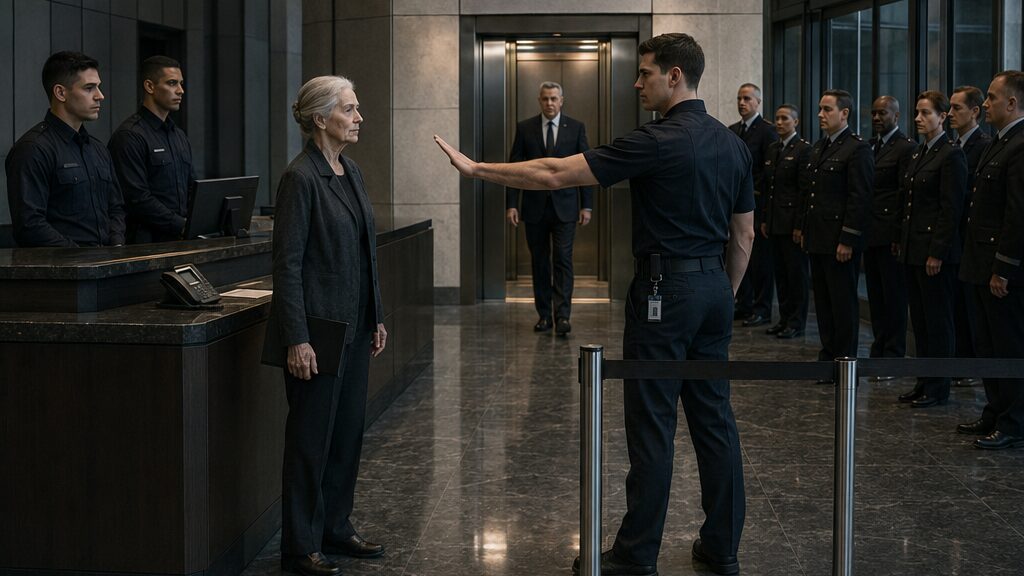
The young guard moved before Katherine Wilson reached the silver line embedded in the marble floor. He planted himself between her and the locked glass doors, one hand near the temporary passes clipped to his belt.
Katherine stopped.
Beyond him, the secured corridor ran toward a bank of elevators and a dark wooden door marked only by a room number. The academy lobby smelled faintly of floor polish and old stone. Portraits of former commanders watched from the walls, each one framed beneath a name, a rank, and a list of honors.
Katherine wore none of those things.
Her faded charcoal jacket had no pins. Her gray hair was pulled neatly behind her head. The unmarked black folder beneath her arm carried no seal visible from the outside.
“I’m expected in Room 417,” she said.
The guard’s eyes moved from her practical shoes to the folder.
“Name?”
“Katherine Wilson.”
He turned to the computer at the polished front desk. Two other guards stood near the screening station. Both were younger than Katherine’s oldest staff officers had been when she first took command. One watched without expression. The other leaned slightly toward the desk, interested.
The guard typed her name.
“No Wilson.”
“Check the restricted arrivals.”
“This is the restricted list.”
“No,” Katherine said. “That is the field-grade attendance roster.”
His jaw tightened. His name strip read JACOB DAVIS.
“You seem very familiar with our paperwork.”
“I’m familiar with the meeting.”
Jacob looked toward his squadmates. The interested one had begun smiling.
Katherine saw the change in Jacob before she heard it. His shoulders squared. His voice grew louder.
“Then you should know everyone attending was instructed to arrive with visible credentials.”
Katherine had been instructed to do the opposite.
The briefing concerned weaknesses that appeared when institutions trusted symbols more readily than judgment. Only four people inside the academy knew the identity of its principal speaker. Her arrival had been separated from the ordinary guest process so no public record would connect her to the meeting before it began.
She could have ended the problem with six words.
I am General Katherine Wilson.
Instead, she looked at the roster angled toward Jacob.
“Your briefing sheet should refer you to a sealed addendum.”
His hand shifted across the lower corner of the page.
For a moment, neither of them spoke.
Katherine had seen the notation. A small black triangle stood beside a line of print near the bottom: additional principal information available through supervisory verification.
Jacob had seen it too.
“The people listed here,” he said, closing the paper roster over the notation, “are the people authorized to pass this checkpoint.”
A senior officer entered through the main doors behind Katherine. He carried a leather portfolio and wore a dark service uniform. Jacob straightened at once.
“Good morning, sir.”
The officer acknowledged him with a brief nod and continued toward the screening station.
Katherine glanced once at the officer’s left sleeve and the worn edge of his portfolio.
“He’ll need the west elevator,” she said. “His session was moved from the command wing.”
The officer stopped.
“How did you know that?”
“The logistics panel was shifted yesterday.”
He studied her face, clearly searching his memory. Before he could ask anything else, another uniformed attendee called to him from beyond the glass doors. He moved on, still looking back.
Jacob’s fingers tightened on the roster.
“You need to step away from the access line.”
“I have given you my name, destination, and arrival window.”
“You have not given me valid identification.”
“My identification is to be verified through the restricted chain.”
“That isn’t how entry works here.”
“It is today.”
The interested guard’s smile faded. The other shifted his weight as if preparing to approach the supervisor’s phone.
Jacob noticed.
“I have this,” he said.
The second guard stopped.
Katherine regarded Jacob carefully. His first decision had been defensible. A civilian-dressed stranger carrying an unmarked folder toward a classified briefing should be stopped. Confidence was not a credential. Age was not an exemption. Familiarity with the building could itself be a warning sign.
But a proper stop was meant to begin verification, not replace it.
“Contact your watch supervisor,” Katherine said. “Give them my full name and the phrase ‘principal access.’”
Jacob’s gaze flicked down to the concealed notation.
“No supervisor is needed.”
“That is what the notation instructs you to do.”
Color rose along his neck.
“You cannot read restricted material from the public side of the desk.”
“The notation is printed in fourteen-point type.”
One of his squadmates looked down quickly, hiding a reaction. Jacob saw it.
His expression hardened.
Katherine knew that expression. She had watched it form on officers in briefing rooms, on commanders at inspection tables, on people who had mistaken retreat from a bad position for loss of authority. Once pride entered a decision, facts became enemies.
Jacob pulled the roster closer to himself.
“I am not opening sealed material because an unidentified civilian tells me to.”
“I did not ask you to open it.”
“You asked for access to a field-grade briefing.”
“I asked you to verify my arrival.”
“You are not on the list.”
“I am on the list you are refusing to check.”
The lobby had grown quieter. The clicking of shoes on stone continued, but voices softened as arriving officers sensed the confrontation.
Katherine felt the familiar impulse to remain still and let the system reveal itself.
Years earlier, a decorated officer had accepted an order because of the rank attached to it, despite three people below him presenting facts that contradicted it. Katherine had spent decades teaching commanders to examine the information in front of them rather than the insignia above it.
She had also developed a habit she rarely admitted: when people failed that test, she let them continue long enough to show the full shape of the failure.
Jacob’s first error did not require humiliation. His next one might.
“Last opportunity,” she said quietly. “Call your supervisor.”
He stared at her.
Then he closed the roster completely.
The sound of the cover striking the desk was small, but it carried across the polished lobby.
Jacob placed his palm over it, covering the sealed-addendum reference beneath his hand. With the other, he pointed toward the academy’s public exit.
“You’ve been told where you do not belong,” he said. “The doors are behind you.”
Chapter 2: The Pass He Chose Not to Check
“Don’t call the watch supervisor,” Jacob said under his breath.
The second guard had already lifted the desk phone. He froze with the receiver an inch above its cradle.
Katherine heard the instruction clearly. So did the other guard, though he looked away as if he had not.
Jacob stepped from behind the desk and positioned himself beside the silver access line. The temporary visitor passes on his belt shifted against one another. One of them was blank, ready to be encoded after controlled verification.
“You were given a lawful direction,” he told Katherine.
“And you were given a workable verification path.”
“You don’t direct this checkpoint.”
“No. Your procedures do.”
His face tightened at the distinction.
The other guard slowly returned the receiver to its cradle.
Three more officers entered the lobby. They moved toward the screening station, then slowed when they found Katherine standing in front of the access line. Jacob’s posture changed again beneath their attention. He looked less like a guard resolving an irregularity and more like an instructor preparing to demonstrate one.
Katherine shifted the folder beneath her arm.
“Why are you unwilling to call your supervisor?”
“I don’t escalate routine denials.”
“This stopped being routine when your roster referred you to restricted verification.”
“You keep claiming you saw something you were not authorized to see.”
“I saw the procedure you are refusing to follow.”
One of the arriving officers glanced at Jacob’s closed roster. Another checked his watch. The briefing was less than twenty minutes from its scheduled start.
Jacob reached behind the desk and drew out a thin incident pad. Beneath it lay a printed evaluation form, face down except for its lower edge. A handwritten phrase showed beside a checked box.
Delayed decisive action.
Jacob noticed Katherine reading it and slid the incident pad over the words.
The gesture told her more than the sentence.
“You were evaluated recently,” she said.
“That is none of your concern.”
“No. But it may be influencing a security decision that is my concern.”
For the first time, uncertainty moved across his face before he suppressed it.
A week earlier, during a staged intrusion exercise, Jacob had detained the correct person but had waited for confirmation before ordering the lobby sealed. The evaluator had called the delay hesitation. The criticism had followed him through shifts, repeated by supervisors who praised decisiveness without explaining where decisiveness ended and recklessness began.
Katherine did not know those details yet. She saw only the residue: the rigid shoulders, the speed with which every question became a challenge, the need to make certainty visible.
“I am not asking you to wave me through,” she said. “I am asking you to verify me.”
“I have verified that you are not on my list.”
“That is not the same thing.”
The desk phone rang.
All three guards looked at it.
The second guard reached first, but Jacob stepped behind the counter and took the call.
“Main checkpoint, Davis.”
His expression remained guarded. Then his eyes shifted briefly toward Katherine.
“No, ma’am. No special principal has checked through.”
Katherine turned her head.
The voice from the receiver was too faint to distinguish, but Jacob’s answer was clear.
“Yes, I have the standard roster.”
A pause.
“No, there is no need to send anyone down. If your guest arrives, we’ll process them.”
Katherine moved one step closer to the desk.
“Tell her Katherine Wilson is here.”
Jacob raised one finger, silencing her without looking at her.
“Yes, ma’am. Understood.”
He ended the call.
“Who was that?” Katherine asked.
“Briefing coordination.”
“What did they ask?”
“That is internal.”
“They asked whether the special principal had arrived.”
Jacob set the receiver down carefully. “They did not give a name.”
“Because the name is in the addendum.”
“You are making assumptions.”
“So are you. Mine can be verified.”
The officers waiting behind Katherine had become a line. The glass doors remained locked. Every time an authorized attendee passed, a guard scanned a credential and the magnetic latch released with a clean mechanical click.
Each click sharpened the contrast.
Visible insignia. Visible pass. Open door.
Civilian jacket. Sealed name. Closed door.
Katherine could feel the attention settling on her back. She had stood under hostile questioning before legislative committees and faced rooms where a single careless word could alter national policy. This was smaller, but not simpler. Small authority often revealed its character more nakedly because it believed no one important was watching.
She lowered her voice.
“You still have a way to resolve this without embarrassment. Contact the watch supervisor. Use the phrase I gave you. You can state that you followed layered verification because the ordinary roster was incomplete.”
Jacob glanced toward his squadmates.
The interested guard no longer looked amused. He looked uneasy.
That should have given Jacob an exit. Instead, it cornered him.
“If I called a supervisor every time someone claimed secret access,” he said loudly, “this academy would have no security at all.”
A few officers exchanged looks.
Katherine saw the moment his purpose changed. He was no longer speaking to her. He was speaking to the audience, constructing a version of events in which firmness proved competence and any retreat proved weakness.
“I have claimed nothing secret,” she said. “I gave you a procedure.”
“You gave me orders.”
“I gave you an option.”
“You do not have options here.”
The words came too quickly. Jacob heard them after he said them. So did everyone else.
Katherine’s patience cooled into concern.
She could state her rank now. It would end the obstruction, but it would teach Jacob only that some people deserved verification because they carried power. It would not correct the belief guiding him—that authority meant never allowing another person to alter his course.
Still, she could no longer pretend her silence was costless. The officers gathering behind her were being delayed. The briefing clock was moving. The junior guards beside Jacob were learning from every decision he made.
“Jacob,” she said, using the name on his strip, “do not turn a correct initial stop into an indefensible refusal.”
His eyes flashed at being addressed by name.
He pulled the incident pad toward him.
“Attention,” he called to the arriving officers. “The checkpoint is temporarily delayed due to an unauthorized access attempt.”
The lobby went still.
Jacob pointed at Katherine’s unmarked folder.
“This civilian is attempting to enter a classified field-grade briefing without valid credentials.”
No one spoke.
Katherine looked at the sealed doors, then at the blank temporary pass hanging unused from Jacob’s belt.
He had been given every tool required to discover the truth.
He had chosen the accusation instead.
Chapter 3: A Civilian Risk Before Witnesses
Jacob reached for the black folder.
Katherine’s hand came down over its sealed edge before his fingers touched it.
“Do not open this at a public checkpoint.”
Her voice was quiet enough that the officers nearest them leaned forward to hear.
Jacob stopped, then converted the hesitation into a challenge.
“If you bring an unidentified package into a secure facility, it is subject to inspection.”
“It is subject to containment and verification. Not inspection by personnel below its compartment level.”
A murmur moved through the waiting officers.
Jacob withdrew his hand, but only slightly. “You expect me to believe you’re carrying material above my clearance?”
“I expect you to follow the procedure for material you cannot clear.”
“Which is?”
“Do not break the seal. Place the item inside a shielded security sleeve. Move it to the controlled cabinet behind your desk. Record the transfer with two witnesses. Then contact the watch supervisor and the issuing authority.”
The second guard looked toward the cabinet.
A stack of gray security sleeves sat beside it.
Jacob noticed the movement.
“Anyone can memorize procedure,” he said.
“Then you should be relieved that the person you called a civilian risk knows how to prevent you from mishandling classified material.”
A colonel near the front of the waiting group hid a reaction behind his hand. Jacob saw that too.
He returned to the terminal and opened an electronic incident form.
Katherine watched him type.
Unknown civilian female. Attempted access to restricted briefing. Refused inspection of suspicious document container.
“You should correct the last sentence,” she said.
He kept typing. “You refused inspection.”
“I prevented an unauthorized opening. Those are not the same action.”
His fingers struck the keys harder.
At the far end of the secured corridor, a uniformed aide appeared behind the glass doors, spoke into a radio, then disappeared toward the elevators. Daniel Hill had been informed that a possible breach was unfolding in his lobby.
Upstairs, the academy commandant stood outside the briefing room with senior officers already taking their seats. He had been told the unidentified person might be the delayed principal. He had also been told the lobby was filling and the meeting could begin without visible disruption if he remained upstairs.
He chose order.
“Hold the checkpoint,” his instruction came through the guard radio. “Do not release anyone without confirmation. Command will respond when the room is secure.”
Jacob listened, then looked at Katherine with renewed certainty.
“You heard the commandant.”
“I heard him tell you to obtain confirmation.”
“He told me to hold you.”
“He told you to hold everyone.”
Behind her, an officer checked his watch again.
Jacob’s incident form reached a field marked THREAT CLASSIFICATION. His cursor hovered over the options.
Administrative discrepancy.
Unverified visitor.
Potential security concern.
Civilian risk.
Katherine saw his eyes pause at the final choice.
“Do not do that,” she said.
He looked up.
“Your initial stop was proper. Your refusal to verify was not. Do not turn your pride into an official judgment about my intent.”
For a second, the lobby disappeared for her.
She remembered another room, another officer holding a written order bearing the signature of a man whose rank made questions feel disloyal. Three analysts had challenged the assumptions beneath it. The officer had obeyed the signature rather than examine the facts.
People had paid for that obedience.
Since then, Katherine had distrusted symbols that made thinking optional. She had arrived that morning without stars on her shoulders because she wanted to enter the academy as information, not status.
But she also recognized what she was doing now.
She was letting Jacob continue.
Part of her wanted to see whether anyone in the system would choose judgment without being rescued by her rank. Part of her had turned the obstruction into a test without telling the young man he was taking one.
She opened her mouth.
“I am—”
The words stopped.
Jacob waited, almost eager.
Katherine looked at the guards beside him, the delayed officers behind her, the sealed addendum beneath the roster, and the unmarked folder under her palm. The scene had become the subject of the briefing waiting upstairs: people reacting to appearance, uncertainty punished as weakness, procedure used as shelter from thought.
She did not state her rank.
Instead, she said, “Select unverified visitor. Preserve the facts until identity is established.”
Jacob’s expression changed. He believed her restraint was retreat.
He clicked CIVILIAN RISK.
The classification appeared in red across the screen.
A quiet discomfort passed through the watching officers. No one intervened. Each of them had entered by displaying the proof Jacob understood. From where they stood, Katherine might still be exactly what he claimed.
Jacob turned the monitor slightly toward the second guard.
“Begin the security hold.”
The guard hesitated. “Shouldn’t we call supervision first?”
“The commandant said hold.”
“He also said confirmation.”
Jacob’s face tightened. “I am the acting checkpoint lead.”
The second guard obeyed, but without conviction. He pressed a control beneath the desk. The glass doors locked into emergency mode with a deeper mechanical sound than before. Red indicators appeared above the handles.
Now no one could pass.
The briefing deadline was eleven minutes away.
Katherine felt the weight of her own decision. Remaining silent had stopped being a private expression of dignity. It was affecting the room, the schedule, and everyone dependent on the meeting.
She could no longer wait for Jacob to rediscover judgment on his own.
“Your secure external line,” she said.
Jacob glanced at the desk phone.
“For whom?”
“The Chief of Staff.”
A few heads lifted sharply.
Jacob almost laughed, but the sound did not form. “Which chief of staff?”
“The military branch hosting this briefing.”
“You expect me to connect an unidentified civilian directly to that office?”
“I expect you to use the directory code printed beneath your emergency contact card.”
His eyes moved involuntarily toward the card mounted beside the terminal.
Katherine took out her phone, then reconsidered. A personal call would allow Jacob to dismiss the number as staged. The academy line would create an official record.
She placed her phone on the desk instead.
“Use yours.”
Jacob folded his arms.
He thought he understood the trap. If he refused, the officers watching might question him. If he allowed the call, the woman would expose herself.
“Fine,” he said. “We’ll settle it.”
He lifted the secure receiver, entered the directory code, and handed it across the desk when the connection began to ring.
Katherine accepted it.
The locked doors stood behind her. The red words CIVILIAN RISK glowed on the screen beside Jacob’s hand.
When the line opened, she held the receiver to her ear and said, “Connect me through the Chief of Staff.”
Chapter 4: The Call That Silenced the Lobby
“General Wilson?”
Gary Lopez’s voice came through the secure receiver before Katherine could identify herself.
Jacob’s posture changed so slightly that anyone not watching him closely might have missed it. His folded arms loosened. His eyes moved from Katherine to the phone, then to the officers gathered behind her.
Katherine held his gaze.
“Yes, Gary.”
The Chief of Staff went silent for half a beat.
“We expected you upstairs twelve minutes ago.”
“I’m still at the main checkpoint.”
“Why?”
Katherine looked at the red classification glowing on Jacob’s monitor.
CIVILIAN RISK.
“There has been a verification problem.”
Jacob stepped nearer the desk. “Ma’am, keep the call to identity confirmation.”
Gary heard him.
“Who is that?”
“The acting checkpoint lead.”
Another pause followed, different from the first. The line no longer carried surprise. It carried control.
“Put me on speaker.”
“No,” Katherine said.
Jacob’s eyes narrowed. He had expected her to display whatever influence she possessed. Her refusal appeared to restore something in him.
Gary lowered his voice. “What do you need?”
“Connect me to Paul.”
The gathered officers became perfectly still.
Jacob glanced at them and found no amusement now, only alert faces and rigid shoulders. He looked back at Katherine as though measuring whether the call could be theater.
Gary did not ask which Paul.
“Hold.”
A tone sounded. Katherine placed the receiver closer to her ear, preventing anyone from hearing the secure exchange. The locked glass doors stood three feet behind her, their red indicators reflected faintly in the polished floor.
Jacob leaned toward the second guard.
“Record that she requested an unauthorized transfer.”
Katherine covered the receiver.
“Do not alter the incident report while verification is active.”
“You don’t issue instructions here.”
“Then consider it advice you will wish you had taken.”
The second guard did not type.
Jacob’s jaw worked once.
The line clicked.
“Katherine?” Paul Martinez said.
His voice was direct, familiar, and impatient.
“Good morning, Mr. Secretary.”
“Where are you?”
“At the checkpoint.”
“You were cleared for direct entry.”
“That information does not appear to have reached the person holding the door.”
Paul exhaled sharply. “Put the commandant on.”
“He isn’t here.”
“Then put whoever stopped you on the phone.”
Katherine watched Jacob. His chin remained raised, but his face had lost color.
She could have handed him the receiver. Paul would have asked three questions. Jacob’s authority would have vanished beneath a voice he recognized, and the incident might have ended as a private correction hidden inside the checkpoint log.
But the red label on the terminal had changed the matter. So had the sealed-addendum notation beneath Jacob’s hand. So had her own choice to remain silent long after she understood what fear was doing to him.
She kept the receiver.
“Mr. Secretary, I’m trying to get to the meeting, but your security says I’m a civilian risk.”
No one in the lobby heard Paul’s response.
They heard only the absence of one.
Katherine’s expression did not change.
“Yes,” she said. “The main entrance.”
Another pause.
“No. There has been no physical incident.”
She listened.
“I agree.”
Then Paul disconnected.
The line went dead without an announcement, a command, or a single word Jacob could verify.
Katherine returned the receiver to its cradle.
The secure phone gave a soft final click.
Jacob stared at it.
“That was the Secretary of Defense?” he asked.
“You connected the call.”
“I connected you to an office.”
“And the office connected me to him.”
“You expect everyone here to accept that because you said ‘Mr. Secretary’ into a receiver?”
Katherine looked toward the officers behind her. None answered for her.
Jacob saw their silence and mistook it for support.
His shoulders rose again.
“Anyone could stage a name on a phone call,” he said. “Anyone could know a directory route.”
The second guard glanced at him. “The Chief of Staff called her General.”
“You heard one word through a secure handset.”
“I heard it clearly.”
Jacob ignored him.
For several seconds after the call, nothing happened.
The lobby remained locked. The commandant did not appear. No aide came running through the secured corridor. The elevators beyond the glass doors stayed closed.
Katherine felt the waiting become physical around her.
This was the dangerous space after a person had committed to a false judgment but before consequence arrived. Sometimes that space restored reason. More often, it invited one final mistake.
Jacob took it.
“Step away from the secured doors,” he said.
Katherine did not move.
“That is a direct instruction.”
“On what grounds?”
“You remain unverified.”
“My identity was confirmed through your own secure line.”
“Not to me.”
“You declined to participate in the confirmation.”
“I declined to be manipulated by a civilian making unsupported claims.”
A colonel near the screening station spoke for the first time.
“Guard, perhaps you should contact the watch supervisor now.”
Jacob turned toward him. His voice became formally respectful, but his meaning did not change.
“Sir, with respect, this checkpoint is under security hold. Interference with the lead guard’s determination could compromise the response.”
The colonel fell silent.
Katherine watched Jacob retreat into procedure as if it were armor. She no longer saw only arrogance. She saw a young man whose idea of decisiveness had narrowed until reversing himself felt more dangerous than being wrong.
She also saw what her silence had helped create.
“Jacob,” she said, “you are still permitted to change course.”
The use of his name struck him harder than a raised voice might have.
“You need to step back.”
He moved toward the silver line, intending to reclaim the physical boundary between them.
Then a chime sounded beyond the glass doors.
Every head turned.
The central elevator indicator illuminated.
Jacob stopped.
The doors slid apart.
Paul Martinez stepped out before the security detail behind him could fully form. Daniel Hill came after him, followed by two senior officers and an academy aide carrying a radio.
Paul did not look at the locked checkpoint first.
He did not look at Jacob, the assembled officers, or the red emergency indicators.
He looked only at Katherine.
Daniel hurried beside him, speaking in a low voice. Paul did not answer. He crossed the secured corridor, reached the emergency-locked doors, and stood waiting while the guards scrambled to release them.
Jacob’s hand hovered over the control.
For one terrible second, he appeared not to remember which button opened the door.
The second guard reached past him and disengaged the lock.
The glass panels parted.
Paul Martinez walked through the checkpoint without slowing, passed every waiting officer, and came directly toward Katherine.
Chapter 5: When the Secretary Crossed the Floor
Paul embraced Katherine before anyone in the lobby had time to salute.
It was not ceremonial. He put both arms around her with the brief, warm certainty of someone greeting a colleague he had trusted for years.
“General Wilson,” he said as he released her. “We’ve been waiting for you.”
The words moved through the lobby more decisively than an order.
The officers behind Katherine snapped to attention. The guards straightened. Daniel Hill stopped two paces from the desk, his face fixed in the controlled expression of a commandant watching a private failure become public.
Jacob did not move at all.
His hand remained beside the terminal where CIVILIAN RISK still glowed in red.
Paul noticed the screen.
“What is that?”
No one answered.
He stepped toward the desk.
Jacob found his voice. “Mr. Secretary, I was responding to an unidentified access attempt.”
Paul looked at Katherine’s faded jacket, the folder beneath her arm, and the roster closed beneath Jacob’s palm.
“You classified General Wilson as a civilian threat?”
“Risk,” Jacob said. “The category is civilian risk.”
The correction landed badly.
Paul’s face hardened. “Remove him from the checkpoint.”
Daniel turned at once. “Yes, sir.”
“No,” Katherine said.
The single word stopped both men.
Paul looked at her. “Katherine.”
“Not yet.”
Jacob’s eyes lifted.
Katherine moved to the terminal. The incident report remained open. A line in the narrative field was changing beneath Jacob’s fingers.
He had highlighted the sentence stating that the sealed-addendum notation had been visible during the initial check. His thumb pressed the delete key.
“Take your hand away,” Katherine said.
Jacob froze.
The lobby’s silence sharpened.
“General, I was correcting an inaccurate entry.”
“You were deleting the moment you knew another verification route existed.”
His hand withdrew.
Katherine addressed the second guard. “Lock the terminal exactly as it is.”
The guard looked to Daniel.
“Do it,” Daniel said.
He entered a command that preserved the active screen and access log. The keyboard stopped responding.
Paul stood beside Katherine, anger held behind a level voice.
“This does not require an investigation to determine whether he remains on duty.”
“It requires one to determine why he believed this was duty.”
“He refused to verify you.”
“Yes.”
“He called you a security risk.”
“Yes.”
“He attempted to alter the record when he understood who you were.”
Jacob lowered his eyes.
Katherine looked at him, then at the two guards who had watched him convert uncertainty into accusation.
“If you remove him now,” she said, “everyone here learns only that he chose the wrong person to mistreat.”
Paul’s expression did not soften. “He chose to ignore procedure.”
“Then preserve the procedure he ignored.”
Daniel stepped forward. “We can conduct a review after the briefing. Quietly.”
Katherine turned to him.
The commandant had intended the word as reassurance. She heard the fear beneath it: protect the academy, contain the scene, prevent a morning failure from becoming the institution’s public face.
“No,” she said. “Not quietly.”
Several officers shifted.
Daniel’s posture remained correct. “General, my concern is the integrity of the academy.”
“So is mine.”
“The principal list was compartmented for security. The guard was not given your identity.”
“He was given an instruction to contact supervision.”
Daniel glanced at the closed roster.
“The sealed addendum could only be opened by the watch supervisor.”
“Then the system presented him with a difficult decision,” Katherine said. “Not an impossible one.”
Daniel’s eyes moved briefly toward Jacob. “The process was designed to prevent unnecessary exposure.”
“And it succeeded. My identity remained protected from everyone except the people responsible for verifying it. The failure began when one of those people chose not to ask.”
Jacob’s breathing had become shallow. Katherine could see how completely the reversal had stripped away the performance he had built. His squadmates no longer watched him with amusement or admiration. They watched with the distance people used when reassessing someone they thought they knew.
Paul looked at the locked glass doors.
“We are already late.”
Katherine nodded. “Open them.”
The second guard released the emergency mode. The red indicators vanished. One glass panel slid aside with a low mechanical hum.
Paul gestured toward the corridor.
Katherine did not cross.
She held out the unmarked folder to the second guard.
“Secure this according to the procedure I gave you.”
The guard blinked. “General?”
“You heard it earlier.”
“Yes, ma’am.”
He took a gray security sleeve, placed the folder inside without breaking its seal, and asked another guard to witness the transfer. Together they logged it, carried it to the controlled cabinet, and contacted the watch supervisor.
The process took less than two minutes.
Jacob watched every step.
When the supervisor confirmed Katherine’s identity and authorized release, the second guard returned the folder to her.
Katherine tucked it beneath her arm.
“That,” she said to Jacob, “was the door you were supposed to use.”
He swallowed. “Yes, ma’am.”
Paul’s patience thinned. “We can continue this upstairs.”
This time Katherine crossed the threshold.
As she passed Jacob, she did not look at him. She could feel the desire in the lobby for a final sentence—for a dismissal, a rebuke, something sharp enough to complete the reversal.
She gave them nothing.
The officers parted in silence.
Paul walked beside her through the secured corridor. Daniel followed half a step behind.
At the elevator, Paul said, “You came without an escort because you wanted to see how the system behaved.”
“I came without an escort because that was the agreed security plan.”
“That is not an answer.”
Katherine watched the lobby recede behind the closing elevator doors.
“No,” she said. “It isn’t.”
The classified briefing room occupied the academy’s fourth floor. A long table faced a wall-sized display. Senior officers stood as Katherine entered, but she motioned them down before the movement became ceremony.
Her original presentation waited on the screen.
READINESS UNDER UNCERTAINTY.
Daniel moved toward his place at the table.
“We should begin with the scheduled material,” he said. “The checkpoint review can follow.”
Katherine placed the unmarked folder before the empty chair at the head of the table.
“Who approved the sealed arrival procedure?”
Daniel hesitated. “My office coordinated with the Chief of Staff.”
“Who trained the guards to use it?”
“Academy security.”
“Who instructed them to avoid unnecessary escalation?”
His silence answered.
Paul pulled out a chair but did not sit.
Katherine went to the presentation controls. With one command, she closed the prepared opening slide.
The display went black.
Then she entered the checkpoint system and requested the preserved timeline. The screen filled with timestamps: arrival, roster search, coordinator call, security classification, emergency lock, secure connection.
At the center of the room, Katherine opened her folder.
“We will begin,” she said, “with what happened downstairs.”
Chapter 6: The Briefing No One Expected to Hear
“At what exact moment,” Katherine asked, “did you stop protecting the briefing and start protecting your pride?”
Jacob stood at the far end of the conference table.
Daniel had brought him upstairs under escort after the checkpoint logs were secured. His uniform remained immaculate, but the confidence he had worn in the lobby was gone. Without it, he looked younger.
The briefing-room doors were closed.
Paul sat to Katherine’s right. Daniel sat opposite him. Gary Lopez appeared on the wall display through a secure video link, his office blurred behind him. The senior officers originally invited to the briefing had been moved to an adjacent room while the principal review began.
Jacob stared at the timeline projected on the screen.
“I believed I was protecting the briefing throughout the incident.”
“That is not what I asked.”
His eyes moved to the first timestamp.
Katherine waited.
The room contained no audience for him to impress now. No squadmates. No line of officers watching from behind Katherine. Only people whose authority was beyond performance.
Jacob pointed to the moment the ordinary roster returned no match.
“My initial stop was correct.”
“Yes,” Katherine said.
The agreement unsettled him.
He looked at Daniel, then Paul.
Katherine continued. “Why?”
“She had no visible credential. She was carrying an unmarked container. Her name was not on the accessible roster.”
“And after that?”
“I asked for identification.”
“I gave you my name.”
“You did not give rank.”
“Was rank required for verification?”
“No, ma’am.”
The answer came reluctantly.
Gary spoke from the display. “The addendum instruction should have appeared at the bottom of the checkpoint sheet.”
“It did,” Jacob said.
Daniel’s head turned sharply toward him.
The admission settled over the table.
Katherine enlarged the scanned roster. The black triangle and supervisory instruction appeared on the wall.
“When did you see it?” she asked.
“During the first search.”
“Why did you cover it?”
Jacob’s fingers curled at his sides. “I had not determined whether it applied to her.”
“What procedure was available to determine that?”
“Contacting the watch supervisor.”
“Why did you not?”
He looked down.
Daniel leaned forward. “Answer the general.”
Jacob’s jaw tightened at the command. Katherine saw the same reflex from the lobby: pressure becoming resistance.
“Let him answer in his own time,” she said.
Paul looked impatient but remained silent.
Jacob studied the timeline again.
“The week before this briefing, we had an evaluation. A staged intrusion.”
Daniel’s expression changed.
“I stopped the subject,” Jacob continued. “But I waited for confirmation before sealing the lobby. The report said I delayed decisive action.”
Gary glanced toward Daniel. “Who issued that evaluation?”
“Academy security assessment,” Daniel said.
“What guidance followed?” Katherine asked.
Daniel’s voice became careful. “Checkpoint leads were reminded that uncertainty cannot become inaction.”
Jacob gave a humorless breath. “We were told people get through doors while guards are afraid of looking rude.”
Katherine let the sentence remain in the room.
It explained something. It excused nothing.
“So when I challenged your decision,” she said, “you believed calling supervision would make you appear hesitant again.”
“Yes, ma’am.”
“That accounts for the first refusal. It does not account for the coordinator’s call.”
Jacob looked toward the projected timestamp marking the incoming communication.
The room became still.
“What did she ask?” Katherine said.
“Whether the special principal had arrived.”
“What did you think that meant?”
“I thought she was asking about another guest.”
“Why?”
“Because General Wilson was standing in front of me dressed as a civilian.”
There it was—the assumption beneath all the procedure.
Katherine folded her hands on the table.
“And when I told you my name?”
He closed his eyes briefly.
“I had already told my squad there was no match.”
The surprise did not come from the log or the roster. It came from the naked simplicity of his answer.
Paul leaned back.
“You ignored a direct coordination call because you did not want your squadmates to see you reverse yourself.”
“Yes, sir.”
Jacob did not defend it now.
“I thought if I called supervision after she corrected me, it would look like I had lost control of the checkpoint.”
Katherine’s voice remained level.
“So you chose control over accuracy.”
“Yes, ma’am.”
“And then you classified me as a civilian risk.”
“Yes.”
“And attempted to remove the notation from your report after learning my identity.”
His face tightened.
“Yes.”
Paul turned to Daniel. “He should not return to duty.”
Daniel nodded. “I agree.”
Katherine looked toward Gary’s image on the wall.
“Send us the arrival packet approved for this meeting.”
Gary worked offscreen. A document appeared beside the timeline.
The main page listed arrival windows, visible credential requirements, and ordinary attendees. Katherine’s name was absent. Her description was absent. The sealed addendum contained both, but only the watch supervisor could open it.
Gary studied the document as though seeing it for the first time.
“We assumed the checkpoint would recognize the principal-access phrase and escalate immediately.”
“You assumed correctly,” Daniel said. “The notation instructed them to.”
“You also gave a junior guard no physical description, no escort code, and no immediate supervisory presence during the highest-sensitivity arrival,” Katherine said.
Gary’s expression hardened with self-reproach. “That was my approval.”
Daniel said, “The system was still workable.”
“Yes,” Katherine replied. “Jacob proved that by refusing to use it.”
Jacob lifted his head. “General, my initial concern was legitimate.”
“It was.”
He seemed surprised again.
“The briefing sheet did not tell me an older woman in civilian clothes might arrive carrying a sealed folder.”
“No,” Katherine said. “It did not.”
Paul looked from Jacob to Katherine.
“And you knew that before you came.”
“I knew my identity would be compartmented.”
“You knew the guards would be forced to judge an irregular arrival.”
“That was the point of layered verification.”
“That is not what I asked.”
Katherine met his eyes.
Paul had known her too long to accept precision when it concealed something.
“When did you realize Jacob was acting from insecurity rather than procedure?” he asked.
She looked at the timeline.
“The moment he saw his squadmates watching.”
“And you still did not state your rank.”
“My rank should not have been required.”
“No. But it would have stopped the delay.”
Daniel said nothing. Gary looked down. Jacob watched Katherine with a wary expression, as though he had expected the room to divide permanently between accuser and accused.
Paul continued.
“Did you allow the confrontation to continue because it proved the argument in your presentation?”
The question cut cleanly.
Katherine remembered the silver line, the unused visitor pass, the instant when she had almost said I am General Wilson and chosen not to.
She had called it patience. She had called it discipline. Beneath both was an older pride: the belief that people should discover truth without needing her to display authority.
“Yes,” she said.
Jacob’s eyes shifted.
Katherine did not look away from Paul.
“Not at first. His initial stop was proper. But after I saw the notation and understood his motive, I allowed him more room to fail than leadership required.”
Paul’s expression softened only slightly.
“Why?”
“Because I wanted the system to reveal itself.”
“And it did.”
“At a cost I was not carrying alone.”
The words changed the room.
Katherine turned toward Jacob.
“My silence did not make your decisions necessary. You chose each one. But I treated the encounter as a test after it had begun affecting other people. That was pride disguised as patience.”
Jacob absorbed the admission without relief.
Daniel looked toward the closed doors.
“I encouraged decisiveness without making clear that escalation is not weakness,” he said. “That is command responsibility.”
Gary added, “I approved an arrival design built around senior assumptions and left junior personnel to bridge the gaps.”
Paul tapped one finger against the table.
“Shared failure does not mean equal failure.”
“No,” Katherine said. “It means accurate failure.”
She stood.
Jacob straightened automatically.
Daniel reached for the disciplinary packet beside him. “General, what action do you recommend?”
Jacob’s face became still. He expected removal, perhaps reassignment, perhaps the end of the recommendation he had been pursuing.
Katherine looked at the doors that had excluded her downstairs and now protected the room’s uncomfortable truth.
“He will not lead the checkpoint today.”
Jacob nodded once.
“He will preserve his original report, including the attempted deletion.”
Another nod.
“Tomorrow morning, he will stand before the same squadmates he tried to impress. He will reconstruct every decision from the first stop to the final classification. He will identify where security procedure ended and personal pride began.”
Daniel studied her.
“And after that?”
“If he can teach the failure without excuses, you will decide whether he has earned the right to resume supervised duty.”
Paul said, “You are leaving him a way back.”
“I am leaving him work.”
Katherine faced Jacob.
“Do you understand the assignment?”
His voice was quiet.
“Yes, ma’am.”
“Then tomorrow, you will open the door correctly.”
Chapter 7: The Door Stayed Open This Time
Jacob placed his palm over the sealed-addendum notation and left it there.
The same two guards stood across from him at the academy’s front desk. Four other members of the security detail formed a narrow half circle near the screening station. No one spoke.
Behind Jacob, the glass doors were unlocked but closed.
“This is where I made the decision,” he said.
His voice sounded different without the hard edge he had used the previous morning. It was not softer. It was more exact.
“I had an unidentified visitor in civilian clothing. She carried an unmarked sealed folder and requested access to a restricted briefing. Stopping her was correct.”
One of the guards shifted slightly. It was the same man who had reached for the supervisor’s phone.
Jacob lifted his hand from the page. The black triangle remained visible beneath it.
“This notation directed me to supervisory verification. I saw it. I did not follow it.”
“Why?” the second guard asked.
Jacob looked at him.
“Because General Wilson had already corrected me in front of you.”
The answer settled over the lobby.
He continued before anyone could soften it.
“I believed that contacting supervision would make it appear that she had taken control of the checkpoint. I was more concerned with how my decision looked than whether it was accurate.”
At the edge of the group, a guard lowered his eyes.
Jacob noticed.
“You can look at me,” he said. “You were watching yesterday. That is part of why I failed, but it is not your responsibility.”
The guard met his gaze again.
Jacob turned toward the terminal. The preserved incident report was displayed on one side of the screen. On the other waited a revised verification flow approved that morning by Daniel Hill.
“After I refused the first verification route, the briefing coordinator called and asked about the special principal. I ended that call without checking the name because I had already told all of you that the woman did not belong here.”
The interested guard from the previous morning crossed his arms.
“We thought you were being decisive,” he said.
“At first,” another guard added.
Jacob waited.
The second guard spoke next. “Then you told me not to call the supervisor.”
No accusation sharpened his tone. That made the words harder to dismiss.
Jacob nodded.
“When did you stop trusting me?”
The guards looked at one another.
The first answered. “When she gave you the procedure for securing the folder and you acted like knowing the rule made her more suspicious.”
Another said, “When the coordinator called.”
The interested guard looked toward the silver line in the floor.
“When you classified her as a civilian risk. By then it felt like you needed her to be dangerous because you had said she was.”
Jacob absorbed each answer without interruption.
Their silence after Paul’s arrival had haunted him overnight. He had believed it was fear—fear of the Secretary, fear of association, fear that his mistake might stain them.
It had been disappointment.
He turned back to the screen.
“The corrected procedure does not lower security standards. It adds a required decision point. If an irregular visitor provides information matching a restricted-access indicator, the lead guard maintains the physical stop, secures materials without opening them, and contacts supervision.”
He lifted a blank temporary pass from the desk.
“This pass does not grant unrestricted entry. It allows controlled movement only after secondary verification.”
A chime sounded at the academy entrance.
Every guard turned.
A woman in a plain navy coat entered carrying a compact equipment case. No insignia showed on her clothing. No credential hung from her neck.
She approached the silver line.
“I’m expected in the communications wing,” she said.
Jacob did not move aside.
“Name and appointment office?”
She provided both.
He searched the ordinary roster.
No match appeared.
The guards around him became still.
The woman watched Jacob with the restrained impatience of someone working against a schedule.
“My arrival was confirmed yesterday,” she said.
Jacob looked at the lower edge of the screen.
A restricted-record indicator appeared beside her appointment office.
He did not cover it.
“Your name is not on the accessible roster,” he said. “I’m going to maintain the stop while we complete secondary verification.”
The woman frowned. “How long will that take?”
“Approximately two minutes if the appointment office answers immediately.”
He turned to the second guard.
“Contact the watch supervisor. Restricted specialist verification, communications wing.”
The guard made the call.
Jacob indicated the equipment case. “Please keep that closed. We will not inspect it unless the issuing office confirms our authorization to do so.”
The woman’s expression eased slightly.
The supervisor answered. The second guard provided her name, appointment office, and arrival time. A confirmation code followed.
Jacob entered it.
The temporary pass encoded with a single controlled destination. He handed it to the woman but did not release the doors yet.
“This pass authorizes escort to the communications wing only. A representative will meet you on the other side.”
A uniformed escort appeared behind the glass.
Jacob checked the name transmitted by supervision against the escort’s credential. Only then did he press the release.
The door opened.
“Thank you,” the specialist said.
Jacob nodded. “Thank you for your patience.”
She passed through without ceremony.
The glass door remained open while the escort scanned her controlled pass.
Jacob looked at the guards.
“That is what should have happened yesterday.”
A voice came from the far edge of the lobby.
“One correction.”
Everyone turned.
Katherine stood near the entrance in the same faded jacket, an unmarked folder tucked beneath her arm. She had arrived without Paul, Daniel, or any visible escort.
Jacob’s face tightened, but he did not retreat behind posture.
“Yes, General?”
“The equipment case should have been placed on the shielded surface while verification was pending. Not left inside the visitor’s control zone.”
Jacob looked at the marked surface beside the desk.
“Yes, ma’am.”
He turned to the group.
“Add that to the procedure.”
No one rushed to salute. Katherine had not come for that.
She approached the checkpoint.
Jacob stepped behind the desk rather than into her path.
“Name and destination?”
A few guards looked surprised.
Katherine did not.
“Katherine Wilson. Room 417.”
Jacob searched the roster.
Her name did not appear on the ordinary list.
He checked the restricted indicator, called the watch supervisor, and spoke the principal-access phrase. He did not glance toward his squadmates while he waited.
Confirmation arrived.
Jacob took a temporary pass from his belt and encoded it.
Before handing it over, he said, “General, I owe you an apology.”
Katherine waited.
“I had a legitimate reason to stop you. I used that reason to justify decisions I knew were no longer about security. I ignored the addendum. I dismissed the coordinator’s call. I called you a civilian risk because admitting uncertainty felt worse than accusing you.”
He held out the pass.
“I am not asking you to excuse it.”
Katherine accepted the card.
“Good,” she said. “An apology is not another verification shortcut.”
Jacob gave a small nod.
She looked toward the secured doors.
“What matters now?”
“That the person in front of me is verified correctly, regardless of rank.”
“And if they challenge your decision?”
“I check the facts. I do not defend the appearance of certainty.”
Katherine placed the pass against the reader.
The indicator changed from red to green.
Jacob pressed the release.
The glass doors opened, and this time no one hurried to hold them for her. The system had done its work. The guard had done his.
Katherine crossed the silver line, then stopped just beyond it.
Yesterday, she would have continued without looking back. Silence had been her shield, and sometimes her pride.
Today she turned.
“Do not wait for insignia before you start thinking,” she said.
Jacob stood at the desk, neither forgiven nor destroyed.
“Yes, ma’am.”
Katherine walked toward the briefing corridor. Behind her, the doors remained open long enough for the next properly verified visitor to pass.
Then Jacob returned to his post.
The story has ended.