They Called the Old Veteran Obsolete Until the Crosswind Killed Every Screen
Chapter 1: The Warning Beneath the Shaking Tower
The loose steel target swung sideways on its chain and struck the sniper tower hard enough to make the stairs tremble beneath Mark Walker’s boots.
He stopped under the lower platform and looked up.
The tower was built to flex. Every tall structure moved if the wind hit it hard enough. But this movement had a second rhythm beneath it—a quick metallic shiver traveling through the southeast support line whenever the gusts came across the open range.
Mark placed two fingers against the cable housing.
The next gust arrived with a low moan through the steel braces. The fitting jumped once beneath his hand.
Not much.
Enough.
A red grease-pencil mark remained on the housing from his inspection three days earlier. Beside it, a thin line of dust had broken away where the fitting had shifted.
Behind him, range flags snapped almost horizontal. The nearest flag pointed north. The one two hundred yards out twisted northeast, then vanished briefly behind a curtain of blown grit.
Mark straightened slowly. At sixty-eight, he had learned not to rise too quickly when he had spent time crouched beneath machinery. His knees protested anyway.
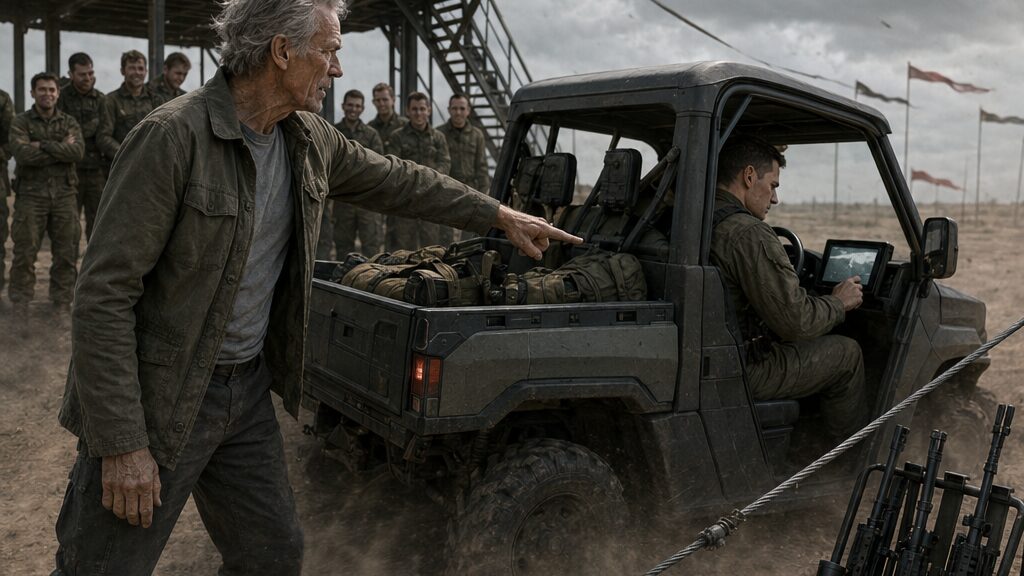
A utility vehicle idled beside the equipment shelter. Its rear bed held rifle cases, spotting screens, power units, and two sealed communications boxes. A small camera above the tailgate showed a bright, clean image on the dashboard display.
Too clean.
Lieutenant Alexander Hall stood beside the open driver’s door, one hand on a tablet. He wore his uniform as if every seam had been inspected for rebellion. Three younger soldiers gathered around him while he explained the positioning overlay.
“The uplink corrects vehicle alignment within ten centimeters,” Alexander said. “Once the tower node confirms the reference point, the system guides the driver into place.”
Mark walked to the rear of the vehicle and wiped a finger across the camera lens. A pale layer of dust came away.
Alexander noticed him. “Something wrong with the equipment?”
“The picture’s stable while it’s parked.”
“That is generally considered a benefit.”
One of the soldiers smiled. Mark ignored it.
He held the camera housing between thumb and forefinger and gave it a careful push. The bracket moved more than it should have.
“Vibration changes it,” Mark said. “Wind’s throwing dust against the lens. Once the vehicle starts moving, the image may lag or blur.”
Alexander glanced at the tablet. “Diagnostics are green.”
Mark looked past him toward the flags. “Diagnostics aren’t standing in this wind.”
Alexander’s jaw tightened, though his voice stayed controlled. “The system was designed for degraded environments.”
“Designed isn’t the same as tested here today.”
Christopher Jackson came down the tower stairs holding a range board beneath one arm. The senior range officer moved with the clipped impatience of a man already behind schedule.
“Tell me we’re not finding new problems,” he said.
Mark pointed toward the southeast fitting. “Same one I marked. It’s moving more.”
Christopher followed his gaze. “Your report classified it as serviceable.”
“I wrote that the wear should be watched under cross-load.”
“And maintenance cleared it for restricted use.”
Mark said nothing.
That had been the exact wording. Restricted use, with monitoring. He had typed it himself after staring at the report for nearly twenty minutes. He could have written suspend operation pending replacement. He could have walked the paper into Christopher’s office and put it directly under his hand.
Instead, he had chosen language that sounded reasonable.
Language that would not start an argument.
Christopher looked toward the dark bank of clouds moving beyond the western ridge. “We have one window before the weather closes us down. If we cancel today, the squad loses the qualification slot for at least three weeks.”
Alexander lifted his tablet. “My equipment is operational. The tower sensors show movement within tolerance.”
Mark looked at the tower, not the screen. “Sensors aren’t mounted on the fitting.”
“They account for total structural displacement.”
“They account for what they were placed to measure.”
Christopher rubbed his thumb along the edge of the range board. “Can we operate safely for four hours?”
Mark felt Alexander watching him.
The honest answer sat behind his teeth: Not if the wind keeps building. Not if the vehicle loads that side. Not if the camera goes blind when they back beneath the platform.
But each answer required another sentence, then another argument. He had spent years being told that contractors advised and officers decided. The distinction had become a wall he no longer tested.
“With monitoring,” he said at last.
Christopher nodded once. “Then monitor it.”
He turned and climbed back toward the platform.
Alexander’s expression did not change, but something eased around his eyes. He had won without having to say so.
Mark moved to the driver’s side mirror and adjusted it outward.
Alexander reached past him and returned it to its original angle.
“The camera provides a wider field,” he said.
“The mirror shows where the vehicle is now.”
“The overlay shows where it will be.”
Mark looked at the tablet. A blue vehicle icon rested inside a yellow guide path. He stepped to the rear wheel and placed a chalk mark on the ground. Then he asked Alexander to roll forward five feet.
Alexander climbed in, moved the vehicle, and stopped.
Mark checked the chalk mark against the tire. The vehicle had traveled nearly seven feet.
He pointed at the display. The blue icon was still moving.
For half a second, Alexander said nothing.
Then the icon settled into its new position.
“Signal refresh,” he said.
“Lag.”
“Less than a second.”
“In a crosswind, a second can move the rear end farther than your screen admits.”
A sharp gust struck the vehicle broadside. Dust rattled against the doors like dry rain.
The rear camera image flickered.
One of the soldiers leaned closer to the display. “It cleared.”
“Because we stopped,” Mark said.
Alexander shut off the engine and stepped down. “The system remains within specification.”
Mark went to the mirror again. In its narrow glass, he could see the support cable, the red inspection mark, and the loaded rear corner of the vehicle in one frame.
Alexander’s screen showed a cleaner world.
No dust.
No vibration.
No cable until the guidance path chose to display it.
The rifle cases were carried from the shelter and secured in the rear bed. Jerry Williams, one of the younger candidates, lifted the last case with both hands. He glanced at Mark’s chalk line, then at the tablet.
“Which position are we using?” Jerry asked.
“The digital reference point,” Alexander said. “That’s the purpose of the demonstration.”
Mark heard the word demonstration and looked toward the small camera mounted on the tower rail. Its indicator light was red.
Christopher had said nothing about recording.
Alexander saw Mark looking. “Post-exercise evaluation. Command wants proof the upgraded system reduces setup time.”
The pressure beneath Alexander’s confidence became visible for only an instant. Then he closed the driver’s door and fastened his seat belt.
Mark returned to the support fitting. Another gust shivered through it. The red mark moved the width of a fingernail.
“Lieutenant,” Mark called.
Alexander raised one hand without looking away from the dashboard.
The reverse lights came on.
The utility vehicle began backing toward the tower, its loaded rear end drifting sideways in the heavy crosswind.
Alexander watched only the screen.
Chapter 2: The Museum Relic Steps Aside
Mark struck the side of the vehicle with the flat of his hand.
The metal report cut through the wind.
“Stop.”
Alexander braked so sharply that one of the rifle cases shifted against its restraint.
Mark stood beside the driver’s window, close enough to see the clean yellow guidance lines on the dashboard. In the physical mirror, the southeast support cable was less than a foot from the vehicle’s rear corner.
On the screen, it appeared farther away.
Alexander lowered the window. “What are you doing?”
“Use your mirrors before you back up.”
“I can see the path.”
“You can see an image of it.”
The squad had gathered beneath the platform. Jerry held the final tie-down strap in his hands. Two others stood near the stair rail, watching the disagreement with the guarded interest of people grateful the attention was not on them.
Alexander pointed at the display. “The system shows clearance.”
Mark pointed toward the mirror. “The mirror shows the cable.”
Alexander looked at the glass. The reflection trembled with the engine. Dust streaked the surface, but the cable was there—close, dark, unmistakable.
Then he looked back at the screen.
No red warning symbol appeared. No alarm sounded.
Alexander’s voice rose just enough for the soldiers to hear. “The proximity system has not registered an obstruction.”
“It’s reading the tower leg. Not the angle of that cable.”
“The cable is mapped.”
“The map isn’t moving in this wind.”
Alexander opened the door and stepped out. “You’ve made your point.”
“No. I stopped the vehicle. That isn’t the same thing.”
The red recording light above them remained steady.
Alexander glanced toward it. When he faced Mark again, his expression had hardened into something polished and public.
“This unit was tested by engineers,” he said. “It was approved through command. It does not become unsafe because a maintenance contractor dislikes the interface.”
Mark felt the old pressure gather in his chest, not anger but the expectation of being dismissed. It was familiar enough to have shape.
He could call Christopher down.
He could order the equipment unloaded under his authority as the armory contractor.
He could say the fitting had moved more since sunrise and force the range to decide in writing.
Instead, he heard himself say, “I don’t dislike it. I don’t trust it alone.”
A gust shoved against the tower. The range flags cracked like whips.
Mark pointed toward them. “Your camera is fixed to the vehicle. Your GPS updates after the movement. The wind is pushing the rear end sideways between refreshes. Use the mirror and a ground guide.”
Alexander gave a thin smile.
“If I wanted advice from a museum relic, I’d buy a ticket.”
The words landed in the open space beneath the tower.
One of the soldiers made a short sound before swallowing it. Jerry laughed once, uncertainly, then looked down at the strap in his hands.
Mark did not answer.
Alexander had expected one. His posture remained set for resistance, chin slightly lifted, shoulders squared toward the recording camera.
Mark stepped away.
The movement cost him more than the insult.
He crossed to the edge of the equipment shelter and picked up his inspection clipboard. The paper beneath the metal clip fluttered wildly. He held it down with one hand and stared at the sentence he had written three days earlier.
Monitor for increased movement under lateral load.
There it was. Accurate enough to defend. Weak enough to ignore.
Behind him, Alexander addressed the squad. “Continue loading. We are not allowing unsupported opinions to interrupt a qualification exercise.”
Jerry secured the strap, but his eyes moved to the side mirror.
From where he stood, the glass caught both the vehicle’s rear corner and the cable. He shifted one step left, comparing it to the dashboard display through the open window.
“Sir,” he said.
Alexander turned.
Jerry’s mouth closed.
“What is it?”
“Nothing, sir.”
Mark watched the young man retreat from his own observation. The same small surrender. The same decision to let rank carry the burden of truth.
Mark could have stopped it then.
He knew that later.
In the moment, he remained beside the shelter with the clipboard against his leg.
Alexander climbed back into the vehicle. The red recording light stayed on. He tapped the screen, recalibrated the route, and engaged reverse.
A soft electronic tone sounded.
The vehicle moved.
For the first few feet, the camera image remained clear. The yellow guidelines curved neatly toward the marked parking position beneath the tower. The blue icon tracked the vehicle with measured precision.
Then the crosswind hit.
The rear end slid toward the cable.
Mark saw it in the mirror.
The dashboard still showed clearance.
“Hold,” Jerry called, too softly.
Alexander either did not hear him or chose not to.
Mark took one step forward.
The vehicle stopped.
Alexander adjusted the steering wheel, watching the overlay correct itself. The blue icon shifted after the tires had already turned.
There. The lag.
Visible now.
Jerry saw it too. His head snapped from the screen to Mark.
Alexander eased back again.
Dust swept across the range in a low brown sheet. It struck the vehicle and climbed over the tailgate. The camera image bloomed pale, then recovered.
A warning box flashed on the display.
SIGNAL QUALITY REDUCED.
Alexander cleared it with his thumb.
Mark started toward him. “That’s enough.”
Alexander kept moving. “The feed is active.”
“The lens is loading with dust.”
“It has automatic compensation.”
“Compensation can brighten dirt. It can’t see through it.”
Alexander’s mouth tightened. “Return to your station.”
The phrase stopped Mark more effectively than the insult.
Return to your station.
Years fell away in a single breath: a dark interior, dead navigation screens, rain beating against metal, a younger voice saying the ridge line looked wrong. Mark had seen the same thing. He had kept his place.
He had waited for permission.
The memory vanished beneath another blast of wind.
The camera feed flashed white.
Alexander lifted his foot from the brake.
In the physical mirror, the support cable vanished behind the vehicle’s rear corner.
Chapter 3: When the Camera Turned White
The display turned white one second before steel tore against steel.
The utility vehicle lurched sideways.
A rifle rack folded inward with a shriek. Two cases dropped from the rear bed. One struck the tower leg, burst its latch, and spilled a qualification rifle across the gravel.
The vehicle’s rear corner caught the support cable and pulled it tight.
The tower shifted.
Above them, boots hammered against the platform as the soldiers on the stairs grabbed for the rails.
“Brake!” Mark shouted.
Alexander’s foot was already down, but the vehicle kept moving an inch at a time, dragged sideways by its own angle and the wind pressing against the loaded bed.
The dashboard erupted in warnings.
CAMERA OBSCURED.
REFERENCE SIGNAL LOST.
POSITION UPDATE PENDING.
Alexander stared at them as if one of the messages might explain which danger mattered first.
“Neutral,” Mark said. “Set the brake. Nobody touch the cases.”
Alexander reached for the gear selector, then stopped when the GPS icon jumped backward on the map.
“That position is wrong,” he said.
Mark looked through the windshield at the actual wheel angle. “Forget the map.”
The cable gave a high, singing vibration.
Everyone heard it.
Jerry stood beneath the lower stairs with another rifle case sliding toward him from the damaged rack. He looked at Alexander for direction.
Alexander looked at the screen.
Mark raised one hand and pointed sharply toward the shelter.
Jerry obeyed. He caught the case against his chest, dragged it clear of the cable line, and shoved it behind the concrete barrier.
“Everyone off the stairs,” Mark called. “Move away from the southeast side.”
This time the squad moved.
Christopher descended from the platform, one hand on the rail. “What happened?”
“Camera whited out,” Alexander said. “The GPS dropped position.”
“The vehicle drifted,” Mark said. “The cable’s under load.”
Christopher looked from the strained line to the bent rack. “Can we move it?”
“Not until we know what the fitting is doing.”
A metallic crack came from above.
The tower settled half an inch.
Amanda Torres ran from the medical shelter with her field bag bouncing against her hip. “Anyone hit?”
“No,” Christopher said.
“Not yet,” Mark added.
Alexander flinched at the words.
The rifle that had fallen lay on its side near the rear wheel. Its digital optic was dark. Dust coated the receiver and filled the open edge of the action.
Alexander moved toward it.
“Leave it,” Mark said.
“It belongs to my system.”
“It belongs to the range until it’s safe.”
Alexander picked it up anyway.
The bolt had locked partially rearward. He pulled at the charging handle. Nothing moved.
“Put it down,” Mark said.
Alexander pulled harder.
The rifle shifted in his hands, muzzle crossing toward the open ground near the squad.
Mark closed the distance and caught the handguard, forcing it down.
“Stop.”
Alexander jerked the rifle back. “Take your hand off it.”
“Clear the area first.”
“I know how to clear a malfunction.”
“Then act like it.”
The squad had fallen silent. Even the wind seemed farther away beneath the rapid electronic alarms from the vehicle.
Alexander tried the charging handle again. His face reddened.
Mark could see what the others saw now: not an officer solving a problem, but a man fighting an object because it had refused to obey him.
“The action’s locked,” Mark said. “Forcing it here is reckless.”
“You’ve done enough.”
Mark released the handguard but did not step back. “Set it on the mat. Point it downrange. Get everyone behind the barrier.”
Alexander looked past him.
Jerry stood near the shelter, breathing hard. The laughter was gone from his face.
Christopher’s expression had changed too. He was no longer watching the equipment. He was watching Alexander.
The realization struck the lieutenant like another collision. Every pair of eyes had become a judgment.
He thrust the rifle toward Mark. “You wanted control? Take it.”
Mark did not reach for it.
“Not until the line is secured.”
Alexander dropped the rifle onto the rubber mat. It landed hard enough to make Amanda curse.
“What is wrong with you?” she said.
Alexander turned toward Mark. “He interfered with an active demonstration. He struck the vehicle. He distracted the driver.”
“You were the driver,” Jerry said.
The words escaped before he could stop them.
Alexander faced him. “What did you say?”
Jerry’s gaze fell, but only for a moment. “The mirror showed the cable, sir.”
Mark saw fear pass through the young soldier’s face. He also saw him remain where he stood.
Alexander looked back at the blank rear-camera feed. Dust had turned it into a bright gray field. On the GPS overlay, the vehicle icon now sat safely inside the intended path.
The screen showed a position the vehicle had never occupied.
Alexander slapped the display.
It did not change.
The tower cable hummed above them.
Christopher stepped between the vehicle and the squad. “Power the system down.”
Alexander did not move.
“That is an order,” Christopher said.
Alexander reached into the cab and killed the display. The warnings vanished. The sudden absence of electronic sound left only wind, rattling steel, and the rough breathing of people who had come too close to being hurt.
Mark crouched beside the southeast fitting.
The red grease-pencil mark was no longer aligned. The retaining plate had twisted against its bolts. A bright crescent of exposed metal showed where the housing had shifted.
Christopher came beside him.
“How bad?”
“Loaded wrong and moving.”
“Can it hold?”
“For now.”
“That is not an answer.”
“It’s the only honest one.”
Christopher stared at the fitting. “Was this in your report?”
Mark felt the clipboard against his leg, though he had left it by the shelter.
“Wear was.”
“This movement?”
“Not this much.”
Alexander approached from behind them. His voice was low and sharp. “Because it did not happen until he disrupted the maneuver.”
Mark stood.
The lieutenant’s right hand closed into a fist.
Amanda saw it first. “Alexander.”
He stepped toward Mark.
Perhaps he meant only to shove him. Perhaps, with the squad watching and the screens dead and Jerry’s correction still hanging in the air, he needed one thing to yield.
He swung hard.
Mark moved half a step.
The punch passed in front of his chest. Alexander’s momentum carried him into the tower rail. His shoulder struck steel at an angle, and a blunt pop sounded beneath the wind.
Alexander dropped to one knee with a strangled cry, clutching his arm.
Amanda was beside him immediately. “Do not move it.”
Mark remained where he had shifted, hands open at his sides.
No satisfaction came. Only weariness.
Christopher looked at the lieutenant, then at Mark, then down toward the strained fitting.
His gaze stopped on the red grease-pencil line.
He crouched and touched it with one finger. The mark crossed both the fixed plate and the section that had rotated out of alignment.
“You marked this before today,” he said.
Mark did not answer quickly enough.
Christopher turned to him.
“Why wasn’t this range shut down?”
Chapter 4: The Report That Said Too Little
Christopher placed Mark’s maintenance note beside a photograph of the twisted support fitting.
“Tell me why these look like two different hazards.”
The range control room was too small for the number of people inside it. Dust streaked the narrow windows. Wind pressed against the walls in blunt, uneven blows, and every few seconds the disabled tower camera flashed a frozen image across the largest monitor.
Mark stood at the end of the table.
In the photograph, his red inspection line had split apart where the retaining plate had rotated. In the report beneath it, the words were neat and restrained.
Minor lateral movement observed. Monitor under cross-load. Suitable for restricted operation pending scheduled service.
Christopher tapped the final sentence.
“You wrote suitable.”
“I wrote restricted.”
“You knew what word would be remembered.”
Mark looked at the paper. “Yes.”
Across the room, Alexander sat with his right arm secured against his chest. Amanda had reduced the dislocation, but his face remained gray beneath the anger. An ice pack rested against his shoulder.
“The accident was caused by unexpected environmental interference,” Alexander said. “Not by the fitting.”
Christopher did not look at him. “The fitting is bent.”
“Because the vehicle was stopped abruptly and then approached by unauthorized personnel.”
Mark lifted his eyes.
Alexander met them. The accusation was controlled now, stripped of the wildness that had preceded the punch.
“He struck the vehicle,” Alexander continued. “He interfered with an active demonstration. He issued commands outside his authority and distracted the operator.”
Amanda adjusted the strap across Alexander’s chest. “You also tried to hit him.”
Alexander’s mouth tightened.
Christopher turned. “The injury happened during the collision?”
“No,” Amanda said. “It happened afterward, when he swung at Mark and met the rail instead.”
Silence filled the control room.
The frozen tower image changed. For one frame, the utility vehicle appeared straight beneath the platform. Then the feed skipped ahead and showed it angled against the cable.
The recording had missed the drift between those images.
Christopher crossed to the console and replayed the sequence.
Straight.
Static.
Collision.
“The system log shows a safety pause,” he said.
Alexander said nothing.
Christopher expanded the data. “It initiated when camera confidence dropped below threshold.”
“The warning was transient.”
“You cleared it.”
“The vehicle remained controllable.”
“You cleared an automatic safety pause while visibility was degraded.”
Alexander leaned forward and flinched as the movement pulled his shoulder. “The demonstration was being evaluated. A false stop would have been recorded as system failure.”
“It was system failure.”
“It was recoverable.”
Mark looked toward the monitor. The camera showed only selected moments. Every screen in the room offered numbers, timestamps, and tidy lines. None showed the cable sliding out of the mirror’s edge. None showed Jerry open his mouth and decide not to speak.
Christopher returned to the table.
“Mark, when did you first notice increased movement?”
“This morning.”
“And when did you notify me?”
“I told you it was moving more.”
“You also told me we could operate with monitoring.”
Mark could feel Amanda watching him.
The easier answer waited nearby: Christopher had made the decision. Alexander had ignored the warning. Maintenance had approved restricted use. Every fact was true.
None was complete.
“I should have stopped it,” Mark said.
Alexander gave a short breath that might have been satisfaction.
Christopher’s expression hardened. “You did not have command authority to cancel the range.”
“I had authority over the equipment.”
“Then why didn’t you pull it?”
Mark looked again at his report.
Because the last time he had insisted, someone had called him difficult. Because every uniform in the room had taught him where his voice ended. Because after enough years outside the chain of command, a man learned to package concern so no one could accuse him of overstepping.
Those answers sounded thin beside the photograph.
“I thought the warning was enough.”
Christopher looked almost offended. “You thought?”
“I expected someone else to make it official.”
Jerry stood near the door, dust still on his uniform. He had been brought in to give a statement, but he had not yet spoken.
Christopher turned toward him. “You saw the mirror?”
Jerry swallowed. “Yes, sir.”
“Before the collision?”
“Yes.”
“Did you say anything?”
“I tried.”
Alexander stared at him.
Jerry’s shoulders drew inward. “I said ‘hold,’ but not loud enough.”
“Why not?”
The young soldier glanced at Mark.
It was brief, but Mark understood.
Because the lieutenant had already made an example of the older man who challenged him. Because silence looked safer when authority had chosen its version of reality.
Jerry looked at the floor. “I didn’t want to be wrong in front of everyone.”
Mark felt the answer settle against his ribs.
The same fear, wearing a younger face.
Christopher closed the report folder. “The range is suspended. The tower remains restricted until engineering clears the support assembly. All recordings and system logs are preserved.”
Alexander straightened. “My evaluation—”
“Is no longer the priority.”
“The modernization review is tied to this exercise.”
Christopher faced him. “Then the review will include what happened.”
Alexander’s gaze shifted toward Mark. “Including contractor interference.”
Mark had spent years letting accusations pass because answering them made things larger. He nearly did it again.
He could accept a portion of blame, sign whatever corrective statement appeared, and return to the armory once the tower reopened. Alexander would defend his program. Christopher would revise a procedure. Jerry would learn to speak a little louder next time.
Nothing deeper would change.
Then Jerry folded his hands behind his back and went still—the posture of someone making himself smaller beneath rank.
Mark turned toward Christopher.
“The first mistake wasn’t the camera,” he said.
Christopher waited.
“It was training people to believe a dead screen meant they had no other way to know where they were.”
Alexander’s face changed, not much, but enough.
Mark continued before the old instinct could stop him.
“I’ve seen a whole team wait for satellites to come back. Navigation gone. Powered sights gone. Weather closing the ground around them.”
The wind hit the control room wall.
For an instant, the electronic tone from the damaged communications unit sounded from the adjoining equipment bay—three descending notes, then silence.
Mark knew that sound.
His hand tightened on the edge of the table.
Christopher’s voice lowered. “What happened to that team?”
Mark looked past the frozen screens toward the flags bending outside.
“One of them never came home.”
Chapter 5: The Team That Waited for Satellites
The damaged communications unit gave three descending tones from the equipment bay.
Mark named the fault before the technician reached the shelter door.
“Timing reference loss.”
The technician paused with one hand on the frame. “That code isn’t on the local display.”
“It won’t be. Listen to the interval.”
The tone repeated—three notes, a four-second pause, then three again.
Mark had heard it in another place, under harder rain, with mud pressing against the tires and young men waiting for a screen to tell them which direction was safe.
Christopher watched him from across the storm shelter.
The firing line had been closed, and the squad had been moved inside while engineers traveled from the main installation. Alexander sat behind a canvas partition in the treatment area, his injured arm fixed in a sling. Amanda stood near the opening, close enough to keep him from pretending the injury did not matter.
“You recognized that quickly,” Christopher said.
Mark looked at the communications box. “Some sounds stay.”
No one spoke for several seconds.
Jerry sat on a folding bench with a training tablet resting dark across his knees. The other candidates had been sent to inventory equipment, but Christopher had kept him there because he had witnessed the collision.
Amanda folded her arms. “You said one man didn’t come home.”
Mark moved toward the shelter window. Beyond the glass, the tower stood against the brown sky with the vehicle still caught beneath it. The red inspection mark was too far away to see, but he knew exactly where it was.
“It was a long time ago.”
“That does not make it unrelated,” Christopher said.
Mark’s reflection hovered faintly in the window. Behind it, range flags pulled nearly flat in the wind.
“We were moving through bad ground,” he said. “Weather came faster than forecast. Satellite navigation began dropping in and out. Then the optics failed.”
Jerry looked up from the dark tablet.
“We had maps,” Mark continued. “Compasses. Terrain references. Enough to move if we trusted what was in front of us.”
“But you waited,” Amanda said.
Mark nodded.
The admission hurt less than the memory of the waiting.
A younger soldier had found a rock formation on the paper map that matched the ridge outside. Mark had seen it too. Their actual position was farther east than the digital track claimed. Moving toward the ridge would have taken them to better ground before the flood channel filled.
The officer in charge ordered them to hold for satellite restoration.
Mark had known the order was wrong.
He had also known his place.
“We waited for the screens,” he said. “The water rose. By the time we moved, the route was gone.”
He did not describe the search that followed. He did not describe the empty seat on the return trip or the mud drying on a young soldier’s gloves.
Christopher’s voice was quiet. “You could have overridden the order?”
“No.”
“Could you have argued harder?”
Mark watched the range flag shudder.
“Yes.”
Amanda lowered her arms.
That was the wound stripped of decoration. Not that Mark had lacked rank. Not that the equipment had failed. He had seen the physical truth and chosen obedience over insistence.
“I told myself I had warned them,” he said. “I had. Once.”
Jerry’s fingers tightened around the edge of the tablet.
Christopher sat on the end of the folding table. “Why didn’t you teach the lesson afterward?”
“They wrote new procedures.”
“That isn’t what I asked.”
Mark glanced toward the partition. Alexander’s boots were visible beneath it, motionless.
“I did not want to stand in front of young soldiers and tell them I knew better after someone was already dead.”
“So you stopped standing in front of them.”
“Yes.”
The word left nothing to defend.
Jerry looked down at his tablet and pressed the power button. The qualification program opened to a sequence of digital wind calculations, optic confirmations, and automated correction prompts.
“Sir,” he said to Christopher, “when do we do the stage without this?”
Christopher frowned. “Manual backup is covered during preliminary instruction.”
“I mean an entire stage.”
The young soldier scrolled through the program.
“When do we shoot without powered optics? Or move the support vehicle without the camera?”
Christopher looked toward Alexander’s side of the shelter.
“We conduct degraded-system drills.”
Jerry shook his head. “The system tells us it’s degraded. Then it gives us the backup steps.”
Mark almost smiled, but there was nothing amusing in it.
Even the failure had been mediated.
Amanda pulled the partition aside and stepped through. Alexander sat upright on the treatment cot. Pain had dulled the edge of his anger, but not removed it.
“The program is designed around the equipment we actually deploy,” he said.
Jerry went rigid.
Alexander looked at Mark. “We are not preparing soldiers for a museum exhibit.”
Amanda’s expression sharpened. “Careful.”
Alexander ignored her. “Modern systems reduce error. They extend range. They save time. Pretending otherwise because one contractor carries an old regret is irresponsible.”
Mark turned from the window.
“I never said the systems were useless.”
“You removed them from the solution the moment they failed.”
“They removed themselves.”
Alexander flinched, this time without moving.
Mark saw the truth beneath the lieutenant’s hostility: the dead screens were not merely broken tools. They were evidence being gathered against him.
Christopher saw it too. “What exactly is tied to today’s demonstration?”
Alexander looked away.
“The modernization review,” Christopher said. “You mentioned it earlier.”
For a long moment, Alexander seemed ready to refuse.
Then he spoke through his teeth.
“My promotion recommendation was deferred after a previous satellite exercise lost synchronization in front of command observers. I was assigned to prove the revised architecture could function under environmental stress.”
Amanda glanced toward the tower. “So you continued because stopping would look like another failure.”
“The pause was triggered by reduced camera confidence, not total loss. The system could have recovered.”
Mark studied him.
Alexander was not a fool. He had designed redundancies, understood signal paths, and likely knew more about the communications architecture than anyone at the range. But the system had become inseparable from his worth. Every warning sounded personal because failure threatened more than equipment.
“They taught you to trust it,” Mark said.
Alexander’s eyes narrowed.
“They rewarded you for making everyone else trust it too.”
“That does not excuse your interference.”
“No.”
The answer unsettled him more than resistance would have.
Mark stepped closer to the treatment area.
“I should have pulled the vehicle before you ever climbed inside. I knew the fitting was wrong. I wrote around it because I didn’t want another fight with command.”
Christopher absorbed the admission without interrupting.
“But you cleared the warning,” Mark continued. “You saw what the wind was doing. You heard Jerry. You chose the demonstration.”
Alexander looked at the sling across his chest.
Neither man had anywhere left to hide.
A deep metallic groan came from outside.
Everyone turned.
Through the shelter window, the utility vehicle rolled several inches sideways. Its rear tire shifted in the gravel, and the strained support cable snapped taut.
The lower tower platform jerked.
An unsecured equipment case slid across the deck above and struck the rail.
Christopher reached for his radio. Only static answered.
Mark was already moving toward the door.
“Stay here,” Christopher said. “Engineering is coming.”
Another gust hit the vehicle.
The cable tightened further.
Mark looked once at Christopher, then at the tower.
Years earlier, he had waited for permission while water erased the route.
This time, he opened the shelter door and walked into the wind.
Chapter 6: Two Seconds After the Screens Died
The support cable released a sharp metallic crack.
“Everybody off the tower,” Mark ordered.
He did not look at Christopher.
He pointed to Jerry. “Clear the lower path. No one crosses behind that vehicle.”
Jerry moved at once, shouting the order toward the two soldiers near the equipment barrier.
Mark crossed the gravel with the wind pushing at his left shoulder. The utility vehicle sat crooked beneath the tower, its loaded rear corner pressing into the support line. The driver’s-side mirror trembled but still reflected the rear tire, the cable, and a narrow strip of open ground.
The dashboard screens were dark.
Good.
No one would wait for them.
Christopher caught up beside him. “What do you need?”
“A ground guide on the left. Wheel chocks. Two people on the loose cases, but nobody enters the cable line.”
Christopher relayed the orders.
Mark crouched near the front tire and studied its angle. The vehicle did not need to travel far. It needed to move straight enough to release pressure without dragging the support farther out of alignment.
Amanda appeared at the shelter entrance. “Alexander stays inside.”
“No,” Alexander called behind her.
He came out with his arm secured, face tight against the pain.
Amanda moved to stop him, but he raised his uninjured hand. “The vehicle’s communications controller shares the auxiliary power circuit with the parking assist.”
Mark looked toward him.
“If the damaged controller is still energized,” Alexander said, “the brake module may pulse when the ignition comes on. Disconnect the auxiliary circuit first.”
Christopher glanced at Mark.
The old reflex would have rejected the advice simply because of its source.
Mark nodded. “Show Jerry which cutoff.”
Alexander did not expect that.
For half a second, the anger left his face.
He directed Jerry to an external panel near the front wheel. Jerry opened it, found the marked switch, and isolated the damaged circuit.
“Done,” Jerry called.
Mark climbed into the driver’s seat.
The blank camera display reflected his weathered face. He turned it away and adjusted the side mirrors until both rear corners were visible.
Jerry took position well outside the danger line.
Mark lowered the window. “Hand signals only. If you lose sight of me, stop the movement.”
Jerry nodded.
The engine started without the electronic chime. No guidance path appeared. No blue icon reassured anyone.
Mark placed the vehicle in gear and watched the mirror.
Jerry raised one hand, then moved it slowly.
The vehicle crept forward.
A gust struck broadside. Mark felt the rear begin to slide before the mirror showed it. He corrected gently.
The cable’s pitch lowered.
“Hold,” Jerry called.
Mark stopped.
One soldier placed the chock. Another secured the loose case that had shifted toward the tower stairs.
“Again,” Mark said.
Jerry guided him another foot.
The support line relaxed.
The tower settled back against its undamaged braces with a long groan instead of a snap.
Christopher exhaled. “Chock it. Kill the engine.”
Mark obeyed.
When he stepped down, no one cheered. The silence was better than applause. It meant they were watching closely enough to understand that the danger had not been dramatic. It had been made of small choices.
The rifle still lay on the rubber mat, its action locked and its dark optic coated with dust.
Christopher looked toward it. “Can it be transported as-is?”
Mark shook his head. “Not safely.”
Alexander shifted beside Amanda. “The action has to be resolved here.”
Mark looked at him.
“That is correct,” he said.
The lieutenant’s jaw tightened, but he did not turn the agreement into a contest.
Christopher cleared the area and established a controlled line. The squad moved behind the barrier. The rifle remained pointed toward the range, isolated from the scattered equipment.
Mark knelt beside it.
He checked the condition methodically, speaking only enough for Christopher to confirm each safety step. The weapon had taken grit and impact at the worst possible angle. Its powered optic remained dead, but the iron sights beneath it were intact.
Alexander watched from several yards away.
“Charging handle is locked,” Christopher said.
Mark nodded.
He did not rush. Speed without order was only another kind of panic.
Once the line was controlled and the rifle’s direction secure, he used the old field method the situation required—a firm, disciplined movement born from repetition rather than force for its own sake.
The butt struck the protected ground.
The action released.
Mark worked it once.
A damaged round came free and landed on the mat.
Two seconds of motion ended what several minutes of anger had failed to solve.
No one spoke.
Mark inspected the chamber, secured the weapon, and removed the dead optic. Beneath it, the iron sights formed a plain, uninterrupted line toward the distant targets.
He rose and handed the rifle to Christopher in its safe condition.
Jerry stared at the removed optic. “You knew that would work?”
“I knew what had to move,” Mark said. “That’s different.”
The distinction seemed to trouble the young soldier in a useful way.
Alexander stood rigidly beside Amanda. His face held no trace of the confidence he had worn that morning, but neither was it empty. He had contributed when the brake circuit mattered. Mark had used the information. The tower stood because old observation and modern knowledge had finally occupied the same problem without fighting for status.
Christopher carried the rifle to the secure case.
Then he returned to Mark.
“The squad needs to hear what happened here.”
“They saw it.”
“They saw pieces.”
“That is usually enough.”
“No,” Amanda said from behind them. “It was not enough when you wrote the report.”
Mark turned.
Her words were not cruel. That made them harder to dismiss.
Christopher lowered his voice. “Address them before they leave.”
Mark looked at the candidates gathered beyond the barrier. Jerry stood nearest. The others avoided his eyes, perhaps remembering their laughter, perhaps waiting for him to make them feel worse.
Mark had no desire to stand in front of them as proof that an old man had been right.
“I’m a contractor,” he said. “Write the corrective action. Add the manual block. That’s your job.”
He began walking toward the equipment shelter.
Behind him, Christopher said, “Mark.”
He kept moving.
Then Alexander’s voice carried across the gravel.
“Wait.”
Mark stopped, but did not turn.
The wind pulled at his jacket. On the tower, the dead camera faced the range without seeing anything.
Alexander took one careful breath.
“I need to say this before he does.”
Chapter 7: What Still Works When Everything Dies
Alexander arrived the next morning with his arm secured against his chest and ordered the squad to shut off every screen.
No one moved at first.
The tower had reopened under temporary restrictions after engineers replaced the damaged support fitting and marked the southeast side with fresh inspection paint. The utility vehicle stood on level ground nearby, its rear camera uncovered, its GPS receiver active, and its displays glowing with orderly lines.
Alexander faced the candidates beneath the lower platform.
“All of them,” he said.
Jerry reached into the vehicle and powered down the dashboard display. Another soldier switched off the electronic spotting station. One by one, the tablets, range monitors, and digital optics went dark.
The wind was lighter than the day before, but it still moved across the open ground in visible layers. Near the tower, the flags leaned east. Farther downrange, they pulled south for several seconds before changing again.
Mark stood beside the equipment shelter with his clipboard tucked beneath one arm.
He had come to inspect the replaced fitting, sign the restricted-use form, and return to the armory. That was all he had agreed to do.
Christopher approached carrying a thin folder.
“The preliminary review is complete,” he said.
Mark looked at the tower. “That was quick.”
“The final review will take longer. The immediate corrections cannot.”
He opened the folder.
“The modernization program stays. The equipment did not create every failure yesterday.”
Mark glanced toward Alexander.
“No,” he said. “It didn’t.”
“Manual movement procedures will be added to every vehicle block. Full qualification stages will be conducted without powered optics or digital wind correction. Contractors assigned to safety-critical systems will have authority to trigger an operational pause.”
Mark’s eyes returned to Christopher.
“That last one will make people unhappy.”
“It already has.”
“Good sign it was needed.”
Christopher handed him a page from the folder. At the top, beneath the range designation, was a proposed title for a permanent instructor position.
Mark did not take it.
“I maintain equipment.”
“You also know what to do when it stops maintaining anyone.”
“That doesn’t make me an instructor.”
“No. Knowing how to explain it would.”
“I haven’t proved that.”
“You have not tried.”
Mark looked past him.
The squad had formed a loose line near the tower. Jerry stood at the front, watching the physical flags instead of the dead spotting display. Amanda waited beside the medical vehicle, not close enough to appear involved but near enough to prevent Alexander from pretending his shoulder had healed overnight.
Alexander stepped forward.
The wind pressed his uniform sleeve against the sling.
“Yesterday,” he said, “I ignored a valid safety warning.”
The squad remained silent.
“I cleared an automatic pause because I believed stopping the demonstration would damage confidence in the system. After the collision, I handled the rifle without establishing control of the line. I blamed the person who warned me.”
His gaze moved toward Mark.
“And I attempted to strike him.”
There was no recording camera active now. No red light waited to preserve the words for an evaluation. Alexander had chosen the place where the insult had happened and the same people who had heard it.
“I confused confidence with refusing correction,” he said. “That was not a technical failure.”
Mark saw Jerry’s shoulders shift, as though something heavy had been removed from the air between rank and truth.
Alexander took a careful breath.
“Mr. Walker, I am formally requesting that you teach this squad the old way.”
Mark’s answer came before he could soften it.
“There is no old way.”
Alexander’s face tightened, but he waited.
Mark stepped toward the utility vehicle and touched the side mirror. Dust remained in its corners despite the morning cleaning.
“There is the primary system,” he said. “Then there is what remains when the primary system is gone.”
He pointed toward the dark dashboard.
“You do not throw this away because it failed once. You learn what it can tell you, what it cannot tell you, and how to recognize the difference.”
His hand moved from the mirror toward the range flags.
“The lesson is not that older tools are better. The lesson is that no tool gets to carry your responsibility.”
Jerry raised his hand slightly, then stopped as if unsure whether the moment allowed questions.
Mark noticed.
“What?”
Jerry lowered his hand. “How do we know when to stop trusting the system?”
Mark considered the dead screens, the shifting flags, and the tower fitting now marked in clean yellow paint.
“You do not stop trusting it all at once,” he said. “You compare it to something independent. A mirror. A map. The ground. Another person’s eyes. When they disagree, you slow down before deciding which one you want to believe.”
Christopher held out the instructor-position page again.
Mark shook his head.
“I’ll give them the block today.”
“This cannot depend on whether you happen to be assigned here.”
“Put it in the manual.”
“A manual did not stop the vehicle.”
The words struck harder than Christopher intended. Mark looked at him.
Christopher did not retreat.
“You wrote a warning that allowed everyone to continue,” he said. “I read it the way the schedule needed me to read it. Alexander trusted a system because his career needed it to work. Jerry saw the cable and barely spoke. We all found a way to make someone else responsible.”
Amanda came closer.
“Teaching one class lets you leave with the pleasant part,” she said. “Being right.”
Mark looked toward her.
“And the unpleasant part?”
“Staying.”
The wind shifted. The nearest flag sagged, then lifted in the opposite direction.
Mark had believed for years that silence was restraint. He had worn it like discipline, polished it with patience, and called it respect for authority. But silence had protected him too. It had spared him arguments, accusations, and the risk of being wrong loudly.
It had not protected the young man who never came home.
It had not protected Jerry beneath the tower.
Mark took the page from Christopher.
“I understated the hazard,” he said, loud enough for the squad to hear. “I saw more than I wrote. When my warning was dismissed, I stepped aside.”
Alexander watched him carefully.
“That does not excuse what happened after,” Mark continued. “But it is part of what happened.”
He looked at Christopher.
“I will teach under three conditions.”
Christopher waited.
“Every manual block ends with the digital system turned back on. They learn how the two support each other, not how to choose tribes.”
“Agreed.”
“Any person who sees a safety contradiction can call a pause. Rank answers the evidence before the person.”
Christopher nodded.
“And nobody calls it the old way.”
A faint movement passed through the squad—not laughter, but relief.
Alexander looked toward the powered-down equipment. “What do we call it?”
Mark handed the clipboard to Christopher.
“The way that still works.”
He led them first to the vehicle.
Jerry took the driver’s seat. Alexander stood outside on the safe side of the movement lane, directing with his uninjured hand. Mark adjusted the mirrors, then deliberately left the camera off.
“Do not look for certainty,” he told Jerry. “Look for disagreement.”
Jerry checked the left mirror, the right mirror, the ground guide, and the angle of the rear tire.
The vehicle moved backward slowly and stopped exactly where it should.
At the firing line, Mark removed the dead electronic optic from the damaged rifle and placed it beside the repaired unit that would replace it. He did not let anyone treat one as failure and the other as salvation.
He showed them the iron sights beneath.
Then he pointed downrange.
“Before you touch the rifle, tell me what the wind is doing.”
The candidates studied the flags.
Several answered too quickly.
Jerry waited.
The near flag pushed east. The middle flag changed direction. At the distant target, heat distortion bent through the air at a different angle than either.
“It isn’t one wind,” Jerry said.
Mark nodded once. “Now you’re looking.”
Jerry settled behind the rifle. He checked the direct view before glancing at the restored display beside him.
The screen offered a number.
The range offered a pattern.
He adjusted, breathed, and fired.
Far downrange, a steel target rang through the crosswind.
Mark kept his eyes on the flags as the sound returned across the open ground.
This time, no one had waited for a screen to tell them what they had already seen.
The story has ended.