The Medal Gregory Tried to Sell Before His Last Brother Died Alone
Chapter 1: The Price Placed on a Torn Ribbon
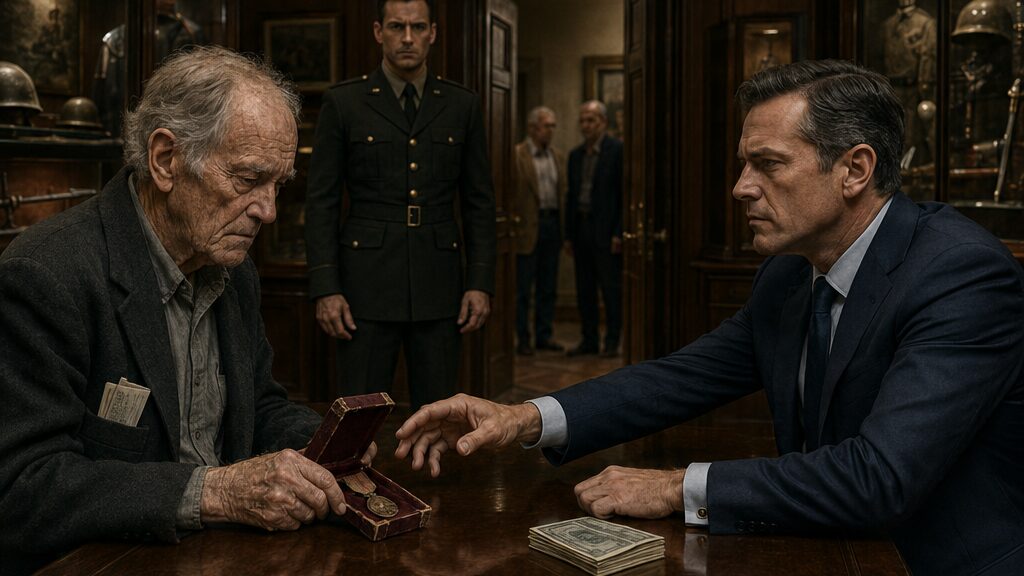
Jeffrey Davis shoved the open velvet box across the polished desk before Gregory Martin had fully lowered himself into the leather chair.
“I’m doing you a favor taking this junk.”
The box stopped against Gregory’s wrist. The impact made the Bronze Star jump in its faded lining. One corner of the case had split years ago, exposing a pale seam beneath the dark velvet. Gregory pressed his thumb over the crack as though the box might come apart if he released it.
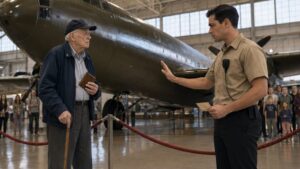
Behind him, the private gallery remained unnaturally quiet. Glass cabinets held helmets, field radios, bayonets, flight jackets, and framed citations under careful pools of light. Three customers waited beyond the half-open office door. One wore a dark service uniform. Gregory had noticed him only because the man stood straight without appearing stiff.
Jeffrey leaned back and studied Gregory’s coat, his worn shoes, and the tremor running through the hand that held the box.
“The ribbon is torn,” Jeffrey said. “The case is cracked. The finish has oxidation.”
Gregory looked at the small stack of bills Jeffrey had placed on the desk.
“That is not what you offered on the telephone.”
“On the telephone, you said you had a Bronze Star. You did not describe its condition.”
“It is the same medal in either condition.”
“Not to a buyer.”
Jeffrey picked it up by the edge. The ribbon had faded from bright red, white, and blue to softer colors, and one side had been repaired with uneven stitches. He pinched the damaged section between two fingers.
Gregory’s thumb pressed harder against the box.
Jeffrey turned the medal, and the small bronze “V” device caught the desk lamp. His eyes paused on it. The pause lasted no more than a breath, but Gregory saw the change: the slight narrowing, the calculation, the quick glance at the engraved name on the back.
Then Jeffrey placed the medal face down.
“With the damage,” he said, sliding two bills away from the stack, “this is the best I can do.”
Gregory stared at the reduced amount. His right hand shook again. He put it beneath the desk.
From his coat pocket, a folded itinerary protruded beside a hospice number written in blue ink. The flight left at three forty-five. A connection followed, then a hired car for the last eighty miles. He had calculated the cost six times at his kitchen table.
The money Jeffrey offered would not cover the car.
“I need the amount we discussed.”
“Then you need a medal in the condition you implied.”
“I did not imply anything.”
Jeffrey gave a small, practiced smile. “Everyone believes the story increases the value. Collectors pay for provenance, documentation, condition. Not grief.”
Gregory lifted his eyes.
“Timothy is not part of your appraisal.”
“Who?”
“The man connected to that medal.”
The tremor stopped.
Jeffrey seemed to notice. He placed both hands on the desk, his cuff links shining beneath the lamp.
“If this Timothy has papers proving historical significance, I can review them.”
“He has a hospice bed.”
The words settled between them.
Gregory removed the itinerary and unfolded it. A boarding deadline had been circled twice. Beneath it was a printed message from Cynthia Gonzalez: They say he may not be awake much longer. He keeps asking whether you are coming.
Jeffrey glanced at the page without touching it.
“I am sorry for your situation,” he said. “But urgency does not improve damaged merchandise.”
Gregory almost smiled at the neatness of the sentence. Jeffrey could place anything behind glass, even cruelty.
“He was beside me when I earned it,” Gregory said.
“Then I am sure he understands sacrifice.”
Gregory’s jaw tightened. For one second, the office was gone. There was only a broken slope, smoke pressed low against the ground, and a voice behind him saying his name through clenched teeth.
He pushed the memory down.
“Yes,” Gregory said. “He does.”
Jeffrey slid an intake form across the desk and uncapped a pen.
“The offer expires when you leave the office. I have another appointment.”
Gregory looked through the doorway at the expensive relics, each tagged and cataloged. A flight jacket displayed in the nearest cabinet still held the shape of shoulders that were no longer inside it. Somewhere, a printed card probably explained who had worn it and what had happened afterward.
Timothy had asked for no display. Only a visit.
Gregory picked up the pen.
The first line requested his name. The second requested proof of ownership. Beneath several paragraphs of smaller print, a signature line waited. His vision blurred at the edges, and he leaned closer.
Jeffrey tapped the cash.
“You can make your flight.”
Gregory signed the first page.
His hand shook so badly the final letter trailed downward.
A phone chimed on Jeffrey’s desk. Gregory’s gaze went at once to the itinerary. Jeffrey glanced at the screen.
“Airline notice,” he said. “Weather delay on the northbound route.”
Gregory reached for his own phone. The cracked screen took too long to wake. When it did, the airline application showed the flight still scheduled.
“For now,” Jeffrey added. “You should finish.”
Gregory signed the second line and pushed the form back.
Jeffrey gathered the papers, then reached for the velvet box.
Gregory did not let go.
“You have the cash,” Jeffrey said.
“Not yet.”
Jeffrey counted the bills once, slowly, and placed them beside Gregory’s wrist. The amount looked smaller against the broad desk than it had from the chair.
Gregory thought of Timothy’s voice on the last message. It had been thin, interrupted by oxygen, but still impatient.
You always did take the longest road when the door was right in front of you.
Gregory loosened his thumb from the cracked corner.
Jeffrey closed his hand over the box.
A shoulder struck him from the side—not violently, but with enough controlled force to drive him away from the desk. His chair rolled backward and hit the cabinet behind him.
The uniformed man from the waiting line stepped between Jeffrey and Gregory.
His hand covered the velvet box before Jeffrey could take it.
“Take your hands off that medal,” Jack Thompson said.
Chapter 2: The Officer Who Mistook Rescue for Resolution
Jeffrey reached for the papers instead.
Jack caught the top page and pinned it flat against the desk with one hand while the other remained over the medal box.
“You do not touch my records,” Jeffrey said.
“You do not remove anything until he understands what he signed.”
The waiting customers had moved closer to the office door. Jeffrey noticed them and lowered his voice.
“This is a private transaction.”
Jack’s uniform carried no ceremony beyond its clean lines and restrained insignia. He did not raise his voice.
“Then explain it privately.”
Gregory pushed himself out of the chair. His knees resisted, and he gripped the desk until they steadied.
“Officer,” he said, “I appreciate what you are trying to do.”
Jack looked at him. Up close, he was younger than Gregory had first thought, perhaps in his late thirties. His expression changed when he saw the trembling hand.
“Sir, he called a Bronze Star with a valor device junk.”
“He can call it whatever he likes.”
“No, sir.”
Gregory’s mouth hardened. “You cannot salute a man onto an airplane.”
The sentence struck harder than Gregory intended. Jack’s fingers eased on the box.
Jeffrey straightened his jacket.
“Your customer is correct. He came voluntarily. I made an offer. He accepted it.”
“You recognized the device,” Jack said.
“I recognize everything that enters this gallery.”
“Then you knew what it meant.”
“I know what collectors pay for. Those are not the same thing.”
Jack opened the box fully. The star lay face down where Jeffrey had left it. He lifted it by the ring rather than the ribbon, turned it, and examined the small bronze letter.
Then he read the engraving on the back.
“Gregory Martin.”
Gregory said nothing.
Jack looked from the name to Gregory’s face. The disciplined certainty in him faltered, not from doubt but from recognition arriving too quickly.
“I have read that citation,” he said.
Gregory felt the room tighten around him.
Jeffrey watched them both.
Jack continued more quietly. “You crossed open ground three times. You brought wounded men back when the evacuation route was under fire.”
“That is what the paper says.”
“You were hit on the third trip.”
Gregory reached for the medal. Jack placed the box in his hands at once.
Gregory did not close it.
“The paper leaves things out,” he said.
Jeffrey gestured toward the cash. “Whatever the paper leaves out does not alter the signed transaction.”
Jack pulled his wallet from his pocket. He emptied it onto the desk: bills, receipts, an identification card, and a photograph turned face down.
“Take this,” he told Gregory.
Jeffrey gave a humorless breath. “That is not even half the probable travel cost.”
“It is more than your offer.”
Gregory looked at the money. The gesture should have relieved something. Instead, heat gathered behind his eyes.
Jack began counting.
“There is an airport shuttle two blocks from here. I can call the airline and explain—”
“Explain what?”
“That you need assistance.”
Gregory closed his fingers around the cracked edge of the box.
“I need a ticket.”
“We will get you one.”
“Timothy needs me there before he stops knowing I came.”
Jack’s hands stilled.
“That is the man you mentioned?”
“He was with me that day.”
“In the citation?”
Gregory glanced at the open doorway. The waiting customers were pretending not to listen.
“Not by name.”
Jeffrey pulled the intake form from beneath Jack’s hand.
“Mr. Martin disclosed none of this during the appraisal.”
“You saw the device,” Jack said.
“I appraised the object presented. I do not purchase a seller’s emotional circumstances.”
“No. You use them to lower the price.”
Jeffrey’s face remained controlled, but the skin beneath his eyes tightened.
“People come here because they need liquidity. That is not a secret. A medal is not exempt from commerce because a uniformed stranger finds the sale distasteful.”
Gregory’s phone vibrated.
The airline message filled the cracked screen.
FLIGHT 284 CANCELLED. REBOOKING OPTIONS AVAILABLE.
For a moment, the words refused to arrange themselves into meaning.
Jack saw them over his shoulder. “Let me check the alternatives.”
Gregory handed him the phone.
Jack moved quickly, tapping through the options. His jaw tightened with each screen.
“There is another route,” he said. “Connection through the capital, then an overnight bus or a car.”
“What time?”
“You would arrive tomorrow morning.”
Gregory looked at Cynthia’s message again. Hours of reliable awareness, the hospice nurse had said. Not a morning. Not a promise.
“There has to be something else.”
“The direct flights are full.”
Jeffrey, who had been silent, gathered Jack’s scattered money into a neat stack and pushed it back toward him.
“My offer was based on immediate payment. Mr. Martin can still make private travel arrangements.”
“With that amount?” Jack asked.
“With additional resources, perhaps.”
Gregory understood the invitation. Jeffrey was waiting for him to ask.
He hated him for it.
He hated himself more for considering it.
Jack called the airline and stepped toward the gallery entrance, speaking in clipped, respectful sentences. He mentioned medical urgency but not Gregory’s medal. Gregory watched him request a supervisor, then another. The people in line drifted away, no longer entertained now that the scene had become logistical and helpless.
Recognition had lasted less than a minute. The cancelled flight remained.
Jack ended the call.
“They can put you on standby for the connection. No guarantee.”
“Cost?”
Jack named it.
The figure exceeded Jeffrey’s original promise and Jack’s wallet combined.
Gregory looked down at the medal. Timothy had once told him the thing was too heavy for something that small. Gregory had thought he meant the bronze.
“Give me the original amount,” Gregory told Jeffrey.
Jack turned. “Sir—”
“The amount we agreed on by telephone.”
Jeffrey folded his hands. “That offer was based on incomplete information about condition.”
“You have more information now.”
“That history could increase value if properly verified.”
“Then increase it.”
Jeffrey studied him. Something almost human passed across his face—fatigue, perhaps, or the strain of a man seeing two collapsing choices and calculating which fall he might survive.
“The gallery is not a charity,” he said.
“Neither am I,” Gregory replied.
Jack stepped closer. “You do not have to sell it.”
Gregory looked directly at him. “You think because you know what the letter means, you know what keeping it costs.”
Jack’s expression shifted.
Gregory regretted the words, but he did not withdraw them.
Jeffrey opened a drawer and removed a tablet. He tapped through several files, then turned the screen toward them.
A scanned copy of Gregory’s signature filled the display. Beneath it, highlighted in yellow, was a paragraph in smaller type.
Title to the described item and all associated materials transfers upon seller’s execution of this agreement.
Gregory read the sentence twice.
“I had not been paid.”
“Payment was tendered,” Jeffrey said. “You chose not to pick it up.”
“You changed the amount.”
“The signed form records the final amount.”
Jack took the tablet and enlarged the scan. “He did not initial this clause.”
“He signed the agreement.”
Gregory’s thumb returned to the crack in the box.
Jeffrey extended his hand, palm upward.
“The medal cannot legally leave this office.”
Chapter 3: What the Dealer Saw Beneath the Damage
Jack saw the message before Jeffrey could lock the tablet.
The notification slid across the top of the scanned agreement and remained there long enough to read.
CONFIRMED. WITH VERIFIED CITATION AND OWNER HISTORY, OFFER STANDS AT 18,000.
Jack’s gaze moved from the number to the cash on Jeffrey’s desk.
The amount offered to Gregory was less than one-tenth of it.
Jeffrey reached for the tablet. Jack turned the screen toward Gregory instead.
“Who is that buyer?”
“A client.”
“You contacted him before completing the appraisal.”
“I contact clients whenever an item may fit their interests.”
Gregory read the message without expression. Jeffrey’s insult returned to him in pieces: torn ribbon, cracked case, terrible condition. Words chosen not from ignorance but from method.
“You knew,” Gregory said.
Jeffrey reclaimed the tablet.
“I knew it might have a market.”
“You knew my name.”
“Your name is engraved on the reverse.”
“You looked up the citation before you made the offer.”
Jeffrey did not answer.
Jack pointed at the office door. “We are not discussing this in front of your customers. Show us the appraisal record.”
“You have no authority here.”
“No,” Jack said. “But he has grounds to challenge the transfer, and you know it.”
Jeffrey glanced toward the gallery. One of the remaining customers had raised a phone, though whether recording or checking a message was unclear. Jeffrey closed the office door.
He led them through a narrow corridor behind the display cases. A keypad guarded the archive room. Inside, shelves held gray boxes, sealed bags, document sleeves, and tagged objects awaiting authentication. The air smelled of paper, metal, and the dry filtration system humming above them.
Jeffrey placed the tablet beneath a white appraisal lamp.
“The buyer’s message is conditional,” he said. “Verification, chain of ownership, original documentation. None of which Mr. Martin provided.”
“You had enough to call it junk,” Jack said, “and enough to shop it privately.”
“I run a business.”
“A business in trouble?”
Jeffrey looked at him sharply.
Jack nodded toward a folder open beside the lamp. A bank notice showed through the transparent cover. Past due appeared twice in red.
Jeffrey closed it.
“For twenty-two years,” he said, “I have preserved items families would have thrown away. I have paid storage, insurance, conservation, authentication. People admire history when someone else bears the cost.”
“That did not make his emergency yours to exploit,” Jack said.
“Every seller believes his need should determine my price. If I paid according to sorrow, I would have no gallery left.”
The bitterness in Jeffrey’s voice did not soften Gregory, but it clarified him. This was not a man who failed to see meaning. Jeffrey saw it clearly and converted it into margin.
Gregory placed the velvet box beneath the lamp.
“Show me what you recorded.”
Jeffrey opened the appraisal file. Photographs appeared one after another: front of medal, reverse engraving, valor device, repaired ribbon, cracked case. The image timestamps were from twenty minutes before Jeffrey named his offer.
The final screen showed a search result containing Gregory’s citation.
Jack leaned closer. “You verified it.”
“I located a likely match.”
“You called the buyer.”
“I tested interest.”
“And then told him the damage made it worthless.”
Jeffrey’s control slipped for the first time.
“I did not say worthless. I named a price he was prepared to accept.”
Gregory heard the truth inside the sentence. Jeffrey had measured not the medal, but him.
The itinerary in Gregory’s pocket seemed suddenly heavier than the box. He pulled it out and checked the time. Even if the transfer dispute ended now, the standby counter would close in less than an hour.
“Pay the amount in that message,” he said.
Jack turned toward him.
Jeffrey gave a quiet laugh. “That is not an offer to you. It includes my risk, authentication, and access to the buyer.”
“Then cancel the transfer.”
“I cannot do both.”
“You can,” Jack said. “You choose not to.”
Gregory folded the itinerary along its old crease.
“Call Timothy’s family,” Jack said. “They may be able to pay for the route or arrange something from their end.”
“No.”
The answer came too quickly.
Jack studied him. “You said he was asking for you.”
“He is.”
“Then his family knows you are coming.”
Gregory slipped the itinerary back into his coat. “They know I was invited.”
“That is not what I asked.”
“They do not know I am on my way.”
Jeffrey leaned one hip against the worktable. His expression changed, almost imperceptibly, as he recognized a new weakness.
“Then perhaps,” he said, “the commercial solution remains the only dependable one.”
Jack ignored him.
“Why have you not called them?”
“I do not need permission to visit Timothy.”
“You may need help reaching him.”
“I said no.”
The sharpness left a silence behind it.
Jack’s reverence was gone now. Not replaced by contempt, but by frustration.
“You were ready to surrender this,” he said, indicating the medal, “but you will not make a telephone call.”
Gregory looked away.
Jeffrey opened a metal drawer beneath the appraisal station.
“If we are finished, the item must be secured pending resolution.”
He reached for the box.
Gregory pulled it back. The cracked base scraped beneath the white lamp, and the inner velvet panel shifted.
All three men looked down.
A narrow shadow had appeared along one edge of the lining.
Jeffrey bent closer. “That panel has been removed before.”
“No,” Gregory said.
Jack touched the velvet carefully. “It is lifted here.”
Gregory’s pulse began to beat in his throat. He had owned the box for decades. He had opened it perhaps twelve times, always quickly, never beneath a light this bright.
Jeffrey used a flat conservation tool from the drawer. Gregory caught his wrist.
“Do not damage it.”
“You asked for an appraisal.”
“I did not ask you to take it apart.”
Jack said, “Let him lift only the loose edge.”
Gregory hesitated, then released Jeffrey’s wrist.
The tool slid beneath the velvet. The lining rose a fraction, releasing a faint smell of dust and old adhesive.
Something pale lay underneath.
Jeffrey lifted the panel no farther than necessary. The edge of a small folded paper appeared, yellowed with age and compressed almost flat.
Gregory stopped breathing.
A line of handwriting showed along the exposed fold—block letters leaning slightly to the right.
He knew that hand from field maps, grocery lists, Christmas cards, and letters he had left unanswered.
Timothy had hidden a note inside the cracked velvet box.
Chapter 4: The Note Hidden Under Faded Velvet
Gregory recognized Timothy’s handwriting before Jeffrey had exposed more than six words.
He reached across the appraisal table and seized the cracked box.
The conservation tool slipped from Jeffrey’s fingers and struck the lamp base.
“Do not touch that.”
Gregory’s voice was low, but the command stopped both men. He pulled the box against his coat, leaving the loosened velvet panel raised like a small dark door. The folded paper remained wedged beneath it.
Jeffrey recovered first.
“If the contents were transferred with the item—”
“They were not.”
“You signed for the box and all associated materials.”
Gregory looked at him. “You did not know the note existed.”
“Neither did you.”
Jack moved between them before Jeffrey could step closer.
“Whatever dispute you think you have over the medal,” Jack said, “you are not taking a private letter out of his hands.”
Jeffrey’s gaze shifted to the closed archive door, then to the camera mounted above it.
“The entire appraisal is recorded.”
“Good.”
Gregory hardly heard them.
He set the box on the table and worked one fingernail beneath the paper. His hands had begun shaking again. The note had been folded into a square no larger than two postage stamps, its edges fused by time and pressure. When he tried to lift it, the old paper resisted.
Jack drew nearer but did not touch him.
“Slowly,” he said.
Gregory stopped.
The word carried him backward—not to the battlefield, but to Timothy’s kitchen decades later. Timothy had been repairing the ribbon with a needle too large for the cloth, his broad fingers clumsy under the yellow light.
Slowly, Greg. You pull everything too hard when you think it might break.
Gregory used the flat edge of Jeffrey’s tool. The paper came free with a dry whisper.
He unfolded the first crease.
The ink had browned, but the letters were clear.
Greg—
You tried to throw it into the river. I tore it off you before you could.
Gregory shut his eyes.
Jack stood silent beside him. Jeffrey leaned against the worktable, watching with the fixed attention he gave every object whose value was changing.
Gregory opened the next fold.
I stitched the ribbon because you would not. It looks bad. That is fitting. Nothing about that day came back whole.
His thumb moved over the uneven repair on the medal.
The memory arrived without warning: cold water below a bridge, the medal hanging from Gregory’s neck because Timothy had insisted he wear it to a veterans’ dinner. Gregory had left the table after a stranger asked how it felt to be a hero. Timothy followed him to the riverbank and found him tearing at the clasp.
Gregory had said the star named only the wrong man.
Timothy had grabbed the ribbon. It ripped between them.
They had not spoken for two months afterward.
Jack read only what Gregory allowed to remain visible.
“Timothy repaired it?”
Gregory nodded once. “He kept it until I could look at it again.”
Jeffrey’s expression tightened, not with sympathy but concentration.
“That history materially affects provenance.”
Jack turned on him. “You hear a man describe the worst night of his life and think of provenance?”
“I hear facts relevant to an object whose ownership is disputed.”
Gregory unfolded the last section before either man could say more.
Do not let this medal become proof that you stood alone. It is already lying enough.
And do not pretend you have forgotten the last stretch you still refuse to name.
If you keep it, keep the whole day with it.
T.
The room narrowed around those words.
The last stretch.
Gregory lowered the note, but the letters remained in front of him. A dark slope. A collapsed route. Weight beneath his arms, then no ground where his boots expected it. Timothy’s breath near his ear. The sound of equipment striking stone with every step.
Jack saw Gregory’s face change.
“What last stretch?”
Gregory refolded the note too quickly. The paper buckled at the crease.
“Nothing that concerns the citation.”
“That is not what he wrote.”
“I can read.”
Jeffrey crossed his arms. “If the note contradicts the official account, the buyer will require clarification.”
Gregory placed the note inside his coat pocket.
“There will be no buyer.”
“The transfer remains unresolved.”
“Then resolve it without the note.”
Jeffrey stepped away from the table. “You cannot separate history from the artifact when it benefits you and join them when it increases your objection.”
Gregory looked at the cabinets visible through the archive window. Rows of tagged belongings waited in silence: watches, patches, letters, knives, photographs. Jeffrey had spent years learning how to attach stories to objects while detaching the people who had survived them.
“The note was written to me,” Gregory said. “Not to your buyer.”
Jack picked up the medal box. Without the note beneath the lining, the velvet settled lower, exposing a faint rectangular impression where the paper had rested for decades.
“The torn ribbon was not neglect,” he said.
Gregory took the box from him.
“No.”
“And the crack?”
Gregory ran his thumb over it. “Timothy dropped it when his hands stopped working right. He blamed the table.”
For the first time that afternoon, Gregory almost smiled.
The expression disappeared when his phone began to ring.
The number was unfamiliar but carried Timothy’s area code.
Jack looked at the screen. “That may be his family.”
Gregory let it ring twice.
“You called them,” he said.
“I called the hospice number on your itinerary.”
“I told you not to.”
“I was trying to keep a dying man from waiting because you were too proud to ask anyone for help.”
Gregory’s hand closed around the phone.
Jack’s words were cruel only because they were close enough to truth.
The ringing continued.
Gregory answered. “This is Gregory Martin.”
A woman drew breath on the other end.
“My name is Cynthia Gonzalez.”
Timothy’s daughter. Gregory had seen her once as a child, sleeping beneath two coats at a reunion while Timothy argued over cards nearby. She would be past forty now.
“Cynthia.”
“Are you actually coming?”
“I am trying.”
“That is not an answer.”
Gregory glanced at the itinerary. The cancelled flight remained circled as though ink could preserve it.
“I am at a gallery near the airport. There has been a problem.”
“What kind of gallery?”
He could have said an office. He could have said a business matter.
“A military-relic dealer.”
Silence answered him.
“You took the medal there.”
Gregory did not ask how she knew which medal.
“I needed the fare.”
“My father offered to pay for your ticket three weeks ago.”
“He should not have to.”
“He is dying.”
The words were not shouted. Their quietness made them harder to resist.
Jack turned away, giving Gregory the small privacy the archive room allowed. Jeffrey remained near the table, perhaps because the box still lay within his claim.
Cynthia continued. “He woke up an hour ago. The nurse says he may have periods when he knows where he is, but they are getting shorter.”
Gregory pressed the phone to his ear.
“Put him on.”
“No.”
His grip tightened.
“Cynthia.”
“He asked me not to. Not until I knew why you were coming.”
“To see him.”
“You had years to see him.”
Gregory looked at Timothy’s folded note protruding slightly from his pocket.
“There were reasons.”
“There were letters.”
He had kept them in a kitchen drawer beneath expired insurance papers. Some remained unopened because he recognized the handwriting and knew Timothy would say what Gregory had spent years avoiding.
Cynthia’s voice roughened.
“He wrote every birthday. Every year after my mother died. He asked you to visit when he could still walk. When he could still drive. When he could still sit outside without an oxygen tank.”
Gregory’s mouth went dry.
“I answered some.”
“You answered four.”
Jack looked back at him.
Gregory lowered his eyes.
A sound came through the phone—fabric moving, a door closing, the soft electronic pulse of equipment somewhere near Cynthia.
“My father still asks for you,” she said. “I do not understand that. I am trying to.”
Gregory touched the torn ribbon. Timothy had repaired it badly because Gregory had refused to repair anything at all.
“I found a note,” he said. “Inside the medal box.”
“What note?”
“One he wrote a long time ago.”
“What does it say?”
Gregory read the final line silently.
Keep the whole day with it.
“He says I left something out.”
“Did you?”
Jeffrey shifted beside the table. The slight movement drew Gregory’s attention, giving him somewhere else to look.
“Yes.”
Cynthia did not respond at once.
Gregory waited for anger. Instead she sounded tired.
“Is that why you stayed away?”
He could not answer without naming the slope, the command decision, Timothy’s arms beneath his weight, and the years that followed. He could not fit it through a telephone while Jeffrey listened and the transport clock continued moving.
“I will tell him when I arrive.”
“That is what you want.”
“It is what must be done.”
“No,” Cynthia said. “What must be done is keeping him peaceful. What you want may be something else.”
Gregory leaned against the worktable. His knees had begun to weaken.
Jack took a step toward him, but Gregory lifted one hand.
Cynthia spoke again.
“If you come, I need to know what you expect from him.”
“Nothing.”
“Everyone who visits a dying person wants something. One more conversation. One more memory. Permission to stop feeling guilty.”
Gregory’s eyes fell to the cash still visible through the archive doorway, spread uselessly across Jeffrey’s desk.
“I need to tell him the truth.”
“For him?”
Gregory could hear his own breathing.
“Or for you?” Cynthia asked.
The question remained on the open line, waiting for an answer Gregory had spent decades refusing to give.
Chapter 5: The Courage Missing from the Official Citation
“Timothy should have been named with me.”
Gregory’s answer came too late and too abruptly.
Cynthia was silent.
“He should have shared the citation,” Gregory continued. “The official account ends before the last evacuation was complete.”
“What happened after it ends?”
Gregory looked at Jack. Then at Jeffrey. Then at the appraisal lamp shining down on the empty impression beneath the velvet lining.
“I cannot tell it like this.”
“You called me from a dealer’s office with my father’s medal on a table.”
“It is not his medal.”
The correction left his mouth from habit.
Cynthia heard it.
“No,” she said. “Apparently it is yours.”
Gregory flinched.
He ended the call.
Jack stared at the dark screen in Gregory’s hand. “Why did you do that?”
“Because she was right to ask, and I was answering badly.”
“You stopped answering.”
Gregory placed the phone beside the box.
Jeffrey appeared in the archive doorway holding a new set of papers.
“I may have a solution.”
Jack’s shoulders hardened. “You have offered enough solutions.”
“This one meets Mr. Martin’s stated need.”
Jeffrey laid the papers beneath the appraisal light. The first page contained a revised figure—large enough for a charter seat listed through a private aviation service.
Gregory read it once.
Jeffrey placed a second page beside it.
“In exchange, the sale includes the medal, box, note, all related correspondence, and exclusive rights to the associated provenance. You agree not to dispute the authenticated account or release contradictory claims without the buyer’s consent.”
Jack read over Gregory’s shoulder.
“You want him to sell his silence.”
“I want a clean chain of ownership. Collectors do not pay premium prices for contested history.”
“The history is contested because the citation is incomplete.”
“Then uncertainty reduces value. This offer compensates him for that risk.”
Jeffrey’s tone remained measured, but his fingers pressed too firmly against the paper. The past-due notice in the folder had not disappeared. Neither had the buyer’s message. Gregory could see the narrow path Jeffrey had constructed for himself: acquire the medal, control the story, rescue the gallery.
The private flight could put Gregory at the hospice before dark.
He lifted the medal from the box.
Without velvet beneath it, the bronze felt colder and heavier. The points pressed into his palm.
For years he had kept the star shut away because its official meaning was too clean. Now Jeffrey was offering enough money to make the lie permanent.
“Tell me what happened after the citation ends,” Jack said.
Gregory did not look at him.
“The third trip brought back two men. I was wounded before I reached cover.”
“That is in the record.”
“The record says I continued under my own power.”
Jeffrey’s eyes moved to the medal.
Gregory closed his hand around it.
“I did not.”
The archive room vanished beneath memory.
The ground had tilted. He had tried to stand and found one leg useless. Smoke covered the lower slope, but not enough. Someone shouted that the route had been abandoned. Timothy appeared through it anyway.
He had hooked Gregory’s arm over his shoulders.
Gregory had told him to leave.
Timothy answered with an obscenity and lifted.
“There was an exposed stretch between the drainage cut and the aid position,” Gregory said. “About seventy yards. Timothy carried me across it.”
Jack said nothing.
“He went back for equipment afterward,” Gregory continued. “Then helped move another casualty when the position shifted.”
“Why was that omitted?”
Gregory unfolded his fingers. The star had left five red points in his palm.
“Because the route should have been closed earlier. Men had been ordered through after the cover failed. A full report would have brought an investigation. Timothy was asked whether I made the last distance alone.”
“And he lied?” Jeffrey asked.
“He protected people.”
“People responsible for the failed route?”
Gregory’s jaw tightened. “Some were responsible. Others would have carried the same stain because their names were on the orders.”
Jack’s voice was quiet. “And Timothy refused recognition.”
“He said enough men had already been turned into evidence.”
Gregory placed the medal beside the new contract.
The official citation had arrived months later. Gregory tried to refuse it. Timothy told him refusal would not correct the report; it would only erase the wounded men Gregory had actually brought back.
So Gregory accepted the star.
Then allowed the world to believe he had crossed the final stretch on his own.
“He made the lie possible,” Gregory said. “I made it permanent.”
Jack looked at the note in Gregory’s pocket. “You could have corrected it later.”
“Yes.”
“But you did not.”
“No.”
There was no defense that did not become another form of hiding.
Jeffrey slid a pen beside the revised contract.
“This agreement does not prevent a private reconciliation. It prevents commercial damage through conflicting public claims.”
Gregory looked at the figure again. Enough to reach Timothy. Enough to arrive before the next decline. Enough to make the whole day belong to Jeffrey’s buyer forever.
He picked up the pen.
Jack did not stop him.
That restraint mattered more than an argument would have.
Gregory held the pen over the signature line, then drew a firm diagonal mark across both pages.
Jeffrey’s face emptied.
“No.”
“Think carefully,” Jeffrey said. “The commercial routes will not get you there tonight.”
“Then I may arrive too late.”
“And you are willing to accept that?”
Gregory returned the medal to the cracked box.
“I was willing to sell the star to reach him. I am not willing to sell what happened to us.”
Jeffrey gathered the damaged contract. “You signed the first transfer.”
“After you showed me a fraction of the item’s value and described the damage as the basis for that fraction, while you had already verified the citation and solicited a buyer.”
“That does not automatically void an agreement.”
“No,” Gregory said. “It makes it disputed.”
He turned toward the archive camera.
“My name is Gregory Martin. I reject the transfer because the appraisal was materially misrepresented. The medal, box, and private note remain mine.”
Jeffrey stepped beneath the camera. “You are creating a record without legal advice.”
“I am creating the record I should have created years ago.”
The words surprised Gregory as much as they did Jack.
Jeffrey looked at him for a long moment. The fight in his expression did not disappear, but it became calculation again.
“A dispute will freeze the item,” he said. “The buyer will withdraw. I will have legal expenses. You may still lose.”
“I may.”
“And your friend?”
Gregory closed the box, though the lifted velvet kept the lid from settling fully.
“My friend has already paid for my silence.”
He walked out of the archive room.
Jack followed him through the gallery and into the loading entrance, where delivery crates stood beneath bare fluorescent lights. The afternoon had begun to thin beyond the metal door.
“I made calls,” Jack said. “There is a medical transport leaving from the military side of the airport. It is carrying equipment and two patients north. There may be an observer seat.”
“May be?”
“The transport officer needs authorization.”
“From whom?”
“My command.”
Jack checked the time. “I can get you to the terminal, but I cannot continue past the transfer point. I am due back before evening accountability.”
Gregory nearly told him to stop trying.
Then his phone lit with a message from Cynthia.
He is awake. He asked whether you sold it.
Gregory read the line twice.
“He knew,” he said.
“Knew what?”
“That I would try to pay for the visit by giving up the one thing he once stopped me from destroying.”
Jack held out his phone. “The transport officer will reserve the seat on one condition.”
Gregory waited.
“You call Cynthia again before departure. You tell her enough of the truth that she agrees to receive you. They will not reroute medical transport for a visit the family may refuse.”
Gregory looked toward the loading door. On the other side lay the airport road, the cancelled ticket, and whatever remained of Timothy’s waking hours.
Jack did not soften the demand.
“I can get you onto that aircraft,” he said. “I cannot open the hospice door.”
Gregory took out his phone.
Chapter 6: The Flight That Required More Than Money
“He is awake now,” Cynthia said, “but the nurse cannot promise he will still know you when you arrive.”
Gregory stood beside the transport gate with the phone pressed to his ear. Beyond the glass, ground crews moved around a gray aircraft while a wheeled case was secured beneath its open cargo hatch.
Jack waited several steps away, giving him privacy without leaving him alone.
“I understand,” Gregory said.
“No. I do not think you do.”
The terminal announcement above them called for medical personnel. Gregory watched two attendants guide a patient through the secure door.
Cynthia continued. “You keep speaking as though arriving completes something.”
“It does not.”
“Then tell me why you are coming.”
Gregory opened the velvet box on a metal bench. The medal lay beside Timothy’s note. During the drive from the gallery, he had used the back of his cancelled itinerary to write what the citation omitted.
The handwriting was unsteady but readable.
“Timothy carried me after I was wounded,” he said. “The official record says I reached cover under my own power. I let that stand.”
“For more than fifty years.”
“Yes.”
“Why?”
Gregory watched the cracked lid tremble in the air moving through the terminal.
“At first, because correcting it would have exposed decisions that sent men down a route after it was no longer safe. Timothy did not want other families dragged through an inquiry that would change nothing.”
“And later?”
“Later there was no excuse.”
Cynthia did not rescue him from the silence.
“I was ashamed,” he said. “Every time he wrote, I thought he was offering forgiveness I had not earned. So I answered when I could pretend we were discussing ordinary things. When he came close to the truth, I stopped.”
“You punished him for knowing you.”
Gregory shut his eyes.
“Yes.”
A boarding light flashed above the secure door.
Cynthia’s voice changed—not kinder, but less guarded.
“My father never wanted your medal.”
“I know.”
“No, I mean he never wanted his name added so people would call him a hero. He wanted you to stop acting as though the medal had built a wall between you.”
Gregory looked at Timothy’s old note.
Do not let this medal become proof that you stood alone.
“I made the wall,” he said.
“Yes.”
A transport officer approached Jack and pointed at the clock.
Gregory folded his written account along the itinerary’s original crease. He slid it beneath the velvet lining beside Timothy’s note, leaving both edges visible.
“I am not coming to ask him to absolve me,” Gregory said. “I am coming to tell him what I should have said while he was strong enough to argue.”
Cynthia breathed out slowly.
“If he becomes distressed, I will end the visit.”
“You should.”
“And if he does not want to hear it?”
“Then I will sit there and say nothing.”
The secure door opened.
“Come,” Cynthia said.
The word nearly failed to reach him beneath the terminal noise.
“I will meet you at the hospice.”
The flight was short and loud. Gregory sat beneath the cabin’s dim lights with the box secured inside his coat, one hand resting over it whenever the aircraft shifted.
Jack sat opposite him for the first leg, knees braced against the vibration. He had made three more calls and arranged a vehicle at the medical terminal. Each practical victory seemed to trouble him now, as though he finally understood that movement was not the same as repair.
Near the transfer point, he said, “I could go in with you.”
Gregory looked up.
“The uniform may help with the hospice staff,” Jack added. “And if Cynthia has concerns, I can explain the transport.”
Gregory studied the clean insignia on Jack’s chest.
At the gallery, that uniform had interrupted Jeffrey’s power. At the hospice, it could become another shield—something bright and official standing between Gregory and the man he had failed.
“No,” Gregory said.
Jack’s mouth tightened. “You should not have to do this alone.”
“I am not going in alone. Timothy will be there.”
The answer made Jack lower his eyes.
When the aircraft landed, Jack walked Gregory to the waiting vehicle. He returned the cash from his wallet, which Gregory had refused twice before.
“For the ride back,” Jack said.
Gregory accepted only enough for food and a bus if the transport arrangement ended.
Jack looked at the cracked box beneath Gregory’s coat.
“Do you want me to carry it?”
“No.”
This time, Jack nodded without argument.
The hospice stood beyond a low row of trees, its entrance lit against the evening. Cynthia waited inside the glass doors with both arms folded. She had Timothy’s square jaw and none of his old ease.
When Gregory entered, she did not offer her hand.
“You made it.”
“Yes.”
Her gaze dropped to the shape beneath his coat.
“Did you sell it?”
“No.”
“Did the officer stop you?”
“He interrupted me. I stopped myself later.”
Cynthia considered the distinction.
She led him down a quiet corridor. At the nurses’ station, a lamp shone over medication cups and folded charts. Gregory’s legs felt less dependable with each door they passed.
Cynthia stopped before the final room.
“He has asked about the medal four times today,” she said.
Gregory touched the box.
“How did he know?”
“He said you would try to trade away something valuable rather than admit you needed help. He said that was what you always did.”
The truth of it removed the last defense Gregory had carried from the gallery.
“He knew me better than I allowed him to.”
“He kept trying.”
Cynthia opened the door.
The room was dim except for a lamp near the bed. Timothy lay propped against white pillows, smaller than Gregory had prepared himself to see. Oxygen tubing crossed his face. His hands rested above the blanket, the fingers thin and slightly curled.
For one terrible second, his eyes showed no recognition.
Then they moved to Gregory’s coat.
Gregory stepped closer and brought out the cracked velvet box.
Timothy’s gaze sharpened.
His voice emerged rough and faint.
“What did you let them pay you for it?”
Chapter 7: The Medal Between the Two Men Who Earned It
“Almost nothing,” Gregory said.
He remained beside the bed with the cracked box in both hands.
“They offered almost nothing at first. Later they offered enough to bring me here before dark.”
Timothy’s eyes stayed on the box.
“And you took it?”
“No.”
A shallow breath moved through Timothy’s chest. The oxygen machine answered with its steady pulse.
Cynthia stood near the door. Gregory could feel her attention, but he did not turn toward her.
“An officer stopped the first sale,” Gregory said. “That is the part I would have told you once. The part that made me sound less responsible.”
Timothy’s mouth shifted faintly. “You always did edit for rank.”
Gregory lowered himself into the chair beside the bed. His knees trembled until his feet settled flat against the floor.
“The officer interrupted me,” he said. “I stopped myself later.”
“Better.”
“Not much.”
“Didn’t say much.”
Gregory opened the box.
The Bronze Star rested above the two folded papers. Under the hospice lamp, its surface looked duller than it had in Jeffrey’s white appraisal light. The small “V” cast a narrow shadow across the faded ribbon.
Timothy stared at the uneven stitches.
“You found it,” he said.
“The note?”
Timothy blinked once.
“You hid it beneath the velvet.”
“You never looked.”
“No.”
“That was the idea.”
Gregory removed the old note and laid it across the blanket. Timothy did not reach for it. His hands remained motionless, but his eyes followed every crease.
“I read it,” Gregory said.
“About time.”
“You wrote that the medal was already lying.”
“It was.”
“I helped it.”
Timothy closed his eyes. For several seconds, Gregory feared he had slipped beyond the conversation. Then Timothy spoke again.
“You came all this way to tell me something I knew?”
“No.”
Gregory reached beneath the velvet and removed the page he had written on the back of the cancelled itinerary. The airline’s printed route showed faintly through his words. He unfolded it carefully.
“I came to say it where Cynthia could hear it.”
Timothy’s eyes opened.
Gregory glanced toward the door.
Cynthia had moved closer, though she kept one hand on the frame as if prepared to stop the visit.
Gregory looked down at the page.
“The citation states that I crossed the exposed area three times and brought the wounded back to the aid position. That is true.”
Timothy’s breathing roughened. Gregory waited until it steadied.
“It states that after I was struck, I continued under my own power.”
He forced himself to keep reading.
“That is false. I reached the drainage cut and collapsed. The route had already been declared unusable, though the order reached us too late. Timothy Gonzalez came back through the smoke after I told him not to. He carried me from the drainage cut across the final open ground. He returned for abandoned equipment and then assisted another wounded man when the position moved.”
Timothy turned his face toward the window.
Gregory’s voice weakened. He steadied the paper against his knee.
“When asked afterward, Timothy did not report what he had done. He believed the inquiry would punish men who had followed orders along with those who had failed to close the route. I accepted a citation that omitted his action. I told myself I was respecting his decision.”
Cynthia lowered her hand from the doorframe.
Gregory read the final lines.
“In the years after, Timothy asked me to stop treating the omission as a debt between us. I refused by remaining silent. This account is written to correct my part of that silence. The final stretch belonged to him.”
The room held only the sound of oxygen and paper shifting in Gregory’s hands.
Timothy looked back at him.
“Finished?”
“With the page.”
“That isn’t what I asked.”
Gregory folded the account once.
“No.”
Timothy waited.
Gregory placed the page on the blanket beside the old note.
“I nearly signed away both papers,” he said. “The dealer offered private transport if I let his buyer control the history. I considered it because getting here seemed more important than how I got here.”
“Sounds like you.”
“Yes.”
“You refused?”
“Yes.”
“Why?”
Gregory looked at the medal.
“Because I understood I was about to do the same thing again. Preserve one part by burying another.”
Timothy’s fingers moved. The effort was small but visible.
Gregory lifted the medal from the box and placed it in Timothy’s open palm. Timothy could not close his hand around it, so Gregory supported the weight beneath him.
The frayed ribbon lay across the blanket.
“This should have been yours too,” Gregory said.
Timothy’s thumb brushed one of the crooked stitches.
“No.”
“You carried me.”
“You carried others.”
“The record names only me.”
“Then fix the record.”
“I am trying.”
“Good. Don’t give me the hardware.”
Gregory left the medal in Timothy’s hand a moment longer.
“I want you to decide where it belongs.”
Timothy’s eyes moved from the star to Gregory.
“You think that is generosity?”
Gregory said nothing.
“It is another burden,” Timothy whispered. “You carried it until you got tired, and now you want me to tell you where to put it.”
The words struck cleanly because Timothy had too little strength to soften them.
Gregory began to withdraw his hand.
Timothy touched the torn ribbon again.
“This is the honest part.”
“The tear?”
“The ceremony said the day ended clean. This says it didn’t.”
A faint smile passed over his face.
“My stitches were terrible.”
“They held.”
“So did we. Badly.”
Gregory lowered his head.
“I was a coward.”
Timothy’s expression sharpened.
“No.”
“I let you write for years.”
“You were ashamed.”
“I abandoned you.”
“You stayed away.”
“That is the same thing.”
“No.” Timothy’s voice thinned, but his gaze did not. “Do not make yourself worse just because you do not know how to be forgiven.”
Gregory looked at him.
Timothy drew a difficult breath.
“You think calling yourself a coward pays me something. It does not. It only keeps you in charge of the sentence.”
Cynthia turned her face away and pressed her knuckles to her mouth.
Gregory felt the old answer rise—I should have, I failed, I owe you—but each phrase now sounded like another locked case.
“What do you want me to say?” he asked.
“The truth without punishing anybody with it.”
“I missed years.”
“Yes.”
“I cannot return them.”
“No.”
“I am sorry.”
Timothy watched him for a long moment.
“There,” he said. “Leave it alone.”
Gregory’s eyes burned. He did not wipe them.
Timothy nudged the medal weakly toward him.
“Keep it.”
“I do not know if I can.”
“You tried throwing it in a river. You tried selling it. Try carrying it correctly.”
Gregory closed his fingers around the star.
“How?”
“With my name in the box. Not on your back.”
Gregory looked at the two pages resting between them.
Timothy’s eyes had begun to lose focus, but he continued.
“And answer Cynthia when she writes.”
A sound escaped Cynthia that was almost a laugh and almost grief.
Gregory nodded.
“I will.”
“Do not promise like a soldier.”
“How should I promise?”
“Like an old man who owns a telephone.”
Gregory smiled despite himself.
Timothy’s eyelids lowered. His breathing remained steady, though each breath seemed to travel farther to reach him.
Gregory returned the medal to the cracked box. He folded his corrected account and Timothy’s note together beneath the loosened velvet, leaving enough of both visible that no one could forget they were there.
He placed the open box between them on the bed.
Timothy rested two fingers against its edge.
Neither man spoke.
After several minutes, Timothy’s hand relaxed. His breathing settled into sleep rather than distress. Cynthia approached the bed, checked his face, and drew the blanket higher over his chest.
Gregory stood.
In the corridor, he removed the corrected account from the box and offered it to her.
“You should keep a copy.”
Cynthia read the first lines.
“What will you do with the original?”
“Put it back beneath the velvet. With his note.”
She looked through the doorway at her father.
“He kept copies of your letters,” she said.
Gregory frowned. “The letters I sent?”
“And some you did not.”
“I do not understand.”
“He saved the envelopes from the ones you answered. For the years you did not, he kept copies of what he had written to you.”
Gregory stared at her.
“He knew why you were silent,” Cynthia said. “Not at first. Later he did. He said you believed friendship was a debt and that you would keep paying until there was nothing left of either of you.”
Gregory held the cracked box against his chest.
“I thought he believed I chose the medal over him.”
“Sometimes he did.”
The honesty hurt, but Cynthia did not look away.
“He was angry. He was also worried you would outlive him and still think surviving made you guilty.”
Gregory glanced into the room. Timothy slept with one hand open on the blanket.
Cynthia folded the corrected account carefully.
“I will keep this with his papers,” she said. “Not for display.”
“That is what I want.”
“What about the dealer?”
“The transfer is disputed.”
“Will you fight him?”
Gregory looked at the medal. For the first time in years, he did not feel the urge to close the lid.
“Yes.”
Not because the star proved what he had done. Not because Jeffrey had insulted it. Because the box now held the part the official record had excluded, and Gregory would no longer permit another man to own the right to tell it.
Cynthia touched the cracked corner.
“My father blamed a table for this.”
“He was a poor liar about small things.”
“And better at large ones.”
Gregory nodded.
“So was I.”
He slipped the box into the outer pocket of his coat instead of hiding it inside. The lid remained slightly open, the frayed ribbon visible beneath the corridor lights.
Before he left, he returned to Timothy’s doorway.
There was no salute. No final declaration. Gregory stood where Timothy would see him if he woke, and where Cynthia could find him if the night changed.
The medal rested openly against his heart, no lighter than before.
But no longer his alone.
The story has ended.