What Remained Between Them
Part I — The Number on the Tag
The diner went silent when Emily Miller touched the stranger’s wrist.
She was six years old, small enough that her chin barely reached the edge of the corner booth, but she had crossed the closed dining room like she belonged there. Past the empty counter stools. Past the handwritten sign on the door that said Private Breakfast. Past her mother’s sharp whisper from behind the register.
Straight to the man with the gray-muzzled German Shepherd.
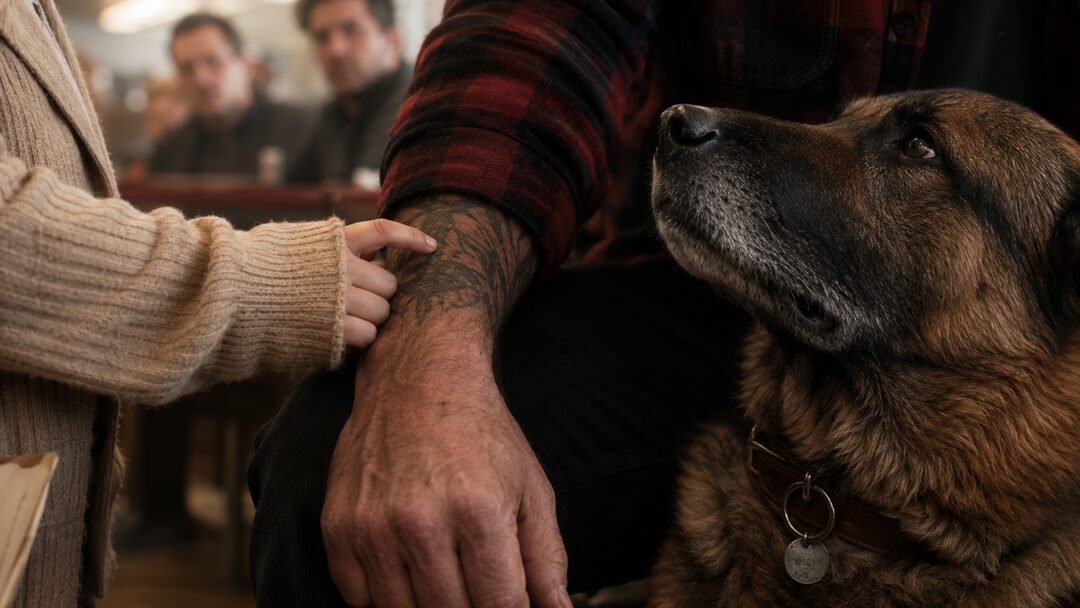
The man was built like a locked door. Broad shoulders. Close-cropped hair. Red-and-black flannel sleeves rolled to his forearms. A heavy watch. A faded band of numbers and symbols tattooed around his wrist.
Emily placed her fingers on the tattoo.
The German Shepherd lifted his head.
Three men at the booth stopped moving.
The stranger looked down at her hand, then at her face.
Emily pointed at the worn tag hanging from the dog’s collar and asked, “Why does your dog have my daddy’s number?”
No one answered.
Not the men in the booth.
Not her mother, Sarah, who had been pouring coffee two seconds before.
Not John Miller, Emily’s grandfather, who stood blurred behind the kitchen’s glass doors with a towel in his hands and flour on his sleeves.
Even the old clock above the pie case seemed to lose its nerve.
The stranger’s name was Michael Harris. Sarah knew it because he came every year on this date with the same group of men, sat in the same corner booth, ordered the same black coffee, and left too much money under the cup.
He never talked much.
None of them did.
They arrived before opening, while the diner still smelled of bleach, bacon grease, and coffee grounds. Sarah unlocked the door for them because her father insisted on it. They ate quietly under the amber pendant lights while the rest of town waited outside for normal hours.
Every year, Sarah told herself it was just breakfast.
Every year, she kept Emily upstairs until they were gone.
This year, Emily had found the photograph.
Michael’s hand stayed perfectly still under the child’s fingers.
Beside him, Ranger watched Emily with tired brown eyes. The dog’s ears were uneven, one standing clean, the other torn at the top and folded slightly forward. His muzzle had gone white. His body was old but alert, pressed close to Michael’s leg like he still had a job.
Robert Kane, the lean man sitting across from Michael, lowered his fork.
“Mike,” he said quietly. “Don’t.”
Michael did not look at him.
Emily slipped her other hand into the pocket of her beige sweater and pulled out a folded photograph. It was soft from handling, the corners bent white. She opened it carefully, the way children handle things adults told them not to touch.
“My daddy had this dog,” she said.
Sarah was already moving.
“Emily.” Her voice cracked against the quiet. “Come here.”
But Emily held the photograph up to Michael.
In the picture, David Miller knelt in pale dust beside a younger Ranger. David’s smile was tired and bright, one arm around the dog’s neck. Behind them, everything was sun-bleached and temporary. Tents. Trucks. A horizon with no trees.
On the back, in David’s crooked writing, were six words Sarah had read so many times she hated them.
Ranger brought me home once.
Michael took the photograph like it might fall apart in his hands.
His face did something Sarah had never seen before.
It did not soften.
It broke inward.
Robert’s jaw tightened. “This is not the place.”
Emily looked at him. “It’s my picture.”
Sarah reached them and put both hands on her daughter’s shoulders.
“I’m sorry,” she said to the table, though she did not know exactly who she was apologizing to. “She didn’t mean to interrupt.”
Michael finally spoke.
His voice was low and rough, as if he had not used it all morning.
“No,” he said. “She meant to.”
Sarah felt the words land in the room.
Emily leaned into her mother’s hands but did not back away.
Michael looked again at the photograph.
“Where did you get this?”
Sarah held out her palm. “Emily, give me the photo.”
Emily clutched it to her chest. “It was in the blue box.”
Sarah closed her eyes.
The blue box sat at the back of the bedroom closet, under winter blankets and old tax folders. It held David’s letters, his watch, two faded shirts, and the version of him Sarah could stand to keep.
Not the whole version.
Never the whole version.
Michael looked up at Sarah.
“David mailed this home?”
“Three days before,” she said.
She did not finish.
She did not need to.
The men knew the date. They had come to eat breakfast on it every year.
Robert shifted in his seat. “Sarah, I’m sorry. Truly. But this isn’t something for—”
“For what?” she asked.
His eyes flicked toward Emily.
“For her.”
Emily looked from one adult to another.
“Was my daddy bad?”
The question was small.
It emptied the room.
Part II — The Photograph
Sarah pulled Emily behind her so quickly the child stumbled.
“No,” Sarah said.
She said it to Emily, but she was looking at the men.
“No. Your father was not bad.”
Emily’s mouth tightened. “Then why does everyone stop talking when I ask?”
The coffee pot still sat on the counter, half full, steam ghosting against the glass. Outside, two regulars peered through the front window, saw the private sign, and walked away. Inside, the booth had become the only place in the world.
Michael placed the photograph on the table but did not release it.
Ranger made a low sound. Not a growl. Something closer to a breath pushed through memory.
Emily noticed.
“He knows me,” she whispered.
Robert leaned back. “The dog doesn’t know you.”
Ranger rose slowly.
Michael put one hand down, not to restrain him, just to feel where he was. The dog stepped forward until his nose hovered near Emily’s sweater.
Sarah went rigid.
“It’s okay,” Michael said.
“Do not tell me what’s okay,” Sarah snapped.
Michael pulled his hand back as if she had struck him.
Ranger sniffed once at the pocket where the photograph had been, then lowered his head. After a moment, he pressed his muzzle against Emily’s knee.
Emily did not move.
Her eyes filled, but she did not cry.
Sarah hated that most of all. The way her daughter had learned to hold questions like grown people held grief.
Michael stared at the dog.
Robert said, “Mike.”
This time the warning was sharper.
Michael ignored it.
“David worked with Ranger during Grayline,” he said.
Sarah heard the name of the operation like a dish breaking in another room. She had seen it on forms, letters, folded documents with official seals. Grayline. A clean word for the place where David had vanished from her life.
“You said he was assigned transport support,” Sarah said.
“He was.”
“But the dog was yours.”
Michael’s eyes moved to Ranger. “Yes.”
Emily looked up. “Then why did Daddy have him?”
No one answered fast enough.
Sarah turned on Michael. “You’ve been coming here for years.”
“Yes.”
“You sat ten feet from me.”
“Yes.”
“You knew who I was.”
“Yes.”
Her voice dropped. “And you never said anything?”
Michael’s fingers curled once against the table.
Robert spoke before he could. “Because there was nothing useful to say.”
Sarah laughed once, without humor. “Useful?”
“Sarah,” Robert said, “I’m not trying to be cruel.”
“Then stop practicing.”
The other two men at the booth looked away.
Michael still had the photograph under his hand.
Sarah reached for it. “Give it back.”
He did.
Their fingers did not touch.
On the back, beneath David’s sentence, Sarah saw something she had ignored for years because she had not wanted it to matter.
Two words in the corner.
Tell Harris.
She had always told herself it could mean anything. A joke. A message. A supply note. Some military shorthand she did not understand.
Now Michael was sitting in her father’s diner with David’s number on a dog’s collar and that same number hidden in faded ink around his wrist.
She looked at Michael. “What did he want me to tell you?”
Michael’s eyes flicked to Emily.
Sarah understood the answer before he gave it.
There was more.
There had always been more.
“I can talk to you in the back,” Michael said.
Robert’s chair scraped softly.
“Absolutely not.”
Michael’s head turned.
Robert did not raise his voice. Men like him did not have to. “This is how it starts. One memory turns into ten. Ten turn into accusations. Then somebody writes a letter. Somebody calls somebody. And after all these years, David becomes a headline instead of a man.”
John moved behind the glass kitchen doors.
Sarah saw him clearly now. Her father had been standing there the whole time.
Watching.
Not helping.
That was his talent with grief. He made rooms for it, then hid inside them.
Sarah took Emily’s hand.
“We’re going to the hallway,” she said.
Robert’s mouth tightened. “Sarah—”
She looked at him with a coldness that surprised even herself.
“You do not get to decide where my husband’s name can be spoken.”
Michael rose slowly.
He was taller than she remembered from every silent breakfast. Ranger stood with him, joints stiff, tag clicking softly against his collar.
Emily looked at the dog.
Then at Michael’s wrist.
Then at the kitchen doors, where her grandfather had disappeared again.
“Grandpa says people come back in pieces,” she said.
No one moved.
Robert closed his eyes.
And for the first time, Sarah wondered if Emily had not found the blue box by accident at all.
Part III — Pieces
The hallway behind the dining room was narrow and smelled of dish soap, old wood, and warm bread. Sarah stood with her back to the wall, Emily pressed against her side.
Michael stopped several feet away, giving them space.
Ranger sat between them.
Robert came too, though no one invited him.
Sarah looked at Michael. “Start talking.”
Michael glanced at Emily.
Sarah said, “She already knows enough to be scared. Don’t use her as your excuse.”
That hit him. She saw it.
Good, she thought.
Then hated herself for thinking it.
Michael rubbed his thumb over the inside of his wrist, over the faded tattoo.
“Grayline was supposed to be simple,” he said.
Robert let out a short breath. “Mike.”
Michael kept going. “Get civilians to the checkpoint. Pull our people back. No extra routes. No heroics.”
Emily leaned against Sarah’s apron. “What’s heroics?”
Sarah touched her hair. “It means doing something dangerous because you think it matters.”
Michael looked at the child. “Sometimes because it does.”
Robert’s voice turned hard. “Sometimes because it gets people killed.”
The hallway seemed to shrink.
Michael accepted that without flinching.
“Ranger broke from the convoy,” he said. “He caught scent from the old school building. We had been told it was cleared.”
“Was it?” Sarah asked.
“No.”
Emily whispered, “People were there?”
Michael nodded once. “Yes.”
Sarah felt something cold move through her. She had spent years imagining David’s final hours as a sealed room. Now the door had opened, and there were strangers inside it.
“David went after Ranger,” Michael said. “I went after David.”
Robert cut in. “They left their assigned position.”
Sarah stared at him.
Robert’s face was pale but controlled. “That matters.”
“To who?” Sarah asked.
“To the men who had to pull everyone else out while the route collapsed.”
“Route?” Emily asked.
Sarah tightened her arm around her.
Michael looked at Sarah, not Emily. “Ranger led them to a group trapped inside. Families. An interpreter. Two medics. More than the official count ever listed.”
“Why not?” Sarah asked.
Michael’s mouth worked once before he answered.
“Because if they were counted, someone had to explain why they were left off the plan.”
The silence after that was different.
Not empty.
Crowded.
Sarah saw Robert look away.
Emily stepped out from Sarah’s side. “So Daddy helped them?”
“Yes,” Michael said.
Robert’s voice was barely above a whisper. “And disobeyed.”
Emily looked between them.
“Was he brave or bad?”
Sarah almost told her again that David was good. That he was kind. That he sang off-key and burned toast and put hot sauce on eggs. That he cried the first time Emily grabbed his finger as a newborn and pretended he had dust in his eyes.
But the words stuck.
Because Emily was not asking for a bedtime answer.
She was asking why grown men could not say her father’s name without arguing.
Michael crouched slowly, though not fully to her height yet.
“He was brave,” he said. “And stubborn.”
Robert said, “That’s not the whole truth.”
“No,” Michael said. “It isn’t.”
Sarah turned on him. “Then what is?”
Michael looked down at Ranger.
The dog’s head had lowered to his paws.
“David saved my life before Grayline,” Michael said. “A transport went over near the south road. I was pinned. Ranger was trapped behind the door. David came back for us when he was told not to.”
Robert’s face changed.
Not surprise.
Recognition.
Sarah noticed.
“You knew that part too,” she said.
Robert did not answer.
Michael pushed up his sleeve.
Under the tattoo, beneath the dark band of ink, was an old raised line of damaged skin. The number wrapped around it like someone had tried to turn harm into order.
Emily reached toward it, then stopped herself.
Michael noticed.
“You can ask,” he said.
“Is that Daddy’s number?”
“Yes.”
“Why is it on you?”
Sarah wanted to stop this. She wanted to grab Emily and run upstairs and lock the blue box in the trunk of her car and never serve another private breakfast again.
But Emily was looking at Michael with a calm that made Sarah ache.
Michael said, “Because he got me home once.”
Emily looked at Ranger. “Like the picture.”
“Yes,” Michael said.
Robert’s voice came from behind them.
“Breakfast is not a confession booth.”
This time, no one pretended he was only warning Michael.
Sarah looked at him.
“No,” she said. “It’s my father’s diner. And apparently it’s been one for years.”
The kitchen doors swung softly.
John Miller stepped into the hallway.
Flour dusted his hands. His gray hair was combed back badly. His old cap sat on a shelf behind him, where it always did, never on his head.
He looked at Robert first.
Then Michael.
Then Emily.
“Your daddy wasn’t bad,” John said. “But nobody in this room has been good at telling the truth.”
Part IV — Behind the Glass Doors
John had owned Miller’s Diner for thirty-one years and had avoided the corner booth every anniversary morning.
He unlocked the front door.
He made the coffee.
He checked the bacon.
Then he went behind the glass doors and let the men sit with their silence.
Sarah had always thought it was weakness.
Now, watching him step into the hallway, she realized it might have been something worse.
Patience.
Robert straightened. “John.”
“Don’t,” John said.
One word. Flat as a hand on a table.
Robert stopped.
Emily slipped from Sarah and went to her grandfather. John looked suddenly older when she touched his leg.
“You said soldiers don’t come back,” Emily said.
Sarah flinched at the word, but John only closed his eyes.
“I said people come back in pieces.”
Emily looked toward Michael. “Is Ranger a piece?”
Michael did not answer.
John did.
“Yes.”
Sarah’s throat tightened.
John looked at Michael. “I invited you boys here every year.”
Robert’s face hardened. “We came out of respect.”
“No,” John said. “You came because guilt keeps a calendar.”
The two other men in the booth, visible through the hallway opening, sat frozen over cold eggs.
Michael looked as if the words had struck bone.
John wiped his hands on the towel. “First year, I thought one of you would say his name. Second year, I thought maybe you needed time. Third year, I figured out men like us can turn silence into a uniform and wear it anywhere.”
Sarah stared at him. “You knew?”
John looked at her with grief too old to defend itself.
“I knew there was more.”
“And you didn’t tell me?”
“I didn’t have the words.”
Sarah’s laugh came out small and wounded. “No. You had a diner full of them. Every year.”
John looked down.
That was the first time Sarah had ever seen her father accept a blow without raising a wall.
Robert stepped forward. “David’s record was honored.”
John turned on him. “His record? I am talking about my son.”
Robert’s eyes flashed. “So am I.”
“No,” Sarah said. “You’re talking about paperwork.”
Robert’s jaw worked.
For a moment, his controlled face almost gave way. Then it settled again, sharper than before.
“You want the truth?” he said. “The truth is that Grayline was chaos. The truth is men made calls with half a map and bad information. The truth is if this gets pulled apart now, nobody comes out clean. Not command. Not the unit. Not David.”
Michael’s voice was quiet. “David doesn’t need clean.”
Robert looked at him.
Michael met his eyes. “He needs true.”
That sentence changed the air.
Even Sarah felt it. Not forgiveness. Not relief.
A crack.
Emily crouched beside Ranger and spoke into his ear.
Nobody heard the first words.
Then she asked louder, “Was my daddy scared?”
She asked the dog.
Not the men.
That was what finally undid Michael.
His face folded once, quickly, before discipline pulled it back into place. He put one hand against the wall, as if the hallway had shifted under him.
Sarah moved to stop Emily, but John gently touched her arm.
“Let him answer,” he said.
Sarah hated him for asking.
She hated herself for wanting it.
Michael sank down until one knee touched the old tile.
Ranger rose and stepped close to him.
“I don’t know everything your father felt,” Michael said.
Emily turned from the dog to him.
Michael swallowed. “But I know what he did.”
Robert said nothing.
Sarah did not breathe.
Michael looked at his wrist. “Smoke was everywhere. I had Ranger’s lead wrapped around my hand. David tied it there himself.”
His voice thinned but did not break.
“He said, ‘Take him home if I don’t get to.’”
Emily’s face changed.
Not fear.
Recognition of something too large for her, arriving anyway.
Michael closed his fingers around the tattoo.
“I had the lead,” he said. “Then I didn’t.”
Sarah felt the wall against her back.
Michael kept his eyes on Emily, because looking anywhere else might have been easier.
“When the blast hit, I lost it. Ranger came back later with part of your dad’s sleeve in his teeth.”
A small sound escaped John.
Sarah had never heard her father make that sound before.
Robert turned his face away.
Emily looked down at Ranger’s mouth as if expecting it to still be carrying something.
“Daddy didn’t come back with him,” she said.
Michael’s answer was barely a voice.
“No.”
The hallway held all of them.
Then Sarah stepped forward.
“That is enough.”
Michael bowed his head once.
But Emily was not done.
“Did he save the people?”
Michael looked at Sarah.
Sarah wanted to say no more.
She wanted to carry her daughter upstairs.
She wanted to keep one piece of David unburned by adult truth.
But Emily’s hand was on Ranger’s head. The dog stood very still beneath it.
Sarah heard herself say, “Answer only that.”
Michael nodded.
“Yes,” he said. “He saved people.”
Emily absorbed this.
Then she asked the question that hurt more than all the others.
“Then why didn’t anyone tell me?”
No one could give her a clean answer.
Because there was none.
Part V — Enough Truth
They returned to the dining room because the hallway had become too narrow for what was in it.
Michael sat at the corner booth, but only for a moment. Then he stood again. He unclipped Ranger’s tag from the worn ring on his collar and placed it on the table.
The metal made a small sound.
Everyone heard it.
Emily stared at the tag.
The top line carried Ranger’s identifier, rubbed smooth at the edges by years of movement. Under it, cut later and slightly uneven, was David’s number.
Sarah stared at the engraving.
She had seen that number on envelopes, forms, and folded flags of language people handed her when they did not know what to say.
On Ranger’s collar, it looked different.
Less official.
More alive.
Michael picked up the tag and held it out to Emily.
Emily opened her palm.
Sarah moved before she could stop herself.
“No.”
Michael froze.
Sarah stepped between them.
“No,” she said again, quieter but harder. “You do not give that to her because you are tired of carrying it.”
Michael’s face went still.
Sarah’s voice trembled, but she did not take it back.
“She is six. She does not get your guilt because you finally found somewhere to put it.”
Michael looked at the tag in his hand.
Then at Emily.
Then at Sarah.
“You’re right,” he said.
That was all.
No defense. No wounded pride. No explanation.
He clipped the tag back onto Ranger’s collar.
Sarah felt something in herself loosen and tighten at the same time.
Michael crouched in front of Emily.
This time fully to her height.
He did not touch her. He did not reach for the photograph. He did not look at Sarah for rescue.
“Your dad was brave,” he said.
Emily listened.
“He was scared too. Brave people usually are.”
Her eyes stayed on his.
“He was stubborn. He was kind. He did not always follow orders when people needed help. That made some people angry. It also meant some people got to go home.”
Robert closed his eyes.
Michael continued.
“He saved me once. At the end, he tried to save others. Ranger found them. Your dad stayed.”
Emily’s lips parted.
“Was he bad?”
“No,” Michael said.
“Was he perfect?”
A faint, broken breath came from John.
Michael shook his head.
“No. He was a person. A good one.”
Emily looked down at Ranger.
The old dog leaned into her knee again.
“Did Daddy come home?”
Michael’s mouth tightened.
Sarah almost stopped him.
But there was no kind lie left that would not become another locked door.
Michael said, “Not the way he should have.”
Emily’s eyes filled.
Michael touched Ranger’s collar.
“But he sent this old dog ahead of him.” His voice turned rough. “And I should have brought him to you sooner.”
Sarah looked away.
Not because she forgave him.
Because for the first time, she believed him.
Robert stood abruptly.
His napkin fell from his lap to the floor.
“I can’t sit here for this.”
John looked at him. “Then stand.”
Robert’s face flushed.
For a second, Sarah thought he might leave without another word.
Instead, he looked at Emily.
Then at Ranger.
Then at Michael.
“You make it sound simple,” he said.
Michael rose slowly. “No. I don’t.”
Robert’s eyes shone with anger or grief. Maybe both. “You tell one piece and everyone thinks they know the whole thing.”
“No one here knows the whole thing,” Michael said. “That’s what we did wrong.”
Robert pressed his lips together.
The diner’s front door rattled softly as someone outside tried the handle, found it locked, and moved on.
The ordinary world was waiting.
Inside, Robert looked at Sarah.
“I followed the report,” he said.
Sarah said nothing.
He looked at John.
“I thought if we kept it clean, he stayed honored.”
John’s voice was tired. “Clean is not the same as honored.”
Robert flinched.
Then he looked at Emily.
For once, his voice lost its clipped edge.
“David Miller,” he said.
Emily blinked.
Robert swallowed.
“Your father’s name was David Miller. He was in my unit. He was difficult. He was brave. And he deserved better from us.”
No one moved.
Robert picked up his jacket from the booth.
At the door, he stopped with his hand on the lock.
He did not turn around.
“David,” he said once more.
Then he left.
The bell over the door rang behind him.
It sounded too bright for the room.
Part VI — Once a Month
John reopened the diner at ten-thirty.
He flipped the sign with flour still on his hands, then walked behind the counter and poured coffee for men who no longer knew where to sit.
The two remaining veterans paid and left quietly.
They shook John’s hand.
One of them touched Ranger’s head before he went.
The other looked at Sarah as if he wanted to say something, then thought better of it.
That restraint felt like the first honest thing he had offered.
Emily sat in the corner booth beside Ranger, her small hand resting on the dog’s back. She did not ask more questions. Not because she had run out, Sarah knew. Because some answers need time to become small enough to hold.
Michael stood near the register.
He looked ready to leave and unable to.
Sarah folded the photograph and slipped it into her apron pocket. She would put it back in the blue box later.
Or maybe she would not.
Maybe Emily had earned a frame.
John brought Michael a cup of coffee he had not asked for.
Michael looked at it, then at him.
John said, “Don’t make me carry it over there.”
Michael took the cup.
Their hands did not touch.
It was almost enough.
Then Michael reached inside his jacket and pulled out a small envelope, yellowed at the corners and soft along the fold.
Sarah knew before he said anything.
Her body knew.
Her hand went to the wedding ring on the chain under her shirt.
Michael held the envelope out.
“David wrote most of it,” he said. “He gave it to me before the last run. Said if anything happened, I should mail it.”
Sarah stared at the envelope.
“You didn’t.”
“No.”
“Why?”
Michael did not look away.
“Because his last line was to me.”
Sarah’s eyes burned.
“What did it say?”
Michael’s voice was flat with the effort not to break.
“It said, ‘If I don’t make it, don’t let them turn me into paperwork.’”
The diner noise seemed far away, though no one was speaking.
Sarah took the envelope.
Michael did not ask her to read it.
He did not ask for forgiveness.
That mattered.
Sarah slipped the letter into her apron pocket beside the photograph.
It was too much weight for one pocket.
She carried it anyway.
At the booth, Emily whispered something into Ranger’s ear. The dog’s tail moved once against the floor.
Then she looked at Michael.
“Can Ranger come back?”
Michael looked at Sarah.
Not with pleading.
With permission.
“If your mother says he can,” he said.
Emily turned.
Sarah thought of all the years she had kept Emily upstairs on this morning. All the times she had told herself silence was a soft thing. A blanket. A closed door. A way to keep a child from reaching for pain.
But silence had not kept Emily safe.
It had only taught her to search closets.
Sarah looked at Ranger.
Then at Michael, who had finally stopped hiding behind the dog.
“Once a month,” she said.
Emily’s face opened in a way Sarah had not seen in a long time.
Not joy exactly.
Something gentler.
Belonging with edges.
John turned away too quickly and wiped the counter that was already clean.
Michael nodded once.
“Once a month.”
Emily slid from the booth and took Ranger’s lead. The dog moved slowly, old hips stiff, but he followed her toward the glass kitchen doors as if he understood that this, too, was a kind of duty.
The old men watched her go.
So did Sarah.
So did Michael.
Emily stopped at the doors and looked back.
“Grandpa,” she called, “Ranger wants bacon.”
John cleared his throat.
“Ranger has always had expensive taste.”
For the first time that morning, Sarah almost smiled.
Michael looked down at his wrist, at the faded number Emily had touched before anyone was ready.
Then he let his sleeve fall over it.
Not to hide it.
Just to carry it differently.
Emily pushed through the glass doors with Ranger beside her, and warm kitchen light folded around them both.
Behind her, the diner did not become healed.
It became honest.
And for that morning, honest was enough.