What Remained in the Room
Part I — The Quiet Seat
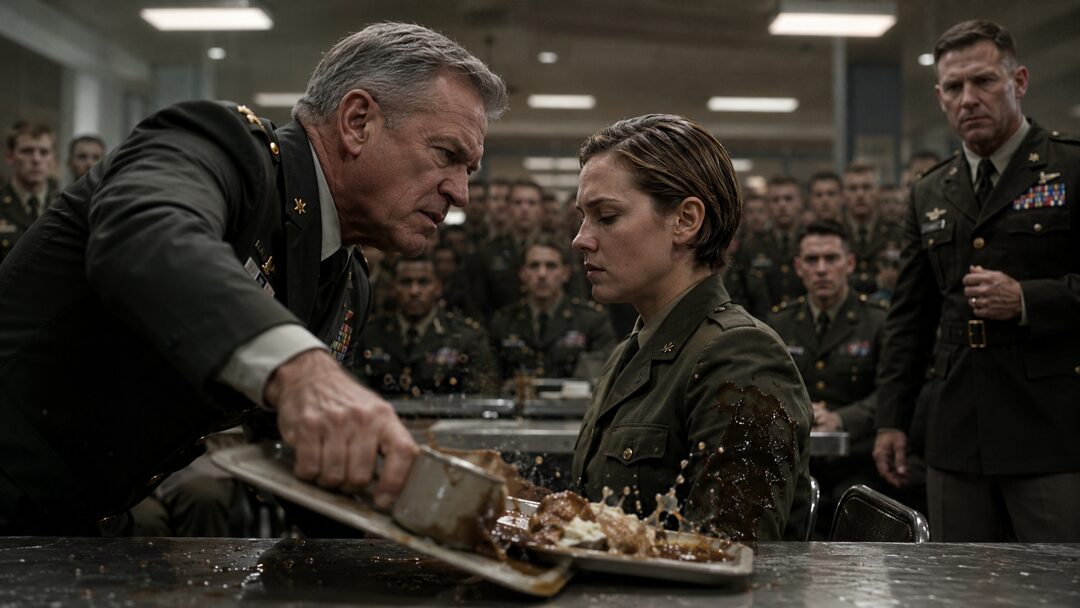
Colonel Robert Hayes hit Emily Carter’s lunch tray so hard that coffee jumped from the paper cup and gravy slid across the metal table in a brown wave, soaking the cuff of her sleeve before anyone in the dining hall remembered how to breathe.
A fork clattered somewhere behind her.
Then nothing.
No chair scraped. No one laughed. No one told the colonel to calm down.
Emily kept both hands in her lap.
She did not wipe her sleeve.
She did not look at the food running toward the edge of the tray.
She looked at the colonel’s polished belt buckle, because looking at his eyes would have made the room think she was challenging him before she was ready.
“You want to ask questions?” Hayes said.
His voice did not need to be loud. It had filled rooms larger than this one. It had crossed training fields, briefing tents, hangars, memorial platforms. It had told men to move when they were afraid and told families their sons had served with honor.
Now it landed on Emily like something meant to leave no mark.
“Ask them here.”
The dining hall at Fort Canaan had been noisy thirty seconds earlier. Trays, boots, cheap chairs, low jokes. Soldiers trying to make lunch feel like anything but another scheduled hour inside a machine. Now two hundred people sat still beneath fluorescent lights, watching a twenty-four-year-old intelligence recruit with gravy drying on her sleeve.
Emily heard the hum of the soda machine.
She heard her own pulse.
She heard, inside her pocket, the tiny dead weight of Daniel’s field watch.
It had not ticked in six weeks.
Hayes leaned closer. He was broad-shouldered, iron-haired, immaculate. His campaign ribbons sat on his chest like a row of locked doors. Even angry, he looked composed enough to be photographed.
“You’ve been in my intelligence office for nineteen days,” he said. “Nineteen. And somehow you believe that gives you the right to drag your grief through classified files.”
Emily’s fingers curled once beneath the table.
Across the room, Captain Mark Sullivan sat at the end of an officers’ table, one hand wrapped around a cup he had not lifted. He did not look at Emily.
That was how she knew he knew.
Hayes followed her glance and smiled without warmth.
“No, Carter. Don’t look around for rescue. You wanted witnesses.”
Emily finally raised her eyes.
“I wanted a review.”
The words were quiet enough that the soldiers nearest her leaned in without meaning to.
Hayes’s face did not change, but something behind his eyes tightened.
“A review,” he repeated.
“Yes, sir.”
“Of Operation Red Lantern.”
The name moved through the room without sound. No one said anything, but shoulders changed. A spoon stopped halfway to someone’s mouth. A young private at the next table stared down at his tray as if it might save him.
Red Lantern had been spoken of only in pieces since the bodies came home.
Three dead. One of them Sergeant Daniel Carter.
Emily’s brother.
Hayes straightened, and the simple motion made him seem larger.
“You think this unit survives because every grieving sister with a badge and a password gets to dig through mission reports?”
Emily did not answer.
That angered him more than an argument would have.
“Stand up,” Hayes said.
She stayed seated.
The air grew thinner.
Someone at the back whispered, “Don’t.”
Hayes heard it. Everyone heard it.
He placed both hands on the table and bent toward Emily until his shadow crossed her tray.
“You are poisoning morale,” he said. “You are suggesting that your brother’s death was not the result of hostile conditions, but command failure. Say it. If you have the courage to imply it in an office, say it where the people who served under me can hear you.”
Emily’s throat tightened.
She saw Daniel at seventeen, leaning over the kitchen table with a broken watch he’d bought at a flea market, telling her all machines lied if you didn’t know where to look.
She saw him at twenty-nine in the last photo their mother ever framed, sleeves rolled unevenly, face sunburned, grin too wide.
She felt the watch in her pocket.
Stopped at 02:17.
The official report said Daniel’s team was lost at 02:05.
Twelve minutes could be a lifetime when someone was still calling for extraction.
“I don’t have all the proof,” Emily said.
Hayes laughed once, sharp and humorless.
“There it is.”
She looked at him.
“There is enough to ask.”
“To accuse.”
“To ask.”
His palm slapped the tabletop.
Several soldiers flinched.
Emily did not.
Hayes stared at her sleeve, at the coffee and gravy darkening the fabric.
“You know what discipline is, Carter? Discipline is not dragging the dead into the lunch hour because pain makes you restless.”
Emily felt that one. It went in clean.
For a moment, she wanted to wipe her sleeve. Not because it bothered her, but because every eye in the room was on it. The stain made her visible in a way rank never had.
She kept her hands in her lap.
Hayes lowered his voice.
“Discipline is silence when silence keeps the unit alive.”
At the officers’ table, Captain Sullivan finally moved.
Only his thumb.
It rubbed once over his wedding ring.
Then stopped.
Part II — The Offered Hand
Hayes pulled out the chair across from Emily and sat as if accepting an invitation.
No one else moved.
The colonel placed his right elbow on the table.
Emily saw what was happening before he opened his hand.
A few soldiers did too. The reaction passed through them in tiny shifts: lifted brows, tightened mouths, exchanged glances that vanished quickly.
The grip.
It was an old dining hall ritual, older than Emily’s time at Fort Canaan. Not official. Never written. Nothing like that would be written. It belonged to the culture beneath the culture, the place where men called cruelty tradition and everyone pretended choice existed.
A soldier questioned a superior too openly, or bragged too loudly, or refused to back down. Someone offered a hand. If you took it and lost, you apologized. Publicly. You dropped whatever you had raised.
If you refused, you were a coward.
If you accepted, you were already trapped.
Hayes held out his hand.
“Let’s make this simple.”
Emily looked at the hand. Thick fingers. Wide palm. A commander’s hand. A hand that had signed reports and folded flags and gripped shoulders beside closed caskets.
“Sir,” Sullivan said from the officers’ table.
Only one word.
It was enough to turn every eye toward him.
Hayes did not look away from Emily.
“Not now, Captain.”
“This isn’t the place.”
Now Hayes turned his head.
His gaze moved slowly, giving Sullivan time to regret speaking.
“The place?” Hayes said. “She brought her accusation into my unit. She brought it into my mess. She brought it to men and women still trying to do their jobs with fresh graves behind them.”
Emily saw Sullivan’s jaw tighten.
But he said nothing else.
Hayes turned back to her.
“Grip my hand, Carter. If you win, I’ll personally walk your little review request to command. If you lose, you apologize to this room and stop digging through grief like it’s evidence.”
The words were clean.
The trap was cleaner.
Emily’s left hand touched her pocket beneath the table.
The watch pressed against her fingers.
She had filed the request that morning at 0710. Not through Hayes. Around him. Formal channel, timestamped, copied where it could not disappear quietly.
She had not known he would come for her in the dining hall.
But she had known he would come.
Men like Hayes did not fear questions until questions had paperwork attached.
Emily lifted her right hand and placed her elbow on the table.
A low current moved through the room.
Hayes’s mouth tightened with satisfaction.
“There she is.”
His hand swallowed hers.
His skin was dry and warm. His grip closed before she had finished setting her fingers. She adjusted once, small enough that he might think it was panic.
It was not.
Daniel had taught her how to grip when she was twelve and he was seventeen, both of them sitting at the kitchen table while their mother worked late.
“Don’t fight the hand,” he had said. “Fight the moment they think they already have you.”
Hayes leaned in.
“Ready?”
Emily looked at their joined hands.
Coffee still crept across the tabletop in a thin brown line.
“Yes, sir.”
He applied pressure slowly.
Not enough to end it.
Enough to announce that he could.
Emily’s wrist angled a fraction. Heat shot through her forearm. Her shoulder tightened. She let it. Pain was information. Pain told her where the force was going.
She did not look at him.
That bothered him.
“Eyes up,” Hayes said.
Emily raised her eyes.
The colonel smiled.
Around them, two hundred soldiers watched a commander try to bend a recruit’s hand to the table.
No one was eating now.
Hayes kept the pressure steady. He could have forced her down quickly. Everyone knew it. He was choosing not to. He wanted the room to see her strain. He wanted the apology to ripen.
Emily’s fingers trembled.
A young woman two seats down looked away.
Across the room, Sullivan looked at the table between his hands.
Still not at Emily.
Still not at the colonel.
Not yet.
Hayes spoke softly enough that only the nearest tables heard him, which meant the silence had to carry his words.
“Your brother was a good man.”
Emily’s wrist dipped another inch.
“He deserved better than this.”
Her breath caught before she could stop it.
Hayes saw.
There. His eyes said. There you are.
Emily almost hated him for being right. Not about Daniel. Not about Red Lantern. About the fact that grief had a handle, and he had found it.
Her brother’s name could still move her faster than force.
Hayes pressed harder.
The back of her hand lowered toward the table.
“Apologize,” he said. “And I’ll forget this happened.”
Emily’s sleeve clung cold against her wrist.
She looked past him at Sullivan.
This time, Sullivan almost met her eyes.
Almost.
Emily said, “My brother sent his last transmission twelve minutes after you reported him dead.”
Hayes froze.
Only a fraction of a second.
But in a room trained to notice fractions, it was enough.
Part III — The Missing Minutes
No one breathed loudly.
The pressure on Emily’s hand eased so slightly that it would not have shown from across the room. But Emily felt it. She felt the hesitation travel from Hayes’s shoulder into his palm.
Then his grip tightened again.
“What did you say?” he asked.
Emily’s wrist throbbed.
“Daniel’s call sign transmitted at 02:17. The report lists loss of contact at 02:05.”
Hayes stared at her.
“You had no authority to access that file.”
“I was assigned to archive signal logs.”
“To archive,” he said. “Not interpret.”
“The timestamp didn’t need interpretation.”
A few soldiers shifted. Someone whispered Daniel’s call sign under their breath and was hushed immediately.
Sullivan’s head lowered.
That was the second mistake.
Emily saw it.
Hayes saw her see it.
His voice cooled.
“You found a broken timestamp in a damaged record and built a conspiracy around your brother’s last minutes.”
Emily swallowed.
The room blurred at the edges, but Hayes stayed sharp.
“I found a transmission after the official time of death.”
“Loss of contact is not time of death.”
“Then why does the report use it that way?”
His grip jerked.
Pain flashed bright up her arm.
Emily’s hand dropped closer to the table.
Several soldiers leaned forward, not cheering now, not enjoying it. The room had changed. A ritual of submission had become something no one knew how to name.
Hayes’s face had not reddened. He had not lost control in the way people expected angry men to lose it. That made him more frightening.
He looked almost calm.
“Do you know what command is?” he asked.
Emily did not answer.
“Command is choosing between terrible outcomes while people who were never there decide later what kind of man you were.”
There was something real in his voice. Not kindness. Not innocence. Something older than both.
Emily felt the first crack of uncertainty.
Because she had wondered. In the intelligence office at 0310, with Daniel’s last transmission in one ear and the official report on the screen, she had wondered if the missing twelve minutes had an answer that would make her ashamed of asking.
Maybe the route had closed.
Maybe the team had already been beyond reach.
Maybe command had chosen five living people over three dying ones.
Maybe Daniel had died inside a necessary decision.
That possibility had frightened her more than Hayes did.
Hayes leaned closer.
“Your brother served under my command. He knew the burden. He knew that not every life can be saved because a sister wants a different ending.”
Emily’s arm shook.
Her fingers tightened around his.
For the first time, her face changed.
Not much.
Enough.
Hayes saw grief reach the surface, and something like triumph moved behind his eyes.
“You don’t want truth,” he said. “You want someone to blame.”
Sullivan stood.
His chair scraped the floor with a sound that cut through the room.
Hayes did not look at him.
“Sit down, Captain.”
Sullivan remained standing.
The room held still around him.
“Sir,” Sullivan said, his voice low, “this should be handled through review.”
Hayes laughed.
“Review?”
“Yes, sir.”
“Now you care about process?”
Sullivan’s mouth closed.
The colonel looked at him then, and the look was almost intimate in its warning.
“Sit down.”
Sullivan sat.
Not quickly.
But he sat.
Something in Emily’s chest sank.
Hayes turned back to her with renewed force.
“You see that?” he said. “That is discipline. That is what separates a unit from a crowd.”
Emily breathed through the pain in her wrist.
“No,” she said.
Hayes’s brows lifted.
She looked directly at him.
“That’s fear.”
For the first time, the colonel’s expression changed in a way everyone could see.
His jaw hardened.
The pressure came down so suddenly Emily’s elbow skidded. Her hand dropped within inches of the table. Pain burst through her wrist, hot and clean.
She almost cried out.
She bit the sound in half.
Hayes leaned in until only she could hear him.
“You are very close to ending your career over a file you don’t understand.”
Emily’s eyes watered. She refused to blink.
“I filed the review request this morning.”
His grip tightened.
“No,” he said softly.
“0710. Formal channel. Copied outside battalion.”
The silence moved again, sharper this time.
Hayes stared at her as the meaning landed.
Emily’s voice stayed low.
“You made the rest public.”
His hand did not move, but the room did.
Not physically. Something less visible shifted, a redistribution of weight. Soldiers were still seated, still silent, still careful. But careful was not the same as obedient.
Hayes had thought he was making an example of her.
Now the example had turned around.
Part IV — One Person to Remember
“You think paperwork protects you?” Hayes asked.
Emily’s wrist was almost flat now.
“No, sir.”
“Then what?”
She could barely breathe through the pain.
“Witnesses.”
A muscle jumped in his cheek.
There it was.
Not rage.
Fear.
Not of Emily. Not exactly.
Fear of the room no longer belonging to him.
Hayes looked around, slow and deliberate, as if reminding every soldier who signed their evaluations, approved their assignments, knew their weaknesses, held their futures between thumb and forefinger.
Some lowered their eyes.
Some did not.
Sullivan stared at his own hands.
Emily saw the wedding ring again. The thumb rubbing it. The same motion from every briefing she had watched through the glass. A man sanding himself down one circle at a time.
Hayes’s voice was low.
“Silence keeps units alive.”
Emily looked at Sullivan when she answered.
“Silence kept you safe.”
Hayes drove her hand lower.
Her knuckles whitened. The side of her wrist hovered a breath above the metal table. If he pinned her, the ritual would complete. The room could pretend the rest had been noise. Hayes could call it discipline. Sullivan could call it complicated. Everyone could go back to lunch with the relief of people spared from choosing.
Emily’s vision narrowed.
Her brother’s watch pressed into her thigh.
Daniel at the kitchen table: Fight the moment they think they already have you.
But this was not a kitchen table.
And Daniel was not laughing across from her.
He was a voice in a corrupted signal log, twelve minutes inconvenient to the living.
Hayes bent closer.
“Yield.”
Her hand trembled so violently now that even the soldiers at the far tables could see.
Emily knew she could not hold much longer.
She had not come to beat him.
She had not come to look strong.
That was the part no one understood. Strength had never felt like this. This felt ugly. Small. Desperate. Like clinging to a doorframe while the whole building tried to pull her through.
She turned her head just enough to see Sullivan.
He was still seated.
Still silent.
Still hiding inside the word loyal.
Emily’s voice came out rough.
“I only need one person here to remember what happened.”
Sullivan closed his eyes.
Hayes heard the line and smiled, but the smile had lost its certainty.
“No one remembers what they can’t prove.”
Emily looked at him then.
“Daniel did.”
The name hit Sullivan visibly.
His head came up.
Hayes pushed.
Emily’s wrist touched the table.
Not pinned.
Touching.
A murmur moved through the room and died.
Hayes’s grip bore down for the final inch.
Sullivan stood again.
This time, his chair fell backward.
Everyone turned.
Hayes did not.
He kept his eyes on Emily, as if looking away would be a kind of surrender.
“Captain,” he said.
Sullivan’s face had gone pale.
He looked at Emily’s hand, nearly flat beneath Hayes’s.
He looked at her sleeve, still stained where the coffee and gravy had dried stiff against the fabric.
He looked at the room.
Then he looked at the colonel.
Not around him.
At him.
“The hold order came after the route was burned.”
The room went so still it seemed the lights had stopped humming.
Hayes released Emily’s hand.
Not slowly.
Not gently.
As if it had burned him.
Emily drew her hand back into her lap, fingers shaking uncontrollably.
She did not cradle it.
She did not hide it.
Hayes rose from his chair.
“What did you say?”
Sullivan’s throat worked.
For a moment, Emily thought he would retreat. She saw the old habit fight for him. She saw his career, his reputation, his family, his fear. She saw Hayes’s shadow still covering him.
Then Sullivan spoke again.
“The evacuation route was compromised before 02:05. Carter’s team reported movement on the ridge. They requested immediate extraction.”
Hayes’s face had gone flat.
“Enough.”
Sullivan shook his head once, almost to himself.
“They were ordered to hold.”
“Enough.”
“Because Command wanted confirmation the informant crossed first.”
Someone at the back whispered, “Jesus.”
Sullivan continued before courage could leave him.
“Daniel Carter’s team became the shield. They were still alive when we listed them as lost.”
The words did not explode.
They landed.
That was worse.
Emily felt them enter the room and take up space no order could remove.
Hayes turned slowly toward the soldiers watching him.
For years, command had lived in his posture, in his voice, in the assumption that the room would tighten when he tightened.
Now the room only looked back.
Not mutinous.
Not loud.
Just awake.
Part V — The Line He Couldn’t Cross
Hayes said nothing for several seconds.
Emily thought that was when she finally understood him.
Not fully. Maybe no one deserved that much certainty about another person.
But enough.
He was not surprised by what Sullivan had said.
He was surprised it had been said aloud.
That was the wound.
Not the decision. Not the three names. Not Daniel’s last twelve minutes.
The sound.
Truth in a room full of witnesses.
Hayes adjusted his cuffs.
It was a small motion. Habitual. Almost graceful. A man trying to return his body to a version of itself that still commanded.
“You do not know what you are doing, Captain,” he said.
Sullivan’s hands were shaking at his sides.
“No, sir,” he said. “I think I finally do.”
Hayes looked at Emily.
The old force tried to gather in his expression, but it had nowhere to go. She was still seated, still lower than him, still young, still wet-sleeved and pale.
But she was no longer alone.
That was the part he could not cross.
Emily stood.
Her legs felt unsteady. Her right hand throbbed. She let it hang at her side where everyone could see the tremor.
Hayes’s eyes dropped to it.
For the first time all afternoon, he looked older.
Emily reached into her pocket with her left hand and closed her fingers around Daniel’s watch.
She did not take it out.
Not yet.
“He was alive,” she said, “when you decided he was already gone.”
No one moved.
Hayes’s face changed in a way that was almost too private for the room. His eyes did not soften exactly. They lost their armor for one second, and behind it Emily saw exhaustion, fury, shame, and something he might once have called duty before he needed a cleaner name.
Then he closed his eyes.
It was not surrender. Not apology.
But it was recognition.
And for that moment, recognition was all the room could force from him.
Sullivan stepped away from the officers’ table.
“Emily,” he said.
She looked at him.
He seemed to understand at once that he did not have the right to use her first name.
“Carter,” he corrected softly.
She waited.
“I’m sorry.”
The words were small in the hall. Too small for Daniel. Too small for three folded flags. Too small for twelve minutes of radio static and men waiting for an order that came too late.
Emily nodded once.
Not forgiveness.
Acknowledgment.
There was a difference, and Sullivan seemed to feel it.
Hayes turned from them, but no one parted for him immediately. It took half a second too long. Half a second in which the old rhythm failed. Then soldiers shifted, chairs scraped, a path opened.
He walked out with his shoulders squared.
No one saluted.
That was the first consequence.
No one spoke until the doors swung shut behind him.
Then the dining hall filled with sound again, but not the old sound. No jokes. No lunch-hour clatter. Just movement, whispers, uncertainty, the fragile noise of people realizing they had witnessed something that would not fit back into silence.
Emily looked down at her tray.
The gravy had dried at the edge of the metal.
Her coffee cup lay on its side.
She should have been embarrassed by the stain on her sleeve, by the shaking in her hand, by the way everyone watched her now with a tenderness that felt almost as exposing as cruelty.
Instead she felt only tired.
Sullivan came closer, but stopped before he reached her.
“The inquiry will open now,” he said.
Emily looked at him.
His eyes were finally steady.
“It won’t be clean,” he added. “It won’t bring him back. And it may hurt people who tell the truth.”
Emily thought of Daniel laughing at the kitchen table. Daniel teaching her how to read machines. Daniel telling her that loyalty was only worth something if it cost you comfort.
She looked at Sullivan’s ring.
“I know,” she said.
He nodded.
There was nothing else to say that would not make the moment smaller.
Emily turned and walked out of the dining hall with the stain still on her sleeve.
No one stopped her.
No one told her to apologize.
Part VI — The Watch Begins Again
Outside, the afternoon light was too bright.
Emily sat on the low concrete wall beside the barracks, away from the main path, where the noise of the dining hall could not follow her all at once. Her right hand had begun to swell. When she flexed her fingers, pain ran through her palm in thin lines.
She let it.
For six weeks, she had been afraid that if she allowed herself to feel anything fully, she would lose the discipline Daniel had taught her to respect.
But discipline had not saved him.
Neither had silence.
She took the watch from her pocket.
It was scuffed along the rim. Daniel had never replaced the scratched glass because, he said, perfect things made people careless. The hands had stopped at 02:17. She had stared at that time so often it had become less like a number than a place.
A place where Daniel was still alive.
A place where the report had already moved on without him.
A place where Emily had been trapped with him, unable to go forward because forward felt like leaving him there.
Bootsteps approached behind her.
She did not turn.
Sullivan stopped several feet away.
For a while, he said nothing.
That was better than another apology.
Finally, he sat on the far end of the wall, leaving space between them.
“I heard the transmission,” he said.
Emily’s grip tightened around the watch.
“He sounded calm,” Sullivan added. “Not because he thought help was coming. Because his people were listening.”
Emily looked at the ground.
The words hurt. But they gave something back too.
Not peace.
Shape.
“What did he say?” she asked.
Sullivan stared toward the training field.
“He said, ‘Tell Carter the little one was right about broken clocks.’”
Emily closed her eyes.
The breath left her before she could make it quiet.
Little one.
She had hated that nickname when she was thirteen. Daniel used it anyway, even after she grew tall enough to steal his jacket and serious enough to pretend she did not need anyone.
Broken clocks.
He had remembered.
At the end, he had remembered the kitchen table, the watch, the lesson, her.
Emily pressed her thumb against the stopped crown.
For one wild second, she wanted to keep it frozen forever. If the watch stayed at 02:17, then some part of Daniel stayed there too, not gone, not filed, not spoken over by men who needed clean reports.
But the longer she held it, the more she understood.
A stopped watch did not preserve time.
It only refused to admit time had passed.
Her hand shook as she pulled the crown out, turned it, and set the hands forward.
The movement was small.
Almost nothing.
The watch resisted at first, then gave.
Tick.
Emily stared at it.
Tick.
Sullivan heard it too. She knew because his head lowered.
Neither of them spoke.
Across the yard, the dining hall doors opened and closed. Voices moved in fragments. Somewhere inside the building, the story was already changing as it passed from person to person. Some would tell it wrong. Some would make Emily braver than she had felt. Some would make Hayes crueler or cleaner than he was. Some would forget the stain and remember only the hand.
But someone would remember.
That had been all she asked.
Emily slipped the watch back into her pocket.
Her sleeve was still stiff. Her hand still hurt. Daniel was still gone. The inquiry would not be merciful just because the truth had finally entered the room.
Sullivan stood first.
He did not ask if she was all right.
She was grateful for that.
At the path, he paused.
“Carter.”
She looked up.
He seemed to search for a sentence large enough and settled, wisely, for a smaller one.
“I’ll be there.”
Emily nodded.
After he left, she stayed on the wall until the sun moved behind the barracks and the concrete cooled beneath her hands.
Then she rose.
For a moment, she looked back at the dining hall windows, bright with reflections she could not see through.
Inside that room, a tray still needed clearing. A chair still sat out of place. A silence had ended, and another had begun.
Emily walked toward the barracks with Daniel’s watch ticking in her pocket.
It did not sound like healing.
It sounded like time deciding to continue.