The Room That Remembered
Part I — The Man in the Lobby
Ryan Caulfield stepped through the revolving glass door of the Caulfield Grand looking like the kind of man the hotel had been trained to remove.
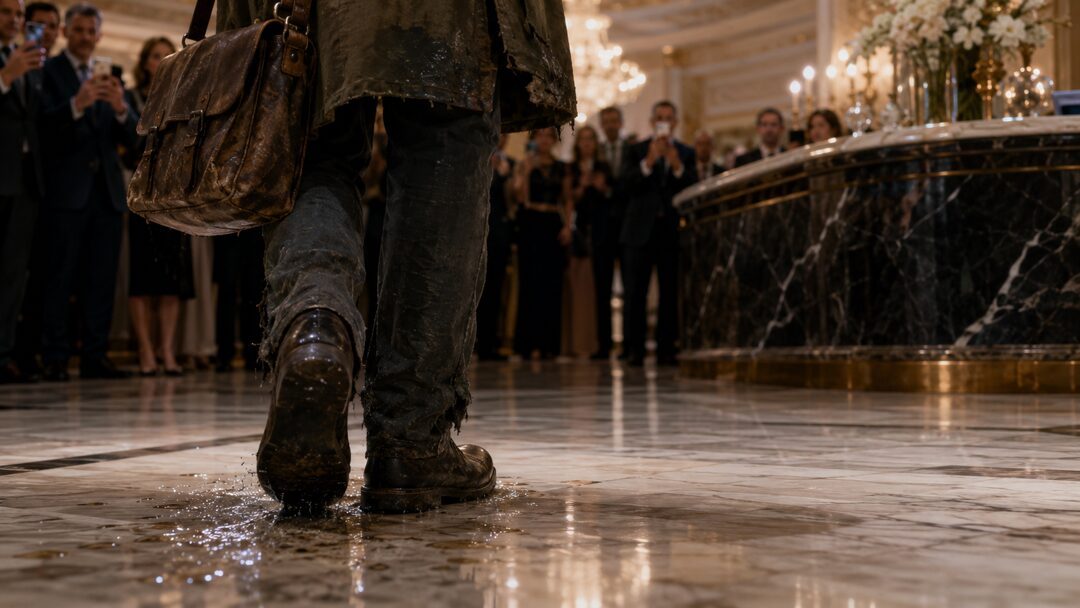
Rain clung to his gray hair. His olive jacket was torn at one elbow and stained dark at the collar. His boots left dull half-moons of water on the marble floor, each one reflected beneath him by stone so polished it made even his ruin look expensive.
The engagement party stopped breathing.
A hundred people in black dresses, tailored suits, pearl earrings, gold watches, and polished shoes turned toward him. Then, almost together, they lifted their phones.
Ryan did not look at the phones.
He looked at the chandelier.
For one second, something passed over his face that did not belong to a trespasser. Recognition. Not admiration. Not wonder.
Memory.
Behind the marble reception desk, David Mercer straightened his navy suit jacket and came forward with the calm of a man who had ordered many people out of beautiful rooms.
He did not ask Ryan’s name.
He already knew it.
“Ryan Caulfield,” David said, his voice clear enough to carry under the crystal lights, “you don’t belong here.”
The lobby went perfectly quiet after that. Even the string quartet tucked near the bar let one note fade before deciding not to play the next.
Ryan lowered his eyes from the chandelier.
He was seventy-two, though weather had added years to him and grief had taken the softness from his face. His cheeks were hollow. His hands were cracked. A worn leather satchel hung from his shoulder, the strap repaired with two different kinds of thread.
He looked at David Mercer as if the man were standing in the wrong place.
“I came for Room 363,” Ryan said.
A few people whispered. Someone laughed too softly and then stopped.
David’s expression did not change, but his right hand tightened around the edge of the reception desk.
“There is no Room 363,” he said.
Ryan glanced past him, toward the private elevator bank at the far end of the lobby.
“There was,” he said. “Before you locked it.”
The phones tilted higher.
It had started as an interruption. Now it was becoming content.
Near the champagne tower, Emily Caulfield stood frozen in a cream engagement dress that cost more than Ryan’s truck had been worth the year it was taken. Her dark-blonde hair was pinned perfectly at the nape of her neck. Pearls rested against her throat.
Her fiancé, Mark Mercer, stood beside her with one hand at the small of her back.
Emily had imagined this evening many times. She had imagined the speeches, the photos, the careful approval of people who used words like legacy and stewardship. She had imagined David Mercer raising a glass and calling her family.
She had not imagined her father walking in from the rain.
She had told them he was dead.
Not in those exact words at first. At first, she had only let silence do the work. When Mark asked about her father, she said, “He’s not in my life.” When David asked whether Ryan might cause difficulty, she said, “He won’t come.” When the hotel board’s wives asked about her parents, she smiled with practiced sadness and said, “My mother passed years ago. My father is gone too.”
Gone was a useful word.
It could mean anything.
Now Ryan stood beneath the chandelier with the whole room filming him, very much alive.
His eyes found Emily across the lobby.
She forgot how to swallow.
For a moment he looked not old, not ruined, not strange. He looked like the father who once lifted her onto the half-built reception desk when she was six and told her, “One day this floor will shine so bright you’ll see your shoes twice.”
She looked down.
Her shoes shone back.
Ryan saw the movement. His mouth tightened, but he did not call her daughter. He did not embarrass her with tenderness.
He only said, “I came for what your mother left in Room 363.”
That was when Emily’s face changed.
Mark felt it beneath his hand.
“Don’t react,” he murmured.
She barely heard him.
Ryan took one step farther into the lobby.
David lifted his hand, and two hotel security men moved in from the side corridors, black suits, earpieces, polite faces.
“Mr. Caulfield,” David said, every syllable smooth, “this is a private event. You are distressing our guests.”
“I am one of your guests,” Ryan said.
“No,” David replied. “You are not.”
The room absorbed the sentence greedily.
Ryan’s wet boots stood on the marble. Emily’s fingers curled into the skirt of her engagement dress. Mark’s hand remained at her back, warm and firm.
A woman near the champagne tower whispered, “Is that really him?”
Another whispered, “I thought he died.”
Emily heard both.
So did Ryan.
He smiled then, but it was not a happy thing.
David leaned closer, lowering his voice just enough to pretend mercy while making sure the nearest phones still caught it.
“Leave quietly,” he said. “Let this family have its evening.”
Ryan looked past him again.
“This family?” he asked.
David’s face hardened by one careful degree.
Mark’s hand closed around Emily’s wrist.
Not roughly enough for anyone else to see.
Firmly enough that she could not move.
Part II — A Perfect Evening
Before the rain, before the phones, before Ryan crossed the lobby like a stain no one could wipe away, Emily had stood in the bridal suite upstairs and let a stylist fasten pearls around her neck.
“You look like you belong here,” the stylist had said.
Emily had smiled too quickly.
That was the thing she had wanted most and trusted least.
Belonging.
At the Caulfield Grand, belonging had rules. You did not laugh too loudly. You did not mention money unless you had enough to make it sound like weather. You did not ask why the hotel still carried the Caulfield name when no Caulfield seemed to own a single inch of it.
David Mercer had explained that once, in his office, during the first year of her management internship.
“Names are complicated things,” he had said, signing a recommendation letter that would place her in the hotel’s executive track. “Sometimes they outlive the people who damage them.”
Emily had known which person he meant.
She had said nothing.
Silence had been the first rent she paid to enter the Mercer world.
Mark had made it easier. He was kind in the way powerful men can afford to be kind. He noticed when Emily skipped lunch. He sent cars when it rained. He listened when she spoke about her mother, Rebecca, and never asked too many questions about Ryan.
When Emily once admitted, after two glasses of wine, that she was ashamed of the way her father lived, Mark took her hand and said, “You are not responsible for where you came from.”
It had felt like love then.
Later, she would understand the shape of the sentence. It had offered comfort by cutting her loose.
Now, in the lobby, that same hand held her still.
“Emily,” Mark said softly, smiling for the room, “look at me.”
She did.
His eyes were tender. That made it worse.
“Let your father leave with one last piece of dignity,” he said.
Ryan was close enough to hear.
Emily watched the words reach him.
He did not flinch. That was somehow more painful than if he had.
“Dignity,” Ryan repeated, tasting it like a word from a language he used to know.
David turned sharply toward Mark, a warning in his glance. Mark’s jaw tightened, but he did not apologize.
The first security guard touched Ryan’s arm.
Ryan looked down at the hand.
“Don’t,” he said.
The guard hesitated.
David stepped forward. “There’s no need for theater.”
Ryan’s eyes moved to the phones.
“This room was built for theater,” he said.
Several guests murmured. A young man near the bar laughed under his breath, then lifted his phone higher when David looked his way.
David recovered quickly.
“Mr. Caulfield has had difficulties for many years,” he said to the room, his tone taking on the polished sorrow of public explanation. “Out of respect for his daughter and for this occasion, I ask everyone to give him privacy.”
Privacy, Emily thought wildly, while every phone in the lobby was recording.
David turned that sorrow back on Ryan.
“You need help,” he said.
Ryan’s gaze sharpened.
“I needed help twelve years ago.”
A pulse went through Emily. Twelve years. The year her mother died. The year Ryan disappeared for weeks at a time. The year men in suits came to their old house and spoke in low voices while Emily sat on the stairs, counting the cracks in the banister.
David’s expression remained controlled, but the color shifted slightly in his neck.
“That is enough,” he said.
“No,” Ryan said. “It never was.”
He reached into his jacket.
The security men moved faster then. One caught Ryan by the shoulder. The other caught his arm. A woman gasped as if she were watching something dangerous rather than something indecent.
Emily stepped forward.
Mark’s grip stopped her.
“Do not make this worse,” he said.
“For who?” she whispered.
His eyes flicked toward the phones.
“For you.”
That should have comforted her.
Instead, it opened a small cold place in her chest.
Ryan struggled once, not to escape, but to free his right hand. His fingers closed around something inside his jacket. The guard tightened his grip.
“Mr. Mercer,” Ryan said, voice low now, “tell them where Room 363 went.”
David’s smile returned, thin and bright.
“There is no such room.”
Ryan looked at Emily.
“Ask him why your mother’s handwriting is still inside it.”
The lobby seemed to tilt.
Emily’s mother had been dead for twelve years, but her handwriting could still undo a room. Rebecca Caulfield had written in blue ink on every scrap of paper in their house—grocery lists, hotel sketches, birthday cards, notes tucked into Emily’s lunchbox.
One note had stayed in Emily’s wallet until the paper softened at the folds.
Be brave enough to know what you know.
She had thrown it away the week Mark proposed.
Or she thought she had.
Her hand went to her purse now, uselessly, as if memory might still be hiding there.
David saw the movement.
“Emily,” he said, and for the first time that night his voice lost its polish. “This is not something you need to entertain.”
Ryan laughed once. It had no humor in it.
“There it is,” he said. “That old Mercer kindness. Always telling people which truth is too heavy for them.”
Mark stepped in before David could answer.
“Ryan,” he said, using the name like an act of grace, “whatever you believe happened, this is not the place.”
Ryan looked at him.
“You’re marrying my daughter in the place your family took from her.”
Mark’s face changed.
Not enough for the room.
Enough for Emily.
There was recognition there. Not surprise. Not confusion.
Recognition.
She pulled her wrist free.
Mark let her, but slowly, as if the release itself belonged to him.
Part III — Room 363
The first time Emily had seen Room 363, she was seven and forbidden to be there.
The hotel had still smelled of sawdust then. Bare wires hung from ceilings. Workers shouted from ladders. Her mother wore jeans and a white hard hat with REBECCA written across the front in blue marker.
Ryan carried Emily on his shoulders through the unfinished third floor and told her that someday people would come from all over the city to sleep in rooms he had measured by hand.
“This one,” Rebecca said, stopping at a door with no handle yet, “is ours.”
Ryan laughed. “We’re building a hotel so my wife can hide in it.”
Rebecca pressed her palm to the raw wood.
“No,” she said. “So something true stays in one place.”
Emily had forgotten that sentence.
Or buried it.
Now, twelve years and a lifetime later, she stood beside a service corridor while the lobby watched her father being held by security, and the sentence came back clean.
So something true stays in one place.
She moved before she knew she had decided.
“Wait,” Emily said.
The word was not loud, but it traveled.
David turned.
Mark turned.
Ryan did not.
He kept his eyes on the marble floor as if he had already spent too many years hoping she would speak.
Emily walked toward him. Every phone followed.
Her dress brushed the wet marks his boots had left behind.
When she reached him, the security guard looked to David. David gave the smallest shake of his head: do not release him.
Emily noticed.
So did Ryan.
“Why are you here?” she asked him.
His face was close enough now for her to see how thin he had become, how rainwater had gathered in the lines around his mouth, how his left hand trembled when he tried to still it.
“I told you,” he said. “Your mother left something.”
“My mother left me with you,” Emily said, too quickly, too sharply. “And then you left too.”
The room went hungry-quiet.
Ryan absorbed that one. It landed harder than David’s sentence. Harder than the hands on his arms.
“I know,” he said.
Emily hated that he did not defend himself.
She wanted him to rage. To make himself easier to reject.
“Do you?” she asked. “Because I waited. I waited for calls, letters, anything. David was the one who helped me. Mark was the one who stayed. These people—”
She stopped before she said gave me a life.
Ryan finished it anyway.
“These people taught you how to stand in a room while your father is dragged out of it.”
Emily’s face went hot.
Mark moved beside her.
“That’s enough,” he said.
Ryan’s eyes moved to him. “You don’t get to measure enough.”
Mark’s voice stayed low and gentle. “I’m trying to protect her.”
“From me?”
“From what you’ll turn her into if you keep going.”
That line cut differently. Emily felt it because part of her believed it. She had spent years outrunning the small apartments, the shut-off notices, the rumors about Ryan drinking in his truck outside job sites that would no longer hire him.
She had loved her father once with the total faith of a child.
Then she had learned people could love you and still become a place you were ashamed to be from.
Ryan looked at her and seemed to read all of it.
“I fought,” he said.
Emily’s eyes stung. “When?”
“When Mercer’s lawyers sent papers saying I was unstable. When they told me if I came near you, they’d reopen the custody file. When they said they had records from your mother’s treatment, my bankruptcy, every bad week we ever had. I fought until fighting meant they would make your childhood a public exhibit.”
David’s voice cracked across the lobby.
“Do not stand in my hotel and invent threats.”
Ryan turned toward him.
“Your father’s name is on the first threat.”
A ripple moved through the guests.
David’s father had been dead for five years, but his portrait still hung above the private elevators. Samuel Mercer, the man credited with saving the Caulfield Grand from collapse. The man whose family had “preserved a landmark.” The phrase appeared on bronze plaques, charity programs, and Mark’s engagement toast.
Emily looked at Mark.
He was watching his father.
Not Ryan.
Not her.
His face was controlled, but not confused.
“Mark,” she said.
He turned quickly. “Emily, don’t.”
“Don’t what?”
“Don’t let him turn grief into evidence.”
Ryan let out a small breath.
“Good line,” he said. “David teach you that one?”
Mark’s jaw tightened.
David stepped away from the desk and came closer, no longer performing only for Ryan. Now he performed for the room.
“Emily,” he said, “I understand this is painful. Your father has carried resentment for a long time. He was part of the early construction team. No one denies that. But he was never the owner of this hotel.”
Ryan smiled faintly.
“There it is. Part of the construction team.”
He shifted his shoulder against the guard’s grip. “I poured the first footing. Rebecca negotiated the land option. We signed the original rights agreement before the Mercers ever touched the project.”
David’s voice stayed smooth. “There is no valid document supporting that.”
“In Room 363,” Ryan said.
“There is no Room 363.”
Ryan finally freed his hand from inside his jacket.
The guard grabbed for it, but Ryan was already holding the object up.
A plastic hotel key sleeve, cloudy with age.
Inside it lay an old brass key.
On the sleeve, in faded block letters, someone had written:
RAR 363
Emily stared.
RAR.
Rebecca Ann Ryan.
Her mother’s married initials, written in blue ink.
The lobby came alive. Whispers. Camera shutters. A livestreamer near the bar whispered, “Oh my God, he has a key.”
David laughed.
It was a bad laugh. Too quick. Too thin.
“A souvenir,” he said. “A sad little souvenir.”
Ryan looked at him.
“Then let it fail.”
David did not answer.
That silence did what Ryan’s words could not.
It made everyone wonder why a useless key frightened the most powerful man in the room.
Part IV — The Choice in Public
David recovered by choosing procedure.
It was what he did best.
He nodded toward the security guards. “Escort Mr. Caulfield outside. If he returns, notify the authorities.”
“David,” Emily said.
He did not look at her. “Not now.”
The words struck her with the force of habit. Not now. Later. Quietly. Privately. Appropriately.
All the words powerful people used when the truth was becoming inconvenient.
The guards pulled Ryan backward.
He did not resist this time. He looked only at Emily.
That was worse.
If he had shouted, she might have stayed where she was. If he had begged, she could have called it manipulation. But he only looked at her as if the last door in his life had her hand on it.
Then two uniformed officers entered through the side entrance.
The hotel had called them before Ryan ever raised the key.
Emily turned to David.
“You knew he was coming.”
David’s expression softened, and for one foolish second she remembered every scholarship dinner, every careful introduction, every time he had told her Rebecca would be proud.
“My dear,” he said, “I knew he might try.”
Something in Emily recoiled from the affection.
Mark came to her side.
“Listen to me,” he said, low enough that only she could hear. “This can still be contained.”
Contained.
Not solved. Not understood. Not faced.
Contained.
“What did you know?” she asked.
His eyes tightened.
“I knew there were old claims.”
“Old claims?”
“Nothing enforceable.”
“About my family?”
“About a building,” he said.
She stared at him.
He reached for her hand. “Emily, I love you.”
That was the cruel part. She believed him.
She believed that he loved the way she looked in cream silk. The way she made him feel less like his father. The way her Caulfield name, once polished and married to his, could smooth the last rough edge of the Mercer story.
He loved her.
He also needed her useful.
The two truths stood side by side, and one did not erase the other.
“Did you know about the room?” she asked.
Mark did not answer quickly enough.
Her throat tightened.
Ryan was near the door now, one officer holding his arm, the other speaking into a radio.
Ryan lifted the key again.
“Stop,” he said.
It was not loud.
It stopped them anyway.
Maybe because he sounded less like a man asking permission than a man calling a room back to order.
The officer glanced at David.
David’s smile had vanished.
“Emily,” David said, and now the whole lobby could hear the warning beneath her name, “think very carefully. If you indulge this, you do not simply embarrass this family. You embarrass yourself. Your mother’s name. Your future.”
My future, Emily thought.
He meant Mark.
He meant the engagement.
He meant the board seat quietly promised after the wedding. The foundation role. The apartment overlooking the river. The life where no one looked at her and saw eviction notices, her father’s shaking hands, her mother’s pill bottles hidden in ceramic jars.
David stepped closer.
“You can ask him to leave,” he said. “And we will continue with dignity.”
Emily looked at Ryan.
His jacket dripped steadily onto the marble.
David continued, “Or you can open a private family matter in front of strangers who will not love you in the morning.”
That was almost true.
The strangers would not love her.
But neither, she suddenly understood, would the Mercers if love required her silence.
Mark took both her hands now, making the gesture look tender for the cameras.
“Come with me,” he said. “We’ll talk upstairs. I’ll protect you.”
“From what?” she asked.
His grip tightened.
“From becoming the story.”
She looked at the phones.
She was already the story.
Her father had been the story for twelve years without being allowed to tell it.
Mark leaned closer, and his voice broke just enough to be real.
“Don’t make our love into a courtroom.”
Emily’s eyes filled, but the tears did not fall.
The line might have saved him if he had said it before she knew.
Before the old claims.
Before the silence.
Before Room 363.
She looked at his hands around hers.
“You made it a contract before I knew it was love.”
Mark let go as if she had struck him.
Emily walked to Ryan.
No one stopped her now.
Not David.
Not Mark.
Not the officers.
Perhaps they all still believed she would say the proper thing. That she would smooth the room, save the night, ask her father to leave with the dignity they had already taken from him.
Ryan watched her come.
She held out her hand.
For the first time since he entered, his composure faltered.
“Emily,” he said.
“The key,” she said.
His eyes searched her face. For belief. For mercy. For the child who had once fallen asleep against his shoulder in an unfinished hotel room while rain ticked against plastic-covered windows.
He placed the key in her palm.
His fingers were cold.
The brass was warm.
Part V — What Rebecca Left
The private elevator accepted the key with a sound so soft that half the lobby missed it.
The other half did not.
David lunged forward. “Stop her.”
No one moved.
The security guards looked at the officers. The officers looked at the key. The guests looked at David.
Authority is a fragile thing when everyone sees it panic.
Emily stepped into the elevator alone.
As the doors closed, she saw Mark watching her with a face she had never seen before. Not angry. Not pleading.
Afraid.
The elevator rose only two floors, but it felt like surfacing through years.
When the doors opened, the hallway was dim and narrow, nothing like the guest floors below. No music. No flowers. No staff. Just old carpet, locked storage doors, and a small brass plaque at the end:
PRIVATE ARCHIVE
Emily’s hand shook as she approached.
The key slid into the lock.
For one terrible second, nothing happened.
Then the lock turned.
The room smelled of dust, paper, and cedar.
It was not a guest room anymore, but it had once been one. The shape remained. Windows facing the city. A stripped bed frame against one wall. Boxes stacked beneath white sheets. A drafting table covered with rolled plans.
On the far wall hung a framed photograph.
Ryan and Rebecca Caulfield stood in the unfinished lobby, young enough to look almost like strangers. Ryan wore a work shirt with sleeves rolled to the elbows. Rebecca stood beside him in a hard hat, one hand on a spread of architectural drawings, the other resting over the slight curve of her stomach.
Emily.
Her knees weakened.
Beneath the photograph sat a metal document box.
On top of it was an envelope.
Her name was written across it in blue ink.
Emily Ann.
Not Miss Caulfield.
Not Emily.
Emily Ann, the way her mother said it when calling her in from the yard.
For a moment, Emily could not touch it.
Then she thought of Ryan downstairs with two officers beside him, wet and humiliated beneath chandeliers he had once watched being installed.
She opened the envelope.
The letter was not long.
Her mother had always known how to say the thing and leave space around it.
Emily read only enough before she understood why the room had stayed locked.
My darling Emily Ann,
If you are reading this, it means the story has gone where I feared it would.
Your father did not lose the hotel because he was careless. He trusted people who knew how to make paperwork look cleaner than truth. The original rights to the Caulfield name and project were ours before the Mercer transfer. Copies are in this box. So are the letters Samuel Mercer sent after he learned I was too ill to fight him.
Your father will be blamed. He will blame himself too. That is his weakness. He thinks silence is protection.
Do not inherit our silence.
Emily covered her mouth.
The box contained partnership papers, old correspondence, copies of agreements, Rebecca’s notes, and a photograph of David Mercer as a younger man standing beside his father and Ryan at the construction site.
On one letter, David’s signature appeared beneath language so cold it made Emily’s skin prickle.
Any continued contact with the minor child may require review of the household instability previously documented.
Minor child.
Emily.
She had been used as a locked door before she ever knew there was a room.
When she returned to the lobby, the party had changed shape.
No one was drinking. No one was pretending. The string quartet was gone. The champagne tower stood untouched, ridiculous and gleaming.
Ryan remained near the entrance, but the officers no longer held him.
David stood in the center of the lobby, his face pale beneath the warm light.
Mark was near the private elevators, waiting for her.
Emily carried the document box in both arms. The photograph rested on top. Her mother’s letter lay open against it.
Every phone rose again.
This time, Emily did not look away.
She walked to the marble reception desk.
The same desk where David had pronounced her father unfit to stand.
The same desk where, years ago, Ryan had lifted a little girl and told her the floor would shine.
Emily placed the photograph on the marble.
Gasps moved through the lobby.
Someone whispered, “That’s him.”
Ryan did not come closer.
He looked at the photograph from where he stood, and his face broke quietly. Not dramatically. Not for the room.
For Rebecca.
David spoke first.
“Emily, those documents are old and complex. They require proper review.”
She almost laughed.
Proper review.
The old magic words again.
She lifted the letter.
“My mother wrote this to me.”
David’s face tightened. “This is not the forum.”
Emily looked at him.
“No. This is the room you chose.”
The lobby went still.
She read just three sentences aloud. Not all of it. Not the private parts. Not the pieces that belonged only to a daughter.
But enough.
Enough for the room to hear that Ryan had not invented the claim.
Enough for the room to hear the Mercer name beside threat and transfer.
Enough for Mark to lower his eyes.
Enough for David to lose the shape of respectability.
Ryan stood motionless.
Emily folded the letter carefully.
Then she turned to her father.
For years, she had imagined seeing him again and feeling only embarrassment. Anger. Relief that she had escaped becoming him.
Now she saw the wet jacket, the dirty boots, the trembling hand, and beneath all of it the man who had stayed outside her life because other men had learned which threats a ruined father would believe.
That did not make him innocent.
It made him human.
It made her silence heavier.
“I’m sorry,” she said.
Ryan closed his eyes.
The words were too small. They both knew it.
Mark stepped forward then, grief and calculation fighting across his face.
“Emily,” he said, “please. We can handle this together.”
She looked at him.
The love was still there. That was the worst of it. It had not vanished just because its shadow had been named.
“I think you did handle it,” she said. “For years.”
He flinched.
David said, “Mark.”
But Mark ignored him.
“I didn’t know all of it,” he said.
Emily believed that too.
The partial innocence hurt more than a clean lie would have.
“But you knew enough,” she said.
Mark’s mouth opened, then closed.
There was no gentle way through that sentence.
Part VI — The Walk Outside
The engagement ended without anyone announcing it.
There was no broken glass, no shouted farewell, no dramatic exit from Mark. The collapse was quieter and more complete than that.
People simply began to leave.
They lowered their phones only after they had captured enough. They collected coats. They murmured near the revolving door. They glanced at Ryan now with a different kind of discomfort, as if pity were more embarrassing than contempt.
David remained beside the reception desk, speaking quietly to two board members who no longer leaned toward him.
Mark stood alone near the champagne tower.
Emily removed the engagement ring in the shadow of a marble column.
She did not throw it. She did not make a speech. She held it for a moment, remembering the night Mark had given it to her, how happy she had been, how relieved.
Then she placed it on the ledge beside an untouched glass of champagne.
Mark saw.
He did not come after her.
Maybe he finally understood that some doors do not open just because you have always had access.
Ryan waited by the revolving door.
The rain outside had softened to a mist. City lights blurred on the wet street. The lobby behind them still glowed with gold, but the warmth had gone out of it.
Emily walked to him carrying her mother’s letter.
Up close, she saw how tired he was. Not just from tonight. From years of being misremembered by the only person whose memory mattered to him.
“Did you know she wrote it to me?” Emily asked.
Ryan nodded.
“Why didn’t you tell me?”
“I tried once,” he said. “You were nineteen. You saw me outside your dorm and crossed the street.”
Emily remembered.
She had been with friends from her scholarship program. Ryan had stood by a rusted pickup in a coat too thin for November. She had recognized him and felt a hot wave of panic.
She had crossed before he could call her name.
At the time, she told herself she was protecting her future.
Now she understood she had been protecting an audience.
“I thought you came for money,” she said.
“I know.”
“You let me think that?”
Ryan looked toward the desk where the brass key now lay.
“I let you think a lot of things,” he said. “Some because I was ashamed. Some because I thought it was safer. Most because I was tired.”
Emily nodded once.
It was not forgiveness.
It was the beginning of honesty, which felt less comforting and more useful.
Behind them, David’s voice rose slightly, then fell. He sounded smaller now. Still dangerous, perhaps. Still powerful in ways that would matter tomorrow. Lawyers would come. Statements would be drafted. The hotel would not hand itself back because a room had opened and a letter had been read.
Truth did not work that quickly.
But shame had.
Shame had built walls in minutes and kept them standing for years.
Tonight, one had opened.
Emily looked at Ryan.
“Can you forgive me?” she asked.
The question left her before she could make it prettier.
Ryan’s face tightened. For a moment she saw the answer he might have given if love were simple.
Then he shook his head.
“Not tonight.”
Emily looked down.
The words hurt, but they did not punish. They were clean. Cleaner than comfort would have been.
Ryan shifted his satchel on his shoulder.
“But I can walk with you,” he said.
Emily pressed her lips together, holding back something too large for the lobby.
“All right,” she whispered.
Ryan pushed the revolving door, then paused.
He looked back once at the Caulfield Grand.
At the chandelier Rebecca had chosen.
At the marble floor he had measured.
At the desk where David Mercer stood pretending not to watch him leave.
At the key marked RAR 363 resting on the stone, no longer a strange object in a ruined man’s hand, but a small brass witness to everything the room had tried not to remember.
Then Ryan stepped outside.
Emily followed.
The door turned behind them, glass and gold and rain moving in a slow circle.
For the first time in years, father and daughter walked into the same weather.
Not healed.
Not yet.
But no longer separated by the lie.