The Blue Door Promise
Part I — The Lobby Under Glass
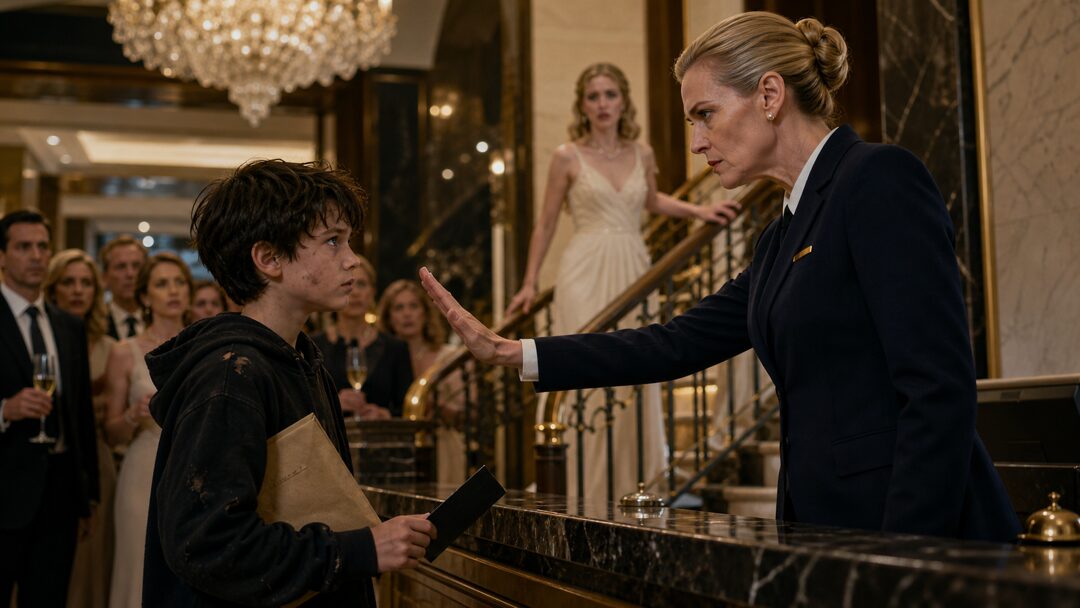
The boy walked into Carter House during the engagement toast, wearing one muddy sneaker without a lace and a torn black hoodie that made every diamond in the lobby seem louder.
For half a second, no one moved.
Above him, the chandelier poured light over marble, champagne flutes, white roses, gold trim, polished shoes, and people who had spent their whole lives learning not to stare.
Then they stared.
The boy did not.
He stood just inside the revolving doors with his hands at his sides, face dirty, lip split, pale blue eyes fixed on the front desk as if he had come by appointment.
Patricia Wells saw him before security did.
She had managed the Carter House lobby for nineteen years. She could read money by its silence, power by its posture, trouble by the way it entered a room. Trouble usually came loud.
This boy came quiet.
That made him worse.
Patricia crossed the marble floor quickly, her navy suit sharp enough to look like a warning. She stepped between the boy and the velvet rope that separated hotel guests from the private reception.
“Sweetheart,” she said, lowering her voice in the way adults used when they wanted cruelty to sound like manners, “the shelter entrance is two blocks over, on Mercer.”
The boy looked up at her.
“I’m here to see Emily Carter.”
Patricia’s expression did not change, but something behind it locked.
Emily Carter was not simply a guest. She was the daughter of Carter House, the woman whose engagement party currently glittered beneath the chandelier. Her face was printed on the invitation cards. Her wedding announcement had run beside a photograph of the hotel’s founder’s staircase.
Children with split lips did not ask for Emily Carter.
Especially not tonight.
“I’m afraid Miss Carter is unavailable,” Patricia said.
“She’ll see me.”
A security guard had reached the edge of the desk now. Another waited near the brass elevator doors. Guests had begun to pretend they were not watching.
Patricia smiled without warmth.
“And who should I say is asking?”
The boy reached inside his hoodie.
Both guards shifted.
He took out a sealed envelope.
Then he placed a matte black card on the marble counter.
It made almost no sound.
That was what made Patricia look down.
The card was not plastic, not like room keys or club passes. It was heavy, dark, clean, with the old Carter crest pressed into one corner: a small brass door beneath a crown of laurel.
Patricia’s throat moved.
“That card is not yours.”
The boy said nothing.
“Where did you get this?”
He rested one finger on the envelope, which was stamped and sealed in faded blue wax.
“I was told to bring both.”
“By whom?”
The boy’s eyes stayed on hers.
“Robert Carter.”
The name crossed Patricia’s face like a hand.
Robert Carter had been dead for three years.
Behind her, laughter from the reception thinned. Someone whispered, “What is happening?” Another guest lifted a phone, then lowered it when Patricia looked over.
Patricia picked up the card as if it might stain her gloves, though she was not wearing any.
“Wait here,” she said.
“I’ve been doing that,” the boy replied.
It was the first thing he said that made her flinch.
Part II — The Black Card
Patricia took the card behind the desk and slid it into a reader used so rarely most of the younger staff had never seen it work.
The screen asked for a second verification.
Her fingers hovered.
The boy watched.
He did not fidget. He did not wipe his face. He did not pull at his torn sleeve or glance at the guests who had started gathering in small, polished clusters. There was no performance of helplessness in him.
That made the room angrier.
People preferred need when it bowed.
Patricia typed her manager code.
A red line blinked.
Then the screen changed.
Restricted account access.
Founder’s Descendant.
Immediate Access Required.
Name: Joshua Carter Hale.
Patricia stopped breathing for one full second.
The guard beside her leaned in. “Ma’am?”
She snapped the monitor slightly away from him.
Too late.
He had seen enough.
Patricia looked back at the boy. Not at his hoodie now. Not at the mud on his shoes. At his face.
His pale eyes did not change.
The guests saw her face before they knew the reason for it.
A woman in pearls whispered, “Patricia?”
Patricia forced her mouth into a shape that almost became a smile.
“Please come with me.”
“No,” Joshua said.
The word was small, but it cut cleanly through the lobby.
Patricia blinked.
“Excuse me?”
“I said I need to see Emily Carter.”
“This is not the place—”
“This is the place I was told to come.”
His hand went to the envelope again.
The first champagne glass clinked against marble somewhere behind him. Not shattered. Just set down too hard.
At the top of the staircase, Emily Carter appeared in ivory.
The entire lobby seemed to remember itself.
She stood beneath a sweep of white flowers, one hand resting lightly on the banister, her engagement dress fitted like a promise no one had questioned. Beside her was Michael Grant, tall, immaculate in a navy tuxedo, one hand at the small of her back.
He looked down first with polite curiosity.
Emily looked down and went still.
Not pale in the way people did under bad lighting.
Pale like someone had opened a locked room inside her.
Michael noticed before anyone else.
“Emily?” he murmured.
She did not answer.
Joshua looked up at her.
For a moment, he was ten years old in a lobby full of adults.
Then he said, clearly enough for the closest guests to hear, “You told me to wait by the blue door.”
Emily’s hand slipped from the banister.
Michael’s smile remained, but his eyes moved from Joshua to Emily and stayed there.
“Do you know him?” he asked.
Emily’s lips parted.
“No.”
She said it too fast.
Joshua lowered his eyes.
Not in surprise.
In recognition.
That hurt more.
From behind the staircase, Margaret Carter entered the lobby like a woman arriving to correct a room. Her silver-blonde bob did not move. Her black dress had no wrinkle. A diamond brooch shaped like the Carter crest shone at her collar.
She saw Joshua.
Then she saw the black card in Patricia’s hand.
Her face hardened before she smoothed it.
“Patricia,” Margaret said, voice low and bright. “Take this somewhere private.”
Joshua picked up the envelope.
“I won’t move until she opens it.”
Margaret’s smile was almost perfect.
“This child is confused.”
“I know my name,” Joshua said.
The lobby went quieter.
Emily descended one step.
Margaret turned just enough to stop her without touching her.
“Not here.”
Michael’s hand returned to Emily’s back. Gentle. Possessive.
“Let’s handle this calmly,” he said.
Joshua looked at his hand.
Then at Emily.
She looked away first.
Part III — The Letter Behind the Desk
They brought Joshua to the private office behind the lobby, but he walked in as if he had allowed it, not as if he had been taken.
The office smelled of lemon polish and old paper. On the wall hung a black-and-white photograph of Robert Carter cutting the ribbon on the hotel’s restored entrance. He had one hand raised, smiling in the easy way wealthy men smiled when the world still agreed with them.
Joshua stood beneath that photograph.
Emily could not look at him without seeing the stairs at the service entrance ten years ago.
The blue door had been behind the kitchen, painted too brightly for the gray alley it opened onto. She had been seventeen, shaking, wearing her school sweater beneath one of Margaret’s coats. Joshua had been wrapped in a hospital blanket, newborn and furious at the cold.
“You wait here,” Emily had whispered then, though the baby could not understand. “Just for a little while.”
Margaret had taken him from her arms.
Emily had believed the story because she needed to live inside it.
A private guardian. A safe house. Money sent every month. Updates when appropriate. A future when the timing was better.
The timing, Margaret always said, was never better.
Now Joshua placed the envelope on the desk between them.
“Open it,” he said.
Emily’s fingers would not move.
Margaret reached for it.
Joshua covered it with his hand.
“Her.”
The word embarrassed Emily more than an accusation would have. It assumed she still mattered.
Michael stood near the door, one hand in his pocket, posture easy. Only his jaw had changed.
Patricia remained by the filing cabinet, holding the black card as if it had become heavier.
Emily broke the wax seal.
Inside were two folded documents and a letter in her father’s handwriting.
She knew it before reading a word.
Robert Carter had written slowly, with old-fashioned loops and too much pressure on the page. When she was little, he had written notes and slipped them under her breakfast plate. Don’t let your mother make you afraid of weather. Storms pass. People who never get wet don’t grow.
Emily had not thought of that note in years.
Her hands trembled so badly the paper shook.
Emily,
If Joshua comes to Carter House with this card, it means the protections I arranged have failed or been interfered with. He is to be received, sheltered, and represented at once. He is your son. He is my grandson. He is a Carter, whether the world was told or not.
Emily stopped.
The office had no sound except the reception music muffled through the wall.
Michael looked at Margaret.
Not Emily.
Margaret’s face had not moved.
Emily read the rest in fragments.
Trust beneficiary.
Founder’s descendant.
Protected heir.
Emergency review.
No transfer, sale, or restructuring of Carter House assets to proceed while his welfare remains unresolved.
At the bottom was her father’s signature.
Beside it, the signature of the family attorney.
Emily looked at Joshua.
His face was still.
Too still.
“I thought you were safe,” she said.
It came out smaller than she meant.
Joshua did not answer.
Margaret exhaled.
“Robert was sentimental in his final years.”
Emily turned to her mother.
“You knew.”
Margaret lifted her chin.
“I managed a difficult situation after your father made it legally impossible to do so cleanly.”
“You knew he had a trust.”
“I knew your father made provisions that could destroy this family if mishandled.”
Joshua’s hand tightened around the edge of the desk.
Emily saw it.
A child’s hand. Dirty under the nails. The knuckles scraped.
“What happened to the guardian?” Emily asked him.
Joshua looked at the letter, not at her.
“Mrs. Donnelly left.”
“When?”
“Six months ago.”
Emily’s breath caught.
“The payments stopped before that.”
Margaret’s eyes flashed.
“That is not possible.”
Patricia looked down.
Joshua’s voice stayed flat.
“She said she couldn’t keep me. Then she was gone. The attorney’s office moved. I found the address in the folder. It said if I wasn’t safe, come here.”
Emily gripped the letter so hard it creased.
“Where have you been?”
Joshua’s silence answered before he did.
“Different places.”
The words were careful.
He had learned to make hunger sound like logistics.
Michael finally spoke.
“How much control does the trust give him?”
Emily turned toward him.
The question hung in the office, clean and cold.
Not Is he all right?
Not What does he need?
How much control?
Michael seemed to realize too late that everyone had heard him exactly.
He softened his voice.
“I mean we need to understand the implications.”
Margaret seized the phrasing like a rope.
“Yes. Precisely. This is delicate.”
Emily laughed once, without humor.
“Delicate.”
Margaret stepped closer.
“Do not become theatrical. You were seventeen. I protected you.”
“You took him.”
“I preserved your future.”
Joshua looked up then.
At Emily.
Not Margaret.
That was worse.
Because Margaret had only been the hand.
Emily had been the door.
Part IV — What the Room Was Asked to Forget
Outside the office, the engagement party had begun to curdle.
Guests clustered beneath the chandelier with untouched champagne and hungry faces. No one knew enough to speak openly. Everyone knew enough to stay.
Public uncertainty was its own kind of entertainment.
Inside, Emily read the legal notice again. The words did not change.
No sale.
No transfer.
Immediate welfare review.
Michael moved closer to her.
“Emily,” he said quietly, “come here.”
It was the voice he used when photographers were near. Calm. Protective. A little sad, as if her panic was something he could absorb.
She went to him because she had gone to him for two years.
When the hotel’s debts became numbers Margaret could no longer hide, Michael had arrived with solutions. He knew buyers. He knew banks. He knew how to speak to men who smiled over dying family properties and called it opportunity.
He also knew how to make Emily feel chosen.
At first, that had seemed like love.
Now his hand closed gently around her elbow.
“I need you to think beyond this moment,” he said.
“This moment is a child.”
His eyes flicked toward Joshua.
Then back to her.
“This moment is a room full of people, a signed agreement waiting upstairs, and your family’s last chance to keep any part of its name intact.”
Emily pulled her arm back.
Michael let her.
That was one of his talents. He never held on long enough for anyone else to call it force.
Margaret stood by the desk, voice low.
“There are ways to handle this without ruining every life in that room.”
Joshua picked up the black card from where Patricia had set it down.
Patricia did not stop him.
“What ways?” Emily asked.
Margaret’s eyes sharpened.
“A private settlement. A proper placement. A statement later, when we have counsel.”
“A statement,” Emily repeated.
“What would you prefer?” Margaret snapped softly. “That I send you out there to announce that, before you were old enough to understand consequence, you gave birth to a boy no one has seen in ten years? That your father built a trap into the hotel paperwork? That Michael’s investment is now subject to review by a child who appeared tonight looking like—”
She stopped.
Joshua looked at her.
“Like what?”
No one answered.
That was the answer.
Emily stepped between them.
“Don’t.”
Margaret’s mouth tightened.
“Do not mistake guilt for wisdom.”
“And don’t mistake control for love.”
For the first time, Margaret looked hurt.
Not sorry.
Hurt.
As if Emily had broken the rules by naming the family language.
Michael glanced toward the closed office door. The muffled music outside shifted; someone had begun tapping a microphone.
The toast.
The papers upstairs.
The whole evening moving without permission.
Michael leaned in close enough that only Emily should have heard him.
“I love you,” he said. “But I need to know you can protect our future.”
Emily stared at him.
Our future.
The phrase that had once felt like shelter now had locks on it.
“And Joshua?” she asked.
Michael’s expression did not harden. That would have been easier.
It softened.
“That depends on how you manage this.”
The boy had been silent since Margaret’s almost-insult.
Now he moved.
He took the envelope from the desk and slid the letter inside with careful hands. Then he took the black card and walked toward the door.
Emily turned.
“Joshua.”
He paused, but he did not look back.
“I came because the paper said I had to,” he said. “Not because I thought you would want me.”
The words struck her without raising their voice.
He opened the door.
Light from the lobby spilled over him.
The guests turned as one.
Part V — The Name Under the Chandelier
Michael was faster than everyone wanted to admit.
By the time Joshua stepped back into the lobby, Michael had already taken a glass from a passing server and walked beneath the chandelier with his public smile restored.
It was a beautiful smile.
Emily had loved it once because it made hard rooms easier.
Now she watched it gather the guests.
“Friends,” Michael called, lifting his glass. “Thank you for your patience. Tonight is about family, legacy, and the future of Carter House.”
A few uncertain smiles returned.
People liked being told what a moment meant.
Joshua walked straight to the champagne table.
His muddy shoes left faint marks on the polished floor.
Patricia followed two steps behind him, face pale.
Margaret emerged from the office with the authority of someone used to rewriting events before they became memory.
Emily came last.
That was how it had always been.
Margaret first.
Emily after.
Michael continued, voice warm and carrying.
“This hotel has stood for generations because the Carter family understood something rare. That what we inherit is not only property, but responsibility.”
Joshua placed the black card on the champagne table.
It lay between crystal flutes and a silver bucket of roses.
The old crest caught the chandelier light.
Michael stopped.
Not for long.
Only long enough for the closest guests to notice.
Patricia closed her eyes.
Margaret spoke before anyone else could.
“I apologize for the interruption,” she said, smiling to the room. “A young person has come to us with a family matter that has clearly been misunderstood.”
Joshua did not move.
A man near the staircase whispered, “Is that the founder’s card?”
Another voice answered, “There aren’t any of those left.”
Michael stepped toward Emily.
His voice dropped.
“End this now.”
It was not loud.
It did not need to be.
Emily looked at him. At the man who had held her hand through bank meetings, kissed her temple in elevators, told her she looked brave when she was only obedient.
Then she looked at her mother.
Margaret’s eyes said, We survive this by staying quiet.
Then Emily looked at Joshua.
His face gave her nothing.
No plea. No anger. No forgiveness waiting to be purchased with one decent act.
He had already learned the danger of hoping in front of people.
Patricia moved to the front desk as if pulled by a wire. She typed something into the old terminal. Her hands shook.
Margaret saw her.
“Patricia.”
The warning was soft enough to be elegant.
Patricia stared at the screen.
Then at Joshua.
Then at the guests.
Her voice, when it came, was thin but clear.
“The card is valid.”
The room changed.
Not loudly.
Worse.
Quietly.
Patricia swallowed.
“It belongs to Joshua Carter Hale. Founder’s descendant. Trust beneficiary. Immediate access.”
A woman gasped.
Someone else said Emily’s name.
Margaret’s face lost color, but not control.
“This is a private legal matter,” she said.
“No,” Joshua said.
Every adult turned toward him.
He looked at Emily.
“I waited.”
Two words.
That was all.
But Emily was seventeen again, standing by the blue service door, arms empty, listening to her mother say, If you love him, you will let me fix this.
She had believed love could be proven by disappearing.
She had believed silence was temporary.
She had believed she could become good later.
Later had walked into the lobby with mud on his shoes.
Emily stepped forward.
Michael caught her wrist.
Not hard.
Just enough.
“Emily.”
She looked down at his hand.
He released her immediately.
But the room had seen.
So had she.
Emily moved beneath the chandelier, ivory dress brushing the marks Joshua had left on the floor.
Her voice almost failed.
Then she saw Joshua brace himself for it.
For denial.
Again.
“My name is Emily Carter,” she said.
No one breathed.
“And Joshua Carter Hale is my son.”
The lobby cracked without making a sound.
Margaret closed her eyes.
Michael’s expression emptied.
Emily kept going because stopping would be another kind of lie.
“I was seventeen when he was born. I was ashamed. I was afraid. I let my family hide him, and I told myself that being quiet was the same as keeping him safe.”
Her eyes found Joshua.
“It wasn’t.”
Joshua did not blink.
Emily turned back to the room.
“He came here tonight because he was told this was the place that would protect him if no one else did. And the first thing we did was try to send him away.”
Patricia lowered her head.
Margaret’s voice cut in, low and controlled.
“Emily, enough.”
Emily looked at her mother.
For once, she did not lower her voice.
“No.”
It was not dramatic.
It was not graceful.
It was simply a door closing.
Michael set his champagne glass down.
“If this is how you choose to handle it,” he said, “then I can’t protect you from the consequences.”
Emily almost smiled.
Not happily.
With the tired clarity of someone finally hearing the sentence under every sentence.
“I think that was always the problem,” she said. “You only loved me when protection looked like control.”
Michael’s jaw shifted.
For a moment, something wounded showed through his polish.
Then it vanished.
He turned and walked toward the elevators.
No slammed door.
No raised voice.
Only the soft departure of a man who could not bear to be seen losing the terms of his own generosity.
The elevator opened.
Closed.
And still no one moved.
Part VI — The Door Opens Differently
After Michael left, the lobby did not return to itself.
It tried.
A waiter collected abandoned glasses. Someone whispered into a phone near the white roses. A guest who had once kissed Margaret on both cheeks at charity luncheons avoided her eyes.
That was how power changed hands in rooms like Carter House.
Not with shouting.
With people deciding where not to look.
Margaret stood very straight.
For years, that posture had made others straighten too.
Now it only made her seem alone.
“You have no idea what you’ve done,” she said to Emily.
Emily’s hand was still trembling.
“Yes,” she said. “I do.”
Margaret looked at Joshua then, really looked at him. Not as a risk. Not as paperwork. As a boy beneath the chandelier, holding a card her husband had left behind like a final refusal to obey her.
For one brief second, grief moved across her face.
Then pride covered it.
She turned and walked toward the private elevator.
No one followed.
Patricia came out from behind the front desk carrying something small in both hands.
It was an old brass key, darker with age near the teeth, tied to a faded blue ribbon.
Emily recognized it.
The founder’s key.
Robert Carter had kept it in a glass box behind the desk, not because it opened anything important anymore, but because he said every house needed to remember its first door.
Patricia stopped in front of Joshua.
“I was told,” she said.
Her voice broke on the last word, but she corrected it quickly. Patricia Wells did not fall apart in lobbies.
“I was told someone might come with a fake card. I should have checked before I spoke to you that way.”
Joshua looked at the key.
Patricia held it out.
“I’m sorry,” she said. “I don’t expect that to fix anything.”
Joshua took the key.
It looked too large in his hand.
For the first time all night, he seemed his age.
Emily wanted to touch his shoulder.
She did not.
Wanting had never been enough. She knew that now.
“Joshua,” she said.
He looked at her.
The guests were still watching, though some had learned enough shame to pretend otherwise.
“There’s an attorney we need to meet,” Emily said. “And a doctor, if you’ll let me take you. And somewhere safe tonight. Not hidden. Safe.”
He studied her face.
Children who had waited too long learned to hear promises as weather.
Maybe it would rain.
Maybe it would pass.
“Are you coming because of the card?” he asked.
Emily felt the question go through her.
“No.”
Then, because he deserved more than a pretty answer, she added, “But I don’t know if I would have been brave enough without it.”
His eyes lowered to the black card on the table.
Then to the brass key in his palm.
“Grandpa said the card was for when people forgot.”
Emily could barely speak.
“And the key?”
Joshua looked past her, up toward the chandelier.
All that light. All that glass. All those years of shining over rooms that had practiced not seeing him.
“He said the key was for when they remembered.”
Emily closed her eyes.
When she opened them, Joshua was looking at the lobby.
At the desk where Patricia had tried to redirect him.
At the velvet rope.
At the champagne table.
At the guests who now understood they had witnessed not an interruption, but a return.
Finally, he looked at Emily.
He gave the faintest smile.
It was not forgiveness.
It was not victory.
It was the expression of someone who had stopped standing outside a door that should never have been locked.
Emily stepped beside him, leaving a careful space between them.
Not enough space to deny him.
Enough space not to claim what she had not earned.
Together, they walked across the marble floor.
No one stopped them.
At the revolving doors, Joshua paused and looked back once more at the chandelier.
This time, it did not seem to hang above him like judgment.
It simply witnessed him.
Emily held the door open.
Joshua walked through first.