When the Storm Broke Over Harvest, She Finally Told Her Father What the Farm Had Cost Her
Chapter 1: The Key She Refused to Return
“Give me the key.”
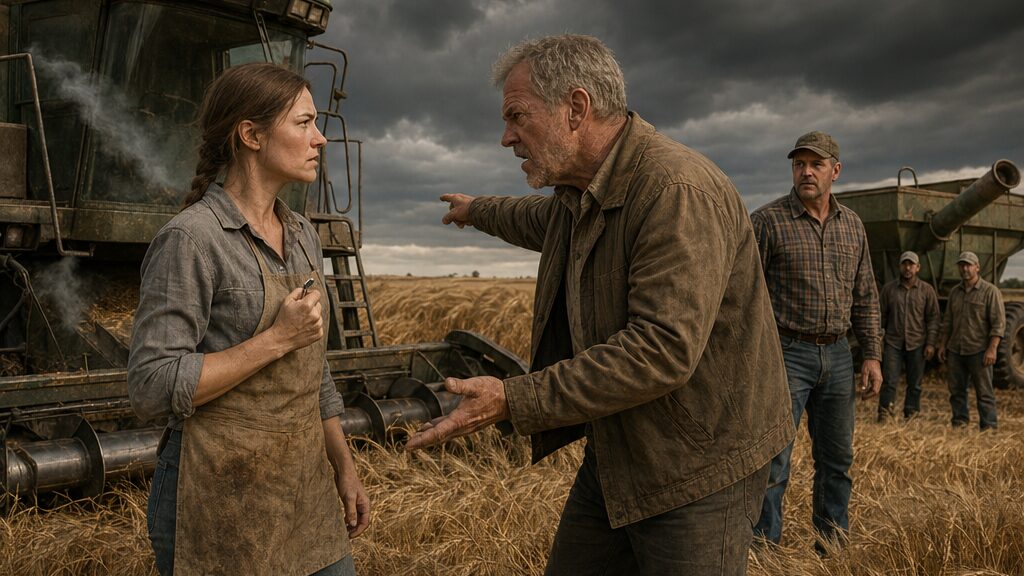
Ronald Davis held out his hand beneath the shadow of the combine, palm up, fingers stiff. Thunder rolled beyond the western fields, low enough to feel through the dry ground.
Nancy kept the ignition key closed inside her fist.
Behind them, the wheat stood shoulder-high and ready, every head bent with grain. The storm had darkened the sky above the county road, but the field around them still burned gold in the late light. Two seasonal workers waited beside the grain cart. Timothy Harris had climbed down from his tractor and was watching from twenty yards away.
No one spoke.
Ronald stepped closer. “We have maybe three hours before that rain reaches us.”
“The machine isn’t running.”
“I can see that.”
“I shut it down because the feeder housing was heating up.”
“You shut it down because it started rattling.”
“It was more than a rattle.”
Ronald glanced toward the others, as if Nancy had embarrassed him by saying the words aloud. “You hit a rough patch. The header took in too much material. Clear it and start again.”
Nancy could still feel the vibration in her hands. It had traveled through the steering column in a hard, irregular pulse. Then came the smell—not smoke exactly, but scorched grease and hot metal.
She had killed the engine before the warning light came on.
“The bearing is failing,” she said.
“You don’t know that.”
“The housing was too hot to touch.”
“You were running it too fast.”
Nancy looked at him. She had spent most of the afternoon below the speed he had demanded because the wheat was thick near the low ground. He knew that. He had stood at the field edge twice, circling one hand above his head to tell her to push harder.
“I was at four miles an hour.”
“Then your feed rate was wrong.”
“It wasn’t.”
Ronald’s jaw tightened. “Give me the key.”
Timothy shifted his weight beside the tractor. “We could let it cool twenty minutes and try her slow.”
Nancy looked toward him.
He lifted both hands. “Just saying. Storm’s not waiting.”
The first gust came across the wheat, flattening a wide silver-gold path through the heads. Dust lifted around the combine’s tires.
Ronald extended his hand farther. “You heard him.”
Nancy opened her fist enough for the brass edge of the key to show, then closed it again.
“No.”
The word seemed to stop everything except the wind.
Ronald stared at her. In thirty-two years, Nancy had disagreed with him hundreds of times. She had done it over invoices, planting dates, diesel orders, seed populations, and the decision to keep the north quarter in wheat after two thin years. But she had learned to disagree quietly, in the kitchen after everyone left, or in the shop with the doors closed.
She had never refused him in front of a crew.
“You’re going to cost us the contract,” he said.
“I’m trying to keep us from setting the field on fire.”
“That machine has run longer than you’ve been alive.”
“And I’m the one who has been operating it every day this harvest.”
Ronald moved nearer until she could smell sweat and engine dust on his jacket. “Your mother never stopped work because a machine made a noise.”
Nancy felt the old reflex rise inside her: lower her eyes, wait for his anger to spend itself, answer later when no one could hear.
Instead, she said, “Mom didn’t run this combine.”
One of the seasonal workers turned away.
Ronald’s face changed. Not much, but enough. His anger sharpened around something wounded.
“You think because you sit in that cab you run this farm?”
“I think the bearing is failing.”
“You think I don’t know my own equipment?”
Nancy’s hand tightened around the key until its teeth pressed into her palm. “I think you’re asking me to ignore what the machine is telling us.”
He pointed at the combine. “What that machine is telling us is that it needs an operator who won’t panic with weather coming.”
The accusation landed harder because Timothy heard it.
Nancy had rebuilt the header drive with Ronald two winters earlier. She had spent nights studying the service manual after he refused to pay the dealer’s labor rate. She had tracked every repair in the ledger, ordered filters, calibrated yield monitors, and climbed beneath the machine before dawn when a sensor failed.
Still, the crew looked from him to her as though ownership settled the question.
Ronald reached for her fist.
Nancy pulled it back.
His hand closed around her upper arm.
For one suspended second, she did nothing. The pressure of his fingers stunned her more than pain would have. He had grabbed her as a child near traffic, once beside a kicking heifer, once when she almost stepped through rotten hayloft boards.
Never like this.
Never because she had said no.
“Let go,” she said.
“Give me the key.”
His grip tightened.
Nancy looked down at his hand, then raised her head. The storm-dark light showed every crease around his mouth, every gray bristle along his jaw. She saw fear there, but it did not excuse the hand on her arm.
She pulled free.
“Everybody step back from the machine.”
Ronald blinked.
Nancy pointed toward the feeder housing. A thin thread of gray had begun to curl from the seam beneath the guard.
Timothy saw it first. “Ronald.”
The older man turned.
The smell reached them a moment later—burnt grease, bitter and unmistakable.
Nancy walked past her father and pressed the back of two fingers near the metal without touching it. Heat radiated against her skin.
“If that bearing seizes,” she said, louder now, “the belt can shred. If it throws sparks into this wheat, we lose more than a delivery.”
Ronald’s voice dropped. “You don’t know it will.”
“No. I know it can.”
She faced him fully. “And I’m not starting it.”
The mechanic arrived twenty-five minutes later in a service truck coated with road dust. By then, the thunder had moved closer, and the wind came in steady waves. Ronald stood apart from the others with his arms folded while the mechanic removed the side guard and shone a light inside.
Nancy watched his expression.
He reached in with a magnetic pickup tool and drew out a sliver of bright metal.
Then another.
The third piece was jagged and still black with overheated grease.
The mechanic set them in Ronald’s palm.
“These came off fresh,” he said. “You’re lucky she shut it down when she did.”
Ronald stared at the fragments without answering.
The mechanic leaned closer to the open housing. “This bearing didn’t start going bad today.”
Nancy looked at her father.
For the first time since she had stopped the combine, Ronald would not meet her eyes.
Chapter 2: The Repair That Never Reached the Ledger
“Who canceled the spring bearing replacement?”
The mechanic’s question followed Nancy into the workshop.
Rain had begun as a scattered tapping on the metal roof, too light to settle the dust and too late to erase the heat from the day. The damaged combine sat outside with its side panel open, a dark shape under the yard light. Inside, the mechanic had spread parts and paperwork across the scarred workbench.
Ronald stood near the door.
“No replacement was scheduled,” he said.
The mechanic looked down at the service printout. “It was on the inspection sheet in March.”
Nancy wiped grease from her fingers with a shop rag and stepped closer. The page was a duplicate from the dealer’s inspection booklet, creased and stained at one corner.
Feeder-house bearing: elevated play. Replace before harvest.
A handwritten note ran beside it.
Deferred by customer.
Nancy read the line twice.
“We didn’t replace it,” Ronald said. “That doesn’t mean it failed because of that.”
The mechanic tapped one of the metal fragments in a parts tray. “It failed because the bearing wore past tolerance. Whether that happened this morning or last month, I can’t tell you. But somebody knew it had play.”
Ronald’s expression hardened. “We had the housing checked.”
“Who checked it?”
“I did.”
The mechanic glanced at Nancy, then back at Ronald. “Did you pull the shaft?”
“I greased it. There was no noise.”
“There doesn’t have to be.”
Ronald turned away. “How fast can you get a replacement?”
“Part by tomorrow afternoon if the warehouse has one. But I need to inspect the shaft and the belt assembly. Heat may have damaged more than the bearing.”
“We don’t have until tomorrow afternoon.”
The mechanic gave him a tired look. “The machine does.”
Ronald left the workshop without another word.
The door struck the frame behind him.
Nancy waited until his boots crossed the gravel toward the house before she asked, “Can I keep that sheet?”
The mechanic hesitated. “It belongs with your service records.”
“That’s what I thought.”
He studied her face, perhaps remembering the marks Ronald’s fingers had left on her arm. Four red shapes had already begun fading into dull patches.
“You were right to shut it down,” he said.
The words should have felt like relief.
Instead, Nancy stared at the handwritten note.
Deferred by customer.
The mechanic packed his tools and promised to return after sunrise. Once his truck disappeared down the lane, Nancy carried the inspection sheet into the farmhouse.
The kitchen office occupied one end of the room where her mother had once kept cookbooks and school calendars. Now the shelves held binders labeled by year, a printer that jammed in damp weather, seed invoices, chemical records, and bank statements.
Ronald sat at the table with a mug of coffee he had not touched.
Nancy placed the inspection sheet in front of him.
“Who deferred it?”
He did not look down. “We couldn’t replace every part the dealer recommended.”
“That isn’t what I asked.”
“You know what those inspections are. They write up everything so they can sell service.”
“The mechanic found metal in the housing.”
“And you stopped it in time.”
His tone made the fact sound like an inconvenience.
Nancy pulled the maintenance ledger from the shelf. “The March inspection should be entered here.”
“It probably is.”
It was not.
The last entry for the feeder assembly was from the previous August: lubrication, chain tension, belt wear acceptable. Nancy had written it herself.
She opened the invoice drawer. Dealer receipts were arranged by month, but March held only fuel filters and a hydraulic hose. At the back, folded beneath a property-tax envelope, she found the original inspection estimate.
The recommended bearing replacement was circled.
Beside the total, someone had written: Hold until after operating renewal.
Nancy knew Ronald’s handwriting.
She turned the page.
A smaller form had been stapled behind it, approving limited work while declining the bearing replacement. The customer authorization line carried two initials.
N.D.
Her own.
For a moment, she heard only rain on the window.
Ronald reached for the paper. Nancy moved it out of his reach.
“I didn’t write this note.”
“You initialed the form.”
“I initialed a stack you put in front of me.”
“You handle maintenance records.”
“I handle what you show me.”
His chair scraped back. “Don’t start making this something it isn’t.”
“What is it?”
“A repair we delayed because there wasn’t money for every recommendation.”
“And you let me operate it.”
“I checked it.”
“You let me tell the crew today that I didn’t know whether you were aware.”
“I didn’t ask you to say anything.”
“No. You counted on me not saying anything.”
Ronald looked toward the dark window. “We had payments due.”
“What payments?”
“The same payments every farm has.”
“That note says operating renewal.”
He finally faced her. “You think shutting down one machine means the rest of the bills stop?”
Nancy looked again at the form. Her initials were unmistakable. She remembered the night Ronald had brought a stack of documents into the kitchen while she was entering fertilizer costs. He had marked tabs with yellow slips and said the dealer needed routine acknowledgments before morning.
She had signed and initialed without reading every page.
Not because she trusted the paperwork.
Because she trusted him.
Or because reading it would have required asking questions he did not want answered.
“You should have told me,” she said.
“You should have read what you signed.”
The truth of it hit with humiliating precision.
Nancy lowered herself into the chair. Her mechanical judgment had saved the combine from a worse failure and possibly saved the field. But the form made the decision look shared. If anyone asked who approved the delay, Ronald could point to her initials.
Maybe that had never been his intention.
Maybe intention no longer mattered.
The kitchen phone lit up on the counter. Neither of them moved before it shifted to voicemail.
Ashley Martin’s voice filled the room.
“Ronald, this is Ashley from Prairie County Agricultural Credit. I need to meet at the farm tomorrow morning at six-thirty. The review committee has flagged the operating account and the delivery covenant. Please have your current harvest figures, maintenance liabilities, and collateral documents ready. Nancy should attend if she is involved in the records.”
There was a pause.
“This cannot be postponed again.”
The message ended.
Ronald stood very still.
Nancy looked from the silent phone to the note beside the repair estimate.
Hold until after operating renewal.
“What did you leave out of the ledger?” she asked.
He picked up his coffee, though his hand trembled enough to ripple the surface.
“We’ll talk in the morning.”
“No,” Nancy said. “In the morning, the bank will.”
Chapter 3: Before the Bank Came Through the Door
Ashley Martin arrived before sunrise carrying a leather folder and a document marked DRAFT NOTICE OF DEFAULT.
Nancy saw the heading as soon as Ashley laid it on the kitchen table.
Outside, rainwater dripped from the eaves, but the storm had delivered less than a quarter inch. The western fields remained harvestable if the wind dried the heads by noon. The combine, however, stood disabled in the machinery yard beneath a gray sky.
Ronald poured coffee as though the paper were not there.
Ashley declined the cup.
“I want to be clear,” she said. “This is not a filed notice. Not yet.”
Nancy sat across from her with the maintenance ledger, current yield sheets, grain contracts, and three years of operating statements arranged in separate stacks.
Ronald remained standing.
Ashley opened her folder. “You’re below the delivery threshold attached to the operating renewal.”
“We’re in the middle of harvest,” Ronald said.
“You were expected to be farther along.”
“We lost a day to equipment trouble.”
“You were already behind before yesterday.”
Ronald looked at Nancy. “She slowed the pace in the south field.”
Nancy felt the old impulse to correct him gently, to preserve the appearance of agreement in front of an outsider.
She placed the mechanic’s inspection sheet beside Ashley’s folder.
“The feeder-house bearing was failing. The dealer recommended replacement in March. It was deferred.”
Ashley read the note. “Who approved that?”
Ronald answered first. “It was an operating decision.”
“Made by whom?”
“I own the farm.”
Nancy heard the words for what they were: not an answer, but a boundary.
Ashley turned to her. “Did you know the repair had been deferred?”
“Not until last night.”
Ronald tapped the form. “Her initials are on the authorization.”
Ashley examined it.
Nancy did not look away. “They are. I initialed a stack of documents without reading each one.”
“Why?”
Because her mother had died eighteen months earlier and every room in the house had seemed too quiet. Because Ronald had stopped sleeping and begun working before dawn. Because Nancy had promised at the hospital that she would keep things together. Because asking her father to explain every paper had felt like accusing him of failing when grief already bent his shoulders.
She said, “Because I let routine replace oversight.”
Ashley held her gaze for a moment, then nodded once. Not approval. Recognition.
“That matters,” she said. “So does who selected the work and who controlled the account.”
Ronald pulled out a chair and sat. “Are we here to discuss a bearing or a loan?”
“The loan,” Ashley said. “The bearing is relevant because deferred liabilities affect your risk profile.”
“We’ll repair it.”
“With what funds?”
Ronald’s mouth tightened.
Ashley removed another sheet. “Your operating line is within four percent of its ceiling. The grain contract requires delivery of at least sixty percent of the pledged volume within three days. If you miss that threshold without an approved modification, the committee can freeze additional advances.”
Nancy calculated silently. They had harvested forty-two percent. The west and north fields could close most of the gap, but not without another combine.
“What would support a modification?” she asked.
Ashley turned toward her fully for the first time. “A documented repair assessment. Updated harvest capacity. Confirmed access to replacement equipment. Revised delivery scheduling. And a person with clear authority to execute the plan.”
“We have authority,” Ronald said.
“Who is ‘we’?”
“This is a family farm.”
“That is not a legal role.”
Ronald leaned back. “I’m the owner.”
Ashley’s patience thinned but did not break. “Then you are the authorized decision-maker unless your documents say otherwise. Yet Nancy maintains the operational records, communicates with vendors, runs the primary combine, and appears on several account forms. I need to know whether she can commit the farm to a revised plan.”
“She can bring me information.”
Nancy looked at him.
Ashley closed the folder halfway. “That answer creates a problem.”
Ronald’s hand moved across the table toward the ignition key lying beside the maintenance ledger. Nancy had placed it there after returning from the field.
He picked it up and slipped it into his coat pocket.
The motion was small, almost casual.
It told Nancy everything.
Yesterday, the key had represented whether the combine would run. This morning, it represented whether she was permitted to act even after her judgment had been proven right.
Ashley noticed the movement.
“The repair estimate won’t arrive until afternoon,” Nancy said. “But Timothy Harris has a newer machine. He may be able to help with the west field.”
Ronald shook his head. “We’re not begging neighbors to harvest our crop.”
“It would be a cost-sharing arrangement.”
“We don’t need it.”
“Our combine may be down two days.”
“One.”
“The mechanic didn’t say one.”
Ronald’s voice sharpened. “You’ve said enough about the mechanic.”
Ashley placed both hands on her folder. “A credible plan could give me grounds to recommend a temporary covenant adjustment. But the person presenting that plan must have authority to schedule machinery, negotiate delivery windows, and approve related expenses.”
“Nancy doesn’t sign on behalf of the farm,” Ronald said.
The sentence settled between them.
Nancy had negotiated seed prices, tracked chemicals, scheduled seasonal workers, met grain trucks at midnight, and spent three winters rebuilding equipment to avoid dealer labor charges. Yet when authority became useful rather than burdensome, it vanished.
Ashley studied Ronald. “Then I will require your direct approval on every element.”
“You’ll have it.”
“By tomorrow morning.”
He nodded.
Ashley did not appear reassured.
She opened the draft notice and slid a second packet from beneath it. “There is another issue.”
Ronald’s hand stopped near his coffee.
“The committee flagged a collateral amendment from last year. The legal description does not match the acreage listed in the original renewal.”
Nancy glanced at her father.
“What acreage?” she asked.
Ashley looked between them. “Were you not involved in the amendment?”
“No.”
Ronald said, “It was an internal restructuring.”
Ashley turned a page toward Nancy. “This signature appears to be yours.”
Nancy recognized it immediately.
The signature was broader than the initials on the maintenance form, hurried but genuine. She remembered signing several documents at the kitchen counter two weeks after her mother’s funeral. Ronald had said they were necessary to extend the operating line and keep the spring inputs covered.
She had not read the property descriptions.
“What did I sign?” she asked.
Ronald’s chair creaked.
Ashley pointed to a highlighted paragraph. “The amendment added acreage expected to transfer under the Davis family estate plan.”
Nancy read the parcel numbers.
She knew them without checking a map.
The west pasture. The old windbreak. The eighty acres beyond the grain bins where her mother had taught her to drive a pickup at twelve years old.
Land her mother had always said would pass to Nancy.
Ashley’s voice softened. “This parcel is now pledged as additional collateral.”
Nancy looked up.
Ronald was no longer watching Ashley.
He was watching the pocket where he had put the key.
Chapter 4: The Promise Nancy Mistook for Silence
Nancy recognized the signature because of the broken loop in the D.
Her mother used to tease her about it, saying every Davis woman wrote her name as though she had somewhere else to be. On the collateral amendment, the rest of the signature leaned hard to the right, rushed and uneven, but the broken loop was hers.
The legal description beneath it was not.
Ashley remained seated across the table. Ronald had not moved since she turned the document around.
Nancy traced the parcel numbers with one finger. “This includes the eighty.”
Ronald looked toward the window.
“The west eighty,” Nancy said. “The land Mom set aside for me.”
“It was never formally transferred.”
“That isn’t an answer.”
Ashley closed the draft default notice and folded her hands over it. “I can step outside.”
“No,” Nancy said.
Ronald’s eyes snapped toward her.
For years, that look had been enough to change the room. Nancy would lower her voice, move the disagreement elsewhere, wait until he had cooled. It had seemed respectful. It had seemed kind.
Now it looked like a habit they had both learned to use.
“Stay,” Nancy told Ashley. “I want to understand what I signed.”
Ronald pushed back from the table. “This is family business.”
“It became bank business when you pledged the land.”
“We needed collateral.”
“You told me those papers extended the operating line.”
“They did.”
“You did not tell me they put my acreage behind it.”
“It wasn’t yours yet.”
The words were quiet, and because they were quiet, they cut deeper.
Nancy lifted the amendment. “Mom wanted it to be.”
“Your mother wanted a lot of things before she got sick.”
The room tightened around that sentence.
Ashley looked down at the folder, giving them what privacy she could without leaving.
Nancy remembered the hospital room, the blanket tucked under her mother’s thin arms, Ronald standing at the window because he could not bear to sit. Her mother had taken Nancy’s hand and said, Keep him from selling everything when he gets scared.
Nancy had promised.
She had understood the promise as staying. Keeping the books. Running the machinery. Absorbing Ronald’s silences and smoothing his anger before it reached anyone else.
She had never asked what keeping the family together was allowed to cost.
“When did you add the acreage?” she asked.
“Last year.”
“How close were we?”
Ronald rubbed both hands over his face. “Close enough.”
“To what?”
“To not planting.”
Ashley spoke carefully. “The amendment was attached to a restructuring after two operating shortfalls.”
Nancy turned toward her. “Two?”
Ashley nodded. “One from the previous harvest year. One from spring input costs.”
Ronald’s chair struck the wall as he stood. “That’s enough.”
“No,” Nancy said. “It isn’t.”
He stared at her, breathing hard.
“You let me carry the books,” she continued. “But you kept a second set of decisions in your head. You let me think we were tight, not failing.”
“We are not failing.”
“You used land that wasn’t supposed to be yours to risk.”
“It is legally mine.”
“And you used my signature.”
“You signed.”
The answer came too quickly.
Nancy looked down at the paper and saw the truth she had been avoiding. Ronald had put the documents in front of her. He had explained only what he wanted her to hear.
But she had chosen not to read them.
She had seen the yellow tabs. She had noticed the pages beneath the signature sheets. She had felt the question form and pushed it aside because the kitchen still smelled like her mother’s coffee, because Ronald’s hands shook when he sorted mail, because asking would have forced them to admit the farm had become something neither of them controlled.
“I did sign,” Nancy said.
Ronald’s anger faltered.
“I signed because I didn’t want to know how bad it was. I told myself I was helping you. I was helping myself avoid the fight.”
Ashley watched her without speaking.
Nancy set the amendment flat. “That was my mistake. It doesn’t make what you did honest.”
Ronald walked to the counter and braced both hands against it. For a moment, his back looked smaller than it had in the field.
“I thought if I told you,” he said, “you’d leave.”
Nancy almost laughed, but nothing about it was funny.
“Leave for where?”
“Anywhere that didn’t need this much from you.”
“You mean anywhere that let me make decisions.”
He turned. “You already think you can run the place better than I can.”
“I think I have been running half of it while you pretended I was helping.”
His face tightened again. “I built this farm.”
“No. You inherited part, bought part, and worked all of it. So did Mom. So have I.”
Ashley shifted in her chair. “The review committee will need a clarified authority structure. Without that, any harvest modification will be difficult.”
Ronald pointed toward the door. “We’re done.”
Ashley gathered her papers, but Nancy stopped her.
“What happens if we miss the threshold?”
“The committee can freeze remaining advances. That could affect fuel, repair costs, and delivery expenses.”
“Can the covenant be modified?”
“If there is a documented plan and someone authorized to execute it.”
Nancy nodded.
Ronald said nothing.
Ashley left her card on the table. “I’ll return tomorrow morning. Earlier if needed.”
After the door closed, Ronald remained at the counter.
Nancy carried the collateral amendment into the hallway office where the old farm calendar still hung beneath a framed photograph of her mother. The calendar was two years out of date. Ronald had never taken it down.
Below it, on a nail, hung a spare key ring.
One tractor key. The grain-bin padlock key. A faded red tag from the combine.
The main combine key was missing from Ronald’s coat pocket.
Nancy stared at the empty hook.
“You moved the land because you thought I’d leave,” she said.
Ronald stood in the doorway. “I moved it because the bank required security.”
“You could have asked me.”
“You would have said no.”
“You don’t know that.”
“I know you.”
“No,” Nancy said. “You know how often I stayed quiet.”
A truck engine sounded outside.
Timothy pulled into the yard and stopped near the shop. He climbed out before the engine had fully settled and came toward the house at a fast walk.
Nancy opened the door.
“What happened?” she asked.
Timothy glanced behind him toward the machinery yard. “Ronald called the crew.”
Nancy turned.
Her father was no longer in the doorway.
The coat he had worn at breakfast was gone from the hook.
Timothy lowered his voice. “He said the mechanic’s temporary brace would hold long enough to finish the west field.”
“The mechanic didn’t install a brace.”
“I know.”
Nancy looked toward the yard. The pickup was missing.
“So is the combine key,” she said.
Timothy’s face changed.
“He’s taking them back out,” he said.
Chapter 5: The Field Could Burn Before the Rain Arrived
The combine header was already moving when Nancy saw it from the county road.
Half a mile away, the machine crawled into the west field, cutting a clean path through wheat that should have remained standing. Its engine note carried across the damp air in a heavy, uneven growl.
Nancy pressed harder on the accelerator.
Timothy’s truck followed close behind.
Rain had passed, but the ground had dried quickly under the wind. The wheat was no longer wet enough to protect itself. If heat reached the chaff packed around the feeder housing, the whole field could go before the next storm arrived.
Nancy turned off the road and hit the field approach too fast. The pickup bounced through the ditch, tools slamming behind the seat.
Ronald had placed one seasonal worker in the grain cart and another at the field edge. Neither looked comfortable.
Nancy stopped beside the stubble and jumped out.
“Shut it down!” she shouted.
The combine kept moving.
Timothy pulled in behind her and ran toward the field. “He can’t hear you.”
“He can see me.”
Nancy stepped into the cut row and waved both arms.
Inside the cab, Ronald looked down.
For one second, their eyes met through the dusty glass.
Then he turned forward and continued.
Nancy felt something inside her go still.
Yesterday, she had been afraid of humiliating him. This morning, she had been afraid of losing the farm. Now all she could see was the dry wheat feeding beneath the header and the man in the cab gambling with everyone around him.
Timothy caught her arm. “Don’t get in front.”
“I know.”
The combine passed twenty yards away. Its feeder chain clattered beneath the engine noise. Nancy heard the irregular knock almost immediately.
Worse than before.
The temporary repair was nothing more than a steel strap bolted across the bearing guard. It might hold the panel in place. It could not restore the bearing.
Ronald reached the end of the row and turned.
Nancy ran toward the ladder as the machine slowed.
He opened the cab door but did not stop the engine.
“Get off,” she said.
“We’re running under load limit.”
“The bearing is still damaged.”
“It cooled overnight.”
“That does not repair metal.”
Ronald pointed to the field behind him. “It’s cutting.”
“For now.”
“The dealer has the part coming. We can take the west field before noon.”
Timothy stood below the ladder. “Ronald, this isn’t right.”
Ronald looked down at him. “You wanted the harvest moving yesterday.”
“I wanted it checked.”
“You wanted your cart filled.”
Timothy’s mouth closed.
Nancy climbed one rung. “Shut it down.”
“You don’t give orders from the ground.”
“Then move.”
She reached for the cab rail. Ronald blocked the doorway.
“This farm cannot miss that contract,” he said.
“There won’t be a farm if this machine starts a fire.”
His eyes were bright with exhaustion. “You think one warning makes you the only person who understands risk?”
“I think you know exactly what this bearing did last week.”
He froze.
Nancy saw the answer before he spoke.
“What happened last week?” Timothy asked.
Ronald looked toward the field.
Nancy climbed another rung. “You felt the heat.”
“It ran warm.”
“How warm?”
“It was harvest.”
“How warm?”
He gripped the doorframe. “Warm enough that I greased it twice.”
Nancy stared at him. “And you never told me.”
“I watched it.”
“You put me in the cab.”
“I checked it every night.”
“You knew.”
“I knew it needed work. I did not know it would fail.”
“You knew enough to hide it.”
The feeder chain struck once, hard enough to shake the ladder.
A puff of gray smoke curled from beneath the housing.
Timothy pointed. “There.”
Ronald turned.
The smoke thickened.
Nancy climbed into the cab and reached past him for the shutdown control. He caught her wrist.
“Wait.”
“No.”
“We’re in the middle of the row.”
“Then we stop in the middle.”
“If you kill it under load, you can jam the entire drive.”
“If we keep running, we can ignite the field.”
He held her wrist for one more second.
Nancy looked at his hand.
Ronald released her.
She pulled the throttle back, disengaged the header, and turned the key.
The engine wound down with a deep mechanical groan. For a moment, the sudden quiet made the field seem enormous.
Then came a sharp metallic snap beneath them.
The cab jolted.
The machine stopped dead.
Timothy climbed onto the platform. “What was that?”
Nancy already knew it was worse than a bearing.
She opened the cab door and descended. Smoke leaked from the feeder housing in a slow ribbon. One seasonal worker arrived with a fire extinguisher.
“Keep it ready,” Nancy said. “Don’t spray unless you see flame.”
Ronald climbed down behind her.
Together they removed the guard bolts. The panel shifted outward as soon as the final bolt loosened.
The drive belt had torn along one edge. Strands of black cord hung from it like burned rope. The shaft sat crooked in the housing.
Timothy crouched beside Nancy. “It’s done.”
“For this harvest,” she said.
Ronald stood above them, silent.
Timothy rose. “You knew it was running hot?”
Ronald did not answer.
“I had my nephew hauling beside this thing yesterday,” Timothy said. “You knew?”
“I believed it would hold.”
“That isn’t what she asked.”
The change in Timothy’s voice drew everyone’s attention. He had spent most of his life stepping around Ronald’s authority, borrowing equipment, trading labor, letting older men settle disagreements with certainty rather than proof.
Now he stepped between Ronald and the combine.
“You don’t start this again,” Timothy said.
Ronald’s face hardened. “It cannot start.”
“I mean even if the mechanic gets it turning. Not until Nancy says it’s safe.”
Nancy looked at Timothy.
He did not look back. He stared at Ronald as though ashamed it had taken smoke to make him choose a side.
A gust moved across the field. The damaged belt tapped against the housing.
Ronald walked away from them and stood at the edge of the uncut wheat.
Nancy wanted to follow him. The impulse came automatically: explain, soften, remind him she had not meant to expose him.
She stayed beside the machine.
The mechanic arrived before noon and confirmed the shaft had warped during the emergency shutdown. The drive assembly would require parts the regional warehouse did not have. Even with expedited shipping, the combine would be out for several days.
“You saved the feeder house,” he told Nancy. “But this machine isn’t harvesting again this week.”
Ronald heard from the other side of the panel.
Nancy waited for him to blame the shutdown. He said nothing.
By late afternoon, the crew had gone home. Timothy had taken the grain cart back to his farm. The disabled combine remained stranded in a narrow strip of stubble, surrounded on three sides by standing wheat.
Nancy sat on the pickup tailgate with the maintenance report in her hand when her phone rang.
Ashley did not waste time.
“The committee reviewed the preliminary numbers,” she said. “Without your combine, the delivery covenant will not be met.”
“I’m working on replacement capacity.”
“I need more than intent.”
“What exactly?”
“A field schedule, equipment commitments, fuel requirements, delivery slots, and authorized signatures.”
“When?”
“By seven tomorrow morning.”
Nancy looked at Ronald across the field. He had not moved in several minutes.
“And if I don’t have it?”
“The review proceeds on the current record.”
“Meaning default.”
“Meaning I may not be able to recommend modification.”
Nancy closed her eyes.
Ashley’s voice softened. “A safe shutdown does not erase the financial problem. But it gives you a reason to ask for time. Use it.”
The call ended.
Nancy folded the report and placed it beside her on the tailgate. The farm had survived the day without fire. That was the only victory she could claim.
By morning, she would need a harvest plan, borrowed machinery, new delivery arrangements, and the authority to bind a farm Ronald still insisted was his alone.
She stood and faced him across the ruined row.
This time, she did not walk over to ask what he wanted.
She went to the workshop to decide what had to happen next.
Chapter 6: A Farm Plan With Her Name on It
Nancy had nine hours to build a harvest plan for a farm she was not authorized to manage.
She wrote the deadline at the top of a clean legal pad and drew a line beneath it.
7:00 A.M. — BANK REVIEW.
The workshop office smelled of grease, cold coffee, and rain-damp work clothes. Through the window, the yard lights shone on the empty place where the combine should have been parked.
Ronald sat in the kitchen. Nancy could see his silhouette through the farmhouse window, motionless at the table.
She did not go to him.
First, she called the grain elevator.
The clerk could move one delivery slot to the following afternoon but would not hold more without confirmation. Nancy wrote the time in the margin.
Then she called the county extension agent, who confirmed the wheat could stand another two days with limited quality loss if the forecast held. After that, risk increased sharply.
Nancy divided the fields into blocks.
West field: one hundred sixty acres.
North quarter: ninety.
Low south ground: forty remaining.
She calculated machine hours, travel time, unloading delays, fuel use, and the number of trucks needed to keep a borrowed combine from sitting full.
At ten-thirty, she called Timothy.
He answered on the fourth ring. “I figured you would.”
“I need your machine after you finish the ridge field.”
“I have forty acres left.”
“What time?”
“Maybe two in the morning.”
“I can send our cart and both workers. That gets you done by midnight.”
A pause.
“What are you offering?” he asked.
“Fuel, labor, and the custom rate for every acre you cut here.”
“You don’t have cash for a full custom rate.”
“I can put it against our grain settlement if the bank approves the modification.”
“If.”
“Yes.”
Another pause.
Timothy exhaled. “My machine can take the west field. Not all three.”
“I’m calling two more farms.”
“You think they’ll say yes?”
“I think they’ll say yes if the schedule is real.”
“You have Ronald’s approval?”
Nancy looked at the farmhouse window.
“Not yet.”
“Then you don’t have a deal.”
“You know the crop needs to come off.”
“I also know Ronald can refuse to pay me after it does.”
“He won’t.”
“You told me yesterday you didn’t know about the repair. This morning you didn’t know about the collateral. I’m not saying that to hurt you.”
“It still does.”
“I know. But I need paper.”
Nancy pressed the phone against her ear and stared at the legal pad.
“What paper?”
“Written field authority. Your name. His signature. Something that says you can schedule equipment and approve harvest costs.”
“He won’t sign that.”
“Then I can’t put my machine in your field.”
The line went quiet.
Timothy spoke again, more softly. “I should’ve backed you before the smoke. I didn’t. But I’m not walking into another fight between you two with half my crop still out.”
Nancy understood. His refusal was not cowardice alone. It was self-protection, the same kind she had practiced for years.
“I’ll get the signature,” she said.
After the call, she drafted a one-page operating agreement.
Nancy Davis is authorized to schedule harvest equipment, negotiate grain-delivery timing, approve necessary fuel and repair expenses, and direct field operations for the remainder of the current harvest.
She added reporting requirements, expense limits, and a section requiring both signatures for any new debt or collateral changes.
At midnight, Ronald entered the workshop.
He read the first line from where he stood.
“No.”
Nancy kept writing.
“That document makes me a hired hand on my own land.”
“It makes me accountable for decisions I’m already expected to make.”
“You can schedule trucks without this.”
“Timothy won’t bring his combine without it. Neither will anyone else once they hear ours is down.”
Ronald picked up the page. “Full field authority?”
“For this harvest.”
“Financial disclosure?”
“From now on.”
His eyes stopped at the clause requiring joint approval for collateral.
“You wrote this for the bank.”
“I wrote it because you used my signature when you thought I wouldn’t ask questions.”
“You did sign.”
“And I will never sign blind again.”
Ronald dropped the agreement on the desk. “You want me to announce to the county that I can’t run my own operation.”
“I want you to announce nothing. I want your signature.”
“You think this stays private? Timothy will know. The bank will know. The elevator will know.”
“They already know the combine is broken.”
“That isn’t the same as knowing my daughter took control.”
Nancy set down her pen.
“Is that what scares you?”
His face went blank.
She continued before she could retreat. “Not losing the contract. Not the land. Me making decisions where people can see.”
“You have no idea what it took to keep this place.”
“I know exactly what it took from me.”
The words entered the room and remained there.
Ronald looked toward the dark yard. “Your mother never asked me to sign away my place.”
“Mom also never asked me to carry yours.”
He turned on her. “Do not use her.”
“I’m trying to stop using her. I have hidden behind a promise to keep this family together since the day she died. I thought that meant never forcing you to admit anything.”
Ronald’s hand tightened around the edge of the desk.
Nancy pushed the agreement toward him. “It meant I let you decide which truths I was allowed to know.”
He left without signing.
For the next five hours, Nancy worked.
One neighboring farmer declined because his soybeans came first. Another offered a machine after noon if Nancy supplied a driver. The grain elevator shifted two loads. The seasonal workers agreed to return before dawn. Timothy texted that his ridge field would be finished by twelve-forty.
By four-thirty, Nancy had a viable schedule.
It depended on borrowed equipment, tight unloading rotations, no major weather delay, and Ronald’s signature.
She printed the plan and attached the operating agreement.
At five, she carried a duffel bag from her room and placed it beside the workshop door.
She did not intend to threaten him with leaving. Threats had filled enough of the week. But if he refused written authority while expecting her to absorb the consequences, she would not continue pretending she managed the farm.
She would give Ashley the records she had and step aside.
At five-forty, the eastern sky began to pale.
Nancy sat at the desk with her hands wrapped around a cup of cold coffee. The operating agreement lay unsigned beneath the harvest schedule.
The workshop door opened.
Ronald entered without his coat.
He looked older in the fluorescent light. His shirt was wrinkled. There was dried grease beneath one thumbnail.
His eyes moved from the duffel bag to the paperwork.
“You called Harris?” he asked.
“Yes.”
“What did he say?”
“He’ll bring the combine if I have authority.”
Ronald gave a bitter half laugh. “He never needed paper when I helped him.”
“No. He needed your word.”
“And mine isn’t enough now.”
“Not for a plan I’m responsible for.”
Ronald stood across from her.
The clock above the parts shelf clicked toward six.
Nancy slid the pen beside the signature line.
He did not touch it.
Instead, he reached into his pocket.
The combine key landed on the harvest plan with a small metallic sound.
Nancy looked at it, then at him.
Ronald turned and walked out before she could speak.
The key remained on the page.
The signature line beneath it was still blank.
Chapter 7: What Ronald Feared Losing Was Not Only Land
“Are you planning to take the land and leave?”
Ronald’s voice came from the open doorway of the machine shed.
Nancy looked up from the unsigned agreement. Dawn had not fully reached the yard. The disabled combine stood inside the shed with its feeder housing open, the metal fragments arranged in a tray on the workbench. Between them, on top of the harvest plan, lay the ignition key.
Ronald entered and closed the door behind him.
Nancy did not answer at once. “Is that what you think this is?”
“I saw the bag.”
“It’s there because I won’t keep doing the work without the authority.”
“That sounds like leaving.”
“It sounds like a boundary.”
Ronald pulled a folding chair from the wall but did not sit. He turned it around twice, aligning it with the concrete seam beneath his boots.
“When your mother died,” he said, “everyone started asking what I was going to do.”
Nancy waited.
“The bank. The insurance agent. Harris. Even the parts clerk asked whether you were taking over.”
“They were asking how the farm would run.”
“They were asking whether I could still run it.”
His words carried no anger now. That made them harder to dismiss.
Ronald sat. “Your mother knew where everything was. Not just the books. People. Promises. Which bill could wait. Which neighbor would say no before saying yes. After she was gone, you stepped into all of it.”
“You needed help.”
“I needed more than help.”
The key caught the pale light from the open side window.
Ronald rubbed his thumb along one knuckle. “Every time you fixed something I missed, I was relieved. Then I was ashamed of being relieved.”
Nancy looked toward the combine. “So you stopped telling me what you missed.”
“I thought if you saw how far behind we were, you’d decide there was nothing here for you.”
“You pledged my land to make sure I couldn’t.”
His eyes closed briefly.
“I told myself it was temporary,” he said. “One good year, and I would release it.”
“You did not have the right to decide that for me.”
“No.”
It was the first unqualified answer he had given her.
Nancy folded her arms. The fading bruises on her upper arm pressed against her sleeve.
Ronald noticed.
His face changed. “I should not have grabbed you.”
“No.”
“I was angry.”
“That explains it. It does not reduce it.”
“I know.”
She let the silence remain uncomfortable.
He looked down. “I saw you standing there with the key, and everyone watching me wait for you to decide whether the harvest moved. It felt like the farm had already passed me by.”
“So you put your hand on me.”
“Yes.”
The admission did not repair anything. It did, however, leave nowhere for the lie to stand.
Nancy sat across from him.
“I helped you hide things,” she said.
Ronald looked up.
“I told myself I was keeping the peace. When invoices disappeared, I entered totals without asking for the pages. When you made decisions and told me afterward, I adjusted the plan. When you handed me forms, I signed them because reading them would have started another argument.”
“You trusted me.”
“Sometimes. Sometimes I was afraid to find out I shouldn’t.”
Ronald’s jaw shifted.
“I promised Mom I would keep us together,” Nancy continued. “I made that promise mean you never had to hear no from me.”
“She asked you to stay?”
“She asked me not to let fear make you sell everything.”
A faint, painful smile crossed his face. “That sounds like her.”
“I thought protecting the farm meant protecting you from embarrassment. It didn’t. It meant I helped build a system where I carried responsibility and you kept control.”
Ronald stared at the key.
“What happens if I sign?” he asked.
“We harvest under the schedule. Timothy brings his machine. Ashley reviews the restructuring. Every new debt and collateral change is disclosed. I direct field operations for the rest of harvest.”
“And after?”
“We decide after. In writing.”
He gave a dry laugh. “Everything in writing.”
“Yes.”
“I spent forty years doing business on a handshake.”
“And I spent ten years cleaning up what nobody wrote down.”
The laugh died.
Ronald reached for the agreement, then stopped before touching it. “The disclosure clause is too broad.”
“It includes every operating liability.”
“The equipment note is not relevant to field authority.”
“It is relevant to whether I can afford the plan.”
“You don’t need every detail.”
Nancy lifted the document and slid it toward him.
“There it is,” she said.
“What?”
“The part where you apologize for one secret and ask to keep another.”
His mouth tightened.
“The bank will be here soon,” he said.
“Yes.”
“If I refuse?”
“I give Ashley the records I have. I tell Timothy there is no deal. Then I step away from operations.”
“You would let the crop stand?”
“I would refuse to pretend I can save it while you block every decision.”
“That is not the same thing.”
“It is exactly the same thing.”
Ronald stood and walked to the combine. He laid one hand against the dusty cab door.
Nancy watched him through the machine’s ladder rails.
“I used to know every sound it made,” he said.
“You still know a lot.”
“Not enough.”
“Knowing less than you used to does not make you useless.”
“It feels close.”
Nancy looked at the agreement. “Then stop making usefulness depend on being the only person allowed to decide.”
Outside, an engine turned into the yard. Ashley’s car.
Ronald remained beside the combine.
Nancy placed the pen across the signature line and pushed the paper to the edge of the workbench.
“The harvest proceeds only if you sign all of it,” she said. “Not just the authority page. The disclosure terms too.”
He turned toward her.
The car door closed outside.
Nancy left the pen where it was and walked toward the shed entrance.
Behind her, she heard the chair scrape across the concrete.
She did not look back.
Chapter 8: The Harvest Continued Under Different Hands
Ashley arrived as two borrowed combines entered the west field.
Their lights moved through the early haze, wide and steady, with Timothy’s grain cart following behind. Nancy stood beside the farm office holding the signed operating agreement in one hand and the revised harvest schedule in the other.
Ronald came out of the machine shed several steps behind her.
Ashley read the signature pages before looking toward the field. “He signed the disclosure provision?”
“Yes.”
“All liabilities?”
Ronald answered. “All of them.”
Ashley opened her folder on the hood of her car. The meeting was brief and exact. Nancy explained the machine schedule, fuel commitments, delivery windows, labor assignments, and the agreement with Timothy. Ashley questioned every assumption.
Nancy answered what she knew and marked what required confirmation.
She did not look to Ronald for permission.
At last, Ashley closed the folder.
“I can recommend a temporary covenant modification,” she said. “But the restructuring still requires a reduction in collateral exposure.”
Nancy had expected the sentence. She had not expected the parcel Ashley indicated.
The west eighty.
Her mother’s promised acreage.
“The committee will release the remaining core ground if that parcel is sold after harvest,” Ashley said. “The proceeds would reduce the operating balance and repair note.”
Ronald stepped forward. “Use the south pasture instead.”
“The south pasture has weaker market value and supports the livestock line,” Ashley said. “This parcel is the cleanest option.”
Nancy looked across the yard toward the windbreak bordering the west eighty. She knew every low spot in that ground, every place snow settled in January, every fence post her mother had replaced with her own hands.
Ronald spoke quietly. “We can refuse.”
“And lose the modification?” Nancy asked.
Ashley did not soften the answer. “Possibly.”
The borrowed combines moved into the first standing rows. Wheat folded beneath their headers.
Nancy felt the loss before agreeing to it.
Not as a dramatic tearing, but as a precise removal. A future she had assumed would wait for her was being exchanged for the farm that remained.
She signed the acknowledgment.
Ronald watched the pen move. “Nancy.”
She looked at him.
“I am not doing this for you,” she said. “And I am not doing it because the land matters less to me.”
He lowered his eyes.
“I am doing it because this is the cost of the decisions we both avoided.”
Ashley gathered the documents. “The committee still has to approve final terms. But with today’s delivery plan and these signatures, I can hold the default action.”
It was not rescue. It was time purchased with acreage.
By noon, Timothy’s combine had cleared the western slope. The second borrowed machine moved north while Nancy coordinated trucks from the field edge. Ronald stayed nearby but did not countermand her.
Once, he started toward a driver with instructions.
He stopped and looked at Nancy first.
“Do you want the next truck at the north gate?” he asked.
“Yes. After it unloads, send it to the elevator. The west bin can wait.”
Ronald nodded and relayed the order exactly.
Near evening, they returned to the disabled combine.
The mechanic had finished enough work to move it under its own power, though it could not harvest. Nancy climbed into the cab. The ignition key felt different in her hand—not heavier, but stripped of whatever authority they had once imagined it contained.
She started the engine and drove the machine slowly into the storage shed.
Outside, the borrowed combines continued beyond it, cutting wheat beneath a clearing sky.
When she shut the engine down, Ronald stood below the ladder.
“Anything else?” he asked.
Nancy looked around the shed. “Bring the expense sheets to the office. All of them.”
“All right.”
No argument. No wounded performance. Only the task.
After the final grain truck left for the elevator, Nancy mounted a small board beside the office door. She had written the responsibilities in black marker.
Field operations: Nancy.
Financial records: Nancy and Ronald.
New debt or collateral: both signatures.
Equipment safety: operator authority to stop work.
Below the list, she installed two hooks.
She hung the main combine key on one.
Ronald approached with the duplicate in his palm. For a moment, he held it beneath the board.
Then he placed it on the second hook.
The keys hung side by side, neither hidden in a pocket nor clenched in a fist.
Outside, the remaining wheat moved under the borrowed machines. The farm would survive smaller than before. The west eighty would belong to someone else. The bruises on Nancy’s arm had not disappeared, and neither had the years behind them.
Ronald read the board once more.
“North field after dawn?” he asked.
Nancy looked at the schedule.
“Six-thirty,” she said. “Not before the dew lifts.”
He nodded.
This time, he waited for her answer before walking away.
The story has ended.