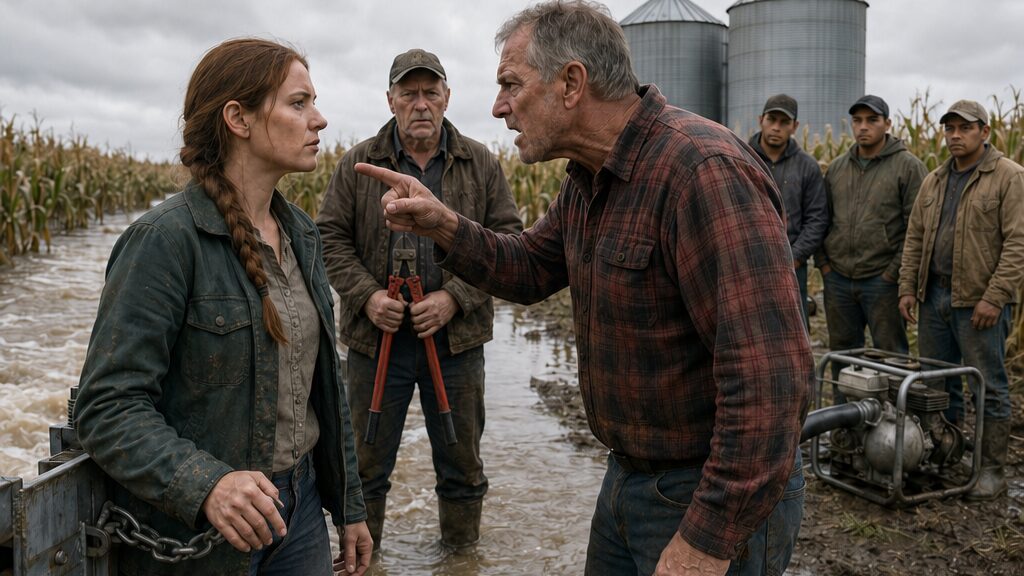
When Emily Gripped the Floodgate Chain, the Whole Farm Learned What Charles Had Hidden
Chapter 1: The Water Was Already Moving Backward
Charles Martin raised his finger just as the muddy water reached the first row of corn.
“There,” he said. “You see what you did?”
The water pressed through the grass in a slow brown sheet, carrying shredded leaves and pale husks toward the field. Behind him, three seasonal workers stood beside the utility cart, their boots sunk ankle-deep in the softened lane. Joseph Baker had shut down the small diesel pump, but its flywheel still ticked as it cooled.
Emily Harris did not answer.
Charles stepped closer. His plaid sleeve was wet to the elbow, and rain-darkened hair clung behind his ears. “I told you Friday that gate had to stay secured. One instruction. That was all.”
Emily looked past his shoulder toward the drainage channel.
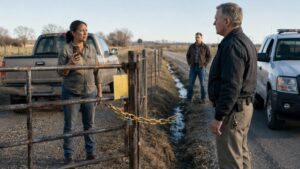
The steel gate sat between two concrete posts at the narrowest point of the ditch. Water leaned hard against its lower panels. A length of galvanized chain wrapped twice around the latch housing, disappearing beneath a brass-bodied padlock stained green at the edges.
Locked.
The fact should have relieved her. Instead, it tightened something beneath her ribs.
Charles mistook her silence for surrender.
“You come back here with spreadsheets and soil maps,” he said, loud enough for the crew, “but none of that means a thing if you can’t remember to close a gate.”
One of the workers looked down at his gloves. Another glanced toward the silos, as if the argument might become less embarrassing if he studied something taller.
Emily crouched near the edge of the water.
Mud soaked through one knee of her work pants. A flattened corn leaf drifted past her boot, then stopped against a clump of sedge. A second leaf slid beside it.
Both were moving south.
That was wrong.
The channel’s ordinary fall ran north toward the county ditch. Even after heavy rain, runoff from the south field should have drawn leaves away from the corn, not pushed them back toward it.
Charles kept speaking behind her.
“The lower stop was clear yesterday morning. Joseph checked it. Then you were down here alone before supper, and now this.”
Emily reached into the water. It was colder than the air, and the pull against her fingers came from upstream.
Not from the field.
From the diversion line.
She stood and wiped her hand on her thigh. “When did the water cross the lane?”
Charles gave a short, humorless laugh. “Don’t start changing the subject.”
“I’m asking when.”
“Before six. Maybe earlier.”
“Who saw it first?”
“The feed driver.”
Emily looked at Joseph. “Was the chain like this when you got here?”
Joseph’s jaw shifted beneath his gray stubble. “I didn’t touch it.”
“That isn’t what I asked.”
Charles moved between them. “He doesn’t need to answer questions to make you feel better.”
The workers went still.
Emily felt the old pressure rise in her—the instinct to let Charles fill every silence until the moment passed. He had done it at family dinners, at machinery auctions, during meetings with the lender. He spoke first and longest, and everyone else adjusted around him.
Her father had called it Charles’s weather. You waited for it to move through.
Emily had spent years waiting.
She looked again at the chain. Rust had marked the concrete beneath it in a narrow orange arc. The lock’s face was clean where someone’s thumb had rubbed away the grime, but the chain itself was pulled tight enough to leave no slack.
“If I left the gate open,” she said, “how did the chain get locked around it twice?”
Charles’s expression did not change. “You could have locked it after the water rose.”
“In water this high?”
“You were here.”
“So were other people.”
A murmur moved among the workers and died immediately.
Charles turned toward them. “Get the portable pump from the west shed. Set the discharge across the county lane.”
Emily said, “Don’t pump across the lane.”
He faced her again. “We’re not losing ten acres while you conduct an investigation.”
“The ditch on the other side feeds Sarah Nelson’s lower pasture.”
“It can carry the volume.”
“You don’t know that.”
“I’ve worked this ground since before you could walk.”
“And the water is moving backward.”
That stopped him.
Only for a second, but Emily saw it.
His eyes shifted toward the upper bend of the channel, where cattails hid the inlet pipe from view.
Joseph saw it too. He rubbed his palm over the back of his neck.
Charles recovered. “High water swirls.”
“This isn’t a swirl.”
“You planning to lecture gravity now?”
Emily stepped past him and followed the concrete edge upstream. Her boots slipped twice. Behind her, Charles ordered the workers to fetch the pump anyway.
“Treat the gate as failed,” he called after them. “Until we know otherwise, this was an operator error.”
Emily stopped.
Operator error.
The phrase had the weight of a report. Something that could be written down, given to the insurer, repeated to the lender. A private accusation was one thing. Charles was turning it into the farm’s official version before anyone had checked the system.
She turned back. “Do not put my name on anything yet.”
Charles spread his hands. “Then give me another explanation.”
“I’m finding one.”
“You had all weekend to find one.”
The words struck harder than the accusation. She had noticed the strange dampness near the upper bank on Friday. She had written it in her notebook and told herself she would inspect the line after the grain delivery.
Then after the combine belt was replaced.
Then Monday.
She had wanted one complete fact before she questioned Charles. One clean piece of evidence no one could dismiss as the nervousness of someone newly returned.
Now the first row of corn stood in water.
Emily continued upstream.
The inlet pipe emerged beneath a shelf of packed clay fifty yards beyond the gate. Weeds had been pressed flat around it. The fitting at the pipe’s elbow was newer than the surrounding steel, its black coating unbleached by weather.
She knelt and brushed away a skin of mud.
Four bright crescents cut through the paint around the coupling.
Fresh wrench marks.
Behind her, the portable pump coughed to life.
Emily placed two fingers against the fitting and felt the pipe tremble with moving water.
Someone had changed the line recently.
And whoever had done it had used a wrench large enough to leave marks Joseph would recognize.
Chapter 2: She Let Him Finish Before Answering
“Joseph,” Charles shouted, “bring the bolt cutters.”
Emily was still crouched beside the diversion fitting when the workers returned to the gate. Joseph carried the red-handled cutters over one shoulder, but he walked slowly, as if each step might make the decision belong to him.
Charles pointed at the chain. “Cut it. We need that gate open before the water gets another foot into the corn.”
Emily rose and came down the bank. “Nobody cuts the chain.”
Charles did not look at her. “The gate is holding back water.”
“The gate is holding back water from the wrong direction.”
“It’s a floodgate. That is what it does.”
Joseph lowered the bolt cutters.
Charles snapped, “I gave you an instruction.”
Emily reached the gate first. Cold water covered the toes of her boots. She closed her right hand around the chain.
The metal was slick and tight under her palm. The current shoved against the gate hard enough to make the links pulse.
“Look at the lock,” she said.
Charles’s face reddened. “We have looked at the lock.”
“No. You’ve looked at me.”
The workers stood in a rough half circle behind him. The diesel pump rattled near the lane, its hose still dry.
Charles stepped close enough that Emily could smell coffee and wet wool from his shirt. “You want to perform for everybody? Fine. Explain how this gate flooded the field.”
She waited.
He pointed toward the corn. “You were responsible for the south checks. You were here Friday evening. You changed the inspection schedule, and now twenty acres are taking water.”
Emily let him finish.
The finger remained inches from her face. She could have slapped it away. Instead, she tightened her grip on the chain and felt the gate shudder.
Then she looked at Joseph.
“What size wrench did you use on the new elbow fitting upstream?”
Joseph’s gaze went first to Charles.
The movement was small, but every worker saw it.
Charles lowered his hand. “That has nothing to do with this.”
Emily kept her eyes on Joseph. “One and seven-eighths?”
Joseph swallowed. “Two-inch adjustable.”
“When did you install it?”
He shifted the cutters from one hand to the other. “Thursday.”
The pump engine seemed suddenly louder.
Emily asked, “Who told you to?”
Charles stepped in. “Maintenance decisions don’t need a public hearing.”
“Who told you to?” Emily repeated.
Joseph looked at the mud. “I was given a work order.”
“By whom?”
“Emily,” Charles said sharply. “You know how this farm operates.”
She turned to him. “Then say it.”
His mouth tightened.
The crew had worked for Charles long enough to know when silence meant more than anger.
Joseph finally said, “Mr. Martin marked the fitting on the service sheet.”
Charles swung toward him. “I told you to replace a corroded elbow.”
“You told me to turn the bypass north.”
The words landed without drama. Joseph did not sound defiant. He sounded tired.
Emily looked upstream. “How far?”
“Quarter turn from the old stop.”
“That would push water into the south line when the county ditch rises.”
Joseph nodded once.
Charles pointed at the channel. “The county ditch was forecast to stay below bank.”
“That doesn’t answer why the route was changed.”
“It was a temporary adjustment.”
“You didn’t tell me.”
“I didn’t need permission to keep our acreage draining.”
“Our acreage?” Emily asked. “Which acreage?”
Charles’s eyes hardened. “This is not the time.”
“That means the north field.”
He said nothing.
Emily looked toward the workers. The first row of corn bowed beneath the moving water. For several minutes they had watched her stand accused of leaving a gate open. Now they looked at the locked chain, the current, and Charles.
One of them quietly set down a shovel.
The visible accusation had broken apart, but relief did not come. Emily felt only a sharper fear.
Charles had changed the diversion. Joseph had installed it. And she had seen enough on Friday to know something was wrong.
She released the chain.
A pale line remained across her palm.
Charles said, “The gate still has to open.”
“Not until we trace where the discharge goes.”
“We don’t have time.”
“We have less time if we flood Sarah’s pasture.”
“We are already flooding our own land.”
“Because the upstream line is feeding this channel.”
His voice dropped. “You think one fitting explains all of it?”
“I think it explains why debris is moving south.”
“And you think that clears you?”
The question struck with an edge she did not understand.
Charles turned to Joseph. “Get the planning binder from the truck.”
Joseph did not move.
“Now.”
He left the cutters in the mud and walked toward the utility vehicle.
Emily watched Charles. “What are you doing?”
“Giving you the facts you keep demanding.”
He folded his arms and waited. Rain began again, fine enough to cling to the hairs on Emily’s forearms.
Joseph returned with a black three-ring binder swollen from damp. Charles took it, flipped past planting maps and chemical logs, then pulled out a single yellow planning sheet.
He held it up by one corner.
At first Emily saw only a hand-drawn map of the drainage lines. Then she recognized the date: the previous Tuesday, during the operations meeting in the farm office.
Charles tapped a line beside the north bypass.
“Temporary diversion adjustment pending county ditch level,” he read. “Approved for installation before weekend rainfall.”
Emily stared at the paper.
“That isn’t my wording.”
“Your initials are underneath it.”
He turned the page toward the workers.
E.H. appeared at the bottom in blue ink.
The letters were hers.
Emily remembered the meeting. Charles had kept taking calls from the lender. Joseph had brought in a list of repair parts. She had initialed the attendance sheet and two fuel orders before leaving to meet the seed representative.
She did not remember this line.
Charles held the paper closer. “You wanted proof before anyone blamed you. There it is.”
The workers looked from the initials to Emily.
She stepped forward and studied the page. The ink of her initials had bled slightly into the paper fibers. The sentence above them was written in black.
Different pen.
Possibly a different time.
But possibly was not enough. Not with water in the corn and witnesses waiting.
Charles lowered his voice so only she could hear. “You came back asking for equal authority. Equal authority means you don’t get to forget the decisions that go bad.”
Emily met his eyes.
For the first time that morning, she could not tell whether he was lying to her or reminding her of something she had failed to understand.
Chapter 3: The Notes She Never Reported
Emily recognized the initials.
She did not recognize the sentence above them.
The difference was too small to save her in front of the crew and too important to ignore. She carried the planning sheet to the farm office while the portable pump began pulling water from the lower channel.
The office occupied one end of the machinery shed, separated from the tractors by a wall that never kept out dust. A grain calendar hung beside the window. The corners of every paper on Charles’s desk curled from humidity.
Emily laid the yellow sheet beneath the fluorescent light.
Her initials were in blue ballpoint, pressed hard enough to leave an indentation. The drainage note above them was in black roller ink. The handwriting leaned slightly farther right than Charles’s usual block print, but the capital letters were his.
She opened the planning binder to the pages before and after it.
Tuesday’s agenda listed fuel contracts, combine repairs, seasonal payroll, and crop insurance photographs. No diversion adjustment.
The numbered page after it began with Thursday’s maintenance notes.
The yellow sheet had been inserted later.
Emily found the staple holes near its upper edge. Two small tears, but no staple.
A loose page made to look as if it belonged.
She should have felt vindicated. Instead, her gaze fell on the mud-stained notebook protruding from her jacket pocket.
She had carried it all morning without opening it.
The cover resisted where water had dried along the edge. She peeled it back and turned to Friday.
South bank damp above normal line.
The entry was followed by a rough sketch of the floodgate chain and a question mark beside the upstream pipe.
Two pages later:
Flow sound at bypass after pump shutdown. Check valve?
Then Saturday:
Sedge flattened near inlet. Ask Joseph Monday.
Three warnings.
Three chances to stop what had happened.
The office door opened.
Joseph stood there with rain running from the bill of his cap. Behind him, the machinery shed echoed with the pump hose being dragged across concrete.
Emily closed neither the notebook nor the binder.
“Did Charles send you?”
“No.”
“Then why are you here?”
Joseph looked at the yellow sheet. “Because I should’ve said more down there.”
“Yes.”
He accepted the answer.
Emily pointed to the drainage note. “Was this on the page when I initialed it?”
“I never saw that page at the Tuesday meeting.”
“Did Charles write it Thursday?”
“I don’t know.”
“But you installed the fitting.”
“Yes.”
“Under a written order?”
“He marked a service sheet.”
“Where is it?”
Joseph took off his cap and rubbed the wet brim between his fingers. “Charles kept the top copy.”
“And yours?”
“In my toolbox.”
“Bring it.”
He did not move.
Emily felt the warning before he spoke.
“You told me not to make an issue of the flow.”
The pump outside changed pitch, then steadied.
Emily’s mouth went dry. “I told you I wanted to inspect it first.”
“You said Charles had enough on him with the lender.”
“That is not the same as telling you to hide it.”
“No.” Joseph put his cap back on. “But you asked if the new fitting could wait until Monday before we logged anything.”
She remembered standing beside the machinery shed Friday afternoon. Joseph had mentioned hearing water in the bypass after the pump stopped. She had looked through the open office door and seen Charles on the telephone, one hand pressed to his forehead.
She had said, Let me check it before we put another problem in front of him.
At the time, it had sounded measured.
Now it sounded like permission.
“Why didn’t you report it yourself?” she asked.
Joseph’s face tightened. “To who? Charles ordered the change. You told me to wait. You’re both my bosses.”
“And that made silence the safe option.”
“It made silence the option that kept me working.”
Emily looked away.
Through the office window, the farmyard had become a pattern of wet gravel and dark tire tracks. One of the seasonal workers was coupling a second hose to the pump. Charles stood over them, directing every movement as if speed could restore his authority.
Joseph said, “I didn’t know it would back up like this.”
“Neither did I.”
“But you knew enough to write it down.”
Emily looked at the notebook.
The words had become evidence against the version of herself she preferred: careful, responsible, waiting only because she needed facts. She had believed delay was different from avoidance because she documented it.
The water did not care what she called it.
“Get the service sheet,” she said.
Joseph hesitated. “What are you going to do?”
“Find out what happened.”
“And after that?”
Emily did not answer.
He went to the machinery bay.
She examined the yellow planning sheet again. Under magnification from the desk lamp, the black line crossed faint grit embedded in the paper. Her blue initials did not. The sentence had likely been added after the sheet had been carried outside or handled in the shed.
It mattered.
It did not erase Friday.
Joseph returned with a grease-marked duplicate form. The order read: Replace north bypass elbow. Reorient outlet to alternate drainage route. Temporary.
Charles’s initials appeared at the bottom.
No mention of Emily.
She placed the service sheet beside the planning page. “This proves he ordered the work.”
Joseph nodded.
“It also proves you knew the outlet changed.”
His shoulders lowered.
“And my notebook proves I suspected the result before today.”
Joseph looked toward the door. “You going to show him?”
“I’m going to show whoever asks.”
The office phone rang.
Emily picked it up.
Sarah Nelson did not bother with a greeting. “Water crossed my lower fence.”
Emily closed her eyes for one second. “How far?”
“Past the hay strip. It’s moving toward the east culvert.”
“That culvert leads to the county road.”
“I know where it leads.”
Emily heard a truck door slam through the phone.
Sarah continued, “I’m at your south entrance with the drainage inspector. We need every maintenance record from the last ten days.”
Emily looked at the altered planning page, the service order, and her open notebook.
Outside, Charles shouted for more fuel.
Sarah’s voice softened, but only slightly. “Emily, this isn’t staying between families now.”
A white county pickup turned into the yard, amber light flashing across the wet side of the machinery shed.
Emily gathered all three records.
For the first time that day, she understood that proving Charles had lied would not be enough.
She would also have to explain why she had waited.
Chapter 4: The Field Charles Could Not Lose
The county inspector did not begin at the flooded gate.
He began uphill, where the ground was dry.
By eight Tuesday morning, he had walked the drainage line from Sarah Nelson’s lower pasture to the north field, stopping every few yards to push a steel probe into the soil. Emily followed with her notebook tucked beneath one arm. Sarah walked on the other side of the ditch, while Charles stayed twenty paces behind them, answering questions nobody had asked him.
The contrast sharpened as they climbed.
Below them, Sarah’s hay strip lay flattened under a brown film of silt. Water stood between fence posts and reflected the pale morning sky. But beyond the rise, the north field remained firm enough for the inspector’s boots to leave only shallow prints.
He crouched at the edge of the corn and pressed his palm to the earth.
“This field should be taking some of that water,” he said.
Charles stopped. “Not with the grade we put in fifteen years ago.”
The inspector looked toward the bypass line. “The grade hasn’t changed.”
“No.”
“The routing did.”
Charles’s mouth narrowed.
Emily opened her notebook. She had already drawn the channel, the gate, and the alternate outlet. Seeing the pattern on paper had made it harder to deny. The new fitting redirected rising water away from the north field, through the south line, and toward the lower acreage.
The inspector stood and looked across the dry corn.
“Who owns this parcel?”
“We do,” Charles said.
Emily answered at the same time. “The partnership.”
The inspector glanced between them. “Is it separately financed?”
Charles said nothing.
Emily looked at him.
That silence was an answer she had not expected.
The north field had always been described as the farm’s best ground. Deep black soil. Reliable yield. Her father had once said it could make up for mistakes everywhere else. But nobody had told her the land itself had been pledged.
“Separately financed?” she repeated.
Charles shifted his weight. “The operating line is tied to projected production.”
“That isn’t what he asked.”
Sarah stopped beside the fence. “Charles.”
He looked at her with the irritation reserved for people who knew too much and spoke carefully.
The inspector closed his probe. “I need the loan documents and the drainage map submitted with your crop plan.”
Charles said, “That information has nothing to do with water moving across Sarah’s property.”
“It may explain why water was kept off this one.”
The words settled over the field.
Emily looked down the rows. The stalks stood straight and dry, green fading toward harvest gold. Everything Charles had risked was visible here—not as cash, but as acreage, yield, wages, fuel, and another season purchased on credit.
She had thought the diversion was about control.
It was.
But control had been attached to something more fragile.
Sarah walked toward the road. “There’s another thing.”
Charles’s head turned sharply. “What?”
She rubbed mud from her boot against the grass. “You called me last month about an exception.”
Emily watched him.
Sarah continued, “You asked whether the drainage board could approve temporary redirection if the county ditch rose above the culvert.”
“That was a hypothetical question.”
“You gave me the north field parcel number.”
“I was planning.”
“You were asking me to keep it informal.”
Charles’s voice hardened. “And you said the board would take six weeks to review it.”
“I said we couldn’t approve a change that moved water onto neighboring ground.”
“I never said anything about neighboring ground.”
“You didn’t have to.”
The inspector looked at Sarah. “Did you document the call?”
“No formal request was filed.”
“That wasn’t my question.”
Sarah folded her arms. “I made a note in my board calendar.”
Charles gave a dry laugh. “So now a conversation is evidence.”
“No,” Emily said. “The fitting is evidence.”
He turned toward her. “And your notebook?”
The question struck cleanly.
The inspector looked at her.
Emily felt the notebook under her arm as if it had become heavier. “I recorded unusual flow on Friday and Saturday.”
“You reported it when?” he asked.
“Monday morning.”
Sarah’s expression changed—not surprise, exactly, but disappointment.
Charles looked away toward the corn.
The inspector wrote something on his pad. “So the alteration was concealed, but warning signs were observed before the flooding.”
“Yes,” Emily said.
“And no corrective action was taken.”
“No.”
Charles could have used the moment to attack her. He did not.
That restraint unsettled her more than another accusation would have.
They returned to the road, where the county pickup waited beside Sarah’s truck. The inspector spread maps across the hood. One showed the drainage district boundaries. Another marked easements, culverts, and shared runoff routes.
He traced the bypass with one finger.
“The adjustment protected roughly forty-two acres here,” he said, tapping the north field, “while increasing flow toward the south channel. Under normal conditions, that might not have caused immediate damage. Once the county ditch reached capacity, it turned the lower route into the relief point.”
Sarah said, “My place became the overflow.”
“And ours,” Emily added.
Charles leaned over the map. “The south field is lower-value ground.”
The inspector looked up.
Charles seemed to hear himself too late.
Emily said, “Lower value doesn’t mean expendable.”
“I didn’t say it did.”
“You decided where the loss would go.”
“I decided where we had a chance to survive it.”
The inspector stepped back from the hood. “That decision may expose the partnership to restoration costs and a civil drainage claim.”
Charles’s face lost color.
Sarah asked, “How soon does the board issue an order?”
“After I submit my report. Until then, no additional pumping across property lines and no changes to the gate.”
“We need to drain the corn,” Charles said.
“You need written approval.”
“We could lose the crop waiting.”
“You could lose more than that by moving the water again.”
The inspector gathered the maps and left to photograph the culvert.
Sarah remained beside the truck. She looked at Emily, then Charles.
“The agricultural lender called me yesterday,” she said.
Charles went still.
Emily said, “Why would the lender call you?”
“They heard there might be a drainage complaint affecting secured acreage.”
Charles’s eyes sharpened. “Who told them?”
“Not me.”
The feed-store clerk knew everything by noon. The seasonal workers had families. A county truck with an amber light had sat in the yard for two hours. News did not need malice in a town this size. It needed only a recognizable vehicle.
Sarah lowered her voice. “If this becomes a formal liability dispute, they may freeze your harvest draw until they know the exposure.”
Emily looked toward the north field again.
The dry rows no longer looked protected. They looked isolated.
Charles walked away from the trucks and stopped at the fence. His hands rested on the top wire. For a moment he seemed older than he had at the gate, the width gone from his shoulders.
Emily joined him.
“How much?” she asked.
He did not pretend not to understand. “Enough.”
“That is not a number.”
“It is enough that if this field fails, payroll stops before November.”
She waited.
He stared through the fence. “Your father refinanced after the drought. I rolled it forward when fertilizer jumped. The lender renewed on projected north-field yield.”
“You never showed me.”
“You had been back four months.”
“I’m a co-owner.”
“You were a co-owner in the county records.”
The distinction cut deeper than he intended, or perhaps exactly as deep.
Emily said, “You redirected water onto the south field and Sarah’s ground to protect collateral.”
“I redirected water toward acreage we could afford to lose.”
“You forged an approval line.”
“I documented a decision.”
“With my initials under it.”
“You signed the page.”
“Before you added the decision.”
Charles’s fingers tightened around the wire. “I was trying to keep the bank from deciding this farm was worth more without us.”
“That doesn’t make it yours to hide.”
“No.” His voice dropped. “It makes it mine to carry when everyone else leaves.”
Emily turned toward him.
He kept looking at the field.
“I changed the system,” he said, “because I expected you to do what you did last time.”
“What does that mean?”
He finally faced her.
“I expected you to leave again.”
Chapter 5: What Silence Had Cost Them Both
Charles placed the old gate key on the kitchen table instead of answering her question.
It landed beside Emily’s notebook with a small, dull click.
Rain had begun tapping the farmhouse windows before sunset. Now it ran steadily along the glass, blurring the yard light and the dark shape of the machinery shed beyond it. The weather radio on the counter repeated a flood watch for three counties.
Emily looked at the key.
Its oval head was worn smooth, the stamped number nearly gone. Her father had kept it in a chipped ceramic cup with pencils, seed tags, and bolts that belonged nowhere else. After his death, the cup had remained above the sink.
“You said you expected me to leave,” she said.
Charles sat across from her, one hand wrapped around untouched coffee. “You did.”
“I came back.”
“After four years.”
“I was working.”
“So was I.”
The refrigerator motor started. Somewhere in the wall, an old pipe knocked once.
Emily waited for him to say more. He had accused her publicly with no hesitation, but here, in the kitchen where her father’s boots had once dried by the back door, he seemed to measure every word.
“When he got sick,” Charles said, “you came home for the first surgery.”
“I remember.”
“You stayed six days.”
“I had a job.”
“He asked about you every morning after that.”
The words were not new. The accusation inside them was.
Emily looked toward the window. “I called.”
“You called me.”
“Because he couldn’t always talk.”
“You asked how he was. You asked what the doctors said. You sent money for the home nurse.”
“I didn’t know what else to do.”
“You could have been here.”
She looked back at him. “You told me he was improving.”
Charles’s jaw moved.
“You told me not to quit my job,” she continued. “You said the farm was handled.”
“It had to be handled.”
“That is not the same thing.”
“No.” He stared into his coffee. “It isn’t.”
The rain strengthened against the roof.
Emily thought of those phone calls: Charles answering from a tractor cab, a hospital corridor, the farmhouse porch. His voice always practical. Treatment went fine. Harvest is behind. Your dad is sleeping. Nothing you can do from here.
She had accepted every sentence because it allowed her to remain where she was.
“You wanted me gone,” she said.
“I wanted one of us earning money that didn’t depend on weather.”
“And when I believed you, you punished me for it.”
His eyes rose. “Your father didn’t need money. He needed his daughter.”
Emily pushed back from the table. The chair legs scraped the floor.
“And you needed to be the one he depended on.”
Charles flinched, almost invisibly.
There it was—the part neither of them could place entirely on the other.
He had carried the burden. He had also guarded it.
Emily walked to the counter and lifted the chipped cup. Dust marked the shelf beneath it. Inside were two carpenter’s pencils, a stripped screw, a folded seed label, and an empty space where the key had been.
“My father kept this key where anyone could take it,” she said.
“Everyone knew to ask first.”
“No. Everyone knew to ask you.”
“He trusted me with the water system.”
“He trusted you with everything because you made yourself necessary.”
Charles stood. “Somebody had to be.”
The force in his voice faded as soon as it left him.
Emily looked down at her notebook. The three entries from Friday and Saturday waited in her handwriting.
“I saw the signs,” she said.
Charles did not respond.
“I heard the bypass moving after the pump stopped. The upper bank was damp. The sedge was flattened.” She turned the notebook so he could see. “I wrote all of it down.”
He read the entries.
“You knew?” he asked.
“I suspected.”
“You said nothing.”
“I asked Joseph to wait until I checked it.”
“Why?”
Emily’s first answer rose easily: because she needed proof. Because Charles dismissed anything that did not arrive finished. Because she was tired of being treated like a visiting consultant on land she partly owned.
All of those things were true.
None was the whole truth.
She sat again.
“Because every time I questioned you,” she said, “I felt like I was taking something from you.”
Charles looked at her without understanding.
“Dad’s chair at the office. The lender calls. The planting decisions. The crew coming to you first. I came back with my name on half the farm, and you heard it as me asking you to disappear.”
“You did ask for equal authority.”
“I did.”
“And I was supposed to believe you would stay when it got ugly?”
Emily touched the edge of the notebook. “I didn’t report the flow because I thought if I made one more problem official, you would think I was building a case to push you out.”
“Were you?”
“No.”
He looked at the old key between them.
Emily said, “But I also didn’t want to know for certain that you had done it.”
The admission changed the room.
Charles lowered himself into the chair.
“I thought silence gave you dignity,” she said. “It gave the water time.”
He rubbed both hands over his face.
“I thought keeping the loan trouble from you gave you room to prove yourself,” he said. “It gave me room to make decisions nobody could stop.”
Neither apology came fully formed. Neither of them reached for one.
The weather radio interrupted with a sharper tone.
A new bulletin followed: two to three inches of rain possible overnight, with localized higher amounts. Low-lying drainage systems were expected to reach capacity before dawn.
Emily looked at the clock. The county’s temporary repair crew was scheduled for Thursday.
Too late.
“We need the pumps fueled and both tractors ready,” she said.
Charles nodded automatically, then paused. “The electric pump can carry the south channel if the power holds.”
“And if it doesn’t?”
“The diesel portable buys time.”
“It barely kept pace today.”
He looked toward the dark yard.
“There’s the old spillway,” he said.
Emily had seen it on historical maps, a narrow cut running west from the gate toward a depression between the north and south fields. Her father had stopped using it years before.
“I thought it was filled.”
“Mostly.”
“Mostly isn’t a drainage plan.”
“No. But I kept the control boards.”
She stared at him. “Why?”
“Because your father believed every field needed somewhere to lose water.”
The sentence carried more than farming.
A gust hit the side of the house. The yard light flickered once.
Emily picked up the gate key.
“We inspect the spillway now.”
Charles took his coat from the hook. “In this rain?”
“Before the channel decides for us.”
They had reached the back door when the lights went out.
The refrigerator stopped. The weather radio fell silent.
For one breath, the farmhouse held only the sound of rain.
Then, from the yard, the electric pump wound down into a low mechanical groan.
Chapter 6: The Gate Could Only Open Once
By the time Emily reached the channel, water had climbed to the floodgate hinges.
Joseph’s flashlight beam shook across the steel panels as he waded along the bank. The electric pump sat silent beside the lane, its intake hose twitching with the current. The portable diesel unit had been dragged into place, but its discharge was too narrow to match the rising flow.
“Power line’s down near the county road,” Joseph shouted. “Could be hours.”
Charles came behind Emily carrying a pry bar and the wooden control boards from the old spillway. Two seasonal workers followed with shovels.
The gate chain disappeared beneath brown water before rising around the latch.
Emily looked from the south field to the dark line of Sarah’s property. If the channel overtopped the bank, the water would spread toward the east culvert and the houses beyond the county road.
If they opened the gate fully, the surge would follow the old grade across their own ground.
The farm could not avoid loss now.
It could only choose where the loss went.
Emily raised her voice over the rain. “Joseph, take the portable pump to the west cut. Discharge into the old spillway.”
Charles caught her arm. “No.”
She pulled free. “It buys us enough drop to open the gate.”
“It puts Joseph below the control bank.”
“He’ll have the tractor.”
“The west wall is soft. If it gives way, the tractor pins him between the spillway and the fence.”
Joseph looked from one to the other.
Emily felt the crew waiting for the argument to become what it had been the day before—Charles commanding, her resisting, everyone else trapped between them.
The plan had been hers.
That did not make it safe.
She looked toward the west cut. In the flashlight beam, water already seeped through the grassy wall.
Charles was right.
“Joseph stays on the upper bank,” she said. “Run the hose down without the tractor.”
“We’ll lose reach,” Joseph said.
“Add the spare section from the sprayer.”
“It’ll cut pressure.”
“Enough to prime the spillway?”
He considered it. “Maybe.”
“Do it.”
Charles’s grip loosened on the pry bar.
Emily turned to the workers. “One of you clears the first spillway board. The other takes the shovel to the north lip. Nobody steps below the bank.”
They moved.
No one looked to Charles for confirmation.
Emily felt the weight of that, but there was no satisfaction in it. Authority in daylight had seemed like a question of who was believed. Here it was a matter of where people placed their bodies.
She waded to the gate.
The key resisted the padlock. Mud had packed into the mechanism. She wiped it against her shirt, inserted it again, and turned.
Nothing.
Charles joined her. “The shackle is under pressure.”
“I know.”
“You have to take weight off the chain.”
“The gate is carrying the whole channel.”
“Then we lever the latch.”
She looked at the pry bar. “If it releases suddenly, the gate swings.”
“It opens inward three inches before the stop catches.”
“You’re sure?”
“I maintained it.”
The answer could have sounded like another claim to authority. Instead it sounded like information she needed.
Emily nodded. “Set the bar. I’ll turn the key.”
Charles wedged the steel tip beneath the latch plate. Water struck his thigh and nearly moved him. Emily caught his sleeve until he regained footing.
“On three,” she said.
He looked at her. “The key turns before I lift.”
“Then say when.”
He adjusted the bar. “Now.”
Emily twisted.
Charles pulled upward.
The padlock opened with a hard metallic snap, but the chain did not fall. Its lower loops had crossed beneath the latch and drawn tight against themselves.
“Jammed,” Emily said.
Behind them, the diesel pump coughed as Joseph primed the extended hose.
A worker shouted from the spillway. “First board’s loose!”
Water began spilling into the old cut in a narrow, foaming stream.
Charles reached beneath the surface and tugged at the chain. “It’s crossed under.”
Emily pushed both hands into the cold water. Her fingers found one link trapped behind the latch bracket.
“We need slack.”
“There isn’t any.”
“Then move the gate toward the current.”
“That takes pressure, not releases it.”
“Only for a second.”
He looked at her. “If the stop fails—”
“We lose the south bank.”
“And part of the north field.”
She met his eyes. “Yes.”
The word settled between them.
Not your field. Not mine.
The north field would take water. Payroll might stop. The lender might freeze the draw. Everything Charles had tried to prevent waited on the other side of the gate.
He looked toward the dark rows rising beyond the channel.
Then he planted both boots against the concrete post.
“Push on my count.”
They set their shoulders against the gate.
“One.”
Water hammered the steel.
“Two.”
Emily’s boots slid six inches through the mud.
“Three.”
They pushed together.
The gate shifted barely an inch upstream. The chain sagged.
Emily dropped to one knee, plunged her hand beneath the latch, and pulled the crossed link free. Metal tore skin across her knuckles, but the loop came loose.
“Back!”
The gate slammed against the stop.
The chain whipped across the water. Charles caught it before it struck Emily’s face.
For a moment they stood bent over, breathing hard, each holding one end.
Then the first spillway board gave way.
Water rushed west through the old cut, spreading across the depression between the fields. The level at the gate dropped enough to expose the lower hinge.
Joseph shouted, “Pump is holding!”
Emily examined the current. “Open the gate one notch.”
Charles looked at the north field.
“One notch sends it across the lower north rows,” he said.
“I know.”
“We could hold another twenty minutes.”
“And risk the east culvert.”
He looked at the houses beyond Sarah’s land, their porch lights dim through the rain.
Emily said, “We choose now.”
Charles lowered his end of the chain.
Together they pulled the gate to the first stop.
Water surged through.
The force nearly took the chain from Emily’s hands. Charles wrapped it around his forearm and braced against the post while she secured the first link to the emergency hook.
The old spillway filled from bank to bank. Water spread in a controlled sheet over the low ground, dividing between the south field and the edge of the north.
A worker called from uphill. “It’s crossing the north headland!”
Charles closed his eyes once.
Emily waited for him to order the gate shut.
He did not.
“Second board,” he shouted instead. “Give the spillway more room.”
They worked until the rain eased near dawn.
The pump drained the south channel by inches. The gate remained open at the first stop. Water reached the lower rows of the north field, darkening the soil beneath the corn Charles had tried to protect.
But it did not cross Sarah’s east culvert.
When daylight finally spread beneath the clouds, Emily climbed the lane with mud to her waist and blood dried across her knuckles.
From the rise, the damage became visible.
Several acres of the south field lay underwater. The lower end of the north field gleamed in broad brown pools. Corn leaned where the spillway had carried debris across the rows.
Beyond the county road, the houses remained dry.
Sarah stood near her fence, watching the water settle within the banks. She lifted one hand toward Emily, not in celebration, only acknowledgment.
Charles came to stand beside her.
The north field stretched before them, no longer untouched.
“How much did we lose?” Emily asked.
He studied the rows. “Enough.”
This time the word meant something different.
Enough crop to threaten the operating line.
Enough truth to end the old arrangement.
Enough shared damage that neither of them could claim the farm had been saved alone.
Chapter 7: The Farm After the Water Fell
Emily entered the county meeting with her notebook open to the page that could cost her the farm.
The room above the highway department garage smelled of wet coats, old coffee, and copier heat. Folding tables had been arranged in a square. The county drainage inspector sat at one end with his report stacked beside him. Sarah Nelson occupied a chair along the side reserved for the drainage board. Joseph waited near the back wall, cap turning slowly between his hands.
Charles sat beside his attorney.
He did not look at Emily when she entered.
Three weeks had passed since the night they opened the gate. The water had fallen, leaving silt across the south field and a brown line around the lower stalks in the north. The combine had harvested what remained dry enough to stand. Every grain ticket showed the loss more clearly than the flooded rows had.
Emily placed her records on the table.
The board chair glanced at the clock. “We are here to address the unauthorized drainage alteration, the resulting property damage, and the corrective operating plan proposed by Harris-Martin Farms.”
Charles’s attorney leaned forward. “Before we begin, I want the record to reflect that the partnership disputes any characterization suggesting intentional harm.”
The inspector said, “The report describes an intentional alteration. It does not claim the resulting damage was the intended outcome.”
“That distinction matters.”
“It does.”
Emily looked at Charles.
His attorney had organized the papers into two neat piles. One contained the service order bearing Charles’s initials. The other held copies of Emily’s notebook entries.
The division was obvious: his action, her delay.
The board chair asked Emily to speak first.
She had rehearsed a careful opening in the farmhouse kitchen. It included the altered planning sheet, the locked gate, the backward current, and the emergency spillway. All of it was true. All of it placed Charles’s decision before her own.
She closed the prepared statement.
“On Friday before the flood,” she said, “I recorded abnormal moisture above the south bank. Later that day, I heard flow through the bypass after the pump had shut down. On Saturday, I saw flattened vegetation near the inlet.”
Charles’s attorney looked toward him.
Emily continued. “I did not report those observations to the county or order the system shut down. I asked Joseph to wait while I inspected it myself.”
The board chair said, “Why?”
“Because I did not yet know what had changed.”
“That explains why you investigated. It does not explain why you waited.”
Emily felt the old instinct to protect the family by narrowing the answer.
She let it pass.
“I was afraid of accusing my operating partner without proof,” she said. “I was also afraid that challenging him would turn a management disagreement into a fight over who belonged on the farm. That fear affected my judgment.”
Sarah watched her without expression.
The inspector wrote one line on his pad.
Emily placed the notebook on the table. “The alteration was made without my approval. My initials were later used beneath a drainage note I did not sign. But I had enough information to order a temporary shutdown before Monday, and I did not do it.”
The room remained quiet.
The board chair turned to Charles. “Mr. Martin?”
His attorney opened the first pile. “Mr. Martin acknowledges ordering replacement of a deteriorated fitting. The language concerning redirection—”
Charles put one hand on the papers.
The attorney stopped.
Charles looked across the table at Emily. His face had thinned during harvest. The scrape on his forearm from the chain had healed into a red line.
“I ordered Joseph to turn the outlet toward the alternate route,” he said.
His attorney murmured, “Charles.”
“I knew it would protect the north field if the county ditch rose.”
The board chair asked, “Did you know it could transfer water onto neighboring land?”
“I knew it could increase pressure on the south channel.”
“That was not the question.”
Charles looked at Sarah. “Yes.”
Joseph stopped turning his cap.
The attorney pulled his chair closer. “My client was responding to immediate financial pressure and relied on long-standing operational authority. Ms. Harris’s own notes demonstrate that she observed the condition and failed to intervene. The partnership’s internal allocation of responsibility—”
“No,” Charles said.
His attorney went silent again.
Charles pushed Emily’s notebook away from his pile of documents.
“She waited,” he said. “That caused damage. But she did not order the fitting changed, and she did not write the approval above her initials.”
The board chair asked, “Who did?”
“I did.”
Emily had known he would admit the diversion. She had not known he would admit the page.
The attorney removed his glasses. “I strongly advise—”
Charles turned toward him. “You advised me to say the page reflected a shared decision.”
“It could be interpreted that way.”
“It would be false.”
The sentence carried no apology, but it changed the room more completely than one might have.
Sarah looked down at her hands.
The board chair reviewed the proposed order. The partnership would pay for Sarah’s fence repairs and soil restoration along the hay strip. The county would assess a penalty for the unapproved diversion, reduced because the emergency spillway had prevented damage to the east culvert and nearby homes.
The gate and bypass system would be inspected monthly during the wet season. Every change would require two written approvals. Joseph would maintain the service log, but neither owner could ask him to delay an entry.
Then came the lender’s letter.
Emily had read it twice that morning and still did not trust the relief it offered.
The operating line would continue under three conditions: shared financial reporting, a reduced planting plan for the next season, and removal of unilateral authority over secured acreage. The farm would lose expansion money and operate with little margin, but payroll could continue through winter.
Charles read the letter without lifting his head.
The board chair asked, “Do both partners agree to the revised operating structure?”
Emily said, “Yes.”
Everyone looked at Charles.
He folded the lender’s letter along its existing crease.
“I agree,” he said.
His attorney leaned near him. “You understand this removes you as sole operations manager.”
“I understand.”
The hearing ended without applause. Chairs scraped. Papers went into folders. The inspector told Joseph where to collect the new maintenance forms.
Sarah approached Emily near the door.
“I should have reported Charles’s call when he asked about the exception,” she said.
Emily buttoned her coat. “You did not approve anything.”
“I told myself that meant I was neutral.”
“You were trying to keep a disagreement from becoming public.”
Sarah gave a small, tired smile. “That worked well.”
Emily looked across the room at Charles, who stood alone while his attorney packed the briefcase.
“Silence has a way of choosing a side,” she said.
Outside, the wind had dried the county lot into hard ridges of mud.
They returned to the farm separately.
Emily found Joseph at the repaired gate, fastening a weatherproof log box to the concrete post. The new chain hung loosely through the latch. It was heavier than the old one, bright silver against the stained steel.
“County wants the inspection card signed every Friday,” he said.
“By both owners.”
“That is what the form says.”
“And if one of us tells you to wait?”
Joseph tightened the last bolt. “I call Sarah.”
Emily nodded. “Good.”
He looked toward the lane, where Charles’s truck had stopped.
“I should’ve said something sooner,” Joseph said.
“So should I.”
“That does not make it the same.”
“No,” Emily said. “But it makes the new rule necessary.”
Joseph closed the log box and left them beside the channel.
The water ran low and clear enough to reveal stones beneath the gate. On either side, the banks had been reshaped and seeded with grass. The old spillway remained visible as a shallow cut across the fields, no longer hidden beneath weeds.
Charles approached carrying two brass keys with white plastic tags.
He gave one to Emily.
Her tag read EMILY—GATE.
The other read CHARLES—GATE.
“Subtle,” she said.
“The inspector’s idea.”
“You could have refused.”
“I have reached my limit for refusing paperwork.”
He placed his key in his coat pocket.
Emily tested hers in the padlock. It turned without resistance.
Charles watched the current. “The lower south section needs tile before spring.”
“We cannot afford the full run.”
“We can do half.”
“The worst half?”
“The western half first. It connects to the spillway.”
Emily considered the grade. “Sarah’s boundary needs surveyed before we trench.”
“I already called the county.”
She looked at him.
He shrugged once. “Written request.”
The distance between them had not vanished. It had changed shape.
Charles would no longer control the lender calls, the crew, or the water system alone. Emily would no longer be able to mistake observation for action. Neither had been cleared of responsibility, and neither had been driven from the land.
Across the south field, the combine moved through the last standing rows. Its engine carried faintly over the stubble.
Emily removed the new key and closed her hand around it.
Charles started toward his truck, then stopped.
“What field do we inspect first?” he asked.
Emily looked north, where the lower rows had been cut early because of water damage. Then she looked south, toward the repaired bank and the spillway that had divided the loss.
“The north field,” she said. “Then we walk the whole route downhill.”
Charles nodded.
This time, he waited for her to lead.
The story has ended.