The Day Sarah Stopped Her Grandfather From Cutting Off the Water to Their Last Field
Chapter 1: The Hose Gary Tried to Take Away
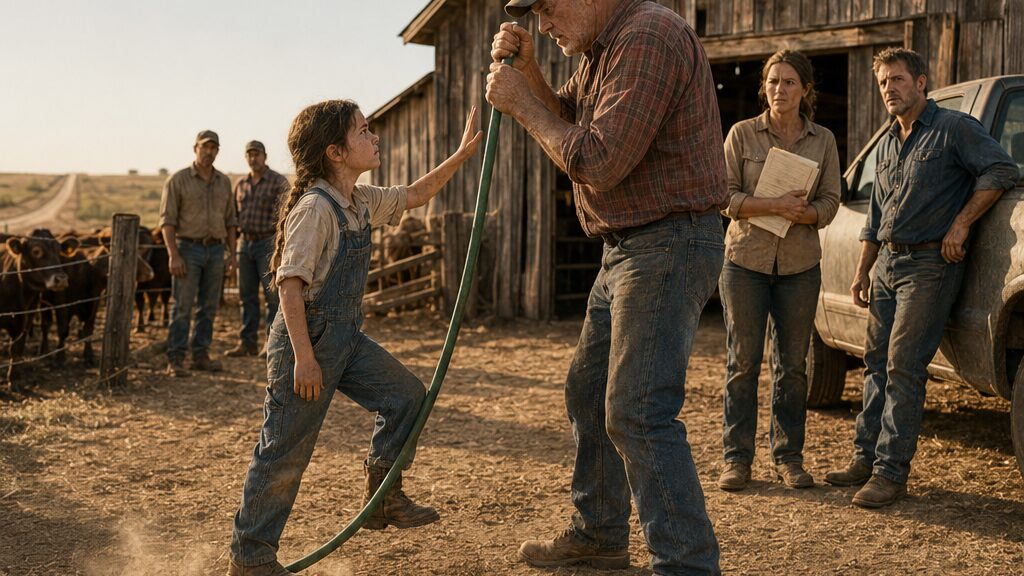
Gary Carter jerked the green hose so hard it snapped against Sarah’s boot.
“Move your foot.”
Sarah pressed down harder.
The hose ran across the baked yard from the pump shed to the only strip of alfalfa that still held any green. Beyond it, the rest of the field had gone the color of old rope. Forty-three cows stood along the fence, their heads angled toward the pasture as if they could smell the water moving beneath the dirt.
Gary bent, caught the hose in both hands, and pulled again.
Sarah’s heel slid half an inch through the dust.
“I said move.”
“And I said they need that field.”
Two neighboring farm workers stopped beside the barn. Michael Hall stood near his pickup with one hand on the open door. Sarah’s mother, Lisa, had come out carrying a feed invoice and now held it folded against her chest.
Nobody stepped closer.
That made it worse.
Gary straightened. He was tall enough that Sarah had to tilt her head back to keep looking at him. Sweat darkened the collar of his faded plaid shirt, and a pale line of dust marked the brim of his cap.
“You don’t know what they need.”
Sarah felt the watching adults settle into that silence people used when they had already decided a child was about to embarrass herself.
“Twenty-seven cows are nursing,” she said. “Sixteen aren’t. The nursing cows need twenty-six pounds of dry matter each. The rest need about twenty. The north pasture won’t carry them another week.”
One of the workers looked toward the cattle.
Gary’s jaw shifted.
Sarah kept going before her voice could shake.
“If this field dies, we buy hay. If we buy hay for all forty-three, that’s more than three hundred dollars a day at the price from Tuesday.”
Michael closed his truck door slowly.
Gary pointed toward the house. “Go inside.”
“No.”
The word came out smaller than she wanted, but it did not break.
Gary stepped forward. “This is not a discussion.”
Sarah’s hand rose before she thought about it. Her palm landed against the center of his chest, not hard enough to push him, only hard enough to stop him from coming closer.
For one second, everybody froze.
The hose hung between them, lifted in Gary’s fist and trapped beneath Sarah’s boot.
She could feel his breathing through the cloth of his shirt.
“If you cut it off,” she said, “you better tell me which cows you’re letting go hungry.”
Gary stared at her as if she had become someone else while he was looking away.
Then he lowered the hose.
Sarah thought she had won.
The thought lasted only until he turned toward the pump shed.
He crossed the yard without speaking, opened the metal control box, and pulled the disconnect lever down. The pump’s low mechanical hum died. Water inside the hose gave one last soft shudder beneath Sarah’s sole.
Gary took the brass valve key from the hook by the door and put it in his pocket.
“You want to stand on it all night,” he said, “stand on it.”
He walked past Michael toward the barn.
The two workers followed, avoiding Sarah’s eyes. Michael stayed by his truck.
“You had numbers,” he said at last.
Sarah stepped off the hose. “Numbers don’t matter if nobody listens.”
“They matter.” Michael looked toward the field. “They just aren’t the only numbers.”
Before she could ask what that meant, he climbed into his pickup.
Lisa waited until the truck disappeared down the dirt road.
“You should not have put your hand on him.”
“He shouldn’t have talked to me like I was five.”
“You’re twelve.”
“I know how many cows we have.”
“That isn’t the point.”
“It is exactly the point.”
Lisa’s mouth tightened. She looked toward the barn, where Gary had vanished into the shadows.
“There are things you don’t know.”
“Then tell me.”
Lisa unfolded the feed invoice, folded it again, and walked back to the house.
The sun lowered behind the equipment shed. The last green field seemed brighter in the slanting light, almost unnatural against the dry ground around it.
Sarah waited until she heard the kitchen door close.
Then she went to the pump shed.
Gary had locked the control box, but the side window no longer latched properly. Sarah knew because she had been the one to hold it shut with wire all spring. She pulled the wire loose, slid her arm through, and reached for the manual reset.
Her father had shown her the sequence when she was eight.
Breaker up. Pressure release. Prime switch. Count to five.
Never let the place die, she had told him once when he was sick and too tired to walk the field.
He had smiled as though she had said something brave.
She had kept it as a promise.
The pump coughed once.
Sarah waited.
It coughed again, then caught with a hard metallic rattle. The hose on the ground stiffened. Water surged through it toward the alfalfa.
Sarah ran outside.
At the far end, the sprinklers began turning, weak at first, then steadier. Thin arcs caught the evening light.
She laughed once under her breath.
Gary had been wrong. The pump still worked. The field could still be saved.
A sharp pop came from inside the shed.
The pump screamed.
Sarah spun around as water burst through the doorway in a white, hammering sheet.
She reached the control box, slipped on the wet concrete, and struck the cutoff with both hands.
The motor died.
For a moment there was only the sound of water draining across the floor.
Then a metal coupling rolled out through the doorway and stopped against her boot.
A fresh crack ran almost all the way around it.
Chapter 2: The Well Was Failing Before She Touched It
No water came from the kitchen tap.
Sarah turned the handle farther, though she knew handles did not make empty pipes fuller.
Behind her, Gary set his coffee cup down.
The ceramic struck the table harder than necessary.
“How long did you run it?”
Sarah faced him. “Maybe thirty seconds.”
“Maybe?”
“Less than a minute.”
Lisa stood at the counter with her arms folded. Her eyes looked tired rather than angry, which made Sarah feel worse.
Gary pushed back from the table.
“You went into a locked control box.”
“The window was open.”
“You restarted equipment I shut down.”
“It was working until the coupling broke.”
“It broke because you forced pressure through it.”
“You don’t know that.”
Gary stared at her.
Sarah wished she had not said it, but she would not take it back.
He picked up his cap from the table. “Come look.”
The pump shed smelled of hot metal, wet dust, and the sour mineral odor that rose from the well line. Mud coated the concrete where the burst water had carried years of dirt out from beneath the pipes.
The green hose lay collapsed outside, dull and flattened in the morning sun.
Gary crouched beside the broken coupling. “See that split?”
“Yes.”
“That happens when pressure spikes against a weak fitting.”
“So it was weak.”
“It was holding.”
“That’s not the same thing.”
Gary glanced up at her.
Sarah knelt before he could tell her not to. Rust darkened the fitting, but the broken edge was bright. Near the pipe joint, beneath a smear of mud, she saw two clean wrench marks.
She rubbed them with her thumb.
The metal beneath was silver.
“These are new.”
Gary did not answer.
Sarah leaned closer. A strip of sealing tape showed beneath the threads. It had not yet yellowed with age.
“You worked on this.”
“Last week.”
“You said the pump was fine.”
“I said nothing about the pump.”
“You let everybody think I broke it.”
“You did break it.”
“It was already failing.”
Gary stood with effort, pressing one hand against his knee. “Both can be true.”
Sarah looked past him toward the silent field.
The answer stole some of the sharpness from her anger and left something more difficult behind.
“How long?”
Gary wiped his hands on a rag.
“How long has the well been dropping?”
He folded the rag once. “Since May.”
It was August.
Sarah counted the months without meaning to.
“Why didn’t you tell us?”
“I told your mother.”
From the doorway, Lisa said, “He told me the output was down. Not how far.”
Gary’s face closed.
Sarah turned back to the pipe. A pressure gauge hung above it, its glass scratched. Somebody had written dates and numbers in pencil on the wooden frame.
June 4 — 18.2
June 26 — 15.7
July 19 — 12.1
August 7 — 9.4
Sarah read them twice.
“What are these?”
“Gallons per minute,” Gary said.
The number should have been above twenty.
She knew that much.
“If it drops under eight,” he continued, “the pump starts drawing sediment. Under six, we can damage the well casing.”
“And watering the field makes it drop faster.”
“Yes.”
Sarah looked at the broken coupling in her hand.
“So you were shutting it down to protect the well.”
“I was shutting it down because there isn’t enough water to do everything.”
“Why didn’t you say that yesterday?”
Gary picked up his toolbox. “Because I told you to move.”
“That isn’t an answer.”
“It’s the one I’ve got.”
A county truck turned in from the dirt road before Sarah could follow him.
It stopped beside the barn, raising a thin cloud of dust. A woman in a tan work shirt stepped out carrying a clipboard and a small testing case.
Gary muttered something under his breath.
Lisa looked at him. “You called them?”
“No.”
The woman crossed the yard.
“Patricia Green,” she said. “County agricultural extension. We received a low-output report from the water district.”
Gary’s eyes moved toward Michael’s property beyond the fence.
Patricia followed his glance but did not comment.
“I need to inspect the well head, meter, and pump condition,” she said. “If the output is below the drought threshold, there may be restrictions.”
Sarah watched Gary’s grip tighten on the toolbox handle.
“What kind of restrictions?” Lisa asked.
“Reduced pumping hours. Possibly suspension if the well is at risk.”
Gary said, “The pump is offline.”
“I can see that.”
Patricia stepped into the shed, examined the cracked fitting, then looked at Sarah’s muddy clothes.
“Were you present when it failed?”
Gary answered before Sarah could.
“She restarted it without authorization.”
Patricia’s expression did not change. “Then I’ll need that included in the report.”
Heat climbed Sarah’s neck.
“But the fitting had already been repaired,” she said. “And the well output was dropping.”
Patricia looked at the pencil marks on the frame.
“Those readings yours?”
“His.”
Gary said nothing.
Patricia copied them onto her form.
“The failure may be mechanical,” she said, “but the larger issue is the decline. I’ll return Friday morning for a flow test once the fitting is replaced. Until then, do not operate the pump.”
She tore a yellow sheet from the clipboard and handed it to Gary.
Sarah read the bold line across the top.
TEMPORARY NON-OPERATION NOTICE.
Patricia packed her case and walked back to the truck.
Gary folded the notice and put it in his pocket with the valve key.
“You see?” he said to Sarah. “This is what happens when you decide knowing one part means you know all of it.”
Sarah looked at the fresh wrench marks again.
“You knew enough to hide the repairs.”
His face hardened, but before he could answer, Lisa called him toward the cattle lot.
A heifer had pushed through a weak section of fence.
Gary and Lisa hurried away.
Sarah remained in the shed until the dust from Patricia’s truck settled.
The broken coupling had not cleared her of blame. She had forced the pump. She had made the failure happen sooner.
But Gary had known the system was failing and had chosen silence.
Both could be true.
She carried the coupling to his truck, intending to leave it on the seat.
The passenger door was unlocked.
When she set the fitting down, something white showed beneath the bench seat. Sarah reached under and pulled out a thick envelope.
The return address belonged to an auction company two counties east.
Across the front, in block letters, someone had written:
CARTER LIVESTOCK — PRELIMINARY VALUATION.
Chapter 3: The Envelope Under the Truck Seat
Sarah opened the envelope before Gary came back from the cattle lot.
Inside were six pages clipped together. The first showed the auction company’s logo, a date from the previous week, and a list of fees. The second contained columns of ear-tag numbers, ages, weights, and estimated prices.
At the top, beside Gary’s name, someone had typed:
Partial herd dispersal inquiry. No sale authorized.
Sarah read that sentence three times.
No sale authorized meant he had not sold them.
Inquiry meant he had considered it.
She turned the page.
The cattle were grouped by bloodline. Most of the numbers meant nothing until she reached the letter C.
C-14. C-19. C-22. C-31.
Her father had started that line from a red-coated heifer he bought with money saved from summer road work. Sarah remembered him painting the first C tags at the kitchen table. He had let her hold the marker, though she was too young to keep the numbers straight.
All eleven remaining cows from that line were listed.
At the bottom, a handwritten note read:
Strong genetics. Market before winter weight loss.
Sarah heard the barn gate slam.
She shoved the papers back into the envelope, but Gary’s truck door creaked as she tried to close it.
Lisa stood ten feet away.
“What are you doing?”
Sarah held up the envelope.
Lisa’s face changed so slightly that someone else might have missed it.
“You knew.”
“Put that back.”
“You knew.”
“Sarah.”
“Are you selling Dad’s cows?”
Lisa crossed the yard quickly and lowered her voice. “Not here.”
“That means yes.”
“It means your grandfather requested numbers.”
“For eleven of Dad’s cows.”
“For part of the herd.”
Sarah pulled the valuation sheets out again. “They wrote that they should go before winter.”
Lisa reached for them.
Sarah stepped back.
“Does Gary know you’re going through his truck?”
“Does Gary know you’re lying for him?”
The nearest worker looked over from the barn. Lisa waited until he turned away.
“We are not doing this in the yard.”
“That’s where everybody else gets to talk about our farm.”
Lisa took the envelope from Sarah, not roughly, but with enough force to bend one corner.
“The feed supplier called again,” she said. “We are behind.”
“How far?”
“Sarah.”
“How far?”
Lisa looked toward the house. “More than we can fix by pretending there isn’t a problem.”
“Then why did you pretend?”
“I was trying to give you one normal summer.”
Sarah laughed once, though nothing was funny.
“A normal summer where the field dies and Dad’s cattle disappear?”
“No decision has been made.”
“Then show me all of it.”
Lisa pressed the papers flat against her thigh. “Go help at the lot.”
Sarah did not move.
“Now.”
The word sounded like Gary.
That hurt more than Sarah expected.
She walked past the barn, through the side gate, and down the dirt road toward the feed store without asking permission. It was nearly two miles, and the heat made the air above the gravel tremble.
She kept seeing the handwritten note.
Before winter weight loss.
As if the cows were already becoming less valuable each day they stayed.
At the feed store, a delivery truck idled beside stacked pallets. The supplier stood behind the counter writing in a ledger. He stopped when Sarah entered.
“Your mother with you?”
“No.”
“You need something?”
“Current hay price.”
He studied her. “Same as Tuesday.”
“Delivered?”
“Depends on quantity.”
“For forty-three cows.”
His pen stopped.
“Sarah, that’s a conversation for your grandfather.”
“Just tell me.”
The supplier sighed. “Two hundred eighty a ton, plus delivery. More if everybody keeps buying.”
Sarah did the numbers in her head.
Not exactly three hundred dollars a day, but close enough that her argument in the yard had not been foolish.
“What if there were thirty cows?”
He gave her a long look.
“Less feed,” he said. “Same bad price.”
She left before he could ask more.
Michael’s pickup was parked near the road outside the store. He sat on the tailgate drinking from a paper cup.
“You walking home?”
“I’m walking.”
“That wasn’t my question.”
Sarah kept going.
Michael caught up in the truck and rolled beside her at the speed of a slow horse.
“Get in.”
“No.”
“You planning to prove something by getting heatstroke?”
She climbed into the passenger seat.
The cab smelled of dust, coffee, and grease. For half a mile, Michael said nothing.
Then Sarah asked, “Did Gary tell you he was selling cows?”
Michael’s hands tightened slightly on the wheel.
“He asked what mine brought last spring.”
“That’s not what I asked.”
“No. He didn’t tell me he was selling.”
“What about the field?”
Michael looked at her, then back at the road.
“What about it?”
“Yesterday you said there were other numbers.”
He drove past the Carter mailbox without turning in.
“Where are we going?”
“To the north fence. Gary asked me to look at the boundary markers.”
Sarah sat straighter. “Why?”
Michael exhaled through his nose.
“That field has road access. Good fencing on two sides. Easy equipment entry.”
“For what?”
“He asked whether I knew anyone interested in a three-year lease.”
The words landed more quietly than the hose had.
Sarah looked through the windshield at the dry acreage stretching toward the county road.
“How long ago?”
“Two weeks.”
“Before the pump broke.”
“Yes.”
“Before he shut off the water.”
“Yes.”
“So this was never just about the well.”
Michael slowed beside the north gate.
“I figured he had talked to Lisa.”
“He talked to everybody except me.”
“You’re twelve.”
Sarah turned toward him.
Michael winced. “That came out wrong.”
“No. It came out exactly how everybody means it.”
At the house, Lisa waited on the porch with the auction envelope tucked beneath her arm.
Gary was nowhere in sight.
Sarah got out before Michael fully stopped.
“Tell her,” Sarah said.
Michael remained behind the wheel.
Lisa looked from him to Sarah. “Tell me what?”
“That Gary’s been asking about leasing the field.”
Lisa closed her eyes for one second.
That was enough.
“You knew that too,” Sarah said.
Lisa stepped down from the porch. “I knew he was considering options.”
“You knew about the cows. You knew about the field. You knew about the well.”
“I knew pieces.”
“And you helped him hide all of them.”
Lisa’s shoulders lowered.
“Yes,” she said. “I knew about the valuation.”
The admission was quiet, but it changed the whole yard.
Sarah looked at the envelope beneath her mother’s arm and understood that Gary’s silence had not stood alone.
Lisa had been guarding it with him.
Chapter 4: What Lisa Signed Without Telling Sarah
Lisa placed three unopened notices on the kitchen table.
She did it carefully, lining the envelopes beside one another as if straight edges could make what they contained less dangerous.
Sarah stood across from her, still dusty from the road. Gary remained outside near the cattle lot. Through the screen door came the scrape of a shovel and the low complaint of a cow pressing against the fence.
“Open them,” Sarah said.
Lisa rested both hands on the back of a chair. “You already know enough to be scared.”
“That isn’t the same as knowing.”
“It feels the same at your age.”
Sarah pulled out the chair and sat. “Then let me decide.”
Lisa looked toward the window. For a moment Sarah thought she would gather the envelopes and carry them away again.
Instead, she pushed the first one across the table.
It came from the feed supplier. The amount past due filled nearly half a line, but Sarah understood it before she finished counting the digits.
The second was from the farm lender. Payment required within thirty days. Failure to cure may result in further action against secured assets.
The third carried the county water district seal.
Lisa opened that one herself.
“They want usage records,” she said. “And they want a plan before the well test.”
“Why?”
“Because we pumped over the voluntary limit in June.”
Sarah looked toward the pump shed. “Gary knew?”
“Yes.”
“And you?”
“I saw the meter reports.”
“Why didn’t you cut back then?”
“We did.”
“You cut water to the garden.”
“And the south trough. And the wash line. It wasn’t enough.”
Sarah touched the feed notice with one finger. “How close are we?”
Lisa sat at last.
“The lender payment is due next month. Feed is already late. If the well is restricted, we cannot keep the whole herd through winter without buying more hay.”
“So Gary’s plan is to sell cows and lease the field.”
“Gary’s plan is to make sure we still have the house.”
The words landed harder than Sarah expected.
She looked around the kitchen: the uneven cabinet door Gary had never fixed, the burn mark beside the stove, the pencil lines inside the pantry where her height had been measured every birthday.
“The house is part of the farm.”
“It is also collateral.”
Sarah lowered her eyes to the envelopes.
Lisa reached toward her, then stopped before touching her arm.
“I did not tell you because I wanted you to have a summer that wasn’t built around bills.”
“You let me argue with him in front of everybody.”
“I did not know he was going to cut the hose then.”
“But you knew why.”
“Some of why.”
Sarah pushed back from the table.
“You and Gary keep saying that. Pieces. Some of it. Not everything. Like if you divide a lie into enough parts, it stops being one.”
Lisa flinched.
The screen door opened.
Gary entered, carrying dust and heat with him. His eyes moved from the notices to Sarah.
“You showed her.”
“She found the valuation,” Lisa said.
Gary removed his cap and set it on the counter.
Sarah waited for him to deny something.
He did not.
“We’re going to the county office tomorrow,” Lisa said. “Patricia wants the records before the test.”
Gary opened the refrigerator, looked inside without taking anything, and shut it again.
“No point.”
Sarah turned. “No point in what?”
“Writing a plan for water that isn’t there.”
“The well still has nine gallons a minute.”
“Had.”
“Then we use less.”
Gary looked at Lisa. “This is why you don’t put children in the middle of adult problems.”
“You put me in the middle when you cut off the field I work in.”
“You help in it.”
“I keep the livestock records.”
“You write numbers in a school notebook.”
“I know more about those cows than the auction company does.”
Gary’s voice dropped. “Enough.”
Sarah felt the old urge to press harder simply because he wanted silence.
Instead, she gathered the three notices.
“I’m going tomorrow.”
“You have school.”
“It’s summer.”
“You’re staying here.”
Lisa said, “She should hear what Patricia says.”
Gary gave her a look that carried another argument Sarah had not witnessed.
The next morning, Lisa drove Sarah to the county agricultural office in town. Gary followed in his truck but parked at the far end of the lot.
Patricia Green met them in a narrow conference room where maps of the county watershed covered one wall. She placed the Carter meter reports beside the pump readings.
“The well decline is not just seasonal,” she said. “Your drawdown is accelerating.”
Gary leaned back in his chair. “We know.”
Patricia pointed to a graph. “If the repaired pump is operated at the old schedule, the well could fall below safe intake depth. At that point, the district can suspend agricultural use.”
“For how long?” Lisa asked.
“Until recovery, if it recovers.”
Sarah stared at the graph. The black line sloped downward like a fence collapsing one post at a time.
“What if we pump fewer hours?” she asked.
Patricia glanced at Gary before answering.
“That depends on the acreage, crop demand, application loss, and livestock use.”
“I can get those.”
Gary said, “Sarah.”
Patricia folded her hands. “A reduced-use plan is possible. It would require measured zones, fixed pumping windows, and weekly meter reporting. No unrestricted irrigation.”
“So the field can stay alive.”
“Part of it might.”
The words sharpened the room.
“How much?” Sarah asked.
“I cannot answer without accurate measurements.”
Gary stood. “Then there’s nothing to discuss.”
Patricia looked up at him. “There is a deadline to discuss.”
“When?”
“Friday at five. If no plan is filed, the temporary notice converts to restricted livestock-only use until further review.”
Lisa’s breath caught.
Sarah looked at Gary. “That would kill the whole field.”
“Yes,” Patricia said.
Gary reached for the records. “Then let it.”
Sarah stared at him.
He placed the papers into a folder without looking at her.
On the drive home, Lisa kept both hands tight on the wheel. Gary’s truck stayed ahead of them, a moving block of dust on the county road.
Sarah opened her notebook.
She copied the well readings first. Then the size of the field as she remembered it. Then the distance between the pump shed and the north boundary.
At home, she uncoiled the green hose beside the barn and counted its sections. Each repaired joint marked fifty feet. She wrote the total length in the margin beside Patricia’s water figures.
Gary watched from the barn doorway.
“What are you doing?”
“Measuring.”
“For what?”
“A plan.”
“I told you there won’t be one.”
“You said there was no point. Patricia said there was.”
Gary came into the yard. “You think a page of arithmetic changes what this place costs?”
“No. But doing nothing doesn’t change it either.”
His expression hardened, but Sarah did not raise her voice.
She wrapped the hose into a tighter coil and wrote down its length.
Gary took the brass valve key from his pocket, turned it once in his fingers, then put it away.
“The lease buyer is coming Saturday morning,” he said.
Lisa stepped onto the porch. “You scheduled it?”
“I confirmed it.”
“You said we would talk first.”
“We just did.”
Gary turned back toward the barn.
Sarah looked down at the figures in her notebook. It was Wednesday afternoon.
By Saturday, either the field would become someone else’s decision, or she would have to show them a future none of the adults believed existed.
Chapter 5: The Plan That Could Not Save Everything
Sarah’s first plan failed before breakfast.
She sat at the kitchen table with a calculator, Patricia’s usage limits, and three pages of measurements. She entered the figures again, certain she had made a mistake.
The result did not change.
The full field required almost twice the water the well could safely provide.
She crossed out the number so hard the pencil tore the paper.
Lisa set a plate beside her. “Eat.”
“I’m not hungry.”
“You’ve been awake since four.”
“The math is wrong.”
Lisa looked at the page. “Is it?”
Sarah shoved the calculator toward her. “The sprinklers lose too much. Wind, evaporation, bad coverage. If we had drip lines—”
“We don’t.”
“We could get them.”
“With what money?”
Sarah pushed the plate away.
Lisa did not push it back. “A plan is not a wish written in columns.”
Sarah hated the sentence because it sounded true.
At the field, she stretched the green hose from the pump shed toward the north fence. Every fifty feet, she drove a short stake into the soil. The hose twisted unless she pulled it taut, and by midmorning her palms were striped with dirt.
The surviving alfalfa covered less ground than it appeared to from the yard. Green remained thick near the lowest swale, thinner toward the road, and nearly gone along the western edge.
Sarah marked all of it anyway.
She carried the figures to the school library, where the air-conditioning made her wet shirt feel cold against her back. Using the public computer, she checked crop-water tables and printed a county guide on reduced irrigation.
By noon, she had another plan.
It saved the whole field by cutting watering frequency and moving the herd to the south lot every third day.
On paper, it worked.
At Michael Hall’s farm, he read the page while standing beside his hay baler.
“No.”
Sarah took it back. “You didn’t even finish.”
“I finished enough.”
“You said numbers mattered.”
“They do. Yours don’t include equipment time.”
“I can move the sprinklers.”
“Every six hours?”
“Yes.”
“At midnight too?”
“Yes.”
“What about school?”
“It’s summer.”
“For another three weeks.”
“I’ll keep doing it.”
Michael handed back the sheet. “And when the pump drops another gallon a minute?”
Sarah said nothing.
“And when one sprinkler clogs? When the wind takes ten percent? When Gary needs the line for the trough?”
“I can adjust.”
“You are building a plan where nothing goes wrong.”
“That doesn’t mean it can’t work.”
“It means it won’t.”
Sarah folded the paper once.
Michael leaned against the baler. “You want my tractor and reel to move water lines?”
“Yes.”
“Then reduce the acreage.”
“How much?”
“Half.”
“No.”
“Then no equipment.”
Sarah stared at him. “You’d help Gary lease it.”
“I’d help him stop losing everything.”
“That’s the same thing everybody says when they want to quit.”
Michael’s face tightened.
“My brother kept every acre of our father’s place,” he said. “Borrowed against all of it because selling any piece felt disloyal. He lost the house with the fields.”
Sarah looked away.
Michael wiped grease from his thumb with a rag.
“Keeping less is not always quitting.”
She walked back to the Carter farm carrying the folded plan in her pocket.
The green hose remained stretched across the field in a long, uneven line. Sarah stood at the northern stake and looked south.
Half the acreage.
She moved the stake twenty feet.
Then fifty.
Then another hundred.
Each step felt like erasing something.
By late afternoon, she had divided the field into three sections. The lowest section held the best soil and could be watered with shorter runs. The middle section might survive with reduced cutting. The western edge would have to go dry.
Sarah wrote the new figures.
This time, the total fit beneath Patricia’s maximum.
She checked it twice.
Then she added livestock demand.
The plan failed again.
Watering even the reduced field left enough for only thirty-two cattle through the worst months.
Sarah sat in the dirt beside the hose.
Eleven cows.
The same number as her father’s breeding line.
She pressed the heels of her hands against her eyes until bright spots moved behind them.
Her promise had always sounded simple because she had made it before she understood that farms could die in pieces.
Never let the place die.
She had thought that meant refusing every loss.
Now every version of saving one thing required choosing another thing not to save.
At dusk, she returned to Michael’s farm.
He was closing the equipment shed.
“I need the reel for two mornings,” she said.
“How much acreage?”
“Twenty-eight acres.”
He paused. “Out of forty-six?”
“Yes.”
“And the herd?”
“Thirty-two through winter. Maybe thirty-four if feed prices come down.”
“They won’t.”
“Then thirty-two.”
Michael studied her face. “Which cattle?”
“I haven’t chosen.”
“That is part of the plan.”
“I know.”
He nodded once. “Two mornings. Fuel is yours. If county approval comes through.”
“And if it doesn’t?”
“No equipment.”
Sarah held out her hand.
Michael shook it.
Back at home, she spread the revised map across the kitchen table. Lisa read the figures silently.
“You did this?”
“With county tables.”
“You cut eighteen acres.”
Sarah swallowed. “They can be leased.”
Lisa touched the herd calculation.
“And eleven cows.”
“I know.”
For the first time since the hose confrontation, Lisa looked at her without trying to soften anything.
“This might be real,” she said.
The small recognition hurt almost as much as failure had.
Sarah taped the field map to a piece of cardboard and carried it toward the pump shed. Gary stood inside fitting the new coupling.
He noticed the map immediately.
“What is that?”
“A reduced-use plan.”
“I said no.”
“You didn’t look.”
“I don’t need to.”
Sarah held it against the wall beside the recorded well readings.
“Twenty-eight acres. Fixed zones. Thirty-two cattle. Michael will lend the reel. Patricia can verify the pumping schedule.”
Gary’s wrench stopped.
For one instant, Sarah thought he was reading.
Then he stepped forward, pulled the map from the cardboard, and tore it down the center.
The sound was small.
Sarah watched one half fall against the dry green hose.
“You would rather kill the field than let me prove you wrong,” she said.
Gary held the other half in his fist.
“This is not about proving me wrong.”
“Then what is it about?”
He looked toward the barn, where the shadows had begun to fill the loft openings.
When he answered, his voice was tired rather than angry.
“This farm has already taken enough from this family.”
He dropped the torn paper and walked toward the barn.
Sarah picked up both halves and followed him.
Chapter 6: Gary’s Reason for Letting the Field Die
“The farm already took one generation,” Gary said from the barn loft. “I’m not giving it another.”
Sarah stopped halfway up the ladder.
Below them, the dry green hose rested against the barn wall where it had been dragged from the field. Through the open loft door, the last light lay across the pasture in narrow red bands.
Gary sat on an old hay bale with the torn map folded between his hands.
Sarah climbed the remaining rungs.
“What does that mean?”
He did not look at her. “It means go back to the house.”
“No.”
A tired sound left him, almost a laugh.
“You always think staying is the brave part.”
“You always think ordering people around is explaining.”
Gary rubbed one thumb along the tear in the paper.
“Your father was nineteen when he decided this place needed him more than college did.”
Sarah stood very still.
“He chose to stay.”
“He thought he did.”
“You made him?”
“No.”
The answer came quickly.
Gary looked out through the loft opening.
“I never had to. I let every broken fence, every bad season, every calf born in a storm tell him for me. I let him believe leaving would mean abandoning us.”
Sarah pictured her father at the kitchen table painting the C tags. She remembered his hands, the dark half-moons of grease beneath his nails, the way he had coughed into his sleeve when he thought nobody watched.
“He loved this farm.”
“Yes.”
“Then maybe he wanted it.”
“He did. That was the trouble.”
Gary unfolded the torn map.
“When he got sick, he asked me to make him a promise.”
Sarah’s throat tightened.
“What promise?”
“That you would never grow up thinking you owed this place your whole life.”
The barn seemed to shift around her.
“He told me never to let it die.”
Gary finally looked at her. “He told you what a father tells a scared little girl.”
“He meant it.”
“He meant he wanted you to feel safe.”
Sarah’s hands curled at her sides.
“You don’t get to change what he said.”
“No. But I know what he said to me after you fell asleep.”
The anger in her chest struck against something heavier and could not get through.
Gary looked back at the map.
“He said you watched too much. Counted every bottle calf. Knew when the feed truck came. He was afraid you would turn his life into your duty.”
“So your answer is to sell it before I can choose?”
“My answer is to leave you something besides debt.”
“You could have told me.”
“You’re twelve.”
“I was twelve when you let me think I broke the well.”
His face tightened.
Sarah moved closer.
“You let me stand in that yard and fight you without knowing what we were fighting about.”
“I was trying to end it.”
“You were trying to end the argument by ending the choice.”
Gary’s fingers closed around the torn map.
For several seconds, only cattle moving below the loft broke the silence.
Then he said, “I talked to the lease buyer before I told your mother.”
Sarah had not expected the admission.
“You said she knew.”
“She knew I was considering it. She did not know I had asked for terms.”
“So you lied to her too.”
“I delayed.”
“That is what you call it when you do it.”
Gary’s mouth pulled tight, but he did not deny it.
Sarah sat on the opposite hay bale.
The torn map lay between them.
“Is the plan wrong?”
Gary studied the numbers. “It doesn’t account for pump repair costs.”
“Lisa has those.”
“It assumes Michael keeps lending equipment.”
“He agreed to two mornings.”
“It sells eleven cows.”
“Yes.”
The word hurt, but Sarah made herself say it clearly.
Gary looked up.
“Which eleven?”
“I don’t know yet.”
“Then you haven’t made the hardest part of the plan.”
“I know.”
He looked at her as if he had been waiting for her to reject that truth.
She did not.
“I cannot save all of it,” Sarah said. “But you cannot decide that means we save none of it.”
Gary leaned his forearms on his knees.
“You think keeping twenty-eight acres changes the lender’s mind?”
“No. Lisa has to talk to them.”
“You think thirty-two cows carry this farm forever?”
“No.”
“You think you can run water lines every night and still have a life?”
“No.”
Each answer seemed to unsettle him more than an argument would have.
Sarah picked up one half of the map.
“I think we can keep the house. A smaller herd. One section of field. I think I can leave for school someday without there being nothing here when I come back.”
Gary’s eyes moved toward the dirt road visible beyond the barn.
“That is not a promise anyone can make.”
“It is more honest than pretending the only choices are everything or nothing.”
Darkness gathered in the lower barn. The hose below had lost its color and become a black curve against the wall.
A vehicle turned from the county road.
Headlights moved slowly along the dirt lane.
Gary stood and looked through the opening.
A pickup towing an empty flatbed trailer approached the house.
“The lease buyer,” he said.
Sarah looked at him. “The meeting is tomorrow.”
“He said he might arrive early.”
“You knew?”
Gary folded the torn map and placed it in his shirt pocket.
“I knew he was driving in tonight.”
He climbed down the ladder.
Sarah followed.
At the bottom, Gary reached for the barn door, but Sarah stepped in front of it.
She did not touch his chest this time.
“I’m coming to the meeting.”
“No.”
“Yes.”
“This is not a performance for the neighbors.”
“I’m not asking them to watch.”
“You don’t have standing to sign anything.”
“I have enough standing to tell Patricia where the water goes and Lisa what the herd can carry.”
Gary took the valve key from his pocket. In the dim barn light, the brass edge flashed once.
“You think being right about some figures makes you ready for this.”
“No,” Sarah said. “I think admitting what the figures cost makes me more ready than I was.”
The pickup stopped beside the house.
A door opened outside.
Gary held Sarah’s gaze.
She stepped aside from the barn door, but not from the decision.
“Invite me or don’t,” she said. “I’ll be there in the morning.”
Chapter 7: The Field Meeting Beside the Broken Pump
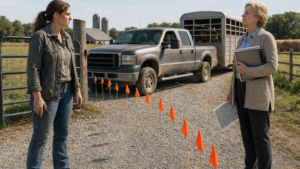
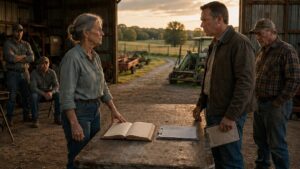
The lease papers lay flat across the hood of Gary’s truck, held down at each corner by whatever was heavy enough to keep the wind from taking them: a wrench, a coffee mug, the broken coupling, and the brass valve key.
Sarah saw the key first.
Gary stood on one side of the truck with the lease buyer and the auction representative. Lisa stood near the barn with her arms folded. Michael had parked by the north gate. Patricia Green’s county truck had arrived ten minutes earlier, and she was already checking the repaired pump with a meter clipped to the discharge line.
Nobody had invited Sarah into the circle.
She carried the two halves of her field map beneath one arm and the green hose over her shoulder.
The lease buyer glanced at her, then at Gary.
“Family meeting?” he asked.
Gary did not answer.
Sarah lowered the hose beside the truck. “Before anyone signs, Patricia needs to see the proposed irrigation boundary.”
Patricia looked up from the pump. “A proposed boundary was not included in the family’s filing.”
“There was no filing,” Gary said.
“There is now.”
Sarah spread the torn map over the lease papers.
The auction representative reached to move it.
Lisa put her hand over the corner. “Leave it.”
Gary’s eyes shifted toward her.
That was the first change.
Sarah placed her notebook beside the map. She had taped the torn pages together during the night. The seam ran through the western field like a new property line.
“Twenty-eight acres,” she said. “Three irrigation zones. Six-hour pumping windows, four days a week, adjusted if the flow test drops below eight gallons a minute.”
Patricia stepped closer.
“Livestock use?”
“Thirty-two cattle through winter. The remaining eleven go before feed demand peaks.”
The auction representative looked at the valuation envelope under Lisa’s arm.
Gary said, “This is not approved.”
“No,” Sarah said. “It’s not.”
She pulled the hose straight across the yard toward the field.
Michael moved first. Without speaking, he picked up the far end and carried it past the pump shed. Sarah followed, uncoiling it across the dirt. The hose crossed the surviving alfalfa and stopped at the stake marking the edge of the lowest section.
Beyond it, the western acreage lay brittle and gray.
Sarah drove the final stake into the ground.
“This side gets water,” she said. “That side is included in the lease.”
The lease buyer studied the divided field. “That is not the acreage we discussed.”
“No,” Gary said.
The single word carried warning, but not toward Sarah.
Patricia walked the hose line with a measuring wheel. She checked Sarah’s stakes, made notes, and returned to the pump.
“Your application loss estimate?” she asked.
“Twenty-eight percent with the current sprinklers.”
“Too low.”
Sarah’s stomach tightened.
Michael said nothing.
Patricia continued. “The county average for equipment this age is thirty-four.”
“I used the measured distance and nozzle output.”
“You measured under pressure?”
“Before the coupling failed.”
“With a stable gauge?”
Sarah looked toward the scratched pressure gauge in the shed.
“No.”
Patricia tapped the notebook. “Then your application estimate is not defensible.”
The lease buyer began gathering the papers.
Gary reached for the wrench holding one corner down.
Sarah felt the old response rise in her—the urge to argue harder, to refuse the number because it threatened what she wanted.
She looked at the dry western field.
Then she erased twenty-eight and wrote twenty-four.
“Four fewer acres,” she said. “Same pumping limit. Higher loss allowance.”
Patricia studied her.
“And if the well drops?”
“Livestock use comes first. Irrigation shuts down until the weekly reading recovers.”
Gary’s face changed slightly.
“You would let the field go dry?” he asked.
“If the well reaches the intake threshold.”
“That was not your position four days ago.”
“No.”
Sarah made herself look directly at him.
“I was wrong four days ago.”
The yard became quiet enough that she could hear the pump meter clicking.
Patricia recalculated the figures on her clipboard.
“The revised acreage could fit within restricted use,” she said. “But only with weekly reporting and no increase in herd size.”
“What about the debt?” Gary asked. “Water approval does not pay the lender.”
Lisa stepped forward with another folder.
“I called them this morning.”
Gary turned sharply.
“You did what?”
“I asked about restructuring the short-term note.”
“You had no authority.”
“I’m on the account.”
“You should have talked to me.”
Lisa held his gaze. “Yes. We should have been doing more of that.”
The words stayed between them.
“The lender will extend the payment if we reduce livestock inventory and document lease income,” she said. “Not enough to keep everything. Enough to keep the house and operating ground.”
The auction representative opened the valuation sheet.
“We can take eleven head next week,” he said. “Market is not improving.”
Sarah’s eyes moved to the C-tag list.
Gary saw.
“You do not have to sell all eleven from that line,” he said.
It was the first time he had spoken to her as if the choice belonged partly to her.
“We should not protect them just because they were Dad’s,” Sarah said.
Her voice nearly failed, but she continued.
“We keep the healthiest six. Sell five from that line and six from the older cows.”
The auction representative made a note.
The lease buyer pointed toward the western acreage. “I need at least twenty acres to make the equipment move worthwhile.”
“You get twenty-two,” Sarah said. “Western section and the north strip. Three years, but no option on the irrigated section.”
Gary looked at her. “You are negotiating now?”
“I am saying what the plan requires.”
Michael coughed into his fist, hiding what might have been a smile.
The lease buyer named a price lower than the estimate.
Lisa countered.
He raised it slightly.
Gary did not speak until both looked toward him.
Then he picked up the lease papers and read the amended acreage.
Sarah waited for him to tear those too.
Instead, he took the valve key from the hood.
He held it above the hose where it crossed between them, the same way he had held the hose on the afternoon of their argument.
“You understand this does not make you in charge,” he said.
Sarah looked at the key.
“No.”
“You understand one dry year can become two.”
“Yes.”
“And that cattle sold do not come back because you regret it.”
“Yes.”
Gary’s fingers closed around the key.
For a moment, Sarah thought he would put it in his pocket again.
Then he placed it in her palm.
The brass was warm from the sun.
“We vote before anything is signed,” he said.
The lease buyer shifted impatiently. “I drove here for an agreement.”
“You drove here for land,” Gary replied. “You can wait five minutes for the people who live on it.”
They stood beside the truck: Gary, Lisa, and Sarah.
Gary voted for the reduced lease and restricted-use plan.
Sarah voted yes.
Lisa looked toward the cattle lot, where the herd pressed shoulder to shoulder along the fence.
“We sell eleven,” she said. “We keep the house, the twenty-four acres, and the cows the land can carry.”
Her voice broke on the last word, but the vote did not.
Chapter 8: What They Chose to Keep Green
Six months later, the leased field stood brown beyond a new wire fence.
The lease buyer had cleared the dead growth and left the ground bare for spring planting. From the barn, the open acreage looked larger than it had when it belonged to them, as if loss always widened after the boundary was marked.
On the Carter side, twenty-four acres held a low winter green.
The repaired hose ran from the pump shed in a clean line, its patched sections no longer hidden beneath coils. Sarah opened the control box with the brass key, checked the meter, and wrote the reading in the county log.
Gary waited beside the valve.
“Nine point one,” she said.
He turned the handle halfway.
Water moved through the hose with a soft internal knock.
The herd was smaller now. Sarah still counted forty-three in her head before correcting herself to thirty-two. Five of her father’s C-line cows remained along the fence, red coats dark against the pale grass.
The sixth had calved early.
Sarah had stayed awake through most of the night with Gary in the barn, neither of them saying that the calf carried the line forward.
Lisa’s car came down the dirt road and stopped beside the house.
She stepped out holding a large envelope.
“You need to finish packing,” she called.
Sarah looked toward the porch, where her duffel bag waited.
The agricultural summer program lasted six weeks. Before the drought, she would have refused to apply. After the field meeting, Patricia had left the brochure on the kitchen table without saying Sarah should go.
Gary shut the valve.
“You’ll miss the bus.”
“The school bus driver said ten.”
“He says ten when he means nine fifty.”
Sarah removed the key from the control box.
Gary watched her loop it around one finger.
“You planning to come back?” he asked.
The question sounded careless, but his hands had gone still.
Sarah looked beyond him at the dirt road.
Once, she had thought leaving meant failing to keep her promise. Then she had thought staying meant proving she was strong enough.
Now the road looked like neither surrender nor rescue.
“It’s six weeks,” she said.
“That was not my question.”
Sarah walked to the barn and hung the valve key on the nail beside the door.
Not in Gary’s pocket.
Not around her neck.
Where either of them could reach it.
“I’m coming back because I choose to,” she said. “Not because the farm cannot survive without me.”
Gary looked at the key, then at her.
“That sounds expensive.”
“It’s a county program.”
“I meant the attitude.”
Sarah smiled despite herself.
Behind them, water settled inside the hose. The reduced field remained green, not all of it, not forever, but enough for the season they had.
Sarah lifted her duffel bag from the porch as the school bus appeared at the end of the dirt road.
The story has ended.