He Put Steel Posts Beside His Hayfield, Then the Wreck Exposed Why They Were There
Chapter 1: The Truck Stopped Where the Hayfield Began
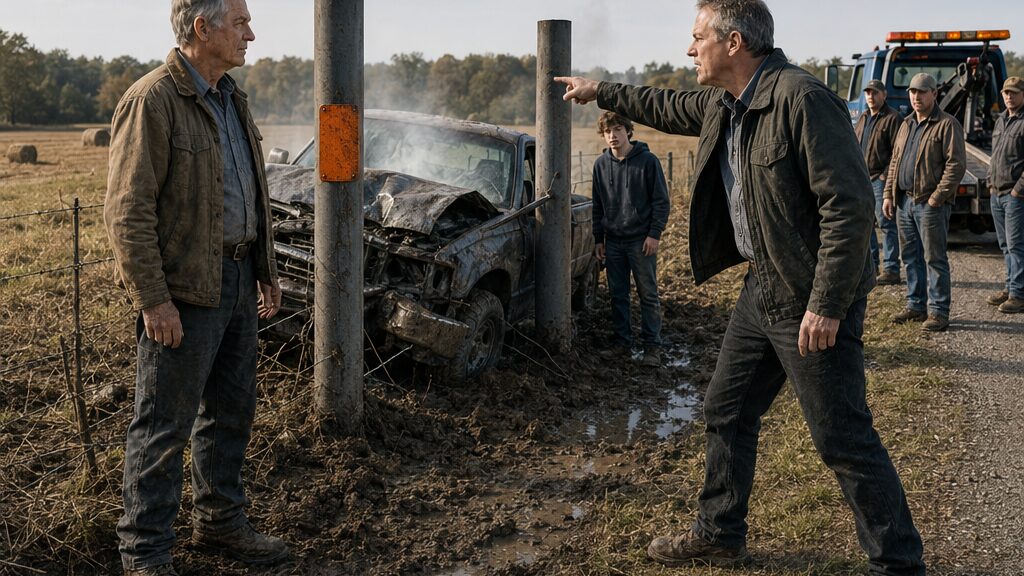
The pickup had folded around the first two steel posts hard enough to lift its rear tires off the ground.
Raymond Hall stood twenty yards away with one hand around his chipped coffee mug and watched white steam drift from beneath the crumpled hood. The truck’s front bumper had split. One headlight hung loose. Mud from the access lane streaked across the passenger door and up onto the windshield.
Andrew King sat on the grass beside the ditch, breathing too fast.
He was upright. No blood Raymond could see. A sheriff’s deputy was crouched beside him, asking questions in a low voice.
Then Jonathan King came through the gate.
He did not look at Raymond first. He went straight to his son, dropped to one knee, put both hands on Andrew’s shoulders and searched his face as if he expected to find something broken.
“You hit your head?”
“No.”
“Your chest?”
“Seat belt caught me.”
Jonathan looked over at the truck.
Then at the posts.
Only then did he look at Raymond.
“What the hell did you put there?”
Raymond took a slow drink from his mug.
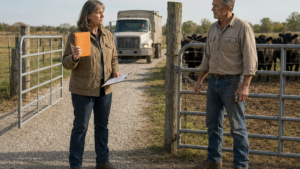
Three galvanized steel posts stood along the inside edge of the hayfield entrance. Two had taken the impact. The third remained straight. Fresh black marks ran across the steel where the pickup had struck.
“They’ve been there six weeks,” Raymond said.
Jonathan walked toward him.
“You put steel in a driving path.”
“I put steel on my property.”
“My son could’ve died.”
Raymond glanced toward Andrew. The boy had lowered his head while the deputy checked something on a notepad.
“I’m aware of that.”
Jonathan stopped two feet from him. “Then why are you standing there drinking coffee?”
Raymond looked at his mug.
“Because yelling won’t unhit the posts.”
A tow truck had just arrived at the road. Its driver slowed as he approached the wreck, staring at the ruined front end. Two neighboring farmers had stopped their pickups along the shoulder as well. Nobody came closer, but nobody left.
Jonathan noticed them.
His voice rose.
“You built a trap beside a farm road.”
“It isn’t a farm road.”
“Everybody around here has used this opening.”
“Not everybody.”
“You buried steel posts in concrete where somebody could hit them.”
Raymond said nothing.
Jonathan pointed at the posts. “You have a permit for that?”
Raymond could hear the change in the question. Jonathan was no longer talking only to him.
He was talking to the people by the road.
Raymond set the mug on the hood of his old farm truck.
Mud had splashed high on the nearest steel post. Raymond walked to it, bent slightly and rubbed his thumb across a rectangle bolted just below waist height.
Orange appeared beneath the brown smear.
Jonathan stopped talking.
Raymond wiped the rest clean.
The county permit tag was sun-faded around the edges but unmistakable.
“Approved May twenty-third,” Raymond said. “Inspected May twenty-ninth.”
Jonathan stared at it.
The tow-truck driver looked away quickly, pretending to check his cable.
“That doesn’t mean those are safe.”
“No,” Raymond said. “It means they’re permitted.”
“For what?”
“Agricultural boundary protection.”
“Against a truck?”
Raymond met his eyes.
“Against vehicles.”
For the first time since arriving, Jonathan looked uncertain.
It lasted less than a second.
Then he turned toward the deputy. “I want this documented. These things shouldn’t be here.”
The deputy stood.
“They already are being documented.”
“I mean as a hazard.”
The deputy glanced toward Raymond. “County installed?”
“No,” Raymond said. “Private installation under permit.”
“Inspection signed off?”
“Yes.”
Jonathan made a sharp sound in his throat. “You two can talk paperwork all morning. My seventeen-year-old just hit three steel columns.”
“Two,” Raymond said.
Jonathan stared at him.
“He hit two.”
“That supposed to make me feel better?”
“No.”
Andrew was standing now.
He avoided Raymond’s eyes.
The deputy told him to remain near the shoulder until the tow truck was ready. Andrew nodded without arguing.
Jonathan lowered his voice.
“Those come out.”
Raymond picked up his mug.
“No.”
“You’ll remove them before someone else gets hurt.”
“No.”
“I’ll file with the county Monday.”
“That’s your right.”
“And insurance.”
“That too.”
Jonathan stepped closer.
“You think a tag protects you from liability?”
Raymond took another sip.
“No.”
That answer seemed to bother Jonathan more than an argument would have.
Raymond added, “But the inspection protects the county from having to guess whether I installed them legally.”
Jonathan’s face tightened.
“You planned this.”
Raymond looked toward the damaged pickup.
“I planned the posts.”
“You knew somebody would hit them.”
“No.”
“You knew Andrew used this lane.”
Raymond’s fingers tightened around the mug.
There it was.
Not a question.
Andrew turned his head slightly.
Raymond saw it.
So did the deputy.
Jonathan seemed to realize what he had said. He changed direction immediately.
“People have always cut through here. It’s been treated like access for years.”
“Not by me.”
“You don’t get to rewrite how land is used because you’re mad.”
Raymond could have answered.
He had photographs in the barn. Repair invoices. A county application. A sheriff’s incident number. He could have told Jonathan, right there in front of the tow driver and the neighbors, exactly why the posts existed.
Instead, he said, “File whatever you need to file.”
Jonathan laughed once without humor.
“Oh, I will.”
The tow driver began hooking the pickup.
Metal scraped against metal as the front end shifted away from the posts.
Andrew flinched at the sound.
Raymond noticed.
Jonathan did not.
He was already on his phone, pacing beside the ditch.
The deputy walked over to Raymond after the truck had been pulled backward six feet.
He looked at the steel posts, then at the tire tracks in the mud.
“These tracks come straight through the opening.”
“Yes.”
“No skid marks I can see.”
Raymond said nothing.
The deputy turned toward him.
“You said these were agricultural boundary protection.”
“That’s what the permit says.”
The deputy studied his face for a moment.
Then he asked, “How many times had the Kings crossed here before today?”
Raymond looked past him toward the fence line.
One repaired cedar post stood darker than all the others.
He had stained it twice.
The tire scars still showed through.
Chapter 2: The Fence Had Been Repaired Twice
The repaired fence post looked ordinary until Raymond stood close enough to see the rubber embedded in the grain.
He ran two fingers across the dark arc Monday’s rain had not washed away.
The deputy stood beside him, boots in the grass.
“This was the first one?”
“First one I documented.”
“That isn’t what I asked.”
Raymond straightened.
“No.”
The deputy waited.
Raymond disliked people who waited well. They made silence feel less like control.
He pointed farther down the boundary.
“Another vehicle clipped the corner years ago. Different family. They came over and apologized. We fixed it.”
“And the Kings?”
Raymond looked toward the barn.
“Twice before Saturday.”
The first time had been in late winter.
Andrew had come through too fast after dark and caught the lower fence with the passenger side of Jonathan’s older pickup. Three boards broke. One post cracked at ground level.
Andrew had been sixteen.
Jonathan arrived before the deputy did.
He had stood in almost the same place where he stood Saturday and said the boy had made a mistake. Raymond believed him.
Raymond repaired the fence himself.
The second time was different.
He opened the barn and pulled a shallow metal file box from a shelf above his workbench.
Inside were invoices, printed photographs and the permit application held together with a black binder clip.
The deputy lifted the first photograph.
A tire rut cut across Raymond’s hayfield. The fence lay open in the background.
“That second incident?”
“Yes.”
“How bad?”
Raymond reached for his mug before remembering he had left it in the farmhouse.
“Four sections of wire down. Gate brace bent. One livestock panel twisted.”
The deputy looked at the next photograph.
A cow stood near the county road.
“That yours?”
“Was.”
The deputy looked up.
Raymond hated the word before the man even said it.
“Was?”
Raymond took the photograph back.
“She got through the opening with two others. We recovered two before dark.”
“And her?”
“Truck hit her before sunrise.”
The barn seemed to get quieter.
Raymond slid the photograph beneath the others.
He did not keep the picture because he wanted to look at it.
He kept it because somebody had eventually asked for proof.
The deputy said, “Did Andrew cause that fence damage?”
“The truck was registered to Jonathan.”
“That’s not what I asked.”
Raymond looked at him.
“I never saw who was driving.”
“Andrew admit it?”
“No.”
“Jonathan?”
“No.”
The deputy leaned against the workbench. “Then how do you know it was them?”
“I knew the truck.”
“That’s different from knowing the driver.”
“Yes.”
Raymond had spent thirty years calculating load paths, soil pressures and failure points. He understood the danger of saying more than a fact could carry.
The deputy returned the photographs.
“What happened after that?”
“I asked Jonathan to stop using the lane.”
“What’d he say?”
“He said it had always been an opening.”
“Had it?”
“For farm equipment.”
“Whose?”
“Mine.”
The deputy nodded.
“That when you applied for the posts?”
“Two days later.”
Raymond pulled out the permit application.
Behind it were two repair invoices and a sketch showing the posts set inside his deeded boundary, leaving clearance for his tractor and hay wagon.
The orange permit copy was clipped to the front.
The deputy tapped it.
“You kept all this together.”
“Yes.”
“Why didn’t you show Jonathan Saturday?”
Raymond closed the box.
“He didn’t ask.”
The deputy almost smiled.
“He asked whether they were legal.”
“I showed him that.”
“You know what I mean.”
Raymond did.
He carried the box outside instead of answering.
Jonathan’s pickup was parked beyond the adjoining field entrance.
Jonathan himself stood at the fence.
Raymond stopped.
The deputy followed his gaze.
Jonathan raised one hand.
Not a wave.
More like a request that they not leave.
When they reached him, Jonathan was calmer than he had been Saturday.
“My insurance adjuster wants pictures of the site,” he said.
The deputy said, “They can contact Raymond.”
Jonathan looked directly at Raymond.
“I also talked to the county.”
“Good.”
“They’re going to review the setback.”
“They inspected it already.”
“They’re reviewing it.”
Raymond felt irritation rise, hot and familiar.
He kept his voice even.
Jonathan nodded toward the barn. “You showing him your little file?”
Raymond said nothing.
“I told you, that lane was used before you put those posts up.”
“By you.”
“By more than me.”
“Name them.”
Jonathan’s jaw shifted.
“That isn’t the point.”
“It is if you’re calling it shared access.”
Jonathan glanced at the deputy.
“This opening connects two farm routes. Everybody around here knows it.”
The deputy asked, “Recorded easement?”
“I don’t know.”
“County road?”
“No.”
“Public right-of-way?”
Jonathan’s expression hardened. “Not everything around here started with paperwork.”
Raymond nearly laughed.
That sentence, coming from Jonathan, was almost too precise.
Jonathan saw it.
“Don’t.”
“I didn’t say anything.”
“You don’t have to.”
The deputy looked between them.
Jonathan lowered his voice.
“Drainage work narrowed my south approach last year. This route has been the practical way through ever since.”
“For you,” Raymond said.
“For farm traffic.”
“You don’t run equipment through my hayfield.”
“My son was using the opening to get home.”
Raymond stared at him.
“Saturday?”
Jonathan hesitated.
“No. Before.”
That was the first time he had acknowledged earlier crossings without being forced.
Raymond felt the ground beneath the argument shift.
Not enough to fall.
Enough to notice.
The deputy asked Jonathan to send anything he had showing historic access.
Jonathan said he would.
After he left, Raymond took the file box into the house and set it on the kitchen table.
His county portal showed three new documents.
One was the complaint Jonathan had filed that morning.
One was an insurance request.
The third was an email forwarded from the conservation district.
Raymond almost ignored it.
Then he saw Jonathan’s name.
The email was four months old.
Jonathan had written it during discussion of drainage work near the south road.
Raymond read the short paragraph twice.
The phrase sat in the middle of the page:
existing access across the Hall property.
Raymond leaned back.
Saturday, Jonathan had claimed people had always used the lane.
Monday, he had called it practical access.
Four months earlier, while sitting on a county board, he had already described Raymond’s private farm opening as though it were established fact.
Raymond printed the email.
The orange permit application lay beside the printer.
For the first time, the question was no longer whether Jonathan had tolerated the shortcut.
It was whether he had tried to give it a name official enough that other people would stop questioning it.
Chapter 3: The Shortcut Nobody Put on Paper
Sandra White did not let Raymond finish his first sentence.
“The posts are legal.”
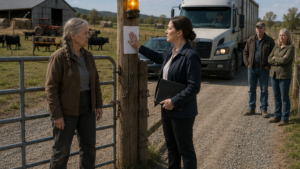
She said it across the counter at the county land-use office before he had fully opened his folder.
Raymond stopped.
Sandra folded her hands.
“They’re inside the surveyed boundary, the setback was checked, and the installation passed inspection. If you came here because somebody told you otherwise, they were wrong.”
“That saves time.”
“It saves one kind of time.”
Raymond looked at her.
Sandra pulled his permit record onto her monitor.
“Why didn’t you report the access dispute when you applied?”
“I reported vehicle damage.”
“You reported damage. You didn’t report an ongoing dispute about claimed access.”
“There is no access.”
“That’s a legal conclusion.”
“It’s my property.”
“That’s also a legal conclusion.”
Raymond stared at her.
Sandra gave him a tired look.
“I’m not arguing with you, Mr. Hall. I’m telling you why everybody is suddenly using different words for the same strip of dirt.”
She printed a parcel map.
The Hall boundary ran cleanly along the hayfield.
No easement crossed it.
No public route.
No county road.
Sandra placed Raymond’s orange permit copy beside the map.
“On paper, your position is strong.”
“On paper?”
“You’re a retired engineer. Don’t pretend you don’t know the difference between what exists and what people get used to.”
Raymond said nothing.
Sandra continued.
“The south drainage project restricted the King approach for heavy equipment. It didn’t close it. It made it inconvenient.”
“So they started cutting across me.”
“Looks that way.”
“And that gives them rights?”
“I didn’t say that.”
“Jonathan did.”
Sandra’s expression changed slightly.
Raymond opened his folder and placed the forwarded email on the counter.
She read the phrase existing access across the Hall property.
Then she sat back.
“You have the full thread?”
“No.”
“I can pull the public portion.”
She searched the district correspondence.
Three minutes later, Raymond was reading messages written during planning for the drainage project.
Most were dull—culvert dimensions, ditch depth, equipment access, temporary closures.
Then Jonathan’s name appeared again.
He had written that the Hall opening had “historically provided customary passage between adjoining agricultural tracts.”
Raymond felt something in his chest tighten.
“He never asked me.”
Sandra looked at him.
“Asked you what?”
“To call it that.”
“He didn’t need permission to write an opinion.”
“He needed permission to use my land.”
“That’s different.”
“To him, apparently not.”
Sandra printed the page.
“You need to be careful here.”
“Why?”
“Because this is starting to look like two arguments stacked on each other.”
“It’s one argument.”
“No. One is whether he had a right to cross. The other is whether you knew he believed he had a right.”
Raymond went still.
Sandra tapped the permit.
“You applied for vehicle-protection posts after repeated crossings.”
“Yes.”
“Did you ever send Jonathan a written notice that you disputed his access claim?”
“No.”
“Certified letter?”
“No.”
“Email?”
“No.”
“Board objection?”
“No.”
Raymond’s irritation returned.
“I told him.”
“When?”
“After the fence was hit.”
“What exactly?”
“I told him to keep his vehicles off my land.”
Sandra nodded.
“That helps.”
“It should end it.”
“It doesn’t.”
Raymond closed the folder harder than necessary.
Sandra looked at him for a long moment.
“Why didn’t you put it in writing?”
“Because a boundary is already in writing.”
The answer came out faster than he intended.
Sandra did not respond immediately.
That silence irritated him more.
“You think I handled it wrong.”
“I think you handled the property part.”
“And the other part?”
“You didn’t handle it.”
Raymond looked toward the window.
Across the parking lot, county trucks sat in neat spaces, each marked by faded white lines.
He thought of the orange tag on his post.
He had liked that tag from the day the inspector bolted it on.
Not because it was bright.
Because it was final.
Measured. Signed. Dated.
No need to argue.
Sandra slid the parcel map toward him.
“You can be right about the boundary and still make the dispute harder.”
Raymond put the map in his folder.
“I didn’t drive through anybody’s fence.”
“No.”
“I didn’t hit those posts.”
“No.”
“I didn’t tell Andrew to cross there.”
Sandra paused.
“I didn’t say you did.”
Raymond looked at her.
She had heard something in his answer that he had not meant to reveal.
He left before she could ask.
The south approach to Jonathan’s place lay a mile down the county road.
Raymond drove there on his way home.
He had not looked closely since the drainage work finished.
The route was narrow but usable.
Fresh stone lined one shoulder. The culvert had been extended. A wide tractor could pass if the driver slowed and lined up properly.
Inconvenient.
Not blocked.
Raymond stood beside his truck and pictured Jonathan choosing between this careful turn and the straight shot through Raymond’s hayfield.
He could understand the temptation.
That annoyed him too.
A pickup approached from Jonathan’s direction.
Andrew was driving.
He slowed when he saw Raymond.
For one second Raymond expected him to continue.
Instead, Andrew pulled onto the shoulder.
His face still showed a faint red mark from the seat belt.
He rolled down the window.
“Mr. Hall.”
Raymond waited.
Andrew looked toward the narrowed approach, then back at him.
“My dad says you’re trying to get him removed from the board.”
“I haven’t asked for that.”
“He says you sent the emails around.”
“I sent nothing around.”
Andrew’s grip tightened on the steering wheel.
“County already had them?”
“Yes.”
The boy nodded as if that confirmed something he did not like.
Raymond said, “You should be resting.”
“I’m fine.”
“You hit steel at forty miles an hour.”
Andrew looked away.
Raymond caught the number only after he said it.
“Was it forty?”
Andrew’s eyes returned to him.
“I don’t know.”
“You just said—”
“I said you hit steel at forty.”
Andrew swallowed.
Raymond waited.
The boy looked down the road toward his house.
Then he said, very quietly, “Can I come talk to you tonight?”
Raymond’s first instinct was refusal.
Nothing involving Jonathan King had improved after private conversation.
“What about?”
Andrew shook his head.
“Not here.”
“Your father know?”
“No.”
That answer changed everything.
Raymond looked at the boy sitting behind the wheel of another pickup, shoulders tight, one hand still locked around the steering wheel.
“When?”
“After supper.”
“Barn.”
Andrew nodded.
Then, before pulling away, he added, “Please don’t call him first.”
Raymond watched the truck turn toward Jonathan’s property.
The county map sat on the passenger seat beside him, showing no easement, no road and no legal shortcut across the Hall farm.
For the first time, Raymond wondered whether the most important thing crossing his land had never been a truck at all.
It might have been an instruction nobody had been willing to admit giving.
Chapter 4: Andrew Finally Said Who Told Him
Andrew arrived after dark without headlights on until he was halfway down Raymond’s gravel drive.
Raymond noticed that first.
The second thing he noticed was that Andrew parked near the equipment shed instead of coming to the house.
The boy climbed out slowly, one hand against his ribs where the seat belt had bruised him. He wore the same gray sweatshirt Raymond had seen at the crash, though the front had been washed clean of mud.
Raymond stood beside the workbench with his chipped mug in one hand.
“You said not to call your father.”
Andrew nodded.
“I didn’t.”
“Thanks.”
Raymond waited.
Andrew looked around the shed as if expecting someone to step from behind the baler.
“No one’s here,” Raymond said.
“I know.”
“Then say what you came to say.”
Andrew rubbed both palms down the front of his jeans.
“My dad told me that way was still open.”
Raymond did not move.
Andrew looked at him quickly, then away.
“He said you couldn’t just close it.”
“When?”
“A bunch of times.”
“That isn’t an answer.”
Andrew swallowed.
“After the drainage work. When the south road got tight.”
Raymond set his mug on the bench.
“What exactly did he tell you?”
Andrew stared at the concrete floor.
“He said people had crossed there forever. Said it was basically an old farm cut-through and you were getting territorial.”
“Basically.”
“That’s what he said.”
“And the first fence?”
Andrew flinched.
“That was me.”
Raymond said nothing.
“I was going too fast.”
“And the second?”
Andrew nodded once.
Raymond felt his jaw tighten.
“The one where the cattle got out?”
“I didn’t know that happened until later.”
“You broke four sections of fence.”
“I know.”
“No. You know now.”
Andrew’s face reddened.
“I said I’m not saying I didn’t do it.”
Raymond looked at him.
The boy was scared, but not of Raymond.
That made the anger harder to hold cleanly.
Andrew continued. “Dad said after the first time that the opening was supposed to stay usable. He said you were trying to make a point.”
“So you made one for me.”
“I was stupid.”
“Yes.”
Andrew accepted it without argument.
Raymond had expected excuses. The lack of them bothered him in a different way.
Andrew took a breath.
“The second time, he told me to use your side because the trailer was parked near our south turn.”
“You were hauling anything?”
“No.”
“Then why not use your own road?”
Andrew looked embarrassed.
“Because it was faster.”
Raymond nodded slowly.
There it was.
No emergency. No necessity. No mistaken turn.
Convenience, backed by a father’s confidence.
“You knew I told your father to stay off my land.”
Andrew hesitated.
“He said you didn’t have the right to block established access.”
“Established by who?”
“I don’t know.”
“You never asked?”
“He’s my dad.”
The words were quiet.
Raymond looked down at the mug.
A small chip was missing from the rim. His wife had wanted him to throw it away years ago. He kept using it because it still held coffee.
Andrew said, “After you put the posts in, he was mad.”
Raymond lifted his eyes.
“What did he say?”
“That you were trying to embarrass him.”
“Why would posts on my land embarrass him?”
Andrew gave him a look that answered before the words did.
“Because of the board.”
Raymond leaned against the bench.
Andrew continued.
“He’d been telling people the route was still usable. Then you put steel there with a county tag on it.”
The orange permit tag flashed in Raymond’s mind.
Bright. Official. Final.
He had liked that.
Too much, maybe.
Andrew shifted his weight and winced.
“Saturday I saw the posts.”
Raymond frowned.
“You saw them?”
“Yeah.”
“Then why did you hit them?”
Andrew’s face changed.
Not guilt now.
Shame.
“I thought you’d left enough room.”
“You accelerated.”
Andrew looked up sharply.
Raymond said, “The deputy measured no skid marks.”
Andrew’s breathing changed.
“My dad said if I slowed down and squeezed through, I’d prove there was still access.”
Raymond stared at him.
Andrew corrected himself immediately.
“He didn’t tell me to hit anything. He didn’t tell me to floor it.”
“What did he tell you?”
“That you couldn’t legally stop us from crossing.”
“And you believed him.”
“Yes.”
“That doesn’t explain the speed.”
Andrew looked toward the open shed door.
“No.”
Raymond waited.
Finally Andrew said, “I was mad.”
“At me?”
“At him. At you. At everything.”
Raymond said nothing.
“My dad had been talking about it for weeks. Every time we drove past, he’d say you’d overstepped. He made it sound like backing down meant admitting you were right.”
“So you decided not to back down.”
Andrew nodded.
“I thought if I got through, he’d stop talking about it.”
Raymond let out a breath through his nose.
For the first time since Saturday, the wreck looked different in his mind.
Not less reckless.
More complicated.
Andrew said, “I’m not asking you to lie for me.”
“Good.”
“I know I caused it.”
“You did.”
“But he knew I was using that way.”
“Yes.”
“And now he’s acting like he didn’t.”
Raymond picked up the mug again.
Andrew watched him.
“You already knew, didn’t you?”
Raymond paused.
“Knew what?”
“That he was telling me to use it.”
Raymond could have denied it.
He had no proof before tonight.
But that was not what Andrew had asked.
Raymond looked toward the dark field.
“I suspected it.”
Andrew’s mouth tightened.
“How long?”
“After the second fence.”
“And you never asked him?”
“No.”
“Why?”
Raymond had an answer ready.
Because Jonathan would have denied it.
Because land records were clearer than arguments.
Because once the county approved the posts, there would be nothing left to debate.
All of those answers were true.
None of them were complete.
“I told him to stay off my land,” Raymond said.
“That’s not what I asked.”
Raymond looked back at the boy.
The sentence sounded exactly like the deputy.
Andrew stepped closer to the bench.
“If you thought my dad was telling me it was okay, why didn’t you confront him before you put steel in the ground?”
Raymond’s fingers closed around the chipped mug.
For once, paperwork offered him no answer.
Chapter 5: Being Right Was Raymond’s Favorite Hiding Place
The notice from the conservation district arrived Wednesday morning with Jonathan King’s name in the first paragraph.
Raymond read it standing at his kitchen counter.
The board would review Jonathan’s participation in discussions involving the Hall property, including whether he had used his position to characterize disputed private access as established agricultural passage.
Raymond read the paragraph twice.
Then he folded the notice and put it beside his coffee.
Winning should have felt cleaner.
Instead, Andrew’s question from the shed stayed with him.
Why didn’t you confront him?
The phone rang before Raymond finished breakfast.
Sandra White.
“The board wants you there tonight.”
“I assumed.”
“They’re also requesting supporting records.”
“I have them.”
“Raymond.”
He waited.
“Andrew spoke to you.”
It was not a question.
“How do you know?”
“I don’t. But Jonathan called this morning asking whether private statements from his son could be admitted.”
Raymond looked toward the kitchen window.
Beyond the yard, the steel posts were visible at the hayfield entrance.
The orange tag caught the light.
“I haven’t submitted anything Andrew told me.”
“Do you intend to?”
Raymond did not answer.
Sandra said, “That’s your decision. But understand something. If Andrew’s statement changes the board’s view of Jonathan’s conduct, they’ll want it.”
“He came to me privately.”
“He’s also part of an active insurance dispute.”
“I know.”
“You can’t pretend that conversation happened outside everything else.”
Raymond rubbed a thumb along the chipped rim of his mug.
“No.”
Sandra softened her voice.
“Just decide what kind of truth you’re bringing into that room.”
The meeting room was half full when Raymond arrived.
That was more people than usual for a conservation-district hearing.
Farmers sat along the back wall. Two county employees occupied one side table. Jonathan sat with the board instead of among the public, though his chair had been moved slightly away from the others.
He looked tired.
Not defeated.
Tired.
When Raymond entered, Jonathan’s eyes went straight to the folder beneath Raymond’s arm.
Raymond sat three rows back.
Sandra took a seat near the county road supervisor.
The chair opened with procedural remarks, then summarized the issue: disputed access, permitted barrier installation, the Saturday collision, and questions regarding Jonathan’s prior board communications.
Jonathan spoke first.
He kept his voice controlled.
“My concern has always been safety.”
Raymond watched him.
“My son made mistakes,” Jonathan continued. “I’m not denying that. But steel barriers at the edge of a route historically used by local farm traffic created an obvious hazard.”
Historically.
Local farm traffic.
The same language as the emails.
Jonathan glanced toward Raymond.
“I believe Mr. Hall used a legal permit to settle a personal argument.”
A murmur moved through the room.
Not agreement exactly.
Recognition.
Raymond felt the old urge rise.
Correct him.
Immediately.
Completely.
The chair asked whether Raymond wished to respond.
“Later.”
Jonathan looked surprised.
The board turned to Sandra.
She explained the permit narrowly. The posts were inside Raymond’s surveyed boundary. The setback had been inspected. No recorded easement crossed the Hall property.
One board member asked, “So the posts were legal.”
Sandra answered, “The installation was compliant.”
Jonathan leaned forward.
“That doesn’t answer whether they were reasonable.”
Sandra looked at him.
“That isn’t what my office approves.”
The small distinction mattered.
Raymond could feel the room shift toward him.
It would have been easy then.
He had repair invoices.
Photographs.
The dead cow.
The public emails.
Andrew’s private admission.
A complete line from injury to blame.
During the break, Sandra approached him near the hallway.
“You can submit supplemental testimony now.”
Raymond opened his folder.
Andrew’s handwritten note was inside.
The boy had returned Tuesday morning and written down what he remembered his father saying about the shortcut. Not because Raymond asked him to. Because Andrew said he did not want the story changed again.
Raymond pulled out the page.
Sandra watched him.
“That would matter,” she said.
“I know.”
“You’re not required to protect him.”
“I’m not protecting Jonathan.”
“I meant Andrew.”
Raymond looked through the meeting-room door.
Jonathan was standing alone beside the board table.
For one instant he did not look like the man yelling beside the wreck.
He looked like a father who had realized a private failure might become public property.
Raymond folded Andrew’s statement and put it back.
“I’m not submitting it.”
Sandra’s eyebrows lifted.
“Why?”
“Because he came to me as a seventeen-year-old trying to tell the truth, not as evidence.”
“The board may still request it later.”
“Then they can ask him.”
Sandra studied him.
“That’s new.”
Raymond almost smiled.
“Don’t make too much of it.”
When the meeting resumed, Jonathan seemed to take Raymond’s restraint for uncertainty.
He leaned harder into the argument.
“I want the record to show that Mr. Hall never formally disputed customary access until after installing the barriers.”
Raymond’s head lifted.
Jonathan continued.
“He never raised it before the district. Never sought mediation. Never objected when drainage planning referenced that passage.”
Sandra looked toward Raymond.
There it was.
The part that hurt because it was true.
Jonathan pressed on.
“He waited. Then he put steel in the ground.”
Raymond stood.
The chair said, “Mr. Hall, you’ll have your turn.”
“I know.”
He remained standing.
Jonathan looked at him.
Raymond held his gaze.
“You think I waited because I didn’t object.”
Jonathan said nothing.
Raymond continued, “I waited because I thought the deed, the fence and the permit would speak clearly enough that I wouldn’t have to.”
The room went quiet.
Jonathan’s expression changed, just slightly.
Raymond reached into his folder and removed the photograph of the orange permit tag.
He placed it on the table.
For weeks, he had treated that bright square as proof that the argument was finished.
Now he saw what it had really done.
It had proved where steel could legally stand.
Nothing more.
Raymond looked at the board.
“You’ve been asking whether those posts were legal.”
The chair nodded cautiously.
Raymond said, “That’s the wrong question.”
Chapter 6: The Board Heard More Than a Property Dispute
“The posts were legal,” Raymond said. “And legality is not the whole story.”
Jonathan shifted in his chair.
Several people in the back stopped whispering.
Raymond remained standing beside the table with the photograph of the orange permit tag in front of him.
“I applied after my fence was hit more than once. I documented the damage. I measured the boundary. I followed the setback. County inspected the installation.”
He looked at Jonathan.
“I did all of that correctly.”
Jonathan’s jaw tightened.
Raymond continued.
“And I did something else badly.”
The chair leaned back.
Raymond heard his own pulse in the silence.
“I knew Jonathan believed that opening was still usable. I knew he was telling people it was established access. After the second fence repair, I suspected he was telling Andrew the same thing.”
Jonathan stared at him.
“You suspected?”
“Yes.”
“And you never said that to me.”
“No.”
Jonathan gave a short, disbelieving laugh.
“So now this is my fault because you guessed what I was thinking?”
Raymond shook his head.
“No. What you told your son is your responsibility. What I chose not to say is mine.”
That stopped him.
Raymond touched the permit photograph.
“I liked this because it was simple. Orange tag. Inspection date. Survey line. I thought once it was bolted there, nobody could argue with me anymore.”
One of the board members asked, “Were the posts intended to stop the King family specifically?”
“They were intended to stop vehicles crossing that entrance without permission.”
“That wasn’t my question.”
Raymond looked at him.
“Yes. Their vehicles were the reason I applied.”
A few heads turned toward Jonathan.
Raymond did not let himself enjoy it.
“I could have told Jonathan that directly. I could have objected to his language in the drainage emails. I could have asked the board to correct the record months ago.”
Jonathan said, “But you didn’t.”
“No.”
“Because you wanted this.”
Jonathan tapped the permit photograph.
“You wanted the county to settle it for you.”
Raymond met his eyes.
“Yes.”
The admission changed the room more than any accusation had.
Jonathan looked almost startled.
Raymond continued before he could respond.
“But that doesn’t make your description of my property true.”
He opened his folder and removed the public email thread.
“You called my opening ‘existing access.’ You called it ‘customary passage.’ You did that while sitting on this board.”
Jonathan glanced at the chair.
“The south approach had become impractical.”
“Impractical isn’t closed.”
“It wasn’t safe for some equipment.”
“Andrew wasn’t hauling equipment Saturday.”
Jonathan’s face hardened.
Raymond went on.
“You knew I had objected after the fence damage.”
“I knew you were angry.”
“I told you to keep vehicles off my land.”
“You said it after a teenager made a mistake.”
“Twice?”
Jonathan looked down.
The room stayed silent.
Raymond did not mention Andrew’s private statement.
He did not need to.
Not yet.
The county road supervisor confirmed that the south route had remained open throughout the drainage project, though larger equipment needed a slower approach.
Sandra confirmed again that no easement crossed Raymond’s parcel.
The board chair turned to Jonathan.
“Did you know the Hall route lacked recorded access?”
Jonathan answered carefully.
“I knew there was no recorded easement.”
“Then why did you describe it as existing agricultural access?”
“Because it had been used.”
“By whom?”
Jonathan hesitated.
“Us.”
The word landed harder than Raymond expected.
Not farmers.
Not neighbors.
Us.
A board member asked, “Did Mr. Hall give permission?”
“No.”
“Did you believe continued use would establish a right?”
Jonathan rubbed one hand across his forehead.
“I believed the history mattered.”
“That wasn’t the question.”
Jonathan looked toward Raymond.
For the first time, Raymond saw the fear beneath the anger clearly.
Not fear of losing a board seat.
Fear that the story would narrow until only Andrew remained inside it.
Jonathan said, “I thought Raymond was overreacting.”
“That still isn’t the question.”
Jonathan’s shoulders dropped.
“No. He didn’t give permission.”
The chair nodded and made a note.
Then came the question Raymond had expected.
“Was your son instructed to continue using that passage?”
Jonathan went still.
Raymond looked at the tabletop.
He would not rescue him.
He would not expose Andrew for him either.
Jonathan said, “Andrew knew I believed the route should remain open.”
The chair asked, “Did you tell him Mr. Hall could not legally block it?”
Jonathan did not answer.
A board member looked toward Raymond.
“Mr. Hall, do you have evidence relevant to that?”
Raymond felt Andrew’s handwritten page inside the folder.
He could produce it.
One movement.
One sheet of paper.
The cleanest kind of victory.
Raymond closed the folder.
“I have a private conversation with a minor,” he said. “If the board needs Andrew’s testimony, ask Andrew.”
Jonathan looked at him sharply.
The chair said, “You’re declining to submit it?”
“I’m declining to use him to finish an argument between two grown men.”
No one spoke for several seconds.
Raymond felt no triumph.
Only the strange relief of not doing the easiest thing.
Jonathan leaned back.
His eyes stayed on Raymond.
The board moved to procedural questions about conflict of interest, recusal and whether Jonathan had improperly used board communications to strengthen a private access claim.
The language became dry.
But the pressure did not.
Jonathan answered each question more slowly than the last.
Finally the chair asked whether he wanted a recess before responding to the remaining issue.
Jonathan looked toward the back of the room.
Andrew stood in the doorway.
Raymond had not heard him enter.
The boy’s arms were folded tight across his chest.
Jonathan saw him.
Something in his face gave way.
Not dramatically.
Just enough.
“Pause the meeting,” Jonathan said.
The chair looked at him.
Jonathan swallowed.
“Please.”
The room waited.
Jonathan turned toward Andrew once, then back to the board.
“My son didn’t invent that shortcut.”
No one moved.
Jonathan’s voice dropped.
“I told him it was still a way through.”
The story, at last, had stopped fitting inside the wreck.
Chapter 7: The Claim Failed, but the Boundary Remained
The wrecked pickup left the repair yard on the back of a flatbed two weeks after the crash.
Raymond saw it by chance.
He had stopped at the farm-supply store for fencing staples when the truck rolled past on the county road, its ruined front end covered by a gray tarp that snapped in the wind.
For a moment he stood beside his own pickup and watched until the flatbed disappeared behind the grain elevator.
Then his phone rang.
The insurance adjuster introduced herself and asked whether Raymond had a few minutes.
“I do.”
“We’ve completed our liability review regarding the King vehicle.”
Raymond leaned against the tailgate.
“And?”
“We are not pursuing recovery against you for the collision.”
He looked across the parking lot at stacked feed bags behind the store window.
The sentence was smaller than he had expected.
No vindication in it.
No apology.
Just a decision.
“What about the posts?”
“The installation was permitted and inspected. We also reviewed the prior property incidents and the circumstances of access.”
Raymond said nothing.
The adjuster continued.
“I can’t discuss the King family’s coverage determination in detail. But the evidence does not support assigning liability to you for maintaining the barrier.”
“Understood.”
“There may still be separate questions regarding future safety improvements.”
That caught him.
“What questions?”
“Emergency access. Visibility. Agricultural equipment clearance. Nothing that changes the determination.”
Raymond looked toward the road where the flatbed had vanished.
“All right.”
When the call ended, he remained against the truck for another minute.
He had expected relief.
What came instead was quiet.
By that afternoon, word had already reached people Raymond had not told.
A neighbor at the fuel pump gave him a nod and said, “Heard insurance dropped it.”
Raymond answered, “They made their decision.”
The neighbor waited for more.
Raymond gave him none.
Jonathan had stopped attending conservation-district meetings.
Not resigned, exactly.
The board notice said he had voluntarily stepped back while the review continued.
Raymond learned that from Sandra when she came to inspect the hayfield entrance again.
She walked around the steel posts with a measuring wheel.
The orange tag remained fixed to the first one, though the sun had dulled it from bright orange to something closer to pumpkin skin.
“You could leave all of this exactly as it is,” Sandra said.
Raymond stood beside her.
“But?”
“But I wouldn’t.”
He almost smiled.
“You always have a second sentence.”
“It’s my most useful skill.”
She measured between the first and second posts.
“The installation is compliant. But an ambulance or fire unit coming from this side would have a tight approach if the county road were blocked farther east.”
“There’s another gate.”
“Half a mile down.”
“For my equipment.”
“Emergency crews won’t know that.”
Raymond stared at the opening.
Six weeks earlier, every inch had seemed necessary.
The posts had stopped what the fence could not.
Now he saw something else.
Not a trap.
Not exactly.
But a boundary designed by a man who had wanted no ambiguity left.
Sandra said, “You could move the outside post three feet and still prevent a vehicle from driving straight through.”
“That leaves more room.”
“Yes.”
“For someone to cut across.”
“If they deliberately turn around the remaining posts.”
Raymond looked at her.
“Then they’d know they were trespassing.”
“That would certainly make the argument simpler.”
He laughed once.
It surprised both of them.
Sandra rolled up the site sketch.
“You don’t have to change anything.”
“I heard you.”
“I mean it. You won.”
Raymond looked at the orange tag.
“No.”
Sandra waited.
“The permit held. The claim failed. That’s not the same thing.”
She nodded slightly.
Two days later, a contractor arrived with a compact auger and lifting chain.
Raymond had marked the new location himself.
Jonathan’s property lay visible across the adjoining field.
No one came over.
The contractor wrapped the chain around the outside steel post.
“You sure you want this one moved?”
“Yes.”
“Could pull all three while I’m here.”
“No.”
The machine groaned.
Concrete cracked beneath the soil.
The post lifted slowly, carrying a thick gray footing with it.
Raymond watched the empty hole appear.
For the first time since the installation, the entrance looked wider.
Not open.
Wider.
The contractor reset the post three feet farther out and packed the surrounding soil.
When he finished, Raymond drove his hay wagon through the entrance.
There was room now to make the turn without brushing the posts.
A fire truck could do it.
So could an ambulance.
A pickup trying to use the opening as a shortcut still could not drive straight through.
Raymond stopped the tractor on the other side and looked back.
Three posts remained.
The orange county tag stayed bolted to the original one.
Nothing about the boundary had disappeared.
Only the assumption that the safest answer was always the hardest one.
Across the field, Jonathan’s truck slowed on the county road.
Raymond saw him looking toward the widened entrance.
Jonathan did not stop.
Neither did Raymond raise a hand.
Not yet.
Chapter 8: One Post Moved, and the Rest Stayed
Andrew was replacing the final damaged fence board when Raymond found him.
The boy had parked beside the road and carried the new cedar plank in by hand.
A hammer lay in the grass.
For a moment Raymond simply watched.
Andrew had grown cautious around the boundary.
He never stepped through the widened entrance without looking toward the farmhouse first, even though Raymond had told him he could come repair the fence whenever he had time.
“You’re setting that one low,” Raymond said.
Andrew looked over his shoulder.
“I measured off the old board.”
“The old board sagged.”
Andrew frowned at it.
Raymond walked closer and lifted one end.
“Half inch.”
Andrew moved it.
“Like that?”
“Better.”
They drove the first nail together only because Andrew had trouble holding the board level and swinging the hammer at the same time.
After that, Raymond stepped back.
Andrew worked quietly.
The restitution agreement had been simple.
No court order.
No public punishment.
Andrew would cover part of the earlier fence repairs from his summer earnings and help replace what he had damaged.
Jonathan had agreed.
Raymond had not expected that part.
Andrew set the last nail and ran his palm across the board.
“That it?”
“That’s it.”
He picked up the old splintered section lying in the grass.
“Want me to haul this?”
“Leave it by the barn.”
Andrew nodded.
Then the sound of another pickup came from the road.
Both men looked up.
Jonathan turned into the entrance.
He slowed noticeably around the posts.
Raymond noticed that too.
Jonathan parked on the gravel and got out.
He looked older than he had at the meeting.
Not by years.
By several bad weeks.
Andrew straightened.
“I told you I’d be done before dinner.”
“I know.”
Jonathan looked at the repaired fence.
“Looks good.”
Andrew shrugged.
“Raymond fixed the height.”
Jonathan glanced at Raymond.
Neither man corrected the use of his first name.
Jonathan walked toward the entrance and stopped beside the steel posts.
His eyes settled on the gap where one had been moved.
“I saw the county crew out here.”
“Contractor,” Raymond said.
“You moved one.”
“Yes.”
Jonathan looked through the widened opening.
“Emergency access?”
“Among other things.”
Jonathan nodded.
He touched nothing.
The orange tag on the nearest post had faded further with the late-summer sun. Mud had dried around the lower bolt.
Jonathan looked at it for several seconds.
“I’m not asking you to take the rest out.”
Raymond had not realized he was waiting to hear that until the words came.
“Good.”
Jonathan gave him a tired half-smile.
“That sounded like you.”
“I’m working on it.”
Andrew looked between them.
Jonathan turned toward his son.
“Go put the tools in your truck.”
Andrew hesitated, then gathered the hammer and scrap wood.
When he was out of earshot, Jonathan said, “I stepped down from the board.”
Raymond looked at him.
“Completely?”
“Yes.”
“I heard you were only taking leave.”
“I changed my mind.”
Raymond waited.
Jonathan shoved both hands into his pockets.
“I kept thinking if I could make the road official enough, then I wouldn’t have to admit I was using something that wasn’t mine.”
Raymond glanced toward the posts.
“I know the feeling.”
Jonathan followed his eyes.
For a second, neither man spoke.
Then Jonathan said, “Andrew was wrong to drive through here.”
“Yes.”
“I was wrong to tell him you couldn’t stop us.”
“Yes.”
Jonathan’s expression tightened.
“You going to make me say every part?”
“No.”
“That’s new too.”
Raymond almost smiled.
Jonathan looked toward the repaired fence.
“I was scared after the wreck.”
“I know.”
“When I saw the truck against those posts, I didn’t care why they were there.”
Raymond nodded.
“If it were my boy, maybe I wouldn’t have either.”
Jonathan looked at him sharply.
It was the closest either man had come to offering the other an excuse.
Raymond did not add to it.
Jonathan said, “Still think steel was too much.”
“Still think your shortcut was too much.”
“Fair.”
That word sat between them.
Not forgiveness.
Not agreement.
Something usable.
Andrew returned carrying the broken fence board.
Jonathan took one end without being asked.
Together they started toward the trucks.
Andrew stopped beside the widened entrance.
“You can actually get an ambulance through now.”
“That’s the idea,” Raymond said.
Andrew looked at the remaining posts.
“But not me.”
“Also the idea.”
Andrew laughed once.
Jonathan shook his head.
The sound faded quickly, but it changed the air.
They carried the damaged board to Raymond’s barn and set it against the wall.
Jonathan did not stay for coffee.
Raymond did not invite him.
That would have been too much too soon.
At the road, Jonathan raised one hand before getting into his truck.
This time Raymond returned the gesture.
Early autumn came quietly.
The hayfield turned pale at the edges.
The new fence board weathered toward the color of the old ones.
Grass grew around the concrete footing where the outside post had been moved.
The orange tag faded until its corners nearly matched the rust-colored leaves collecting along the ditch.
Raymond still checked it sometimes when he passed.
Not because he needed proof anymore.
The boundary was recorded.
The posts were permitted.
The insurance matter was closed.
Those things remained true.
But now when Raymond looked at the entrance, he saw the space between the posts as clearly as the steel itself.
One opening widened enough for help to come through.
Three posts still standing where a fence alone had failed.
Neither surrender nor punishment.
Just a boundary that finally said what Raymond should have said much earlier:
You may not cross here simply because it is easier.
And if there is a real need, there is still a way through.
The story has ended.