The Girl in the Booth
Part I — Blood on the Vinyl
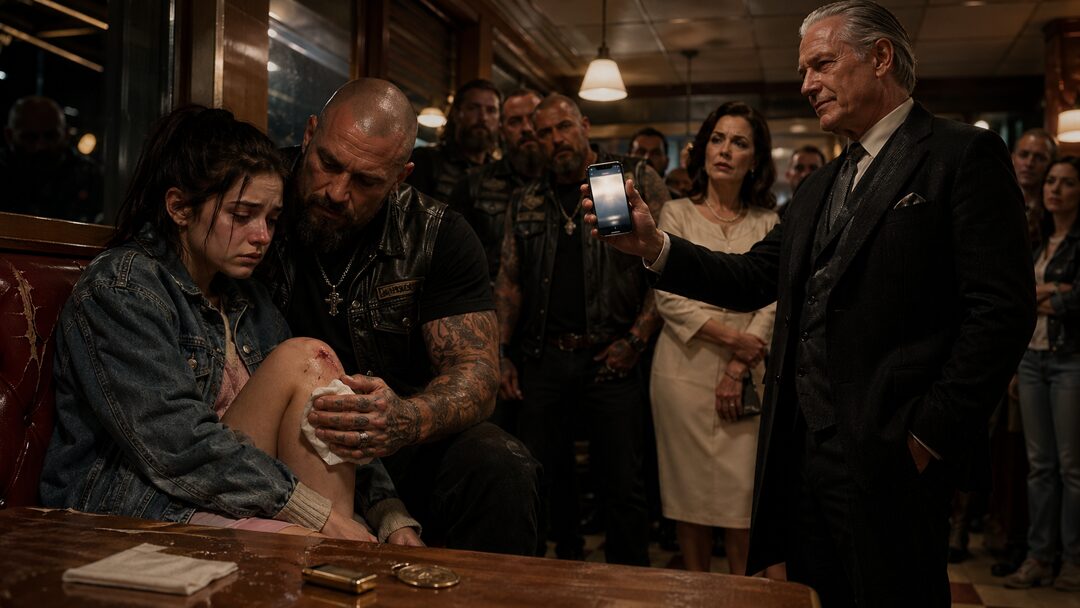
The first thing everyone saw was the biker’s hand on the girl’s bare knee.
Not the blood.
Not the way she sat folded into the corner of the cracked red booth, one sneaker on the seat, one foot barely touching the floor.
Not the way she kept staring at the table like if she looked up, the whole diner might turn into the place she had run from.
They saw Rafe Calder kneeling beside her.
Huge shoulders. Shaved head. Tattooed hands. Black leather vest with a faded club patch across the back. A face built like it had learned early not to ask for kindness.
Three more bikers stood behind him near the aisle, silent as a locked door.
The waitress at the Silver Spur Diner stopped refilling coffee.
Two truckers at the counter stopped chewing.
Outside, the neon sign buzzed against the desert dark: SILVER SPUR — OPEN 24 HOURS.
Rafe laid a gold lighter on the table. Then a dented round medallion, the kind his club wore on chains under their shirts. The metal clicked against the Formica.
Lena Vale flinched at the sound.
Rafe noticed. He noticed everything. But he only dipped a napkin into a glass of ice water and wrung it once over the saucer.
“Hold still,” he said.
His voice was low enough that it should have scared her.
It didn’t.
Lena’s scraped knee pulsed red under the diner lights. Blood had dried in a thin line down her shin, past the hem of her pink shorts. Her denim jacket hung wrong on her shoulders, one sleeve half-slipped, the way things looked after someone had grabbed you and you had pulled away too hard.
Rafe touched the napkin to the scrape.
Lena sucked in air through her teeth.
“Sorry,” he said.
That single word moved through the diner strangely. People expected men like Rafe Calder to say things like move or shut up or you should’ve known better.
They did not expect him to apologize to a sixteen-year-old girl with mascara under her eyes.
The bell above the diner door jingled when the wind pushed at it.
Lena jerked so hard her knee hit the table.
Rafe’s free hand caught the edge of her sneaker before she slipped. His grip was careful, almost too careful for hands that looked made to break things.
Headlights swept across the front windows.
Lena turned white.
“Please,” she whispered.
Rafe looked up.
She had not said his name. She had not needed to.
“Please don’t let her take me back.”
The waitress looked toward the door.
The bikers behind Rafe shifted without speaking.
Rafe did not ask who. He lowered the cold napkin to Lena’s knee again.
“I won’t make that choice for you,” he said.
Lena’s mouth trembled.
“That’s not what I asked.”
His face hardened, but not at her.
“No,” he said. “It isn’t.”
Twenty minutes earlier, Lena had been standing under chandeliers at the High Ridge Country Club while her mother smiled for donors with a diamond on her finger.
Marissa Vale had looked perfect in ivory satin and pearl earrings, every hair pinned into place. She stood beside Grant Whitaker, the developer who owned half the new construction outside town and wanted the other half by summer.
“My daughter has struggled since her father died,” Marissa had told a circle of guests, her hand resting lightly on Lena’s shoulder like a warning. “We’re getting her the structure she needs.”
Lena had felt the word structure enter her body like a locked door.
Then Grant’s son had laughed.
“Boarding program sounds nicer than brat camp,” he said, loud enough for the caterers to hear.
Lena had tried to pull away from her mother. Marissa’s fingers tightened around her wrist.
“Don’t make a scene,” Marissa whispered.
But Lena was already inside one.
Someone lifted a phone.
Grant smiled as if the room belonged to him.
Lena backed into a tray table. Glass shattered. Her heel slid. Her knee struck the edge of a broken serving plate.
She waited for her mother to kneel.
Marissa did not.
She only looked at the blood, then at the staring guests, and said, “Lena.”
Not with fear.
With warning.
So Lena ran.
Across the lawn. Past the valet stand. Down the side road in party shoes that blistered her heels.
A mile later, a motorcycle slowed beside her.
She almost hid in the ditch before she saw Rafe Calder’s face.
Her mother had used his name like a curse for years.
Stay away from Calder’s garage.
Stay away from men like that.
Rafe Calder ruins what he touches.
But he had not touched her until she nodded.
He had only looked at her bleeding knee and said, “Diner’s closer than the hospital. You can tell me no.”
She had not told him no.
Now, in the Silver Spur, headlights stopped outside.
The engine cut.
Lena stared at the door as if it had teeth.
Rafe lifted the napkin from her knee.
“Breathe,” he said.
The bell jingled.
Marissa Vale stepped into the diner in her ivory engagement dress, pearls glowing at her throat, perfect hair beginning to come loose near one ear.
Behind her came Grant Whitaker in a dark tailored coat, silver watch catching the light.
They looked like they had arrived from another world.
Or like the other world had come to collect her.
Part II — Don’t Make a Scene
Marissa found Lena instantly.
For one second, her face broke.
Not enough for anyone else to notice. Just enough for Lena to hate that she still wanted to run into her arms.
Then Marissa saw Rafe kneeling beside the booth.
Her expression closed.
“Get away from my daughter.”
Rafe stood slowly.
He was taller than Grant by three inches and wider by a lifetime. The bikers behind him stayed still, but the room tightened around their silence.
Grant lifted both hands, calm as a man entering a meeting he had already won.
“Let’s not make this uglier than it needs to be.”
Rafe did not look at him.
Marissa moved toward the booth. “Lena, get up.”
Lena’s fingers dug into the vinyl seat.
“She’s bleeding,” Rafe said.
“She fell.” Marissa’s voice was controlled. “Because she ran.”
“Funny thing about blood,” Rafe said. “It usually starts before the running.”
Grant’s mouth curved.
“Mr. Calder, is it?”
The mister sounded like an insult wearing church clothes.
Rafe finally looked at him.
Grant kept smiling. “I appreciate that you thought you were helping. But this is a family matter.”
Lena watched her mother’s face when he said family. Marissa did not look at her. She looked at the waitress. The truckers. The bikers. Everyone who could become a witness.
“My daughter is very emotional tonight,” Marissa said. “She misread a private conversation and embarrassed herself.”
Lena felt the old familiar collapse begin under her ribs.
Embarrassed herself.
Not was humiliated.
Not was hurt.
Not I should have helped her up.
Rafe’s jaw shifted.
Marissa kept going. “She has always been easily influenced. She mistakes attention for love.”
The words landed soft, which made them worse.
Grant stepped closer. “And I’m sure you can understand why it concerns us to find a minor in a diner with—”
He glanced at the bikers.
“With men she doesn’t know.”
One of Rafe’s brothers gave a low laugh.
Rafe silenced him with a look.
Then he turned to Lena.
“Do you want to leave with them?”
The diner seemed to hold its breath.
It should have been an easy question.
She was sixteen. Marissa was her mother. Grant was the man who would soon own the house, the driveway, the breakfast room with her father’s old books boxed in the garage.
Lena opened her mouth.
Nothing came out.
Marissa’s face flushed as if Lena had slapped her.
“Answer me,” Marissa said.
“She’s not your dog,” Rafe said.
Marissa’s eyes snapped to him. “You don’t get to speak to me about my child.”
“No,” Rafe said. “I’m speaking to her.”
The waitress came over because people in diners always came over when things were about to become impossible.
“Can I get anyone anything?”
No one answered.
Then Marissa sat.
She slid into the booth opposite Lena as if they were simply having a late supper. She smoothed her dress over her knees. Her diamond flashed under the light.
“Coffee,” she said. “And toast.”
The waitress blinked.
Marissa added, “For my daughter.”
Lena hated that the word daughter still hurt in the right places.
Grant remained standing behind Marissa, one hand on the booth, a picture of patient concern.
Rafe did not sit. He stayed beside Lena, the wet napkin still in his hand.
Marissa looked at it.
“That’s filthy.”
“It was clean before the blood,” Rafe said.
“You always were dramatic.”
The sentence slipped out too quickly.
Lena looked up.
Rafe did not react, but something moved in his face.
Grant saw it. Of course he saw it.
“You two know each other,” he said.
Marissa’s mouth tightened.
“In this town, everyone knows everyone.”
“No,” Lena said.
It was the first word she had spoken since her mother entered.
All eyes went to her.
She looked from Marissa to Rafe. “You know him.”
Marissa’s hand closed around her coffee spoon.
Rafe put the napkin down.
Grant’s smile thinned. “Your mother had a life before your father, Lena. We don’t need to drag every bad decision into public.”
Rafe took one step forward.
The bikers behind him shifted.
Lena looked at his hands.
They were empty. But they did not look harmless.
Grant noticed too, and his smile sharpened.
“There it is,” he said softly. “People like you always mistake intimidation for virtue.”
Rafe’s voice was flat. “Step back from the booth.”
“I’m standing near my fiancée.”
“You’re standing over a scared kid.”
Grant leaned slightly toward Lena. “Is that what he told you you are? Scared?”
Lena could feel her mother watching her now, not with comfort, but with calculation.
Marissa said, “Rafe helped because he saw a chance to hurt Grant.”
Lena turned to Rafe.
She wanted him to deny it.
She wanted him to look at her the way he had on the roadside, when he had stayed five feet away and asked permission to help. She wanted him to say, No, kid, this is only about you.
But Rafe’s eyes stayed on Grant.
“Your fiancé has been trying to buy the land under my garage for six months,” he said.
Lena’s stomach dropped.
Grant gave a small, polished shrug. “Commercial development is not personal.”
“It is when you send inspectors every Friday.”
“It becomes personal,” Grant said, “when a grown man decides to play rescuer for a broken girl.”
The words changed the room.
Rafe moved before anyone could stop him.
Not far. Just one step.
But one step from Rafe Calder felt like thunder deciding where to land.
Lena reached out without thinking and grabbed his wrist.
His skin was warm. Hard. Still.
He looked down at her hand.
For the first time since Marissa walked in, he seemed to remember she was the one bleeding.
“Don’t,” Lena whispered.
Rafe breathed once through his nose.
Then he stepped back.
Grant watched it happen with satisfaction he could barely hide.
Marissa saw it too.
And for the first time that night, Lena understood something that frightened her more than Rafe’s anger.
Grant had wanted him to move.
Part III — The Man Her Mother Warned Her About
Rafe took Lena to the back hallway near the payphone because she said she was going to be sick.
No one stopped them.
Maybe because Rafe’s brothers blocked the aisle.
Maybe because Grant wanted the room to think he was reasonable.
Maybe because Marissa could not decide whether following would make her look more like a mother or less like one.
The hallway smelled of fryer oil, lemon cleaner, and old cigarette smoke trapped in the walls from a decade when people still pretended poison was atmosphere.
Lena leaned against the payphone shelf and took one shaking breath.
Rafe stood three feet away.
“You can sit,” he said.
“If I sit, I don’t think I’ll get up.”
“Then don’t sit.”
She almost laughed. It came out broken.
He crouched again, but slower this time, making himself smaller. “Put weight on it little by little. Pain lies when you rush it.”
She looked at him.
“That sounds like something from a fortune cookie.”
“Probably stole it from one.”
His face did not change, but the corner of his mouth almost did.
Lena looked back toward the diner.
Marissa’s ivory dress was visible through the gap, a pale shape in the booth. Grant stood beside her, speaking quietly, his head bent like a priest taking confession.
“Why did she hate you?” Lena asked.
Rafe’s gaze dropped to the floor.
“She didn’t always.”
The answer was too short and too full.
Lena swallowed. “She said you were dangerous.”
“I am.”
The honesty startled her.
Rafe looked up. “Not to you.”
“That’s not the same thing.”
“No,” he said. “It isn’t.”
For a moment, the only sound was the hum of the soda cooler.
Lena pressed her palm to her stomach. “Did you help me because of her?”
Rafe’s eyes went colder, but not cruel.
“I helped because you were bleeding.”
“That’s not all.”
He said nothing.
People always thought silence was empty. Lena knew better. Silence could be a locked cabinet. A held breath. A trapdoor.
“She said you ruin what you touch,” Lena said.
Rafe’s jaw tightened. “Your mother left town with a man who had a college ring and a future. I stayed with a garage and a record.”
“My dad?”
Rafe nodded once.
Lena had loved her father in fragments. A hand on top of her head. A green tackle box. The smell of sawdust from shelves he never finished. He had died when she was nine, and Marissa had spent seven years turning grief into furniture no one was allowed to sit on.
“She chose him,” Lena said.
“She chose a life where no one could call her trash.”
The word sounded wrong in his mouth. Like he had heard it too many times and never believed anyone escaped it.
Lena looked down at her knee.
“She chose Grant too.”
Rafe did not answer.
From the dining room, Marissa’s voice rose just enough to carry.
“The program specializes in girls like Lena. It isn’t punishment.”
Lena’s head snapped up.
Rafe was already moving.
When they returned, Marissa had a folder on the table.
Not a thick folder. Just a clean cream-colored one, the kind used for contracts and donor packets and decisions made before the person affected knew they had been discussed.
Lena stared at it.
“What is that?”
Marissa placed her hand on top of the folder.
“Something we were going to talk about after the wedding.”
The diner shrank around Lena.
Grant’s voice stayed gentle. “It’s a six-month residential behavioral program. Excellent staff. Very discreet.”
“Discreet,” Lena repeated.
Marissa looked pained. “You need help.”
“I needed help when I was on the floor.”
Marissa flinched.
Grant did not.
“That is exactly the kind of distorted thinking the program addresses,” he said.
Rafe’s hand hit the table.
Not hard enough to break it.
Hard enough to make every cup jump.
Grant looked delighted.
Marissa stood. “Rafe.”
The way she said his name made Lena look at both of them again.
There it was. Something old. Something unfinished. Something that had nothing to do with her and somehow had landed on her life.
Lena stared at her mother.
“You signed it already.”
Marissa’s silence answered.
The floor seemed to tilt.
“You were going to send me away after you married him.”
“No,” Marissa said quickly. “We were going to get you support.”
“You were going to remove me.”
Marissa’s eyes shone now, but tears did not soften her. They made her more desperate.
“You don’t understand what it takes to keep a life from falling apart.”
Lena laughed once. It sounded ugly.
“I’m the thing falling apart?”
“You are my child,” Marissa said.
“Then why does it feel like you’re trying to survive me?”
No one moved.
Rafe’s medallion sat on the table between the salt shaker and the cooling toast. The gold lighter beside it reflected the overhead lamp like a small controlled fire.
Lena looked at those objects because she could not look at her mother.
Grant reached into his coat pocket.
“I hate to do this,” he said.
Rafe’s eyes sharpened.
“No, you don’t,” he said.
Grant took out his phone.
Part IV — The Cropped Truth
The video was only twelve seconds long.
That was all it took to ruin someone if the right man held the phone.
Grant turned the screen toward the table.
In the clip, Lena stood under the country club chandeliers with her face twisted in anger. Marissa reached for her. Lena jerked back. The angle made it look like Lena shoved her mother.
Then Lena fell.
The video ended before the blood.
Before the broken plate.
Before Marissa’s face when she saw people watching.
Grant lowered the phone.
“I haven’t sent it to anyone,” he said. “Yet.”
Lena felt her throat close.
Marissa looked at the phone, then away.
That was the betrayal.
Not the video. Not even Grant having it.
Her mother had known.
Marissa had let him hold the knife and call it concern.
Rafe’s chair scraped back.
The room changed instantly. The bikers moved. The truckers turned. The waitress froze with a coffee pot in one hand.
Grant did not step back.
He wanted the blow.
Lena saw it with terrifying clarity.
If Rafe hit him, the story became simple. Violent biker. Troubled girl. Frightened mother. Respectable man trying to help.
Rafe’s hand curled.
Lena stood too fast. Pain shot up her leg, white and hot, but she caught his wrist again.
This time, she held on with both hands.
“Don’t give him the ending he wants,” she whispered.
Rafe looked at Grant.
Then at Marissa.
Then at Lena.
His fist opened.
Grant’s smile faded by a fraction.
It was the first thing Lena had seen him lose all night.
Marissa rose abruptly. “Lena. Outside. Now.”
“No.”
The word surprised them all.
It surprised Lena most.
Marissa stared at her as if a chair had spoken.
Rafe did not smile.
But his shoulders lowered.
Marissa grabbed Lena’s cardigan and pulled her toward the hallway, away from the front windows, away from Grant, away from the eyes. For a second Lena almost let her. That was the awful thing about mothers. Even when their hands hurt, some part of you still believed they knew the way home.
In the back hallway, Marissa turned on her.
“You think this is strength?” she whispered. “Standing beside him?”
“I think it’s better than standing beside Grant.”
Marissa’s face crumpled, then rebuilt itself.
“You don’t know what Grant can do.”
“I know what you let him do.”
Marissa’s voice dropped. “He can ruin us.”
“There is no us if I’m the price.”
Marissa looked toward the dining room. Her hands trembled now. Not performative. Not polished. Real fear.
“You think dignity pays the mortgage? You think love keeps people from laughing when you can’t afford the room they invited you into?”
Lena said nothing.
Marissa stepped closer. “After your father died, people brought casseroles for two weeks and then looked at me like I was a bill they hoped someone else would pay. Grant gave us stability.”
“He gave you a way to explain me.”
“Lena—”
“You called me unstable in front of strangers.”
“I was trying to protect you.”
“No. You were trying to make my pain sound managed.”
Marissa’s eyes filled.
For one fragile moment, she looked like the mother who used to sit on the bathroom floor during Lena’s panic attacks, counting breaths with her in the dark.
Then she said, “Come home. Apologize tonight. Go to the program for six months. After the wedding, we’ll fix everything quietly.”
Quietly.
The word landed like a locked room.
Lena stared at her.
Marissa reached for the napkin in Lena’s hand—the same one Rafe had used, pinked with diluted blood. She dabbed at Lena’s knee.
Not gently.
Carefully.
Like removing a stain before it set.
“You can’t go back out there looking like this,” Marissa said.
And that decided it.
Not the folder.
Not the video.
Not even Grant.
That.
Lena pulled the napkin away.
“I’m done being cleaned up for people who made the mess.”
Marissa went still.
Behind them, the bell over the diner door jingled again.
Once.
Then again.
Voices entered with the cold.
Grant had brought witnesses.
Part V — The First Ten Seconds
The Silver Spur Diner stopped being a diner.
It became a smaller, meaner country club.
Three couples from the engagement party stepped in, wrapped in coats over cocktail clothes. Grant’s son came with them, hair perfect, expression bored and hungry. One of Marissa’s charity-board friends stood near the pie case with her phone already in her hand.
The waitress looked like she wanted to tell them all to leave.
She didn’t.
Money trained whole rooms into silence.
Grant stood in the middle aisle, calm and regretful.
“I’m sorry everyone had to come down here,” he said, as if they were guests at a difficult but necessary meeting. “Lena is upset. We’re trying to avoid involving law enforcement.”
Rafe’s brothers formed a loose line behind him.
Rafe stayed by the booth.
Not in front of Lena.
Beside her.
That mattered.
Marissa emerged from the hallway first. Lena followed, limping.
People looked at her knee. Her smudged eyes. Her cheap pink shorts under the party cardigan.
Lena saw the story write itself across their faces.
Poor Marissa.
Troubled girl.
Such a shame.
Grant lifted his phone.
“I think it’s best if everyone understands what happened before rumors start.”
Rafe’s voice cut through the room. “You play that, you better play all of it.”
Grant smiled. “I intend to play the relevant part.”
He tapped the screen.
Lena watched herself appear under chandeliers.
Watched her face, angry and humiliated.
Watched the cropped moment where her body looked like violence instead of escape.
A murmur moved through the room.
Grant’s son smirked.
Marissa stood beside Grant, pale as paper.
Rafe’s hand flexed at his side.
But he did not move.
He looked at Lena.
Not like she was breakable.
Like she was the only one who could decide what happened next.
Lena’s leg shook.
She put weight on the scraped knee anyway.
“Play the first ten seconds before that,” she said.
Grant lowered the phone. “Lena, don’t make this worse.”
The phrase almost made her laugh.
Almost.
“Play it.”
“There’s nothing helpful there.”
“Then it won’t hurt you.”
The diner went quiet in a new way.
Grant’s eyes cooled.
Marissa whispered, “Lena.”
Lena did not look at her.
“One of the servers sent me the full video,” Lena said. “Right after I ran. She said she was tired of watching rich people edit the truth.”
Grant’s son stopped smiling.
Grant’s hand closed around the phone.
Lena took out her own.
Her fingers shook so badly she nearly dropped it. Rafe moved half an inch, then stopped himself. He let her hold it.
That mattered too.
She opened the message.
The full clip filled the little screen.
This time, it began earlier.
Grant’s son leaned close to Lena, champagne-colored light on his face.
“Boarding program sounds nicer than brat camp,” he said.
A few guests laughed.
Marissa’s fingers tightened around Lena’s wrist.
Lena tried to pull away.
Grant stood in the background, smiling.
Not confused.
Not concerned.
Smiling.
Then Lena backed into the tray table. Glass broke. She fell hard. Her knee struck the broken plate.
The room heard the sound she had made.
Small.
Surprised.
Ashamed before anyone even blamed her.
Then Marissa’s voice came through the phone.
“Don’t make a scene.”
The video ended.
No one spoke.
Respectability did not shatter loudly. It cracked in tiny places first. Averted eyes. A hand lowered from a phone. A woman near the pie case looking at Marissa instead of Lena.
Grant recovered first.
Men like him always did.
“This is exactly what I mean,” he said. “Selective context. Emotional manipulation. She is unwell, and Mr. Calder is encouraging—”
“Stop,” Marissa said.
Everyone turned.
It was one word. Too late. Too small.
But it was the first word all night that cost her something.
Grant stared at her.
Marissa’s lips parted. Nothing else came.
Lena looked at her mother and felt the last soft childish hope in her fold itself away.
“You didn’t lose me tonight,” Lena said.
Her voice was quiet enough that the room leaned in to hear it.
“You handed me over before I ran.”
Marissa made a sound like she had been struck.
Grant stepped forward. “Lena—”
“No.”
It was not loud.
It did not need to be.
Lena faced the room. The party guests. Grant’s son. The waitress. The truckers. The bikers. Her mother.
“I’m not apologizing for falling.”
Her knee burned.
She kept standing.
“I’m not going to that program so his wedding pictures look easier.”
Grant’s face tightened.
“And I’m not going to be proof that he’s patient, or that she’s strong, or that Rafe is dangerous.”
At that, Rafe looked away.
The line had found him too.
Lena turned back to Grant.
“You don’t get to hurt me and then use my reaction as evidence.”
For a moment, the only sound was the neon buzzing in the window.
Then Grant’s son said, too softly, “Dad.”
Grant looked at him, and the boy shut up.
Marissa took one step toward Lena.
Lena stepped back.
That hurt worse than the knee.
Rafe offered his hand.
Lena saw it. The tattooed knuckles. The scar across the thumb. The same hand that had held ice to her wound. The same hand that had nearly become exactly what Grant wanted.
She did not take it right away.
She stood on her own one second longer.
Then another.
Only when she had proved to herself that she could did she let Rafe steady her.
His grip was light.
Grant put his phone into his coat.
No apology came.
Not from him.
Not from his son.
Marissa covered her mouth with one trembling hand, but Lena could not tell if she was trying to hold in grief or hold together an image.
Maybe both.
One by one, the guests left the diner.
No one knew what to say when the story they came to witness turned and looked back at them.
Part VI — Not Your Whole Shelter
By the time the sun began to pale the windows, the Silver Spur was almost empty.
The truckers had paid and gone.
Rafe’s brothers waited outside near their bikes, giving him privacy without making him ask.
Grant drove away alone.
Marissa did not.
She stood in the parking lot in her ivory dress, arms wrapped around herself, the desert morning making her look smaller than she had ever allowed herself to look.
Twice, she took a step toward the diner.
Twice, she stopped.
Lena watched through the glass.
A part of her wanted Marissa to come in. Not to fix it. Not even to apologize. Just to choose the harder door for once.
But Marissa stayed where she was.
Outside.
Almost near enough.
Rafe sat back in the booth, exhausted now that no one needed him to be a wall. His gold lighter and dented medallion still lay on the table between them. The toast Marissa had ordered had gone cold and hard on its plate.
Lena slid into the booth beside him, careful with her knee.
For a while, neither of them spoke.
The diner lights hummed.
The waitress set down two fresh glasses of water without asking. She looked at Lena, then at Rafe, then at the bloody napkin balled near the saucer.
“You need anything else, honey?”
Lena shook her head.
The waitress nodded like she understood more than she would ever say and walked away.
Lena touched the edge of Rafe’s medallion.
“Is this supposed to mean loyalty?”
Rafe looked at it. “Supposed to.”
“Does it?”
“Depends who’s wearing it.”
She let that sit.
Outside, Marissa finally turned away from the window. She walked toward the edge of the lot, one hand holding up the hem of her dress so it would not drag through the dust.
Lena did not call after her.
Her throat hurt with not calling.
“Would you have hit him?” she asked.
Rafe did not pretend not to know who she meant.
“Yes.”
The answer landed heavily, but clean.
Lena looked at him.
“If I hadn’t stopped you?”
“Yes.”
She waited for him to soften it.
He didn’t.
“That’s why,” Rafe said after a moment, “you shouldn’t make me your whole shelter.”
The words hurt.
Not because they were cruel.
Because they were the first honest thing an adult had given her all night without wrapping it in a lie.
Lena looked down at her knee. The scrape was ugly, red at the edges, beginning to clot.
“My mom would have said she’d never hurt me.”
Rafe’s face changed.
Just slightly.
“She probably meant it every time she said it.”
“That’s worse.”
“Yeah,” he said. “It is.”
Lena’s eyes filled before she could stop them.
She was tired of stopping things.
Tired of stopping tears. Stopping scenes. Stopping herself from wanting what she could no longer trust.
Rafe did not reach for her right away.
He waited.
That was the difference.
Marissa had grabbed her wrist.
Grant had held up a video.
Rafe opened his arm and left the space between them untouched.
Lena leaned into it.
Only then did he pull her close.
Carefully.
Like she was not proof of his goodness.
Like she was not a weapon against old enemies.
Like she was simply a girl who had been bleeding, and who was allowed to be held without being owned.
His leather vest smelled faintly of smoke, road dust, and cold morning air. His arm was heavy around her shoulders. Outside, motorcycles waited in a row like dark animals at rest.
Lena cried without making much sound.
Rafe looked toward the window where Marissa had been.
He did not say it would be all right.
He did not say her mother would come around.
He did not say he was safe in every way a person could be safe.
He only held her.
The sun climbed over the highway and spilled gold across the diner table, catching the lighter, the medallion, the water glass, the cold toast, the place where blood had thinned into pink on a white napkin.
At the start of the night, everyone had looked at the booth and seen danger.
By morning, Lena knew better.
Danger did not always wear leather.
Sometimes it wore pearls, smiled for cameras, and told you not to make a scene while you bled.
Rafe’s hand rested lightly over her shoulder, steady but not tight.
Lena closed her eyes.
She had not been saved from everything.
But for the first time all night, she was not being cleaned up for someone else.
She was allowed to be hurt.
And held.
And still belong to herself.