The Note on the Frame
Part I — The Girl Behind the Curtain
Mara Vale stood behind the velvet curtain in a coat too old for the room and held a crumpled note that could ruin everyone in it.
Beyond the curtain, the Whitcomb Museum ballroom glittered with champagne flutes, diamond pins, white roses, and the kind of laughter people used when cameras were nearby. Men in tuxedos leaned toward women in silk. Donors lifted their chins toward the stage. Every face shone under gold light.
Mara’s cracked shoes disappeared into the shadow at the edge of the room.
She had once polished these floors for seven dollars above minimum wage.
Tonight, no one had invited her to stand on them.
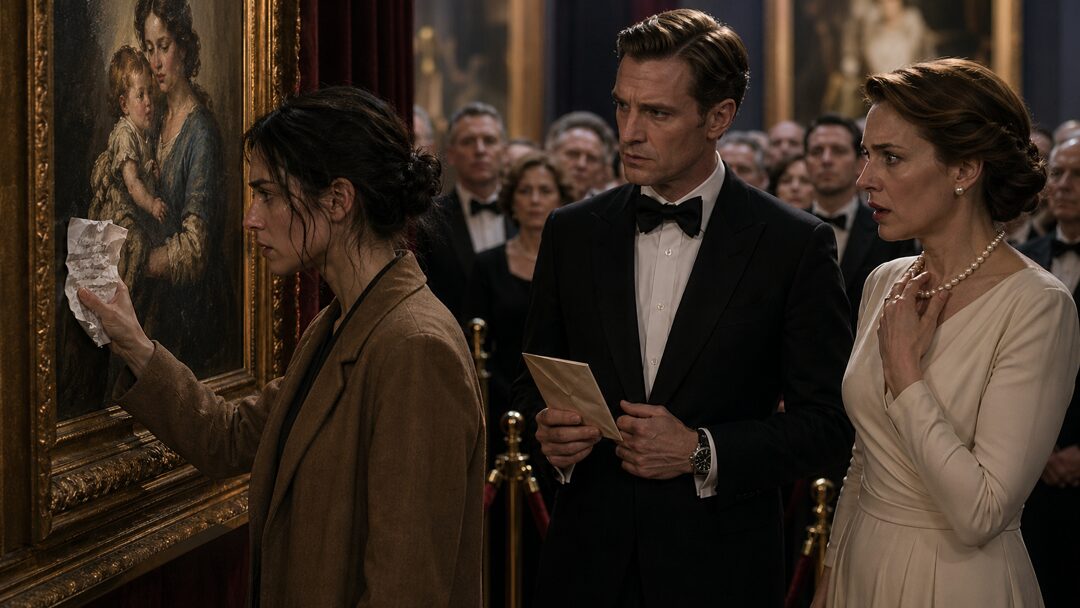
At the far end of the ballroom, behind a red velvet rope, the painting waited under a white cloth. Even covered, Mara knew its shape. Tall frame. Heavy gold corners. A woman seated in blue-gray light, holding a little boy against her chest as if the world had tried to take him and failed.
Mother Holding Child.
That was what the Whitcombs called it.
Mara’s mother had called it something else.
The auctioneer stepped up to the microphone, his smile bright enough to sell grief.
“Ladies and gentlemen, thank you for joining us on this historic night for the Whitcomb Museum Trust. Before bidding begins, we are honored to unveil the centerpiece of this evening’s charity auction.”
Applause rose before he finished.
Mara pressed Leo’s note harder into her palm.
It was written in pencil on lined school paper, folded four times, then reopened so often the creases had gone soft. Leo had drawn a lopsided heart in the corner. Inside, in his careful ten-year-old handwriting, he had written:
Tell Mom I saw it.
He had not asked Mara to take it back.
He had not asked whether the guards would let him in.
He had only handed it to her outside the museum, standing in his too-small sneakers on the cold sidewalk, and said, “Just put it close enough.”
Close enough.
As if love had a measurement.
The cloth came away.
The room inhaled.
Mara forgot, for one terrible second, that she was not allowed to cry here.
The painting burned softly in its frame. Not bright. Not showy. Her mother had hated pretty lies in art. The woman in the painting looked tired, but not broken. Her hand cupped the back of the child’s head with a tenderness so specific it hurt to see. The boy’s cheek pressed against her collarbone. His eyes were closed, trusting the arm around him.
Mara knew that hand.
She had been held by it after fevers, after schoolyard fights, after unpaid bills, after nights when her mother stayed up mixing cheap pigment in chipped bowls because real paint cost too much.
A donor near the curtain whispered, “Exquisite.”
Another replied, “The Whitcombs do have an eye.”
Mara almost laughed.
The Whitcombs had an eye for ownership.
She took one step from behind the curtain.
Only one.
Adrian Whitcomb saw her before security did.
His head turned with the quick precision of someone who had been waiting for disaster. He stood near the front row in a black tuxedo that fit him like inheritance. His pale face did not change, but Mara saw his right hand close around his watch.
He had done that the night he lied.
The night he told her, in the dark storage room behind the conservation lab, that he needed time.
The night he kissed her forehead like an apology and walked upstairs to announce his engagement to her sister.
Now he crossed the ballroom toward her, calm enough that no one noticed the panic in his stride.
“Mara,” he said under his breath when he reached her. “You can’t be here.”
She looked past him at the painting.
“I work here.”
“Not tonight.”
“Then fire me tomorrow.”
His mouth tightened. He glanced at her coat, then at the note in her fist.
The look cut before he spoke.
“What is that?”
“Nothing.”
“Mara.”
She hated the way he said her name. Quietly. Like he had earned softness after using silence as a weapon.
She tried to move around him.
Adrian stepped with her.
“To the side,” he said. “Now.”
A server paused nearby with a tray of champagne. Two women in velvet turned their faces just enough to watch without admitting it.
Mara felt her skin heat.
There it was. The old lesson.
Rich people did not need to raise their voices to humiliate you. They only needed to make you aware that everyone would believe their calm before your pain.
“I’m not here to make a scene,” Mara said.
“You already are one.”
The sentence landed softly. That made it worse.
Her fingers tightened around Leo’s note until the paper bent.
Adrian saw it. His expression changed.
“You brought something.”
“It isn’t for you.”
His eyes flicked toward the painting. For a moment, the old Adrian surfaced—the one who had stood beside her in the archive basement with dust on his sleeve, staring at her mother’s sketches like they were evidence of a crime committed by beauty.
Then he buried him.
“Give it to me,” he said.
Mara almost smiled.
He had always thought protection meant taking something from her.
“No.”
“Mara, whatever you think this will do—”
“You don’t know what I think.”
“I know this room.”
“And I know that painting.”
His jaw clenched.
Behind him, the auctioneer’s voice floated over the room, rich and smooth.
“Tonight’s sale will support the creation of the Eleanor Whitcomb Maternal Arts Wing, honoring the woman whose patronage and vision inspired this masterpiece.”
Mara stopped breathing.
Eleanor Whitcomb.
Not her mother.
Not Lena Vale, who had painted through migraines and eviction notices, who had wrapped brushes in newspaper because she could not afford proper cases, who had told Mara that mothers were not saints in paintings because saints never had rent due.
Eleanor Whitcomb.
The name moved across the ballroom like a seal pressed into wax.
Permanent.
Mara looked at the painting again.
Her mother’s blue-gray light. Her mother’s hand. Her mother’s boy.
Leo’s note grew heavy in her fist.
Adrian saw her face and said, very quietly, “Don’t.”
That was when Mara knew she had to.
Part II — Pearls That Did Not Belong to Her
“Mara.”
The second voice was softer than Adrian’s and far more dangerous.
Elise Vale appeared beside a cluster of donors, smiling as if she had simply drifted over to greet a beloved guest. Her ivory dress caught the ballroom light. Her hair was smooth, pinned low. Around her neck, Mara’s mother’s pearl earrings had been remade into a necklace.
Mara noticed because she had cleaned dried blood from one of those pearls after their mother’s last hospital stay.
Elise touched Adrian’s arm.
A small gesture. Public. Possessive.
“Darling,” she said, “your father’s looking for you.”
Adrian did not move.
Elise turned to Mara. Her smile did not slip.
“I didn’t know you were scheduled tonight.”
“I wasn’t.”
“How unfortunate.”
The women with champagne leaned closer.
Mara could feel their curiosity. Not sympathy. Curiosity.
Elise reached for Mara’s sleeve and gave it the gentlest squeeze, the kind that looked like affection from a distance and warning up close.
“Let’s not do this here,” Elise murmured.
“Do what?”
“Embarrass yourself.”
Mara looked at the pearls.
Elise’s fingers rose to them automatically.
Their mother had worn those earrings on only three occasions that Mara could remember. A school recital. A courthouse appointment. The day she walked into the Whitcomb home to deliver finished restoration sketches and returned without her portfolio.
Mara had been thirteen then. Elise had been twenty-one and already tired in a way young women should not be.
Their mother died four months later.
The sketchbooks disappeared before the funeral flowers browned.
“Elise,” Mara said, “where’s Leo?”
Something flickered in her sister’s eyes.
Then the smile returned.
“At home, I hope.”
“He came with me.”
Elise’s grip tightened.
“You brought him here?”
“He wanted to see it.”
“This is not a field trip.”
“He’s her son.”
Elise’s smile sharpened, still aimed at the room.
“He is a scholarship boy at St. Anselm because some of us understand how to speak to people with power.”
Mara felt Adrian look away.
There it was.
The hook in every conversation.
Leo’s scholarship. Leo’s future. Leo’s chance to enter clean rooms through the front door someday, if Mara could just keep swallowing dirt now.
Elise lowered her voice.
“If you embarrass the Whitcombs tonight, that scholarship review becomes very difficult.”
Mara stared at her.
“You would use Leo for this?”
“I am protecting Leo.”
“You always call it protecting when you need me quiet.”
The smile vanished for half a second.
A photographer turned. Elise’s smile returned so fast it looked painful.
“You came in through the staff entrance wearing our mother’s old coat,” Elise said sweetly. “Do you really want people asking why?”
Mara looked down.
The camel coat hung loose at her wrists. One button was wrong. One pocket had been patched with darker fabric. Her mother had worn it to the museum on winter mornings, smelling of turpentine and drugstore soap.
Mara had thought wearing it would make her brave.
Under the ballroom lights, it made her visible.
A donor’s gaze slid over her shoes.
Elise saw it too. She leaned closer.
“Go home,” she whispered. “Before you make poverty the only thing anyone remembers about her.”
Mara’s throat tightened.
Adrian said, “Elise.”
Not enough to defend Mara.
Just enough to soften the cruelty after it had landed.
That was Adrian’s gift. He could notice the wound without stopping the knife.
The auctioneer lifted his hand toward the painting.
“Before we begin, Mr. Charles Whitcomb will offer a few words about legacy, maternal devotion, and the preservation of beauty.”
Adrian’s father rose.
The room applauded again.
Charles Whitcomb was tall, silver-haired, and built from the same polished material as the museum plaques. He took the microphone with practiced humility.
“Art,” he said, “belongs not only to those who create it, but to those who understand its value.”
Mara felt the words move through her like cold water.
Adrian closed his eyes briefly.
Elise’s hand found his again.
Charles continued. “For three generations, my family has preserved beauty for the public good. Tonight, with the sale of Mother Holding Child, we ensure that Mrs. Eleanor Whitcomb’s spirit of compassion will live on in the new wing bearing her name.”
Mara turned to leave.
Not because she had surrendered.
Because if she stayed one more second, she might scream.
Then a young security guard appeared near the side entrance, scanning the room with discomfort. He spotted Elise first. Then Adrian. Then Mara.
He approached with his hands folded in front of him.
“Ms. Vale?”
Both sisters turned.
The guard flushed.
“There’s a boy in the front lobby asking for Mara. He says he’s with you.”
Mara’s body went still.
Elise whispered, “No.”
The guard swallowed. “He doesn’t have an invitation. He’s been outside for a while, but he won’t leave unless someone tells him the painting is still here.”
Mara heard nothing after that.
Not the auctioneer.
Not the applause.
Not Elise saying her name.
Only Leo, outside in the cold, waiting for proof that their mother had not vanished behind a price tag.
Mara shoved past Adrian.
This time, he did not stop her fast enough.
Part III — The Envelope He Kept
Adrian caught up with her in the side corridor beneath a row of donor plaques.
Not grabbed. Never that. Adrian was too well-trained for violence that left witnesses.
He stepped in front of her and lowered his voice.
“If you go to him now, my father will have you removed from the property.”
“Then let him.”
“Mara, listen to me.”
“I did. For months.”
The corridor was narrow, paneled in dark wood, smelling faintly of lilies and old money. Names glittered on brass plates along the wall. Whitcomb. Whitcomb. Whitcomb.
There were so many ways to be remembered if you could afford the metal.
Mara tried to move around him.
Adrian said, “I still have it.”
She stopped.
He reached inside his jacket and touched the inner pocket.
Not pulling anything out. Not yet.
“The envelope,” he said.
Mara’s pulse hit once, hard.
The envelope.
She had given it to him in February behind the conservation lab, when she still believed love could make a coward brave.
Inside had been everything she could find from her mother’s last year: small figure studies, pigment receipts, a photograph of Lena Vale standing beside the unfinished painting with a brush in her mouth and baby Leo asleep in a sling against her chest.
On the back of one sketch, her mother had written a line Mara had never forgotten.
For my children, so they remember how I held them.
Mara had given the envelope to Adrian because he had access to the board.
Because he had kissed her in empty rooms and said, “I believe you.”
Because she had mistaken being believed in private for being defended in public.
“You told me you destroyed it,” she said.
“I told you it was safer if no one found it.”
“That is not the same thing.”
“No,” Adrian said. “It isn’t.”
Mara looked at him fully then.
He seemed older than twenty-five under the corridor light. Still beautiful in the clean Whitcomb way, but strained. His watch gleamed at his wrist. He turned it once with his thumb.
“You kept it,” she said.
“Yes.”
“And did nothing.”
His face tightened.
“My father knew you were looking. He knew about your mother’s sketches before you gave them to me. He said if any of it surfaced, the museum would say she stole materials from the Whitcomb studio. That she forged her own claim after being dismissed.”
“My mother was never dismissed.”
“I know.”
“She was hired, underpaid, used, and erased.”
“I know.”
The words came too quickly. Too softly.
Mara hated him for knowing.
It would have hurt less if he had doubted her.
Adrian stepped closer, lowering his voice further.
“He said they would bury your family in court. Your sister would lose the apartment. Leo would lose school. You would lose your job. Everything.”
“So you let them keep her painting.”
“I tried to protect you.”
“No,” Mara said. “You protected the version of me that didn’t cost you anything.”
He flinched.
For a second, she saw the storage room again. Adrian’s mouth on her temple. His hands trembling when he said he needed time. The next morning, Elise’s engagement photo appeared on the museum newsletter. Adrian beside her, smiling like the family had arranged his face.
Mara had not cried until Leo asked why Elise was wearing their mother’s pearls.
Adrian said, “I was going to fix it after the auction.”
She almost laughed.
“After it was sold?”
“Privately. There are ways.”
“There are always ways when no one has to see.”
His eyes moved toward the ballroom doors. Music swelled on the other side. A polite storm gathering.
“Mara, please. Give me until tonight is over.”
That word again.
Please.
He used it like tenderness.
She looked at the brass plaques beside them.
Eleanor Whitcomb. Charles Whitcomb. Adrian Whitcomb.
“You don’t understand,” she said.
“I do.”
“No. You understand risk. You understand scandal. You understand what your father can take from you.”
She lifted Leo’s note.
“You don’t understand a ten-year-old boy standing outside a room built from his mother’s hands, asking to be allowed to love her.”
Adrian’s face opened with pain.
Too late.
The ballroom doors opened behind them.
Elise stepped out.
Her smile was gone now.
“Leo is being handled,” she said.
Mara turned slowly.
“What does that mean?”
“It means I told security to keep him in the lobby until a car comes.”
“A car?”
“To take him home.”
“He’s ten.”
“And you brought him to a donor auction like a prop.”
Mara moved toward her. Adrian shifted between them, then stopped himself.
“Elise,” he said, “don’t.”
Elise’s laugh was small and sharp.
“Now you find your spine?”
Adrian went quiet.
Mara stared at her sister.
The pearls at Elise’s throat caught the corridor light. Her mother’s pearls. Broken apart. Rebuilt into something smoother.
“Elise,” Mara said, “what did you do with Mom’s sketchbooks?”
The corridor changed.
Not visibly. The lilies still smelled too sweet. The brass plaques still shone.
But Elise’s face lost its social polish for one raw second.
That was enough.
Mara whispered, “You didn’t lose them.”
Elise looked toward the ballroom doors.
“Mara—”
“You said the landlord threw them out.”
“I was twenty-one.”
“You said you came back and they were gone.”
“I was trying to keep us alive.”
Mara stepped back as if touched by fire.
Adrian stared at Elise.
“What are you saying?”
Elise’s eyes flashed at him.
“Don’t pretend your family didn’t know what they were buying.”
Mara’s ears rang.
“Buying?”
Elise looked at her then, and for the first time all night, she looked like the sister who had learned to cook rice three ways because there was nothing else in the pantry. Tired. Furious. Afraid.
“Mom left debt,” Elise said. “Hospital bills. Rent. Leo’s daycare. Your school fees. I had no degree, no lawyer, no one answering my calls. Charles Whitcomb offered money for the studio materials.”
“You sold them.”
“I saved us.”
“You sold her.”
Elise’s mouth trembled.
Then hardened.
“Dead women don’t pay rent.”
The sentence cracked through Mara so cleanly she almost did not feel it at first.
Adrian said, “Elise.”
She rounded on him.
“You don’t get to be shocked. Your father knew exactly what those books were. He knew what he could build from them. You all did.”
Mara could barely breathe.
All this time, she had pictured the theft as a door closed by strangers.
But the key had been in her sister’s hand.
Part IV — The Boy in the Lobby
Mara found Leo on a velvet bench beneath a portrait of Charles Whitcomb’s grandfather.
He was asleep sitting upright, chin tucked into his chest, his puffy jacket zipped to his mouth. His school blazer showed under it, navy wool too thin for the weather. One shoelace trailed loose. Ink stained two fingers.
The sight of him nearly undid her.
Not because he looked pitiful.
Because he had tried to look proper.
He had worn his school uniform to meet his mother’s painting.
Mara knelt in front of him.
“Leo.”
His eyes opened at once, serious and scared before he recognized her.
“Did they sell it?”
“Not yet.”
“Did you put the note?”
Mara closed her hand around the paper.
“Not yet.”
He looked toward the ballroom doors.
“They said I couldn’t go in.”
“I know.”
“I told them I didn’t need champagne.”
A broken laugh slipped from her throat.
Leo looked embarrassed.
“I thought that was why.”
Mara touched his cold cheek.
His eyes searched her face.
“Did Mom really paint it?”
Mara froze.
They had never said it plainly to him. Not fully. Children heard more than adults allowed for. They collected silences the way other people collected receipts.
“Yes,” she said.
His face did not change much. But his shoulders lowered, as if some private suspicion had finally been given permission to rest.
“Then why does it say Whitcomb?”
Mara had no answer that would not poison him.
Before she could try, Elise entered the lobby.
She moved quickly, still elegant, but the corridor had scraped something from her. Adrian followed several steps behind. The security guard hovered near the front desk, miserable.
Leo sat straighter.
Elise’s expression softened when she saw him.
For a second, Mara hated that softness most of all.
Because it was real.
“Leo,” Elise said gently, “you shouldn’t be here.”
He looked at the pearls at her throat.
“Those were Mom’s.”
Elise’s hand flew up.
No donor was watching. No camera. No need to perform.
Still, she looked ashamed.
“They’re mine now,” she said.
Leo frowned.
“Did she give them to you?”
Elise did not answer.
Mara rose.
“That’s enough.”
Elise looked at her. “You think I wanted this?”
“I think you learned to want it.”
The words hurt Elise. Mara saw it.
Good, she thought.
Then hated herself for the relief.
Elise stepped closer.
“You were a child when she died. You remember her painting at the kitchen table and singing to Leo. I remember collection calls. I remember deciding whether to buy antibiotics or groceries. I remember Charles Whitcomb offering a check big enough to keep us housed.”
“And later?” Mara asked. “When you knew what they did with the books?”
Elise’s face went still.
“Later I understood the world.”
“No,” Mara said. “Later you got invited into it.”
Adrian said quietly, “The bidding is starting.”
All three adults turned toward the ballroom.
From inside, the auctioneer’s voice rose with theatrical warmth.
“Ladies and gentlemen, we begin at two million.”
Leo looked from one face to another.
“Two million what?”
No one answered.
The first bid came quickly.
Then another.
Then another.
Numbers floated through the doors, clean and bright.
Three million.
Three and a half.
Four.
Mara looked at Leo’s sneakers. At the loose lace. At his ink-stained fingers.
Then at the note.
Her mother’s painting had become something men lifted paddles to possess.
Her brother was not allowed to stand in the same room as it.
Elise stepped between Mara and the ballroom.
“Think,” she said. “If you do this, they will destroy you.”
“They already did.”
“They will destroy Leo.”
Mara looked at her sister. “No. That’s what you always say right before you ask me to help them.”
Elise swallowed.
“I gave up everything for you.”
“No,” Mara said. “You gave up Mom and called the rest of us the reason.”
Elise’s face folded, just slightly.
Then applause burst from the ballroom as a bid crossed five million.
The sound snapped something inside Mara into place.
She took off the camel coat and wrapped it around Leo.
His eyes widened.
“Mara?”
“Stay here.”
“Are you going in?”
“Yes.”
“Will they be mad?”
She looked at him for a long second.
“They might.”
“Are you scared?”
“Yes.”
He nodded, as if that made sense.
Then he reached into his pocket and pulled out a second folded scrap of paper.
Mara stared.
“What is that?”
“In case the first one got lost.”
Her breath caught.
Of course.
Leo had made a backup for love.
This one was smaller, torn from the corner of a worksheet. On it he had drawn three stick figures: a woman, a girl, and a boy. Above them, in cramped letters, he had written:
We remembered.
Mara closed her fingers around both notes.
Adrian’s voice came from behind her.
“Mara.”
She turned.
He stood with his hand inside his jacket, where the envelope waited.
His face was pale.
“Don’t ask me to wait,” she said.
His jaw tightened.
“I wasn’t.”
Part V — Close Enough
The ballroom did not go silent when Mara entered.
That came later.
At first, it only noticed her in pieces.
A woman lowering her glass.
A man turning from the stage.
A photographer’s lens drifting.
The security guard near the rope straightening as Mara crossed the polished floor in a plain black dress, no coat now, her bare arms cold under the gold light.
The auctioneer was saying, “Five million four hundred thousand. Do I hear five point five?”
Mara walked toward the painting.
Adrian moved behind her.
Elise followed, face white, one hand still at her mother’s pearls.
Charles Whitcomb saw them from the stage.
His eyes sharpened.
The room understood something was happening before it knew what.
That was enough.
Whispers began at the edges.
Mara felt every step in her cracked shoes. She did not look at the donors. If she did, she might become the girl they saw: staff, disturbance, poor relation, mistake.
So she looked at the painting.
Her mother’s hand around the child’s head.
Her mother’s blue-gray shadows.
Her mother’s refusal to make tenderness look easy.
Two guards stepped toward her.
Adrian’s voice cut through the room.
“Let her pass.”
It was not loud.
But he was a Whitcomb.
The guards stopped.
Charles Whitcomb left the stage.
“Adrian,” he said, still smiling for the room, “this is not the moment.”
Adrian looked at his father.
“No. It is.”
Mara reached the rope.
For one second, she stopped there.
The boundary was ridiculous up close. Red velvet on brass posts. A line pretending to be law.
The painting rose above her, enormous and intimate.
She unfolded Leo’s first note.
The paper trembled.
She wanted to say something beautiful. Something that would make them understand without forcing Leo’s pain into the room as proof. Something worthy of her mother.
All she had was the truth.
She stepped past the rope.
A collective breath moved through the donors.
The auctioneer stammered, “Miss, you can’t—”
Mara placed the note gently against the lower edge of the gold frame.
Not on the painted surface.
On the frame.
Close enough.
Then she placed the second note beside it.
The little drawing of three stick figures looked absurd against all that gold.
It looked alive.
Charles reached her first.
“You need to step back,” he said.
Mara turned to the room.
“He wanted his mother to know he saw it.”
The words were not loud.
They carried anyway.
A murmur passed through the ballroom.
Charles’s smile vanished.
“Remove her.”
The guards moved.
Adrian stepped between them and Mara.
Then he pulled the envelope from his jacket.
Mara saw it and felt, stupidly, the old ache of recognition. The envelope was creased at one corner. He had kept it close enough to wear down.
His hands shook once.
Charles saw the envelope.
“Adrian.”
One word. A lifetime of threat inside it.
Adrian looked at Mara.
There was apology in his face.
She did not reach for it.
He opened the envelope.
The room had gone silent now.
Even the auctioneer lowered his gavel.
Adrian withdrew the photograph first. He held it up with two fingers, careful as a man handling flame.
“This is Lena Vale,” he said.
Mara heard Elise inhale behind her.
Adrian’s voice was steady, but only because he forced it to be.
“She worked in restoration for this museum and in private commission for the Whitcomb family. This photograph shows her with the unfinished version of the painting currently being auctioned.”
Charles moved toward him.
Adrian did not step back.
“There are pigment receipts,” he continued. “Dated studies. Figure sketches. Written notes in her hand.”
He pulled out one sketch.
The paper was yellowed at the edges. Mara could see, even from where she stood, the curve of the mother’s shoulder. The child’s sleeping head. Her mother’s line, unmistakable.
Adrian turned the sketch over.
His voice changed.
Not breaking.
Worse.
Softening.
“On the back, she wrote: ‘For my children, so they remember how I held them.’”
No one moved.
Mara closed her eyes.
For one second, the ballroom fell away, and she was seven years old again, half-asleep against her mother’s side, listening to a brush click in a jar.
Then Elise made a sound.
Not a sob. Not quite.
Mara opened her eyes.
Elise stood near the rope with both hands over the pearls. Her face had lost every polished thing. She looked young. Too young. Like the twenty-one-year-old girl who had signed away a dead woman’s sketchbooks because bills were louder than grief.
Charles spoke first.
“My son is emotional. This is a private family matter.”
Mara laughed once.
A small sound. Sharp enough to draw blood.
“Whose family?”
Cameras lifted.
Charles saw them.
So did Elise.
So did Adrian.
That was the true altar of the room. Not art. Not charity. Witness.
Charles lowered his voice. “Miss Vale, you are making accusations you cannot possibly understand.”
Mara looked at him.
“I understand being told to be grateful for what was taken from me.”
The room held the sentence.
Adrian turned to the auctioneer.
“The sale is suspended.”
Charles said, “You do not have that authority.”
Adrian looked at the board members seated in the first row. Some stared at the envelope. Some at the cameras. Some at Charles, calculating which loyalty would cost less by morning.
“No,” Adrian said. “But they do.”
Silence.
Then a woman from the board, older, rigid-backed, rose slowly.
“Until provenance is reviewed,” she said, “the museum cannot proceed.”
Charles turned on her.
The donors began whispering in earnest now.
Not cruelly.
Hungrily.
Mara looked at the notes on the frame.
Leo’s pencil heart.
His crooked family.
His little sentence: We remembered.
For the first time all night, the painting did not look trapped.
It looked witnessed.
Elise stepped close to Mara.
“Mara,” she whispered.
Mara did not look away from the frame.
“Did you know they would do this?” she asked.
Elise’s silence was answer enough.
“Did you know they would put Eleanor’s name on it?”
Elise’s eyes filled.
“I told myself names mattered less than survival.”
Mara finally looked at her.
“And now?”
Elise touched the pearls.
One of them had twisted backward against her throat.
“Now I know survival can become a very expensive kind of death.”
It was the first honest thing Elise had said all night.
It was not enough.
Mara stepped away from her.
The cameras kept clicking.
Part VI — What Was Left on the Gold
By morning, the plaque was gone.
Not the painting. Not the lawsuits. Not the newspapers gathering outside the museum doors like birds around a wound.
Just the plaque.
The brass rectangle that had read Gift of the Whitcomb Family in honor of Eleanor Whitcomb had been removed from the wall, leaving four pale marks where the screws had been.
Mara stood in the empty ballroom as two conservators spoke in low voices near the painting. The chairs were still out of order from the halted auction. A few abandoned programs lay on the floor. Someone’s white rose had been crushed near the rope.
Leo slept on a lobby couch wrapped in the camel coat.
He had tried to stay awake for the ending.
Children always thought endings happened when adults stopped talking.
Adrian stood near the ballroom entrance, no tuxedo jacket now, his bow tie undone. Without the ceremony around him, he looked less like an heir and more like a man who had spent his life mistaking delay for mercy.
He did not come closer until Mara looked at him.
“They’re securing the evidence,” he said.
She nodded.
“The board will issue a statement.”
Another nod.
“My father has stepped down pending review.”
Mara looked at the empty space where the plaque had been.
“Pending,” she said.
Adrian flinched.
“Yes.”
One of the conservators approached the frame with gloved hands.
Mara stiffened.
“They have to remove the notes,” Adrian said gently. “Paper can damage the gilding.”
“I know.”
But when the conservator reached for Leo’s note, Mara had to turn away.
Adrian saw.
Of course he saw.
That had always been the cruelest part. He noticed everything except the moment noticing needed to become courage.
“They’ll preserve them,” he said. “Both notes. With the file.”
Mara almost said thank you.
She stopped herself.
Gratitude was too easy to confuse with forgiveness.
From the lobby, Leo shifted in his sleep. The camel coat slipped from his shoulder. Mara crossed to him and pulled it back up.
He opened one eye.
“Did Mom get it?”
Mara crouched beside him.
“Yes.”
His eye closed again.
“Good.”
That was all.
No speech. No miracle. No child made wise for adults to feel better.
Just relief.
Mara pressed her hand over her mouth until she could breathe.
When she stood, Adrian was closer.
Not too close.
He had learned at least that much.
“Mara,” he said.
She waited.
He looked at the floor, then at her, then at the painting.
“I should have chosen you sooner.”
There it was.
The sentence she had wanted months ago.
Back when it would have meant a door opening instead of a ruin being named.
Mara looked at him carefully. At the man who had kept proof close to his heart and still asked her to remain hidden. At the boy he must have been, trained by a father who made love sound like liability. At the heir who had finally done the right thing when the room left him no clean way to do less.
She did not hate him.
That would have been simpler.
“You did choose me,” she said.
His eyes lifted.
“In storage rooms. In hallways. In sentences no one else could hear.”
Adrian swallowed.
“That wasn’t enough.”
“No.”
“I know that now.”
Mara looked back toward Leo.
He was asleep again, one ink-stained hand curled near his face.
“Being chosen after the room turns against you,” she said, “is not the same as being cherished before it costs you.”
Adrian closed his eyes.
The words did what she had not trusted herself to do. They left him standing. They left her free.
Behind them, the conservator removed Leo’s first note from the frame and laid it flat inside a clear sleeve.
The paper looked smaller now.
Still crumpled. Still ordinary. Still stronger than the gold that had held it.
Elise appeared at the far end of the lobby.
She had changed out of the ivory dress. The pearls were gone from her throat. In her hand, she held them loose, a broken strand of borrowed memory.
Mara saw her.
Elise took one step forward, then stopped.
For once, she seemed to understand that not every distance could be crossed because she had decided to cross it.
She set the pearls on the front desk.
Not dramatically.
Not with apology enough to heal anything.
Just placed them there, as if returning a stolen thing to a house already burned.
Mara did not go to her.
Not yet.
Maybe not ever in the way Elise wanted.
But she looked at the pearls.
That was all she could give.
Outside, dawn pressed pale light against the museum glass.
The donors were gone. The cameras waited beyond the doors. The painting remained behind its rope, but the room around it had changed. Not enough. Not completely.
Enough that the lie no longer stood untouched.
Mara lifted Leo carefully. He was too big to carry easily, but she managed. His head fell against her shoulder the way it had against their mother in the painting.
Adrian reached as if to help.
Mara shook her head.
He let his hand fall.
She walked past him, past Elise, past the empty wall where the Whitcomb name had been.
At the front desk, she paused just long enough to take her mother’s pearls.
Not to wear them.
Not to forgive.
To keep them from becoming another beautiful thing someone else explained.
Then she carried Leo out through the museum doors and into the cold morning.
Behind her, inside the gold frame’s shadow, the painting held its silence.
But now, somewhere in the museum record, beside receipts and sketches and the first official crack in the Whitcomb story, there were two small notes from a boy who had not been allowed into the room.
One said his mother had been seen.
The other said she had been remembered.