The Day Nancy Walker Led Her Mules Across the Boundary Everyone Said Was Gone
Chapter 1: The Man in the Black Coat Crossed Her Furrow
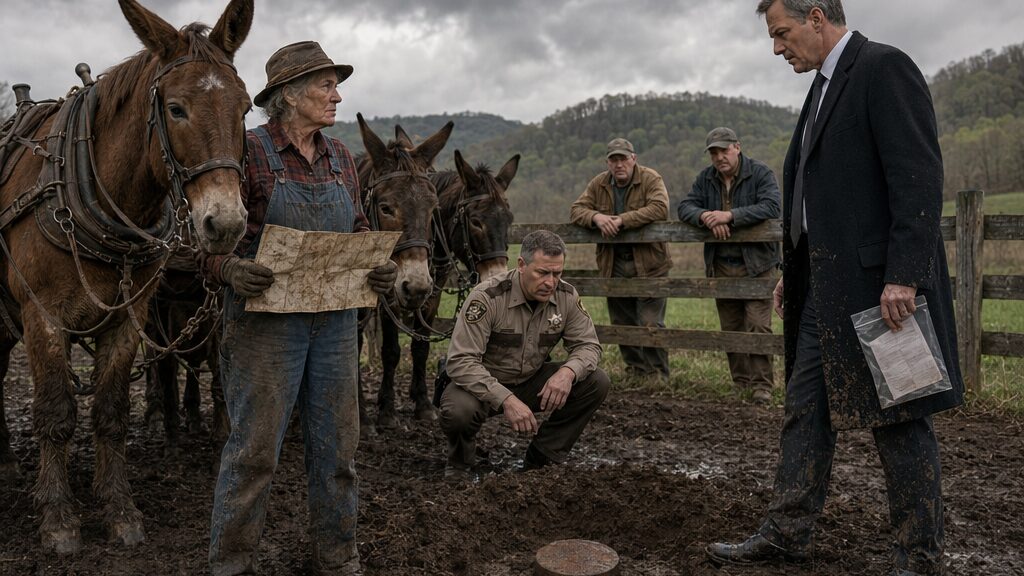
Jonathan Miller’s polished shoe sank past the sole before Nancy Walker saw the rest of him.
The black leather disappeared into the fresh furrow with a wet sucking sound. Jonathan jerked backward, but the mud held him long enough to twist his composed face into something sharp and private.
Nancy tightened the lines in her gloved hands.
“Easy, Queen.”
The lead mule stopped. The other two settled behind her, harness chains ticking in the cold morning air. Their breath rose pale above the newly turned earth.
Jonathan pulled his shoe free and stepped onto the firmer ridge between furrows. He wore a black overcoat over a gray suit, as if he had taken a wrong turn between a bank and a funeral. Mud spotted one trouser cuff.
“You need to unhitch them,” he said.
Nancy looked past him toward the road. A white pickup stood beside the gate with its lights on. She recognized the county seal on the door.
“You crossed a closed gate to tell me that?”
“The gate was open.”
“It was chained.”
Jonathan glanced back, then returned his attention to her. “The deputy cut it because you didn’t answer the house.”
Nancy’s hands remained steady, but the leather lines seemed suddenly thinner between her fingers.
Queen shifted her weight. The plow blade sat buried behind the team, holding the last slice of earth open like a dark wound.
Jonathan stepped closer.
“This field isn’t yours to work anymore.”
Nancy looked down at the ground between them. “Seems to be taking the plow same as yesterday.”
“I’m not here to argue about what it looks like.”
“You came dressed for it.”
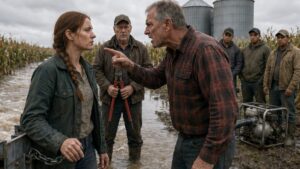
The younger of the two neighboring farmers stood near the fence, pretending to examine a broken staple. His brother remained by their truck. They had stopped when they saw the county vehicle, and neither had found a reason to leave.
Jonathan lowered his voice.
“I bought the parcel at the county tax sale. The deed was recorded Friday.”
“What parcel?”
“You know which one.”
“I asked you to say it.”
His jaw moved once before he answered.
“Twenty point six acres running from the old chestnut line down to Miller Creek, including the eastern access strip.”
Nancy felt the words before she understood them. They were familiar, arranged in an order she had heard once in her father’s kitchen when she was still young enough to think grown men could settle a boundary by speaking louder.
The old chestnut line.
There had been no chestnut trees on that ridge for more than fifty years.
Her father had called the description a liar’s compass. He said it began at something dead, followed a creek that had moved, and ended at a stone no surveyor had ever agreed upon.
Nancy looked toward the low hill beyond Jonathan. The grass there bowed under last night’s rain. Somewhere beneath it ran the route her father had walked with her when she was twelve, tapping fence posts with the back of a hammer.
Jonathan watched recognition settle over her face.
“You’ve seen the description,” he said.
“I’ve seen bad descriptions.”
“I have a tax deed.”
“And I have three mules standing in a field my family has worked since before your father put up his first grain bin.”
“That doesn’t change the record.”
The driver’s door of the county pickup opened.
The deputy came through the gate carrying a clear plastic sleeve. He was broad through the shoulders, careful with his boots, and visibly unhappy to be standing between two families he had known all his life.
“Morning, Nancy.”
“You already cut my chain. No need to make it friendly.”
“It’s temporary.”
“So is most damage.”
The deputy stopped several feet away and held out the sleeve. Inside was a folded notice bearing the county court stamp.
Jonathan spoke before the deputy could.
“It’s a temporary trespass order. Until the possession hearing, you can’t cultivate, graze, remove timber, or interfere with access.”
Nancy looked at the open furrow behind her.
“I started before daylight.”
“Every new furrow after service may count as damage,” Jonathan said.
The two neighboring farmers had stopped pretending not to listen.
Nancy studied Jonathan’s coat, his clean white collar, the dry edge of the paper inside the sleeve. He had come into her field prepared to turn the work beneath her boots into evidence against her.
The deputy extended the notice again.
“I need you to take it.”
Nancy looped the lines around one wrist and accepted the sleeve. The plastic crackled in the silence.
The parcel number meant nothing to her. The legal description meant too much.
Miller Creek. The chestnut line. The eastern access strip.
Jonathan had not bought only the lower slope where weeds overtook the old tobacco rows. He was claiming the narrow rise from the county road, the spring branch, and the broad field where Queen now stood.
Without that strip, Nancy’s remaining land would be cut off from the equipment road. Her barn would face property she could no longer cross.
Jonathan pointed toward the team.
“Unhitch them, Nancy.”
She folded the notice once without removing it from the plastic.
“Did you come to buy tax debt,” she asked, “or did you come for a road?”
His eyes changed, though his posture did not.
“My plans aren’t relevant.”
“They are if the road starts where you say it starts.”
“The deed is recorded.”
“That isn’t what I asked.”
The deputy shifted his weight. “Nancy, let’s not make this harder than it has to be.”
She looked at him. “Harder for who?”
Queen tossed her head, bothered by the halted plow. Nancy touched the mule’s neck until the animal settled.
For one reckless moment, she wanted to click her tongue and send the team forward. The blade would bite another ten yards before anyone could stop it. Jonathan’s shoe would sink again. The watching men would see whose hands the field obeyed.
But each new furrow could become a number on a claim.
Nancy pulled the plow blade free and laid the lines across the handles.
Jonathan relaxed slightly, mistaking restraint for surrender.
“That’s the sensible choice.”
She turned toward him.
Inside her canvas coat, beneath the inner lining her husband had repaired with green thread, a folded sheet pressed against her ribs.
She had carried it for years without showing Samuel. Without showing the probate clerk. Without showing anyone who might ask why an old copy had become more trustworthy to her than a courthouse envelope.
Her father’s boundary map was soft along its folds and stained in one corner by machine oil. It was not a deed. It had no seal. But the lines upon it did not begin at a dead chestnut.
They began at an iron pin.
Nancy reached into her coat.
The deputy’s gaze dropped to her hand. Jonathan’s did too.
She brought out the folded paper and opened it carefully against the plow handle. Wind lifted one brittle corner. Faded blue lines crossed the yellowed sheet, along with handwritten measurements and her father’s square block printing.
Jonathan stepped closer.
“What is that?”
Nancy placed one gloved finger on a line running north of the spring branch.
“It means,” she said, “your road begins on the wrong side of the hill.”
Chapter 2: The Mule Remembered What the Courthouse Forgot
Jonathan reached for the map.
Nancy pulled it against her chest before his fingers touched the paper.
“You don’t take things from my hands,” she said.
“I was trying to read it.”
“You can read from where you stand.”
The deputy moved between them without fully committing himself to either side. “Let’s keep our hands to ourselves.”
Jonathan ignored him. His eyes remained fixed on the map.
“That isn’t recorded.”
“You decided that fast.”
“It’s a farm sketch.”
“It was drawn from a survey.”
“By whom?”
Nancy looked at the faded initials near the lower edge. Rain and years had turned them into pale scratches.
“My father kept the original survey with this copy.”
“Where is it?”
“If I had it in my pocket, I’d have shown you that.”
Jonathan gave a humorless breath. “Then it proves nothing.”
The younger neighboring farmer looked away too late. Nancy caught the small movement and understood that the judgment had already begun. Old woman with an old paper. Too stubborn to know when she had lost.
She unfolded the map against the plow’s wooden handle. A blue line followed the spring before bending toward a mark labeled PIN 14. Beyond it, faint dashes ran uphill beside two words nearly hidden by the center fold.
WAGON TRACE.
Nancy remembered that route. Not as ink, but as pressure through her boots.
Her father had walked it every autumn to check the fence. Queen had followed the same rise for seventeen years, first behind Nancy’s older mule and later at the head of the team. Animals learned ground differently from people. They remembered grades, wet places, stones under grass.
The deputy glanced at the order. “Even if the map means what you say, you can’t continue cultivating.”
“I’m not asking to cultivate.”
“What are you asking?”
“To walk my team.”
Jonathan stepped into her path. “Across my parcel?”
“Across the line you say isn’t there.”
“You’ll be trespassing.”
Nancy looked at the deputy. “Does the order prohibit leading livestock without breaking ground?”
He read the page more closely. Jonathan turned toward him.
“You know the intent.”
“I know what it says,” the deputy replied.
“And?”
“It prohibits cultivation, grazing, timber removal, obstruction, and interference with access.”
Nancy gathered the lines.
Jonathan’s face reddened. “This is a stunt.”
“No,” she said. “A stunt needs an audience you invited.”
One of the farmers coughed into his fist.
Nancy lifted the plow chain from Queen’s trace and left the blade where it stood. She unhooked the other two mules, tying them to the fence rail. Queen watched her with one dark, patient eye.
Nancy slipped the folded map into the bib of her overalls, keeping one corner visible.
“Come on, girl.”
She led Queen east, not toward the hilltop but along the shallow contour where the plowed earth met old sod. Jonathan followed, speaking first to the deputy and then into his phone. The farmers moved along the fence at a distance.
The route looked empty. No post remained. No wire. Only winter grass, mud, and the uneven bank of the spring branch.
Nancy gave Queen more line.
The mule walked without hesitation.
At the first washout she angled uphill. At a cluster of shale she stepped left before Nancy guided her. The old trace lived in the animal’s body as surely as it lived in Nancy’s.
Jonathan came beside the deputy.
“You cannot establish a legal boundary by following a mule.”
Nancy did not turn. “Good thing I’m following a map.”
The ground narrowed between the spring and a rise of broom sedge. Queen slowed.
Nancy checked the map. The blue line bent sharply there. Her father’s note read twelve links west of white oak, but the oak was gone, and she no longer knew how long a surveyor’s link had been.
Jonathan stopped behind her.
“This is over.”
Queen took two steps and halted.
There was no fence, tree, rock, or visible marker ahead of her. Only a patch of bare mud darkened by rain.
Nancy clicked her tongue.
Queen did not move.
The mule lowered her head, sniffed, then scraped once with her right forehoof.
Mud peeled back.
The sound beneath it was small but unmistakable—a hard metallic knock.
Everyone went quiet.
Queen scraped again. Her hoof struck iron.
Nancy handed the lines to the deputy before he could object, dropped to one knee, and cleared the mud with both gloves. A rusted circular cap emerged beneath the grass roots, no wider than a jar lid. Its center was stamped with a number.
The younger farmer climbed through the fence.
“I remember an iron there,” he said. “When we were boys.”
His brother stayed back but nodded slowly.
Jonathan stared at the cap.
For the first time that morning, he looked less angry than exposed.
Nancy saw it.
“You know that number.”
“No.”
“You looked at it before I wiped the mud.”
“It’s a survey marker. They’re numbered.”
“Not all the same.”
The deputy crouched beside the cap but did not touch it. “Nobody moves this. Nobody digs around it. We call the county surveyor.”
Jonathan took out his phone. “The parcel survey is already in the tax file.”
“Then they can compare them.”
“The deed controls.”
“The court decides what controls,” the deputy said. “Until then, I’m suspending field enforcement around this marker.”
Jonathan turned on him. “You don’t have that authority.”
“I have authority not to stand here while disputed physical evidence gets plowed under.”
Nancy rose. Mud darkened both knees of her overalls. The map corner stuck out against her chest.
A pulse of triumph moved through her, quick and dangerous. Jonathan had entered with a stamped order and a county vehicle behind him. Now everyone watched him stand over a marker his paperwork had failed to explain.
She wanted to tell him to take his black coat and walk back across the right boundary.
Instead, she asked, “What survey number was in the warning?”
Jonathan’s head snapped toward her.
The deputy stood. “What warning?”
“I don’t know what she’s talking about.”
Nancy had guessed. His reaction answered enough.
Jonathan stepped closer, voice low.
“That pin does not give you twenty acres. It may belong to an abandoned division line. It may predate the creek survey. It may mark nothing currently enforceable.”
“Then why are you scared of it?”
“I’m not scared.”
“You’re shouting at an iron cap.”
His gaze moved toward the watching farmers. The anger returned, but it had changed. It was no longer the anger of a man certain the record stood behind him. It was the anger of a man who had lost control of how the scene looked.
The deputy gave Queen’s lines back to Nancy.
“You can take the team to the barn. No more plowing this section until the surveyor comes.”
Nancy nodded.
Jonathan pointed at the map. “That needs to be preserved.”
“It has been.”
“In evidence.”
“It isn’t yours.”
“If you alter it—”
“I’ve kept it longer than you’ve kept that coat clean.”
A truck engine climbed the county road.
Nancy looked toward the gate, expecting the surveyor already, though no one could have arrived that quickly.
A dark pickup turned in and stopped behind the county vehicle. The driver remained seated for a moment, hands on the wheel.
Nancy knew the truck before she saw the man.
Samuel stepped down wearing his work jacket and a pale ball cap stained above the brim. He took in the deputy, Jonathan, the farmers, the halted mule team, and finally the map protruding from Nancy’s overalls.
His mouth tightened.
For one foolish second, relief loosened something inside her. Samuel had come. Whatever lay between them, he had come when the farm was threatened.
Nancy walked toward him.
“They found the old pin,” she said. “Right where your granddad marked it.”
Samuel did not look at the pin.
He looked at the folded paper.
“You brought that out now?”
“It stopped them.”
“It stopped them for a morning.”
Jonathan watched from several yards away, suddenly silent.
Nancy lowered her voice. “I need you with me on this.”
Samuel’s expression did not soften.
“That map can’t save land you never finished inheriting.”
Chapter 3: Her Son Knew Why the Deed Was Never Filed
Samuel placed three unopened courthouse letters beside the map.
The envelopes landed one at a time on Nancy’s kitchen table, each bearing a different date and the same red forwarding mark. The oldest was six years old. The newest had been mailed nine months before Jonathan bought the parcel.
Nancy stood at the sink with her back to him.
“Where did you get those?”
“Your desk.”
“You went through my desk?”
“I went looking for the tax receipt you told me existed.”
Rain tapped the window above the sink. Outside, Queen stood under the shed roof, harness removed but mud still drying along her legs.
Samuel pulled out a chair but did not sit. The old boundary map lay open beneath a brown county envelope, its center fold lifting slightly from the table.
“You told me the probate was closed,” he said.
“It should have been.”
“That isn’t an answer.”
“It was what the lawyer said your father’s papers would do.”
“Dad’s papers transferred his share to you. They didn’t fix Granddad’s estate.”
Nancy turned.
Samuel had grown heavier through the shoulders since she last saw him at Christmas. There was gray at his temples now, though he was not yet fifty. She had missed its arrival.
“My father left me this farm.”
“He told you he was leaving it. That’s not the same as recording it.”
“You think I don’t know the difference?”
“I think you knew enough to hide these.”
Nancy dried her hands slowly on a dish towel.
Jonathan’s trespass notice sat near the stove. She had not opened the plastic sleeve again. The sight of Samuel’s envelopes beside the old map made the kitchen feel smaller than it had that morning.
“The county sent notices to the wrong box,” she said.
“The first one, maybe.”
“All the mail changed after your father died.”
“The second went to this house.”
“I was dealing with funeral bills.”
“The third came four years later.”
Nancy glanced at it.
Samuel pushed the envelope toward her with one finger. “Delinquent estate parcel. Failure to establish successor ownership. Pending tax disposition.”
“I paid taxes every year.”
“On the home parcel.”
“I paid what they sent.”
“They split the eastern strip under Granddad’s estate number after the mapping update. You kept paying the bill with the barn and house on it. The other bill went unpaid because you wouldn’t accept that the county had separated them.”
“They had no right to separate them.”
“Maybe not. But you don’t beat a mistake by refusing to answer the letter.”
Nancy gripped the towel.
Samuel’s anger was controlled, which made it worse. As a boy he had shouted, slammed doors, torn out in trucks too fast for the gravel. Now he spoke like a mechanic diagnosing a machine whose owner had ignored a warning light.
“You came here to help Jonathan?” she asked.
“I came because the deputy called me.”
“Not because I did.”
“You didn’t call.”
“I knew what you’d say.”
“That’s been your excuse for years.”
Nancy pulled out the chair opposite him and sat. The map rustled under the county envelope.
Samuel picked up the oldest letter.
“Six years ago I offered to take these to the probate clerk. I had the forms. I’d talked to someone at the courthouse. You told me I was trying to get my name on the farm before you were dead.”
Nancy remembered the equipment shed, the smell of diesel and cut hay, Samuel holding a manila folder. She remembered the shame that had risen in her before anger covered it.
“You were talking about selling the lower fields.”
“I was talking about paying the lien.”
“You wanted to mortgage the place.”
“I wanted to keep the county from auctioning part of it.”
“You said we could sell if the numbers didn’t work.”
Samuel leaned both palms on the table.
“Because I couldn’t promise they would. You didn’t want help. You wanted me to tell you nothing could happen as long as you kept working.”
“I kept it going.”
“You kept the animals fed. You kept fences patched. You did not keep the title clear.”
Nancy looked toward the window.
Beyond the glass, the eastern hill was hidden by rain. Somewhere under that gray slope sat the iron cap Queen had uncovered. For several hours Nancy had held that discovery like a shield.
Now it seemed no larger than it was: a rusted piece of evidence in ground whose ownership remained uncertain.
Samuel sat at last.
“What did Granddad make you promise?”
Nancy’s eyes returned to him.
“You always bring him into it when you want me to feel foolish.”
“I’m asking.”
She smoothed one corner of the map.
“He said not to let them break up the home place.”
“Who was ‘them’?”
“Banks. Buyers. Anybody waiting for a hard year.”
“And you decided that included me.”
Nancy did not answer.
Samuel’s face changed—not into surprise, but confirmation.
“That’s what I needed to know.”
He stood.
“Where are you going?”
“To the shed. I left tools there last winter.”
“You just got here.”
“I’m not staying.”
Nancy pushed herself up. “Jonathan is trying to take the road, the spring, half the east field.”
“And your answer is that I should stand beside you and pretend the papers were fine.”
“They were wrong.”
“So were you.”
The words landed without volume.
Nancy folded her arms. “What do you intend to do?”
“If the survey says Jonathan owns it, you negotiate.”
“With the man who served me in my own furrow?”
“If that keeps the rest.”
“He offered nothing.”
“He hasn’t had to yet.”
“You sound like you want me to sell.”
Samuel looked toward the ceiling, then back at her.
“I want this farm to stop eating every conversation we have.”
“It fed you.”
“It also decided when I could leave, what work counted, and whether helping you meant obeying you.”
Nancy’s grip tightened around her elbows.
Samuel picked up his cap from the table.
“If Jonathan offers to buy the full place at a fair price, I think you should hear him.”
“You’d support him?”
“I’d support ending this before legal fees finish what the tax sale started.”
Nancy’s face heated. “Then go tell him.”
“I might.”
He walked through the mudroom toward the back door.
“Samuel.”
He stopped but did not turn.
Nancy looked at the map, the envelopes, and the unpaid notice spread across the table like pieces of one accusation.
“I thought signing those forms would give you the right to sell after I was gone.”
Samuel faced her then.
“You could have asked.”
“I didn’t know how.”
“No. You didn’t want to hear an answer you couldn’t control.”
The door shut behind him.
For several minutes Nancy remained in the kitchen, listening to rain drum against the metal shed roof as Samuel moved tools into his truck.
The telephone rang on the wall.
She nearly let it continue. On the fourth ring, she answered.
“Nancy Walker.”
“This is Patricia Anderson at county records.”
Nancy closed her eyes.
“I figured someone from there would call.”
“I’m calling before this goes any further in the wrong direction.”
“What direction is that?”
“The tax deed Jonathan Miller recorded uses the creek survey from 1978. Your family description follows an older ridge survey.”
“The one on my map?”
“Possibly. I need to see it.”
“You’re not taking it.”
“I didn’t say I was. Nancy, listen carefully. The parcel descriptions overlap.”
Nancy watched Samuel cross the yard through the rain, carrying a toolbox toward his truck.
“How much?”
“I can’t tell without a resurvey. But the tax-sale parcel may include ground that was never properly separated from your father’s estate.”
Relief tried to rise. Patricia stopped it.
“That does not mean the sale was invalid. It may mean your family has occupied land the county continued carrying under a different estate number.”
Nancy pressed the receiver harder to her ear.
“So whose field is it?”
“That is exactly what the records cannot answer.”
Outside, Samuel closed his truck bed and looked toward the house once before climbing into the cab.
Patricia continued.
“Bring the map Monday morning. Until we compare both descriptions, you need to prepare for two possibilities.”
Nancy watched her son’s truck roll away.
“What possibilities?”
“That the county sold land it had no right to sell,” Patricia said, “or that yo
Chapter 4: Two Legal Boundaries Could Not Occupy One Field
Patricia Anderson placed two clear acrylic weights on the corners of Nancy’s map and said, “This is a copy.”
Nancy had not yet removed her coat.
The records room was colder than the courthouse hallway, and the long metal table between them reflected the overhead lights in hard white strips. Behind Patricia, shelves held deed books with cracked spines, tax ledgers, rolled plats, and gray archival boxes labeled in black marker.
Nancy stared at the map flattened beneath the weights.
“My father kept it with the farm papers.”
“I believe you.”
“He called it the survey.”
“He may have called it that because it was copied from one.”
Nancy pulled out a chair. “You said you needed to see it.”
“I did. It helps.”
“But it doesn’t count.”
Patricia lowered herself into the chair opposite her. She wore reading glasses on a cord and handled paper with the care of someone accustomed to seeing a family’s certainty reduced to ink.
“It counts as evidence of what your father believed the boundary to be. It may also show what surveyor he relied on. But there’s no seal, no recording stamp, and no signature I can confirm.”
Nancy looked at the faded initials near the edge. “Those were clearer once.”
“So were half the descriptions in this county.”
Patricia opened a thick deed book and turned it sideways.
One page contained a typed legal description from 1978. Another sheet beside it held a newer parcel printout with bright colored lines.
“The tax-sale deed Jonathan recorded follows this survey,” Patricia said. “It begins at Miller Creek, runs to the former chestnut line, then follows a ridge bearing southeast.”
Nancy leaned closer. “The creek moved.”
“Yes.”
“It washed east after the flood.”
“Yes.”
“Then the line moved with it?”
“That depends on whether the original description intended the creek bank, the creek center, or a fixed monument that no longer appears.”
Nancy sat back. “That sounds like three answers to one question.”
“It is.”
Patricia drew another file closer. “Your family description follows a ridge survey from 1949. It references an iron pin, a white oak, and a wagon trace. The pin may be the one your mule uncovered. The oak is gone. The trace is no longer visible on the county map.”
“It’s visible if you know where to look.”
“That matters. It just doesn’t settle title by itself.”
The door opened behind Nancy.
Samuel entered carrying a cardboard tube and a yellow legal pad. He stopped when Nancy turned.
“I told him to come,” Patricia said.
Nancy looked back at her. “You could have told me.”
“I thought one difficult conversation was enough for the morning.”
Samuel took the chair at the end of the table. He did not greet Nancy. He slid the tube toward Patricia.
“The survey crew’s preliminary overlay.”
Patricia unrolled the sheet carefully. Red, blue, and black lines crossed the outline of the Walker and Miller parcels.
Two boundaries occupied the same field.
Nancy followed the red line with one finger. It cut through the lower slope, crossed the spring branch, and continued uphill through the area she had plowed.
“What is the blue?”
“The older ridge description,” Samuel said.
“And black?”
“The line the county currently displays.”
Nancy looked from one to the other. “Which one is legal?”
Patricia removed her glasses.
“That is what a judge may have to decide.”
By noon, the four of them stood in the eastern field with the county survey crew. Jonathan arrived late in work boots and a dark field coat instead of his suit. He kept his distance from Nancy.
The crew had driven temporary stakes at three possible lines. Red flags followed the tax-sale description. Blue flags tracked the ridge survey. White flags marked a proposed reconciliation based on existing monuments.
The red flags crossed directly over the spring.
Nancy stopped beside the shallow stone basin where cold water rose through gravel.
“That road goes here?”
A surveyor checked the tablet in his hands. “Jonathan’s preliminary access plan follows the red corridor.”
“He’ll pave over the spring.”
Jonathan spoke from behind her. “The engineer can pipe it.”
Nancy turned. “That spring waters my lower pasture.”
“We can install a culvert.”
“You can install anything after you ruin it.”
Jonathan’s face hardened, but he kept his voice low. “The access has to meet grade. The higher route is too steep for loaded trucks.”
Samuel crouched near the bank and pressed a thumb into the saturated soil.
“You pave this, water will run under the base,” he said. “You’ll be repairing it every spring.”
Jonathan looked at him. “The engineer disagrees.”
“The engineer studied contour data. I’m standing in the seep.”
One of the surveyors called them uphill. At the iron cap Queen had uncovered, he had brushed the surface clean enough to reveal a stamped number and two faint letters.
The number matched Nancy’s map.
A small satisfaction moved through her.
The surveyor pointed toward the blue flags. “This establishes a historic monument consistent with the Walker copy.”
Nancy looked at Jonathan.
He did not look away.
“But,” the surveyor continued, “the monument appears to belong to a subdivision line, not necessarily the exterior boundary used in the later tax mapping.”
The satisfaction vanished.
Patricia asked, “Does long-term use affect access?”
“It may support an easement claim. It may support adverse possession in some circumstances. That’s for counsel and the court.”
Nancy stared at the field. She had crossed it daily, repaired its fences, cleared storm damage, and led animals along its edge for decades. The law seemed capable of seeing every action except the life made from them.
Jonathan’s phone rang. He stepped aside to answer.
Nancy heard only pieces.
“Yes.”
“No, the survey isn’t final.”
“I understand the date.”
His hand tightened around the phone.
Samuel heard it too.
When Jonathan returned, he addressed the surveyor. “How soon can you certify?”
“Not before next week.”
“I don’t have next week.”
Nancy folded her arms. “The ground isn’t going anywhere.”
“That isn’t the only thing moving.”
He walked back toward his truck.
Patricia watched him leave, then opened her folder.
“There’s something else.”
Nancy expected another description, another line, another word that could mean three things.
Instead, Patricia removed a copy of Jonathan’s tax-sale packet.
A handwritten notation appeared across the final page.
Possible conflict with prior ridge survey. Field verification recommended before conveyance.
Samuel read it twice.
“When was this added?”
“Before the sale closed.”
Nancy looked toward Jonathan’s truck at the gate.
“He saw it?”
Patricia tapped the signature beneath the notation.
“He acknowledged receipt.”
At that moment the courthouse clerk called Patricia’s phone. She listened, said almost nothing, and ended the call with her mouth set tight.
“What?” Nancy asked.
Patricia looked at Jonathan’s departing truck.
“He filed for expedited possession this morning. He wants authority to begin road work before the survey is finished.”
Chapter 5: Jonathan Miller Could Not Afford to Be Wrong
The lender laid a single page on Jonathan’s desk and asked, “Does the access road legally exist?”
Beyond the office window, the grain facility rose in unfinished sections of concrete and steel. Two new storage bins stood empty beside an excavation filled with rainwater. A crane remained parked with its boom lowered, costing money even while still.
Jonathan kept his eyes on the page.
“The deed includes the corridor.”
“That wasn’t my question.”
The lender wore no coat, though the office heat had failed again. He rubbed his hands together and nodded toward the construction site.
“Our agreement requires permanent all-weather access suitable for commercial loads. Thirty days from today.”
“The court will hear possession next week.”
“And if the court delays?”
“It won’t.”
The lender leaned back.
“You said the boundary was clean.”
“It was represented that way in the sale documents.”
“Was it clean?”
Jonathan looked through the glass at the empty bins.
His father had begun the business with one rusted dryer and borrowed trucks. By the time Jonathan took control, every neighboring farmer treated Miller Grain as permanent. They did not see the refinanced equipment, the missed expansion projections, or the contracts that would move elsewhere if the new bins were not operating before harvest.
“If access fails,” the lender said, “we suspend the remaining draw.”
“That would stop the project.”
“Yes.”
“It would also leave six growers without contracted storage.”
The lender gathered his papers. “Then settle the access.”
After he left, Jonathan remained behind the desk.
Nancy’s boundary map lay beneath his loan file.
It was only a photocopy, made from a phone image one of the neighboring farmers had taken in the field. The blue line was faint. The words WAGON TRACE were almost lost in the fold.
Jonathan had seen a similar notation before the auction.
He had told himself it referred to an abandoned internal line. The county parcel map was current. The tax certificate was current. The sale was public. He had paid what was required.
But he had also signed the warning.
At the afternoon agricultural board meeting, Nancy sat in the back row beside Samuel. Jonathan had not expected her there.
The board members discussed road weights, seed reimbursements, and a proposed drainage grant. Then Jonathan’s expansion appeared under public comment because the access corridor crossed land now under dispute.
One neighboring farmer stood.
“We need those bins open by harvest.”
Another answered, “Not through her spring.”
The room divided quietly. No one shouted. Chairs shifted. Men who owed Jonathan money avoided Nancy’s eyes. Families who had known the Walkers for generations studied the floor.
Jonathan spoke from the front table.
“The deed was lawfully purchased. The access route was engineered before construction began.”
Nancy raised her hand.
The board chair hesitated, then recognized her.
“Did you know about the survey warning?” she asked.
Jonathan felt every face in the room turn toward him.
“The notation was not a determination.”
“That wasn’t my question.”
He could have repeated the legal language. He could have said the county proceeded with the sale, which was true. He could have said Nancy ignored notices, which was also true.
Instead, he looked at the unfinished facility through the narrow meeting-room window.
“Yes,” he said. “I saw it.”
A low movement passed through the room.
Nancy’s expression did not brighten. She only watched him more carefully.
Jonathan continued. “I also saw a recorded parcel, years of unpaid estate taxes, and no active challenge from the Walker family.”
Samuel’s jaw tightened.
“You knew there was doubt,” Nancy said.
“I knew there was a notation.”
“And you filed possession before the survey finished.”
“I have obligations you don’t see.”
“You made those obligations.”
“So did you.”
The room went still again.
Jonathan stood.
“You want this reduced to a man in a coat taking land from a woman behind a plow. That is easier for everyone. But your family left the title unresolved. Taxes went unpaid. The county sold what its records said it owned. I bought it because my operation needs access.”
Nancy rose too.
“Your need does not move my spring.”
“No. But your memory does not erase a deed.”
Samuel touched Nancy’s sleeve, but she pulled away.
Jonathan took an envelope from his folder.
“I am offering to buy the Walker farm.”
The board chair stared at him. “This is not the place.”
“It became the place when the dispute entered public comment.”
Nancy laughed once, without humor. “You couldn’t take twenty acres cleanly, so now you want all of it.”
“I’m offering above the current agricultural appraisal. You keep lifetime residence in the house. I absorb the title costs and delinquent estate taxes.”
Samuel looked at the envelope.
Nancy did not.
“You think putting a price on it makes this decent?”
“I think it keeps you from spending money you don’t have on a claim you may lose.”
“And gives you the road.”
“Yes.”
The plain answer unsettled her more than a denial might have.
Jonathan held the envelope toward Samuel.
Nancy stepped between them.
“No.”
Samuel said, “You haven’t heard the number.”
“I heard enough.”
“You should read it.”
“I said no.”
Jonathan lowered the envelope.
For a moment, something like exhaustion replaced the hardness in his face.
“I am trying to leave you a house and remove a problem neither of us can afford.”
“You served me in a field before you spoke to me.”
“I came twice before the sale.”
“You came to ask whether I would sell.”
“I came to tell you the tax parcel was listed.”
“You came after you decided what you wanted.”
Jonathan’s voice dropped.
“And you decided years ago that anyone carrying paper meant to steal from you.”
Nancy’s face changed.
He regretted the sentence as soon as he spoke it, not because it was entirely false, but because it was too close to something neither of them had earned the right to say publicly.
The board chair called the meeting back to order. The lender stood at the doorway, watching.
Jonathan placed the envelope on the table.
“The offer expires before the hearing.”
Nancy turned and walked out.
Samuel remained just long enough to pick up the envelope.
In the parking lot, Nancy reached her truck before he caught her.
“You had no right,” she said.
“To take a sealed offer?”
“To stand there considering it.”
“I was reading what you refused to.”
“You think a number changes what he did?”
“No. I think thirty days changes what he might do next.”
Nancy opened the driver’s door.
Samuel held the envelope at his side.
“He is scared,” he said.
“So am I.”
“That doesn’t make you right about everything.”
She looked at him.
Samuel glanced toward the dark outline of Jonathan’s unfinished bins.
“If you force this to total victory or total loss, one farm may not be the only thing that fails.”
Chapter 6: The Price of Keeping Every Inch
Rainwater had carved a channel across Jonathan’s proposed road before a single truck traveled it.
Nancy stood at the spring line with mud over the toes of her boots and watched brown water rush through the red survey flags. One stake had tilted downhill. Another lay flat in the wash.
Samuel arrived carrying a level, marking paint, and a coil of orange string.
“You could have called before coming,” Nancy said.
“You could have called before walking into runoff alone.”
“I’ve crossed this field in worse.”
“That isn’t the point.”
He stepped over the channel and studied the slope. Since the board meeting, they had spoken only about practical things: feed delivery, the hearing date, Patricia’s request for documents. The unopened purchase offer remained on Nancy’s kitchen table.
Samuel drove a small stake above the spring and stretched string toward the ridge.
“What are you doing?”
“Finding another grade.”
“Jonathan says there isn’t one.”
“Jonathan’s engineer found the straightest route.”
Samuel worked uphill, checking rise and distance. Nancy followed despite herself.
The alternate line curved north of the spring, crossed a narrow bench behind the old equipment shed, then descended toward Jonathan’s facility. It would require a longer road and a sharper turn, but it avoided the lower pasture and most of the disputed field.
At the ridge, Samuel looked back.
“Loaded trucks could make this if they widened the turn and stabilized the upper bank.”
“It takes part of my hay lot.”
“Less than the red route.”
“It still takes land.”
“Yes.”
Nancy stared at the orange string. “You came to help him.”
“I came to see whether both of you were lying about there being no other choice.”
She looked at him sharply.
Samuel crouched and brushed wet grass away from a flat stone.
“Granddad’s wagon trace ran close to this, didn’t it?”
Nancy took the map from inside her coat. She had begun carrying it again, though now its weight felt less like protection and more like obligation.
They returned to the farmhouse and spread it across the table.
Samuel flattened the center fold with both palms.
“The words are under here.”
“I know what they say.”
“You know the first two.”
He angled the paper toward the window. Faded pencil marks appeared beyond WAGON TRACE, nearly erased by years of folding.
Samuel took a magnifying glass from the drawer.
Nancy leaned close.
Shared lane to upper mill.
She read it twice.
“No.”
“That’s what it says.”
“My father never called it shared.”
“Maybe because the mill was gone by then.”
“He said the line kept Miller wagons east.”
Samuel traced the dashed marks.
“The line might mark where they were allowed to cross, not where they were forbidden.”
Nancy pulled the map toward herself.
“You’re making a road out of handwriting.”
“You made a boundary out of it.”
The sentence hurt because it was quiet.
She sat down.
A memory came not as a full scene, but as her father’s hand closing the map along that exact fold. He had shown her the iron pin and the spring. He had told her never to let anyone take the home place apart. But she could not remember him saying no one had ever crossed it.
The promise had hardened over time, shaped by bank letters, her husband’s illness, Samuel’s talk of liens and sales, until keeping the farm meant refusing every hand extended toward it.
Samuel rolled the orange string into a loose circle.
“If the old lane was shared, that doesn’t give Jonathan the whole strip.”
“No.”
“It gives you a reason to offer something narrower.”
“He filed against me.”
“And he should pay for that.”
“He knew about the warning.”
“Yes.”
“He stood in my field and called my work damage.”
Samuel met her eyes.
“I’m not asking you to forgive him.”
“What are you asking?”
“To stop treating compromise like surrender.”
A truck door closed outside.
Jonathan entered through the mudroom after knocking once. He carried no envelope this time.
Nancy did not invite him to sit.
“My offer is withdrawn,” he said.
Samuel looked up. “Why?”
“Because she rejected it publicly, and because financing terms changed this morning.”
Nancy folded the map halfway.
“Then what do you want?”
“A settlement before the hearing.”
Samuel pointed toward the window. “There’s an alternate route north of the spring.”
Jonathan’s attention shifted to him.
“What grade?”
“Manageable with bank work and a wider turn.”
“It crosses the hay lot.”
Nancy said, “A narrow strip.”
Jonathan moved to the table. Samuel sketched the curve on a blank sheet, marking the spring and equipment shed.
Jonathan studied it.
“It adds nearly four hundred feet.”
“It saves the spring,” Samuel said.
“And reduces the disputed acreage,” Nancy added.
Jonathan looked from the sketch to the old map.
“What is that notation?”
Nancy hesitated.
Samuel answered. “Shared lane to the upper mill.”
Jonathan’s shoulders lowered slightly.
“My grandfather mentioned a mill road.”
“You never said that,” Nancy replied.
“I didn’t know where it ran.”
“You knew enough to ask.”
“So did you.”
The room tightened again.
Jonathan placed both hands on the chair back.
“I will consider the northern route. I will withdraw expedited possession if we sign a temporary standstill.”
“And the trespass claim?” Nancy asked.
“Withdrawn as part of a final agreement.”
“You pay for the survey.”
“If the corrected line gives you the spring and main field, yes.”
“And the damaged gate.”
“Yes.”
Samuel looked between them. “That is more than either of you offered yesterday.”
Nancy did not answer.
Jonathan’s expression hardened.
“There is one condition.”
She knew before he said it.
“You acknowledge the title defect.”
Samuel went still.
Jonathan continued. “Not that I own all twenty acres. Not that the sale was clean. You acknowledge the estate transfer was incomplete and taxes went unpaid. Without that, I cannot settle. It would appear I abandoned a valid deed under pressure.”
“You did file under pressure.”
“And you occupied under defective title.”
Nancy pushed back from the table.
“You want me to hand you the sentence you’ll use at the hearing.”
“I want both of us to stop pretending the other created this alone.”
He left the sketch on the table and walked out.
Samuel waited until Jonathan’s truck started.
“He is right about that part.”
Nancy stood at the sink, looking toward the rain-cut field.
“I know.”
It was the first time she had said it aloud.
That afternoon, she drove to the courthouse alone.
Patricia was closing a ledger when Nancy entered the records room. She glanced at the clock, then at Nancy’s face.
“The hearing file is already prepared.”
“I need something added.”
Patricia reached for a form.
Nancy placed the three unopened notices on the table. She had slit each envelope before leaving home. The paper inside smelled faintly of dust and old glue.
“What are these?” Patricia asked.
“My probate notices.”
Patricia read the dates.
“You understand Jonathan’s counsel will see them.”
“Yes.”
“They may argue you had actual knowledge of the defect.”
“I did.”
Patricia removed her glasses.
“Nancy, once this goes into the record, you cannot take it back because the hearing turns against you.”
Nancy unfolded the old map beside the letters. The shared-lane notation lay exposed rather than hidden in its crease.
“I spent six years acting like paper was dangerous because it could change what I believed,” she said. “It changed things anyway.”
Patricia placed a blank affidavit before her.
“What do you want the record to say?”
Nancy took the pen.
“Say I received notice that my father’s estate was incomplete. Say my son offered to help. Say I refused because I believed signing would let him sell the farm.”
Patricia remained silent.
Nancy signed at the bottom.
Then she slid the affidavit across the table.
“Put my failure in the hearing file.”
Chapter 7: Nancy Drew a New Line Without Erasing the Old One
Nancy began by admitting the fact Jonathan expected her to deny.
“My father’s estate was never properly closed,” she said.
The county hearing room held fewer than thirty people, but the silence made it feel crowded. Samuel sat behind her. Patricia occupied a chair beside the records cart, hands folded over a file thick with surveys, notices, and corrected parcel overlays.
Across the aisle, Jonathan looked up from his attorney’s notes.
Nancy kept both palms flat on the table.
“I received notices. My son offered to help me answer them. I refused because I believed signing anything would put the farm beyond my control.”
The hearing officer studied her over his glasses.
“You understood there was a title problem?”
“I understood there was paperwork I did not trust.”
“That is not the same question.”
“No,” Nancy said. “I knew there was a problem.”
Jonathan’s attorney shifted as though preparing to speak. Jonathan touched the man’s sleeve and stopped him.
The hearing officer turned toward Nancy’s affidavit.
“This admission may weaken your challenge to the tax sale.”
“I know.”
Samuel’s chair creaked behind her.
Nancy unfolded her father’s map. Patricia had placed it inside a protective sleeve, but the old center fold remained visible, along with the pale words Samuel had found.
Shared lane to upper mill.
“This map is not a deed,” Nancy said. “I treated it like one because it said what I needed to believe. But it does show an older boundary, an iron marker, and a lane both farms used before the county descriptions split apart.”
The hearing officer compared it with the certified survey.
The new document lay beside the old one, crisp and white, its lines drawn with unambiguous measurements. The historic ridge boundary protected Nancy’s spring and most of the eastern field. The later creek description supported part of Jonathan’s tax parcel, but not the broad corridor he had claimed.
Two wrong certainties had produced one disputed strip.
Jonathan’s attorney stood.
“My client relied on a recorded tax deed issued through a lawful public sale.”
Patricia opened the file.
“The sale packet also contained a warning recommending field verification before conveyance.”
The attorney glanced at Jonathan.
The hearing officer asked, “Mr. Miller, did you receive that warning?”
Jonathan stood slowly.
“Yes.”
“And you sought expedited possession before the resurvey was completed?”
“Yes.”
“Why?”
Jonathan looked toward the rear windows. Beyond them, the unfinished grain bins were not visible, but everyone in the room knew they stood less than three miles away.
“My financing required permanent commercial access within thirty days. Without it, the remaining funds would be suspended.”
“That explains urgency,” the hearing officer said. “It does not explain why you represented possession as uncontested.”
Jonathan’s mouth tightened.
“No,” he said. “It does not.”
Nancy turned slightly.
She had expected resistance, legal phrasing, perhaps another attempt to make her silence carry the full blame. Instead, Jonathan stood with his hands at his sides and let the answer remain plain.
The hearing officer reviewed the survey again.
“The court can continue the possession dispute, refer the title questions for litigation, and preserve the temporary restrictions. That process could take months.”
A murmur moved through the room.
Months meant legal bills. Missed planting. Jonathan’s loan collapsing. Nancy’s eastern field remaining unusable while uncertainty hardened into expense.
The hearing officer looked at both parties.
“Or you may attempt a stipulated boundary and access agreement today.”
Jonathan’s attorney leaned toward him.
Samuel leaned toward Nancy.
“You know the route,” he whispered.
Nancy thought of the orange string curving above the spring. Four hundred extra feet. A widened turn. Part of the hay lot, but not the water, not the main field, not Queen’s familiar path along the buried line.
She stood.
“I have a proposal.”
Jonathan’s attorney began, “We have not—”
Jonathan raised one hand.
“Let her speak.”
Nancy carried the certified survey to the display board. Her finger followed the northern bench Samuel had measured.
“A commercial lane can come from Miller’s lower parcel, turn here behind my equipment shed, and meet the facility road above the spring.”
The hearing officer asked, “What width?”
“Twenty-four feet of permanent easement, with temporary construction access no wider than necessary.”
Jonathan stepped closer to the board.
“The upper turn needs more room.”
“Thirty feet at the turn only,” Samuel said from behind her. “Then it narrows again.”
The hearing officer looked at him. “You inspected the grade?”
“Yes.”
Jonathan studied the line.
“It requires bank stabilization.”
“You pay for it,” Nancy said.
His eyes moved to hers.
“You also protect the spring with a recorded drainage restriction. No paving, culvert, trench, or runoff diversion within the marked buffer. You withdraw the trespass claim and the expedited possession request.”
“And the disputed taxes?” Jonathan asked.
Nancy breathed once before answering.
“I pay the portion assigned to the acreage confirmed as mine. You pay the portion attached to the land conveyed under your deed.”
His attorney whispered something.
Jonathan did not respond to him.
“What about survey and filing costs?”
“You filed before verification,” Nancy said. “You pay them.”
The room remained still.
Jonathan looked again at the proposed route. It gave him access, but not the straight road he had purchased the parcel to obtain. It protected Nancy’s core field, but required her to grant a permanent right across land she had once insisted no Miller vehicle would cross.
“Lifetime access?” he asked.
“Permanent easement tied to the parcels,” Nancy said. “Not to either of us.”
That distinction settled over her.
Not to either of us.
The land would outlast their anger, their debts, their promises, and the stories they had told themselves about who had the right to decide alone.
Jonathan nodded once.
“I accept, provided the grade is certified and construction damage is restored.”
Nancy looked toward the hearing officer.
“And the gate he cut.”
Jonathan’s expression almost changed.
“The gate too,” he said.
The hearing officer recessed the matter while the terms were written.
In the hallway, Samuel stood beside a vending machine, turning an unopened coffee cup between his hands.
“You did what you came to do,” he said.
“I did what should have been done before you had gray hair.”
“That would have saved time.”
Nancy looked at him.
“The farm still needs a successor recorded.”
Samuel stopped moving the cup.
“I’ll help file it.”
“That is not what I said.”
He waited.
Nancy had practiced the sentence in the truck before the hearing and lost it each time.
“I want your name on the home parcel and the operating agreement.”
Samuel’s face remained guarded.
“As what?”
“Half owner when the probate correction is accepted. Joint responsibility before then.”
“You understand that means I get a vote.”
“I understand.”
“And if the numbers fail?”
“We decide together.”
He looked toward the hearing-room door.
“You won’t call it betrayal if I disagree?”
“I may call it several things.”
Samuel’s mouth moved at one corner.
“But not betrayal,” Nancy said.
He set the coffee down.
“Then put that in writing too.”
A month later, the new survey markers stood bright against spring grass.
Jonathan’s construction crew had begun stabilizing the northern bank. The route curved behind the equipment shed exactly where Samuel’s orange string had run. Gravel stopped well short of the protected spring, where clear water moved over stone into the lower pasture.
Jonathan paid for a new gate.
He did not deliver it himself, and Nancy did not expect him to.
The corrected deed arrived on a Thursday afternoon.
Patricia carried it to the farm in a stiff courthouse envelope rather than trusting the mail. She stood at the kitchen table while Nancy and Samuel signed the operating agreement beneath it.
“No missing pages,” Patricia said.
Samuel checked anyway.
Nancy watched him do it and felt no insult.
In the barn, she placed the corrected deed inside a weatherproof case. Beside it she laid the old folded map.
For years, she had carried that map against her ribs as though her father’s lines could protect the land from every change. Now the paper looked smaller behind clear plastic. Its faded boundary did not match the new survey exactly. Its shared lane curved where memory had once drawn a wall.
It was not proof of everything.
It was proof that people had crossed this ground before them and left imperfect directions behind.
Samuel entered leading Queen.
The mule had been idle through most of the dispute and objected to it by testing the lead rope whenever she saw open ground.
“You ready?” he asked.
Nancy closed the case and fastened it above the new deed.
“For what?”
“To finish the east field.”
The possession restrictions had been lifted that morning.
Outside, the other two mules waited in harness. Fresh furrows ran parallel to the corrected boundary, stopping well before the new access lane.
Samuel handed Nancy the reins.
She looked at them, then at him.
“You take the lead.”
He hesitated only a moment before closing his hand around the leather.
Queen stepped forward.
Samuel guided the team toward the field, following the line that remained theirs. Nancy walked beside him, close enough to correct him if he pulled too hard, far enough to let him learn the weight for himself.
At the northern rise, the new road curved away from the spring.
The old path had not vanished.
It had simply become part of a line neither of them had to carry alone.
The story has ended.