She Let the Farmer Finish Shouting Before Opening the Ledger That Could Cost Them Both the Land
Chapter 1: The Count That Changed Before Anyone Reached the Fence
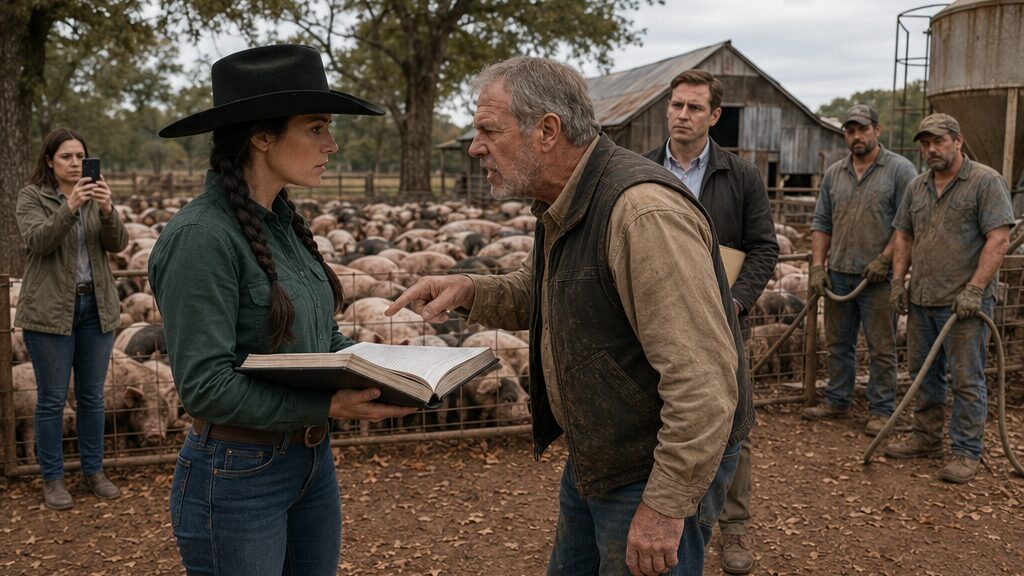
Raymond Clark pointed at Nicole’s ledger before she finished counting.
“That book’s wrong.”
His voice carried across the enclosure, above the squeal of young pigs and the metallic rattle of bodies pressing against the low wire fence. One of the seasonal farmhands stopped dragging a feed hose. The other turned from the water line. Near the gate, Jonathan Lewis lowered his phone and looked from Raymond to Nicole.
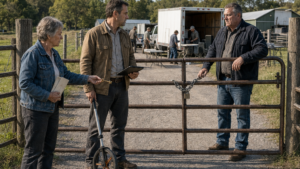
The local reporter kept filming.
Nicole rested her thumb beneath the line she had reached. One hundred eighty-seven animals stood, shoved, rooted, or slept inside the main enclosure. She had counted twice from the raised loading step, separating breeding sows from feeder pigs by tag color.
“I’m not finished,” she said.
“You were finished before you got here.” Raymond stepped close enough that the brim of his work cap nearly touched her black hat. “County office tells you what ought to be standing here, and your eyes just arrange themselves around it.”
Nicole did not move. Behind Raymond, three pigs fought over a strip of burlap, snapping it back and forth until it tore.
Jonathan cleared his throat. “Let her complete the verification.”
Raymond swung toward him. “She knows numbers. She doesn’t know these animals.”
The words found their mark because they were partly true.
Nicole knew feed-conversion ratios, breeding records, movement certificates, loan schedules, and the quiet ways bad paperwork could hide disease, neglect, or collateral sold twice. She had grown up on this property, but she had left before Raymond expanded the hog operation. Most of the animals before her had been born after her mother became too sick to answer Nicole’s calls without sounding tired.
She marked the final line.
“One hundred ninety-two,” she said.
Raymond laughed once, without humor. “Two hundred sixteen.”
The reporter shifted closer.
Nicole looked over the fence again. “There are not two hundred sixteen animals in this enclosure.”
“Didn’t say they were all in this enclosure.”
The farmyard became still in a way the pigs never did.
Nicole lifted her eyes from the page. “Where are the other twenty-four?”
Raymond spread both hands toward the farm as if the answer were obvious. The farrowing barn, equipment shed, feed bins, and wooded back acreage lay beyond him. “They’re where they need to be.”
“That isn’t a location.”
“It is when you know the place.”
Jonathan stepped between them without fully entering the space. His clean boots already had red mud around the soles. “The loan file identifies this farm as the housing location for all pledged livestock.”
Raymond’s face hardened. “The bank pledged them. I raised them.”
Nicole turned a page in the ledger. The official herd list showed two hundred sixteen active animals. Twenty-four were missing from the physical count, but the tag problem was worse. Three consecutive groups—yellow tags 411 through 418, blue tags 702 through 709, and red tags 880 through 887—did not appear anywhere in the enclosure.
Orderly absences were rarely accidental.
A missing animal could escape. A tag could tear out. A worker could transpose two digits. But eight animals from each of three sequences meant someone had selected them.
Nicole looked toward the feed bins. The delivery slips clipped inside the ledger showed consumption high enough to support at least two hundred ten animals over the previous six weeks.
Raymond saw where she was looking.
“Feed gets wasted,” he said.
“Not that much.”
“Rats.”
“Then you have rats eating nearly two tons a month.”
One farmhand looked down to hide a smile. Raymond heard it anyway.
He jabbed a finger toward Nicole’s open book. “Your mother knew better than to come out here waving paper at people.”
The sentence struck harder than his shouting.
Nicole closed her mouth before the first answer escaped. She could have told him that her mother had signed every deed, tax return, veterinary authorization, and loan renewal on the property. She could have reminded him that without paper, Raymond would be an employee claiming authority over land owned by two daughters he barely spoke to.
Instead, she turned the ledger so the others could see.
“Tags 411 through 418,” she said. “702 through 709. 880 through 887. You’re not missing random animals. You moved three selected groups.”
Raymond stopped pointing.
The reporter’s phone remained trained on him. Jonathan looked at the ledger, then at the barns.
Nicole felt a small, bitter satisfaction. It lasted less than a second.
Raymond had not denied it.
She faced the reporter, whose expectant expression made the scene feel cheaper than it was. Nicole gave a restrained smile, not because anything was funny, but because Raymond’s own answer had confirmed what the count alone could not.
“These animals were deliberately relocated,” she said. “Until we verify where and under whose authorization, the herd record cannot be certified.”
Raymond stood behind her shoulder. His anger had drained into something more guarded.
Jonathan asked the reporter to stop filming. The reporter lowered the phone but did not put it away.
“Here’s what happens now,” Jonathan said. “The lender requires a complete location record, movement dates, ownership documentation, and matching feed invoices.”
“How long?” Nicole asked.
“Forty-eight hours.”
Raymond made a sound under his breath.
Jonathan continued. “If the documentation doesn’t support the loan file, the account is referred for default review. The county may also examine land-use compliance.”
“The payment isn’t late,” Raymond said.
“This is a collateral issue.”
“They’re pigs, not stolen trucks.”
“They secure the operating note.”
Raymond looked past Jonathan toward the enclosure. A sow pushed her snout through the wire and worked her mouth against empty air. He rubbed the gray stubble along his jaw.
Nicole had seen that gesture before, years earlier, when her mother asked him a question he did not intend to answer.
The others dispersed after Jonathan set the deadline. The reporter walked toward her car, already typing. The farmhands resumed work but spoke more quietly. Raymond went into the farrowing barn without looking at Nicole.
She remained beside the fence.
The ledger felt heavier now that it had done what she wanted. It had established a discrepancy cleanly and publicly. It had also given Jonathan the grounds to turn a farm argument into an official threat.
Nicole flipped back through the active herd pages. Each tag range contained acquisition dates, vaccine marks, parent stock, and weight estimates. The entries appeared consistent until she reached the yellow sequence.
Beside tags 411 through 418, someone had written two initials in faded blue ink.
M.D.
Nicole stared at them until the shapes stopped looking like letters.
Her mother had signed her name that way on grocery lists, feed checks, birthday cards, and the note she left on Nicole’s suitcase the morning Nicole went to college.
The ink was more than a year old.
Nicole ran her thumb above it without touching.
Raymond had moved the pigs.
But her mother had marked the animals first.
Chapter 2: Her Mother’s Initials Were Written Beside the Missing Animals
The missing pages had been cut from the old ledger with a knife.
Nicole found the ragged stubs after lunch, when she carried three years of livestock books from the farm office to the long metal desk beneath the window. Pages 63 through 70 were gone from the previous year’s volume. Whoever removed them had sliced close to the binding, leaving thin numbered edges buried near the spine.
Raymond stood in the doorway with a coffee cup.
“Where are they?”
He looked at the ledger, not at her. “Could be anywhere.”
“They were cut out.”
“Then they didn’t wander off.”
Nicole held up the book. “My mother’s initials are beside the first missing tag range.”
Raymond took a drink.
“What did she authorize?”
“We’ll talk when Laura gets here.”
“This is not an estate meeting.”
“It became one when you found your mother’s handwriting.”
Nicole set the ledger down carefully. “Jonathan gave us forty-eight hours.”
“Jonathan’s been looking for a reason to tighten that note since grain prices dropped.”
“He doesn’t need to look anymore.”
Raymond’s jaw shifted. “That what you wanted?”
The question irritated her because she did not have an answer that sounded clean.
“I wanted an accurate count.”
“You got one.”
“No. I got proof that the official count was false.”
“That’s different from inaccurate?”
“You know it is.”
Raymond crossed the office and placed his cup beside the ledger. A dark ring spread across an old feed invoice. “Your mother understood the difference between lying and keeping something alive.”
Nicole felt the muscles in her neck tighten. “People usually say things like that right before they explain the lie.”
“Laura first.”
He left before she could stop him.
Nicole photographed the cut binding, the initials, and every page covering the missing sequences. Then she walked to the feed shed, where invoice boxes were stacked above mineral tubs and cracked buckets.
The delivery records should have been simple. Farm name, account number, weight, product, date.
Instead, the last six months included four account names.
Davis-Clark Farm appeared most often. Two invoices belonged to neighboring operations. A fourth had only a family surname she recognized from a mailbox on the county road.
The quantities were divided almost evenly.
Nicole called the feed supplier from the shed.
The man on the line hesitated when she read the invoice numbers. “Those are delivery splits.”
“To different properties?”
“Same truck route.”
“Who requested them?”
“Usually Raymond. Sometimes your mother, before she got bad.”
Nicole looked at the dust caught in a shaft of light above the doorway. “Were the loads physically separated?”
“Not always. Depends where the driver could get in.”
“So feed billed to another farm may have been unloaded here.”
“Or the other way around.”
“Why?”
A pause.
“You need to ask the people involved.”
“I am asking the person who issued the invoices.”
“And I’m telling you what the invoices prove. Feed was billed across several accounts. They don’t prove which hog ate which pound.”
It was a careful answer, probably learned through years of rural business conducted on trust until trust became evidence.
At the county records desk, Nicole requested parcel leases and livestock-use filings for every account listed. The clerk brought her a stack of copies held together with a black clip.
The main farm had approved hog use. The western parcel, separated from it by an old fence and a strip of woods, did not appear on the current operating lease.
Yet three veterinary movement notations referenced its field number.
Nicole drove back before dark.
Raymond was behind the farrowing barn repairing a hinge. She held the parcel copy where he could see it.
“You rotated animals through the western property.”
He kept working.
“It isn’t on the lease.”
“I know whose land it is.”
“That doesn’t give you the right to use it.”
“The owner gave me the right.”
“Then where is the agreement?”
Raymond drove the hinge pin in with two hard strikes. “Gone, probably.”
“Like the ledger pages?”
He lowered the hammer.
Nicole waited. Silence had always been her preferred tool. It made other people fill the space. Her mother used to say Nicole could outwait a fence post.
Raymond looked toward the woods. “The groups were moved on purpose.”
The admission brought no satisfaction now.
“All twenty-four?”
“Yes.”
“When?”
“Different times.”
“Who authorized it?”
“I already told you. Laura comes, we talk.”
“You didn’t tell me anything.”
“I told you the part that matters today.”
“No, you told me the part you can’t deny.”
Raymond’s eyes sharpened. For a moment she expected another explosion. Instead he looked tired.
“You think I was stealing from your mother?”
“I think you altered collateral records.”
“That wasn’t my question.”
Nicole glanced at the hammer in his hand, the repaired hinge, the rust stains on his sleeves. “I don’t know what you were doing.”
“That’s the first honest thing you’ve said since you got here.”
Her phone rang before she could answer.
Laura.
Nicole stepped away from Raymond and accepted the call.
“I’m coming tonight,” Laura said. Traffic hummed behind her voice. “But don’t agree to anything before I get there.”
“I found Mom’s initials in the herd book.”
Laura went quiet.
“You knew?”
“I knew she wrote in the books.”
“Pages are missing.”
“Nicole, listen to me. I contacted an auction representative this morning.”
Nicole turned toward the office window. “You did what?”
“We have a lender deadline and animals no one can account for.”
“I can account for where some of them went.”
“That is not the same as proving we own them.”
“You don’t call an auction before we know what happened.”
“I called before Jonathan decides for us.”
Raymond had stopped pretending not to listen.
Laura continued, “The representative can value the herd tomorrow. If we sell voluntarily, we control the timing.”
“You said you were coming to discuss it.”
“I am. I’m just not coming empty-handed.”
The call ended with Laura two hours away.
Raymond set the hammer on a fence post. “She always did prefer a receipt after the damage was done.”
Nicole ignored him and returned to the county copies. The western parcel map included the owner’s loan status in a small notation attached to a tax filing.
Delinquent.
A second document showed two liens and a scheduled review by the same lending office Jonathan represented.
The missing pigs had not been moved to unused family acreage.
They had been moved onto land owned by a neighboring farmer already close to losing it.
Chapter 3: The Neighboring Farms Had Been Feeding the Same Herd
Nicole recognized yellow tag 414 before the neighboring farmer finished saying there were no Davis animals on his property.
The gilt stood behind a welded panel under a corrugated shelter, mud dried along one flank. The yellow tag was scratched, but the final three digits were clear.
Nicole rested both hands on the top rail. “That one was born on our farm.”
The neighboring cattle farmer followed her gaze. “That one belongs to whoever paid to breed and feed her.”
“That isn’t how livestock ownership works.”
“It is how survival works.”
Raymond stood several yards behind Nicole, arms crossed. He had insisted on coming but had said almost nothing since they arrived. The neighboring farmer had said plenty, most of it contradictory.
First, the pigs were only being boarded. Then they were part of a breeding exchange. Then they had been transferred in payment for pasture work. Each explanation changed when Nicole asked for dates.
She opened the ledger to the missing sequence.
“Eight yellow-tagged gilts came here,” she said. “Where are the other seven?”
The farmer looked at Raymond.
Nicole noticed.
“Don’t ask him,” she said. “I’m asking you.”
“Two are here. Three went south to a sow operation. The rest went back after breeding.”
“Back to our farm?”
“Back into the arrangement.”
“There is no legal entity called ‘the arrangement.’”
The farmer’s expression hardened. “That’s easy to say when your paycheck doesn’t depend on a sick sow making it through the week.”
Nicole wrote down the locations he gave her. None matched the official movement records.
At the next property, blue tags 704 and 708 stood in a pen behind an equipment shed. The owner called them loaned breeding stock. At a third farm, red-tagged animals had produced a litter recorded under another family’s name.
By noon, the ledger had stopped describing animals and begun describing claims.
Each pig had one official owner, one physical location, one account paying feed, and sometimes a different farm claiming the offspring. The lines crossed until Nicole could no longer fit notes in the margins.
“You made them impossible to trace,” she told Raymond as they drove toward the veterinarian’s office.
“We kept track.”
“In your head.”
“In more than one head.”
“Which means no one person knew the whole system.”
“That was the point.”
Nicole turned toward him. “Why would confusion be the point?”
“If one farm got quarantined, the whole bloodline didn’t disappear with it.”
The veterinarian confirmed the disease scare.
Two years earlier, a respiratory outbreak had appeared in a commercial operation three counties away. Testing was delayed. Rumors moved faster than results, and buyers stopped taking pigs from small farms in the region. Several lenders began reevaluating livestock collateral.
“Nothing on the Davis place tested positive,” the veterinarian said. “But nobody knew how wide it would go.”
“So they scattered breeding animals,” Nicole said.
“Selected ones. Different lines, different properties.”
“Without complete movement certificates.”
The veterinarian folded his hands on the desk. “Some certificates were filed.”
“Some?”
“You’re asking me whether every movement happened according to procedure. No.”
Raymond stared at the wall.
Nicole looked down at her ledger. “Did it work?”
The veterinarian answered reluctantly. “It preserved the breeding lines. One farm lost access to buyers for four months. Another couldn’t afford replacement stock. The shared animals kept five operations from shutting down entirely.”
There it was—the first answer that made Raymond’s conduct look less like theft.
It also made the paperwork worse.
Nicole traced one blue-tagged sow through three farms, two feed accounts, and a litter sold under a fourth name. Sale proceeds had been used to pay a veterinary invoice on property that never legally owned the sow.
“Were taxes reported on those sales?” she asked.
The veterinarian leaned back. “That isn’t my area.”
“Were lenders told that pledged animals were being moved?”
“You know the answer.”
Raymond finally spoke. “They would’ve called the notes.”
“Maybe.”
“No maybe.”
“And hiding collateral gave them cause to call the notes anyway.”
“Two years later,” Raymond said. “After people stayed on their land.”
Nicole closed the ledger halfway. “You keep saying what happened as if that excuses how you did it.”
“No. I’m saying how we did it is why it happened.”
On the drive back, her phone filled with messages from Laura, Jonathan, and the county office. Laura wanted the auction inspection scheduled. Jonathan wanted all movement records by the following morning. The county requested clarification because Nicole’s initial discrepancy notice referenced livestock that might have crossed parcel boundaries without proper reporting.
She had filed that notice before asking Raymond why the counts differed.
At the time, it had felt disciplined. Neutral. Correct.
Now it was moving through offices faster than the truth could follow.
They stopped at the western parcel before returning to the main farm. Beyond the low wire fence, two sows rooted beneath oak trees while smaller pigs moved through leaves behind them. The nearly bankrupt owner watched from his porch but did not approach.
Nicole opened the ledger again.
“Which of these animals secures our operating loan?”
Raymond named four.
“Which secures his?”
Raymond did not answer.
Nicole looked at him. “The same animals?”
“On paper, maybe.”
Her stomach tightened. “You pledged the same breeding value twice.”
“We didn’t pledge anything twice.”
“You let two lenders believe they had separate collateral.”
“The banks valued herds. We valued what the herds could produce.”
“That distinction will not survive an investigation.”
Raymond leaned against the fence post. “Neither would those farms have survived doing it your way.”
Her phone sounded.
The message came from the county compliance office. It referenced her filed notice, the mismatched sales records, and possible misrepresentation of secured livestock. Her full audit had been requested for preliminary fraud review.
Nicole read it twice.
Raymond watched her face. “What is it?”
She turned the screen off.
The ledger in her hands no longer felt like proof against him. It felt like a door she had opened before checking who stood on the other side.
“My report has been referred,” she said.
“To who?”
“County counsel. Possibly the state agriculture office.”
The pigs shifted behind the wire, crossing from sunlight into shade without regard for the boundary line beneath them.
Nicole looked at the names she had written across three farms, then at the official owner column that allowed only one answer.
If she completed the record exactly as she now understood it, she could expose false sales, duplicate collateral, and unreported animal movements across five families.
If she softened any of it, she would become part of the concealment.
By the time she and Raymond returned to the truck, Nicole no longer wondered whether he had lied.
She wondered how many farms the truth would take with it.
Chapter 4: Laura Had Been Paying for a Farm She Wanted Sold
Laura placed the first canceled check beside Nicole’s audit before taking off her coat.
Then she added another.
And another.
By the time she stopped, the farmhouse kitchen table held six years of property-tax payments, veterinary balances, utility notices, and hospital bills, each flattened beneath Laura’s palm as though she expected the paper to rise and accuse her.
Nicole stood across from her with the livestock ledger still under one arm.
“You kept these?”
“I kept proof.”
“Why didn’t you tell me?”
Laura gave a short laugh. “You mean why didn’t I send you monthly updates from the life you left?”
The auction representative had not come with her, but his business card sat on top of the checks. That felt worse. Laura had not made an emotional threat. She had begun a process.
Raymond remained by the back door. He had washed the mud from his hands, but dirt still darkened the creases around his nails.
Nicole picked up a check written to the county tax office. Laura’s signature crossed the bottom in the quick slant Nicole remembered from school permission forms.
“This was the year Mom said the farm covered itself.”
“It didn’t.”
Another check paid the feed supplier. Another covered the deductible on their mother’s surgery.
“How much?” Nicole asked.
Laura folded her arms. “Enough.”
“That isn’t an answer.”
“It’s the answer I got every time I asked Mom.”
Nicole looked at the stack again. “Did Raymond know?”
Raymond stared through the screen door.
Laura answered for him. “Some of it.”
“Some?”
“He knew what the farm needed. He didn’t know what I was using to cover it.”
“What were you using?”
“Savings. Credit. The money from selling my house after the divorce.”
Nicole lowered the check.
Laura’s expression changed only slightly, but the restraint made the words heavier.
“You never told me you sold because of this.”
“I sold because I couldn’t afford the house alone. The farm made the timing worse.”
Nicole wanted to defend herself. The familiar language rose first: she had paid for college without help, built a career, taken every late call from their mother, returned whenever someone admitted there was a crisis. Each fact was true.
None belonged on the table beside Laura’s checks.
“I would have helped,” she said.
Laura looked at her for a long moment. “Mom said you already had.”
The refrigerator clicked off. Without its hum, the kitchen seemed to contract around them.
Nicole turned to Raymond. “What does that mean?”
He reached for the door handle.
“Don’t,” Laura said.
Raymond stopped.
Laura opened the small spiral notebook she had carried in her purse. Its cover was bent, and several pages had been repaired with tape. She placed it beside the official ledger.
On the left were dates and amounts. On the right were brief notes: taxes, medicine, feed, roof, electric, transport.
Nicole recognized her mother’s habit in the abbreviations, although the handwriting was Laura’s.
“Mom called me when she needed money,” Laura said. “She called Raymond when she needed something fixed. She called you when she wanted to hear about somewhere else.”
Nicole’s fingers tightened against the back of a chair.
“That isn’t fair.”
“No. It isn’t.”
“I came when she asked.”
“She stopped asking.”
Raymond moved from the door. “Laura.”
“You don’t get to soften it now.”
He pressed his lips together.
Nicole opened the ledger to the page bearing their mother’s initials. “She approved the animal transfers.”
Laura glanced at the page. “Some of them.”
“You knew?”
“I knew there was an arrangement. I didn’t know they were using the same animals against separate loans.”
Raymond said, “That wasn’t how it started.”
Laura turned on him. “Nothing starts the way it ends around here.”
Nicole saw him absorb the sentence without resisting it.
She sat at the table and placed the two books side by side. The livestock ledger had numbered pages, ruled columns, and official headings. Laura’s notebook had no system beyond persistence. Yet the private book accounted for every month the public records claimed the farm had survived on its own.
“What did Mom tell you about me?” Nicole asked.
Laura did not answer immediately.
Raymond looked toward the sink.
Nicole understood before either spoke. “She told you not to call me.”
Laura’s eyes shifted to Raymond.
He rubbed the back of his neck. “When she got worse, she made it plain.”
“How plain?”
“She said you’d spent half your childhood keeping the rest of us from falling apart.”
Nicole felt heat rise into her face. “So she decided to lie to me.”
“She decided you were allowed a life.”
“That wasn’t her decision.”
“No,” Raymond said. “But she made it.”
Nicole stood so quickly the chair legs scraped the floor.
All those phone calls in which her mother had said the treatments were manageable. All the weekends Nicole offered to come home and was told there was nothing to do. All the careful conversations about work, apartments, promotions—proof, Nicole had believed, that leaving had not become abandonment.
They had curated her distance.
“You all let me think she didn’t need me.”
Laura’s mouth tightened. “She needed everybody. That was the problem.”
“And you just accepted it?”
“I argued with her. Then the tax bill came.”
Nicole looked down at the checks. Her anger found no single place to land.
Laura pulled the auction card from the stack. “This is why I want to sell. Not because I hate the farm. Because every person who loves it has been expected to disappear into it.”
Raymond stepped forward. “Selling the whole place isn’t necessary.”
“I will not support any plan that leaves you in charge of the money or the records.”
His face hardened. “I kept this operation alive.”
“You also made sure no one else knew what alive cost.”
A floorboard creaked in the dark hallway.
All three turned.
Raymond had been standing in the kitchen, but the sound came from the mudroom beyond it. The screen door there eased shut.
Nicole crossed the room and looked outside.
A truck engine started near the equipment shed.
She returned to the table. Raymond’s coat was gone from its hook, though she had never seen him take it.
The man who had been listening by the doorway had left before they finished deciding what to disclose.
Laura looked toward the receding headlights.
“He heard us say we might report everything.”
Nicole closed the official ledger.
Outside, Raymond’s truck turned toward the farrowing barn instead of the county road.
Chapter 5: Raymond Locked the Gate and Called It Stewardship
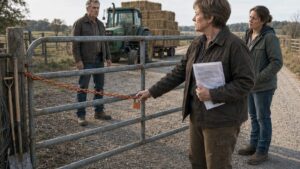
The chain around the main gate was new.
Nicole saw its bright steel links before she saw Raymond standing on the other side. He had looped it twice through the cattle panels and secured it with a heavy padlock.
Behind Nicole, Jonathan’s county vehicle idled beside the road. The livestock veterinarian sat in the passenger seat, holding the official recount forms against the dashboard.
Jonathan stepped out. “Open the gate, Raymond.”
“No.”
It was the first time Raymond had answered him without raising his voice.
Nicole approached the chain. “What are you doing?”
“Preventing a bad decision made in a hurry.”
“The recount was scheduled.”
“Then reschedule it.”
Jonathan looked at Nicole. “You said the operator would cooperate.”
“I believed he would.”
Raymond’s eyes stayed on her. “You believed what was convenient.”
Nicole took the ledger from her bag. “The county has authority to inspect the pledged herd.”
“The county can come back with the sheriff if that’s what everybody needs.”
The veterinarian looked away.
Nicole rested the ledger against the gate. “You moved animals last night.”
Raymond said nothing.
“Where?”
“Safe.”
“From whom?”
“From this.”
He touched one finger to the ledger through the wire.
Jonathan raised his phone. “I’m documenting refusal of access.”
“You document everything except what happens after you leave,” Raymond said.
Jonathan’s face tightened, but he did not respond. He returned to the vehicle to make a call.
Nicole stared at Raymond through the gate. “Laura and I have not decided to sell.”
“You decided plenty when you filed that notice.”
“I filed what the count showed.”
“You filed before asking why.”
The accusation was true, which made it difficult to answer without hiding inside procedure.
Nicole closed the ledger.
Raymond noticed.
“I’m asking now,” she said. “Where are the animals?”
He looked toward the farrowing barn.
Nicole followed the glance. Above the low roofline, she could see the top edge of a livestock trailer where no trailer had been parked the day before.
She climbed the roadside ditch and walked along the fence.
“Nicole,” Jonathan called.
She continued until the tree line concealed her from the gate. The old boundary fence sagged beneath honeysuckle. She found the place where pigs had pushed under years ago and stepped carefully across.
Raymond reached her near the barn.
“You’re trespassing now?” he asked.
“On land I partly own?”
“You’ve made ownership mean whatever helps you.”
“So have you.”
The trailers stood behind the farrowing barn, two of them backed against the loading lane. Straw clung to their ramps. One engine block still ticked with cooling metal.
Nicole looked through the slats. Empty.
“How many did you move?”
Raymond did not answer.
“Were these the remaining breeding animals?”
“I wasn’t selling them.”
“That is not the only way to lose them.”
“I was taking them where they couldn’t be inventoried into somebody else’s decision.”
“You mean hidden.”
“I mean protected.”
Nicole opened the nearest trailer door. A blue ear tag lay in the straw near the wheel well. She picked it up.
The tag belonged to one of the missing sequences.
“You moved them again after learning the county was involved.”
“I moved them before Jonathan could freeze every farm connected to this.”
“And now the movement itself proves concealment.”
Raymond stepped close. “You think words change what a thing is.”
“Words determine who is responsible.”
“That’s why you like them.”
Nicole held the tag between them. “Where are the pigs?”
“You’ll know when I know they won’t be seized.”
Jonathan’s voice carried from the gate. “County counsel says refusal will be included in tomorrow’s hearing.”
Raymond looked past Nicole toward the sound.
She lowered the tag. “There was an agreement with my mother.”
His shoulders shifted.
“I found references to it,” she said. “Not the full document.”
“Because there wasn’t a full document.”
“What was there?”
Raymond entered the farrowing barn. Nicole followed.
He moved a stack of empty vaccine cartons from a shelf and pulled down a narrow metal cashbox. Inside were folded receipts, veterinary notes, and half a legal pad covered in her mother’s handwriting.
Nicole unfolded the pages.
The agreement named five farms. It listed breeding groups, emergency feed responsibilities, and a plan to formalize ownership after the disease restrictions ended. The last section stopped midway through a sentence.
No signatures.
No date of termination.
No collateral disclosures.
“She meant to finish it,” Raymond said.
“But she didn’t.”
“She got sick.”
“And you kept operating under an unfinished plan.”
“People were still depending on it.”
Nicole looked at the final line. Her mother had written: Each family will receive credit according to—
Nothing followed.
The unfinished sentence seemed more honest than any completed entry in the livestock ledger.
“Why didn’t you show me this Monday?”
Raymond leaned against the stall divider. “Because you would’ve done exactly what you did.”
“Filed the discrepancy?”
“Turned it into a problem that could be solved without you.”
Nicole folded the pages. “You don’t know that.”
“Your mother did.”
The words landed between them.
Raymond looked toward the empty loading lane. “She didn’t keep you away because she thought you were weak. She kept you away because she knew you’d stay once you saw what was needed.”
Nicole said nothing.
“She talked about your job like it was a place she built with her own hands,” he continued. “Every promotion. Every apartment. She’d tell me the distance meant the farm hadn’t swallowed both daughters.”
“And Laura?”
His face tightened. “Laura was already paying bills before your mother understood what that was costing her.”
“You let her.”
“I didn’t know all of it.”
“You knew enough.”
“Yes.”
It was the first admission he gave without defense.
Outside, Jonathan struck the gate chain with something metal, testing it.
Raymond looked toward the sound. “I’ll tell them I moved everything. I’ll say your mother never approved it.”
“That would be false.”
“It puts the responsibility where it belongs.”
“It would invalidate the loan anyway. It could pull the neighboring farms into a criminal inquiry when their records don’t match your statement.”
“They don’t need you carrying this.”
Nicole looked at the half-written agreement.
Her mother had tried to spare her by withholding responsibility. Raymond was attempting the same thing now, with guilt instead of love and nearly the same arrogance.
“You do not get to decide what I carry.”
He met her eyes.
Nicole placed the livestock ledger on a feed barrel and shut it.
For the first time since arriving, she did not hold it between them.
At the gate, Jonathan had ended his call. “We need a decision.”
Nicole walked back through the broken section of fence and approached him.
“The recount cannot proceed,” she said.
“I gathered that.”
“My original discrepancy report was incomplete.”
Jonathan’s gaze sharpened. “Incomplete how?”
“I documented the count before investigating the operating arrangement and the movement history.”
“You reported what you observed.”
“I reported a conclusion the evidence did not yet support.”
Behind the fence, Raymond stopped beside the chain.
Jonathan lowered his voice. “Be careful what you put on record.”
“That advice would have been useful Monday.”
“If you withdraw the report now, it may look like pressure from the operator.”
“I’m not withdrawing the facts. I’m correcting the interpretation.”
“That correction could expand the inquiry.”
“I know.”
Jonathan studied her as though deciding whether she remained useful to him.
“The hearing is at nine tomorrow,” he said. “Bring every record. The county will decide whether the account can be restructured or must be referred.”
Nicole looked back at Raymond. He had one hand on the padlock but had not opened it.
“My audit failed to include the context,” she said. “That failure was mine.”
Jonathan’s expression gave her no clue whether the admission had saved an option or destroyed one.
He returned to the vehicle.
Raymond finally unlocked the gate, but the county team did not enter.
The chain fell into the dirt between them.
Chapter 6: The Hearing Could Save the Land Only by Exposing the Lie
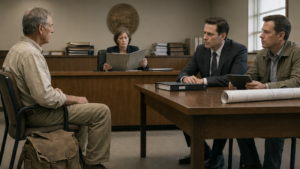
Jonathan opened Nicole’s original report and asked whether she still stood by it.
The county hearing room held fewer than thirty chairs, but every one was occupied. Farmers from the five connected properties sat along the back wall. Laura was beside Nicole at the front table. Raymond sat on her other side, wearing the same dark vest he had worn at the enclosure.
The corrected ledger rested unopened before Nicole.
“I stand by the physical count and the missing tag sequences,” she said. “I do not stand by the conclusion that they represented an isolated unauthorized transfer.”
A committee member adjusted his glasses. “Were the transfers authorized?”
“Some were authorized privately. None were documented adequately for the loan, tax, or county records.”
“So your answer is no.”
“My answer is that the authorization was real and the compliance was not.”
Jonathan leaned toward his microphone. “That distinction does not change the lender’s collateral concern.”
“No,” Nicole said. “It changes who knew what, when they knew it, and why the animals were moved.”
Raymond shifted in his chair.
Nicole opened the corrected ledger.
The old volume had treated each animal as a single line. Her revision required several. Official owner. Physical location. Feed account. Breeding contributor. Sale recipient. Loan claim. Every shared animal now carried a trail across the page.
The committee chair looked down at it. “You prepared this overnight?”
“With help from the veterinarian, feed supplier, county records, and each participating farm.”
“Each?”
“Four cooperated. One gave partial records.”
Raymond’s jaw moved.
Nicole continued before he could speak. “The system preserved breeding stock during the regional disease scare and subsequent buyer freeze. It helped five farms continue operating.”
A murmur moved through the back row.
“It also concealed animal movement, divided sales among accounts that did not always match ownership, and allowed lenders to value overlapping breeding assets.”
Jonathan said, “Duplicate collateral.”
“Overlapping value,” Raymond cut in.
Nicole turned to him. “Not here.”
His face reddened, but he fell silent.
The committee chair asked, “Did your mother create this system?”
“She helped create it.”
“Did you know?”
“No.”
“Did your sister?”
Laura’s hand rested beside the spiral notebook she had brought from the farmhouse.
“She knew there was shared stock,” Nicole said. “She did not know the full collateral structure.”
Jonathan looked at Laura. “You paid operating expenses for the property during this period.”
Laura glanced at Nicole, then faced the committee. “Taxes, medical bills, utilities, feed shortages.”
“Were you reimbursed?”
“No.”
“Did you expect ownership credit?”
“I expected my mother to live long enough for us to sort it out.”
The room became quiet.
A committee member asked why Nicole had been excluded if she was a co-heir and livestock-record professional.
Nicole felt Raymond turn slightly toward her.
Laura answered before he could.
“Our mother ordered Raymond not to call her home.”
Nicole looked at her sister.
Laura’s voice remained controlled. “Nicole had spent years handling every family emergency. Mom believed that if Nicole knew how bad the farm and the illness had become, she would leave her job and come back permanently.”
“Was that likely?” the chair asked.
Laura looked at Nicole. “Yes.”
There was no accusation in the answer. That made it harder to hear.
Nicole placed both hands on the corrected ledger.
“My lack of knowledge was intentional,” she said. “But my initial report was still my responsibility. I used the available count to reach a conclusion before asking why the records differed. I treated procedure as if it removed the need for judgment.”
Jonathan watched her closely. “Are you suggesting the county ignore the violations because the motive was sympathetic?”
“No.”
Raymond turned toward her.
Nicole continued, “The motive explains the system. It does not make the system safe. No farm should depend on one man’s memory, one dying woman’s unfinished notes, and five families being too frightened to ask what they legally own.”
Raymond’s hands closed around the edge of the table.
She opened the ledger to the traced herd pages.
“I am submitting a full correction. Every animal we could locate is listed. The missing sales are identified. Feed obligations and breeding interests are separated from legal ownership. Where records conflict, I marked the conflict instead of choosing the answer most favorable to this farm.”
The chair examined the pages. “And the animals moved yesterday?”
Raymond leaned toward his microphone. “That was me.”
Nicole said, “Yes. Raymond moved them to prevent immediate seizure. I did not authorize it.”
“I’ll accept sole responsibility,” he said.
“No,” Nicole replied.
He stared at her.
“You acted alone yesterday. You did not create the entire arrangement alone. A false confession is still a false record.”
One of the farmers in the back lowered his head.
Jonathan closed the original report. “Even with correction, the lender cannot continue under the current structure. The pledged herd cannot be verified as exclusive collateral. The operating note is in breach.”
The sentence sounded final because he delivered it without emphasis.
Nicole had once trusted that tone.
“What options remain?” she asked.
Jonathan glanced toward the committee chair. “Liquidation. Voluntary sale sufficient to retire the note. Or a restructured entity with verified ownership, independent record controls, and additional security.”
Laura spoke quietly. “What additional security?”
“Land not already burdened by disputed operating claims.”
“The back parcel,” Raymond said.
Nicole looked at him.
The unused acreage ran beyond the woods, dry enough for grazing but too far from the water system for the hog operation. It had belonged to Nicole’s grandfather. Raymond spoke of it as though history itself had fenced it off.
The chair said, “The county could consider a documented livestock cooperative, but not under sole operator control.”
Raymond sat back. “Meaning?”
“Shared governance. Outside accounting. Movement reporting. Separate collateral schedules.”
“I’ve run that farm thirty years.”
“And the current system brought us here,” Jonathan said.
Raymond’s face tightened.
Laura opened her notebook. “If land is sold, my tax advances are paid before anyone puts more money into the operation.”
Raymond turned toward her. “There may not be enough.”
“Then there is no agreement.”
Nicole saw the old pattern begin again: Raymond defending the whole farm as if losing a piece meant dishonoring the dead; Laura defending repayment because no one had acknowledged what she had already given; Jonathan reducing uncertainty until human motives disappeared from view.
All of them were right about something.
That was why the farm was failing.
The committee chair folded his hands. “We will recess for thirty minutes. If the owners cannot present a viable structure, the county will proceed on the assumption that voluntary liquidation is the least damaging option.”
Chairs scraped across the floor. The farmers at the back began speaking in low voices.
Raymond remained seated.
“Your mother would never have sold that parcel,” he said.
Nicole closed the corrected ledger. “My mother also intended to finish the agreement.”
“That land is the last part nobody touched.”
Laura looked at him. “Nobody touched it because I paid the taxes.”
He flinched.
Nicole stood.
Jonathan gathered his files. “Thirty minutes is not enough to build a cooperative.”
“No,” Nicole said. “But it is enough to decide what we are willing to risk.”
She asked the chair for the recess room and carried the ledger with her.
At the doorway, she turned to Laura and Raymond.
“I have an offer,” she said. “Neither of you is going to like it.”
Chapter 7: They Could Keep the Herd, but Not the Farm They Remembered
Nicole offered her inherited share as the cooperative’s compliance guarantee before Raymond had finished sitting down.
The recess room was small enough that the four of them could not avoid one another’s eyes. Jonathan stood near the door with his files against his chest. Laura sat at the narrow conference table, one hand over her payment notebook. Raymond remained standing.
“You can’t pledge your share without mine,” Laura said.
“I’m not pledging the land by myself. I’m pledging my interest in the operating entity we create.”
“There is no entity.”
“There will be if we agree.”
Raymond shook his head. “You came here three days ago looking for a clean way out.”
“I was wrong.”
The words stopped him more effectively than an argument.
Nicole opened the corrected ledger to the last page, where she had drawn a proposed ownership schedule during the hearing. The handwriting was cramped but legible.
“The back parcel is sold,” she said. “The proceeds retire enough of the operating note to make restructuring possible. Laura’s documented tax and medical advances are repaid first. The remaining herd goes into a cooperative owned by the participating farms according to verified breeding interest and legal contribution.”
Raymond looked at the page but did not move closer.
“Who runs it?” he asked.
“No one alone.”
“That means no one runs it.”
“It means animal movements require two approvals. Sales are recorded under the cooperative. Feed charges are assigned monthly. An outside accountant reviews the records.”
“And when a sow needs moving at two in the morning?”
“You move her. Then you report it.”
He gave her a flat look. “That sounds simple when you’ve never done it.”
“No. It sounds necessary because I’ve seen what happens when only you know.”
Laura tapped the payment notebook. “Where am I in this?”
“Co-owner. Creditor until you are repaid. Voting member after that, if you want it.”
“If I don’t?”
“You keep your land share and appoint a representative.”
Laura studied her. “And you?”
“I stay for one year. I build the record system, complete the compliance reports, and train someone local to maintain it.”
Raymond’s expression changed. “You have a job.”
“I know.”
“You’re going to leave it?”
“I’m taking a leave.”
“You already decided?”
“No. I’m deciding now.”
Jonathan finally spoke. “Your personal guarantee would expose you if the cooperative fails.”
Nicole closed the ledger halfway. “So would pretending the farm can keep operating as it did.”
Raymond turned toward the window. Beyond the glass, the back parcel rolled toward the tree line in a long strip of dry grass. Nicole had crossed it as a child to reach the creek, believing boundaries were permanent because adults spoke of them that way.
“That land belonged to your grandfather,” Raymond said.
“And the debt belongs to us.”
“He never sold an acre.”
“He never had this loan.”
Raymond faced her. “You think keeping the barns and losing the land is saving the farm?”
“No. I think it is saving what can still work.”
He looked down at the proposed schedule. “I won’t sign away control to people who don’t know the herd.”
Laura stood. “Then the whole farm sells.”
Raymond’s head snapped toward her.
She placed her notebook beside Nicole’s ledger. “You keep speaking as if you are the only person who paid to keep this place alive. I paid taxes while you moved animals nobody could trace. I paid the electric bill while Mom told Nicole everything was fine. If there is a cooperative, my money is recognized, my ownership is recognized, and you do not get the final word because you shout first.”
Raymond’s face went pale beneath the weathering.
For several seconds, the only sound was the murmur of voices through the hearing-room wall.
Then he pulled out a chair.
“What percentage?” he asked.
They returned before the committee with seven minutes left in the recess.
The agreement was not complete, and Jonathan said so. The ownership shares would require verification. The parcel appraisal could change the repayment schedule. The lender would demand monthly reporting, movement certificates, independent accounting, and restrictions on new borrowing.
The county imposed a compliance penalty small enough to survive but large enough to matter.
No one called it mercy.
Raymond signed only after the chair stated plainly that refusing would move the estate toward liquidation. Laura signed after a repayment priority was added in writing. Nicole signed last, placing her inherited operating interest behind the cooperative’s obligations for one year.
When she lifted the pen, Raymond was looking at her.
“You don’t have to stay,” he said quietly.
“That was never yours to decide.”
He nodded once.
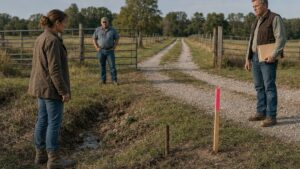
The unused parcel sold six weeks later to the neighboring cattle farmer, who needed grazing land more than access to the hog operation. The sale line cut through the property where Nicole’s grandfather’s fence had once stood. Raymond watched the survey stakes appear and said nothing.
Laura received the first repayment on a Friday. She checked the amount twice, folded the statement, and put it into her old spiral notebook.
By early autumn, the farm office no longer smelled only of dust and feed. Nicole had replaced the damaged desk, installed locking file cabinets, and mounted a whiteboard listing every animal movement awaiting confirmation.
The old livestock ledger remained on the shelf.
She did not throw it away.
The new cooperative book had wider columns. Legal ownership appeared first, followed by physical location, breeding interest, feed responsibility, and collateral status. No animal could be entered without two signatures.
Raymond complained about the system for the first month. Then he began leaving movement slips on Nicole’s desk before sunrise.
One cool morning, a sow delivered nine piglets in the farrowing barn. Nicole stood at the rail while Raymond checked each one, his hands moving with the same certainty that had once made him believe explanation was unnecessary.
She opened the new ledger.
“Dam number?”
He told her.
“Time?”
“Four sixteen.”
“Any assistance?”
“Last two.”
Nicole recorded the details, then turned the book toward him.
Raymond read the entry before signing. His finger paused above the line.
“Your mother would’ve written ‘nine alive’ and gone back to work,” he said.
“She would’ve remembered everything else.”
“Probably.”
Nicole looked at him.
He rubbed the stubble along his jaw. “That didn’t mean the rest of us did.”
It was not an apology. It was closer than anything he had offered.
Nicole signed beneath him. Laura’s name appeared on the ownership page at the front, no longer hidden inside a private notebook. The other farms had their own sections, their obligations written beside their rights.
Outside, the pigs pressed against the low wire fence, testing it in the places they always had.
Raymond waited until Nicole closed the ledger.
Then he pointed toward the smallest piglet, which had worked its way beneath the sow’s front leg.
“You missed one detail,” he said.
Nicole looked again.
The piglet had a narrow white mark over one eye.
She reopened the ledger.
This time, Raymond did not tell her the book was wrong.
The story has ended.