She Tore Up the Farm Sale, Then the Purple Flowers Exposed What Everyone Had Missed
Chapter 1: The Contract at the Edge of the Green Field
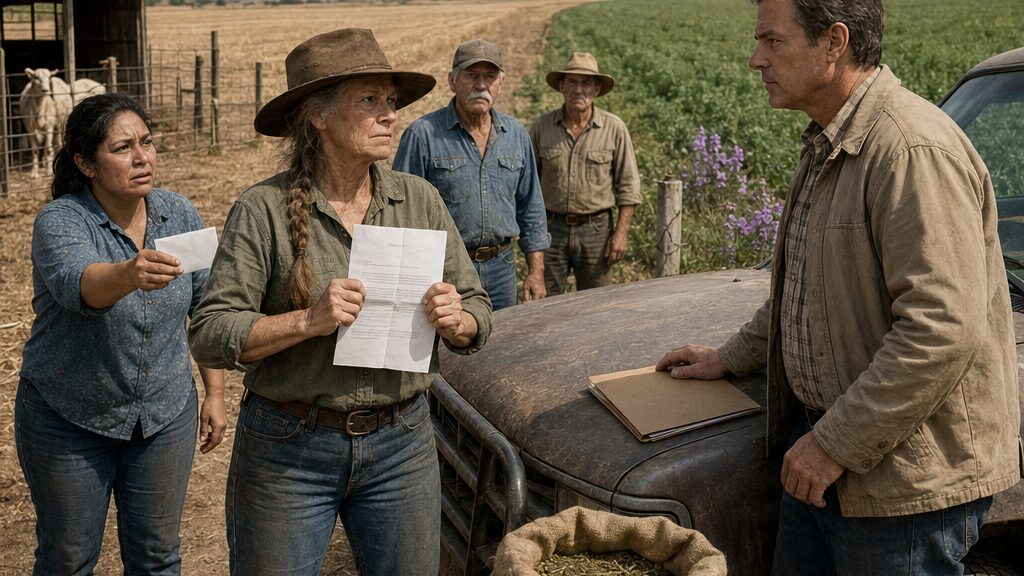
Joseph Allen held the purchase agreement out over the hood of Kathleen Davis’s truck while the unopened bank notice worked its way farther out of her shirt pocket.
The white edge of the envelope flashed whenever she breathed.
Joseph noticed it. His eyes moved there once, then returned to her face with the deliberate courtesy of a man pretending not to have seen something.
“You should read the revised terms before you decide,” he said.
“I decided when you called yesterday.”
“You hadn’t seen the number yesterday.”
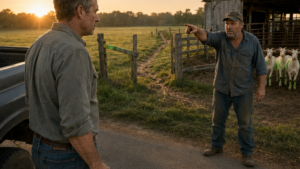
Behind him, the western field divided the land like an argument. On one side, the harvested alfalfa lay pale and brittle beneath the late-summer sun. On the other, a ragged green strip followed the shallow depression toward the old irrigation ditch. A few light-colored goats pressed against the wire beyond the livestock shed, complaining because Kathleen had delayed their feed.
At her boots sat an open burlap sack of alfalfa pellets.
Joseph placed the agreement on the truck hood and kept one palm on it against the wind. He had dressed for the farm without quite dressing like a farmer: clean jeans, checked shirt, beige jacket despite the heat. Dust had settled only along the edges of his boots.
Kathleen left the paper where it was.
“The acreage figure is wrong,” she said.
Joseph glanced down. “It came from the county assessor.”
“The assessor counts the drainage strip as cultivable ground.”
“It is part of the parcel.”
“That wasn’t what I said.”
His mouth tightened almost invisibly. “The offer covers the entire parcel, including the house, the livestock structures, the equipment shed, and the attached water allocation.”
“Seasonal allocation.”
“The current record says attached agricultural allocation.”
“The current record is incomplete.”
Joseph gave the field a patient look, as though the brown half of it had already settled the matter. “Kathleen, nothing in this document prevents you from having your own attorney review it.”
“I’m sure your people would appreciate that.”
“My people are trying to give you an option before the lender removes your options.”
The envelope in her pocket seemed to sharpen against her ribs.
She reached past the agreement and took her work gloves from the hood. “You don’t know what the lender is doing.”
Joseph said nothing.
That silence told her enough.
The goats called again. Kathleen lifted the feed sack, although the pull in her shoulder warned her she should have dragged it instead. She carried it toward the shed, making Joseph follow if he wanted the conversation.
He did.
“The offer would discharge the secured note,” he said. “It would clear the equipment liens. You’d have enough left to relocate without carrying the debt.”
“This is my location.”
“You know what I mean.”
“I know exactly what you mean.”
The old shed leaned slightly east, its boards silvered by years of sun. Kathleen set the sack beneath the awning and cut the twine. A dry, sweet smell rose from the pellets.
Joseph stopped outside the shade. “You could keep the livestock through closing.”
“That generous?”
“It’s practical.”
“For whom?”
He exhaled through his nose. “The company has been fair.”
Kathleen straightened. Beyond him, movement on the county road raised a low trail of dust. A blue sedan turned through the open gate.
Maria.
Kathleen felt the bank notice against her chest again and pushed it deeper into her pocket.
Joseph followed her gaze. “Did you tell her I was coming?”
“No.”
“Maybe you should have.”
“That advice included in your commission?”
The sedan stopped beside the truck. Maria Perez stepped out holding her phone and a canvas folder. She wore office shoes that immediately sank into the soft dirt near the trough.
“You said the pump invoice was in the kitchen,” Maria called.
Then she saw Joseph.
Her face changed before she reached them—not surprise exactly, but recognition followed by calculation.
“Mr. Allen,” she said.
“Maria.”
Kathleen looked between them. “You two know each other?”
“He emailed the preliminary offer to the farm account,” Maria said.
“You opened it?”
“I manage the books.”
“You pay invoices.”
“That would be easier if I knew what money was coming in.”
Joseph moved toward the truck. “The revised figure is on the first page.”
Maria reached it before Kathleen could stop her. She read in silence. Her eyes paused on the total, moved down, then returned to it.
“This is more than the email,” she said.
“The company adjusted for the equipment structures and accelerated closing,” Joseph replied.
“How much more?” Kathleen asked, though she had seen the figure that morning.
Maria looked at her. “You already read it.”
“I’m asking what has you staring.”
Maria told her.
The number sounded different spoken aloud in the field. Large enough to make the dead acreage disappear. Large enough to turn debt into arithmetic instead of shame. Large enough that the goats, the shed, the broken pump, and the dry canal all seemed briefly priced and labeled.
Maria lowered the agreement. “This pays everything.”
“It buys everything,” Kathleen said.
“It pays the liens.”
“The baler lien is nearly cleared.”
“It is not nearly cleared.”
Joseph shifted his weight but had the sense not to interrupt.
Maria opened the canvas folder. “The July payment was returned. The pump company sent a final demand. We have payroll Friday.”
“We’ll sell the north hay.”
“The north hay is already pledged to the feed account.”
Kathleen stared at her daughter.
Maria’s voice dropped. “You told them?”
“I handled it.”
“You promised we weren’t borrowing against inventory.”
“I said I was handling it.”
“That is not the same thing.”
A breeze crossed the field and lifted the top page of the agreement. Joseph caught it before it folded over.
Kathleen stepped closer and tapped the parcel description with one dirt-lined fingernail. “This says one hundred eighty-six irrigable acres.”
Maria looked down. “Isn’t it?”
“One hundred seventy-three in regular rotation. Seven seasonal. Six drainage and habitat margin.”
Joseph said, “The company is buying land, not your planting schedule.”
“And this says the eastern well serves both parcels. It doesn’t. The shallow well was capped in 2009.”
“The valuation doesn’t depend on that well.”
“Then why include it?”
Joseph’s patience slipped. “Because the legal description includes appurtenant infrastructure.”
“Dead pipe is not infrastructure.”
Maria studied the pages more carefully now. “Why would they pay more for acreage they described wrong?”
Joseph’s gaze moved to her. “Because closing certainty has value.”
“To whom?” Kathleen asked again.
This time he answered.
“To a company assembling contiguous parcels before the next planning cycle.”
The words landed softly, but Kathleen heard the concealed edge. “What planning cycle?”
“Internal scheduling.”
“That isn’t what I asked.”
“It’s what I can answer.”
The green strip at the far side of the field shifted in the wind. Among the leaves, something purple appeared and vanished. Kathleen had noticed the color the week before and dismissed it as thistle. Now the brief flash caught her attention again.
Joseph gathered the pages into alignment.
“The written offer expires forty-eight hours from noon,” he said.
Maria looked up. “Forty-eight hours?”
“The lender’s review is already in process. After the deadline, the company may redirect the acquisition budget.”
Kathleen heard only the first part. “What review?”
Joseph’s expression told her he regretted the wording.
Maria turned to Kathleen. “What review?”
“No one has scheduled anything.”
Joseph closed the folder around the agreement. “I’m not authorized to discuss your loan.”
“But you’re authorized to use it against me,” Kathleen said.
“I’m telling you the time matters.”
“To your company.”
“To everyone involved.”
The goats knocked against the gate, and one of the hinges gave a metallic crack. Kathleen moved automatically, lifting the latch and pushing the animals back with her knee. Her hands knew what to do even while her thoughts narrowed around the deadline.
Forty-eight hours.
She had expected another month. Perhaps three weeks if the lender grew impatient. Enough time to move the north hay, negotiate the pump bill, and ask for an extension without Maria ever knowing how close the note had come.
Joseph placed the agreement on the truck hood again.
“I’ll return tomorrow,” he said. “Read it. Call whoever you trust. But don’t confuse rejecting me with defeating the bank.”
He walked toward his vehicle.
Maria waited until the door closed behind him.
Then she held out her hand. “Give me the notice.”
Kathleen reached for the feed scoop. “The goats haven’t been fed.”
“The envelope in your pocket.”
“It’s nothing you need.”
Maria stepped closer and pulled it free before Kathleen could turn away. The flap was still sealed. Across the front, beneath the lender’s return address, was a bold red line:
NOTICE OF DEFAULT—ACTION REQUIRED.
Maria looked from the envelope to her mother.
“How long?” she asked.
Kathleen could not make herself answer.
Maria tore it open.
Chapter 2: The Paper She Tore Before Anyone Could Stop Her
Joseph returned before noon with a revised agreement, two neighboring growers, and the kind of careful expression people wore when they expected Kathleen to embarrass herself.
Maria stood beside the truck with the default notice folded in her back pocket. She had barely spoken since reading it. What she had said had been worse than shouting.
Twenty-three days past due.
Equipment liens Kathleen had described as manageable.
A foreclosure review that could begin within a week.
Joseph’s vehicle stopped near the western field. Larry Wright climbed from his own pickup behind him. Another neighbor followed, hat in hand, visibly unhappy to be present.
Kathleen looked at Maria. “You called Larry?”
“I called someone who understands the irrigation district.”
“You called an audience.”
“I called help.”
Joseph crossed the dirt carrying a fresh document folder. “I asked them to witness the offer. Nothing more.”
Larry rubbed the back of his neck. “He said you might want someone local here.”
“I’ve been local longer than he has.”
“That isn’t the issue.”
“It becomes the issue whenever someone wants my land.”
Joseph opened the folder on the hood. “The company has removed the equipment shed from the valuation discrepancy and added a temporary livestock occupancy provision. You can remain through the end of the season.”
Kathleen did not touch the pages.
The second grower studied the dry field and then the green strip. “It’s not a bad exit, Kathleen.”
She turned toward him. “Exit from what?”
He looked away.
Maria stepped between them. “Mom, read it.”
“I read the first one.”
“This one is different.”
“That is how pressure works. They change the shape and call it choice.”
Maria’s jaw tightened. “The bank doesn’t care what shape it is.”
Joseph kept his voice level. “The revised offer expires at noon tomorrow. We can fund the payoff directly through escrow. No interruption, no public sale, no equipment seizure.”
There it was—the picture he wanted everyone to see. Kathleen being spared the humiliation of strangers walking through the shed and attaching lot numbers to her father’s tools.
Larry shifted closer. “Maybe listen before you decide.”
“I am listening.”
“No, you’re waiting for him to stop talking.”
Kathleen looked past them toward the field. The green strip ran unevenly along the drainage depression, darker near the old cracked marker. Purple flickered again among the stems.
She remembered a coffee can in her father’s hands.
Not the whole memory. Only fragments: punched holes in the lid, paper packets folded small, his thumb stained dark with soil. He had walked that same strip when she was young, scattering seed where the cultivated rows gave way to the ditch. She had asked why he was planting flowers where hay ought to grow.
Keeps the useful things coming back, he had said.
At the time she had assumed he meant bees.
Maria pushed the agreement toward her. “Please.”
Kathleen looked at her daughter’s face. Beneath the anger was exhaustion. Maria had been keeping the farm’s books after working full days elsewhere, driving out twice a week, fixing numbers Kathleen had made deliberately difficult to find.
For one dangerous second, Kathleen imagined signing.
The lender paid. Maria released. The goats sold properly instead of at auction. Kathleen in a small rental house where no broken pump called her name before breakfast.
Then she saw the legal description again.
Parcel code 7B had been removed from the page she was shown.
She leaned closer.
“What happened to the supplemental classification?”
Joseph’s fingers tightened on the folder. “The company simplified the description.”
“Land does not get simpler because you change the paper.”
“The full legal attachments come at closing.”
“Where is 7B?”
Larry frowned. “What’s 7B?”
Joseph replied too quickly. “An obsolete county notation.”
Kathleen lifted her eyes. “Obsolete for what?”
“It has no effect on the purchase price.”
“That was not my question.”
Maria came around the hood. “Do you know what it means?”
Kathleen did not. That was the worst of it.
Joseph turned the agreement so the signature line faced her. “What I know is that this offer clears the farm’s liabilities. It gives you control over how this ends.”
The neighbors stood close enough to hear every word. The dry field stretched behind them like evidence. The goats had gathered at the fence. Even the old shed seemed to lean toward the decision.
Maria whispered, “We don’t have another offer.”
Kathleen took the agreement.
Joseph released a breath.
She folded the pages once, pressing the crease with the side of her thumb.
“Mom,” Maria said.
Kathleen tore through the signature line.
The sound was sharper than she expected. Paper fibers resisted, then gave. She tore again, separating the purchase price from the legal description, and dropped the pieces into the open sack of alfalfa pellets.
No one moved.
The second grower muttered something under his breath.
Larry stared at the sack. “What did that accomplish?”
Kathleen’s heartbeat struck hard behind her ears. “It answered him.”
“It answered everybody,” Maria said. Her face had gone pale. “You would rather let the bank take it than let me help decide.”
“That is not what I said.”
“You never say it. You just make sure it’s true.”
Joseph bent toward the sack, then stopped himself. His professional calm had broken at the edges.
“This doesn’t delay the lender,” he said.
Kathleen walked away before he could turn the torn paper into another argument.
She crossed the dry ground toward the green strip. Stems brushed her jeans when she stepped into it. Up close, the purple color was not thistle. The blossoms grew in clustered spikes, small and dense, above gray-green leaves.
She knelt.
The scent was faint, clean, almost peppery when she rubbed one leaf between her fingers.
Her father’s coffee can returned to her in full: the rattle of seed, the evening light, his warning not to mow the ditch margin before the flowers set.
Kathleen pointed. “Larry.”
No one answered at first.
She looked back. “Come here.”
Larry approached reluctantly, with Maria and Joseph behind him.
Kathleen parted the taller grass and showed them three separate clusters extending toward the cracked irrigation marker.
“These weren’t here last season,” Maria said.
“They were,” Kathleen replied. “Just not enough to notice.”
The second grower crouched at the edge. “Looks like some kind of native vetch.”
“It isn’t vetch,” Kathleen said.
Joseph had gone still.
That interested her more than the flower.
“You recognize it?” she asked.
“No.”
“You didn’t look at it like a stranger.”
“I looked because you tore up a binding offer and walked into a ditch.”
“It wasn’t binding. I hadn’t signed it.”
His gaze shifted to the cracked marker, then to the line of purple blossoms.
Larry scratched his jaw. “Your father used to leave this strip wild.”
“He seeded it.”
“With what?”
Kathleen stood slowly, one hand braced on her knee. “I don’t remember the name.”
Maria gave a short, disbelieving laugh. “So this is what we’re doing now? Betting the farm on a flower you can’t name?”
“I’m not betting anything.”
“You just threw away the only offer we have.”
Kathleen held out the crushed leaf. “He planted these for a reason.”
“Your father did many things for reasons that did not pay invoices.”
The words struck deeper because they were true.
Kathleen closed her fingers around the leaf. “I need the old ledgers.”
Maria stepped back. “You need to call the lender.”
“I’ll do both.”
“No. I will call them. If you won’t tell me what’s happening, I’ll get it from them myself.”
“You are not authorized.”
“I’m the person covering the accounts you hide.”
The field seemed to contract around them.
Joseph moved toward the feed sack while Maria and Kathleen faced each other. He crouched and retrieved one piece of the torn agreement, smoothing it against his palm.
Kathleen saw only the blank reverse side from where she stood.
“You should go,” she told him.
He folded the piece and slipped it inside his document folder.
Then he looked once more at the flowers.
“I’ll be available until the deadline,” he said.
His voice had changed. The persuasion was gone.
As he turned away, Kathleen saw the printed side of the fragment before the folder closed.
At its bottom was a code she had not seen on her copy.
7B-HM.
Joseph carried it back to his vehicle without another word.
Chapter 3: The Debt Maria Was Never Supposed to Find
Maria spread the unpaid notices across the kitchen table until there was no clear space left for Kathleen’s coffee cup.
The default letter sat in the center. Around it lay the pump company’s final demand, two equipment lien statements, the feed account, returned checks, and a payroll sheet due in three days.
Kathleen stood at the sink with her back to the table.
“Turn around,” Maria said.
“I can hear you.”
“I need to know whether you can look at this.”
Kathleen dried her hands slowly and faced her daughter.
The kitchen had not changed much since Maria was a child. The same pine cabinets. The same narrow window over the sink. The same scar in the table from the time Kathleen’s father had dropped a branding iron before it cooled. But the papers transformed the room into an office where every familiar thing could be assigned a value.
Maria tapped the lien statement. “You said the baler was nearly paid.”
“It would have been after the north hay sold.”
“The north hay is pledged.”
“Temporarily.”
“It cannot be sold twice.”
“I know how collateral works.”
“Then why did you tell me it was free inventory?”
Kathleen sat across from her. “Because I expected to release it.”
“With what money?”
“The livestock checks. The fall cutting. An extension on the pump.”
“The fall cutting is not going to cover this.”
Kathleen said nothing.
Maria stared at her. “You knew.”
“I knew it would be tight.”
“You knew it would fail.”
“I knew I needed time.”
“And instead of asking me, you let me keep paying routine bills while all of this sat somewhere I couldn’t see.”
“It was not your debt.”
Maria leaned back as if Kathleen had pushed her. “I have been doing the books for three years.”
“You have your own life.”
“I had my own savings too.”
Kathleen’s attention fixed on her.
Maria’s expression changed a fraction too late.
“What did you pay?” Kathleen asked.
“That isn’t the point.”
“What did you pay?”
“The seasonal hand. Last month.”
The chair legs scraped as Kathleen stood. “You had no right.”
Maria laughed once, without humor. “No right to pay someone who worked for us?”
“I would have handled payroll.”
“With what?”
Kathleen opened her mouth and found no answer that was not another concealment.
Maria gathered the notices into separate stacks. Her hands shook, though her voice remained flat. “You keep saying you’re protecting me. What you mean is you don’t want me close enough to disagree.”
“That farm was promised to me intact.”
“By Grandpa.”
“Yes.”
“And what did you promise me?”
Kathleen looked toward the window. Darkness had settled over the yard. In the glass, she could see their reflections facing each other across the table.
Maria closed the folder. “Tomorrow we take the flower to the extension office. If it’s something, we find out what. If it’s nothing, we call Joseph before noon.”
“I’m not signing his agreement.”
“You may not be the only person deciding what happens next.”
Kathleen turned sharply.
Maria met her gaze. “I am calling the lender in the morning.”
“You are not on the note.”
“I can still tell them I’m helping prepare a restructuring proposal.”
“There is no proposal.”
“Then we make one. Or we sell before strangers make one for us.”
Kathleen slept little.
Before dawn she went to the cabinet above the old desk and removed three ledgers wrapped in a dish towel. Her father’s handwriting filled the pages in compressed pencil: feed weights, breeding dates, rainfall, seed purchases, irrigation turns.
She found the pressed flower in the second ledger.
It lay between entries dated more than thirty years earlier, faded nearly gray but still holding the shape of a narrow purple spike. Beside it her father had written:
West margin. Do not cut before seed. Hold soil. Bring bees back after dry years.
Below that was a notation she did not understand.
7B—seasonal habitat maintenance.
When Maria entered the kitchen, Kathleen had placed the ledger beside a fresh flower sample wrapped in damp paper.
Maria read the note twice.
“You remembered this?”
“Not the code.”
“But the flower.”
“I remembered him planting something.”
Maria touched the edge of the pressed specimen, careful not to break it. “This still doesn’t make it valuable.”
“No.”
The admission seemed to surprise them both.
Kathleen closed the ledger. “Let’s find out what it makes it.”
The county agricultural extension office occupied two rooms behind the fairgrounds administration building. A display near the entrance showed soil layers, irrigation efficiency, and photographs of invasive weeds. Maria carried the fresh sample in a glass jar. Kathleen held the ledger against her chest.
The extension specialist came from the back room wearing magnifying glasses pushed up on her head.
“What are we identifying?” she asked.
Maria set down the jar.
The specialist removed the flower with tweezers and turned it under the desk lamp. Her casual expression disappeared.
“Where did you collect this?”
Kathleen noticed the wording. Not what is it. Where.
“My western field.”
“Roadside edge?”
“Inside the parcel. Along an old drainage strip.”
“How many plants?”
“Three visible groups. Maybe more under the grass.”
The specialist examined the leaves, then the flower structure. “This resembles a native prairie clover recorded in the county before the canal expansion. I’m not confirming that from one sample.”
Maria looked at Kathleen. “Rare?”
“Locally uncommon. Possibly significant if it is an established remnant population rather than a recent seed mix.”
“Significant financially?” Maria asked.
The specialist lowered the tweezers. “That is not how habitat designation usually works.”
Kathleen felt Maria’s disappointment before she saw it.
“What does it mean?” Kathleen asked.
“It could mean survey requirements. Seasonal mowing limits. Restrictions on herbicide use. Depending on associated species and the water record, it may affect cultivation or development.”
Maria folded her arms. “So instead of saving the farm, it could reduce what we can do with it.”
“It could,” the specialist said. “Or it could qualify the acreage for conservation programs. But those take time, and none of them erase private debt.”
Kathleen heard Joseph’s voice: Don’t confuse rejecting me with defeating the bank.
The specialist turned the ledger toward herself. “Did your father plant this?”
“He maintained the strip. I don’t know whether the original stand was already there.”
“These notes matter. Not as proof by themselves, but as history.”
She read farther, stopping at the code.
“Seven-B,” she murmured.
“You know it?” Maria asked.
“Maybe.”
The specialist went to a metal filing cabinet, opened two drawers, then closed them again. “Older habitat surveys were archived when the county digitized parcel records. Some were transferred to the irrigation district. I can check the extension index.”
She sat at a computer and searched through a database whose pale screens reflected in her glasses.
Kathleen stood behind Maria. On the desk between them, the living flower and the pressed one seemed like two ends of a message delayed for decades.
The specialist clicked through scanned index cards.
“There,” she said.
A record opened with a grainy map of Kathleen’s western acreage. Along the drainage strip was the same designation from the ledger.
7B-HM.
Maria leaned closer. “That was on Joseph’s torn page.”
Kathleen looked at her.
“I saw him take it,” Maria said. “I didn’t see the code.”
The specialist scrolled. “The full survey is not attached here. This index says it was completed during a water-use review and forwarded to the district.”
“What does HM stand for?” Kathleen asked.
“Habitat maintenance, most likely.”
“And why isn’t it on the current assessor record?”
“I can’t answer that.”
Maria pointed to a line beneath the map. “What’s that date?”
The specialist read it aloud.
The survey had been accessed six weeks earlier.
“By whom?” Kathleen asked.
The specialist opened the activity log, then hesitated.
“An external records request,” she said.
“Whose?”
The requestor field displayed the name of Joseph’s agricultural investment company.
Maria slowly turned toward Kathleen.
The specialist printed the index page. “You need the irrigation district’s complete file.”
Kathleen took the sheet. The paper was warm from the printer.
Six weeks earlier, Joseph’s company had searched the forgotten habitat record.
That was before the returned payment.
Before the lender’s default notice.
Before Joseph had stood in her field and described the purchase as an answer to a problem only she had created.
Maria looked again at the company name.
“If they knew about the survey,” she said, “why wasn’t it in the agreement?”
Chapter 4: The Water Record That Changed the Price of Everything
“The complete Davis parcel file was checked out yesterday,” the irrigation-district clerk said. “By the same company listed on your extension request.”
Kathleen kept both hands flat on the counter.
The district office smelled of old paper, dust, and the burnt coffee warming behind the clerk. Metal shelves filled the back wall, each one bowed under ledgers and rolled canal maps. Through the narrow window, the concrete channel outside lay dry except for a dark stain along its lowest seam.
“Checked out by whom?” Kathleen asked.
“The company, not an individual.”
“You let private buyers remove public records?”
“Review them. Not remove them.” The clerk adjusted her glasses. “The file is in the conference room.”
“Then bring it out.”
“I can’t interrupt an active records review.”
Maria stood beside Kathleen with the extension printout tucked under her arm. She had driven them there in silence. The kitchen argument had not ended; it had only moved into the truck with them.
“Can we request copies of whatever they requested?” Maria asked.
“Yes, but some of the older materials are oversized.”
“We’ll pay.”
Kathleen looked at her. “With what account?”
Maria did not turn. “The one I can still access.”
The clerk heard the edge between them and focused on her keyboard. “The parcel is listed under Davis Agricultural Holdings.”
“There is no holding company,” Kathleen said.
“That’s the assessor’s category.”
“Another description made by someone who doesn’t work the land.”
A door opened behind the shelves.
Larry Wright stepped into the lobby holding a tube of maps. He stopped when he saw them.
“Kathleen.”
“What are you doing here?”
“Board work.”
“At nine in the morning?”
“The district has been answering emergency allocation appeals since six.”
His eyes settled on the extension report in Maria’s hand, then moved to the clerk.
Kathleen understood the look.
“You knew the company was reviewing my file.”
Larry rested the map tube against his leg. “I knew they had questions.”
“What questions?”
“About the seasonal designation.”
Maria stepped closer. “They asked before the purchase offer?”
Larry hesitated long enough to answer.
“How long before?” Kathleen demanded.
“Early summer.”
The room seemed to narrow around the counter.
That was before the pump failure, before the returned check, before Kathleen had missed the secured-note payment.
“What did you tell them?” she asked.
“That the old classifications were inconsistent. Some parcels still carry language from the habitat-maintenance program, even where the program hasn’t been active for years.”
“You told them mine did?”
“I told them they should review the record.”
“Why didn’t you tell me?”
Larry’s voice hardened. “Because I didn’t know they were buying your place.”
“You knew they were assembling parcels.”
“Everyone knew they were looking.”
“That is not the same thing.”
“No,” he said. “It isn’t.”
The conference-room door opened again. A young man in a company polo emerged carrying a phone and a yellow legal pad. He gave the clerk the file number, thanked her, and walked past Kathleen without recognizing her.
The clerk went back and returned with a thick folder and two rolled maps.
Kathleen reached for it.
“Copies only,” the clerk warned.
The first map showed the western acreage before the canal realignment. The drainage depression appeared as a narrow shaded strip crossing the field. Beside it, in faded type, was the designation Maria had seen at the extension office:
7B-HM.
Another page described it in more detail.
Seasonal habitat-maintenance allocation. Supplemental water use permitted for soil stabilization and pollinator-support vegetation during drought recovery periods.
Kathleen read the sentence twice.
Maria leaned over her shoulder. “That means water could still be attached to the strip.”
“Not regular crop water,” Larry said. “Limited maintenance volume.”
“Still water,” Kathleen replied.
“Possibly. The designation was never formally retired.”
The clerk slid another sheet beneath the glass copier. “The district’s current digital record doesn’t show this page.”
“Why not?” Maria asked.
“Probably a migration error.”
Kathleen looked at Larry. “Probably?”
He shifted the map tube to his other hand. “Half the archive was entered by temporary staff fifteen years ago.”
“And the buyer found what the district lost.”
“No one lost it. The paper existed.”
“Paper that wasn’t on my account, wasn’t in the assessor file, and wasn’t in their offer.”
Larry’s jaw worked. “You need to be careful about what you’re implying.”
“I’m asking why a company checked my water classification before it knew I was in default.”
The clerk stopped copying.
Larry lowered his voice. “They were evaluating several contiguous parcels for development feasibility.”
Maria glanced at Kathleen. “Development.”
“Storage, processing, maybe housing for seasonal labor,” Larry said. “The plans weren’t final.”
“And my strip matters because?” Kathleen asked.
“The old designation may require mitigation if they disturb it.”
“Or may give them water-credit value if they preserve it,” Maria said.
Larry looked at her differently then.
Maria opened the extension report. “The specialist said habitat and water records can affect development approvals.”
“They can,” Larry admitted.
Kathleen felt a small, hard satisfaction settle in her chest. Joseph’s company had not come because the field was worthless. They had come because the field was useful in a way their papers did not explain.
Then Maria’s phone rang.
She checked the screen and stepped outside.
Kathleen watched through the window as Maria listened. Her free hand pressed against the hood of the sedan. She did not speak for nearly a minute.
When she came back, her face had lost all color.
“The lender scheduled a foreclosure review,” she said.
“For when?”
“Next Thursday.”
“That is not foreclosure.”
“It is the committee that decides whether to accelerate the note.”
Kathleen looked down at the old map. The faded blue line of the seasonal allocation crossed the purple-flowered strip like a promise written too lightly to survive neglect.
“We’ll challenge the record before then.”
Maria folded her arms. “We don’t have time for another plan that exists only in your head.”
“This is proof.”
“It is a water designation, not money.”
“It changes the property.”
“It does not pay payroll Friday.”
Larry looked away.
Kathleen rolled the map carefully. “I said I’ll handle it.”
Maria laughed, but her eyes filled. “I covered payroll last month.”
Kathleen froze.
“You said that already.”
“I didn’t tell you how.” Maria’s voice became quieter. “I emptied the savings account.”
The words hurt more in the district office than they had in the kitchen. There was nowhere to turn without meeting the public evidence of how badly Kathleen had failed to contain the problem.
“What savings?”
“The down payment account.”
Kathleen knew which one.
Maria and her husband had been setting money aside for a house nearer town. Not much by anyone else’s standards, but years of careful deposits.
“You put that into the farm?”
“I put it into people who had already worked.”
“You should have let me miss payroll.”
“And let them find out after their checks bounced?”
“It was not yours to fix.”
Maria stepped close enough that Kathleen could see the red at the rims of her eyes.
“That is what you say every time I act like this farm belongs to my life too.”
Kathleen held the copied map between them.
“It does belong to you.”
“Then let me decide something.”
The clerk quietly stacked the remaining copies.
Maria continued, “I want full access to every account, every lien, every agreement, and every communication with the lender.”
Kathleen’s first instinct rose fast and familiar: no.
The accounts were disordered because she had been moving payments to keep the most visible trouble away. The figures would show every delay, every promise, every week she had believed one more cutting or one more sale could restore control.
Maria saw the refusal before Kathleen spoke.
“If you won’t give me authority,” she said, “I will support the sale.”
“You would sell after finding this?”
“I would sell before the bank takes it and leaves us with nothing.”
“The company hid why they wanted it.”
“And you hid why we might have no choice.”
Larry said her name softly. “Kathleen.”
She turned on him. “Stay out of this.”
“I tried that. It didn’t help.”
Maria placed a blank authorization form from the lender on top of the copied water record.
“Sign this by tonight,” she said. “Or tomorrow I call Joseph.”
Then she walked out of the office, leaving Kathleen with a paper that could save the farm only if she surrendered the part of it she guarded most fiercely: the right to decide alone.
Chapter 5: The Buyer Who Knew What Losing a Farm Cost
Joseph’s supervisor called before the feed store opened.
“I need the Davis signature before the habitat review posts,” the man said. “Not after. Before.”
Joseph sat in his truck beneath the store’s dark awning, watching a delivery driver unlock the side gate.
“Kathleen tore up the last agreement.”
“Then print another.”
“She knows about 7B.”
Silence filled the line.
“How much does she know?”
“She found the extension index.”
“That is not the report.”
“No.”
“Then close the acquisition.”
Joseph looked through the windshield at the stacked feed pallets. The faded logos on the plastic wrap reminded him of the store where his father had once bought mineral blocks on credit. For three years after their farm sold, his father had avoided driving past that road.
“The lender is moving faster than we expected,” Joseph said.
“That helps us.”
“It helps us pressure her.”
His supervisor sighed. “You are not her adviser. The offer clears her liabilities and pays above appraised value.”
“Because the parcel supports the mitigation plan.”
“Because contiguous acreage has value.”
“And because the old water classification can be used to offset the development footprint.”
“Those are internal planning considerations.”
Joseph rubbed a thumb along the edge of the torn page in his folder. “They are why we want the land.”
“They do not change what the land is worth to her in its current use.”
“That depends on what she knows.”
“Exactly. So stop educating the seller and do your job.”
The call ended.
Joseph remained in the truck.
He had spent years telling himself that clean exits were merciful. He had seen farms collapse slowly under deferred maintenance and family arguments, watched owners refuse reasonable offers until auctions stripped the property into separate lots.
His parents had done the opposite.
They had signed quickly.
A lender’s representative had explained that delay would only reduce what remained. Joseph’s father believed him. By the time a neighboring dairy offered a partnership that might have kept them operating, the sale was binding.
His father never called the representative dishonest. He blamed himself for being afraid.
Joseph opened the folder.
A small purple flower had dried inside the fold of the torn agreement. It must have caught there when he knelt beside the feed sack. Its stem had flattened across the company’s logo, and one papery blossom clung to the margin near 7B-HM.
He removed it carefully.
The feed-store owner unlocked the front door and nodded through the glass. Joseph went inside, bought coffee he did not want, and found Kathleen’s account name written on the whiteboard behind the counter under a column marked HOLD.
The owner saw him looking.
“She’s good for it,” he said.
Joseph lifted his cup. “I didn’t ask.”
“People who come asking questions usually pretend they didn’t.”
“I’m here for coffee.”
“Then you bought the worst reason to stop.”
Joseph almost smiled.
The owner wiped the counter. “She turned your offer down?”
“Yes.”
“Probably offended you.”
“She tore it in half.”
“That sounds like Kathleen.”
“You think she should keep the farm?”
The owner considered it. “I think wanting to keep something and being able to keep it are separate matters.”
“That isn’t an answer.”
“It’s the only honest one.”
Outside, Joseph called Kathleen.
She answered on the fifth ring. “What?”
“I need to speak with you.”
“You had two days.”
“The company is filing something that affects your water classification.”
The line went quiet.
“What kind of filing?”
“A challenge to the continued validity of 7B-HM.”
“You said it was obsolete.”
“I said it had no effect on the offer.”
“That was not the same thing.”
“No.”
The admission cost him more than he expected.
“Why tell me now?” she asked.
Joseph watched a forklift carry feed sacks across the yard.
“Because the habitat review is scheduled to post Tuesday morning. The company wants the purchase signed before then.”
“Send me the report.”
“I can’t.”
“Won’t.”
“Both.”
She was silent again.
He continued, “The filing deadline is tomorrow at four. If you intend to respond, you need to notify the district before then.”
“You expect thanks?”
“No.”
“You expect me to believe this makes you decent?”
“No.”
Her voice hardened. “Then what do you expect?”
Joseph looked at the purple flower on his dashboard.
“My parents sold their farm under a deadline,” he said. “They were told there was no time to consider another option.”
Kathleen did not answer.
“They signed,” he continued. “The representative was not lying about the debt. He simply didn’t tell them everything he knew.”
“And you decided to become him?”
“I decided being direct about bad choices was better than letting people drift into worse ones.”
“How has that worked?”
Joseph could have ended the call. Instead he said, “Until yesterday, well enough.”
A tractor moved slowly along the road beyond the feed yard.
Kathleen’s voice softened only slightly. “Why does your company need the classification removed if it has no value?”
“They need certainty. If the habitat designation remains, they may have to preserve the strip and use its seasonal water credit as part of a mitigation plan. If it is removed, they can redesign the parcel.”
“So either way, they wanted control of it.”
“Yes.”
“Was that in the offer?”
“No.”
“Was it illegal to leave it out?”
“I’m not your attorney.”
“That is not what I asked.”
“I don’t know.”
The truth sat badly between them.
Kathleen said, “Email me the filing date.”
“I can do that.”
“And the name of the review body.”
“Yes.”
“The report.”
“No.”
She hung up.
Joseph sent the limited information before he could reconsider. The email looked harmless: a date, a department, a reference number. Nothing confidential. Nothing that proved the company’s motive.
Enough to give her time.
Not enough to save her.
By late afternoon he drove to the farm boundary. Kathleen’s truck stood near the green strip. Maria was beside it, photographing the purple flowers against cracked concrete irrigation markers.
Kathleen noticed his vehicle and came to the fence.
“You sent the deadline,” she said.
“Yes.”
“Maria has the lender authorization now.”
Joseph glanced toward her daughter. “That is probably wise.”
“Careful. You might sound pleased.”
“I am pleased you are not doing this alone.”
Kathleen studied him. “You still want the signature.”
“My employer does.”
“That wasn’t the question.”
Joseph looked past her at the field. “I think the offer is financially defensible.”
“And morally?”
“I think morality becomes easier when you are not responsible for payroll.”
“That sounds like experience.”
“It is.”
She folded her arms. “Then tell me one more thing. Did your company find the purple stand before it contacted me?”
Joseph could not answer directly without confirming the internal survey.
Kathleen read the silence.
“You knew,” she said.
“We suspected the classification mattered.”
“That is a polished sentence.”
“It is the one I am allowed to give you.”
“You are standing at my fence after warning me about your own company.”
“I know.”
“Why?”
Joseph looked down at the dried flower on his dashboard.
“Because a deadline can be true and still be used dishonestly.”
Kathleen’s expression did not warm, but something in it shifted.
A notification sounded from Maria’s phone.
She opened the message, then came toward them carrying a printed page she had retrieved from the truck.
“What is it?” Kathleen asked.
Maria handed it over.
At the top was the irrigation district’s seal. Beneath it, in formal language, the company had petitioned to declare the seasonal habitat-maintenance designation abandoned through nonuse.
A hearing date appeared below.
The same morning as the lender’s foreclosure review.
Kathleen read the final line.
If uncontested, the classification could be removed from the parcel record before either the habitat survey or restructuring proposal was complete.
Joseph remained on the other side of the fence.
Kathleen looked up at him.
“You gave us the deadline,” she said. “Now your company has taken the time.”
Chapter 6: The Hearing Where Kathleen Could No Longer Stand Alone
“The strip is unmanaged vegetation,” the company attorney said. “Calling it habitat does not make it habitat.”
On the table before him lay a reconstructed copy of the purchase agreement. Beside it, under a clear specimen cover, stood one living purple flower from Kathleen’s western field.
The hearing room was smaller than Kathleen had imagined. Twenty metal chairs faced a raised table where the county agricultural officer and two district representatives reviewed the files. The fluorescent lights flattened everyone’s faces.
Maria sat to Kathleen’s right with the lender authorization, debt schedule, and restructuring notes arranged in precise stacks.
Larry sat behind them.
Joseph stood near the back wall, no longer carrying a company folder.
The attorney gestured toward an aerial photograph. “The landowner has cultivated around this strip for decades. There is no evidence of an active management plan, no current conservation contract, and no consistent seasonal water use recorded in the digital system.”
Kathleen kept her hands beneath the table so no one would see them tighten.
The county officer turned to her. “Ms. Davis, do you contend that the designation has remained active?”
“I contend that it was never properly removed.”
“Those are different claims.”
“Yes.”
Maria glanced at her, perhaps expecting the old answer—the forceful one, the answer that made uncertainty sound like insult.
Kathleen opened her father’s ledger.
“He maintained the strip,” she said. “He seeded native plants after dry years and kept it out of the regular cutting schedule.”
The attorney rose. “But you cannot identify a commercial purpose.”
“It did not have one.”
The admission created a brief stir among the growers seated behind them.
The attorney seemed surprised. “Then you agree the strip did not contribute to farm production.”
“I agree it did not produce hay.”
“What did it produce?”
Kathleen looked at the purple flower.
“Cover on loose soil. Pollinators. Seed that came back after drought.”
“None of which paid the district assessments.”
“No.”
Maria’s hand moved closer to the ledger but did not touch it.
The attorney placed a digital parcel record on the display screen. “The active account contains no habitat-maintenance designation. Only the archived paper file does.”
The irrigation clerk had already testified that the omission likely occurred during digitization. Likely was not proof.
Larry leaned toward Kathleen. “Tell them the seasonal water was used every year.”
She turned.
“Was it?” she whispered.
“Your father ran water down that ditch.”
“Every year?”
Larry’s eyes shifted. “Enough years.”
Kathleen understood what he was asking. Not a grand lie. Only an enlargement. The kind rural records often survived on because everyone knew the system was imperfect.
The county officer called Larry forward.
He sat at the witness table and explained the district’s old habitat program, the canal realignment, and the practice of allowing supplemental water for erosion-control strips. His voice grew more certain as he spoke.
“The Davis parcel maintained that use continuously,” he said.
Kathleen stood.
Maria caught her sleeve. “What are you doing?”
Kathleen addressed the officer. “That is not accurate.”
Larry turned in his chair.
The attorney stopped writing.
Kathleen continued, “The strip was maintained, but the seasonal water was not used every year. During the worst restrictions, my father relied on runoff and shallow flow. After he died, I left the strip alone, but I did not apply separately for the maintenance allocation.”
The room held still.
The company attorney gave a small nod, as if she had done his work for him.
Larry returned to his seat with anger in every step.
“You just weakened your own case,” he whispered.
“I corrected it.”
“You think they care about the difference?”
“They should.”
Maria leaned toward Kathleen. “And if they don’t?”
Kathleen looked at the debt schedule beside her daughter’s hand.
“Then at least they reject the truth instead of something we made easier for them to accept.”
The extension specialist testified next.
She confirmed that the plant was a locally uncommon native prairie clover associated with older pollinator corridors. The stand appeared established rather than recently introduced. Additional species had been found in the same strip, and the soil showed less erosion than the adjoining cultivated ground.
The attorney asked whether the flowers made Kathleen’s farm commercially valuable.
“No,” the specialist said.
Kathleen heard a neighbor exhale behind her.
“Could habitat protection reduce the acreage available for cultivation?”
“Yes.”
“Could it complicate development?”
“Yes.”
“Could it also qualify the land for conservation-compatible lease payments?”
“Potentially. That would require a separate agreement.”
The hearing officer examined the ledger.
“These notes mention ‘bring bees back after dry years.’ Do you know whether this was the purpose of the original classification?”
The specialist pointed to an archived survey description. “The language is consistent. Soil stabilization and pollinator support were both named functions.”
The company attorney stood again. “Even if the historic designation existed, the landowner has not shown continuous compliance.”
Maria placed a folder in front of Kathleen. Inside were photographs of the purple strip beside the cracked irrigation markers, dated seed notes, and records showing that the drainage margin had been excluded from chemical treatment for years.
Kathleen looked at her daughter.
“You found all this?”
“In the invoices and field logs.”
Records Kathleen had treated as routine clutter had become evidence only because Maria understood how to arrange them.
Maria spoke quietly. “Use them.”
Kathleen submitted the folder.
The attorney objected to the photographs as recent and incomplete. The district accepted them as supporting material, not conclusive proof.
Then the company introduced its challenge petition and argued that abandonment should be presumed from the missing digital entry.
Kathleen felt the hearing slipping toward paperwork again.
She stood once more.
“I tore up their agreement because I believed the field was worth more than they said.”
The reconstructed agreement lay beside the flower, its torn signature line visible beneath clear tape.
“At first,” she continued, “I thought finding those flowers proved I was right.”
Maria watched her closely.
“It did not. The flowers do not pay my debt. They may stop me from cultivating land I thought I controlled. They may require changes I do not want.”
The attorney folded his arms.
Kathleen faced the hearing officers.
“But their company searched this classification before it offered to buy. It knew the record might matter. I did not. That does not make me blameless. It means both of us were measuring the land through what we needed it to be.”
Her voice nearly failed on the next words.
“My farm cannot continue as it has.”
She heard Larry shift behind her.
“I concealed debt from my daughter. I delayed repairs. I treated asking for help like giving the land away. If this board restores the record, I am not asking you to pretend those failures disappear.”
Maria lowered her eyes.
“I am asking you not to erase an existing land use because the digital file failed to carry it forward and a buyer would prefer certainty.”
The county officer recessed the hearing.
They waited in the hallway.
Larry stood apart until Kathleen approached him.
“You made me look dishonest,” he said.
“You asked me to be.”
“I asked you to describe how the district worked.”
“You said continuously.”
“You think every farm in this county can prove every seasonal use for forty years?”
“No.”
“Then why hand them the weakness?”
“Because they already knew it was there.”
Larry stared through the hallway window at the dry canal. “You always did mistake stubbornness for principle.”
Kathleen accepted the blow. “Sometimes.”
He looked at her then, surprised by the answer.
Maria joined them holding her phone.
“The lender postponed the review until this hearing ends,” she said. “Only until today.”
“What does the restructuring look like?” Kathleen asked.
Maria’s expression remained guarded. “It depends on whether there is lease income.”
“You prepared one?”
“I prepared options.”
Kathleen nodded. “Good.”
Maria waited, perhaps expecting Kathleen to take the folder and reclaim control.
Instead Kathleen said, “You present them.”
Before Maria could respond, the hearing-room door opened.
The county officer called everyone back.
The district declined to remove the 7B-HM designation. The archived survey, ledger notes, physical plant stand, and migration history were sufficient to treat the digital omission as unresolved rather than evidence of abandonment.
The habitat finding would remain under review, and Kathleen would have to enter a current maintenance plan to preserve the seasonal allocation.
Relief moved through her body so quickly she had to grip the table.
Then the officer added, “This decision does not affect private debt enforcement.”
The lender representative, seated near the aisle, closed his folder.
The company attorney gathered his papers without looking at Joseph.
Kathleen had kept the classification.
She had not saved the farm.
Outside the hearing room, Maria opened her restructuring folder.
“There is a conservation group willing to discuss a lease,” she said. “The seasonal allocation and habitat finding make the parcel eligible. The payments might support a modified note, but only if we reduce livestock, stop cultivating the western margin, and place restrictions on future development.”
“For how long?”
“Thirty years.”
Kathleen felt the number like a gate closing.
“That would bind the farm after me.”
“Yes.”
“And reduce usable acreage.”
“Yes.”
“And you have already spoken to them.”
“I made an inquiry. I did not agree.”
Kathleen heard the distinction Maria had been asking her to respect for years.
People began leaving the room around them. Larry paused, touched two fingers to the brim of his hat, and moved on. Joseph remained by the wall but did not approach.
Kathleen looked at her daughter.
“I want you on the operating documents,” she said.
Maria’s face did not change.
“Not as bookkeeper,” Kathleen continued. “Equal manager.”
“You cannot offer that because you are frightened today and take it back tomorrow.”
“I know.”
“Do you?”
Kathleen looked through the open door at the flower beside the torn contract. The blossom had begun to bend beneath the specimen cover.
“I knew how to refuse him,” she said. “I did not know how to let you stand beside me.”
Maria closed the restructuring folder.
“I will,” she said. “On one condition.”
Kathleen waited.
“We take the conservation lease seriously. Not as a temporary trick to keep everything exactly the same.”
Thirty years. Uncultivated acres. Fewer animals. A different farm carrying the same name.
Kathleen looked at the daughter she had nearly protected out of her own future.
Maria held out the folder.
“Either we preserve what can live,” she said, “or we keep worshiping what is already failing.”
Chapter 7: What the Purple Flowers Were Worth in the End
The new agreement lay across the hood of Kathleen’s truck in the same place where she had torn the first one.
This time, no one stood over her waiting for a decision.
The conservation representative had already gone through the terms twice. The lender’s restructuring officer waited inside the farmhouse with a calculator, a legal pad, and enough patience to suggest that the numbers finally worked. Maria stood on the opposite side of the hood, one hand resting beside the signature page.
Beyond them, stakes marked the new boundary of the western habitat strip. Nearly nine acres would remain uncultivated. The green margin would widen around the drainage depression, and seasonal water could be used only according to the maintenance plan.
Thirty years.
Kathleen read the number again.
Thirty years during which the land could not be subdivided, developed, or returned fully to crop production without penalties neither she nor Maria could afford.
Her father had promised never to divide the farm. Kathleen had spent most of her life treating that promise as a command to resist every alteration.
Now the only way to keep the property whole was to accept that part of it would no longer belong entirely to farming.
Maria tapped the page. “The lease payment begins after the first inspection. The lender applies the first year directly to the delinquent balance.”
“I know.”
“The modified note lowers the monthly payment. We sell half the goats, keep the breeding stock, and stop pretending the old baler is worth repairing.”
“I know.”
“The north field stays in rotation. The western margin does not.”
“I heard every word.”
Maria withdrew her hand. “Then say what you disagree with.”
Kathleen looked toward the livestock shed. Several goats pressed against the fence, watching them with the irritating confidence of animals certain that every gathering involved food.
“I disagree with needing it,” she said.
Maria’s expression softened, though not enough to become pity. “So do I.”
Kathleen turned another page. The lender had required both of them to sign the operating plan. Equal managers. Equal access to accounts. Neither could pledge inventory, equipment, or future lease revenue without the other’s written consent.
The clause felt more restrictive than the conservation easement.
It also felt deserved.
Three months earlier, Kathleen would have hidden the document in the kitchen drawer and convinced herself that silence bought time. Now every figure was highlighted in Maria’s neat hand, each obligation exposed to daylight.
A truck slowed on the county road.
For an instant Kathleen expected Joseph’s beige jacket and careful walk. Instead, the vehicle continued past.
His company had withdrawn its offer two weeks after the hearing. Once the habitat designation survived and the conservation group expressed interest, the parcel no longer fit the development plan cleanly. The company could have preserved the western strip and continued, but the added review, water restrictions, and mitigation requirements changed the economics.
Joseph had sent one final email.
It contained no apology. Only confirmation that he no longer represented the acquisition and a brief sentence wishing them luck with the restructuring.
Kathleen respected him more for not asking to be forgiven.
Maria uncapped the pen and held it out.
Kathleen took it.
The signature line waited beneath the sentence granting long-term management rights to the conservation group. She imagined the tractors stopping at the marked stakes. She imagined future seasons when the purple strip would grow taller while the neighboring field was cut. From the road, some people would still call it weeds.
Her father might have called it unfinished work.
Kathleen pressed the pen to the paper, then stopped.
Maria’s shoulders tightened. “What now?”
Kathleen turned the pen in her fingers and extended it across the hood.
“You sign first.”
Maria stared at it.
“You are the primary financial manager,” Kathleen said. “It should start with you.”
“That isn’t required.”
“No.”
Maria did not reach for the pen immediately.
Kathleen kept her arm extended.
At last Maria accepted it and signed in the first space. Her handwriting was smaller than Kathleen’s, controlled and clean. She moved the document back across the hood.
Kathleen signed beneath her.
The act was quieter than tearing paper. No sharp sound. No witnesses waiting for spectacle. Just ink passing from one woman’s hand to the other.
Inside the farmhouse, the lender’s officer reviewed the signatures and attached the restructuring approval. The final plan would not make them comfortable. It would make them current.
The lease income covered the reduced note and seasonal maintenance costs. Selling part of the herd paid the pump company and cleared the oldest equipment lien. The farm would rely less on hay volume and more on carefully managed livestock, conservation work, and the surviving productive acreage.
Every solution required them to become smaller in one way and more accountable in another.
When the lender’s officer left, Maria remained at the kitchen table entering dates into a new ledger.
Kathleen set down two cups of coffee.
“You changed the password,” she said.
“To the farm account.”
“You noticed.”
“You used Grandpa’s birthday.”
“It was easy to remember.”
“It was easy for anyone to guess.”
Kathleen sat opposite her. “What is it now?”
Maria slid a card across the table.
Kathleen read the new password, then placed the card beside the computer instead of tucking it into her pocket.
Maria noticed but said nothing.
Outside, a truck from the livestock auction arrived. Kathleen had chosen the animals the night before, marking their collars with strips of blue tape. When the driver lowered the ramp, the goats resisted in the ordinary, stubborn way of creatures who did not understand financial restructuring.
Kathleen guided them one by one.
The last doe stopped at the ramp and turned toward the shed.
For a moment Kathleen considered removing the blue tape.
Maria stood nearby holding the gate.
“We can keep her,” Maria said.
Kathleen shook her head. “Then we keep another next week. And another after that.”
Together they eased the doe up the ramp.
When the truck left, the pasture looked too large for the animals that remained.
Kathleen stood at the fence until Maria came beside her.
“This is the part no one puts in the agreement,” Kathleen said.
“What part?”
“What saving something looks like while you are doing it.”
Maria leaned her forearms on the top rail. “It looks worse before it looks better.”
“Does it get better?”
“We have a working pump, current payroll, and no foreclosure review.”
“That sounds like bookkeeping.”
“It is. You should try respecting it.”
Kathleen smiled despite herself.
By late afternoon they carried the old burlap feed sack to the western field. It was the same kind as the sack that had caught the torn purchase agreement, though Maria had scrubbed away most of the faded pellet dust. Inside were native seeds collected with the extension specialist from the established purple stand.
The conservation plan called for reseeding the damaged edges before the autumn rains.
White stakes followed the new boundary. On one side, the harvested field stretched toward the barn. On the other, the green strip held its late-season color. Most of the blossoms had dried, leaving dark seed heads that rattled when the breeze moved through them.
Kathleen opened the sack.
Maria reached inside and lifted a handful of seed mixed with clean sand.
“Not too heavy,” Kathleen said. “We need it to reach the far marker.”
“I read the instructions.”
“I am aware.”
They walked parallel to the boundary, scattering the mixture in broad, low arcs. The seeds disappeared as soon as they touched the soil. There was no guarantee that every one would grow. Some would wash away. Some would be eaten. Some would wait underground through more than one dry season.
Near the cracked irrigation marker, Kathleen stopped.
A late purple blossom remained close to the ground, bent but open.
Maria crouched beside it. “That one survived everything.”
Kathleen looked across the farm.
The dry field had not become rich. The flowers had not turned into a miraculous crop. The debt had not vanished, and the restrictions would outlast her. The land had been saved only by admitting that ownership did not mean freedom from limits.
She poured the last seed into Maria’s hands.
Her daughter divided it and returned half.
They scattered the final handful together.
The wind carried some beyond the marked boundary. Kathleen almost objected, then watched the seeds settle wherever the ground received them.
“Dad used to say useful things came back if you left room,” she said.
Maria brushed the dust from her palms. “You never told me that.”
“I forgot it for a while.”
They folded the empty sack between them and walked toward the house, leaving the restored strip behind.
At the fence, Kathleen looked back once.
The purple flower moved in the evening wind, small against the acreage that had nearly been sold, and no less valuable because its worth could not be reduced to a purchase price.
The story has ended.