His Neighbor Kept Running Goats Across the New Hayfield—Then Three Came Home Bright Green
Chapter 1: The First Brown Gaps in the New Hay
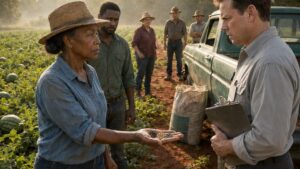
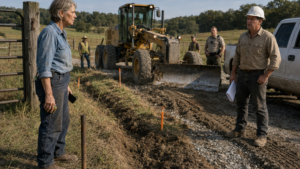
Three bare strips cut through Charles Walker’s lower hayfield on Monday morning.
They had not been there Sunday evening.
Charles stopped his pickup at the field gate and stared through the windshield. The new stand had finally reached the point where he could see what six weeks of work had bought him: straight green rows covering ground that had been thin, weedy, and tired for years.
Now three ragged paths ran through it.
He shut off the engine.
The field had cost more than seed. He had worked the soil twice, corrected the lime, waited for the right moisture, drilled the seed shallow, then watched the forecast every morning as though weather could be negotiated with if a man studied it hard enough.
He crossed the first damaged strip slowly.
Young plants had been cropped almost to the crown. Others were mashed flat. In the softer ground near the fence, small split hoofprints overlapped one another.
Goats.
Charles crouched and touched one of the prints.
Robert Scott kept goats on the adjoining place.
That did not prove anything.
A broken fence could turn any livestock problem into everybody’s problem, and Charles had learned long ago that accusing a neighbor before checking the obvious things made the eventual conversation twice as hard.
He walked the entire fence.
No broken wire.
No sagging corner.
At the northeast edge, though, an old opening between two weathered posts was wide enough for animals to pass. Charles had closed most of it the previous winter with temporary wire while waiting for a fencing contractor, but one section had been pulled aside.
He stood looking through the gap toward Robert’s pasture.
A narrow worn line continued away from it.
Charles replaced the wire and took photographs.
Tuesday morning, the wire was down again.
The damage had spread.
This time he counted seven browsed patches and a longer trail where hooves had crushed the young hay into the damp soil.
He put the wire back.
Wednesday morning, it was down.
Charles did not drive to Robert’s house.
Instead, he went to the equipment shed and pulled an old trail camera from a drawer.
His habit of documenting things had started years earlier with a handshake deal over rented acreage. He had seeded twenty acres based on a verbal promise and lost the ground before first cutting when the owner’s family changed its mind.
Since then, Charles photographed gates before moving cattle. He saved receipts. He marked survey pins. He kept agreements in folders.
People sometimes called it excessive.
Charles called it remembering.
He strapped the camera to a locust post forty yards from the opening, angled it toward the new hay, and left.
The next morning, nothing useful appeared except a raccoon and two deer.
Friday, at 5:58 a.m., the camera caught the first goat.
A pale doe stepped through the opening, paused, then lowered its head into Charles’s new hay.
Another followed.
Then four more.
Charles watched the short clip twice on his phone.
The goats did not wander randomly. They moved in a line, crossed roughly twenty yards of his field, and disappeared near the corner that led toward Robert’s lower pasture.
He felt something settle inside him.
Not anger yet.
Proof.
He spent another day gathering it.
Saturday’s footage showed the same pattern. The same pale doe entered first. The others followed the established hoof track.
Charles walked the route afterward.
What had looked like scattered damage from the truck now had a shape. The animals were cutting diagonally across his field because it shortened the distance between Robert’s upper lot and the lower pasture behind Charles’s property.
He placed small flags beside the worst sections and photographed them with a measuring tape.
By noon, he had a sequence: intact seedlings, hoofprints, cropped plants, repeated camera timestamps.
He should have felt calmer.
Instead, he found himself thinking about the wire.
Goats could push through weak fencing.
Goats could not neatly unhook temporary wire and leave it folded against a post.
Sunday morning, Charles carried coffee to the kitchen table and opened the latest camera files.
At 6:11, the first goat appeared.
At 6:12, three more.
He clicked forward.
At 6:13, a man stepped into the frame.
Charles stopped moving.
Robert stood on the far side of the opening in work boots and a faded cap. One hand rested on the post. With the other, he held the loosened wire aside while the last two goats passed.
Charles enlarged the image.
Robert was not chasing escaped animals.
He was waiting for them.
One goat stopped to eat. Robert looked toward it, then toward Charles’s field, and made no effort to move it along.
The clip lasted only thirty-seven seconds.
When it ended, Charles replayed it.
Then again.
He had expected an animal problem.
What he had was a neighbor problem.
Charles froze the video on Robert standing beside the open fence, his hand still holding the wire.
Chapter 2: The Shortcut Robert Said Was Always His
“That lane was there before either of us.”
Robert Scott said it before Charles had finished explaining why he was at the fence.
Charles had brought printed photographs in a clear plastic sleeve. He had expected an argument about how often the goats crossed or how much damage they caused.
He had not expected Robert to deny that Charles had the right to stop them.
“It isn’t a lane,” Charles said. “It’s my hayfield.”
Robert leaned one shoulder against the post. “Call it what you want. Stock’s gone through there since I was a kid.”
“Your goats went through six times this week.”
“Probably.”
Charles looked at him.
Robert did not seem embarrassed.
“That field was reseeded this spring.”
“I can see that.”
“They’re eating it.”
“They’re crossing it.”
“They stop and eat.”
Robert gave a short shrug. “They’re goats.”
The answer had the same effect on Charles as a gate slamming.
He opened the sleeve and showed Robert a photograph of the flattened seedlings.
“This isn’t about what goats do. It’s about where you’re taking them.”
Robert’s expression tightened.
“I’m not taking them anywhere they haven’t always gone.”
Charles held up another photograph, this one showing the temporary wire pulled aside.
“I have video of you opening this.”
“And?”
Charles waited for something more.
Nothing came.
Robert nodded toward the worn line beyond the fence.
“My father moved cattle through there. The people before your family did too. Everybody around here knew it.”
Charles felt the old reflex rise immediately: record, map, line, document.
“My deed doesn’t show an easement.”
Robert laughed once, without amusement. “Everything doesn’t come with a courthouse stamp.”
“That doesn’t make it yours.”
“And a new bag of seed doesn’t erase fifty years.”
For a moment neither man spoke.
Charles had expected denial. Instead Robert was claiming history.
That bothered him more.
By that afternoon Charles had his survey folder open across the kitchen table.
The parcel had been surveyed three years earlier when Charles replaced fencing along the county road. He found the northeast corner measurement, then carried the plat into the field.
An iron pin sat several feet inside the brush line.
From there, Charles measured toward the second marker.
The worn stock track fell clearly on his side.
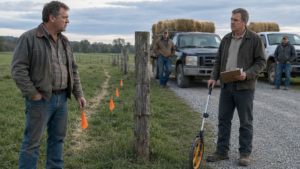
He drove small temporary flags along it, not because the line needed proving to himself but because he wanted the physical ground to match the paper.
On Tuesday morning a surveyor he had used before stopped by between jobs.
They walked the boundary together.
The surveyor found the existing monuments, checked the bearing, and confirmed what Charles already believed.
“The deed line is here,” he said, pointing down the row of flags. “That track’s inside you.”
“How far?”
“Depends where you measure. Twelve feet in at one point. More down there.”
Charles looked toward Robert’s pasture.
“So there’s no question.”
“About ownership? Not from what I’m looking at.”
Those three words—about ownership—caught at him.
“What other question is there?”
The surveyor folded his tripod.
“Use is different. Old farm ground gets messy. People cross each other for forty years and nobody writes anything down. Doesn’t mean they own it. Doesn’t always mean it never mattered either.”
Charles disliked answers with two sides.
That evening Elizabeth Lee stopped at the field entrance after seeing the survey truck.
“What are you measuring?” she asked.
Charles told her.
Her face changed slightly when he mentioned the goat route.
“Oh,” she said. “That old track.”
“You know it?”
Elizabeth rested both hands on her steering wheel through the open window.
“When I was little, there were cattle going through there every fall.”
“Robert’s cattle?”
“His father’s. Sometimes somebody else’s. I couldn’t tell you who had permission from whom.”
Charles glanced toward the flags.
“Was it considered a right?”
Elizabeth thought about that.
“It was considered a thing people did.”
“That’s not the same.”
“No.”
“But Robert says it is.”
Elizabeth looked toward Robert’s barn.
“Robert remembers the part where nobody stopped his father.”
That answer stayed with Charles.
He spent the next evening searching old files his father had kept in metal cabinets. Tax maps. Feed receipts. Fence invoices. Nothing mentioned a stock easement.
By midnight he had arranged the current survey, photographs, and camera captures into a clean stack.
Facts made sense when people did not.
On Wednesday morning Charles walked to the opening and found Robert already there with six goats.
“You’ve got the survey now,” Robert said.
“I do.”
“And?”
“It’s my property.”
Robert nodded as if Charles had confirmed something irrelevant.
“Never said it wasn’t.”
Charles frowned.
“You’re claiming a right to use it.”
“I’m saying we always used it.”
“That isn’t the same thing.”
“Maybe not to a surveyor.”
Charles pointed toward the newly flagged line.
“I’m asking you again. Stop taking them across until we settle this.”
Robert looked across the green field.
The new hay reached nearly to his boots.
For the first time, Charles thought Robert might agree.
Then Robert reached down and lifted the wire.
The pale doe stepped through.
“Robert.”
Robert did not look at him.
“Can’t erase a road because you planted over it.”
One goat followed another.
Charles stood beside the survey flags while the animals crossed his field.
Chapter 3: Three White Goats Came Back Fluorescent Green
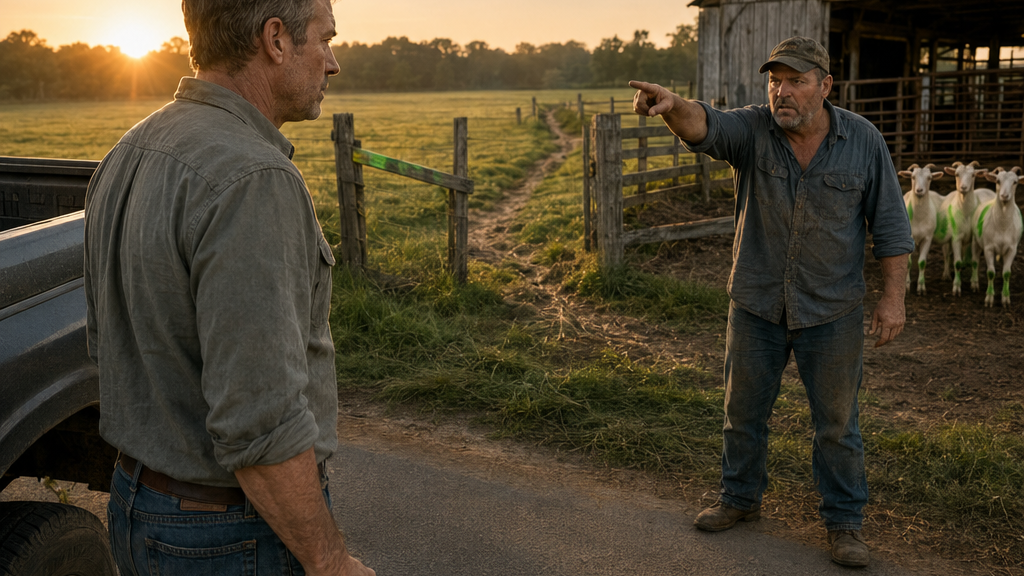
At sunrise on Thursday, three pale goats stood beside Robert Scott’s barn looking as if someone had painted them with a highlighter.
Fluorescent green streaked their shoulders, flanks, and lower legs.
Charles saw them from his side of the road and stopped halfway through closing his truck door.
For one brief second, despite everything, the sight was ridiculous.
Then Robert came across the road fast.
“What did you do?”
Charles shut the door.
“I didn’t touch your goats.”
Robert pointed toward the nearest animal. A vivid green smear ran from its chest along one side.
“You expect me to believe that?”
“Yes.”
“You put something on them.”
“No.”
Robert’s voice rose. “They don’t turn green by themselves.”
Charles looked toward the disputed field.
“No. They don’t.”
Two days earlier, after Robert had deliberately walked the herd through again, Charles had stopped trying to make another conversation work.
He had gone to his equipment shed and taken down a bottle of fluorescent agricultural marking dye used for laying out irrigation work and identifying temporary lines.
He read the label twice.
Then he called the supplier and confirmed its intended agricultural use before he did anything with it.
He did not spray Robert’s animals.
He did not cross Robert’s property.
Instead, on his own side of the boundary, he marked a short rubbing rail near the old opening and treated low vegetation along the narrow route the camera showed the goats repeatedly brushing against.
Then he aimed the trail camera directly at it.
If the goats stopped crossing, nothing would happen.
If Robert sent them through again, the route would identify itself.
Now Robert stared at him with both fists on his hips.
“What was it?”
“Temporary marking dye.”
“On my livestock.”
“On my rail and vegetation.”
Robert stepped closer. “You knew they’d hit it.”
“I knew they might if you brought them through my field again.”
“That’s the same thing.”
“No, it isn’t.”
Robert turned toward the goats.
One of them scratched its shoulder against a fence post, leaving a faint green smear on the wood.
Charles’s satisfaction lasted about three seconds.
Seeing the animals in person made the idea feel different than it had while he stood alone in the field with a spray bottle. The goats were unharmed and behaving normally, but the fluorescent color was so absurdly visible that it turned a private dispute into a spectacle.
A pickup slowed on the county road.
The driver looked toward Robert’s barn.
Robert noticed.
His jaw tightened.
“Get that camera,” he said. “Show me.”
Charles considered refusing.
Then he walked Robert to the fence.
The trail camera file began at 5:43 a.m.
The first pale doe entered through the opening.
She rubbed her shoulder against the marked rail.
Green appeared immediately on her coat.
A second goat pushed past and brushed the same spot. Another stepped through the treated weeds.
Then Robert entered the frame.
He stood behind the animals and waved two stragglers forward.
Charles paused the video.
Robert looked at the screen.
Neither man spoke.
Charles pressed play again.
The goats continued across the exact worn track they had used all week.
Robert remained behind them until the last one passed.
When the clip ended, Charles lowered the phone.
“There’s your answer.”
Robert’s face had gone still.
“You planned this.”
“I documented a route.”
“You embarrassed me.”
“I asked you twice to stop.”
“And I told you why that track matters.”
“No. You told me it was yours to use.”
Robert looked toward the hay.
For an instant Charles thought he might finally explain.
Instead he said, “You always did think paper made you smarter than everybody else.”
The remark landed harder than Charles expected.
“It’s not paper. It’s a boundary.”
“Same thing to you.”
Robert walked back toward his barn.
By eight o’clock, Charles’s phone buzzed.
Elizabeth had sent a photograph.
Three green goats stood beside Robert’s red feed trough.
Underneath she had written: Are these the famous trespassers?
Charles stared at the message.
He did not reply.
At nine fifteen, another farmer sent the same photograph from a different angle.
By ten, somebody had added a joke about Robert starting a new breed.
Charles knew exactly how rural gossip worked. Nobody needed a public post. A photograph could move between feed-store counters, equipment shops, and family group texts before lunch.
He could have stopped some of it.
He could have explained that the marking was temporary, that the goats had contacted it on his property, that the point was evidence rather than humiliation.
Instead, Charles said nothing.
Part of him believed Robert had earned the embarrassment.
That part made him uneasy.
At noon, Robert’s truck pulled into Charles’s drive again.
This time another vehicle followed.
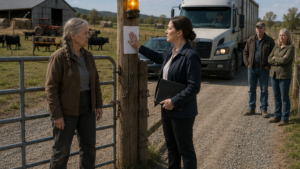
A county livestock officer stepped out carrying a clipboard.
Robert stayed near his truck.
The officer looked first at Charles, then toward the green-streaked goats visible across the road.
“I’ve heard two different versions of this,” the officer said. “So I’d rather start with records than opinions.”
Charles felt himself relax slightly.
Records.
Good.
“I have the survey,” he said.
“I’d like that. Camera footage too, if you have it.”
“I do.”
The officer nodded toward Robert.
“And I want anything you’ve got showing your claimed access.”
Robert folded his arms.
Charles caught the word claimed.
For the first time all morning, he felt the ground firm beneath him again.
He had photographs. Timestamps. Survey markers. A current plat. Video showing Robert opening the fence.
This was exactly the kind of dispute facts were made to settle.
The officer took Charles’s folder but did not open it yet.
“One more thing,” he said. “Old agricultural access can have history that doesn’t show up where people expect. I’m not saying it does here. I’m saying I want both sides.”
Robert looked at Charles.
There was no triumph in his expression.
Only a hard, tired certainty Charles could not yet account for.
“I’ll bring mine,” Robert said.
Charles glanced toward the fluorescent goats, then toward the worn track cutting through his new hay.
For the first time since finding the damage, he wondered whether proving where the boundary stood would actually tell him everything he needed to know.
Chapter 4: The Old Stock Route Was Real, but Not Simple
The old map showed a stock track exactly where Robert said it had been.
Charles found it folded inside a county records box beneath three decades of drainage notes and tax plats. The paper had gone soft at the creases. Someone had sketched fence lines in pencil, then drawn a faint green line from Robert’s side of the ridge toward what was now Charles’s lower field.
Charles stared at it longer than he wanted to.
The county clerk leaned over the counter.
“That what you were looking for?”
“I was looking for an easement.”
“That isn’t one.”
Charles tapped the green line.
“What is it?”
“Looks like an old farm-use sketch.”
“Recorded?”
The clerk checked the file number again.
“No.”
Charles felt some of the tension leave his shoulders.
Then the clerk added, “Doesn’t mean nobody used it.”
He looked at her.
She had already turned back to the computer.
Charles photographed the sketch and spent the next hour checking deed books, parcel transfers, recorded easements, road agreements, utility rights, anything that might turn Robert’s claim into something more than memory.
Nothing did.
The current deed was clean.
The older deed was clean.
The transfer before that mentioned fencing, water access, and a shared maintenance ditch, but no stock lane.
By noon, Charles had enough paper to make the argument he had wanted from the beginning.
Ownership was his.
No formal crossing right existed.
Robert was wrong.
Yet the faint green line on the old sketch kept bothering him.
He laid a copy beside the modern survey in his farm office that afternoon.
The resemblance was too precise to ignore.
The old route entered near the same two posts, crossed the same diagonal, then exited close to the lower corner. Whoever drew it had not guessed.
Someone had used that path deliberately.
Charles called the county livestock officer.
“So there’s no easement,” Charles said.
“Not that I’ve found.”
“Then that settles it.”
“It settles one thing.”
Charles closed his eyes.
He had heard nearly the same sentence from the surveyor.
“What thing?”
“Recorded access.”
“What else matters?”
“History. Permission. Whether there was a license. Whether prior owners tolerated seasonal crossing. Whether anybody represented something to somebody else. I’m not saying Robert has a right. I’m saying old farm arrangements are rarely neat.”
Charles looked again at the faded sketch.
“I asked him to stop.”
“That matters.”
“He kept going.”
“That matters too.”
“So what are we talking about?”
“A dispute you can probably win and still make worse.”
Charles said nothing.
The officer’s tone remained neutral.
“You wanted the facts. Those are the facts.”
After the call, Charles drove to the fence line with both maps.
Elizabeth Lee was already there, checking a salt block in the adjoining pasture. He waved her over.
She studied the old copy.
“Oh,” she said.
“You recognize it?”
“Not the paper. The route.”
“You said cattle used it.”
“They did.”
“Did my family give permission?”
Elizabeth frowned toward the field.
“Your father did sometimes.”
The answer hit Charles harder than the map.
“Sometimes?”
Elizabeth nodded.
“I remember Robert’s father waiting at the opening once until your dad came down. They talked, then the cattle went through.”
“That sounds like permission.”
“Probably was.”
“Every time?”
“I wasn’t keeping records, Charles.”
He almost said somebody should have.
Instead he looked toward the hay.
The cropped patches were beginning to show uneven regrowth.
Elizabeth handed the map back.
“You know what people remember after enough years?”
“What?”
“The crossing. Not the asking.”
Charles looked at her.
She shrugged.
“Routine gets remembered better than courtesy.”
That sentence followed him home.
He opened one of his father’s old metal file drawers and searched again, this time not for legal documents but for calendars and notebooks.
His father had kept practical notes in cramped handwriting: calves treated, hay sold, diesel bought, fence repaired.
Charles found two entries from years apart.
Scott cattle through lower field.
A later one read:
Opened NE gap for Scott. Dry week only.
No contracts.
No signatures.
Just permission written down because Charles’s father wrote down almost everything.
Charles sat back.
Robert had been telling the truth about the route existing.
He had not been telling the whole truth about why.
The distinction should have made Charles feel vindicated.
Instead it embarrassed him.
The green goats had already turned the dispute into a joke across half the county.
He had let that happen because he liked having visible proof.
Now the old notebook showed another kind of proof—one less satisfying.
The crossing had once depended on asking.
The next morning Charles carried copies of the notebook pages to the fence.
Robert approached from the opposite side.
Charles held them up.
“My father let your father through.”
Robert’s face barely changed.
“Told you.”
“Sometimes.”
Robert’s mouth tightened.
“There was a route.”
“There was permission.”
“Same result.”
“No.”
Charles stepped closer to the wire.
“That difference is the whole problem.”
Robert looked past him toward the green field.
“You found your paper. Congratulations.”
Charles felt the familiar irritation rise, but it no longer sat as cleanly as before.
“You could have told me this.”
“I did.”
“You said it was yours to use.”
“It was used.”
“That’s not what I asked.”
Robert turned away.
Charles watched him go.
For the first time he saw something in Robert’s posture that did not look like arrogance.
It looked tired.
Later that afternoon, Sarah Perez pulled into Charles’s drive.
She did not get out right away.
When she finally did, she closed the truck door softly and stood beside it with both hands in her jacket pockets.
“I need to ask you something,” she said.
Charles waited.
“Don’t close that route completely yet.”
He studied her face.
“Why?”
Sarah glanced toward Robert’s property.
“He should have told you.”
“Told me what?”
She hesitated.
“That lower route isn’t just inconvenient right now.”
Charles said nothing.
Sarah looked directly at him.
“It’s barely usable.”
Chapter 5: The Culvert Robert Would Not Admit He Couldn’t Fix
Sarah showed Charles the washed-out crossing before she explained anything else.
The creek was narrow in summer but had cut hard during spring rain. What had once been a gravel culvert crossing now looked as if somebody had bitten a section out of the road.
One pipe was exposed.
The downstream edge had collapsed.
A loaded livestock trailer could not have crossed safely.
Charles stood with his hands on his hips.
“How long?”
“Since March.”
“And Robert’s been using my field since then.”
Sarah nodded.
Charles looked at her.
“He could have said that.”
“I know.”
“Instead he told me the route was his.”
“I know.”
Her willingness to agree took some of the force out of his anger.
They walked farther down the track.
The lower pasture opened beyond the creek. Robert’s goats grazed along the fence, mostly quiet.
One pale doe still carried a faint green stain near the shoulder.
Charles noticed it and looked away.
Sarah did not.
“He was furious about that.”
“He kept sending them through.”
“I’m not defending it.”
“Feels like you are.”
“No.”
She stopped.
“I’m explaining why he’s being stupid.”
Charles looked at her.
Sarah rubbed dirt from the toe of her boot.
“The culvert estimate came in higher than he expected. Then feed went up. Then the tractor needed work.”
“How much higher?”
She hesitated.
“That matters?”
“If I’m supposed to understand why he ignored me, yes.”
Sarah gave him a tired look.
“You always need the number.”
Charles almost denied it.
Then didn’t.
“Usually.”
She nodded toward the washout.
“He doesn’t have enough cash sitting around to fix everything at once.”
“Then finance it.”
“He was offered terms.”
“And?”
“He said no.”
Charles stared at her.
Sarah’s expression hardened.
“Because they wanted updated financials.”
For a moment Charles said nothing.
Then he understood.
Robert had not rejected the financing because it was bad.
He had rejected the humiliation of showing how thin things had become.
“How bad?” Charles asked.
Sarah exhaled.
“Bad enough that if you shut that shortcut completely and he has to truck the goats around every time he moves them between pastures, he’ll probably sell some.”
Charles looked toward the herd.
“That still doesn’t make my field his road.”
“No.”
“He damaged a new stand.”
“Yes.”
“He opened my fence after I told him not to.”
“Yes.”
Sarah’s voice stayed level.
“I’m not asking you to pretend he was right.”
“Then what are you asking?”
“To know what the consequences actually are before you decide what you want.”
Charles looked down at the broken culvert.
That irritated him because it was the sort of sentence he might have said to somebody else.
They walked back in silence.
At the trucks, Sarah leaned against the door.
“He thinks asking makes him weak.”
“That’s his problem.”
“It became yours.”
Charles looked toward Robert’s farm.
“Yes.”
Sarah nodded.
“That’s the part he doesn’t want to admit.”
The next day Charles drove the long route Robert would have to use.
It was not impossible.
It was simply bad.
The road added nearly eight miles each way, part of it narrow county pavement with poor shoulders. For occasional movement, manageable.
For repeated stock transfers during grazing rotation, expensive and time-consuming.
Charles did the math automatically.
Fuel.
Trailer wear.
Hours.
He hated that understanding the numbers made Robert’s behavior easier to understand.
Not acceptable.
Easier.
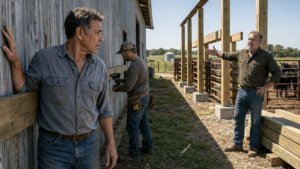
That afternoon Charles found Robert replacing a hinge on a barn gate.
“I saw the culvert.”
Robert kept working.
“Sarah needs to learn when to keep family business in the family.”
“She thought this was already affecting somebody else’s business.”
Robert tightened the bolt.
Charles waited.
Finally Robert said, “What do you want?”
“I want my field left alone.”
“We’re back to that.”
“No.”
Charles surprised himself with the answer.
Robert looked up.
“I’m willing to talk about temporary access.”
Robert’s expression changed immediately.
Not relief.
Suspicion.
“Under what?”
“A defined lane. Limited period. You repair the damage you caused. We put it in writing.”
Robert gave a quiet laugh.
“There it is.”
“What?”
“Paper.”
Charles felt the old defensiveness rise.
“Yes. Paper.”
“My dad didn’t need a contract to move cattle.”
“My dad was asked.”
Robert looked away.
Charles continued.
“That’s what you keep leaving out.”
“I don’t need permission to use something my family’s used for fifty years.”
“Then we’ve got nothing to discuss.”
Charles turned.
“Wait.”
He stopped.
Robert’s jaw worked once.
“What kind of lane?”
Charles faced him again.
“Narrow enough to protect the new stand. Temporary until the culvert is repaired.”
“And you get to decide when that happens?”
“We agree on a date.”
Robert shook his head.
“You want me signing something that says I never had a right.”
“I want you signing something that says you have permission now.”
“That’s the same humiliation with better wording.”
Charles stared at him.
There it was.
Not the legal issue.
Not the goats.
Not even the money.
Humiliation.
Charles thought of the photographs circulating from phone to phone. The green goats at the feed trough. Robert crossing the road furious while drivers slowed to stare.
Charles had enjoyed that for a little while.
He could admit it to himself now.
That made the next words harder.
“I should’ve shut the jokes down sooner.”
Robert’s face went still.
Charles continued.
“The goats proved the route. That was the point. After that, people ran with it.”
“You didn’t exactly stop them.”
“No.”
Robert set the wrench down.
For the first time in days, neither man seemed eager to win the next sentence.
Charles looked toward the lower field.
“The offer stands.”
Robert wiped his hands on his jeans.
“No.”
Charles frowned.
“No temporary lane?”
“No paperwork saying I need your permission to use what my family already used.”
“So you’d rather sell goats?”
Robert’s eyes sharpened.
“That’s none of your business.”
“It became my business when you started running them across my crop.”
Robert picked up the wrench.
“We’re done.”
Charles watched him return to the hinge.
He had come expecting that a reasonable solution would end the argument.
Instead he had discovered that Robert would rather absorb real cost than publicly admit he had been wrong about the route.
Charles drove home understanding something he had not understood before.
The next problem was no longer proving where the boundary belonged.
It was finding a way to protect it without using Robert’s pride as another fence.
Chapter 6: A Boundary That Could Not Stay Informal
“Mark me a route,” Charles told the surveyor.
The surveyor looked up from his instrument.
“I thought you wanted this closed.”
“I did.”
Robert, standing twenty feet away beside the fence, said nothing.
The fencing contractor stopped unloading posts and glanced between them.
Charles pointed toward the edge of the lower hayfield.
“Start at the old opening. Keep it outside the main stand as much as you can. Bring it along the rough strip, then angle back toward Robert’s lower pasture.”
The surveyor studied the ground.
“That’ll take some of your corner.”
“I know.”
Robert finally spoke.
“What are you doing?”
Charles looked at him.
“Solving it.”
“You already offered.”
“I offered before I knew what the ground would actually support.”
The surveyor began walking with the measuring rod.
Charles followed.
The first proposed line cut too far into healthy hay.
He rejected it.
The second passed close to a wet spot that would turn to mud under repeated hooves.
They adjusted again.
By midmorning, a narrow temporary lane took shape along the least productive edge of Charles’s parcel.
The surveyor sprayed small fluorescent green marks at the turns.
Charles stopped when he saw the first one.
For a moment all he could see was the bright stain on pale goat hair.
Then the surveyor moved on.
This green meant something different.
Robert walked the proposed route once without speaking.
At the far end he said, “Too tight.”
“For cattle, maybe.”
“I don’t run cattle.”
“You run goats.”
Robert gave Charles a look.
The fencing contractor hid a smile by turning toward the truck.
Charles did not.
“The lane keeps them out of the reseeded section,” he said. “You get access until the culvert repair date. After that, this gate closes unless we both agree otherwise.”
Robert kicked at the dirt.
“And what do you want for it?”
“Damage to the field.”
“How much?”
“Actual reseeding cost for the strip they damaged.”
“No penalty?”
“No.”
Robert looked skeptical.
“No fee for access?”
“No.”
“Then what’s your angle?”
Charles felt irritation flare.
“My angle is I don’t want your goats in my hay.”
“That’s it?”
“That was always it.”
Robert looked at the green marks.
For a few seconds, Charles thought he might walk away again.
Instead Robert said, “I’m not signing something that says I trespassed for years.”
“It doesn’t.”
Charles took a folded sheet from his truck.
Robert’s face hardened immediately.
Charles nearly laughed.
“Yes,” he said. “It’s paper.”
Robert did not smile.
Charles handed it over.
The agreement was short.
Temporary permission.
Defined route.
Specific start and end date.
Responsibility for controlling livestock.
Payment for documented reseeding damage.
No admission about historical legal rights beyond acknowledging that current access was by Charles’s permission.
Robert read it twice.
“You wrote this?”
“With help.”
“Of course you did.”
Charles waited.
Robert pointed to one paragraph.
“This says I acknowledge no automatic right to continue after the end date.”
“Yes.”
“That’s the same thing.”
“It’s the truth.”
Robert folded the paper.
“According to you.”
“According to the deeds, the survey, and the county records.”
“And according to fifty years of people using it?”
Charles looked at him.
“Fifty years of people asking each other.”
Robert’s face changed slightly.
Charles went on.
“That’s the part we found, Robert. My father wrote down opening that gap for your father. Dry weeks. Seasonal crossings. It wasn’t a public road. It wasn’t yours. It was neighbors saying yes.”
Robert looked toward the old opening.
Elizabeth had arrived during the survey and was standing near her pickup, far enough away not to intrude but close enough to hear.
Robert noticed her.
His mouth tightened.
Charles understood at once.
This was the moment Robert had been resisting.
Not losing land.
Being seen admitting it.
Charles could have pushed.
He could have named the notebook entries, the survey, the photographs, the county review.
Instead he said quietly, “We don’t have to make a show of it.”
Robert looked back at him.
Charles nodded toward the paper.
“Read it. If you want one change, say it.”
Robert unfolded the sheet again.
Several minutes passed.
Then he pointed to the repair date.
“If the contractor gets delayed by weather?”
“We extend it if you show me the schedule.”
Robert considered that.
“And if the lane tears up?”
“You repair it.”
“Fair.”
Charles almost responded, then stopped himself.
Robert took the pen.
Before signing, he looked toward Elizabeth.
She had turned away deliberately and was checking something in the bed of her pickup.
Robert signed.
The fencing contractor began setting temporary posts.
By late afternoon, the new lane was visible.
Not elegant.
Not permanent.
But workable.
At the entrance, the surveyor added one final green mark to the temporary gatepost.
Robert stood beside it.
“Looks like you’ve painted enough green around here.”
Charles met his eyes.
“Different purpose this time.”
Robert gave the smallest nod.
The county livestock officer arrived before they finished and reviewed the agreement.
“No objections from me if both of you understand what it says.”
“I understand it,” Charles said.
The officer looked at Robert.
Robert hesitated.
Then said, “I’m using it because Charles is allowing it.”
The words were quiet.
Nobody celebrated them.
Nobody needed to.
Charles felt something loosen anyway.
The first group of goats moved through the temporary lane before sunset.
They tested the fencing, nosed at weeds, and tried twice to angle toward the richer hay.
Robert corrected them immediately.
Charles noticed.
He said nothing.
After the last animal cleared the far gate, Robert remained beside Charles.
The others had begun packing equipment.
Robert rubbed a thumb across the edge of the signed agreement.
“How much do I owe for reseeding?”
Charles looked at him.
“For the damaged section?”
Robert nodded.
Charles had already calculated the number.
Usually he would have produced it immediately.
Instead he folded the paper and put it in his shirt pocket.
“I’ll show you the receipts tomorrow.”
Robert gave him a tired look.
“Of course you will.”
This time, Charles smiled.
“Yeah.”
Robert almost did too.
Then he turned toward the goats, leaving the green-marked gate standing between them—not open ground anymore, and not a barrier either.
Chapter 7: The Green Mark That Finally Meant Permission
The goats were waiting at the new gate.
Charles saw them from the cab of his pickup and slowed before he reached the lower field. Six animals stood bunched behind Robert’s temporary fence, their heads pushed between the rails toward the grass beyond. The old opening lay less than forty yards away.
Nothing blocked it except the wire Charles had replaced.
For weeks, that had been enough invitation.
This morning, not one goat was in the hay.
Robert stood beside the green-marked gate with one hand resting on the latch.
He did not open it when Charles approached.
Charles parked and stepped out.
“You waiting on something?”
Robert looked at his watch.
“You said access between seven and nine unless we agreed otherwise.”
Charles checked the time.
Six forty-eight.
For a second neither man spoke.
Then Charles said, “You could’ve gone through twelve minutes early.”
Robert shrugged.
“Paper says seven.”
There was almost a challenge in it, but not quite.
Charles looked over the temporary lane. The fencing had held. Hoof traffic had worn a narrow strip of dirt between the posts, but the new hay beside it stood upright.
Three weeks earlier, those same animals would have been scattered through the field before Charles finished his coffee.
Now they waited.
“That green mark’s fading,” Robert said.
Charles glanced at the fluorescent slash on the gatepost.
It had dulled in the sun, but it was still visible.
“I can repaint it.”
Robert shook his head.
“I think everybody knows where the gate is now.”
Charles caught the edge of humor and let it pass without answering.
Robert opened the gate at seven.
The goats moved through quickly, more interested in reaching the lower pasture than sampling the grass outside the lane. Robert walked behind them carrying a sorting stick, correcting one doe when she pressed toward the fence.
Charles watched until the last animal cleared the far end.
The repaired hayfield had changed too.
The worst damaged patches still showed if he knew where to look, but the fresh seed had taken. Young plants filled the brown gaps. From the road, the field appeared nearly continuous again.
Robert latched the far gate and walked back.
“I need Thursday changed.”
Charles looked at him.
“To what?”
“Afternoon instead of morning. Culvert crew’s bringing stone, and I need the goats out of their way.”
The old Robert would simply have changed the time.
Charles recognized that before he recognized anything else.
“What afternoon?”
“Two, maybe three.”
“Three works better.”
Robert nodded.
“Three, then.”
That was all.
No argument about whether permission was necessary.
No reminder that his father had once used the same ground.
Just a question asked and answered.
Charles found himself thinking about his father’s notebook.
Opened NE gap for Scott. Dry week only.
For years Charles had read notes like that as evidence. Dates. Facts. Proof.
Now he understood what the handwriting had preserved without intending to.
Somebody had asked.
Somebody else had said yes.
The value of the arrangement had never been that it was unwritten.
The value had been that both people knew it could not be assumed.
Robert walked toward his truck, then stopped.
“The culvert pipe’s in.”
Charles looked over.
“When?”
“Yesterday.”
“That why there was a dump truck down there?”
Robert nodded.
“Stone today. Grading next week if it stays dry.”
“So you’re actually fixing it.”
Robert gave him a flat look.
“That was generally the idea.”
Charles smiled.
Robert opened his truck door but did not get in.
“And Sarah gave you the check?”
“She did.”
Two days earlier, an envelope had appeared in Charles’s mailbox containing Robert’s agreed share of the reseeding cost.
Not an estimate.
Not a rounded-down figure.
The exact amount from Charles’s receipts.
Charles had checked it twice out of habit.
Then he had caught himself doing it and laughed alone in the kitchen.
“I got it,” he said.
Robert nodded.
“Good.”
He started to climb into the truck.
“Robert.”
Robert paused.
Charles looked toward the green-marked gate.
“I never meant for those pictures to turn into what they did.”
Robert studied him.
“You meant for the goats to turn green.”
Charles could not argue with that.
“Yes.”
“And you enjoyed it.”
Charles hesitated.
“For a little while.”
Robert’s mouth twitched.
“Thought so.”
“I should’ve shut down the jokes sooner.”
Robert looked toward his barn across the road.
“Probably.”
It was not forgiveness.
Charles had not expected it to be.
After a moment Robert said, “I should’ve asked before opening your fence.”
Charles nodded.
“Probably.”
That finally brought the smallest smile from Robert.
Then he drove away.
Later that morning, Elizabeth stopped along the road while Charles was checking the regrowth.
She leaned out her window.
“Looks better.”
“It’s coming.”
Her eyes moved toward the temporary lane.
“So that’s the famous road?”
“It’s a lane.”
Elizabeth laughed.
“You two settled on that, did you?”
“We settled on a lot of things.”
She studied the field.
“My father would’ve liked this.”
“The fence?”
“No. The arguing until everybody finally says what they should’ve said first.”
Charles shook his head.
“Could’ve saved a lot of trouble.”
“That’s usually why people don’t do it.”
She drove on.
By early summer, the lower field was ready for its first light cutting.
Charles walked the rows the evening before, pulling weeds and checking the ground. At the edge of the temporary lane, he found one faint fluorescent stain on the grass beside the gate.
The same color that had once announced trespass from half a mile away.
He crouched and touched it with his thumb.
A truck engine sounded on Robert’s side.
The goats approached the gate in a loose line.
Robert came behind them.
He stopped.
Charles stood.
“You ready?” Robert called.
Charles looked at the hay, then at the gate.
“Go ahead.”
Robert lifted the latch.
The goats passed through the green-marked opening, stayed between the temporary fences, and disappeared toward the lower pasture.
Not one stepped into the repaired rows.
Charles closed the gate after them.
The green mark remained on the post, small and ordinary now.
It no longer meant caught.
It meant allowed.
The story has ended.