They Used Her Farm Lane for Construction Until She Found the Boundary Rule Their Own Permit Required
Chapter 1: The Grader Was Already Past Her Gate
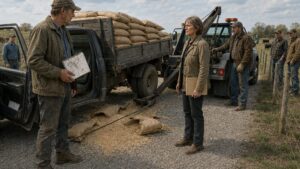
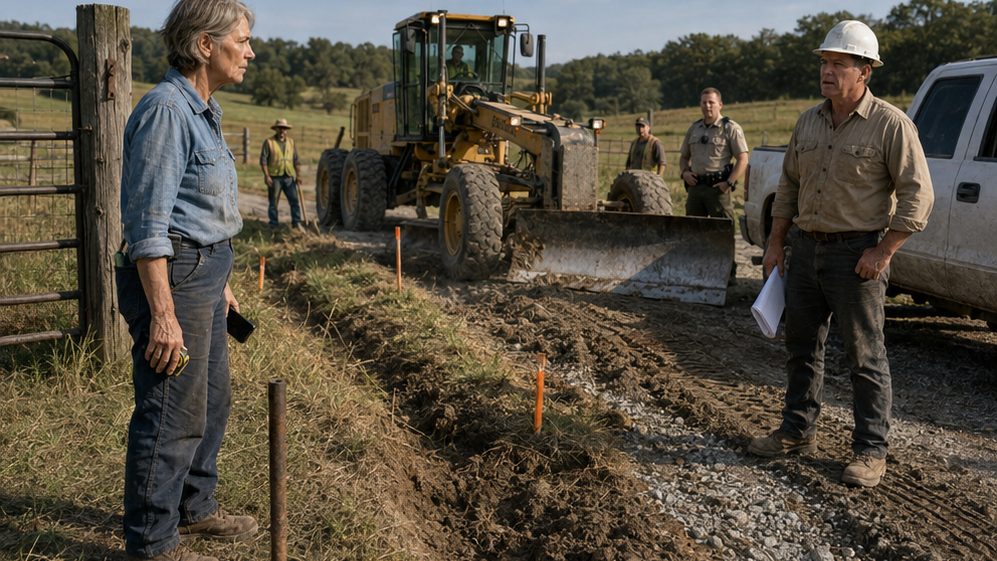
The grader blade was already six feet past Anna Walker’s gate when she stepped into the lane and raised one hand.
The operator saw her late.
The machine lurched to a stop with its front blade angled toward the shallow strip of grass that had always carried rainwater away from the gravel road and down toward Anna’s lower pasture. Fresh gray stone spilled from the blade’s edge. Behind it, two deep tire tracks cut through ground that had been green the evening before.
Anna stood where the lane narrowed between the cattle gate and an old cedar post.
“Back it out.”
The operator looked toward the contractor pickup instead of answering.
A man in a white hard hat climbed from the passenger side. Anna recognized him from the weeks of construction traffic beyond her east fence. Gary Nelson had introduced himself once, briefly, as the superintendent for the new development going in beyond the ridge.
He approached with the brisk patience of someone already behind schedule.
“Morning, Ms. Walker.”
“Your grader’s on my drainage strip.”
Gary glanced at the ground.
“That’s the shoulder.”
“No.”
He looked farther down the lane, where orange field stakes marked the project side at uneven intervals.
“Our limits are staked.”
“Then your stakes are wrong.”
The grader idled behind him. Diesel vibration trembled through the gate chain.
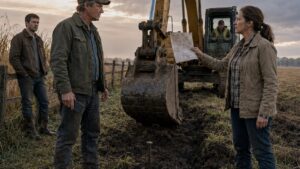
Two workers stopped what they were doing. One leaned against a shovel. Another stood beside a compact excavator farther up the road.
Gary smiled without much humor.
“We’re widening the access according to the approved plan.”
Anna looked at the scraped earth instead of at him.
The shallow strip did not look important. That was the problem.
It was barely a ditch at all—six feet of grass dropping gradually away from the gravel. In a dry week, a person could cross it without noticing. In hard rain, it caught water from the lane before it reached the pasture.
Now half of it had been shaved flat.
“You didn’t have permission to widen onto this side.”
“We’re not on your side.”
Anna crouched near the gatepost.
An iron survey pin sat low in the soil, rust-dark and easy to miss beneath a clump of fescue. She brushed dirt from its top.
Gary watched.
“That marker doesn’t tell you the construction limit.”
“No. It tells me where I start measuring.”
One of the workers gave a short laugh.
Anna heard it.
She stood without looking toward him.
Gary exhaled.
“We’re talking about a few feet of grass.”
Anna finally met his eyes.
“We’re talking about whether you’re supposed to be there.”
Before Gary answered, another vehicle rolled slowly up the county road and stopped behind Anna’s truck. A sheriff’s deputy stepped out.
Gary looked relieved.
Anna did not.
Apparently someone from the crew had called before she arrived at the gate.
The deputy walked over, taking in the grader, the scraped strip and Anna standing in the lane.
“What’s going on?”
Gary answered first.
“Property-line disagreement. We’re inside permitted limits. Ms. Walker wants the road crew stopped.”
Anna said, “I want the machine off my ground until somebody proves it belongs there.”
The deputy looked from one to the other.
“Do you have a survey?”
“I have recorded corners.”
“Do you have something showing the construction boundary?”
“Not their current plan.”
Gary spread his hands slightly.
“There you go.”
Anna felt the heat rise behind her ears.
For one second she wanted to tell them exactly why she was asking.
Fourteen years of reviewing erosion-control plans had taught her what happened when field crews treated drawings as suggestions. It had also taught her that saying you knew the rules was not the same thing as proving which rule applied.
She kept her mouth shut.
The deputy stepped closer to the iron pin.
“I can’t decide a civil boundary dispute out here.”
“I didn’t ask you to.”
“He can keep working,” Gary said.
The deputy frowned.
“I didn’t say that either.”
Gary’s expression tightened.
Anna took out her phone.
She photographed the grader’s position first.
Then the blade.
Then the fresh tire tracks.
Then the iron pin with the cedar gatepost visible behind it.
Gary watched her move methodically from one point to the next.
“What are you doing?”
“Making sure nobody has to remember this later.”
She walked to the grader and copied the equipment number into the small notebook she kept in her shirt pocket.
The operator shifted in his seat.
Gary said, “Anna, if we stop every time somebody dislikes where a stake is, we’ll never finish this road.”
She ignored the first-name familiarity.
“Show me the plan you’re using.”
“We have approved plans.”
“The field sheet.”
Gary glanced toward his truck.
“The engineer signed off.”
“Then showing me the sheet should be easy.”
Something changed in his face—not concern exactly, but irritation edged with caution.
He walked back to the pickup.
The workers began talking quietly among themselves.
Anna photographed the orange stakes. One stood nearly three feet inside the line she would have drawn from the iron pin. Another leaned outward as though it had been knocked and replaced.
Gary returned with a folded plan set.
He opened one sheet across the hood of the pickup and held down the corners with his palms.
“There. Access widening.”
Anna did not touch it.
She read the title block first.
Then the project number.
Then the revision box.
Gary tapped the shaded edge of the road.
“This is the work area.”
Anna’s eyes stayed on the lower right corner.
Revision B.
She knew nothing yet about whether the development was wrong.
But she knew one thing about Revision B.
If the county had approved the erosion-control changes she remembered seeing discussed months earlier, this sheet should not still be the controlling field document.
“When was this printed?”
Gary looked at the date.
“Couple months ago.”
“Is this the latest approved revision?”
“It’s what we were issued.”
“That wasn’t my question.”
His jaw worked once.
“This is what my crew has.”
Anna looked back toward the grader sitting motionless beyond her gate.
The deputy asked, “Does that settle anything?”
Anna folded the corner of the page back just enough to read the date again.
“No.”
Gary straightened.
“What exactly are you suggesting?”
Anna looked at him.
“I’m suggesting you shouldn’t move that machine another foot until you know whether this sheet is still valid.”
For the first time that morning, Gary did not smile.
Chapter 2: The Damage Looked Small Until Rain Came
At four the next morning, Anna woke to the sound of rain hammering the metal roof over her back porch.
By daylight, brown water was crossing the pasture.
She pulled on boots and drove the utility cart toward the lane.
The shallow drainage strip beside the gate had become a fast, muddy channel. Where grass had slowed the runoff before, scraped earth now guided it straight downhill. Gravel rattled through the water like loose teeth.
Anna stopped the cart and stared.
A fan of pale stone had spread twenty yards into the lower pasture.
Silt coated the grass.
The damage looked larger wet.
She took out her phone.
The first photographs were wide shots.
Then close-ups: gravel embedded in turf, exposed soil at the shoulder, the path water had cut beside the iron pin.
She moved slowly because anger made people careless.
That was something she had told contractors for years.
Now she had to tell herself.
By nine, the rain had weakened.
A local equipment operator who occasionally repaired Anna’s farm lanes came out to look at the mess. He walked the damaged strip, measured the washed section and gave her a rough estimate for removing displaced gravel, rebuilding the grade and reseeding.
It was more than three times what Anna had expected.
“That’s if we can shape it back without digging deeper,” he said.
Anna wrote the number down.
“No work yet.”
“You sure?”
“I want it exactly as it is.”
He nodded toward the development.
“You fighting them?”
“I’m measuring them.”
He smiled once.
“That sounds more expensive.”
After he left, Anna returned to the gate with a tape measure.
She began at the iron pin.
The first orange construction stake sat well inside what she believed to be her side. She measured twice.
Then she walked to the next stake.
The line between them did not make sense.
It bowed toward her lane.
Anna crouched and studied the dirt around the second stake. The soil was loose. The stake had been driven recently.
She photographed it.
A truck slowed on the county road.
Stephen Hall leaned through the open window.
“You planning to survey the whole county yourself?”
Anna kept the tape stretched.
“Just the part being scraped.”
Stephen parked and climbed out.
He owned acreage farther downhill and used the same network of farm roads during hay season. He had complained for weeks about construction trucks delaying tractors at the intersection.
He looked over the washed pasture.
“That all from yesterday?”
“Most of it.”
He kicked a piece of gravel from the grass.
“Gary said you stopped them over the shoulder.”
“Gary calls it a shoulder.”
Stephen looked toward the stakes.
“I thought they walked all this before they started.”
“They marked it.”
“That’s not what I mean.”
Anna reeled in the tape.
Stephen hesitated.
“They asked the adjoining owners to meet them before clearing. Gary said you wouldn’t come.”
Anna’s hand stopped.
“He told you that?”
“He didn’t have to. I remember the notice.”
“That meeting wasn’t a survey.”
“No.”
Stephen’s voice stayed calm.
“But it was a chance to stand here and point.”
Anna felt an old irritation return.
“Recorded property doesn’t become less recorded because I don’t attend a contractor’s meeting.”
“I didn’t say it did.”
“You’re close.”
Stephen looked back at the muddy grass.
“I’m saying you make it hard for people to know when you’re protecting something and when you’re just refusing them.”
The words landed harder because he did not say them cruelly.
Anna picked up her notebook.
“Anything else?”
“No.”
Stephen started toward his truck, then stopped.
“For what it’s worth, that runoff shouldn’t be there.”
Anna said nothing.
He left.
In the equipment shed, she spread her photographs across a workbench by date.
She printed images from the previous month: cattle at the gate, a hay wagon coming through, a repaired hinge on the cedar post.
The drainage strip appeared in the background of several.
Green.
Intact.
Undisturbed.
She found one from six weeks earlier showing the iron pin and the grass line in the same frame.
Then she added that morning’s photographs beside it.
There was no argument between those images.
Something had changed.
The question was whether she had helped make the change easier.
Late that afternoon, Anna went inside and opened the metal file drawer beneath the desk in the spare room.
She kept farm records longer than most people thought reasonable—receipts, plat copies, cattle-sale paperwork, county notices.
She found the development folder beneath an old tax assessment.
The envelope on top was unopened.
She knew what it was before she turned it over.
PRECONSTRUCTION ADJOINING PROPERTY WALK.
The county had not required her attendance. The developer had invited her.
She remembered receiving it.
She also remembered putting it aside.
Months earlier, Gary had called and said they wanted to walk the boundary before equipment arrived.
Anna had answered, “The boundary’s already there.”
He had said, “It would help if you showed us what you’re concerned about.”
She had heard something different.
She had heard: help us decide how much of your land we can use.
So she had refused.
Anna sat at the desk with the unopened notice in her hand.
The rain began again, lighter this time.
She looked at the photographs spread across the table, then at the envelope.
The crew might still be wrong.
The plan might still be wrong.
Gary might still be wrong.
But for the first time since the grader crossed her gate, Anna could no longer tell herself she had done everything possible to prevent the mistake.
Chapter 3: Fourteen Years She Never Mentioned
Anna noticed the obsolete code before she finished her first cup of coffee.
Gary’s field sheet lay on her kitchen table in a photograph she had taken Monday morning. She enlarged the lower corner until the print turned grainy.
Revision B.
Below it was a county routing number she had not seen in years but still recognized.
Her thumb stopped on the screen.
“No,” she said quietly.
For fourteen years, Anna had reviewed rural construction and erosion-control plans for the county.
Not houses themselves. Not architectural drawings.
She had dealt with the less glamorous things that determined whether a project stayed where it was supposed to stay: stabilized entrances, drainage swales, sediment barriers, temporary access, disturbed limits, stream buffers.
Most people had found the work boring until mud crossed a road or water entered a basement.
Anna had retired eleven years earlier.
She rarely mentioned the job.
Being known as the former county reviewer had a way of turning every disagreement into a performance. People either expected her to know everything or assumed she was trying to intimidate them.
She wanted neither.
But Revision B bothered her.
She remembered a public agenda item from the previous winter involving revised stormwater routing for the development. If that revision affected the access road, there should have been a later sheet.
Anna called the county records office.
The clerk answered after several rings.
“I need the approved plan set for the development off County Road 18. Including erosion-control revisions.”
“Project number?”
Anna read it from the photograph.
Keyboard clicks followed.
“There are several files.”
“I need the stamped set and revision history.”
A pause.
“Are you representing the property owner?”
“Adjoining landowner.”
“Name?”
“Anna Walker.”
Another pause, shorter but noticeable.
“Walker?”
“Yes.”
“Didn’t you used to—”
“I did.”
The clerk cleared her throat.
“I can send what’s public.”
“That’s all I want.”
The files arrived forty minutes later.
Anna opened them at the kitchen table.
Revision A.
Revision B.
Then Revision C.
Her chair scraped backward.
She printed the title sheet and compared dates.
Revision C had been approved seven weeks after Gary’s field sheet.
That did not automatically mean his road sheet was obsolete. Sometimes later revisions touched only one portion of a project.
Anna knew better than to assume.
She drove to the county office before lunch.
The building had changed since she worked there. New counters. New security glass. Same beige hallways.
Rebecca Davis met her in a small conference room with two plan sets under one arm.
Anna knew Rebecca by reputation more than personally. Rebecca had joined the department near the end of Anna’s career.
She set the plans down.
“I figured you’d come in.”
“I figured you’d rather I did.”
Rebecca pulled out a chair.
“Before we start, I need something clear.”
Anna waited.
“You used to work here. That doesn’t make your complaint stronger.”
“I know.”
“It may make people look at it harder.”
“I know that too.”
Rebecca studied her.
“Good.”
Anna placed the photograph of Gary’s field sheet on the table.
“This is what the superintendent says they’re using.”
Rebecca looked at the revision box.
“Where did you get it?”
“He showed it to me.”
“Did you take it?”
“I took a picture.”
Rebecca almost smiled.
“Of course you did.”
She opened the county set.
Revision B and Revision C lay side by side.
The differences were not dramatic at first glance.
A drainage arrow changed direction.
A sediment-control symbol moved.
Then Anna saw a heavier dashed line running beside the farm access.
“What’s that?”
Rebecca followed her finger.
“Disturbance limit.”
“That wasn’t on B.”
“No.”
Anna leaned closer.
A note referenced stabilization along the adjoining agricultural parcel.
Her pulse quickened, but she forced herself to read every word.
She had made too many younger inspectors uncomfortable years ago by reaching conclusions before they finished the sheet.
“Keep going,” Rebecca said.
Anna looked at her.
“You saw it?”
“I want to know whether you do.”
That irritated Anna enough to make her careful.
She moved to the next sheet.
The final approved erosion-control plan enlarged the access-road section.
There was the gravel lane.
There was the property line.
There was the shallow drainage strip.
And between the marked construction disturbance and Anna’s boundary sat a dimension.
Six feet.
Anna read the associated note twice.
Protected drainage setback.
Stabilized surface.
Temporary barrier during active grading.
She sat back.
Rebecca said nothing.
Anna looked from Revision B to Revision C.
Gary’s crew had not merely scraped close to the required protection.
They had graded through where part of it was supposed to be.
“Was this field change requested by the developer?”
Rebecca nodded.
“Engineering response to runoff comments.”
“So they asked for it.”
“The engineer did.”
“And the county approved it.”
“Yes.”
Anna thought of Gary saying, We’re talking about a few feet of grass.
Rebecca closed one plan set.
“Don’t get ahead of this.”
“I’m not.”
“You’re thinking it.”
Anna folded her hands.
“What would you like me to think?”
“That a discrepancy deserves inspection. Not motive.”
Anna looked at the plan again.
“I didn’t say motive.”
“You didn’t have to.”
That stopped her.
Rebecca leaned back.
“If you file this, file what you can prove. Your photographs. Dates. The field sheet they showed you. Actual measurements. Don’t tell me somebody deliberately ignored a plan unless you know they saw it.”
Anna remembered the unopened meeting notice at home.
“I refused their preconstruction walk.”
Rebecca’s expression changed slightly.
“That matters.”
“I know.”
“It doesn’t erase a permit condition.”
“I know that too.”
“But it may explain how field assumptions went unchallenged early.”
Anna looked toward the conference-room window.
For the first time, the six-foot requirement did not feel like a weapon.
It felt like a line both sides had failed to respect in different ways.
Her refusal had not authorized the crew to cross it.
Gary’s schedule had not authorized him either.
Rebecca slid a copy of Revision C toward her.
“Take this.”
Anna stared at the enlarged access detail.
The six-foot dimension sat cleanly beside the boundary.
Not approximate.
Not implied.
Printed.
Approved.
Required.
She folded the sheet carefully.
“What happens if the barrier was never installed?”
Rebecca said, “First we confirm it wasn’t.”
Anna looked at her.
“And if you confirm?”
“Then the question changes.”
“From what?”
Rebecca tapped the plan.
“From whose memory is right to why the approved protection isn’t on the ground.”
Anna carried Revision C out of the county office under her arm.
By the time she reached the parking lot, she already knew where she would begin measuring the next morning.
At the iron pin.
Six feet outward.
Exactly where Gary’s grader tracks were still pressed into the mud.
Chapter 4: The Six Feet Nobody Built
Anna drove a steel measuring stake into the ground beside the old iron pin and pulled the tape toward the nearest grader track.
Five feet, eight inches.
She measured again.
Then a third time from a different point along the property line.
The result changed by inches, not feet.
The tire track sat inside the six-foot protected strip shown on Revision C.
By seven-thirty, the development was already waking up. Backup alarms sounded beyond the ridge. A dump truck rattled toward the entrance, slowed when its driver saw Anna kneeling beside the lane, then continued past.
She photographed the tape in place.
The orange field stake Gary’s crew had been using stood almost two feet beyond it.
Someone had built the working boundary around the wrong line.
Anna followed the ditch downhill.
The approved plan required the strip to remain stabilized during active grading, with temporary protection separating the construction disturbance from the adjoining agricultural property.
There was no barrier.
No silt fence.
No stabilized grass.
Only tire marks, scraped soil and loose gravel.
She was taking the final photograph when Gary’s pickup appeared.
He stopped beside her.
“You’re back.”
“I never left.”
Gary climbed out carrying coffee and looked at the measuring tape.
“You planning to keep my crew parked all morning?”
“They’re your crew.”
“You know what I mean.”
Anna rolled up the tape.
“Did you look at Revision C?”
His face changed.
Not much.
Enough.
“I talked to engineering.”
“That’s not what I asked.”
Gary set his coffee on the truck hood.
“They made stormwater changes later.”
“And the access detail.”
He looked toward the development.
“That’s what they’re telling me.”
“They’re telling you?”
“I haven’t seen the full stamped set.”
Anna stared at him.
“You’re superintendent.”
“I run field operations. I work from issued drawings.”
“That drawing was replaced.”
“I know that now.”
The admission surprised her.
She had expected denial.
“What exactly did they issue you?”
“Revision B in the road package. Updated drainage sheets in another package. Apparently the access enlargement got caught between them.”
“That’s your explanation?”
“That’s what happened.”
Anna looked at the scraped strip.
“Then stop until you fix it.”
Gary rubbed a hand over his jaw.
“You think I can shut down an access-road operation with crews standing here because one sheet didn’t get circulated?”
“One sheet that controls where you can disturb.”
“We’re not pouring foundations on your land.”
“You removed the drainage protection.”
“We scraped grass.”
“And after the rain?”
Gary glanced downhill.
He had seen the silt.
Anna could tell.
His shoulders lowered slightly.
“That shouldn’t have happened.”
It was the first concession he had made.
She waited.
He added, “But stopping everything is not as simple as you make it sound.”
“I didn’t say everything.”
“This road feeds the whole phase.”
“How many houses?”
Gary frowned.
“Why?”
“How many?”
“Twenty-three under active schedule.”
“And?”
“Seven closing dates in the next three weeks.”
There it was.
Not arrogance.
Pressure.
Gary picked up his coffee but did not drink.
“We lost nine working days to rain this summer. The road package is already over budget. If I stop hauling base stone, I start missing commitments.”
Anna folded Revision C and held it against her leg.
“So you keep crossing a line because people are waiting on houses.”
“I’m saying there are consequences either way.”
“There usually are.”
His eyes narrowed.
“You worked for the county, didn’t you?”
Anna said nothing.
“I asked around yesterday.”
“That relevant?”
“It explains why you talk like an inspection checklist.”
Anna almost smiled, but didn’t.
“Then you know I’m not guessing.”
Gary looked back toward the lane.
“I know you know enough to make this difficult.”
“That isn’t the same thing.”
“No.”
He nodded once.
“It isn’t.”
A compact excavator came toward them and stopped thirty yards away. The operator waited.
Gary unfolded the copy Anna had brought.
She placed it on the pickup hood.
“Here.”
He leaned over it.
She pointed to the heavy dashed line.
“Limit of disturbance.”
Then to the dimension.
“Six feet.”
Then to the note requiring stabilization and temporary separation.
Gary read silently.
His forehead tightened.
“This isn’t on my sheet.”
“I know.”
He traced the line toward the road entrance.
“It clips the turn radius.”
“Which is why somebody revised it.”
He looked at her.
“You think we deliberately ignored this?”
“I don’t know what you did.”
“You think I’m lying.”
“I think the ground doesn’t match the approved plan.”
Gary straightened.
“That’s a better accusation.”
“It isn’t an accusation.”
“It stops work just as effectively.”
Anna looked at the excavator operator waiting in the distance.
For the first time, she saw the dispute through Gary’s side of the windshield: idle machinery billed by the hour, crews standing, delivery schedules, buyers who knew nothing about a six-foot strip of grass.
That did not change the line.
But it changed him.
“What if you shift operations back today?” she asked.
“We’d have to reset the temporary approach.”
“Then reset it.”
“That takes time.”
“So does repairing my pasture.”
Gary looked down the road.
“If the county tells me to stop, I stop.”
Anna waited.
He knew what he had just said.
“You’ve seen the plan now.”
“I have.”
“And you’re going to keep working?”
“I’m going to keep the road crew inside the original field stakes until engineering gives me direction.”
“The stakes are inside the protected strip.”
“They’re the marks my crew has been using.”
“That doesn’t make them approved.”
“No. But I’m not shutting an entire operation because you and I disagree about how a revision applies in the field.”
Anna felt the old anger return, sharper because he was no longer ignorant.
Monday morning, Gary had been working from the wrong sheet.
Now he knew there was another one.
That changed the nature of his decision.
She folded the plan.
“Then I suppose somebody else decides.”
Gary’s mouth tightened.
“You filing?”
“I haven’t decided.”
He looked at her for several seconds.
Then he turned toward the excavator and lifted one hand.
The machine started moving.
Not toward Anna’s pasture.
But not away from the disputed area either.
The bucket lowered.
Anna stepped back to the gate while Gary directed the operator from the road.
He had seen the six feet.
He had read the requirement himself.
And he had chosen to continue.
Chapter 5: She Filed Only What She Could Prove
Anna deleted the sentence that called Gary reckless.
Then she deleted the paragraph accusing the development company of knowingly using her farm as a construction staging area.
She stared at the screen.
Both statements felt true.
Neither was necessary.
Her complaint already contained the parts that mattered.
Photograph one: intact drainage strip, six weeks before grading.
Photograph two: grader beyond the old iron pin.
Photograph three: tire tracks crossing the protected area.
Photograph four: runoff carrying gravel into the lower pasture.
Revision B: field sheet shown by Gary.
Revision C: final county-approved erosion-control plan.
Measurements.
Dates.
Repair estimate.
Anna read the document from the beginning.
Every sentence that guessed at motive came out.
Every sentence she could prove stayed.
By late morning, the complaint was six pages instead of eleven.
She printed it in the small farm office beside the equipment shed.
The printer clicked through the pages while cattle moved beyond the window.
At the bottom of the last sheet, she paused before signing.
Her eyes went to the unopened preconstruction notice sitting beside the keyboard.
She had included that too.
Not as evidence against the developer.
As evidence against herself.
She had written: Adjoining owner declined voluntary preconstruction field walk.
It made the complaint weaker in one sense.
Cleaner in another.
Anna signed.
At the county building department, Rebecca Davis read the packet without expression.
She reached page four and looked up.
“You included the meeting notice.”
“Yes.”
“You didn’t have to.”
“It happened.”
Rebecca went back to reading.
Ten minutes passed.
Anna could hear a copier running in the next room.
Finally Rebecca closed the file.
“What outcome do you want?”
“Compliance.”
“That’s broad.”
“Restore the drainage strip. Install whatever protection Revision C requires. Keep equipment inside the approved disturbance limit.”
“And the access road?”
“If they can build it legally, build it.”
Rebecca leaned back.
“You’re not asking us to revoke the project?”
“No.”
“Not asking for a full-site shutdown?”
“I don’t know enough about the rest of the site to ask for that.”
Rebecca tapped the repair estimate.
“And this?”
“I want verified restoration costs addressed.”
“Through us?”
“However the process requires.”
Rebecca studied Anna.
“You understand an inspection can create consequences you don’t control.”
“I used to tell people that.”
“You still believe it?”
Anna thought of the seven home closings Gary had mentioned.
“Yes.”
Rebecca gathered the documents.
“Then we inspect what you’ve alleged. Nothing more.”
“That’s what I’m asking.”
Two county vehicles arrived at the development the next morning.
Anna watched from beside her gate but did not approach.
Rebecca and another inspector measured the drainage strip. They checked the iron pin location against the recorded site reference, photographed the missing temporary protection and walked the access road with Gary.
The conversation lasted nearly an hour.
At one point Gary pointed toward Anna’s gate.
Rebecca shook her head and showed him something on the plan.
Gary put both hands on his hips.
Anna went back to feeding cattle.
She did not want to stand there waiting for another person to declare her right.
Near noon, Rebecca’s truck came down the lane.
She stopped beside the gate.
“We confirmed the discrepancy.”
Anna rested one hand on the cedar post.
“What kind?”
“The disturbance limit at this entrance does not match the approved erosion-control plan. Required stabilization and temporary separation weren’t installed.”
Anna nodded.
She had expected relief.
What she felt instead was weight.
“What happens now?”
“Corrective order.”
“Road only?”
“For now.”
Rebecca looked toward the development.
“They can submit a field correction or restore according to Revision C.”
“And until then?”
“Work affecting this entrance stops.”
“How long?”
“That depends on them.”
Anna looked down the gravel road.
A loaded stone truck was already waiting at the county intersection.
Rebecca followed her eyes.
“I told you there could be consequences.”
“I remember.”
By two o’clock, Gary came to the farm office.
He did not knock gently.
Anna opened the door.
He held a copy of the county order.
“You got what you wanted.”
“No.”
He laughed once.
“Road’s shut.”
“The disputed work is shut.”
“The entrance is the road.”
“Then fix it.”
“You think engineering changes happen in an afternoon?”
“I think you had the plan yesterday.”
Gary stared at her.
“That’s what this is about?”
“It became part of it.”
His face hardened.
“I had crews booked. Trucks scheduled. Closings tied to this road.”
“And after you saw Revision C?”
“I told you I needed direction.”
“You also told the excavator to keep moving.”
Gary looked away.
That silence mattered more than another argument would have.
When he spoke again, his voice was lower.
“I made a call.”
“Yes.”
“I thought I could keep the operation inside what we’d already been using until engineering sorted it out.”
“And you were wrong.”
“Yes.”
Anna had not expected the word.
It took some of the heat out of her answer.
Gary folded the order.
“My attorney says we can challenge the interpretation.”
“You can.”
“You don’t care?”
“I care what happens on my side of the line.”
He looked toward the pasture.
“What would you have done if I’d stopped yesterday?”
Anna considered lying.
“Filed anyway.”
Gary nodded slowly.
“At least that’s honest.”
He left.
The orange notice went up at the entrance that afternoon.
It was fixed to a temporary barricade beside the scraped drainage strip.
No one cheered.
The grader sat silent.
The excavator was parked.
Workers loaded tools into pickups.
Anna stood near the gate as the site emptied.
She thought the stillness would feel like victory.
Then a diesel engine sounded behind her.
A hay truck came around the county-road bend pulling a loaded trailer stacked high with square bales.
The driver slowed at the entrance.
Then stopped.
The barricade blocked the turning space.
Anna walked toward him.
“Can you make the gate?”
He looked at the orange notice, then at the narrowed approach.
“Not without putting the trailer wheels where they’ve closed it.”
Anna looked beyond him at forty-eight bales she needed under cover before the next rain.
The driver rested an arm on the window.
“What do you want me to do?”
For a long moment Anna could only stare at the entrance she had fought to protect.
The county had stopped the construction crew exactly where she had asked.
It had stopped her too.
Chapter 6: The Stop Order Closed Both Sides
The hay trailer sat on the county road with its flashers blinking while Anna measured a gate she already knew was too narrow.
Without the construction shoulder, the driver could not swing wide enough to clear the cedar post.
Before the development began, trucks approached from the opposite angle through a broader gravel apron. The grading work had narrowed that path. Now the county barricade closed what remained.
The driver climbed down.
“We can back to Hall’s and come around through the lower track.”
“Loaded?”
“I’d rather not.”
Neither would Anna.
The lower track dipped near the creek and had softened under the week’s rain.
She looked at the hay.
Then at the stop-work notice.
“Take it to Stephen’s yard.”
The driver raised his eyebrows.
“All of it?”
“For now.”
Anna hated the words as soon as she said them.
An hour later, she was standing in Stephen Hall’s equipment shed while her hay sat stacked on someone else’s concrete floor.
Stephen cut the tractor engine.
“Didn’t expect this.”
“Neither did I.”
He looked at the bales.
“You can leave them until the entrance opens.”
“I’ll pay storage.”
“No.”
“I’m not asking charity.”
“And I’m not offering charity. I’m offering twenty feet of empty shed.”
Anna’s mouth tightened.
Stephen wiped his hands on his jeans.
“This is what I meant.”
She looked at him.
“About what?”
“Sometimes keeping everybody off your ground doesn’t keep the problem off your ground.”
Anna glanced toward the open shed door.
“I didn’t close the entrance.”
“No. But you started the process.”
“I had a right to.”
“I know.”
That answer irritated her more than disagreement.
Stephen continued, “I’m not saying you were wrong.”
“Sounds close.”
“I’m saying being right doesn’t make the road wider.”
Anna left before the conversation turned into one she would regret.
Gary was waiting at her gate the next morning.
He had no hard hat.
He carried a folder.
“I have a temporary-access proposal.”
Anna did not invite him inside.
He opened the folder on the hood of his pickup.
A sketch showed the construction route shifted away from the drainage strip. To make the turn work, equipment would cross a narrow section farther inside Anna’s property for roughly sixty feet before rejoining the permitted access.
Anna read the accompanying document.
Halfway down the first page, she stopped.
“No.”
Gary sighed.
“You haven’t finished.”
“I’ve finished enough.”
“It’s temporary.”
“This says the developer may use the described access area for construction-related purposes until completion of the project.”
“That’s standard language.”
“No termination date.”
“Project completion is the date.”
“No defined equipment. No restoration standard. No hours.”
Gary rubbed his forehead.
“We’re trying to get traffic moving.”
“You’re asking me to solve your permit problem by giving you broader access than you had before.”
“It’s the only practical turn.”
“Then write a practical agreement.”
“That is one.”
“It’s an easement with a temporary label.”
Gary closed the folder.
“You know what this delay is doing?”
“You’ve mentioned it.”
“No, you know numbers. You don’t know people.”
Anna’s expression changed.
Gary saw it but continued.
“Seven families have closing dates. Two already sold their existing houses. Every day we slip, somebody pays for storage, temporary housing, rate extensions.”
“And your company?”
“Pays too.”
“There it is.”
“Of course there it is. I work for them.”
Anna folded her arms.
Gary looked exhausted rather than angry.
“We’re over budget on the road because the base failed after the summer storms. Engineering changed drainage. Purchasing issued one package, field got another. None of that excuses the six feet.”
Anna said nothing.
He continued.
“But I wasn’t out here trying to steal your farm. I was trying to keep one problem from turning into ten.”
“And when I showed you Revision C?”
Gary’s face tightened.
“I made the wrong call.”
The sentence sat between them.
No excuse followed.
Anna looked at the road.
“You kept working because stopping would make you explain the delay.”
“Yes.”
“And now you want me to sign something broad enough that nobody has to stop again.”
He gave a tired nod.
“Yes.”
“Then no.”
Gary picked up the folder.
“But I’ll give you another route.”
He stopped.
Anna took out her notebook.
“Sixty feet maximum. Flagged before use. Construction traffic only. No storage. No overnight equipment. Defined hours. Restoration to existing grade. Automatic expiration when the drainage stabilization passes inspection.”
Gary stared at her.
“You had that ready?”
“No.”
“You just—”
“I know what I won’t sign.”
He almost laughed.
“What about liability?”
“Your company carries it.”
“What about access if weather delays stabilization?”
“Then request an extension in writing.”
Gary shook his head.
“You really did work for the county.”
“Fourteen years.”
“I heard.”
“That doesn’t mean I’m giving you anything for free.”
“I didn’t expect free.”
“Good.”
He looked down at her notebook.
“I’ll send it to counsel.”
“Send it to engineering too.”
Gary opened his truck door, then paused.
“Anna.”
She waited.
“I should’ve stopped when you showed me the revision.”
“Yes.”
He nodded.
That was all.
By afternoon, another problem arrived.
Stephen called from his lower field.
“You need to see this.”
Anna drove over.
A thin fan of brown sediment had settled along the edge of his hay ground. It was less severe than Anna’s damage but unmistakable. Water had followed the altered drainage route beyond her property.
Stephen stood with one boot in the wet grass.
“I thought this was your six feet.”
“So did Gary.”
“And now?”
Anna looked uphill toward the development.
“Now it’s drainage.”
Stephen crouched and picked up a piece of washed gravel.
“I owe you something.”
“No.”
“I said you were fighting over grass.”
“You said what it looked like.”
“I was wrong.”
Anna took the gravel from him and dropped it.
“So was I about some things.”
Stephen looked surprised.
She did not explain.
The next morning, Rebecca met Anna and Gary at the barricade.
Gary had a revised temporary-access agreement.
Anna read every line.
The sixty-foot route was defined.
Equipment types were limited.
Work hours were listed.
Restoration requirements were attached.
The agreement expired automatically after the county accepted the permanent drainage correction.
Anna tapped one paragraph.
“This lets them widen the temporary route if field conditions require.”
Gary frowned.
“It says by mutual written approval.”
Anna reread it.
He was right.
She nodded once.
Rebecca watched both of them.
“If you sign, I can authorize limited access while the corrective work is built.”
Gary looked at Anna.
No smile.
No challenge.
Just waiting.
Anna looked beyond the barricade at the strip of torn ground that had started everything.
For days she had believed the choice was simple: keep them out or lose something.
Now the choice in front of her was narrower and harder.
Let them cross a defined piece of ground under terms she controlled, or keep the road closed until procedure solved every problem for her.
Rebecca broke the silence.
“The boundary condition stays. The stop order on noncompliant work stays. This only creates a legal route to fix it.”
Anna looked at the pen.
“If I sign, work can start today?”
“Corrective work can.”
“And farm access?”
“We can reopen the turning area once it’s safely marked.”
Gary said, “I can have the temporary route flagged before noon.”
Anna picked up the agreement.
She did not sign yet.
“Flag it first.”
Gary nodded.
Rebecca closed her folder.
“Then that’s what we do.”
By noon, bright stakes marked a narrow temporary curve that stopped well short of the damaged drainage strip.
Anna walked every foot of it herself.
For the first time since the grader crossed her gate, nobody asked her to pretend the boundary was somewhere else.
They were asking whether she would let a road exist beside it.
And this time, the answer could be written down.
Chapter 7: The Boundary Stayed, but the Road Reopened
The first machine that returned to Anna Walker’s gate stopped before its front tire touched the restored boundary marker.
Anna noticed that before she noticed anything else.
Two weeks earlier, the grader had crossed the same place without slowing. Now a compact loader waited on the gravel while its operator leaned out of the cab and looked toward Gary Nelson.
Gary stood beside the temporary stakes with a rolled plan under one arm.
He did not wave the machine forward.
He looked at Anna.
“Your call on the gate.”
Anna rested her hand on the chain.
The temporary-access agreement had been signed the previous afternoon after three revisions. The permitted route was narrow, surveyed against the recorded property line, and limited to equipment needed for drainage stabilization and entrance reconstruction. No material storage. No overnight parking. No widening without written agreement.
The language had annoyed the developer’s attorney.
That had not bothered Anna.
What surprised her was that Gary had stopped arguing about it.
She unhooked the chain.
“Stay between the stakes.”
The operator nodded.
The loader moved through slowly.
Its tires remained several feet from the shallow drainage strip.
Anna watched until it disappeared toward the work area.
Then she closed the gate behind it.
Gary unrolled the final corrective plan across the hood of his pickup.
“We start with the lower grade. Then stabilized soil, seed mat and the temporary barrier.”
“What about the stone they pushed into the pasture?”
“Removed before noon.”
“And the washed section at Hall’s?”
“Same crew goes there after yours.”
Anna looked at him.
“Stephen got added?”
“County treated it as related runoff.”
Gary paused.
“He was right to report it.”
Anna almost smiled.
“You sound disappointed.”
“I’m tired.”
That, at least, was believable.
For three days the entrance changed by inches.
Workers removed loose gravel from Anna’s pasture by hand where machinery would have caused more damage. The scraped shoulder was shaped back into the gentle depression it had been before. Straw-backed erosion matting covered the bare earth. A temporary barrier appeared along the exact line shown on Revision C.
Anna photographed each stage.
Not because she expected another fight.
Because photographs had become something different.
At the beginning, they had been proof of what somebody had done to her land.
Now they recorded what being put right actually looked like.
Rebecca Davis arrived on the second afternoon with a measuring wheel.
She inspected the stabilized strip without asking Anna for an opinion.
Anna appreciated that.
Rebecca checked the setback at three points, tested the barrier anchors and walked the reconstructed drainage path downhill.
Gary followed with a clipboard.
At the final measurement Rebecca said, “Six feet.”
Gary looked at Anna.
“Apparently that number follows me around now.”
“It was following you before.”
He nodded.
“Fair.”
Rebecca wrote something on her inspection sheet.
“The permanent stabilization still needs establishment. Temporary access remains until vegetation takes or an alternate permanent treatment is approved.”
Gary said, “How long?”
“Depends on weather.”
He sighed.
Anna said, “That answer sounds familiar.”
Rebecca ignored both of them.
Before leaving, she handed Anna a copy of the restoration verification.
The amount matched the documented cost of removing displaced stone, reshaping the drainage strip, repairing the damaged pasture edge and reseeding the affected ground.
“No penalty amount in this,” Anna said.
“That isn’t your reimbursement.”
“I know.”
The county’s enforcement consequences belonged to the developer and the county. Anna had stopped asking about them.
Her concern was the land.
Two mornings later, Gary came to the equipment shed with an envelope.
Anna opened it at the workbench.
Inside was a check matching the verified restoration amount.
No extra money.
No dramatic settlement.
Exactly what had been documented.
She set it on the bench.
Gary looked at the old photographs pinned beside the current ones.
“You really had pictures from before we started.”
“I photograph the gate more than you’d think.”
“Why?”
“Calves. Deliveries. Repairs. Sometimes because something looks wrong.”
Gary picked up one photograph without removing it from the clip.
The drainage strip was green in it. The iron pin barely showed beneath the grass.
“You could hardly see the thing.”
“The drainage?”
“The boundary.”
Anna leaned against the bench.
“You didn’t need to see the pin. You needed the right plan.”
Gary put the photograph back.
“I know.”
She waited.
He looked toward the open shed door.
“When you showed me Revision C, I knew enough to stop.”
Anna said nothing.
“I didn’t know whether your interpretation was right. But I knew there was enough conflict between the sheets that I should’ve parked the equipment.”
“That’s what Rebecca said.”
“I’m not telling Rebecca.”
“Why tell me?”
Gary rubbed his thumb along the edge of his hard hat.
“Because Monday morning I really was working from what they gave me.”
“And Tuesday?”
“Tuesday was mine.”
There was no satisfaction in hearing it.
Only clarity.
Gary had not begun the dispute by deciding Anna’s property did not matter.
He had begun with bad information.
Then pressure had turned bad information into a bad decision.
Anna knew enough about herself to recognize the pattern from the other side.
Her refusal to attend the preconstruction walk had begun with a reasonable fear.
Then pride had turned that fear into silence.
Neither mistake erased the other.
“You should put that in your field report,” she said.
“I did.”
Gary gave a short laugh.
“My attorney loved it.”
“That’s not what field reports are for.”
“No.”
He looked at the check.
“We square?”
“The repair cost is square.”
“That’s not what I meant.”
Anna knew.
She looked out toward the entrance.
“No. But we can work from here.”
Gary nodded once.
That was enough.
The temporary route stayed open for another nine days.
Anna disliked every truck that used it.
She also discovered that disliking something was different from losing control of it.
The route had hours.
It had dimensions.
It had an expiration condition.
When a delivery arrived outside the permitted window, Gary turned it around without Anna calling him.
When an operator parked too close to the temporary stakes, another worker moved him before she reached the gate.
Nobody called the restrictions ridiculous anymore.
Stephen came by after the first grass shoots appeared beneath the erosion mat.
He stood with Anna beside the lane.
“Looks better.”
“It’s getting there.”
He pointed toward the new markers.
“Road association wants something similar written for heavy traffic at the lower junction.”
Anna looked at him.
“You supporting paperwork now?”
“I’m aging.”
“That fast?”
“Apparently.”
They walked several yards along the restored strip.
Stephen stopped where the water entered the lower swale.
“They fixed mine too.”
“I heard.”
He pushed the toe of his boot into the soft ground.
“I was wrong about you fighting over grass.”
Anna shook her head.
“You were partly right.”
Stephen glanced at her.
“I made it harder than it needed to be before they started.”
“That doesn’t mean they could grade it.”
“No.”
She looked toward the development.
“But there was a meeting I should’ve gone to.”
Stephen said nothing for a moment.
Then, “Don’t get too reasonable. People will expect it.”
Anna laughed despite herself.
The final inspection came on a clear morning after enough rain had fallen to prove the drainage strip could carry water without washing into the pasture.
Rebecca walked the line once more.
The grass was still thin, but its roots had begun holding the soil.
The temporary barrier stood upright.
The six-foot setback remained undisturbed.
Gary had brought the final access protocol for signatures.
Anna read it beside the gate.
The permanent document did not grant the developer continuing use of her land. Instead, it established maintenance responsibilities along the adjoining road edge, required notice before any future work near the boundary and prohibited construction staging within the protected strip.
The temporary crossing expired at the end of that day.
Gary pointed to the signature line.
“You can still demand we close everything and restore the temporary route first.”
Anna looked across the narrow curve the equipment had used.
The ground was compacted but intact. Restoration of that section was already included in the agreement.
A month earlier, she might have insisted on closure before another wheel moved.
Not because it was necessary.
Because closure would have proved that she could make them leave.
She set the paper against the gatepost.
“What remains today?”
“One load of matting and the small roller.”
“After that?”
“We’re done on your side.”
“And the temporary track gets restored tomorrow?”
“First thing.”
Anna signed.
Gary signed beneath her.
Rebecca added the county acknowledgment.
No one shook hands immediately.
That felt more honest.
By afternoon, the final roller came down the gravel lane.
It reached the permanent marker and stopped.
The operator waited.
Anna was repairing a latch twenty yards away.
Gary did not call to her.
He simply stood beside the machine until she walked over.
“The gate’s yours,” he said.
Anna looked at the tires.
They stopped exactly where the original grader should have stopped.
Beyond them, the rebuilt drainage strip ran beside the lane in a shallow green line. Fresh seed showed through the matting. The old iron pin was visible now, surrounded by a small permanent marker so nobody would have to search through grass for it again.
Anna opened the gate.
The roller passed through on the temporary route.
Later that evening, after the machinery had gone, she walked the boundary once more with her phone.
She photographed the repaired pasture.
The stabilized drainage strip.
The marker.
The gravel lane.
Then she lowered the phone.
For years Anna had treated a boundary as something valuable because it kept people out.
She still believed in boundaries.
Maybe more than before.
But a good boundary did something else too.
It told people exactly where cooperation could begin.
A pickup approached from the development side.
Gary slowed as he reached the gate.
He stopped before the restored strip, even though there was plenty of room.
Anna lifted the chain and swung the gate open.
Gary drove through.
His tires stayed on the gravel.
When he had passed, Anna closed the gate again.
Behind her, the last tire tracks ended neatly at the restored edge.
The line had not moved.
Anna had.
The story has ended.