When Kimberly Refused to Sell the Creek Pasture, the Farm Board Turned Every Rule Against Her
Chapter 1: The Morning They Marked Her Creek Pasture
“Mom, there are people in the creek pasture.”
Nicole came through the kitchen door so fast it struck the wall behind her.
Kimberly Taylor stopped with one hand inside the feed ledger drawer.
“What people?”
“They’re putting orange flags in the ground.”
That got her moving.
Kimberly crossed the mudroom, pulled on her boots without tying them properly, and followed her daughter across the yard.
Three orange flags were already visible beyond the weathered gate.
A fourth stood farther down the slope toward the creek.
Beside them stood Brenda Campbell.
She wore a clean field coat and held a folded map against a clipboard. Two association board members waited behind her while a contractor carried another bundle of marking flags.
Kimberly stopped on her side of the gate.
“You’re on my property.”
Brenda glanced toward the creek.
“We’re marking the proposed maintenance corridor.”
“You’re doing it without asking.”
“We notified you.”
“You mailed me a meeting notice.”
“The corridor was discussed at that meeting.”
Kimberly almost laughed.
“Discussing my land doesn’t give you my land.”
The contractor looked at Brenda.
Brenda gave him a small gesture to wait.
Nicole remained several steps behind Kimberly.
The creek pasture was only a narrow piece of the farm, too rough for serious hay production and too shaded beneath the oaks for much else. To somebody looking at acreage on paper, it probably seemed expendable.
Kimberly knew every bend of it.
Nicole had learned to skip stones there. Her father had hung a rope swing from the largest oak before he died. In late summer, when everything above the creek turned brown, that strip stayed green.
Brenda unfolded the map.
“We need equipment access from the county road to the lower drainage channel. The association has maintained access rights through here for decades.”
“Show me.”
Brenda tapped the paper.
Kimberly did not touch it.
“I said show me the right. Not a line somebody drew on a map.”
One board member shifted his weight.
Brenda’s expression tightened.
“This drainage system serves more than your property.”
“And this gate serves mine.”
“The board can authorize maintenance access.”
“Then authorize it somewhere you own.”
Brenda exhaled slowly.
“Kimberly, nobody is trying to take your farm.”
Nicole looked toward the orange flags.
Kimberly heard the sentence differently.
Nobody was trying to take the farm.
Only a strip.
Only the creek.
Only enough land for trucks and excavators to cross whenever an association decided it was necessary.
She opened the gate, stepped through, pulled the nearest flag from the ground, and handed it to the contractor.
“Nothing gets marked until I see the recorded easement.”
Brenda lowered her clipboard.
“You really want to do this in front of everybody?”
Kimberly looked at the two board members.
“They’re standing in my pasture. I didn’t bring the audience.”
For the first time, Brenda’s controlled manner slipped.
“The board can proceed without your approval if this falls under the existing maintenance authority.”
“Then you won’t mind proving it first.”
Kimberly walked back toward the house.
She returned carrying the brown envelope she kept in the desk with the mortgage papers, tax records, and deed.
She removed the deed and held it open.
“Here’s what the county recorded when this property transferred to us. Show me where your corridor is.”
Brenda didn’t take the deed.
Instead, she opened her map wider.
A shaded band ran along the creek.
“That maintenance strip predates your ownership.”
“Then there should be a record.”
“There are association records.”
“I want the county record.”
The creek moved quietly below them.
Brenda finally folded the map.
“If you obstruct authorized maintenance, the association can assess the additional cost. If equipment has to be rerouted, those costs can be assigned. There are access penalties too.”
Nicole looked at Kimberly.
That glance did more than Brenda’s threat.
Kimberly knew what an unexpected assessment could do to the farm that spring. Fertilizer had already cost more than she’d budgeted. One tractor tire needed replacing. The cattle payment was due before the next hay contract cleared.
Brenda knew enough about farming to understand exactly when money was tight.
“Send me whatever rule you think allows that,” Kimberly said.
“I already have.”
“Then send it again.”
Brenda stared at her for another moment.
“You’re making a practical problem personal.”
Kimberly looked past her toward the creek.
“No. I’m making a property problem accurate.”
She removed the remaining orange flags herself.
By the time Brenda’s group left, Nicole had gathered them into a bundle.
“You okay?” Nicole asked.
“Fine.”
“You don’t look fine.”
“I’ve got chores.”
It was the answer Kimberly gave whenever the real answer would take too long.
Nicole set the flags beside the barn instead of arguing.
That afternoon Kimberly checked the deed again.
Then she checked it a third time.
She found references to utility access along the road and a narrow right-of-way near the north field.
Nothing she could identify described Brenda’s shaded corridor beside the creek.
She considered calling Daniel Mitchell.
Daniel owned the cattle ground downstream and had served on the association longer than she had. He had offered twice that winter to sit down and compare old property maps.
Both times Kimberly had said she had it handled.
Calling now would mean admitting she didn’t.
She put the phone down.
Just before sunset, tires crunched on the gravel.
A delivery vehicle stopped beside the mailbox.
The driver walked to the porch carrying a large envelope and a signature pad.
Kimberly signed.
The return address belonged to the agricultural drainage and access association.
Across the top of the first page were three words she didn’t need a lawyer to understand.
NOTICE OF ENFORCEMENT.
Chapter 2: Every Notice Made the Farm Smaller
The feed truck stopped thirty yards short of Kimberly’s storage bin.
She walked toward it expecting a mechanical problem.
The driver leaned out the window.
“I can’t take it past that tag.”
“What tag?”
He pointed toward a laminated notice wired to the farm-side gate.
Kimberly hadn’t put it there.
AUTHORIZED ACCESS RESTRICTION was printed across the top.
Below it was the association’s name.
“This isn’t a county closure,” Kimberly said.
“I don’t know who issued it. My dispatcher saw the photo and told me not to cross anything under dispute.”
“The bin’s right there.”
“I know.”
She looked at the two tons of feed sitting uselessly on the truck.
“Can you unload here?”
He hesitated.
“If you’ve got a loader.”
So Kimberly spent forty minutes moving feed herself.
By the time the truck left, her shoulders burned and half the morning was gone.
That was how the next two weeks worked.
Nothing dramatic enough to justify panic.
Just friction.
A notice about the gate.
Another about vegetation allegedly interfering with drainage inspection.
A warning that association contractors required safe entry.
A letter reserving the right to recover rerouting expenses.
Each piece of paper made the farm feel a little smaller.
Kimberly kept them all.
She sorted them at the kitchen table after Nicole went upstairs, placing each notice beside the previous one in date order.
Nicole came down once and found her surrounded by envelopes.
“You could ask somebody.”
“I am asking somebody.”
“Who?”
Kimberly lifted the association handbook.
Nicole stared at her.
“A book isn’t somebody.”
The next morning brought heavy rain.
By afternoon the creek had risen halfway up the exposed roots beneath the old oak.
Kimberly was checking the lower fence when Daniel Mitchell’s truck rolled to a stop on the county road.
He climbed out wearing mud-caked boots.
“You seen my south pasture?”
“No.”
“You should.”
“I’ve got enough pasture of my own.”
Daniel pointed downstream.
“Water’s sitting where my calves are supposed to be.”
Kimberly rested both hands on the fence.
“You think that’s my fault?”
“I think the drainage needs work.”
“So Brenda told you to come talk to me.”
“Nobody tells me where to drive.”
“Then you picked a strange day to visit.”
Daniel’s jaw tightened.
“Kimberly, this isn’t about Brenda.”
“Funny. Everything else seems to be.”
He stepped closer to the fence.
“The lower channel hasn’t cleared right in years. Last fall was bad. This spring is worse. If that water backs up another foot, I lose usable ground.”
“And cutting a machinery road through my creek pasture fixes everything?”
“It lets them get equipment in.”
“According to a map nobody has shown me properly.”
“I offered to compare deeds with you months ago.”
There it was.
Kimberly looked toward the creek.
Daniel continued more quietly.
“You wouldn’t even let me bring mine over.”
“I didn’t need it.”
“Maybe you did.”
She turned back.
“You think I’m holding everybody hostage because Nicole likes the creek?”
“I think you decided Brenda was wrong before you checked whether the problem was real.”
That landed harder than she wanted it to.
Daniel pointed downstream again.
“Come look.”
Kimberly nearly refused.
Instead, she climbed into his truck.
His lower pasture was worse than she’d expected.
Brown water covered a broad shallow section near the fence. Hay stubble disappeared beneath it. Several cattle stood crowded on higher ground.
Daniel didn’t say I told you so.
That made it worse.
“The channel used to pull this off faster,” he said.
Kimberly watched water press against a clogged line of brush.
“So clear the channel.”
“Can’t get machinery where it needs to go.”
“Without my land.”
“That’s what Brenda says.”
Kimberly looked at him.
“And what do you say?”
Daniel took a long moment.
“I say I want to see the records.”
For once, they agreed.
Kimberly drove to the association office that afternoon.
Brenda wasn’t there, but a board member gave her a photocopy of the maintenance map.
A shaded strip crossed Kimberly’s creek pasture almost exactly where the orange flags had been placed.
There was a notation beside it identifying the strip as historical maintenance access.
No recording number.
No deed reference.
No date Kimberly trusted.
Still, the line existed.
Back home she laid the association map beside her deed.
The shapes didn’t fit cleanly.
Her deed used bearings, distances, and permanent markers. Brenda’s map looked like a planning drawing copied so many times the property lines had thickened.
Kimberly stared at both until Nicole dropped her school bag on the chair opposite.
“Well?”
“There is a map.”
“Is Brenda right?”
“I don’t know.”
Nicole waited.
Kimberly hated those three words.
She had spent two years avoiding them.
After her husband died, people had arrived with advice before she’d even finished learning which accounts were on automatic payment. Daniel had offered help with cattle. Gregory Johnson had called about association meetings. Neighbors had asked whether she planned to keep farming.
Every offer had sounded like a question underneath:
Can you actually do this alone?
So she had answered all of them the same way.
Yes.
Even when the truth was messier.
That evening an association meeting was scheduled at seven.
At six forty-five Kimberly was still at the kitchen table.
Nicole came downstairs.
“Aren’t you going?”
“No.”
“Why?”
“Because I don’t need another room full of people telling me what my land is.”
“What are you doing instead?”
Kimberly picked up her phone.
This time she called the county survey office and asked for the number of a licensed surveyor who worked rural boundary cases.
Nicole watched her write it down.
At seven exactly, while Brenda opened the association meeting without her, Kimberly made another call.
“I need a boundary checked,” she said. “Especially along a creek.”
Chapter 3: The Iron Pin Beneath the Oak Root
The first wooden stake stood six feet inside Kimberly’s gate.
She found the second halfway down the slope.
Neither had been there the previous evening.
Kimberly stopped walking.
Nicole, behind her, said, “Those aren’t ours.”
“No.”
Orange paint marked the tops.
The contractor had returned.
Kimberly pulled out her phone, photographed each stake where it stood, then called the surveyor.
He was already scheduled to arrive that morning.
“Come straight to the creek gate,” she told him.
Twenty minutes later, another vehicle appeared.
Not his.
Brenda’s.
Behind it came the contractor and two association board members.
Daniel Mitchell pulled onto the shoulder shortly afterward.
Kimberly almost smiled at the symmetry.
Brenda stepped from her vehicle carrying the same folded map.
“You were instructed not to interfere with preliminary marking.”
“And you were told not to mark my property until you proved your right.”
“We’re past that.”
“No. You decided you were.”
The contractor stayed beside his truck.
Brenda pointed toward the stakes.
“This corridor follows the association map.”
Kimberly held up her phone.
“And I have photographs showing who put markers inside disputed ground.”
Brenda’s face changed slightly.
Not fear.
Calculation.
“You’re treating routine maintenance like a trespass case.”
“Because you keep entering after I tell you not to.”
Daniel walked closer.
“Can we settle where the line actually is?”
Brenda looked at him.
“The line isn’t the issue. Historical access is.”
“It becomes an issue when you’re marking somebody else’s pasture.”
Kimberly glanced at Daniel, surprised.
Before Brenda could answer, a white survey truck pulled onto the shoulder.
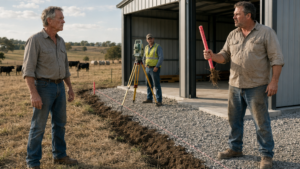
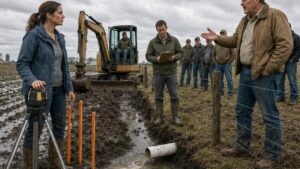
The surveyor introduced himself, listened to both sides without taking either one, then opened Kimberly’s deed and began working from the road reference point.
For the next half hour, argument gave way to measurements.
That suited Kimberly.
Numbers didn’t care who chaired the association.
The surveyor moved toward the creek with his equipment. Kimberly followed. Brenda came behind them, still carrying her map.
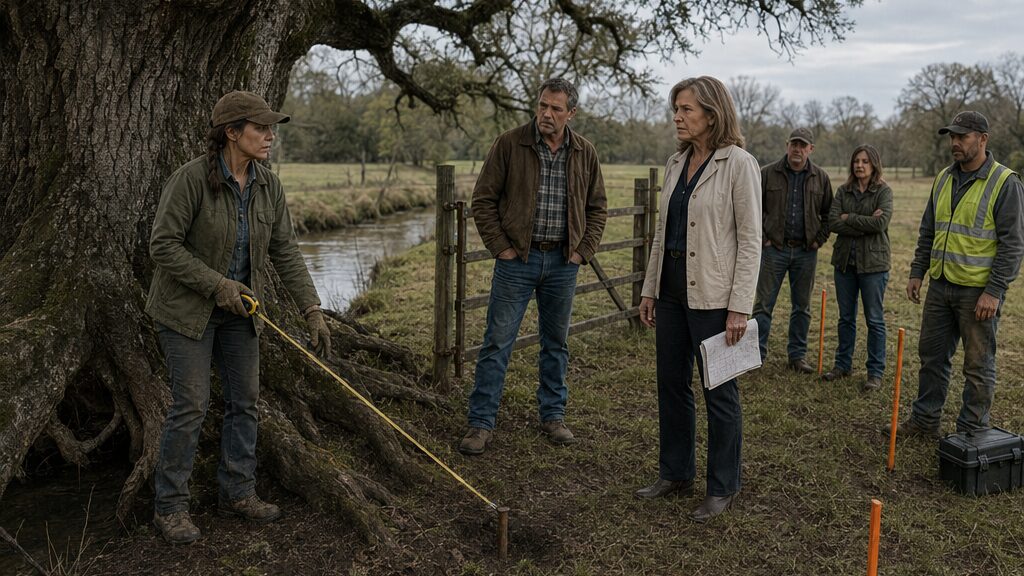
They reached the old oak.
The surveyor checked a measurement twice.
Then he crouched near one of the exposed roots.
“Should be something here.”
Brenda said, “The old markers aren’t reliable.”
The surveyor ignored her.
He scraped away leaves.
Then soil.
Kimberly knelt beside him.
Something dull appeared beneath the dirt.
She cleared another handful.
Iron.
A narrow weathered pin had been driven deep beside the oak root, its top nearly swallowed by decades of soil.
The surveyor cleaned it carefully and checked the position.
Daniel came down the slope.
“That it?”
“Looks consistent with the deed call.”
Brenda unfolded her map.
“The maintenance corridor isn’t based solely on the property boundary.”
Kimberly stood.
“First let’s see where your map puts it.”
The surveyor measured from the pin.
One stake.
Then another.
He looked at the association map and back toward the flags.
“These proposed markings don’t track the deed boundary.”
“How far?” Daniel asked.
“At this section? Roughly twenty feet.”
Nobody spoke.
The creek moved over stones below them.
Kimberly took Brenda’s photocopied map from the folder she’d brought and held it beside the surveyor’s field notes.
For two weeks she’d been told she was emotional, obstructive, sentimental.
Now there was an iron pin in the earth.
She didn’t raise her voice.
She didn’t need to.
“Your corridor is on the wrong side of the recorded line.”
Brenda’s mouth tightened.
“You’re confusing ownership with access.”
“I’m separating them.”
“The association has used this route historically.”
“For what?”
“Maintenance.”
“When?”
Brenda looked toward the board members.
“Over the years.”
Kimberly waited.
No date came.
No equipment record.
No description of work.
Daniel folded his arms.
“I’ve been downstream fifteen years. I don’t remember excavators coming through here.”
“Not every maintenance action requires an excavator,” Brenda said.
Kimberly pointed toward the contractor’s stakes.
“This one apparently does.”
One board member cleared his throat.
“We may need to verify the map.”
Brenda turned on him.
“We don’t need to stop necessary drainage work because a survey pin was found.”
The sentence changed the mood.
Kimberly heard it.
So did Daniel.
The issue had started as whether Kimberly understood her own land.
Now Brenda had been shown evidence that the corridor was misplaced, and she was still insisting the work continue.
Kimberly picked up one of the contractor stakes.
“You can verify whatever you want. Until you do, this doesn’t stay in my ground.”
She handed it to Brenda.
Brenda didn’t take it.
The stake remained between them.
Finally the contractor reached forward and accepted it.
Brenda refolded her map with sharp, precise movements.
“Historical-use rights don’t disappear because you found a pin.”
“Then bring me the record.”
“You’ll receive what the association is required to provide.”
“And until then?”
Brenda looked at the gate.
“Until then, you should think carefully about what happens downstream while you delay.”
She walked back toward the road.
The two board members followed more slowly.
Daniel remained beside the oak.
“You were right about the line,” he said.
“Looks that way.”
“That doesn’t fix my water.”
Kimberly met his eyes.
“I know.”
It was the first time she’d said it without defensiveness.
The surveyor continued taking measurements.
By noon, Kimberly had enough preliminary information to know the association map and the deed did not agree.
It should have felt like victory.
Instead, Brenda’s final warning stayed with her.
If the corridor was wrong, where was the right one?
As Kimberly returned toward the gate, Gregory Johnson stood beside an older pickup parked across the road.
He hadn’t attended the confrontation.
At least not openly.
“Kimberly.”
She stopped.
Gregory looked toward Brenda’s disappearing vehicle.
Then toward the creek.
“I heard they found the old pin.”
“You heard fast.”
“Things travel.”
“You’ve seen their map?”
He nodded.
“More times than I care to admit.”
Kimberly waited.
Gregory lowered his voice.
“If you’re going to keep digging, don’t spend all your time asking whether that corridor is legal.”
“What should I ask?”
For a moment, Gregory looked like a man deciding whether silence was still safer.
Then he said, “Ask where the old culvert used to run.”
Chapter 4: The Night the Creek Bank Burned
“Mom.”
Nicole’s hand was shaking Kimberly’s shoulder.
“Mom, wake up.”
Kimberly opened her eyes to an orange pulse against the bedroom wall.
For half a second she thought headlights were moving across the yard.
Then she smelled smoke.
She was out of bed before Nicole finished saying, “It’s by the creek.”
Kimberly grabbed her jeans from the floor and pulled them on as she ran. By the time she reached the kitchen, the glow beyond the back window had sharpened into flame.
Not the barn.
Not the equipment shed.
The pasture.
She stopped Nicole at the mudroom door.
“Stay here.”
“I’m coming.”
“No.”
“Mom—”
“Call it in. Then stay by the house.”
Kimberly snatched the extinguisher from beside the freezer and ran outside.
Wind pushed smoke low across the field.
The fire was not large enough to take the whole pasture, but it had found dry grass along the creek bank and was crawling fast beneath the fence. Flames snapped through brush near the section Brenda’s contractor had marked.
Kimberly dragged a hose as far as it would reach, then realized how useless it was.
She could hear the creek running only yards away while fire climbed the grass above it.
By the time the volunteer firefighters arrived, one young tree had already blackened from trunk to crown.
Kimberly stood behind the engine with soot on her hands.
Nicole appeared wrapped in a coat.
“I told you to stay inside.”
“I did until the trucks came.”
Kimberly wanted to argue.
Instead, she pulled Nicole against her.
A firefighter cut away part of the damaged fence while another worked down the bank.
The largest oak survived.
Two smaller trees did not.
Near midnight, the flames were out.
What remained looked worse under work lights than it had in the dark.
The creek reflected red emergency lamps. Ash floated in the shallows. A section of woven wire sagged where fence posts had burned.
Kimberly walked toward the gate.
The chain was hanging wrong.
She touched it.
The latch was still closed, but the chain had been looped through from the opposite direction.
Someone had opened the gate and fastened it again.
She crouched.
Tire tracks cut through the damp ground.
They were not hers.
The next morning, a county fire investigator arrived.
He moved slowly along the burn edge, photographing the ground and asking Kimberly where equipment had been parked.
“Nothing down here,” she said.
“No mower?”
“Not this week.”
“ATV?”
“Not since Monday.”
He pointed toward a blackened strip.
“The deepest burn pattern starts here.”
It was almost exactly where the contractor’s stakes had been.
Kimberly folded her arms.
“Could lightning do that?”
“There wasn’t lightning reported close enough.”
“Electrical?”
“No service down here.”
He did not say arson.
Kimberly noticed that.
“What are you thinking?”
“I’m thinking I don’t guess before I finish.”
He walked toward the gate and studied the tracks.
“Anybody have permission to be here last night?”
“No.”
“Anybody who believed they did?”
That was a different question.
Kimberly looked toward the road.
“The drainage association claims historical access.”
“Have they used it?”
“Not with my permission.”
The investigator nodded without reacting.
“Keep every notice they’ve sent you.”
“I already have them.”
“All of them?”
“In date order.”
For the first time that morning, he looked mildly impressed.
“Bring me copies.”
At the kitchen table, Kimberly spread the papers across two chairs.
Notice of enforcement.
Access warning.
Maintenance correspondence.
The map.
Photographs of the stakes.
Nicole stood in the doorway.
“You kept everything?”
“Yes.”
“You always complain about paperwork.”
“I complain. I don’t throw it away.”
Nicole picked up one envelope.
“Do you think Brenda did this?”
Kimberly looked at her daughter.
“I don’t know.”
“You think somebody did.”
“That’s not the same thing.”
Nicole’s eyes stayed on the window facing the creek.
“Can I still go down there?”
Kimberly hesitated too long.
Nicole noticed.
That frightened Kimberly more than the fire had.
Until then, she had treated every fight as a problem she could absorb herself.
A notice could sit in her drawer.
An assessment could be challenged.
A contractor could be sent back through the gate.
But now Nicole was asking permission to walk somewhere she had never before needed permission to go.
“No,” Kimberly said quietly. “Not alone. Not for now.”
Nicole nodded.
She did not complain.
That was worse.
In the afternoon Kimberly remembered the motion camera.
She had installed it months earlier because deer kept rubbing against one of the young trees near the lower fence. It faced the gate at an angle, mostly catching animals and the occasional tractor light.
She pulled the memory card.
Most clips showed darkness.
Then, at 10:43 p.m., two headlights appeared.
A vehicle moved slowly through the gate.
The image was grainy.
The plate could not be read.
The driver could not be seen.
The vehicle remained only twelve seconds before passing beyond the camera’s view.
Kimberly replayed it.
Nicole watched from behind her.
“That’s not Daniel’s truck.”
“No.”
The vehicle had a squared rear profile and a pale reflective strip along the tailgate.
Kimberly had seen that combination dozens of times.
At culvert inspections.
At association meetings.
Parked beside Brenda’s office.
It was one of the maintenance vehicles regularly used by the association.
Kimberly paused the image.
Someone had entered her pasture less than an hour before the fire was reported.
Chapter 5: The Map Was Wrong for a Reason
“There is no recorded easement matching that description.”
The county land-records clerk rotated the monitor toward Kimberly.
Kimberly stared at the parcel image.
“You’re sure?”
“I’m sure I don’t see one recorded against your parcel.”
“What about historical maintenance access?”
“That phrase by itself doesn’t create a recorded easement.”
The clerk scrolled through older entries.
There were utility rights.
A road reservation.
A drainage reference attached to neighboring parcels.
Nothing resembling the shaded strip on Brenda’s map.
Kimberly placed the photocopy on the counter.
“Then what is this?”
The clerk adjusted her glasses.
“I can’t tell you what their internal map means.”
“It shows a corridor through my creek pasture.”
“It may be a planning document.”
“They’re enforcing it like it’s a deed.”
The clerk gave Kimberly the neutral expression of someone who had learned not to interpret disputes from behind a county counter.
“You’ll need the association records for that.”
Kimberly left with certified copies of her deed references and every recorded drainage instrument the clerk could locate.
By noon she was standing in Gregory Johnson’s workshop.
He had cleared one side of a workbench.
Kimberly set Brenda’s map beside the county documents.
“You knew.”
Gregory did not answer immediately.
“You knew this wasn’t recorded.”
“I knew the association map wasn’t a survey.”
“That’s not what I asked.”
Gregory rubbed one hand over his jaw.
“No. It isn’t recorded the way Brenda has been presenting it.”
Kimberly felt anger rise, then settle into something colder.
“How long?”
“The map itself? Years.”
“How many?”
“Long enough.”
She pushed it toward him.
“Where did it come from?”
Gregory opened a metal file drawer and pulled out an older sheet.
The paper was yellowing at the edges.
Its lines were cleaner than the photocopy, but the same shaded corridor was there.
“Planning sketch,” he said. “Made when the association was discussing access alternatives.”
“Alternatives.”
“Yes.”
“Not rights.”
“No.”
Kimberly stared at him.
“And everyone just kept using it?”
“People copied files. New binders got made. The sketch got included with maintenance documents. After a while, nobody remembered why the line was drawn.”
“You remembered.”
Gregory looked away.
“Eventually.”
“That’s a useful word.”
He accepted the criticism.
Kimberly pointed toward the map.
“You told me to ask about the old culvert.”
Gregory went to another cabinet.
This time he removed invoices.
Inspection notes.
Minutes from meetings more than a decade old.
The original drainage route did not cross Kimberly’s creek pasture.
It ran farther north, under a low section of county-side ground before emptying into the same creek.
“So repair that,” Kimberly said.
Gregory gave her a tired look.
“That’s where this stops being simple.”
He laid out photographs.
The old culvert was partially collapsed.
Sediment had narrowed the channel. Root intrusion had worsened the blockage. One maintenance note warned that a full repair would eventually require excavation and replacement.
“How long has it been like this?”
“Getting worse? Years.”
“And Brenda decided cutting through my pasture was cheaper.”
“Easier.”
“Same thing.”
“Not exactly.”
Gregory placed another sheet down.
An estimate.
Kimberly read the total twice.
“That’s what it costs to fix the original route?”
“That was three years ago.”
“It’ll be higher now.”
“Yes.”
The amount would require a substantial assessment across association members.
Suddenly Daniel’s anger made more sense.
So did Brenda’s insistence.
But not the lie.
Kimberly drove directly to Daniel’s farm.
He was standing near the flooded lower field.
She handed him a copy of the old culvert plan.
He studied it.
“So the water problem is real.”
“Yes.”
“And the corridor isn’t.”
“Not as they described it.”
Daniel looked toward the standing water.
“I wish you’d found that first part sooner.”
Kimberly stiffened.
Then stopped herself.
He was right about one thing.
She had spent weeks proving what Brenda could not do.
She had not asked why anybody believed something needed doing at all.
“How long have you been complaining about this?” she asked.
“Three seasons.”
“To Brenda?”
“To the board.”
Kimberly looked at him.
“Was I at any of those meetings?”
Daniel did not answer.
He did not need to.
Back at Gregory’s workshop, Kimberly went through maintenance minutes.
The pattern was not dramatic.
That made it more believable.
Inspection deferred.
Estimate discussed.
Member concerns about cost.
Temporary clearing authorized.
Full replacement postponed.
Again.
Again.
Again.
Then the planning sketch appeared.
A proposed alternate equipment route through higher, firmer ground.
Through what was now Kimberly’s creek pasture.
“Why not bring this to everyone honestly?” Kimberly asked.
Gregory leaned against the workbench.
“Because the assessment would have been ugly.”
“How ugly?”
“Enough that people would have voted no.”
“So Brenda found a cheaper way.”
“She thought she did.”
Kimberly held up the sketch.
“By using somebody else’s land.”
Gregory said nothing.
She opened another folder.
A warning from an agricultural drainage consultant was clipped inside.
Three years old.
The language was plain.
Deferred repair increased the risk of downstream saturation, erosion, and eventual failure.
At the bottom was an acknowledgment signature.
Brenda Campbell.
Kimberly looked up.
“She received this?”
“Yes.”
“And she still told everyone the creek corridor was historical access?”
Gregory folded his arms.
“She didn’t start there.”
“What did she start with?”
“Trying to get the assessment approved.”
“And when that failed?”
Gregory’s eyes settled on the old planning sketch.
Kimberly understood before he answered.
Brenda had not invented the drainage emergency.
She had inherited part of it, managed part of it, and then tried to hide the cost of solving it.
“Why didn’t you say something?”
Gregory looked toward the open workshop door.
“Because every year I thought we’d fix it next year.”
“That isn’t an answer.”
“It’s the one I have.”
Kimberly gathered the records.
At the bottom of the warning letter was a handwritten note in Brenda’s writing.
Explore alternate access before assessment.
The date was three years earlier.
Long before Kimberly’s current dispute began.
The corridor through her pasture had not been an emergency improvisation.
It had been Brenda’s escape route from a problem she had already been warned would get worse.
Chapter 6: Brenda’s Best Argument Was Also Her Worst Choice
“The drainage danger is real.”
Brenda said it before anyone had fully settled into the folding chairs.
Kimberly sat near the back of the association meeting room with her corrected survey rolled beside her.
Daniel sat two seats away.
Gregory remained at the records table.
Brenda stood at the front.
“I’m not going to pretend otherwise,” she continued. “Several properties have already suffered saturation. If we get another wet season without restoring equipment access, those losses will grow.”
Kimberly watched the room.
Some members nodded.
That was Brenda’s strength.
She was not lying about everything.
Brenda displayed a watershed map.
The creek ran blue across the center. Low fields were shaded downstream.
Daniel’s pasture was among them.
“So when Mrs. Taylor blocked access—”
Kimberly stood.
“I blocked an unrecorded corridor across my property.”
Brenda’s eyes hardened.
“You blocked the route the board identified as most practical.”
“Using a planning sketch you presented as historical access.”
One of the board members looked down.
Brenda gripped the edge of the table.
“The association has always had obligations beyond one parcel.”
“And obligations to be accurate.”
Kimberly unrolled her corrected survey.
She placed it over the watershed map.
The two sheets told different stories.
The creek was the same.
The boundaries were not.
A murmur moved through the room.
Brenda spoke over it.
“We were trying to prevent a larger loss.”
“By avoiding the original culvert.”
“By finding a workable alternative.”
“Because the original repair costs more.”
Brenda paused.
That was answer enough.
Gregory stood.
“We should address the old estimates.”
Brenda turned sharply.
“Gregory.”
He did not sit.
“The full replacement was postponed.”
“How many times?” Kimberly asked.
Gregory glanced at the records.
“Three formal postponements.”
Someone near the front asked, “Why?”
Brenda answered.
“Because members opposed the assessment.”
Another voice said, “How much?”
Gregory gave the figure from three years earlier.
The room changed.
Not outrage.
Calculation.
Farmers knew what an assessment meant because each immediately translated the number into fencing, seed, veterinary bills, diesel, loan payments.
Brenda looked around.
“You see the problem.”
Kimberly did.
For the first time, Brenda’s decisions made sense without becoming acceptable.
She had faced a costly repair that members did not want.
She had chosen delay.
When delay became dangerous, she had chosen a cheaper route.
Then she had treated Kimberly’s land as the convenient answer.
Brenda pointed to the downstream shading.
“I made decisions to keep this association functioning.”
Gregory said quietly, “You moved maintenance money.”
The room went still.
Brenda stared at him.
“What?”
“The reserve allocation. Three years ago.”
“That money covered emergency work.”
“Elsewhere,” Gregory said. “After the assessment failed.”
Kimberly looked from one to the other.
“So the money intended for this system was used on other repairs?”
Brenda’s voice sharpened.
“Repairs that also affected members.”
“Without fixing the problem you’d already been warned about.”
“I had twelve properties calling about immediate issues.”
“And mine was easier to cross.”
Brenda looked directly at Kimberly.
“Yes.”
The honesty surprised everyone.
Brenda continued.
“Your creek strip is higher ground. It offers the cleanest machinery path. I believed the association’s historical use gave us enough authority to proceed while legal details were clarified.”
“You knew the map was a planning sketch.”
“I knew the access need was real.”
“That isn’t the same thing.”
“No,” Brenda said. “It isn’t.”
For a moment she looked older.
Not defeated.
Tired.
Then Daniel stood.
“I’ve got something to say.”
Kimberly expected him to speak about flooding.
He looked at her instead.
“You’re right about your boundary.”
She waited.
“But you weren’t at the meetings.”
The sentence struck harder in public.
Daniel continued.
“We talked about drainage last year. And the year before.”
Kimberly’s fingers tightened around the survey.
Brenda said nothing.
She did not need to.
Daniel was not taking Brenda’s side.
That made the criticism harder to dismiss.
“I sent you copies,” Gregory said gently.
Kimberly remembered them.
Association envelopes stacked beside cattle invoices.
Meeting notices she had opened, skimmed, and left under other paperwork.
After her husband died, the meeting room had become one more place filled with people who remembered him sitting beside her.
He had asked questions there.
He had argued over assessments.
He had understood which drainage ditch fed which field before Kimberly ever needed to.
For two years, she had stayed away because walking into that room alone felt too much like announcing that half of her life was missing.
She had called it independence.
“I didn’t come,” Kimberly said.
Nobody moved.
“I should have.”
Brenda looked almost surprised.
Kimberly continued.
“That doesn’t make the corridor legal. It doesn’t excuse false enforcement. But I should have been here before it reached my gate.”
Daniel nodded once.
The admission did not weaken Kimberly the way she had feared admissions always would.
Instead, something in the room relaxed.
They were no longer deciding which woman had been entirely right.
They were looking at a water problem.
Gregory spread the old culvert plan across the table.
“The original system can still be repaired.”
A member asked, “At what cost?”
“More now.”
“How much more?”
Gregory gave the updated estimate.
This time nobody murmured.
The silence was worse.
Brenda folded her arms.
“This is exactly why the alternate route was proposed.”
Kimberly looked at the watershed map.
If Brenda disappeared tomorrow, the creek would still rise.
Daniel’s pasture would still flood.
The collapsed culvert would still be collapsed.
Proving ownership had solved the question Kimberly began with.
It had not solved the problem underneath it.
She studied the corrected survey.
There was higher ground along the edge of her upper field.
Not the creek pasture.
Farther from the oak.
Farther from Nicole’s favorite bank.
Equipment might be able to cross there temporarily.
She traced the route with one finger.
Daniel noticed.
“What?”
Kimberly did not answer immediately.
She looked at Gregory.
“How wide does the equipment actually need?”
“For a replacement job?”
“Yes.”
He considered it.
“Depends on staging.”
“Not the association’s proposed corridor. The minimum.”
Gregory leaned over the map.
Brenda stepped closer.
Kimberly covered the route with her hand.
“Not yet.”
Brenda stopped.
That small motion told Kimberly something had changed.
Two weeks earlier, Brenda had placed flags beyond her gate and told her approval was unnecessary.
Now everyone was waiting for Kimberly to move her hand.
“I need the contractor dimensions,” Kimberly said. “The old culvert measurements. And the updated cost breakdown.”
One member asked, “Why?”
“Because there may be another way in.”
Brenda stared at her.
“Through your land?”
“Maybe.”
Daniel looked toward the corrected boundary.
“What are you proposing?”
“Nothing tonight.”
Kimberly rolled the survey.
She could feel every eye in the room.
For once she did not mistake attention for judgment.
“I want forty-eight hours,” she said. “Then I’ll show you a route that doesn’t require taking my creek pasture.”
Chapter 7: She Offered Access Without Giving Away the Land
Kimberly opened the pasture gate before anyone asked her to.
The old hinges complained as she pulled it wide.
Daniel, Gregory, the contractor, and two association board members stood on the road side looking at her as if they expected some condition before they crossed.
There was one.
Kimberly held up a folded sheet.
“You follow the flagged route and nowhere else.”
The contractor nodded.
“No creek bank?”
“Not unless I’m standing with you.”
Brenda had not come.
That absence sat among them anyway.
Forty-eight hours had passed since Kimberly asked the association for time. She had spent most of those hours walking her own ground.
Not arguing.
Measuring.
The higher edge of the field was less direct than Brenda’s corridor. It curved away from the creek, crossed firmer ground near the hay lot, then dropped toward the old culvert from the north.
The contractor stepped through the gate and studied the route.
“You’re adding distance.”
“I know.”
“Probably thirty percent.”
“I know.”
“And staging here would be tighter.”
Kimberly pointed toward a flat strip beside the upper fence.
“You can stage there.”
He walked it.
Daniel followed, measuring distances with his eyes.
Gregory carried the corrected survey and old culvert plan under one arm.
Nicole stood near the gate with her hands in her jacket pockets.
She had asked to come.
Kimberly had almost said no.
Instead she had said, “Stay where I can see you.”
That was progress, even if it did not feel like much.
The contractor stopped at the crest of the field.
“This route works.”
Daniel looked toward him.
“Works how?”
“For getting equipment to the old culvert.”
“What size?”
“The excavator can make it. Trucks too, one at a time.”
Gregory said, “What about crossing drainage lines?”
“We mat the soft section.”
Kimberly looked toward the creek.
From where she stood, the old oak was visible below.
No orange flags crossed its roots.
No machinery path cut along Nicole’s bank.
The contractor unrolled a sketch on the hood of his truck.
“There’s a catch.”
Of course there was.
“What?” Kimberly asked.
“The original repair costs more than using the alternate corridor.”
Daniel gave a humorless laugh.
“We knew that.”
“No. More than the last estimate.”
He pointed to the access route, staging, culvert replacement, and bank stabilization.
“Temporary matting. Additional labor. More fuel. We’d also need to restore this upper edge after the work.”
Gregory studied the total.
Kimberly saw his face change.
“How much higher?” Daniel asked.
Gregory gave the figure.
Nicole looked at Kimberly.
No one spoke for several seconds.
The problem had become brutally simple.
Brenda’s route had always been attractive because somebody else carried part of its true cost.
Kimberly’s land.
Kimberly’s creek.
Kimberly’s permanent loss of control.
The lawful solution put the cost back where it belonged.
On everybody.
Daniel rubbed the back of his neck.
“That assessment’s going to hurt.”
“Yes,” Kimberly said.
“My operation included.”
“Yes.”
He looked at the flooded lower land in the distance.
Then toward the creek pasture.
“You could just refuse access altogether.”
Kimberly glanced at him.
“I could.”
“You’re not.”
“No.”
“Why?”
She folded her arms.
“Because you were right about the water.”
Daniel seemed to need a second to absorb that.
Kimberly continued.
“You were wrong about my boundary.”
He nodded.
“And I was wrong to pretend the drainage problem belonged to everybody except me.”
The words still felt unfamiliar.
Not humiliating.
Just unfamiliar.
Gregory rolled the survey back up.
“We should take this to the board.”
That evening every chair in the association room was filled.
More people stood along the walls.
Kimberly had seen crowded meetings before, but usually only when taxes, road closures, or livestock regulations were involved.
Brenda sat at the front table.
She had returned.
Her expression gave nothing away.
Gregory presented the corrected survey first.
Then the original culvert route.
Then Kimberly’s temporary access proposal.
No speeches.
Just facts.
A board member asked, “What happens to Mrs. Taylor’s land after construction?”
Kimberly answered.
“Temporary access ends when the repair is complete.”
“Recorded?”
“Yes.”
“No standing maintenance right?”
“No.”
“What about future inspections?”
“Requested individually and documented.”
Brenda leaned back.
“That creates administrative delay.”
Kimberly looked at her.
“It creates consent.”
A few people shifted.
Nobody applauded.
Kimberly was glad.
This was not that kind of room.
A farmer near the wall asked what everybody wanted to know.
“What’s this cost us?”
Gregory read the assessment estimate.
The reaction was immediate.
Someone muttered.
Another person asked whether payment could be staged.
A third wanted to know why reserves did not cover more.
Brenda stared down at the table.
The old problem had finally entered the room in its real form.
Not as Kimberly’s refusal.
As money.
Daniel stood.
“I’ve got the most water sitting downstream right now.”
Several heads turned.
“I wanted the creek route opened.”
Kimberly watched him.
“I thought Kimberly was making this personal.”
He paused.
“I was wrong about that.”
Brenda looked up.
Daniel continued.
“The original system failed because we kept putting the repair off. If we take her ground because that’s cheaper, we haven’t fixed how we got here.”
Someone asked, “So you support paying this?”
Daniel’s mouth tightened.
“No.”
A few people laughed quietly.
He shrugged.
“But I’ll vote for it.”
That mattered more than enthusiasm would have.
Gregory called for discussion.
Questions came fast.
Could the assessment be divided over two seasons?
Could emergency reserves cover part?
Could members provide equipment or labor credits?
Could the work begin before final collection?
Kimberly answered only the questions that concerned her land.
For once, she did not feel responsible for carrying the entire room.
Then Brenda spoke.
“There is still a legal argument for historical access.”
The room quieted.
Kimberly looked at her.
Brenda continued.
“I want that understood before anyone assumes this is settled.”
One board member said, “The county records don’t support the corridor.”
“They don’t eliminate every access doctrine.”
“Are you proposing litigation?”
Brenda did not answer immediately.
Kimberly saw something change in her face.
Maybe exhaustion.
Maybe the realization that every defense now required another fight.
Finally Brenda said, “No.”
Gregory looked at her.
“No?”
“No litigation.”
She gathered the papers in front of her.
“I still believe the board acted under a legitimate emergency.”
Kimberly said nothing.
Brenda met her eyes.
“But I no longer have the board’s confidence to continue making that argument on its behalf.”
She removed a folder from beneath her hand.
“This is my resignation as chair.”
The room remained silent.
Brenda placed the folder beside Gregory.
“Effective tonight.”
Nobody clapped.
Nobody smiled.
Kimberly was glad about that too.
Gregory proceeded with the vote.
Kimberly listened as members answered one after another.
Yes.
Yes.
No.
Yes.
Abstain.
Yes.
The result was already clear before Gregory finished counting.
Kimberly looked toward Brenda’s chair.
It was empty.
She had left before the final number was read aloud.
Chapter 8: The Creek Came Back Before Trust Did
“Mom, look.”
Nicole was crouched beside the creek bank.
Kimberly left the fence repair and walked down the slope.
At first she saw only dark soil.
Then Nicole pointed.
A row of green shoots had pushed through the burned ground.
Small.
Uneven.
Stubborn.
Kimberly knelt.
Months had passed since the fire.
The old culvert had been replaced before late summer. The new channel carried rainwater more cleanly, and Daniel’s lower pasture had dried enough to recover.
The temporary machinery route across Kimberly’s upper field was already disappearing beneath reseeded grass.
The creek pasture had taken longer.
One young tree was gone.
Another had been cut back nearly to the trunk.
The old oak remained.
Its lowest roots still held a thin stain of soot.
Nicole touched one of the new shoots.
“Think they’ll stay?”
“If the cattle don’t find them.”
“I mean after winter.”
Kimberly looked at her daughter.
“Probably.”
Nicole smiled.
That was enough.
The fire investigation had closed without the answer Kimberly once believed she needed.
The motion-camera image established that an association maintenance vehicle entered her pasture before the fire.
Records established that the entry had not been authorized.
But no usable image showed who drove it.
No physical evidence conclusively connected the vehicle to the ignition.
The county investigator had been careful when he explained it.
“We can document unauthorized entry. We can document where the burn started. We cannot honestly tell you who started it.”
Months earlier, Kimberly would have heard only failure in that sentence.
Now she understood the difference between what she believed and what she could prove.
The association formally withdrew its enforcement notices.
The access restriction disappeared.
New rules required written property consent, recorded route maps, and board approval for non-emergency entry.
Gregory hated the extra paperwork.
He implemented it anyway.
Daniel complained about the assessment every time he wrote a check.
He paid it anyway.
Nothing became perfect.
That made Kimberly trust the changes more.
Late one afternoon, a vehicle stopped near the pasture gate.
Kimberly recognized it before the driver stepped out.
Brenda.
She had not been back since the vote.
Kimberly put down the fencing pliers.
Nicole was at the house.
That mattered.
Brenda walked to the gate carrying three old orange markers.
“I found these in association storage.”
Kimberly looked at them.
The same type that had appeared in her pasture that first morning.
“You could’ve left them there.”
“I could have.”
Brenda stood outside the closed gate.
She did not reach for the latch.
“I came to remove the last markers near the county side.”
Kimberly considered her for a moment.
“I’ll come with you.”
Brenda nodded.
Kimberly unlocked the gate herself.
They walked without speaking.
The repaired culvert was visible farther north, where water now passed beneath the reconstructed line instead of backing toward Daniel’s ground.
Brenda stopped near the old oak.
“No machinery came through here.”
“No.”
“The other route cost more.”
“Yes.”
Brenda gave a short breath that was almost a laugh.
“You always answer that way?”
“When the answer’s simple.”
Brenda looked toward the creek.
“I should have brought the assessment back to the members.”
Kimberly waited.
“I did once,” Brenda continued. “They hated it.”
“That was their right.”
“I know that now.”
“You knew it then.”
Brenda’s mouth tightened.
“Yes.”
That answer mattered.
No excuse attached.
Brenda pressed one orange marker into the soil and pulled it back out, as if checking for others.
“When the assessment failed, I thought I was protecting the association.”
“From paying for its own problem.”
“From splitting apart.”
Kimberly said nothing.
Brenda looked at her.
“You think I wanted your land.”
“You acted like you were entitled to it.”
“I wanted the easiest route.”
“That’s not much better.”
“No.”
They reached the fence line.
Brenda found another faded marker partly hidden in weeds.
She pulled it free.
“I kept thinking if I solved the drainage first, I could sort the legal questions afterward.”
“And the notices?”
Brenda looked down at the marker.
“You weren’t cooperating.”
“I wasn’t agreeing.”
“At the time, I stopped seeing the difference.”
There it was.
Not an apology shaped to earn forgiveness.
Something smaller.
More useful.
Kimberly leaned against the fence post.
“You scared my daughter.”
Brenda’s face changed.
“I know.”
“You made her afraid to walk down here.”
“I know.”
Kimberly waited for another explanation.
None came.
The creek moved between stones.
Finally Brenda said, “I chose pressure because admitting the earlier decisions were wrong would have meant admitting I’d wasted years.”
Kimberly looked toward the repaired drainage line.
“That cost everybody more.”
“Yes.”
“And nearly cost me part of this pasture.”
“Yes.”
“Then don’t ask me to tell you it’s fine.”
“I’m not.”
For the first time since Brenda had appeared at the gate with orange flags, Kimberly believed her.
Not trusted.
Believed.
There was a difference.
Brenda gathered the remaining markers.
At the gate, she paused.
“I’m sorry about Nicole.”
Kimberly did not say she forgave her.
She opened the gate.
Brenda walked through.
Then Kimberly closed it behind her.
Two weeks later, Daniel’s maintenance truck stopped on the county road.
Nicole was already outside.
The new access procedure required notice before entry, purpose listed, route confirmed.
Kimberly had received the request the previous afternoon.
Routine inspection of the repaired drainage outlet.
Nothing more.
Daniel leaned from his truck window.
“Your mother around?”
Nicole looked toward the creek.
“She knows.”
Kimberly stood beneath the old oak where she could see both the gate and the clear water below.
Nicole removed the key from the hook inside the fence post box.
For months, Kimberly had kept that key in her own pocket.
Nicole unlocked the gate.
Daniel waited until she pulled it fully open.
“Upper route?” he asked.
“Upper route,” Nicole said.
“No creek bank.”
“I know.”
Daniel drove through slowly.
Nicole closed the gate behind him but did not lock it yet.
Kimberly watched from beside the creek.
The water crossed their land without understanding property lines.
That did not make the lines meaningless.
It made getting them right more important.
Nicole walked down the slope and stopped beside her.
“Everything okay?”
Kimberly looked at the new grass along the burned bank, the old oak above them, and Daniel’s truck following the agreed route in the distance.
“Yeah.”
Nicole glanced at her.
“You mean that this time?”
Kimberly smiled.
“Yeah.”
The creek kept moving.
So did they.
The story has ended.