The Biker In The Garage And The Legacy Of Ben Reed
CHAPTER 1: THE FORTY-THREE DOLLAR BOY
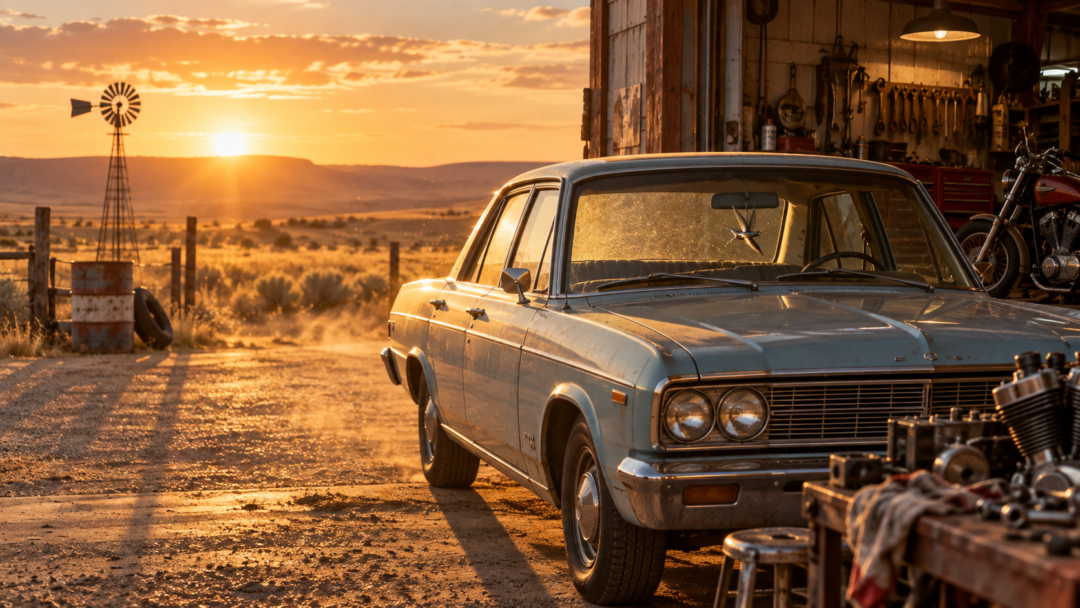
The late afternoon sun poured liquid amber across the gravel lot of Blackwood Customs, casting long, iron-red shadows behind the rows of dismantled farm combines and vintage motorcycles. The air smelled of burnt hydraulic fluid, high-octane racing fuel, and the hot, dry dust of the South Dakota prairie drifting off the nearby wheat fields. Inside the two-bay cinderblock repair shop, the rhythmic, pneumatic thrum of an air compressor was the only sound breaking the summer stillness.
In the center of the asphalt apron, standing before the open hood of a pale blue 1984 Plymouth Reliant sedan, was a slender ten-year-old boy. He wore a faded beige pocket t-shirt stained with red prairie clay, baggy blue jeans frayed at the cuffs, and a pair of worn-out black canvas sneakers with scuffed rubber toes. A battered navy nylon backpack hung from his thin left shoulder by a frayed strap. His brown hair was dusted with road dirt, his pale, freckled face tight with an anxious terror that seemed far too heavy for a child.
Hank Becker stood over the sedan’s engine bay, a chrome-vanadium combination wrench tucked into the back pocket of his denim jeans. Hank was fifty-two years old, built like a hydraulic press, with broad, rounded shoulders and thick forearms covered in fading Navy Seabee tattoos and grease-blackened burn scars. His dark hair was threaded with iron gray, tied back behind his ears, and a long, neatly combed salt-and-pepper goatee fell against the collar of his faded black leather work vest.
Hank leaned forward, his weathered hands gripping the cold steel latch of the sedan’s hood.
“My stepdad said I messed it up,” the boy muttered, his voice barely rising above the rustle of the dry grass along the ditch. His fingers clutched the strap of his backpack until his knuckles turned bloodless. “He said I touched the carburetor screws when he wasn’t looking.”
Hank didn’t answer immediately. He looked at the clean, untouched factory paint on the carburetor housing, then down into the boy’s wide, haunted brown eyes. A gentle, protective warmth softened the hard lines around the mechanic’s eyes.
“Then we don’t know that you did anything wrong, son,” Hank said softly. His voice was deep, bearing the steady, reassuring rumble of a marine diesel.
With a firm, deliberate push of both hands, Hank brought the heavy blue hood down. The iron latch caught with a solid, echoing metallic thud that resonated across the quiet lot.
Beside the hydraulic lift in the first bay, Deke, Hank’s lead shop fabricator, straightened up from a tire balancer, wiping his blackened palms on a red shop rag. Deke shook his head slowly, his eyes meeting Hank’s with grave meaning.
“This isn’t a tire problem, Hank,” Deke called out quietly. “And it sure as hell isn’t a carburetor adjustment.”
The boy bit his trembling lower lip, staring down at his dusty sneakers on the cracked asphalt. He reached deep into the front pocket of his jeans, pulling out a crumpled wad of dirty dollar bills. He smoothed the paper against his thigh with trembling hands.
“I have forty-three dollars,” the boy whispered, extending the money toward Hank’s massive leather-clad chest. “It’s all my paper route money from the summer. Is forty-three dollars enough to fix the brakes so he doesn’t take my dog?”
Hank didn’t take the money. His gaze shifted from the crumpled bills toward the interior of the pale blue sedan.
Hanging from the rearview mirror by a braided strip of black parachute cord was a small, hand-crafted metal ornament. It was shaped like a barn swallow in mid-flight, its wings spread wide in graceful aerodynamic arcs. The body was machined from solid surgical-grade stainless steel, its surface hand-checkered with microscopic geometric bevels that caught the dying sunlight in brilliant flashes of silver and deep black oxide.
Hank’s breath caught in his throat like a swallowed bone. The air seemed to vanish completely from the dusty garage bay.
He stepped to the open driver’s side door, his boots moving in slow, trance-like deliberation. He reached his calloused hand through the open window, his fingertips hovering an inch from the suspended steel bird. He didn’t touch it. He knew every single millimeter of that metal sculpture. He had seen the original wooden template drawn on a scrap of cardboard in a desert bunker outside Fallujah twenty years ago.
“Where did your mother get this ornament, kid?” Hank asked, his voice dropping into a razor-thin whisper that barely carried through the glass.
The boy leaned in toward the open door, his eyes wide with innocent pride. “My dad made it. Before he died in the wheat field. He told me it was a lucky swallow so I’d always find my way home.”
Hank’s scarred brow furrowed with immense dread. A dark, cold hand seized his heart.
“What was your father’s name, son?”
The boy looked straight up into the old mechanic’s eyes, speaking with quiet, unbroken reverence: “Ben Reed.”
Hank froze. The world around him seemed to stop spinning on its axis. He stared through the silhouette of the stainless swallow into the boy’s freckled face, seeing the exact curve of Ben Reed’s jaw, the same stubborn set of the brow, and the deep, unyielding honesty of the finest combat engineer who had ever stood at his shoulder.
“I knew your father,” Hank whispered, his rough voice cracking with unshed tears.
Hank stepped back, knelt beside the sedan’s rear wheel, and glanced beneath the chassis. His flashlight beam caught the brake lines. Bolted directly to the differential housing, magnetically attached to the steel frame, was a black plastic transponder with a wire tapped directly into the hydraulic brake bleeder valve—a remote-activated pressure dump solenoid designed to drain the brake fluid at high speed.