The Biker In The Barn And The Legacy Of Wyatt Stone
CHAPTER 1: THE GAVEL ON THE BLOCK
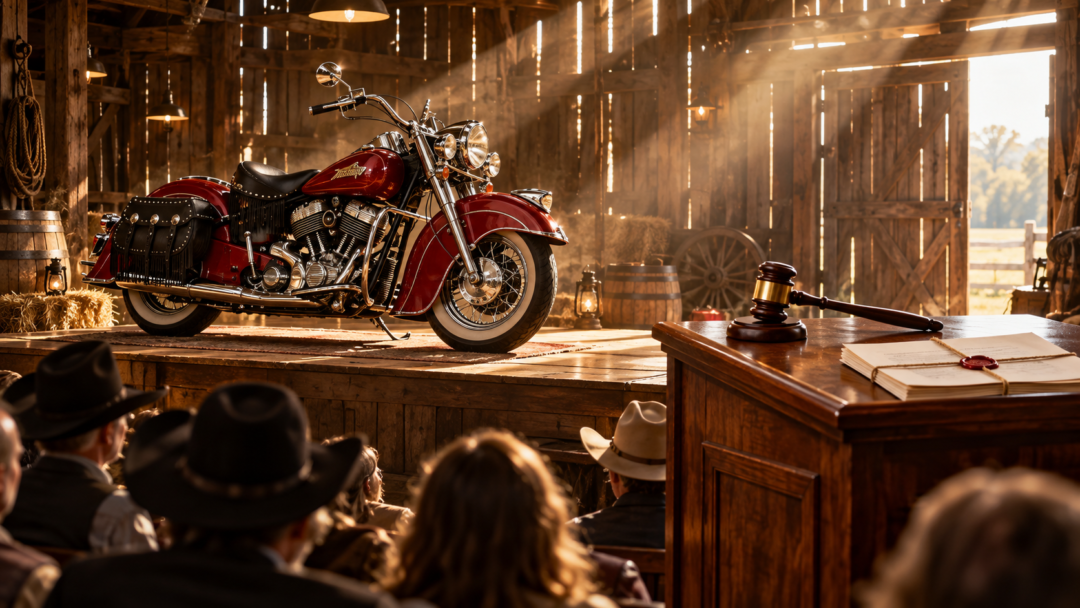
The heavy oak timber rafters of the Stone family barn groaned under the heat of the late August afternoon, dust motes drifting like gold flakes through the shafts of sunlight slicing between the weathered wall slats. The cavernous barn was packed with over a hundred local farmers, timber cutters, and estate liquidators, their worn denim work coats and sweat-stained hats creating a sea of somber, uneasy faces. The smell of dry cured fescue, ancient cedar shavings, and fifty years of motorcycle exhaust hung thick and suffocating in the stagnant mountain air.
In the center of the wooden hay floor, elevated upon a rough-sawn pine auction platform, rested a pristine 1947 Indian Chief motorcycle. Its hand-rubbed crimson lacquer gleamed under the sunbeams, its wide-valanced fenders swooping gracefully over vintage whitewall tires, and its air-cooled flathead V-twin engine polished to the brilliance of fine silver. It was a masterpiece of American mechanical craft, restored over twenty years by the calloused hands of Wyatt Stone.
Sitting on the second row of rough oak spectator benches, eight-year-old Caleb Stone clutched a scratched, vintage black motorcycle helmet against his small chest with desperate, white-knuckled ferocity. He wore a brown-and-tan plaid button-up shirt over a faded dark t-shirt, his baggy jeans dusty from hours of sitting in the hay. Tears tracked hot and dirty down his freckled cheeks, his chest heaving with silent, ragged sobs as he looked up toward the platform.
“Please don’t sell it!” Caleb’s high-pitched voice broke through the low hum of the crowd, trembling with pure, unadulterated heartbreak. “Grandpa promised that motorcycle to me! He built it for me! He made me swear I’d learn to ride it when I turned sixteen!”
Behind the elevated wooden podium, Auctioneer Amos Morton paused for a fraction of a second. Morton was fifty-eight, completely bald, with a stern, leathered face that seemed carved from dry Ozark limestone. He wore a crisp white grid-pattern dress shirt, a dark patterned silk tie, and a gray tailored vest. In his right hand, he held a heavy, polished hickory gavel, poised four inches above the sound block. His mouth tightened into an expression of bureaucratic annoyance at the child’s interruption.
“The young man will remain silent or be escorted from the auction premises,” Morton announced, his voice booming through an old public-address horn mounted to a hay beam. “We are bound by order of the Newton County Probate Court to satisfy estate liabilities. I have an opening bid of twelve thousand dollars from the gentleman on the aisle. Twelve thousand once… twelve thousand twice…”
Morton raised the gavel high, muscles tensing in his forearm to deliver the final strike.
“Hold the sale.”
The voice rolled down the length of the barn like a summer thunderclap over the Boston Mountains. It was deep, sonorous, and carried the undeniable cadence of absolute, immovable authority.
Every head in the barn snapped toward the open double doors at the rear of the threshing floor.
Framed against the blinding white brilliance of the afternoon sun stood Mac “Preacher” Callahan. Mac was fifty-six years old, standing six-foot-three with shoulders like an iron bridge truss. His silver-streaked dark hair fell in thick waves around a weathered, granite jaw, and a neatly trimmed gray goatee gave him the appearance of a frontier lawman. Over his faded blue denim work shirt, he wore a battle-scarred black leather riding vest heavy with embroidered patches: DISCIPLES OF IRON stitched across the top rocker, and a gold combat engineer cross over his left breast pocket.
Mac strode down the center aisle, his heavy steel-toed boots thudding against the oak floorboards with deliberate, measured power that silenced the crowd. Spectators pulled their elbows inward, leaning back to clear a path as the veteran biker walked straight to the auction podium.
Morton scowled down from the stage, his wooden gavel held defensively in mid-air. “Sir, this is a court-ordered estate liquidation under Arkansas statute. If you intend to enter a bid on the vehicle, you are required to register with the clerk and display a bidder number.”
Mac stopped at the edge of the platform. With a single, fluid movement of his thick, scarred right hand, he pulled an oversized legal document bound in blue cardstock from the inner pocket of his leather vest.
With a deafening slap that echoed through the timber rafters like a pistol shot, Mac slammed the document flat down onto the wooden surface of the auction podium, pinning it beneath his calloused palm.
“I’m not bidding,” Mac said, his gray eyes locking onto Morton’s with freezing intensity.
Morton blinked, unsettled by the raw physical presence of the man before him. He reached out with two fingers, sliding the blue parchment closer. In the bottom right corner of the document was the heavy, raised gold-foil seal of the United States Federal District Court in Little Rock, accompanied by the bold, flowing signature of Senior Federal Magistrate Thomas Vance.
Morton’s arrogant frown melted into alarmed suspicion as his eyes scanned the text. His lips parted, his breath catching in his throat.
“This is an Irrevocable Federal Testamentary Trust,” Morton stammered, his eyes darting across the paragraphs. “Dated four days prior to Wyatt Stone’s hospitalization. It grants all mechanical tooling, intellectual property, and vintage rolling stock directly to a named juvenile beneficiary.”
Morton looked up, his brow furrowing as he turned toward the front row. “Why was this motorcycle listed as unsecured bankruptcy property on the county probate schedule?”
Sitting in the front row, directly beside the auction clerk’s desk, a slender, well-groomed man in a dark navy bespoke three-piece suit and a yellow-striped silk tie shifted uncomfortably in his wooden chair. Harrison Vance, the county’s preeminent estate attorney, turned pale as bone, his hands clenching into tight fists against his leather briefcase.
Mac leaned forward over the podium, his scarred index finger jabbing directly into the center of the signature block.
“It was listed because that’s the lie Harrison Vance told Wyatt’s grieving widow,” Mac growled, his voice carrying clearly to every corner of the barn. “He told her Wyatt died four hundred thousand dollars in debt, and that the sheriff would seize her homestead if she didn’t liquidate the barn.”
Auctioneer Morton took a deep, trembling breath. He set his wooden gavel down on the felt blotter and turned his stern gaze from the platform toward the young boy clutching the helmet on the bench.
“Son,” Morton said, his voice dropping into grave legal formality, “what is your full legal name?”
The boy stood up on trembling legs, his small chest lifting with pride as he spoke through his tears: “Caleb Wyatt Stone.”
Harrison Vance’s mouth fell open in a breathless, paralyzed gasp of pure horror. His eyes bulged as the document on the podium suddenly activated an automatic federal seizure clause—a legal tripwire that dismantled his entire criminal syndicate in a single second.