They Pinned a Seizure Notice to Her Shirt While She Stood in the Flooded Field
Chapter 1: The Notice in the Floodwater
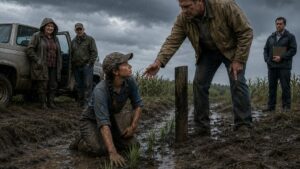
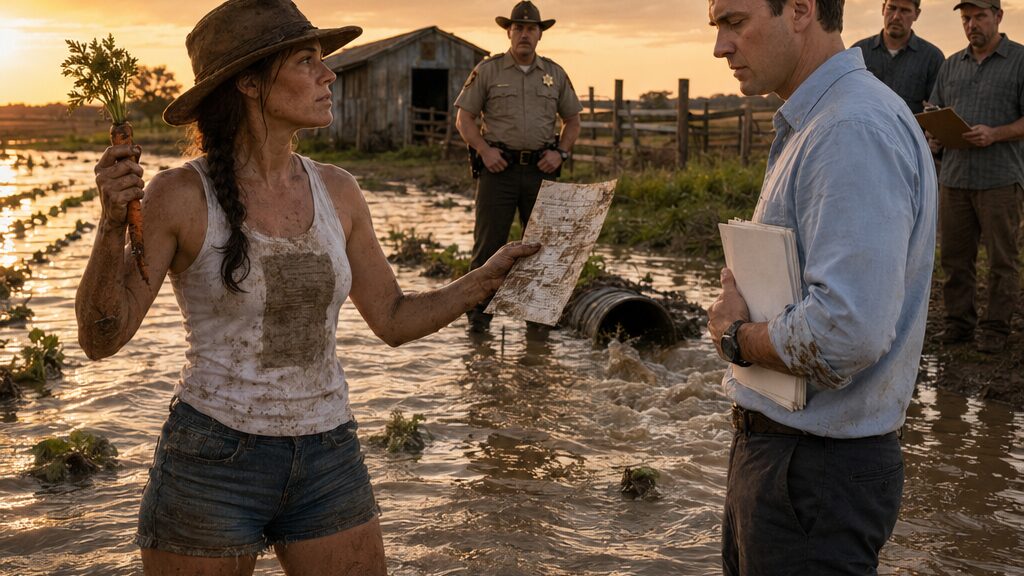
Michael Moore stepped into the flooded field carrying a folded sheet of paper above the water.
Rebecca saw him before he called her name. His pale work shirt was still clean, his dark trousers rolled neatly to the knee, his shoes abandoned on the bank beside a sheriff’s deputy and two men from the lender’s inspection crew. He moved carefully through the brown water as if the mud were an inconvenience that had been arranged for him.
Rebecca turned back toward the row beneath the surface.
Her fingers closed around a carrot top. She worked it loose with a slow pull, feeling the mud resist before releasing the root with a wet sucking sound. The carrot was small, bent, and coated black, but its green crown was alive.
Something had survived.
She held it up to the lowering sun.
“Rebecca.”
Michael’s voice reached her across the water, sharper the second time.
She bent to feel along the submerged bed again. Three feet ahead, the current tugged sideways where no current should have been. The lower field had always drained south toward the creek. Now the water pressed west, toward the old culvert under the boundary road.
“Inspection’s over,” Michael said. “You need to come out.”
“You’ve inspected the shed and the tractor.” Rebecca kept her eyes on the water. “You haven’t looked at the culvert.”
“That isn’t what we’re here for.”
“That’s what put six acres under water.”
Behind him, one of the inspection men shifted on the bank. Rebecca could feel them watching: the deputy, the men with their clipboards, perhaps Brian Campbell from the cab of the pickup parked beyond the fence. In a county this small, people could watch without being seen and know the story before supper.
Michael came closer. “The lender’s position is that required drainage maintenance was not performed.”
“The lender’s position has dry socks.”
His jaw tightened. They had known each other when his shirts came from the same feed store as everyone else’s. Back then he had carried hay after school and complained about the dust in his collar. Now he wore a silver watch and spoke in sentences built by attorneys.
Rebecca moved toward the culvert.
His hand closed around her wrist.
The carrot remained trapped in her fist between them.
“Don’t,” she said.
“You’ve obstructed access twice today.”
“I told your men not to start the tractor while water was in the intake.”
“They were documenting collateral.”
“They were about to ruin it.”
Michael’s grip hardened. “You don’t get to control the inspection anymore.”
Rebecca looked down at his fingers, then up at him. Mud streaked his cuff where he had touched her. For a moment neither moved. Water slapped softly against their thighs.
On the bank, the deputy took one step forward.
Rebecca did not pull. “Take your hand off me.”
Michael released her, but instead of backing away, he opened the folded sheet.
The top line was printed in block letters.
SEIZURE NOTICE.
Below it were paragraphs of smaller type, an account number, legal references, and a description of the secured property. Michael held it between them while he spoke.
“Due to continuing default, concealment of material deterioration, and failure to maintain pledged assets, the lender has exercised its right to possession. Equipment, harvested inventory, and designated acreage are subject to seizure. Public auction is scheduled ten days from today.”
The words seemed to arrive separately.
Default.
Possession.
Ten days.
Rebecca heard a bird calling from the fence as though the field were not drowning around them.
“You said this was an assessment.”
“It was, until you refused access to the lower shed.”
“I refused to let strangers run flooded machinery.”
“You refused three restructuring meetings. You did not answer certified notices. You did not disclose the full crop loss.”
“That does not make this field yours.”
Michael glanced toward the bank. He seemed to become aware of the people watching and, instead of lowering his voice, straightened.
“You were given every chance.”
He pressed the notice against the front of her mud-stained shirt.
The wet fabric caught it. His palm flattened the paper just below her collarbone, leaving it pinned there as if she herself were another item to be marked for repossession.
Rebecca’s first instinct was to shove him.
The second was worse: to let him see what the notice had done.
She took his wrist and removed his hand from her chest. Not violently. Precisely. The paper sagged, already absorbing brown water from her clothes.
Michael leaned toward her. “Do not make this harder than it is.”
Rebecca looked down.
The parcel description appeared beneath the account information. A map reference followed it: Drainage Attachment C.
There was no Attachment C.
She peeled the notice from her shirt. Mud had bled across the lower half, but the parcel number remained visible.
“Where’s the attachment?”
“What?”
“Attachment C. The drainage designation.”
“It’s in the complete file.”
“You brought the seizure order without the page that identifies the seized drainage parcel?”
“The legal description is there.”
“No.” She lifted the notice between them. “The acreage description is there. The drainage classification is in the missing attachment.”
Michael’s eyes flicked across the page. Only once, but she saw it.
Behind them, the water continued moving west.
Rebecca raised the muddy carrot. “This came from the bed you called abandoned.”
“One surviving root doesn’t change the default.”
“It changes the word abandoned.”
“It changes nothing about what you owe.”
That landed because it was true.
The seed supplier had stopped returning her calls. The diesel invoice was folded beneath the sugar jar. Two loan payments had gone unpaid, followed by a third she had covered only by delaying payroll. Michael knew enough truth to make every lie unnecessary.
Rebecca folded the stained notice along its original crease.
“Tell your men the lower shed stays closed until the water drops.”
“The seizure authorizes immediate access.”
“Then bring the attachment.”
His face reddened. “The auction date stands.”
He turned toward the bank, each step pulling hard against the mud. The deputy watched Rebecca but did not reach for her. The inspection crew began gathering their equipment.
Rebecca remained where she was until Michael climbed onto dry ground.
Then she waded to the boundary marker at the edge of the lower field. The wooden stake leaned beneath a strand of flood debris. She scraped away the mud with her thumb and read the stamped number.
She unfolded the notice again.
The numbers did not match.
The order on her chest identified Parcel 18-B.
Hill Farm’s flooded field was Parcel 18-D.
Parcel 18-B lay upstream, beyond the county road, where the drainage channel crossed Brian Campbell’s land.
Chapter 2: The Meetings Rebecca Never Attended
Amy opened the kitchen drawer and found enough certified mail to cover the table.
She did not say anything at first. That was worse than anger.
Rebecca stood at the sink with her forearms under cold water, watching mud spiral into the drain. The stained seizure notice lay beside the faucet. The carrot rested on a chipped saucer near the window, its green crown already beginning to wilt.
Amy placed the first envelope on the table, then another, then five more.
“You signed for these.”
“Some of them.”
“Your name is on every receipt.”
“The carrier knows where I leave the pen.”
Amy looked up. “That is not an answer.”
“It’s the only one I have tonight.”
Outside, a truck slowed on the road. Its tires hissed over wet gravel before continuing past. Rebecca imagined the driver turning toward the farmhouse, looking for the woman who had stood in the flood with a seizure notice stuck to her shirt.
Amy opened one envelope.
“Notice of delinquency.”
“I know what it says.”
“Then why is it sealed?”
“I knew what it would say.”
“That’s not the same thing.”
Rebecca dried her hands on a dish towel. “Did you come to help or inventory my mistakes?”
“I came because someone from the extension office called to ask whether I had a conflict of interest in a foreclosure review involving my sister.”
“It’s not a foreclosure.”
Amy held up the seizure notice. “You want to argue vocabulary tonight?”
Rebecca pulled out a chair but did not sit. Amy was four years younger and had left the farm after college, first for a research station and then for the county extension office. She wore clean work boots, carried two phones, and knew which forms could make a disaster official enough to qualify for assistance.
Raymond had called that kind of work farming from behind glass.
Rebecca had repeated him often enough that Amy stopped visiting unless invited.
Amy sorted the envelopes by date. “Three restructuring appointments.”
“I was planting.”
“The first was in February.”
“I was repairing the cooler.”
“The second was in March.”
“Dad’s tractor threw a belt.”
“And the third?”
Rebecca looked toward the window.
The field beyond the yard reflected the last gray light. “The third was the week the lower rows went under.”
Amy’s voice softened, which Rebecca disliked more than accusation. “You should have gone.”
“And told Michael what? That I couldn’t cover the spring note because the county sent somebody else’s water through our field?”
“You could have started with that.”
“I didn’t have proof.”
“You didn’t need proof to ask for a delay.”
“I needed more than a story.”
Amy broke the seal on another envelope. The paper inside was pale blue.
She read the first paragraph, then stopped.
“What?”
Amy handed it across the table.
Temporary Agricultural Flood-Loss Relief Program.
The letter offered a ninety-day payment suspension, an emergency crop-loss assessment, and access to a low-interest rehabilitation loan. The application deadline was six weeks earlier.
Rebecca read the page twice.
“I never saw this.”
“It was in the drawer.”
“I mean I never opened it.”
“I know what you mean.”
Rebecca sat down.
The chair made a short scraping sound against the floor. In the silence afterward, the refrigerator motor clicked off, and the house seemed to grow too large around them.
Amy pulled a second sheet from the envelope. “You needed an initial damage report and a signed release for the drainage inspection. That’s all.”
“They would have sent Michael.”
“Maybe.”
“He already thought I was hiding losses.”
“You were.”
Rebecca looked at her.
Amy did not look away. “How much?”
“Enough.”
“How much, Rebecca?”
“The south planting. Half the lower beds. The cooler inventory after the power cut.”
“And the upper field?”
“Still producing.”
“Barely?”
Rebecca pushed the relief letter back across the table. “The auction is in ten days. This doesn’t matter now.”
“It matters because Michael told everyone you were given every chance.”
“He wasn’t wrong about every one.”
The admission seemed to alter the room.
Amy gathered the overdue notices. There were feed invoices, lender statements, a machinery insurance warning, and a final demand from the seed supplier. Rebecca had hidden them in different drawers at first. Later she had stopped pretending the locations mattered.
“I was going to catch up after the early harvest,” Rebecca said.
“The one that flooded.”
“Yes.”
“And after that?”
“The upper field.”
“And after that?”
Rebecca’s hand moved toward the saucer. She touched the carrot’s green top with one finger. Mud had dried into hard ridges along the bent root.
“Dad always found another season.”
“Dad borrowed against the next one.”
“He paid it back.”
“Did he?”
Rebecca’s gaze sharpened.
Amy had already turned away. She carried the parcel notice, the lender letters, and her laptop to the far end of the table. “Show me the parcel number again.”
Rebecca unfolded the stained notice and pointed.
Amy opened the county mapping system. Her fingers moved quickly over the keys. Parcel 18-D appeared in pale green: Hill Farm’s lower field. Parcel 18-B lay north and west, a long narrow strip crossing the Campbell property and the drainage channel.
“That could be a clerical error,” Amy said.
“Not if Attachment C assigns the drainage failure to that parcel.”
“Which we don’t have.”
“Michael does.”
“Or the bank attorney does.”
Amy enlarged the map. A series of blue lines marked channels, culverts, and easements. One line cut from Brian Campbell’s north field toward the county road, then turned toward Hill Farm.
Rebecca leaned closer. “That wasn’t there when Dad redid the east ditch.”
“When was that?”
“Five years ago. Maybe six.”
Amy searched the document history. Several versions appeared, most identified only by date. One carried a drainage-board stamp.
She opened it.
The map was scanned from paper and marked in red pencil. A proposed diversion line curved around the Campbell acreage. Beside the line was a handwritten notation approving temporary overflow use.
At the bottom of the page were two initials.
R.H.
Rebecca knew the shape of the R. Raymond made the first stroke too long, as though beginning a fence post.
“No,” she said.
Amy zoomed in.
Under the initials was a date from five years earlier, three months before Raymond’s final hospitalization.
Rebecca took the laptop and drew it toward her.
The note did not say why he had approved it. It did not say how long temporary meant. It only showed that Raymond Hill had placed his initials beside a plan that sent overflow water toward the land he later made Rebecca promise never to divide.
Chapter 3: Water That Was Sent Somewhere
The concrete beneath the culvert was too new.
Rebecca found it two mornings later after the water dropped six inches. She stood knee-deep in the drainage ditch with a shovel, cutting away mats of dead leaves and uprooted lettuce. Beneath the debris, the old stone channel ended in a smooth gray collar poured around a steel gate.
The concrete had not weathered through a single winter.
Amy crouched on the bank with the county map in a plastic sleeve. “The maintenance report says this gate was repaired four years ago.”
“This wasn’t a repair.”
Rebecca drove the shovel under a tangle of roots. Water rushed through the opening and pulled at her boots. A row of young plants had wrapped around the bars, their pale roots exposed like knotted thread.
“This narrows the south outlet,” she said. “When the north channel fills, it has nowhere to go but across our beds.”
Amy studied the map. “The approved design shows a bypass.”
“There is no bypass.”
“Then we need photographs before anybody moves anything.”
A pickup door slammed beyond the fence.
Brian Campbell approached in a clean cap and rubber boots, carrying himself with the unhurried confidence of a man who expected gates to open before he reached them.
“You’re on my side of the line,” he said.
Rebecca planted the shovel blade in the mud. “The culvert serves both properties.”
“The property pin is twenty feet south.”
“The original pin.”
Brian looked at Amy. “You here as her sister or the county?”
“Today I’m here to document drainage conditions.”
“Then you know you can’t make findings without board authorization.”
“I can take photographs of a public easement.”
Brian’s mouth tightened. “That gate passed inspection.”
“By whom?” Rebecca asked.
“A licensed contractor.”
“Who hired him?”
“The board.”
“You chair the board.”
“I’m one vote.”
Rebecca climbed the bank. Mud ran down her jeans and filled the seams of her boots. “Water from your north field enters this channel through a diversion that was supposed to be temporary. The bypass was never built, and the outlet was narrowed.”
Brian glanced at the exposed concrete. “That’s your opinion.”
“It’s standing in my field.”
“We had eleven inches of rain in nine days.”
“And your soybeans are dry.”
“Because I maintained my drainage.”
The words sat between them.
Amy removed a folder from her bag. “The county minutes should clarify who approved what.”
Brian’s eyes moved to the folder, then back to Rebecca. “You need to be careful what you accuse people of when your farm is already in default.”
“So you’ve heard.”
“Everybody’s heard.”
“Did Michael call you?”
“No.”
“Did the bank?”
Brian’s silence lasted half a second too long.
He adjusted his cap. “The lender asked whether access through my north road would be available for an auction crew. I said it would.”
Rebecca stepped closer. “You offered them a road before the hearing.”
“There is no hearing.”
“There will be.”
“Rebecca, the field is gone. You can spend money proving where the water came from, or you can preserve what value is left.”
“By letting the bank sell it.”
“By recognizing that a working operation cannot be run on sentiment.”
His tone was not cruel. That made it worse. Brian believed what he was saying. His farm employed twelve people during harvest and supplied two regional processors. Hill Farm employed three when Rebecca could afford them.
To Brian, acreage was arithmetic.
Amy opened the folder. “The drainage-board minutes from four years ago show you introduced the motion to extend the temporary diversion.”
“It was an emergency measure.”
“You also voted.”
“Of course I voted.”
“You owned the primary benefited parcel.”
Brian’s expression changed, not to guilt but calculation. “My interest was known.”
“It isn’t disclosed in the minutes.”
“The whole county knows where I farm.”
“That isn’t the same as a recorded disclosure.”
He looked toward the road. “Take your pictures. Then get off my property.”
Rebecca pulled the steel gate upward. It moved less than an inch before striking the concrete collar.
“Who changed the opening?”
Brian did not answer.
“Was it your contractor?”
“The contractor followed the approved plan.”
“Show me the plan.”
“Get it from the county.”
He walked back toward his truck.
Rebecca called after him. “The seizure notice lists your parcel.”
Brian stopped.
Only his shoulders moved, a slight tightening beneath his shirt.
Then he turned. “That sounds like the bank’s problem.”
“It becomes yours if they used your drainage classification to call my land neglected.”
“You should have maintained your own ditches.”
“I did.”
“Then prove it.”
He drove away without looking back.
By noon, Rebecca and Amy were in the county records room beneath fluorescent lights that made every old page appear sickly. The clerk brought them drainage-board binders, contractor invoices, and inspection reports stored in gray archival boxes.
The official plan showed the missing bypass.
The contractor invoice billed for it.
The completion photograph did not show it at all.
Amy placed the three documents side by side. “This is enough to challenge the maintenance finding.”
“Not enough to prove where the money went.”
“We don’t need to prove fraud.”
“I didn’t say fraud.”
“You were thinking it loudly.”
Rebecca turned to the meeting minutes. The extension vote had passed four to one. Brian introduced the motion, argued that continued diversion protected county employment, and voted in favor. No conflict disclosure appeared.
A smaller note had been stapled behind the minutes.
Temporary extension approved pending consent of affected landholder.
Attached was a single-page consent form.
Rebecca recognized Raymond’s signature before she read the words above it.
He had granted temporary overflow access across Hill Farm’s lower acreage. The term was described as twelve months, renewable by board agreement. There was no evidence that anyone had obtained his consent for renewal.
Her first feeling was relief.
The extension beyond one year might be invalid.
Then Amy turned the page.
A handwritten reference at the bottom directed the reader to a private settlement number held by the lender.
Rebecca read Raymond’s signature again.
“He wouldn’t have agreed to this.”
Amy kept her voice even. “He did.”
“Not without a reason.”
“There is a reason listed.”
The county clerk helped them locate the cross-reference in an index of recorded agreements. The settlement itself was not filed with the drainage records, but the summary was.
Agricultural debt forbearance in exchange for temporary easement consent and revised collateral terms.
Rebecca gripped the edge of the table.
Five years earlier, Raymond had told her the farm had survived a bad season because he sold two pieces of equipment and negotiated better seed terms. He had never mentioned emergency forbearance. Never mentioned new collateral. Never mentioned giving another farm’s floodwater legal passage across their land.
Amy read the summary in silence.
Rebecca folded the consent form, then opened it again, flattening the crease with her palm as if she could force the page to say something else.
At the bottom, beneath Raymond’s signature, one line identified the lender representative who had processed the private settlement.
Michael Moore.
Chapter 4: The Price Her Father Hid
The ledger showed that Hill Farm had nearly disappeared five years before anyone tried to seize it.
Rebecca found the entry in Raymond’s old office, written in his square hand beneath a column of fertilizer costs.
BALANCE DUE—FINAL EXTENSION.
The amount was larger than she expected and smaller than the farm was worth, which made it more dangerous. It was the kind of debt a person could believe one good season would fix.
Amy stood in the doorway holding the consent form from the county records room. “Did you know he was this far behind?”
“No.”
“You handled the books with him.”
“I handled payroll and suppliers. He kept the loans.”
“Why?”
“Because they were his.”
The answer sounded childish once it entered the room.
Dust filmed the desk except where Rebecca’s hands had moved through the files. Raymond’s cap still hung on a nail beside the window. She had left it there after the funeral and never found a reason strong enough to take it down.
Amy placed the consent form beside the ledger.
Rebecca read the settlement reference again. Emergency forbearance. Temporary easement. Revised collateral terms.
Michael Moore’s name appeared at the bottom.
“He was barely out of college then,” Amy said.
“He was working the agricultural desk.”
“Which means he may have processed it, not designed it.”
Rebecca closed the ledger. “He stood in my field and told me I had every chance.”
“You did have chances.”
“That doesn’t erase this.”
“No. It doesn’t.”
Amy’s refusal to defend her was beginning to feel like its own form of loyalty.
They searched until the light through the office window turned orange. Most of Raymond’s folders were practical: seed invoices, equipment manuals, handwritten planting dates. The private settlement was not among them.
Rebecca found it later inside the machinery shed, in a metal cash box beneath old tractor warranties.
The agreement was twelve pages long.
Raymond had received six months of payment suspension, release of a threatened machinery repossession, and enough operating credit to plant the following spring. In return, he consented to the temporary diversion and allowed the lender to add the lower field to the collateral schedule.
A note in the margin carried his handwriting.
One year only. Fix north channel after harvest.
Rebecca traced the words with her thumb.
He had not sold them out. He had made a bargain under pressure and expected the other side to keep its end.
Another paper was folded behind the agreement: a letter from Raymond to the drainage board, never stamped as received.
The bypass has not been constructed. Continued overflow will damage productive beds. I agreed to one season, not permanent use.
Amy read it over Rebecca’s shoulder. “He objected.”
“And nobody recorded it.”
“Or he never sent it.”
Rebecca looked at the unmarked envelope. The flap had never been sealed.
Raymond had written the protest and kept it.
That was harder to forgive than an ignored letter from the county. It was too familiar.
She put the page down.
On the workbench, the carrot from the flooded field had softened. Its crown remained green, but a dark line had opened along one side. When Rebecca lifted it, the root split beneath her fingers.
The outer flesh was firm.
The center was brown with rot.
Amy took a step toward her. “Rebecca.”
“I’m fine.”
“You keep saying that like it’s a job.”
Rebecca dropped the ruined half into the trash. The other half remained in her palm, green top attached to decay.
Raymond had stood in this same shed, perhaps with the agreement spread across the bench, and told himself that keeping the farm alive justified keeping the truth quiet. Rebecca had spent five years calling that strength.
Her phone rang.
Michael.
She answered without greeting.
“I heard you requested the old settlement file,” he said.
“You heard quickly.”
“The lender archive flagged it.”
“Did it also flag the missing bypass?”
Silence.
Rebecca placed the phone on speaker and set it beside the documents. Amy stayed still.
Michael said, “The drainage board was responsible for construction.”
“You used their classification in your seizure order.”
“We used the county assessment.”
“The assessment lists Parcel 18-B.”
“That appears to be a reference error.”
“It appears to be Brian Campbell’s land.”
“I’m reviewing it.”
“Now?”
Another pause.
Rebecca turned a page in the settlement. “You processed my father’s easement.”
“I processed the forbearance package.”
“You knew the lower field was collateral because of that agreement.”
“Yes.”
“You knew the diversion was temporary.”
“Yes.”
“Then why did your notice call the flood damage neglected maintenance?”
“That determination came from the current asset review.”
“Based on a parcel number you did not check.”
Michael’s voice hardened. “You refused access, Rebecca. You failed to provide complete loss reports. You ignored three meetings. Do not pretend the bank invented your default.”
“I’m not pretending.”
The words surprised both her and Amy.
Rebecca looked at the unopened protest letter. “I’m asking what you knew.”
Michael exhaled. “I knew the file was inconsistent.”
Amy moved closer to the phone.
Rebecca said, “How inconsistent?”
“Enough that I requested an internal drainage review last month.”
The machinery shed seemed to narrow around her.
“Before the seizure?”
“Yes.”
“What happened?”
“It was not approved.”
“Who denied it?”
“I can’t discuss internal decisions.”
“You requested a review because the assessment might be wrong, then you walked into my field with a seizure notice anyway.”
“I withdrew the request.”
Rebecca stared at the phone.
“You withdrew it?”
“The regional office instructed me to close the file before the auction calendar was set.”
“Instructed you, or threatened you?”
“That distinction does not change the notice.”
“It changes you.”
Michael’s voice dropped. “You think I wanted to stand in that field? I spent six months trying to get you into an office.”
“And when I didn’t come, you decided being right mattered more than being accurate.”
“I decided the account could not remain open indefinitely.”
Rebecca picked up Raymond’s unsent letter.
Her anger had somewhere new to go, but it no longer felt clean. Raymond had hidden his bargain. She had hidden her debts. Michael had questioned the file and then silenced himself. Each of them had called delay responsibility.
“Send me your review request,” she said.
“I can’t.”
“Then I’ll subpoena it.”
“You do not have time.”
“The auction is in seven days.”
“Six,” Michael said. “It was moved to Monday morning.”
Amy’s eyes widened.
Rebecca gripped the phone. “The notice says Tuesday.”
“The regional office advanced the schedule after today’s records request.”
For the first time, Michael sounded ashamed.
“The order came from above me,” he said. “But I closed the file.”
Chapter 5: The Man Who Chose the Deadline
Michael offered to delay the auction before Rebecca had shut the truck door.
He stood beside her in the feed-store parking lot, one hand resting on a sealed folder. Morning traffic moved along the county road behind him, farm trucks and school buses passing beneath a pale sky.
“Thirty days,” he said. “No hearing. No additional fees during the extension.”
Rebecca left the stained seizure notice folded in her jacket pocket. “What do you want?”
“The lower field.”
“You already claim it.”
“Not as a deeded transfer. A voluntary collateral surrender.”
“You mean I sign it over.”
“The bank sells that parcel, applies the proceeds, and restructures the remaining balance.”
“The well line crosses the lower field.”
“A utility easement can be drafted.”
“The pump station sits on it.”
“That can be relocated.”
“With what money?”
Michael looked toward the store windows. Two local farmers stood inside near the register, pretending to study a rack of gloves.
“This is the only delay I can authorize without regional approval,” he said.
“You can’t authorize thirty days, but you could move the auction forward.”
“I transmitted the closure.”
“You chose the deadline.”
“I chose to stop carrying an account that would not respond.”
Rebecca stepped closer. “You knew the drainage assessment was incomplete.”
“I suspected it.”
“You requested a review.”
“And withdrew it.”
“Why?”
Michael’s fingers tightened on the folder. “Because my supervisor told me there would be no agricultural desk here by winter if our default rate stayed where it was.”
“That’s your excuse?”
“No. It’s the pressure I was under.”
He opened the folder and removed a printed map. The proposed surrendered acreage was shaded in red. It included the flooded beds, the pump station, the water line, and the only practical route between the upper field and county road.
“If I sign this,” Rebecca said, “the rest of the farm cannot operate.”
“It can operate differently.”
“Not as a vegetable farm.”
“You could lease the upper acreage for hay.”
“So the bank’s solution is to save the name and kill the work.”
Michael folded the map along its crease. “The bank’s solution is to recover part of what it loaned.”
“And your solution?”
He looked at her then.
For a moment she saw the boy who had once helped Raymond pull a calf from a ditch during a storm, not because it belonged to his family but because somebody had shouted for help. Then his face closed again.
“My solution was the restructuring meetings you never attended.”
Rebecca felt the truth of that like a stone underfoot.
“I didn’t open the letters,” she said.
“I know.”
“You knew?”
“I watched the delivery confirmations come back.”
“Then why didn’t you drive out?”
“I did. Twice.”
Rebecca remembered a lender sedan turning at the gate one afternoon while she repaired irrigation pipe. She had gone behind the shed until it left.
Michael continued, “Your father answered his phone. Even when he lied to me, he answered.”
“Don’t use him.”
“I’m not. I’m telling you why I stopped believing another conversation would matter.”
The store door opened. A customer walked past them carrying mineral blocks, his gaze fixed carefully ahead.
Rebecca lowered her voice. “You pinned that notice to me because I missed meetings?”
His face shifted.
“No,” he said. “I did that because I was angry.”
The admission was plain, without defense.
“You made me look like a fool in front of the inspection crew. You acted like I had come to steal something instead of enforce a contract. And part of me wanted you to understand that you did not control the moment anymore.”
Rebecca touched the folded notice through her pocket.
“That was your choice,” she said.
“Yes.”
“Not your supervisor’s.”
“No.”
They stood without speaking.
His honesty did not make the act smaller. It made it belong to him.
Rebecca held out her hand. “The internal review request.”
“I cannot give you the file.”
“You can tell me what it said.”
Michael glanced toward the road. “The parcel reference may have been carried over from the Campbell easement schedule. The reviewer asked whether flood damage should be classified as external impairment instead of borrower neglect.”
“That would change the default treatment.”
“It could change penalties and eligibility for restructuring. It would not erase the debt.”
“I never asked it to.”
“You’ve spent two years acting as if facts you refuse to say should still protect you.”
Rebecca let the sentence land.
Then she took the surrender map from him and tore it once through the shaded lower field.
Michael did not react.
“I’m not giving you the pump,” she said. “And I’m not asking you to forgive the debt.”
“Then Monday stands.”
“I’m filing for an emergency hearing.”
“On what grounds?”
“Wrong parcel classification. Unreviewed flood impairment. Defective notice. Conflict in the drainage-board vote.”
“And when the bank submits your certified letters?”
“I’ll submit them first.”
That finally unsettled him.
Rebecca left him in the parking lot and drove to the county courthouse.
The clerk behind the civil counter gave her a packet thick enough to frighten anyone who had ever believed paper belonged to other people. Rebecca filled it out at a wooden bench beneath a clock that ticked too loudly.
Emergency request for stay.
Statement of disputed facts.
List of secured obligations.
She wrote every unpaid amount.
Seed supplier.
Diesel account.
Equipment note.
Three missed lender payments.
She listed the flood relief letter she had failed to open and each restructuring meeting she had avoided. Her hand paused over the line asking whether the petitioner had withheld material financial information.
Amy, seated beside her, said nothing.
Rebecca checked yes.
Under explanation, she wrote: I believed silence would give me time to repair the loss. It prevented accurate review and made the loss worse.
The sentence looked harsher than anything the bank had written.
She signed beneath it.
At the filing window, the clerk stamped the petition and set the hearing for Friday morning, three days before the auction.
When Rebecca stepped outside, Michael was standing across the street beside his car.
She did not know whether he had followed her or been called by the bank attorney. He watched as she held the stamped petition against the wind.
Rebecca raised it high enough for him to see.
For the first time since he entered the flood, he looked uncertain which of them had more to lose.
Chapter 6: Every Fact That Made Her Look Guilty
The bank attorney began with the letters Rebecca had never opened.
He placed enlarged copies on an easel beside the witness table, each envelope bearing her signature and a date. In the quiet courtroom, the evidence looked less like mail than a calendar of refusal.
“Three restructuring invitations,” he said. “Two delinquency notices. One flood-loss relief offer. All received. None answered.”
Rebecca sat beside Amy at the petitioner’s table with the stained seizure notice inside a clear evidence sleeve.
Across the aisle, Michael stared at his hands.
The judge adjusted her glasses. “Ms. Hill, are you disputing receipt?”
Rebecca’s attorney was a court-appointed civil aid lawyer who had met her the previous afternoon. He leaned toward her, but she had already decided.
“No, ma’am.”
“Are you disputing that payments were missed?”
“No.”
The bank attorney turned from the easel. “Then the default itself is not contested.”
“The cause and treatment are,” Rebecca said.
Her lawyer touched her wrist lightly, warning her to wait.
The judge looked at the bank attorney. “Proceed.”
He built the case carefully. Rebecca had failed to report full crop losses. She had denied inspectors access to machinery. She had missed meetings while the balance increased. The bank had a duty to prevent further deterioration of secured property.
Nothing he said was entirely false.
That was what made it dangerous.
When Rebecca was called, the courtroom benches had filled with farmers, county employees, and people who had heard about the notice in the flooded field. Brian sat near the back in a pressed shirt. The sheriff’s deputy who had witnessed the seizure stood against the wall.
The bank attorney approached with one unopened envelope.
“Ms. Hill, why did you ignore this?”
Rebecca looked at the pale blue edge of the flood-relief letter.
“Because I was afraid it would require proof I did not have.”
“Proof of what?”
“That the water was not caused by my failure to maintain the field.”
“And rather than request an inspection, you ignored the offer?”
“Yes.”
“Rather than attend a meeting, you hid your losses?”
“Yes.”
“Rather than disclose the condition of the collateral, you continued borrowing from suppliers?”
“Yes.”
Her lawyer rose. “Asked and answered.”
The judge nodded, but Rebecca spoke before the attorney sat down.
“I also believed I could fix it before anyone saw how bad it was.”
The bank attorney paused.
Rebecca continued, “That belief was wrong.”
A murmur moved through the benches and stopped when the judge looked up.
The admission changed something. The attorney had prepared to expose her. By saying it herself, she left him with facts but less surprise.
Her lawyer introduced the county maps, the contractor invoice for a bypass never built, photographs of the narrowed outlet, and the drainage-board minutes showing Brian’s vote.
Brian was called next.
He acknowledged supporting the diversion. He insisted it had protected hundreds of acres and several farm jobs during an emergency season.
“Did you disclose your financial interest in the benefited parcel?” Rebecca’s lawyer asked.
“My property ownership was common knowledge.”
“Is that a yes?”
“No formal disclosure appears in the minutes.”
“Did the completed project include the bypass shown in the approved plan?”
“I relied on the contractor.”
“Did water from your property enter Hill Farm?”
“Water flows downhill.”
“Through the diversion you supported?”
Brian’s mouth tightened. “Yes.”
It was not a confession. It was enough to make the room understand that the flood had traveled by decision, not weather alone.
Amy testified about the parcel mismatch and the effect of losing the lower field’s pump station. She did not soften Rebecca’s mistakes. When asked whether the farm had been competently managed, she said, “The crops were managed. The crisis was not.”
Rebecca felt the words more sharply than the bank attorney’s questions.
Then Michael was called.
The bank attorney tried to limit him to the seizure process, but Rebecca’s lawyer produced the archived settlement and asked whether he had processed Raymond’s forbearance.
“Yes.”
“Did the lender know the drainage diversion was temporary?”
“Yes.”
“Did you later request a review of the current assessment?”
Michael looked toward Rebecca once.
“Yes.”
“Why?”
“The seizure file classified all flood damage as borrower-related neglect. The parcel reference and historical easement suggested that classification might be incomplete.”
“What happened to your request?”
“I withdrew it.”
“Under whose direction?”
“My regional supervisor instructed me to close the account before the auction schedule.”
“Were you ordered to withdraw the review?”
“No.”
The answer surprised the room.
Michael swallowed. “I was told delay would be viewed as failure to manage the default. But I made the withdrawal.”
Rebecca watched him claim the choice she had forced him to name in the parking lot.
The bank attorney objected when the stained seizure notice was offered into evidence, arguing that its condition was irrelevant. The judge allowed it for the limited purpose of comparing the served document with the lender’s complete file.
Rebecca’s lawyer placed it beside the clean archival copy.
The served notice lacked Attachment C.
The clean copy included it.
Attachment C identified Parcel 18-B as the drainage-affected tract but applied its maintenance finding to the Hill Farm collateral schedule.
The judge read the page twice.
“Who prepared this attachment?”
The bank attorney requested time to determine that.
“You had time before seizing operating property,” the judge said.
Rebecca’s lawyer then placed the damaged carrot on the evidence table inside a produce bag. It looked small beneath the courtroom lights.
The bank attorney almost smiled. “A single root is not evidence of commercial viability.”
“No,” Rebecca said. “It is evidence the bed was planted and alive when the notice called it abandoned.”
The judge allowed the point but warned that survival of one crop did not establish the farm’s ability to repay.
By late afternoon, Rebecca understood the shape of the result before it was spoken. The seizure process was flawed. The debt remained. The flood damage deserved reassessment. Her own conduct had weakened every remedy available to her.
The judge granted a five-day stay.
Not cancellation.
Not release of the collateral.
Five days to submit an independent drainage estimate, a feasible repayment plan, and proof that the remaining operation could survive.
“If no plan is accepted,” the judge said, “the lender may renew its application for possession.”
Outside the courtroom, people gathered in small groups, speaking quietly. No one applauded. Brian left through a side door. Michael remained near the steps with the bank attorney, his face pale.
Rebecca stood beneath the courthouse awning while rain began spotting the pavement.
Amy joined her carrying the evidence bag with the split carrot and the sleeve containing the stained notice.
“We got the pause,” Amy said.
“Five days.”
“It’s something.”
“It’s not enough.”
“It can be.”
Rebecca looked at her sister.
Amy held out a folder she had prepared during the hearing. Inside were operating projections, drainage repair estimates, and a map divided into colored sections.
The upper fields were marked green.
The flooded lower acreage was marked yellow.
A dry roadside parcel on the western edge was marked red.
Rebecca recognized what the colors meant before Amy spoke.
“The farm can survive,” Amy said. “But not if you keep every acre.”
Chapter 7: The Acres She Could Not Save
The auction markers appeared before sunrise.
Rebecca found the first orange stake at the western fence, driven deep beside the roadside parcel Amy had colored red. A second stood near the equipment lane. A third had been hammered beside the lower field while the court’s five-day stay was still in effect.
She pulled that one from the ground.
A printed tag swung from the top.
PRELIMINARY LOT BOUNDARY.
“They’re not supposed to be here,” Amy said behind her.
Rebecca turned. Amy stood by the truck holding two cups of coffee and the revised operating plan they had finished after midnight.
“They’ll call it preparation,” Rebecca said.
“They’ll call it contempt if we photograph it correctly.”
Rebecca set the stake across the tailgate instead of snapping it. Five days earlier, she would have broken it and let somebody hear the pieces hit the road. Now she took out her phone and photographed the tag, the field, and the date displayed on the screen.
Amy handed her a coffee.
“Good,” she said.
“Don’t sound surprised.”
“I’m adjusting.”
The first version of their recovery plan failed before breakfast.
The drainage contractor estimated the bypass repair, gate replacement, and channel clearing at more than the roadside parcel could cover after lender fees. The second version cut equipment maintenance so deeply that one failed tractor would end the season. The third depended on crop yields no honest person could promise.
By noon, the kitchen table was covered with maps, invoices, and coffee rings. The stained seizure notice lay beneath a glass paperweight beside the clean court order.
Amy tapped the western parcel. “This is the piece buyers will want. Road frontage. Dry ground. Separate access.”
“It was Dad’s first field.”
“It’s fourteen acres of hay and weeds now.”
“He taught me to drive there.”
Amy pulled her hand back from the map. “Do you want me to pretend that doesn’t matter?”
“No.”
“Then don’t pretend it matters more than the pump.”
Rebecca looked through the window toward the machinery shed. Raymond’s promise lived in her memory as clearly as if he had spoken it that morning: Don’t let them split it up after I’m gone.
At the time, she had thought he meant outsiders.
Now she wondered whether he had also meant fear.
The drainage-board meeting began at three in a room above the volunteer fire station. Brian sat at the center table with two other board members and a county attorney. Half the chairs were filled by farmers who had heard the hearing had exposed a parcel error.
Rebecca placed the contractor’s photographs on the table.
“The approved bypass was billed and never built,” she said. “The narrowed outlet increased pressure on Hill Farm. I’m requesting that the board share the cost of correction.”
Brian folded his hands. “You are requesting that county drainage funds repair private property while you are in default.”
“I’m requesting that the board correct work it approved.”
“The work protected more acreage than it affected.”
“Mine was the acreage affected.”
“The county has to consider total economic impact.”
Rebecca slid forward the meeting minutes showing his vote.
“And a board member has to disclose when the land being protected is his.”
The room went quiet.
Brian did not look at the page. “My ownership was public knowledge.”
“You said that in court.”
“Because it is true.”
“It is also not a disclosure.”
The county attorney leaned toward Brian and spoke too softly to hear.
Rebecca opened another folder.
“I drafted a conflict-of-interest complaint this morning. It includes the contractor invoice, the missing bypass, and the extension vote. I can file it today, or the board can agree to an independent engineering review and a proportional repair contribution.”
One of the board members shifted in his chair. “How much contribution?”
Amy answered with the contractor’s figures.
Brian looked at Rebecca for a long time. He had spent years speaking to her as if stubbornness were a weakness found only on smaller farms. Now she saw calculation pass across his face again, but this time the numbers did not all favor him.
“If we agree,” he said, “the complaint goes away?”
“The complaint remains drafted. Whether it gets filed depends on whether the correction is real.”
“That sounds like a threat.”
“It’s a choice with paperwork attached.”
Someone in the back coughed to hide a laugh.
Brian’s face reddened, but he did not raise his voice. “Independent review. Shared repair costs, subject to findings. No admission of wrongdoing.”
“And the gate stays open until the review.”
“The gate opening is limited by the concrete.”
“Then the concrete gets cut tomorrow.”
The county attorney whispered again.
Brian nodded once. “Tomorrow.”
It was not justice. It was leverage, properly documented.
Outside, Amy leaned against the truck. “You were good in there.”
“I was prepared.”
“That’s usually what good looks like.”
Back at the farm, they revised the plan again. Shared drainage costs reduced the amount Rebecca needed to raise, but the bank still required a principal payment large enough to prove the restructuring was more than delay.
The western parcel remained the only answer.
Amy placed a second document beside the sale estimate: a proposed financial-control agreement.
Rebecca read the first page. “Dual approval for expenses over five thousand.”
“Yes.”
“Monthly operating reports.”
“Yes.”
“You want access to the farm account.”
“If I join the recovery plan.”
“You’re my sister, not my keeper.”
“I’m the extension agent putting her name on projections for a farm that hid debts from everyone.”
Rebecca pushed the document away. “I admitted that in court.”
“Admission is not a system.”
“I can manage my own farm.”
“You managed the crops. You did not manage the crisis.”
The same words Amy had used under oath.
Rebecca stood so fast the chair struck the wall.
Amy did not move.
“You left,” Rebecca said.
“Yes.”
“You left Dad and me to keep this place running.”
“I left because every decision in this house came with his name on it.”
“He needed us.”
“He needed control.”
Rebecca’s hands closed against the table edge.
Amy’s voice trembled but remained low. “I did not abandon this family. I stopped disappearing inside it.”
The kitchen seemed to hold both sisters at once: the one who stayed and called it loyalty, and the one who left and was never forgiven for surviving differently.
Amy gathered her papers.
“I will help design the crop plan,” she said. “I will testify again. But I will not put my license or savings behind another drawer full of unopened letters.”
At the door, she stopped.
“You don’t have to give me control. But you do have to share it with someone.”
After she left, Rebecca sat alone until the evening light crossed the map.
She took Raymond’s unsent protest letter from the file and read it again. He had known the diversion was wrong. He had also hidden the agreement, kept the warning, and trusted himself to repair everything alone.
Rebecca had called that inheritance.
She walked to the lower field carrying the split root. One half had rotted beyond saving, but the crown on the other still held a thin green stem. Near the repaired test ditch, she pressed it into a raised row of loose soil.
It might die.
Planting it was not proof that it would live.
Back in the kitchen, Rebecca signed the financial-control agreement. She changed one line before adding her name: major operating decisions required both sisters’ approval, but daily farm management remained hers.
Then she signed the parcel-sale authorization.
The western fourteen acres would be listed immediately, with proceeds restricted to lender settlement and drainage repair.
When Amy returned after dark, Rebecca handed her both documents.
Amy read them without speaking.
“I’m not giving you the farm,” Rebecca said.
“I don’t want it.”
“I’m asking you to help me keep what works.”
Amy signed beneath her.
The following morning, before the lender’s courier arrived, Rebecca drove the parcel-sale authorization to the courthouse and filed it with the recovery plan.
The clerk stamped the document.
As the seal came down, Rebecca watched fourteen acres leave the promise she had made to her father.
Chapter 8: What Grew After the Water Receded
The auction crew arrived forty minutes before the revised order.
Two flatbed trucks turned through Hill Farm’s gate just after eight, followed by a sedan carrying the auction manager and a deputy Rebecca did not recognize. Orange lot cards were stacked against the windshield.
Rebecca stepped into the equipment lane and raised one hand.
The first truck stopped ten feet from her.
The manager got out with a clipboard. “Ms. Hill, we have authorization to inventory and remove listed equipment.”
“There’s a revised restructuring order.”
“I have no notice of one.”
“It was signed this morning.”
“Then your attorney should have served it.”
“She is serving it.”
The manager glanced toward the machinery shed. “Until then, the existing possession order controls.”
Behind Rebecca, Amy came out of the farmhouse carrying the clean court order they had received electronically but not yet in certified form.
The manager looked at the printed copy and shook his head. “I need a filed seal.”
Rebecca felt the old impulse rise: stand in the lane, refuse every inch, make them choose whether to move her.
Then she remembered Michael’s hand on her wrist and her own unopened letters. Force without process had already done enough damage.
She took out her phone and called the county clerk.
The call went to voicemail.
The auction manager signaled to the driver.
The truck began rolling.
Rebecca stepped aside.
Amy stared at her. “What are you doing?”
“Keeping them from saying I obstructed access.”
The truck passed slowly, its tires grinding gravel. Rebecca walked beside it toward the shed.
At the machinery door, she stopped the driver with a second raised hand.
“The tractor is listed under the old collateral schedule,” she said. “The revised plan releases it as essential operating equipment.”
The manager looked irritated. “You just said you would not obstruct us.”
“I’m not. I’m identifying a disputed item before removal.”
“You can identify it after.”
“No.”
The deputy moved closer but kept his hands loose at his sides.
A car came fast down the county road and turned into the gate.
Michael drove past the trucks, braked beside the shed, and got out holding a thick white envelope.
He did not look at Rebecca first. He went to the auction manager.
“Stop the inventory.”
“On whose authority?”
Michael handed him the document.
The court seal was pressed in blue at the bottom.
The revised order stayed execution of the seizure, approved the parcel sale under supervised restructuring, released designated operating equipment, and required an independent drainage assessment before further default penalties could be imposed.
The manager read the first page twice.
“We were dispatched before this was entered.”
“I know,” Michael said.
“Then the bank can cover the cancellation fee.”
Michael’s expression did not change. “Send it to regional.”
The crew remained long enough to photograph the equipment they had not taken. Then the trucks backed out through the gate, carrying nothing.
Rebecca stood beside the tractor until the sound of their engines faded.
Michael held another envelope toward her.
She did not take it immediately.
“What is it?”
“Formal acknowledgment of the internal review request and withdrawal.”
“You signed it?”
“Yes.”
“What happens to you?”
“I keep my job.”
She had expected either punishment or escape. The plainness of the answer irritated her.
“Under disciplinary review,” he added. “No field seizure authority for now.”
“And the regional office?”
“Reviewing procedures.”
“That means nothing.”
“Usually.”
Rebecca took the envelope.
The paper inside was clean and exact. Michael acknowledged that he had identified an incomplete drainage classification, withdrawn his request under professional pressure, and proceeded with seizure despite unresolved inconsistencies.
It did not excuse him.
It also did not ask to.
“The lower parcel?” he asked.
“Sold under contract yesterday.”
“I heard.”
“Of course you did.”
“The proceeds clear the arrears, fund your share of repairs, and reduce principal. The remaining balance goes into a five-year supervised plan.”
“I read the order.”
“Monthly reporting. Dual approval.”
“I read that too.”
Michael looked toward the field. The water had drained from most of the beds, leaving pale lines of silt across the soil.
“I was wrong in the field,” he said.
Rebecca folded his acknowledgment and placed it beside the original stained notice on the truck hood.
“You were wrong before the field.”
“Yes.”
She waited for the apology to become larger, perhaps because once she had imagined that truth would force everyone who harmed her to speak until the harm felt balanced.
It did not.
Michael had admitted his choice in court. Brian had accepted shared costs without admitting fault. The bank had preserved its debt. Rebecca had lost fourteen acres.
No sentence could turn that into victory.
“The notice stays with the record,” she said.
“It should.”
“And if regional asks whether I agreed to withdraw the complaint about the service?”
“I’ll tell them you didn’t.”
Rebecca nodded.
Michael walked back to his car. Before getting in, he looked once toward the lower field.
“I hope the next crop holds.”
“So do I.”
That was all.
The drainage work took three weeks. The contractor cut away the concrete collar, installed the missing bypass, and replaced the gate under the eye of an independent engineer. Brian paid the assessed share through the board. He never apologized, but he stopped calling the flood an opinion.
The western parcel sold to a neighboring hay producer. The first time Rebecca drove past the new boundary stakes, she slowed without meaning to. Raymond had taught her to steer there by making her hold the wheel while he worked the pedals.
The memory did not ask her to buy the land back.
It only remained.
By late summer, the repaired lower field carried six test rows. Rebecca and Amy planted fewer varieties, kept larger reserves, and argued over every expense above five thousand dollars. Amy was often too cautious. Rebecca still waited too long before admitting bad news.
Now the waiting had a limit.
Once a month, they sat at the kitchen table and opened every envelope.
The stained seizure notice stayed in a clear sleeve inside the farm office. Beside it was the clean restructuring order. One paper had been pressed against Rebecca’s body to tell her she no longer controlled her life. The other existed because she had finally placed every damaging fact where someone else could see it.
At the end of the first test harvest, Rebecca walked the lower row after rain.
The soil was dark but not drowned. Water moved through the new channel with a steady sound and disappeared beneath the road.
Near the end of the row, a green crown rose where she had planted the surviving half of the split root.
Rebecca knelt and loosened the earth with both hands.
The carrot came free whole.
It was crooked and smaller than the market grade Amy had written into the projection, but its center was firm when Rebecca wiped away the soil.
Amy stood several steps behind her holding an empty harvest crate.
“Well?” she asked.
Rebecca turned the root in her palm.
For years she had believed keeping the farm meant preserving every boundary, every habit, every promise exactly as Raymond had left it. But the field in front of her was alive because a piece had been sold, a secret admitted, a gate rebuilt, and control shared.
She held the carrot out.
Amy took it carefully, leaving a streak of soil across her clean palm.
Neither of them called it proof.
They carried it back toward the farmhouse together.
The story has ended.