The Bow Tie at the Glass Tower
Part I — The Boy in Cheap Shoes
No one noticed the violinist miss a note.
They noticed the boy.
He came through the ballroom doors in a shirt that had been ironed too carefully and shoes so cheap they looked fragile under the chandeliers. The room was all black silk and diamonds and stemmed glasses; he looked like he had wandered in from a different city, maybe a different life. But he did not look lost. He moved with the frightening calm of someone who had already decided what mattered.
By the time security saw him, he was halfway across the room.
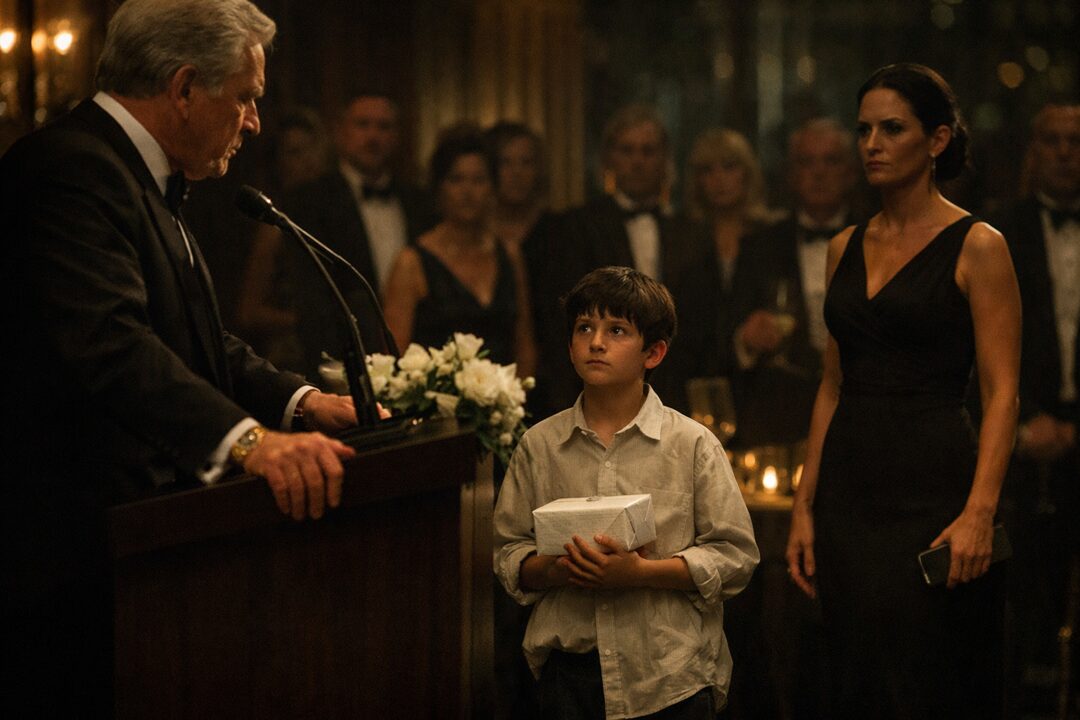
At the far end of the ballroom, beneath a hanging sign that read The Julian Vale Memorial Scholarship Dinner, Gabriel Vale stood surrounded by donors and men who laughed a beat too quickly at his jokes. Silver-haired, straight-backed, wearing a tuxedo that fit like authority itself, Gabriel barely seemed to occupy the same air as everyone else. People orbited him. They always had.
The boy walked straight toward him.
He carried a small box wrapped in white pharmacy paper, folded neatly at the corners. He held it with both hands, not like a gift, but like evidence.
A few conversations broke mid-sentence.
A woman in emerald satin whispered, “Whose child is that?”
No one answered.
When the boy stopped in front of Gabriel, the room had not gone silent, not fully, but it had tilted in that direction. Gabriel looked down, first with annoyance, then with the polished blankness of a man who had trained his face not to flinch in public.
“Yes?” he said.
The boy tipped his chin up. His dark hair had been cut unevenly, maybe by kitchen scissors. One sleeve was buttoned wrong at the cuff.
“Do you know what your son wore,” he asked, “the night he disappeared from your family for good?”
The words were too clean for a child. Too careful.
Something flickered behind Gabriel’s eyes and vanished.
Nearby, a woman in a black gown had gone very still. She was elegant in the cold, expensive way some women learned as armor. Gabriel’s daughter, Eva. Across the room, she had been reaching for a glass. Now her hand hovered in the air, motionless.
Gabriel gave a small smile. It was the kind people wrote articles about. Measured. Benevolent. Useful.
“I think,” he said softly, “you may be in the wrong place.”
The boy shook his head. “My mother said you’d say that.”
He unwrapped the pharmacy paper and lifted the lid from the box.
Inside lay an old black silk bow tie, carefully mended where the fabric had torn. Someone had stitched it by hand with thread a shade too dull to hide.
A donor beside Gabriel inhaled sharply.
The smile stayed on Gabriel’s mouth for one dangerous second too long.
“My mother told me to return it,” the boy said. “To the man who liked clean collars more than messy people.”
The donor’s wife looked at Gabriel’s throat, at the immaculate bow tie fastened there now, and then quickly looked away. A whisper rippled outward. Not loud, but fast. You could feel it moving.
Gabriel crouched slightly, lowering himself to the boy’s level as if kindness were a technique.
“What’s your name?” he asked.
“Leo.”
“Leo,” Gabriel repeated gently. “Where is your mother?”
“Working.”
It was a lie, or half of one.
Gabriel’s smile deepened in a way that made several people relax. This, the room decided, was manageable. A charity child. A confused little messenger. The sort of awkwardness money could absorb.
Then Leo looked at Gabriel’s neck.
“Your bow tie is crooked,” he said.
Before anyone could stop him, he stepped closer and reached up.
His fingers were small and careful. He straightened the silk at Gabriel’s throat with an intimacy that did not belong in that room. It was not the gesture itself that broke the air. It was the familiarity of it. The calm. The way Leo did not behave like a child touching a powerful stranger. He behaved like someone finishing a sentence he had heard before.
“My mom said,” Leo went on, loud enough for the nearest cluster to hear, “you always wore it tighter when you were lying.”
Gabriel froze.
The smile went first.
Then the color drained from his face so quickly it seemed to happen under the skin rather than on it. His jaw loosened. His eyes widened, not with anger, but with something far worse. Recognition arriving too late looked a lot like fear.
Eva set her glass down too hard. It cracked against the tray.
Across the room, a blonde woman in ivory satin—Celeste Hart, the woman the papers had lately begun calling Gabriel’s future wife—turned with a stillness so complete it drew its own attention.
The violinist missed another note.
Gabriel stood up too fast.
“Come with me,” he said.
He did not ask.
Leo did not move.
“I’m supposed to make sure you get this back,” the boy said, lifting the box slightly. “And hear one thing before you send us away.”
Gabriel’s voice dropped. “Now.”
The command hit the room like a shutter slamming closed. He did not touch Leo, but two security men had already started forward.
Then a woman in a plain black work dress stepped out from behind a waiter carrying champagne.
“Don’t.”
She did not raise her voice.
She did not have to.
Gabriel turned.
For a moment the room held all four of them in a single cruel frame: the billionaire in black tie, the boy in cheap clothes, the daughter in her severe gown, and the woman with tired hands and her hair pinned back too tightly, as though neatness could protect a person from contempt.
Mara Serrano had once been young enough to be humiliated by rooms like this.
Now she only looked tired of them.
“I told him not to beg,” she said. “So don’t flatter yourself.”
The silence that followed was not elegant. It was hungry.
Gabriel looked at Mara as if seeing a ghost he had spent years editing out of family history.
Celeste arrived at his side, one hand resting lightly at his back. Not comfort. Placement.
“Gabriel,” she said quietly, “we should move this somewhere private.”
Mara laughed once. Not kindly.
“Private is where you people bury things.”
Gabriel’s face recovered by force. “Eva,” he said without looking at her, “come with us.”
Eva did not answer at first.
Her eyes were on Leo.
Not with curiosity. Not with surprise.
With recognition.
And guilt.
That was when Leo understood something his mother had not said out loud.
Someone here had known about him before tonight.
Gabriel held out his hand toward the side corridor leading to the private lounge, and for the first time, his control looked less like power than panic in a tailored suit.
“Bring the box,” he said.
Leo closed the lid.
He followed.
Because now he needed to know who in that family had practiced not seeing him.
Part II — The Room Behind the Ballroom
The private lounge was upholstered in velvet the color of old wine. It had floor-to-ceiling windows looking over the city and a tray of untouched desserts arranged as if suffering could be made tasteful with enough silver.
The music from the ballroom came through the walls as a muffled pulse.
Gabriel shut the door behind them.
No one sat.
Leo stood beside Mara, still holding the box. Up close, Gabriel seemed even more polished than he had at a distance. The kind of man who had probably never once carried his own shame without trying to rename it.
Celeste leaned one hip against the console table, arms folded loosely. Eva stood near the windows, her reflection doubled in the glass.
Gabriel looked first at Mara.
“You should not have brought him here.”
Mara’s expression did not change. “I didn’t bring him. He insisted.”
“You let a child walk into this.”
“You let your son die thinking you’d never meet his child. We can compare parenting later.”
Gabriel flinched so slightly someone less angry might have missed it.
Leo looked from one adult to another. “So it’s true.”
Mara turned toward him. “Leo—”
“No.” He kept his eyes on Gabriel. “Say it.”
Gabriel’s gaze dropped to the box in Leo’s hands, then rose again. “How old are you?”
“Ten.”
A beat.
“When were you planning to ask my name?” Leo said.
Celeste’s mouth tightened.
Gabriel exhaled through his nose. “Leo.”
It sounded wrong in his voice. Like he was trying on a word he did not deserve.
Mara stepped closer to Leo, not touching him, but near enough that he could feel the heat of her anger.
“Julian kept that tie,” she said. “Even after you threw him out.”
Gabriel’s jaw hardened. “I did not throw him out.”
“No?” Mara’s laugh came sharper this time. “You told him if he walked out with me, he walked out without his family name, his money, his future, and any room in your house. He just happened to leave on his own legs.”
“It was not about you.”
“It was exactly about me.”
Gabriel’s eyes flashed. “It was about the life he was destroying.”
“The life you assigned him.”
Leo looked at the signet watch peeking from beneath Gabriel’s cuff. Heavy gold. Old money made portable.
He thought of all the times he had asked Mara about his father and been given fragments instead of stories.
He liked old jazz.
He laughed with his whole face.
He could never tie a tie correctly.
He loved you.
Only later had Leo learned that the fragments were not mercy. They were what survived after pride burned through the rest.
Eva spoke for the first time.
“Does he know about Julian?”
Mara did not look at her. “Enough.”
Leo turned. “You knew.”
Eva’s throat moved.
“I knew there was a child,” she said.
The room changed shape.
Mara closed her eyes once, briefly, like pain she had already expected had still managed to land.
Leo stared at Eva. “How long?”
Eva looked younger when she was ashamed. Not softer. Just less arranged.
“Years.”
Gabriel swung toward her. “Eva.”
“No,” Mara said. “Let her speak. For once in that family, let somebody say the ugly part out loud.”
Eva’s hands had knotted at her waist. “Julian left me a voicemail the night before he died.”
The words sat in the room like broken glass.
Leo’s fingers tightened around the box.
Eva went on, voice precise in the way some people speak when they are barely holding themselves together.
“He said he’d been trying to reach Father for three days. He said Mara was pregnant. He said if Father wouldn’t take his calls, I had to tell him myself.”
Gabriel went pale again.
Eva looked at Leo now, because she could not say the rest while looking at her father.
“I deleted it.”
No one moved.
“Why?” Leo asked.
Her answer came at once, which was somehow worse.
“Because he promised me if the scandal disappeared, he would stop arranging my life like a merger.”
Gabriel’s face went cold. “That is not what happened.”
Eva gave a brittle smile. “Isn’t it?”
Celeste uncrossed her arms. “This is not helping.”
Eva turned to her. “No. It isn’t.”
Leo felt something inside him go very quiet.
All evening, some part of him had still been holding on to a childish version of the truth—that maybe no one had known, that maybe his father had died before he could tell them, that maybe this family had been cruel by negligence and not design.
But Eva had known.
Which meant someone had held his life in her hands like a message on a screen and decided silence was cheaper.
Mara had warned him, over and over, that being acknowledged by the Vales would not heal anything.
He had still come wanting to test that for himself.
Now he wished he had not.
Gabriel took a step toward the minibar, then stopped, perhaps remembering he was being watched by people who knew exactly what he did when he needed his hands to look occupied.
“What do you want?” he asked finally.
Mara’s face flattened. “There it is.”
“I am asking plainly.”
“No,” she said. “You’re asking in numbers.”
Gabriel’s eyes moved to Leo. “Education. Security. A trust. A home.”
Leo almost laughed, except it would have hurt.
“A home?” Mara said. “Now?”
Celeste spoke before Gabriel could. “You should at least hear what he’s offering.”
Mara turned toward her slowly.
There are kinds of disdain so refined they sound like manners. Celeste used them fluently.
Mara did not.
“You knew too?” Mara asked.
Celeste lifted one shoulder. “I knew there were complications.”
“Complications,” Mara repeated. “That’s one word for a child.”
Celeste held her gaze. “A child can be protected without being displayed.”
Leo looked at her. She was beautiful in the exact way magazines rewarded: composed, expensive, untouched by visible effort. But something in her eyes felt older than vanity. It felt like fear taught into style.
“You want us gone quietly,” Leo said.
Celeste met his stare. “I want you safe from what happens when powerful people become a public spectacle.”
Mara said, “He’s already living in what happens after powerful people.”
The line landed and stayed.
Gabriel rubbed at his cuff. “This is not the time.”
Mara smiled without warmth. “That’s all your kind ever says when truth arrives on schedule.”
Leo looked around the room. The velvet chairs. The skyline. The little gold plaque on the wall crediting the renovation to the Vale Foundation. Julian’s name was likely downstairs on every brochure, every podium, every speech note waiting to be read.
“Why tonight?” he asked his mother.
Mara went still.
For one second, pain crossed her face unguarded.
Then she reached into her coat pocket and pulled out a folded letter, worn white at the creases.
“Because Julian wrote this before he died,” she said. “And because I’m tired of hearing them say he loved family while pretending they don’t know what kind of family he tried to make.”
She held the letter, but did not hand it over to Gabriel.
“His father’s watch,” she said. “That was what Julian wanted Leo to have. Not the money. Not the name. The watch.”
Everyone looked at Gabriel’s wrist.
The watch seemed to gleam harder under the lounge lights.
Leo realized then what tonight really was.
Not a plea.
A return.
The bow tie in the box. The watch on the wrist. One object handed back, one object withheld.
Two versions of inheritance.
Gabriel’s hand covered the watch instinctively. “That is a family heirloom.”
Mara’s voice went flat. “He is family.”
The city glittered outside the windows. Below them, the memorial dinner continued in honor of a man this family had made respectable by making him dead.
Leo looked at Gabriel and said, “Did my dad know you’d never come around?”
No one breathed.
Gabriel answered too slowly. “I thought there would be time.”
Leo nodded once.
That was not an answer.
But it was a confession.
Part III — The Dead Heir, Cleaned Up
The knock at the lounge door came three times, careful and urgent.
A board member’s voice floated through the wood. “Mr. Vale? We’re about to begin the scholarship remarks.”
Gabriel did not answer.
From somewhere in the ballroom, applause rose and fell, as if the evening were still proceeding normally.
Mara took the folded letter back and slid it into her coat.
“You don’t get to read it alone,” she said.
Gabriel looked suddenly older. Not gentler. Just less protected by the architecture of his own reputation.
“It was an accident,” he said.
Nobody in the room mistook that for the real subject.
Mara’s laugh broke on the edges. “You’ve had ten years to turn your son into weather.”
Celeste moved away from the console table. “This can still be handled.”
Eva looked at her sharply. “Can it?”
Celeste’s answer was calm enough to sound cruel. “If everyone here decides not to ruin the living in order to vindicate the dead, yes.”
“The dead don’t need vindicating,” Mara said. “The living do.”
Celeste’s gaze shifted to Leo.
It was not soft, exactly. But it was not empty, either.
Leo understood, with the strange clarity children sometimes have about adults, that Celeste had spent most of her life learning how not to fall beneath the level she had clawed her way up to. She probably loved Gabriel in the only form she trusted: as stability, as walls, as a surname that didn’t shake.
But love built out of fear still knew how to kneel before power.
“Come with me,” Celeste said to Mara. “You and the boy. We can arrange somewhere quiet tonight. A car, a hotel, legal representation in the morning. He doesn’t need to be turned into gossip.”
Mara’s expression sharpened. “He was turned into gossip before he was born.”
Leo asked, “Did you know about me from the beginning?”
Celeste held his gaze for a long second.
“Not from the beginning,” she said. “But long enough.”
That hurt more than if she had lied.
Gabriel said, “Celeste.”
But Leo was already looking at the framed event program on the side table, the one someone had left there by mistake. On the cover: Julian Vale, smiling in black and white, handsome and solemn under the words Legacy. Service. Family.
Leo picked it up.
Inside was a donor page and a tribute paragraph.
Julian Vale never stopped believing that devotion to family is the measure of a man.
Leo read it twice.
Then he looked at Gabriel.
“You made him sound obedient,” he said quietly.
Mara’s face changed. Not anger this time. Grief. The old kind that had learned to stand up straight because sitting down inside it became impossible after a while.
“Your father was a terrible liar,” she told Leo. “He was kind, and it made him bad at hiding things. He thought if he kept showing up, his father would have to become human eventually.”
Gabriel closed his eyes briefly.
Mara kept going. “The night he came to my apartment with that tie, he’d just been thrown out of a dinner like this one. He couldn’t knot it properly. He asked me to fix it. He said maybe if he looked right for once, his father would hear him.”
She looked at Gabriel and let the next line land where it belonged.
“He died still dressed for your forgiveness.”
The room went silent in the most brutal way silence can: no one could deny the sentence, so it stayed.
Eva’s composure cracked.
She stepped away from the window, arms wrapped tight around herself. “There’s more,” she said.
Gabriel turned. “No.”
Eva gave him a look full of old obedience and newer contempt. “That’s your favorite word when truth becomes inconvenient.”
She reached into her clutch and pulled out her phone.
“I restored the voicemail six months ago,” she said.
Gabriel stared at her.
“I couldn’t listen to it at first,” Eva continued. “Then I listened to it too many times.”
Mara inhaled sharply. Leo went very still.
“You kept it?” Mara asked.
Eva nodded once, shame coloring her voice without softening it. “Because deleting it didn’t erase it. It just made me the kind of person he begged not to become.”
Gabriel took a step forward. “Give me the phone.”
Eva’s laugh was low and brief. “You don’t get private access to him now.”
Another knock at the door. Firmer.
“Mr. Vale?” the voice called. “The press table is ready.”
Celeste closed her eyes.
That was when the first real danger entered the room—not emotional danger, which had been there all along, but public contagion. Once a powerful man’s private cruelty became useful to other people, it moved fast.
Gabriel understood this instantly. It showed in the way his posture changed—not collapsed, but tightened.
He turned to Mara. “Name a figure.”
Leo felt his mother go cold beside him.
“Don’t,” he whispered.
Mara’s face hardened with something like relief. The offer had stripped away the last polite disguise.
“You still think money is a language everyone wants to speak,” she said.
“I think,” Gabriel answered, “that children deserve stability.”
Leo looked up at him. “If I had come in a tuxedo, would you have known I belonged to you?”
The question cut through every adult in the room.
Gabriel did not answer.
He could not.
Because yes would be a lie, and no would be too honest.
Celeste moved first, quick and composed and lethal in exactly the way well-bred cruelty often is. She opened the lounge door before anyone could stop her.
A few guests and one event photographer had gathered in the corridor with the pretending-not-to-stare look rich people wore when scandal improved their appetite.
Celeste smiled at them.
“I’m so sorry,” she said lightly, resting two fingers at Leo’s shoulder as though he were fragile and hers to manage. “A child in distress found his way upstairs. We’re taking care of it.”
The sentence was elegant.
It was also a public erasure.
Leo felt every eye on him change. Not curious now. Pitying. Dismissing. Folding him into a category that required no moral reckoning.
A child in distress.
Not a grandson.
Not Julian’s son.
A problem with bad shoes.
Mara knocked Celeste’s hand away.
“Don’t touch him.”
The photographer lowered his camera, then lifted it again.
Eva looked from Celeste to Gabriel and seemed to understand, all at once, what had happened to her brother, to Mara, to Leo, and to herself. Not just cruelty. Management.
That was the family talent.
Turning pain into something presentable.
She walked out into the corridor before anyone could stop her.
“Come back inside,” Gabriel said sharply.
Eva turned.
“No,” she said. “You’ve had enough private rooms.”
Part IV — Legacy Night
The ballroom looked different when they returned to it.
Nothing had changed and everything had.
The chandeliers still burned gold overhead. Waiters still moved with silver trays. A string quartet still played from the corner dais. But now whispers traveled ahead of the Vale family like sparks through dry grass. Board members clustered too close together. Donors pretended not to stare and stared anyway. The memorial podium, dressed in white roses and soft lighting, stood at the center of the raised stage like an altar built for a lie.
Gabriel climbed the steps first because he had spent a lifetime believing that if he reached the front of a room, the room belonged to him again.
Leo remained below the stage with Mara.
Eva stood off to one side, phone in hand.
Celeste paused near the first row, still lovely, still composed, but something in her face had begun to look brittle. A woman like that could survive embarrassment. What she could not survive was a man losing the power that made him worth attaching herself to.
An emcee with a strained smile tapped the microphone. “Ladies and gentlemen, before we announce this year’s scholarship recipients, Mr. Gabriel Vale would like to say a few words about his son Julian’s enduring legacy.”
Applause came, thin and uncertain.
Gabriel stepped to the podium.
He placed both hands on the sides of it, the old family watch glinting beneath the lights. For one second Leo saw exactly how this had always worked. A room. A microphone. A polished version of grief. Enough money to make people mistake curation for love.
Gabriel looked out at the audience. At donors. At cameras. At Leo.
“My son,” he began, “believed deeply in loyalty.”
Eva moved.
It was such a simple thing that the room almost missed it. She walked to the sound console near the side of the stage and connected her phone.
Gabriel stopped speaking.
Eva’s voice, when it came, carried farther than his had.
“No,” she said. “He believed in refusing what loyalty costs when only one side is asked to pay.”
The ballroom stilled.
Gabriel’s face went bloodless. “Eva.”
She looked at him with open grief now, which was worse than anger. “I’m done protecting what made us small.”
She pressed play.
At first there was only static.
Then a young man’s voice filled the room. Unsteady, breathless, unmistakably alive in a way the memorial photographs downstairs were not.
Eva. If you get this before he does—please. Please tell him this isn’t filth. Mara isn’t a mistake. The baby isn’t something to hide until it behaves like a Vale. Tell him I’m tired of being asked to love him in the language of obedience.
The room held its breath.
Julian’s voice cracked, then steadied.
Tell him to meet his grandson before his pride makes him fatherless while I’m still alive.
Someone near the back gasped.
Julian went on, softer now.
And if he won’t come, then tell him the watch was never meant for the son who bowed lowest. It was meant for the child who gets left outside if no one breaks this open.
The message ended in rough breathing and the click of a call cut off too soon.
No one moved.
Not the donors. Not the photographers. Not Celeste.
Especially not Gabriel.
It looked, for one naked moment, as if the force holding him upright had come from other people’s belief in him, and belief had finally stepped back.
Leo felt Mara’s hand at the back of his shoulder. Not pushing. Just there.
Gabriel removed the watch slowly.
The motion was devastating because it was sincere too late.
He stepped down from the stage.
The room parted for him, not out of respect anymore, but because people will always make space for a man whose life is splitting open in public.
He stopped in front of Leo.
The watch lay heavy in his palm.
“This should have been yours,” Gabriel said.
Leo looked at the watch, then at Gabriel.
At this distance he could see the age in the man’s face, the deep fatigue inside his careful posture, the genuine ruin beginning at the edges of him. And still none of it was enough. Pain did not become innocence just because it finally showed up without makeup.
Gabriel swallowed. “My name too. If you want it.”
Mara went very still.
Celeste watched as if she were seeing the exact market value of her future change in real time.
Eva had tears on her face and did not wipe them away.
Leo took the pharmacy paper from the box and opened it. The old black bow tie lay inside, hand-stitched and returned across ten years of silence.
He held Gabriel’s gaze.
“I didn’t come,” he said, voice clear in the microphone hush, “to be let in after begging at the door.”
The sentence moved through the room like truth usually does—slow at first, then all at once.
Leo set the box on the stage, climbed the single step no one had thought to lower for him, and laid the repaired bow tie across the podium beside the white roses and Julian’s smiling photograph.
A relic.
An indictment.
Then he turned back toward Gabriel.
“I came so you’d never get to talk about my father like you loved him cleanly.”
The last word landed harder than the rest.
Because everyone in that room understood what cleanliness meant when rich people used it.
Gabriel’s hand trembled once around the watch.
Leo did not take it.
He stepped down from the stage and went to Mara. She put one hand against the back of his head for the briefest second, not for the room, not for drama, just because he was ten and had just carried more than most adults ever named.
Eva crossed the floor and fell into step beside them.
Gabriel said her name.
She stopped, but did not turn.
“All those years,” she said, staring ahead, “I thought silence was the price of staying loved. It turned out I was only staying useful.”
Then she kept walking.
Celeste remained where she was for one suspended breath. Then she looked at Gabriel—not tenderly, not cruelly, but with a final clarity that stripped illusion clean off both of them.
Without the myth of control, there was nothing seductive left.
She turned away.
The quartet had stopped playing.
The whole ballroom was quiet enough to hear Leo’s cheap shoes on the marble as he walked out with his mother and his aunt into the corridor, away from the podium, the white roses, the donor tables, and the family that had finally claimed him in the exact moment it became worthless.
Part V — What Comes Too Late
By morning, there were photographs everywhere.
Not the ones Gabriel’s foundation had paid for.
The other kind.
A silver-haired industrialist standing rigid beneath a memorial banner. A dark-haired boy in an oversized shirt at the foot of the stage. A bow tie lying beside white roses like a thing returned to the scene of a crime. Headlines did what headlines do: made grief sound sharper, scandal sound cleaner.
The public story split into versions.
Secret grandson.
Family reckoning.
Memorial gala interrupted.
No headline was accurate enough to matter.
Mara went back to work two days later because rent had never once cared about dignity. But she did not lower her eyes anymore when people recognized her name. Something in her had shifted. Not healed. Just finished kneeling.
Eva left the Vale residence within the week.
She sold a piece of jewelry her mother had once called an investment, added money from her own trust, and publicly endowed the scholarship under a new name: The Julian Vale and Mara Serrano Fund for First-Generation Students.
It was not justice.
But it was an act that cost her something, which made it real.
Gabriel sent the watch through lawyers.
Mara did not open the package.
Neither did Leo.
She mailed it back with no note.
There was nothing left to explain with objects.
Months passed.
Spring softened into summer. The city kept moving, as cities do, around the wreckage of people who thought they were too powerful to be changed by one night.
One evening, Gabriel sat in the back seat of a car stopped at a light across from St. Agnes Community School. He had not meant to pass this street. Or perhaps he had.
The schoolyard gates were still open. Children were spilling out in waves of noise and backpacks and unfinished laughter. Mara worked evenings there now, helping with after-school administration. The pay was small. The hours steadier.
Leo came through the gate carrying a folder under one arm.
He was taller already. Still thin. Still dark-haired. His shirt untucked on one side. He said something to another boy and laughed with his whole face.
For a moment Gabriel could not breathe.
Not because the resemblance to Julian was overwhelming, though it was.
Because the child looked unguarded.
A life had gone on without him.
Mara emerged a few steps behind Leo, locking the side door. She saw the car almost immediately. Her gaze found Gabriel through the tinted window with the precision of someone who had spent too many years being watched only when powerful people felt inconvenienced.
She did not look surprised.
Leo turned to see what she was seeing.
His face changed, but only slightly. Not fear. Not longing.
Recognition without need.
Gabriel lifted one hand.
It was a small gesture. Pathetic, maybe. Human, certainly.
Leo looked at it.
Then at Mara.
Then back at Gabriel.
He did not wave.
He did not frown, either.
He only stood there in the late sunlight with his folder under his arm, not wearing the watch, not carrying the name, not marked by any symbol Gabriel could claim.
The traffic light changed.
The driver glanced into the rearview mirror. “Sir?”
Gabriel lowered his hand.
“Go,” he said.
The car moved.
When he looked back, Leo was laughing again at something one of the other children had said. Mara had already turned toward the school entrance.
The city took them from view in pieces—first the gate, then the pavement, then the brief gold of evening on the glass.
Gabriel sat with the knowledge he had spent years refusing because he believed time would wait for his comfort.
Recognition was not the same as belonging.
And some doors did not stay open just because, at last, you found the courage to knock.