The Man Who Walked In Carrying the Weight of the Past
Part I — The Wrong Man for the Room
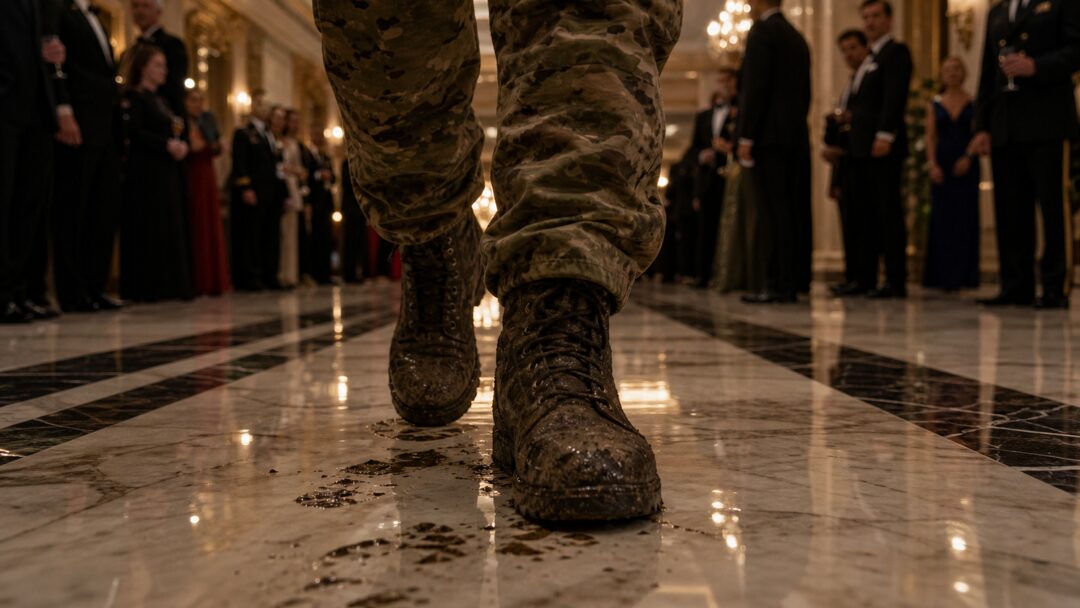
Elias Mercer walked through the gold-framed revolving doors of the Halcyon Grand wearing faded camouflage, mud-stained boots, and the kind of silence that made rich people look twice.
The lobby went still in pieces.
First the concierge stopped smiling.
Then a woman in a silver dress lowered her champagne glass.
Then two security men near the ballroom entrance shifted their weight at the same time, one hand moving toward the radio at his shoulder.
Elias kept walking.
His boots left faint wet marks on the marble, dark half-moons against the polished white floor. Above him, three chandeliers burned like captured stars. To his left, a banner twice the height of a man declared:
THE VALE FOUNDATION ANNUAL GALA
DEDICATING THE MERCER VETERANS RECOVERY WING
No one in the lobby seemed to notice the banner and the old man belonged to the same sentence.
They saw the jacket first.
Then the gray hair.
Then the canvas satchel hanging from his shoulder, patched at the corner and darkened by years of rain.
A young hotel attendant moved quickly from behind the registration desk. She wore a black event suit, an earpiece, and a name badge that read MARA LIN — EVENTS. Everything about her looked controlled: smooth hair, straight posture, tablet pressed to her ribs like a shield.
She reached Elias before security did.
“Good evening, sir,” she said, already lowering her voice. “Can I help you?”
Elias stopped.
He did not look embarrassed. He did not look angry. His face had the flat, weathered calm of a man who had learned long ago that panic wasted breath.
“I’m here for Vale,” he said.
Mara’s smile held for half a second too long.
Across the lobby, one of the security men murmured into his radio. Behind Elias, the revolving door turned again, swallowing the cold night and returning a couple in formalwear who stepped around the wet boot marks as if they were something spilled.
“General Vale is attending a private event tonight,” Mara said. “Do you have an invitation?”
Elias reached inside his field jacket.
Both security men moved.
Mara lifted one hand without looking back.
“Easy,” she said.
Elias pulled out a folded card, soft at the edges and stained as if it had once been soaked through. He handed it to her.
Mara opened it carefully.
The card was real. Cream stock. Embossed seal. Gold lettering.
Mr. E. Mercer
You are cordially invited…
Her eyes flicked to the banner.
Mercer.
Then back to him.
A woman nearby whispered, not softly enough, “Is this some kind of protest?”
Another voice said, “They need to handle that.”
Elias heard them. Mara saw that he heard them. His face did not change.
“Sir,” she said, quieter now, “where did you get this?”
“In the mail.”
“This invitation list was closed weeks ago.”
“Mail came late.”
It should have sounded like a joke. It didn’t.
Mara turned the card over, checking the seating code, the registration mark, anything that would make this simple. It had a small blue dot in the corner. Special handling.
Someone had meant for him to receive it.
Someone, or some mistake.
Behind her, the ballroom doors opened and a wash of warm sound slipped into the lobby: string music, polite laughter, glassware, applause from a video test. A staff member rolled a cart of champagne flutes past a wall of donor names. Men in dress uniforms stood beneath floral arrangements, medals flashing under the light.
Elias looked toward the sound.
For a moment his hand went to his chest, not dramatically, just by habit. His fingers touched something beneath his shirt.
Mara noticed the chain at his collar.
“Mr. Mercer,” she said, tasting the name now, unsure whether to treat it as coincidence or warning. “This is a formal black-tie event.”
He looked down at himself.
Then back at her.
“I know what I’m wearing.”
The line landed harder than it should have.
Mara felt the lobby watching her. Donors. Officers. Staff. The security team waiting for permission. Her manager standing near the staircase with a look that said: solve this before anyone important notices.
But important had already noticed.
At the far end of the lobby, beneath the banner bearing another man’s glory, General Warren Vale had turned.
He was tall, white-haired, straight-backed, dressed in formal military uniform with a chest full of medals and a smile that had probably calmed rooms larger than this one. He had been laughing with a senator when his gaze moved past Mara and landed on Elias.
The smile disappeared.
Only for a second.
But Mara saw it.
Elias saw it too.
And in that second, the old man in muddy boots no longer looked like he had wandered into the wrong hotel.
He looked like he had arrived exactly where he was supposed to.
Part II — The Name on the Card
“Ms. Lin.”
The voice came from Mara’s earpiece, sharp and low. Her manager. “Move him away from the entrance. Now.”
Mara kept her eyes on Elias.
“Mr. Mercer,” she said, “would you come with me for a moment?”
“I came to speak to Vale.”
“I understand.”
“No,” he said. Not harshly. Not loudly. “You don’t.”
The security men were close now. One of them, broad-shouldered and young, looked at Elias’s satchel.
“Sir, for everyone’s comfort, we need you to step aside.”
Elias looked at him for the first time.
The young man swallowed.
It was not fear exactly. It was the discomfort of being measured by someone who had seen worse rooms than this and found them wanting.
Mara stepped between them before the lobby could become a scene.
“He’s with me,” she said.
That was not true until she said it.
Her manager’s voice cracked in her ear. “Mara.”
She ignored it.
She guided Elias toward a seating area near the side wall, where tall plants and low velvet chairs gave the illusion of privacy. Elias chose a chair facing the ballroom doors. He did not sit with his back exposed.
Mara noticed.
She sat across from him with her tablet balanced on her knee.
“Can I take your coat?” she asked, because training sometimes spoke before conscience.
“No.”
“Can I ask what your connection is to General Vale?”
Elias’s gaze moved to the banner again.
“The same as that.”
“The Mercer Wing?”
His mouth tightened.
“They put my name on a room?”
Mara froze.
It was a small sentence. Quiet. Almost dry.
But it changed the temperature.
“You didn’t know?” she asked.
“I knew they were building something. Didn’t know they’d found a use for me.”
Mara looked down at the invitation.
E. Mercer.
Her pulse shifted.
“You’re Elias Mercer?”
“That’s what they wrote on the card.”
“You served with General Vale?”
“I served under him.”
The ballroom doors opened again. This time a staff member leaned out and waved Mara over urgently. Mara held up one finger. The staff member vanished, irritated.
Elias reached into his satchel and pulled out a small bundle wrapped in clear plastic. Inside was a battered notebook, the cover softened and bent, the corners dark. On top of it lay a metal field tag on a chain.
His thumb rested over the stamped name.
Mara stared at the tag.
“What is that?”
“Something that came home with me.”
“And the notebook?”
“Names.”
“Names of who?”
His hand closed over the bundle.
“People who didn’t get a wing.”
Mara’s tablet buzzed.
A message appeared from her manager:
DONORS ASKING. SECURITY READY. DO NOT LET HIM INTO BALLROOM.
She locked the screen.
“Mr. Mercer,” she said carefully, “tonight’s program includes a keynote presentation about Operation Night Orchard.”
Elias’s eyes returned to her.
The name did what no whisper in the lobby had done. It entered him.
For a moment, he looked older.
Only a moment.
Then the wall came back down.
“They still call it that?”
“That’s the name in the program.”
“It was an orchard on a map,” he said. “No trees. No night either, once the flares went up.”
Mara did not know what to say.
She had spent three months coordinating this gala. She knew the seating chart, the donor tiers, the allergy restrictions, the timing of the keynote video, the location of the press wall, and which senator required sparkling water at room temperature.
She knew General Vale’s foundation had funded therapy beds, prosthetic support, family counseling, and one outpatient program that had saved her father from disappearing inside his own house.
She did not know that the mission being celebrated tonight had a man sitting in front of her who spoke of it like a place still burning.
“What do you want from him?” she asked.
Elias leaned back.
Not relaxed. Never that.
“Twelve names.”
Mara glanced at the notebook.
“You want him to read them?”
“I want him to remember them.”
“That’s all?”
His eyes sharpened.
“That’s not small.”
In the ballroom, applause rose. A clean wave. Practiced and bright.
Elias’s fingers tightened around the field tag.
Mara caught one engraved letter before his hand covered it.
R.
“Ms. Lin.” Her manager appeared beside the seating area now, smile fixed for guests, eyes furious for Mara. “A word.”
Mara stood.
Elias looked up at her as if he already knew what came next.
The manager kept his voice smooth. “We have VIPs arriving. This gentleman cannot remain in the lobby dressed like this.”
“He has an invitation,” Mara said.
“He has an issue.”
“He has a name.”
“He has a problem, and you are letting it become ours.”
The sentence was quiet enough that only the three of them heard it.
Elias rose.
Mara turned.
“I didn’t come to be dragged out of a hotel,” he said. “Did that once from a field hospital. Didn’t care for it.”
The manager blinked, annoyed by the line because it carried pain he could not schedule.
“Sir, no one is dragging you anywhere.”
“Good.”
Elias picked up his satchel.
“Then get Vale.”
Part III — Presumed Dead
Mara should have called security.
Instead, she went to the registration desk and opened the internal donor packet on her tablet with hands that looked steadier than they felt.
Mercer Veterans Recovery Wing.
She searched the name.
The first result was not Elias.
It was a glossy paragraph about General Warren Vale’s lifetime of service, his leadership during Operation Night Orchard, and his commitment to the invisible wounds of war.
She searched again.
Mercer, E.
One archival footnote appeared in a scanned background memo attached to the donor narrative.
Unidentified field medic later believed to be Sgt. Elias Mercer, presumed dead during final evacuation phase.
Mara read the line twice.
Then a third time.
Presumed dead.
She looked across the lobby.
Elias stood near the side seating area, still beneath the chandeliers, still in wet boots, still surrounded by people trying not to stare. The man the gala had turned into a sentence was breathing twenty feet from a banner that had made him useful only after erasing him.
Her throat tightened.
A memory came fast and unwanted: her father sitting at the kitchen table three years earlier, both hands around a mug he had not drunk from, while her mother cried quietly in the laundry room. He had come home from his deployment whole enough to walk and broken enough to vanish. The foundation’s outpatient program had not cured him. Mara hated that word.
But it had given him mornings again.
It had given him a therapist who knew not to say, “At least you’re safe now.”
It had given Mara her father back in fragments.
That mattered.
The money raised tonight mattered.
The wing mattered.
And still.
Still.
On the tablet, Elias Mercer was dead.
In the lobby, Elias Mercer waited to be removed for making the living uncomfortable.
“Mara.”
General Vale stood beside her.
Up close, he looked exactly like his photographs but less real. The medals were sharper than his eyes. His hair was perfect. His mouth was arranged in concern.
“Is there a complication?” he asked.
Mara looked past him at Elias.
Vale did too.
This time he could not hide it.
His face changed.
Not much. A tightening around the mouth. A pause in the breath. A man seeing a ghost and deciding how many witnesses might notice.
“You know him,” Mara said.
Vale’s eyes returned to her.
“I know many veterans.”
“That wasn’t what I asked.”
For the first time all evening, Mara heard herself speak without a service smile.
Vale’s expression cooled.
“Miss Lin, this event funds beds that men and women desperately need. I trust you understand the importance of keeping it dignified.”
Dignified.
The word rubbed against the boot marks on the floor.
“What happened to Elias Mercer?” she asked.
Vale’s jaw flexed.
“That is not a conversation for a lobby.”
“He’s in the lobby.”
Vale looked again at Elias.
Elias had not moved. But his hand had lifted to his collar, fingers around the chain.
“General,” Mara said, “the program says thirty-two soldiers were saved during Operation Night Orchard.”
“They were.”
“Mr. Mercer says there are twelve names.”
A silence opened.
People moved around it without knowing.
Vale lowered his voice.
“War leaves men with different memories.”
“That sounds like something you say when one of them is inconvenient.”
His eyes hardened.
Mara felt fear then. Not because he threatened her. He didn’t need to. He was the honored guest, the donor magnet, the reason the room existed. She was twenty-nine, wearing a headset, replaceable by morning.
Vale knew it.
So did she.
Then Elias crossed the lobby.
Security started forward.
Mara lifted her hand again.
Elias stopped two feet from Vale. The old medic and the decorated general stood facing each other between marble columns and white flowers.
For several seconds, neither spoke.
Then Elias pulled the field tag from beneath his shirt and held it out.
It swung once on the chain.
Vale stared at it.
The blood had left his face.
Elias said nothing.
Vale read the stamped name.
His voice was so quiet Mara almost missed it.
“Rourke.”
Elias closed his hand around the tag.
“Good,” he said. “You remember one.”
Vale’s eyes lifted.
“Elias.”
There it was.
Not sir. Not veteran. Not this gentleman.
Elias.
The name struck Mara harder than the footnote.
Vale knew exactly who he was.
Elias leaned closer, not enough to threaten, only enough to make the general hear him without the room.
“I didn’t come for your medals.”
Vale’s mouth tightened.
“I have built something that helps people.”
“I know.”
“Then don’t burn it down.”
Elias looked toward the ballroom doors, where the music had softened for the beginning of dinner service.
“I came to ask you not to build it on them.”
Part IV — The Clean Solution
There are rooms designed to swallow uncomfortable men.
The Halcyon Grand had several.
One was beside the service corridor, painted cream, furnished with two chairs, no windows, and a phone that only called the front desk. Vale’s chief of staff suggested it with the calm of someone offering hospitality.
“We’ll give Mr. Mercer privacy,” he told Mara. “A quiet place to collect himself.”
Elias heard.
He smiled once, without humor.
“Collect myself,” he repeated.
The chief of staff did not look at him. “The keynote begins in seven minutes.”
Seven minutes.
Mara felt the night narrow.
In the ballroom, six hundred guests sat beneath white flowers and blue light. The video screen was ready. The narrator’s voice had been tested twice: solemn, warm, heroic. The donors had already pledged enough to fund the first year of the recovery wing. Reporters waited near the back with cameras lowered but hungry.
If Elias walked into that room, the night would change shape.
If Elias disappeared into the cream room, the night would continue exactly as planned.
No broken glass.
No scandal.
No discomfort.
Nothing lost except one old man’s dignity.
Her manager appeared at Mara’s side.
“This is beyond you,” he whispered.
Maybe it was.
Maybe truth always looked above your pay grade when enough powerful people preferred silence.
Elias adjusted the strap of his satchel.
“I’ll go,” he said.
Mara turned to him.
“What?”
His face had gone distant.
“I’ve seen this before.”
Vale looked away.
Elias continued, voice level. “Men at tables. Men with clean hands deciding what can be carried out of a bad place and what has to stay behind.”
Vale flinched.
Barely.
But Elias saw it.
“You don’t have to do this,” Mara said.
Elias looked at her then.
There was no accusation in his eyes. That almost made it worse.
“You opened the file,” he said.
Mara said nothing.
“You saw the word.”
Presumed dead.
It rose between them.
“My father,” she said, before she could stop herself, “went through one of Vale’s programs.”
Elias waited.
“It helped him.”
“I’m glad.”
That was all. Not sarcasm. Not dismissal.
The answer hurt because it left no excuse.
Mara looked toward the ballroom. She imagined her father on one of his bad mornings, unable to answer when she asked whether he wanted coffee. She imagined the recovery wing opening. Beds filled. Families waiting for a call that sounded like hope.
Then she looked at Elias’s boots.
The mud had dried at the edges. A housekeeper stood a few feet away with a cloth, waiting for permission to erase the marks.
Mara thought: this is how it happens.
Not with cruelty.
With scheduling.
With good causes.
With someone saying now is not the time until every time is gone.
The ballroom lights dimmed.
The keynote video began.
A deep voice rolled through the open doors.
“Twenty years ago, during Operation Night Orchard, General Warren Vale made the command decision that saved thirty-two American soldiers from certain death…”
Elias closed his eyes.
Mara reached for his arm.
He opened them.
“Come with me,” she said.
Her manager grabbed her wrist.
“Mara, don’t.”
She pulled free.
Her hand shook once, then steadied.
She turned to Elias.
“You said you came for Vale.”
Elias looked toward the ballroom.
Then at the field tag in his palm.
“No,” he said softly. “I came for them.”
Mara opened the ballroom doors.
Every head near the back turned.
Light spilled over Elias’s camouflage, his gray hair, his mud-stained boots. The music under the video swelled as if it had been written for another kind of story.
Mara walked beside him down the side aisle.
This time, she was not blocking him.
This time, the room watched her let him in.
Part V — Thirty-One
The video showed grainy images of helicopters, desert roads, silhouettes against smoke, and General Vale twenty years younger, jaw set beneath a helmet.
The narrator continued.
“Under impossible conditions, then-Colonel Vale refused to abandon his men. His order saved thirty-two lives and became the moral foundation of the work we celebrate tonight.”
At the front of the ballroom, Vale stood frozen beside the podium.
He had not expected Elias to enter.
Or maybe he had always expected it, every night for twenty years, and had simply grown tired of waiting.
Elias stopped at the back of the ballroom.
Mara stopped beside him.
The guests turned in waves.
The old whispers began again, but softer now. No one wanted to be the first to sound unkind in a room full of veterans.
On the screen, the narrator said, “Thirty-two came home.”
Elias spoke.
“Thirty-one.”
He did not shout.
He did not need to.
The word cut cleanly through the ballroom.
The video continued for two more seconds before someone killed the sound.
The screen froze on Vale’s younger face.
Six hundred people sat inside the silence.
Vale gripped the edges of the podium.
Mara could hear her own heartbeat in her earpiece.
Elias walked forward alone now.
No security stopped him.
At the center aisle, a retired officer rose halfway from his seat, then sat again. A donor in pearls put one hand to her throat. A camera lifted, then lowered when no one else lifted theirs.
Elias reached the open space before the podium.
He looked smaller there than Mara expected. Not weak. Just human. One old man in a room built to make symbols out of people.
He opened his satchel.
Vale said, “Elias.”
The name carried through the microphone still live at the podium.
The ballroom shifted.
Elias removed the plastic-wrapped notebook. His fingers worked slowly at the fold. The plastic made a small, ugly sound in the beautiful room.
He opened the notebook.
The pages were stained, cramped with handwriting.
“I kept count because no one else could,” he said.
Vale shut his eyes.
Elias looked at the room.
“You were told thirty-two men came home because that number is easier to raise money with. Thirty-one came home.”
No one moved.
“One died after the withdrawal order.”
Vale’s eyes opened.
“Elias,” he said again, but now the word sounded less like warning than plea.
Elias touched the field tag.
“Jonah Rourke.”
The name entered the room and stayed there.
Elias read from the notebook.
“Private Jonah Rourke. Twenty-four. Taped his glasses because the left arm kept breaking. Hummed when he was scared. Asked me if his wife would get the letter before the baby came.”
A woman near the front covered her mouth.
Elias did not look at her.
“Corporal Daniel Mays. Sergeant Luis Ortega. Specialist Henry Bloom. Lieutenant Paul Sutter…”
He read the names one by one.
Not quickly.
Not theatrically.
He gave each name enough room to stand.
Mara looked at Vale.
The general’s face had broken open in a way no camera had ever captured. Not crying. Not absolved. Just old.
When Elias reached the twelfth name, he closed the notebook.
“Those men were not saved by the operation,” he said. “They were hidden by it.”
The ballroom remained silent.
Vale stepped toward the microphone.
His chief of staff moved as if to stop him.
Vale raised one hand.
The chief of staff froze.
For several seconds, Vale could not speak.
When he did, the command voice was gone.
“Sergeant Mercer stayed behind after the final withdrawal order,” he said.
A tremor moved through the room.
“He kept wounded men alive long enough for a second extraction window that was never entered into the public report.”
He turned toward Elias.
“I let that report stand.”
No one breathed.
Vale looked back at the ballroom.
“I told myself the larger truth was that lives had been saved. I told myself the mission had to remain clean because the men coming home needed support, and support required a story people could bear to hear.”
His mouth tightened.
“That was not the whole truth.”
Elias watched him without expression.
Vale stepped away from the podium.
Not far.
Just enough.
Then he looked at Elias and said, “Read them into the microphone.”
Elias did not move.
For a moment, Mara thought he might refuse. That perhaps being offered the room now, after twenty years, was another kind of insult.
Then he walked to the podium.
His muddy boots crossed the polished stage.
He stood where Vale had stood.
He placed the field tag beside the microphone.
And he read the names again.
This time, the room heard them through the speakers.
Jonah Rourke.
Daniel Mays.
Luis Ortega.
Henry Bloom.
Paul Sutter.
And the rest.
Twelve names.
No music under them.
No video.
No applause.
Just names, traveling through a ballroom that had been built for comfort and, for once, had no way to remain comfortable.
When Elias finished, he closed the notebook.
A reporter near the back raised a camera.
Elias looked directly at him.
“Don’t make me into the story,” he said.
The camera lowered.
Then Elias picked up the notebook, left the field tag by the microphone, and walked down from the stage.
No one clapped.
That was the mercy of it.
Part VI — Living
Elias left before the gala knew what to do with him.
People began standing only after he reached the lobby. Not to cheer. Not to crowd him. Mostly because their bodies needed something to do with the shame.
Mara followed him past the registration desk.
“Mr. Mercer.”
He stopped near the boot marks.
They were already fading.
The housekeeper still had not wiped them away.
Mara wanted to say something large enough for the night. There was nothing.
So she said the only thing that seemed honest.
“I’m sorry.”
Elias looked at her.
“For what part?”
The question was not cruel.
That made it harder.
Mara swallowed.
“For almost doing what everyone expected me to do.”
He nodded once.
“That’s usually how it starts.”
Behind them, the ballroom doors opened. Voices leaked out, low and uneven. Vale stood just inside the threshold, surrounded but untouched. For the first time all night, no one seemed to know how close they were allowed to stand to him.
Mara looked back.
“Will you talk to the press?”
“No.”
“They’ll look for you.”
“They’ve been looking for a dead man for twenty years. Let them be confused a little longer.”
He adjusted his satchel.
The notebook was inside it again.
Mara noticed the chain was gone from his neck.
Her eyes moved to the registration desk.
The field tag lay there beside a blank place card.
Jonah Rourke’s name faced upward.
Elias followed her gaze.
“You’re leaving it?”
“I carried him as far as I could.”
The line struck Mara so cleanly she had to look away.
Elias turned toward the revolving doors.
Outside, the night waited cold and wet, indifferent to ceremonies.
“Mr. Mercer,” Mara said.
He paused.
“The name card,” she said. “Yours was never printed.”
A faint expression crossed his face. Not quite a smile.
“Wouldn’t know where to seat a ghost.”
After he walked out, Mara stood behind the registration desk and searched the drawer for a blank card.
Her hands were still shaking.
This time she did not steady them.
She wrote carefully.
Elias Mercer
Combat Medic
Living
She set the card beside Jonah Rourke’s field tag.
In the ballroom, someone began speaking again. Not the narrator. Not the video. A human voice, uncertain and stripped of polish.
Mara did not go in.
She looked at the marble floor instead.
The muddy marks from Elias’s boots had faded into pale shadows, but they had not vanished. The housekeeper stood nearby, cloth in hand, waiting.
Mara shook her head once.
“Leave them,” she said.
The housekeeper looked surprised, then nodded.
Outside, beyond the glass doors, Elias Mercer crossed the driveway in his old camouflage jacket, carrying the notebook of the dead under one arm. No cameras followed him. No applause lifted him. No one gave him back the twenty years in which his name had belonged more to a building than to his body.
But inside the Halcyon Grand, beneath the chandeliers and the banner and the careful flowers, his name sat on the desk at last.
Not as a wing.
Not as a myth.
Not as a presumed sacrifice polished clean for donors.
As a man.
Living.