The Woman Who Raised Her Hand
Part I — The Palm
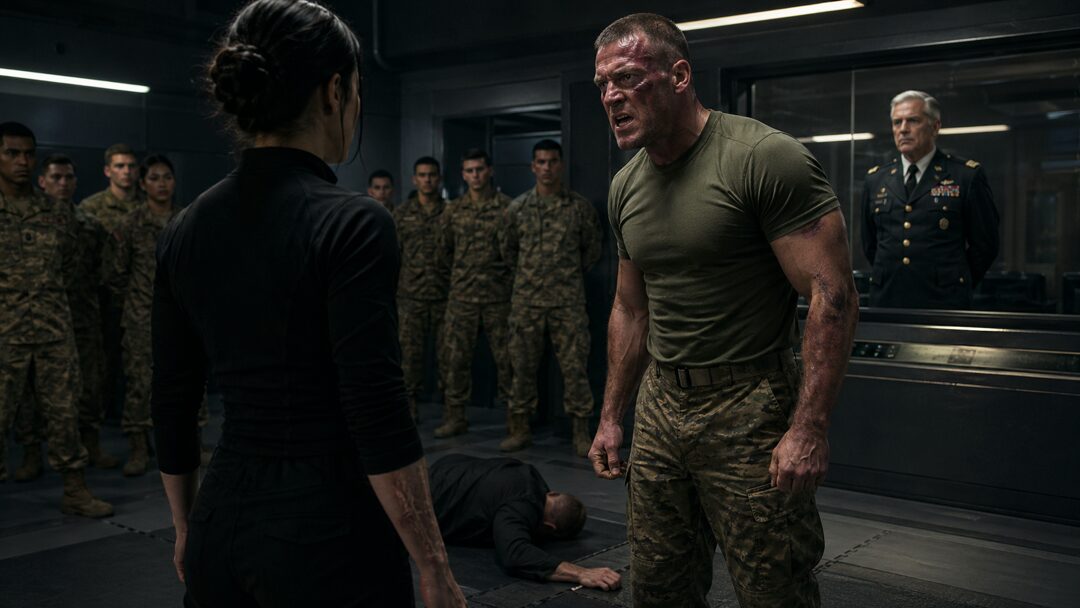
Mara Voss raised one hand between her chest and Sergeant Cole Rainer’s.
Not a shove. Not a plea.
Just a palm.
Cole stood so close that his breath stirred the loose strand of dark hair that had slipped from the knot at the back of her head. He was broad enough to block the overhead light, tall enough to make her look smaller than she was, and angry enough to make the twelve recruits around the mat forget how to breathe.
Behind the glass wall, Lieutenant Colonel Adrian Shaw watched without moving.
That was how Mara knew the disrespect had been permitted.
Cole smiled down at her. “You sure about this, ma’am?”
The word landed wrong. It was dressed as respect, but everyone in the room heard what he meant.
Old woman.
Broken thing.
Mistake.
Mara kept her palm where it was, a few inches from the center of his green training shirt. Her wrist was bare. The old burn scar there caught the light, pale against her skin.
Private Lena Ortiz noticed it because she noticed everything she was not supposed to.
Lena stood in the back row with the other recruits, notebook tucked into her cargo pocket, boots aligned, shoulders stiff. She had been at Fort Selkirk’s coastal intelligence training base for six weeks. Long enough to learn that the safest face in a room was an empty one. Long enough to know Sergeant Rainer was the kind of man recruits admired before they feared him.
And long enough to know the woman in black was not supposed to be here.
Mara Voss had no rank on her sleeve. No unit patch. No visible decoration. Just black tactical clothing, quiet eyes, and the stillness of a locked door.
Cole shifted forward half an inch.
Mara’s palm did not move.
“Step back once,” she said.
Her voice was so calm that it made the room colder.
A few recruits glanced toward Shaw behind the glass, waiting for him to correct Cole. To call the drill to order. To remind the room that this was restraint training, not a public challenge.
Shaw said nothing.
He stood with his hands folded behind his back, silver hair perfect, uniform immaculate, face composed in the mild way of men who ruined lives with paperwork.
Cole’s smile widened.
“Or what?”
The room held.
Mara looked past Cole, just once, toward Shaw.
Then she looked back.
“Or you’ll make a decision you can’t blame on me.”
Something passed through the room. Not fear exactly. Recognition before understanding.
Cole laughed under his breath.
Then he moved.
He was fast for a man his size, and he attacked like someone used to being believed by his own body. His right shoulder dipped. His arm came in hard, meant to seize, crowd, fold her backward, make her fight from panic.
Mara stepped inside the attack.
Not away.
Inside.
Her shoulder vanished beneath his line of force. One hand touched his wrist. The other found the hinge of his elbow. Her foot slid half a step behind his, so small a movement Lena almost missed it.
Cole’s body betrayed him.
His own momentum lifted, turned, emptied.
The sound he made when he hit the mat was not dramatic. It was worse.
It was human.
A rough burst of air. A flat, stunned impact. A roomful of certainty breaking its teeth.
For half a second, nobody moved.
Cole lay on his back, one arm pinned across his own throat, Mara kneeling beside him with no strain in her face. She had released him before he could tap.
Then she stood.
Quietly.
As if she had set down a cup.
Lena heard someone whisper, “Damn.”
Mara looked at Cole on the mat.
“You crossed the line,” she said.
Cole stared up at her, shocked red creeping up his neck.
Behind the glass, Shaw finally leaned toward the microphone.
“Reset,” he said.
Not stop.
Reset.
And that was when Lena understood the first thing the room had gotten wrong.
Mara Voss was not being tested because they doubted she could fight.
She was being tested because someone needed her to fail.
Part II — The First Fall
Cole got up too fast.
That was the first sign his pride was hurt worse than his back. He rolled to one knee, then stood, jaw working, shoulders swelling under the green fabric of his shirt. The recruits straightened without being told. Fear was contagious in a military room. So was embarrassment.
Mara waited in the center of the mat.
She did not bounce on her feet. Did not shake out her arms. Did not smile.
That made it worse.
A man could forgive being beaten by fury. Fury gave him something to hate.
Mara gave him nothing.
Shaw’s voice came through the speaker again. Smooth. Almost bored.
“Sergeant Rainer has requested another pass. Adaptive aggression under stress. Recruits, observe the difference between compliance and control.”
Lena’s stomach tightened.
That sentence sounded like training.
It felt like permission.
Cole rolled his shoulders. “You got lucky.”
Mara looked at his hands. Then his feet. Then his eyes.
“No,” she said.
One word.
It hit harder than if she had mocked him.
Cole came in sharper this time. Less theatrical. More dangerous. The room felt the change and leaned with it. He feinted high, then drove low, reaching for her hips, trying to use weight instead of speed.
Mara let him touch her.
For a sick instant, Lena thought he had her.
Then Mara folded with him, turned her body around the point of contact, and brought Cole’s wrist behind his back as his knees hit the mat. His face twisted. Not from pain yet. From the knowledge that pain was waiting one inch away.
Mara held him there.
The room went very still.
“You still lead with anger,” she said softly.
Cole’s eyes lifted.
That was the second thing Lena noticed: Mara had not said it like an insult.
She had said it like a diagnosis.
Cole’s breathing changed under her grip.
For a moment, something old moved behind his face. Something that did not belong to the drill.
Then he buried it.
“Let go,” he said.
Mara released him at once and stepped away.
Cole rose slower this time. He flexed his fingers. His wrist was intact. That seemed to irritate him more than an injury would have.
Lena looked again at Mara’s scar.
Burns did not usually heal like that unless the skin had been caught against heated metal or blast-torn equipment. There were three pale branches across the wrist, like lightning trapped under skin.
She had seen that pattern before.
Not in person.
In an image flashed for less than five seconds during a restricted casualty ethics briefing that none of them were supposed to discuss outside the room.
Operation Night Glass.
A stairwell full of smoke.
A woman’s hand wrapped around a radio handset, burned raw at the wrist.
Lena’s mouth went dry.
The briefing had never named the woman in the image. It had only said: surviving liaison failed to maintain extraction timing under pressure.
Failed.
That was the word they had used.
Lena looked at Mara standing in front of Cole, untouched, breathing evenly.
Failed did not fit her.
That made the word more frightening.
Shaw’s voice cut through the room.
“Again.”
This time even Cole looked toward the glass.
“Sir?”
“Again, Sergeant.”
A pause.
Then Shaw added, “Unless the demonstration has reached your limit.”
Cole’s face closed.
There it was. The hook in him. Small, precise, placed by a man who knew exactly where pride lived.
Cole turned back to Mara.
Mara had heard it too. Lena saw that she had. Nothing changed in her expression, but her eyes went once to the microphone in the ceiling.
Then to the door.
Then back to Cole.
“You don’t have to,” Mara said.
Cole’s laugh came out ugly. “Don’t start caring now.”
Mara said nothing.
Cole lunged.
This time, when Mara put him down, it was harder.
Not cruel. Not reckless.
But hard enough that the mat snapped under his shoulder and the sound traveled through every recruit’s spine.
Cole lay there, breathing through his teeth.
Mara stood over him.
Not triumphant.
Not sorry.
Controlled.
From behind the glass, Shaw watched her the way a man watches a locked drawer and wonders if the key still works.
Part III — The Shape of an Old Room
“Two-on-one pressure testing,” Shaw said.
The room changed.
Not loudly. There was no gasp, no protest. But the recruits shifted. Boots scraped. Eyes moved. Even obedience has a temperature, and suddenly it had dropped.
A second instructor stepped forward from the wall. Staff Sergeant Hale. Older than Cole by a few years, narrower, experienced enough to dislike what he was being asked to do.
He looked at Mara once.
An apology almost made it to his face.
Almost.
“Yes, sir,” Hale said.
Cole was still on one knee. His pride wanted him upright. His body was voting against it.
Mara turned toward the glass.
For the first time, her stillness sharpened into something Lena could name.
Recognition.
Not surprise.
Recognition.
Shaw had not invented this pressure. He was repeating something.
Mara’s eyes moved to Cole, then Hale, then the sealed door. Three bodies. One exit. Observers. Command behind glass. A room where the people inside were being watched by someone who could leave.
Lena felt the back of her neck prickle.
This was not a training drill anymore.
Or maybe it had never been one.
Shaw’s voice came through the speaker. “Begin when ready.”
No whistle.
No countdown.
No clean start.
Cole attacked first because anger made him easy to time. Hale moved half a breath later, disciplined but reluctant, coming from Mara’s left.
For one second, the room saw what Shaw wanted them to see: Mara surrounded, small in the dark center of the mat, men closing in from both sides.
Then she disappeared from where they expected her to be.
Cole collided with absence.
Hale checked his own strike too late.
Mara caught Hale’s sleeve, turned with his momentum, and used him as the barrier Cole had failed to become. Cole’s shoulder drove into Hale’s ribs. Hale grunted. Mara cut low, hooked Cole’s leg, and sent him down across Hale’s path.
It happened too fast to admire.
It happened just slow enough to understand.
Hale tried to recover. Mara put two fingers into the notch beneath his wrist, folded his arm, and lowered him face-first to the mat as if guiding someone into a chair. Cole pushed up behind her. She shifted her weight, let him rise into his own imbalance, and put him down again beside Hale.
Two men.
One breath.
Mara stepped back.
Her chest rose once. Fell once.
Nothing else.
This time, the silence did not belong to shock.
It belonged to calculation.
Every recruit in that room was rewriting the story in their head. Every assumption they had made about size, rank, reputation, and command approval had been dragged onto the mat and left there gasping.
Lena’s hands had curled into fists.
She forced them open.
Shaw’s reflection appeared in the glass above Mara’s shoulder. He was not angry.
That was worse.
“Strength is not enough,” Shaw said through the speaker. “Speed is not enough. Training is not enough. In the field, hesitation kills.”
Mara’s head turned slightly.
Cole lifted himself on one arm. Sweat had darkened his collar. His face was flushed with pain and humiliation, but when Shaw said hesitation, his eyes changed.
They found Mara.
Not as an opponent now.
As a memory someone else had handed him.
Shaw continued. “A single failure to move can compromise an entire team.”
Mara’s jaw tightened.
Only once.
Lena saw it because she was already looking.
Cole pushed to his feet. “Say it plain, sir.”
Shaw did not answer.
Cole looked at Mara. His voice dropped lower, rougher.
“Night Glass.”
The room froze.
Mara did not move.
That was how Lena knew the name had hit.
Cole took one step toward her. Slower this time. No lunge. No drill.
“My brother-in-law was on that floor,” he said.
Mara’s eyes stayed on him.
Cole’s voice cracked around the edges, and anger poured in to cover it. “Evan Tate. You remember him? Or did you leave too fast?”
A few recruits looked down.
Hale was still on the mat. He did not get up.
Shaw’s face behind the glass remained composed, but one hand had moved from behind his back to the front of his jacket.
Mara said nothing.
Cole’s breathing grew harsh.
“They said you froze,” he continued. “They said you had the corridor and lost your nerve. They said my sister got a flag because you came home breathing.”
Lena felt the sentence hit the room like a dropped blade.
Mara could have destroyed him for it.
Everyone knew that now.
She could have crossed the distance before Cole finished speaking. She could have broken something. She could have made his grief kneel beside his pride.
Instead, she stood there.
Silent.
That silence did not look empty anymore.
It looked full of names.
Cole’s eyes shone, and he hated her for seeing it.
“Say something,” he snapped.
Mara looked past him, toward the glass.
Her voice, when it came, was low enough that the room leaned in.
“Are they cleared to hear why the extraction corridor was empty?”
Shaw’s hand dropped to the console.
“Drill terminated.”
The speaker cracked with the force of it.
No one moved.
Not even Cole.
Because in that instant, the room understood the third thing it had gotten wrong.
Mara’s silence had never been proof.
It had been containment.
Part IV — Eleven Minutes
“Recruits, out,” Shaw ordered.
The door lock clicked open.
Nobody moved at first. Then training took over. Boots turned. Bodies filed toward the exit. Hale rose with one arm wrapped around his ribs and joined the line without looking at Shaw.
Lena moved with them because obedience was muscle memory.
Then she stopped.
She did not mean to. Her boots simply failed to carry her through the door.
Mara noticed.
So did Shaw.
“Private Ortiz,” Shaw said, voice soft now that the microphone was off and he had entered the room. “You were given an order.”
Lena’s pulse thudded in her throat.
“Yes, sir.”
But she stayed.
Cole stood several feet from Mara, one hand gripping his own wrist as if only now feeling where she had spared him. His face had lost its hard shape. Without certainty, grief made him look younger.
He did not look at Lena.
He looked at Mara.
“What did you mean?” he asked.
Shaw stepped forward. “Sergeant, that is enough.”
Cole ignored him.
It was the first brave thing he had done all morning.
“What did you mean by empty?”
Mara’s gaze rested on Cole. Then on Shaw. Then on the door where the last recruit had disappeared.
There were only four of them now.
Mara. Cole. Shaw. Lena.
And the dead, who had never really left.
Mara spoke carefully.
“I held the south stairwell for eleven minutes after the evacuation window closed.”
Cole’s face moved as if struck.
Mara continued. “Evan Tate was alive when I last saw him.”
The name changed the air.
Cole blinked once. Twice.
“No.”
Mara did not soften the word by arguing with it.
No was a wall people built when the truth was too close.
Shaw’s voice hardened. Not loud. Never loud.
“Ms. Voss, you are approaching classified territory.”
Mara looked at him. “I’ve lived there for four years.”
“Then you know the consequences.”
“I know them better than you do.”
Shaw’s expression did not change, but the room felt him narrow.
“Your disability appeal is still under review,” he said. “Your consulting status is conditional. Your prior conduct remains subject to administrative interpretation.”
There it was.
The knife wrapped in paper.
Lena stared at him.
She had heard instructors say the institution protected its own. She had believed that meant soldiers. People in the field. People who bled.
Now she understood it could also mean records. Careers. Men behind glass.
Cole turned toward Shaw slowly.
“You told us she froze.”
Shaw did not look at him. “You were briefed on the findings.”
“The findings said the corridor was secured.”
Mara laughed once.
No humor.
Just air escaping something old.
Shaw’s eyes flashed. “Careful.”
Mara took one step toward him.
It was not much. Just one step. But Shaw’s shoulders tightened before he could hide it.
“You already buried the dead,” she said. “You don’t get to bury the living too.”
Lena felt the line enter her body and stay there.
Cole looked like he wanted to ask ten questions and feared every answer.
“My sister,” he said, voice barely above breath. “She thinks—”
“I know what she thinks,” Mara said.
The words were not cruel.
That made them worse.
“She sent me a letter,” Mara continued. “I never answered.”
Cole’s face twisted. “Why?”
Mara’s eyes dropped to her scarred wrist.
For a second, she was not in the training room.
Lena saw the absence pass over her. Smoke. Metal. A radio too hot to hold. Men shouting through concrete. A corridor that should have opened but did not.
Then Mara came back.
“Because I could not give her half the truth,” she said. “And I was ordered not to give her the whole one.”
Cole’s hand fell from his wrist.
Shaw moved toward the wall console.
“That is enough.”
Mara did not stop him.
Lena saw the small red light above the archive panel.
Training rooms recorded by default. Everyone knew that. Most forgot. Recordings were reviewed, clipped, archived, erased.
Lena had cleaned the panels during first-week detail. She knew where the manual preservation switch was.
Her fingers trembled.
Shaw’s hand hovered near the console.
“Sergeant Rainer,” he said, “escort Ms. Voss out.”
Cole did not move.
Shaw turned his head slightly. “That was an order.”
Cole stared at Mara.
All the rage he had carried into the room had not vanished. It had simply lost its address.
“Did he know?” Cole asked her.
Mara did not answer quickly.
That was answer enough.
Cole closed his eyes.
Only for a second.
When he opened them, Shaw’s voice cut through the room.
“Sergeant.”
Cole stepped toward Mara.
Lena stopped breathing.
Part V — The Choice
For the second time that morning, Cole Rainer crossed the mat toward Mara Voss.
But this time he did not look certain.
His body remembered the first two falls. His pride remembered the room. His grief remembered a folded flag, a sister in black, a story that had given pain somewhere to go.
Mara watched him come.
Then she raised her hand.
The same palm.
The same quiet line between them.
The whole room folded back into the first moment.
A large man. A smaller woman. Command watching. A choice pretending to be a drill.
Cole stopped.
Not because he was afraid of her.
Because, at last, he understood she had never been asking for fear.
She had been asking for a decision.
Shaw’s voice went flat. “Sergeant Rainer, complete the order.”
Cole did not look away from Mara.
“No, sir.”
The words were quiet.
They were also irreversible.
Shaw stared at him. “You are refusing a direct order.”
Cole swallowed. “I’m refusing to remove a witness before I know what she witnessed.”
The silence after that was different from every silence before it.
This one had teeth.
Lena reached behind her with one shaking hand and pressed the small recessed switch beneath the archive panel.
The red light blinked.
Then held steady.
Preserved.
Shaw heard the click.
His eyes snapped to Lena.
Private Lena Ortiz, six weeks into training, bottom of every hierarchy in the room, felt the full weight of a lieutenant colonel’s attention settle on her.
Her knees almost gave.
But Mara had raised her hand to a man twice her size and survived the room’s judgment without begging it to understand.
So Lena stood still.
Shaw’s face remained controlled, but control was no longer the same as power.
“You have no idea what you are interfering with,” he said.
Lena’s voice came out thin but clear. “No, sir.”
A beat.
“That’s why I preserved it.”
Cole turned then.
Not fully toward Lena. Not away from Mara.
Enough.
Shaw moved.
It was not a punch or a grab. Men like Shaw did not begin with visible violence. He stepped toward the archive panel, toward Lena, toward the machine that had suddenly become more dangerous than any person in the room.
Mara intercepted him.
No flourish.
No spectacle.
Her hand closed around his wrist before he reached the panel. She turned just enough to remove his balance and his authority at the same time. Shaw’s polished shoes slipped on the mat. His shoulder dipped. His hand opened.
The metal command badge clipped to his chest struck the floor.
A small sound.
Sharper than the earlier falls.
Shaw did not hit the mat the way Cole had. Mara did not need him there. She held him bent just far enough that he could not pretend he had chosen the posture.
Cole stared at the badge.
So did Lena.
It lay between them, faceup, reflecting the overhead light.
For years, that badge had meant clearance. Command. Interpretation. The right to decide which truth became official.
On the floor, it looked smaller.
Mara released Shaw.
He straightened slowly. His face had gone pale beneath its discipline.
“You think this changes anything?” he said.
Mara looked at him.
“No,” she said. “Not everything.”
The honesty of it hurt more than triumph would have.
Then she looked at Cole.
“Evan was trying to get two wounded men up the stairwell when the corridor went dark,” she said. “That’s all I’m giving you here.”
Cole’s jaw trembled.
“Did he suffer?”
Mara’s eyes did not leave his.
“Yes.”
Cole flinched.
Mara let the truth stand there. Not softened. Not decorated. Not hidden.
Then she added, “He was not alone.”
Cole looked down.
His shoulders broke in a way no takedown had managed.
For a moment, he was not a senior instructor. Not a broad-shouldered man in a green shirt. Not the room’s weapon.
He was simply someone who had spent four years hating the wrong shape because it was easier than having no shape at all.
“I told my sister you ran,” he said.
Mara said nothing.
Cole dragged a hand over his face.
“I told her that.”
“I know,” Mara said.
No forgiveness.
No punishment.
Just the truth returning to the people who had mishandled it.
Behind them, the archive light remained red.
Steady.
Shaw’s eyes stayed on it.
For the first time all morning, he looked like a man in a room he could not leave clean.
Part VI — The Silence Changed
When Mara walked out of the training room, nobody cheered.
That would have ruined it.
The recruits stood in the corridor in two uneven lines, pretending badly that they had not been waiting. Hale was among them, one arm still pressed to his ribs. Their faces held the same question in twelve different ways.
Mara did not answer any of them.
She passed through the doorway with the same controlled step she had used on the mat. Her hair had loosened. The burn scar on her wrist was visible again. There was a faint red mark along her jaw where Cole’s sleeve had caught her skin during the second pass.
She looked neither victorious nor relieved.
She looked tired in a way young soldiers did not yet understand.
Behind her, Cole remained inside the room on one knee, though no one had ordered him there. Shaw stood near the archive panel, his command badge still on the floor between his polished shoes. Lena stood at attention beside the wall, hand at her side, face pale, eyes forward.
Mara paused beside Lena.
For one second, Lena thought she might be reprimanded. Or thanked. Or told she had just ended her career before it had begun.
Mara said none of those things.
She only said, “Witnesses pay for what they keep.”
Lena’s throat tightened.
“Yes, ma’am.”
Mara looked at her then, fully.
“And for what they lose.”
Lena nodded, though she did not yet know all the meanings of that.
She would.
Mara continued down the corridor.
The walls outside the training wing were lined with old unit photographs. Most recruits passed them without looking after the first week. Faces in rows. Names on brass plates. Campaigns reduced to dates and dusted glass.
Mara stopped at one frame near the end.
Operation Night Glass had not been given a proud display. No dramatic plaque. No polished tribute. Just a faded photograph tucked among other classified liaison teams, the kind visitors would overlook because there was nothing to admire unless you knew where to place your grief.
Seven people stood in the photo.
Mara was younger there. Her hair shorter. Her face less guarded.
Beside her was a man with a crooked smile and one hand lifted halfway, as if someone had said something just before the camera flashed.
Evan Tate.
Mara touched the edge of the frame.
Not his face.
Not her own.
Just the border, where dust had gathered in a thin gray line.
For eleven minutes, she had believed the corridor would open.
For four years, she had known it never would.
Behind her, the recruits had gone still.
They did not salute all at once. That would have been too clean, too practiced, too easy.
But one by one, as Mara’s hand dropped from the photograph, their spines straightened.
No command gave it shape.
No rank required it.
Cole appeared in the training room doorway. His face was wrecked, but he stood.
Mara did not turn back.
That mattered.
Some victories did not need witnesses at the end. Some truths, once carried into the room, could walk on without asking who followed.
She moved down the corridor toward the exit and the gray coastal light beyond it.
The base siren sounded somewhere far off, routine and indifferent. Waves struck the seawall beyond the compound. Life resumed its official rhythm, as it always did after damage.
But inside the training wing, the silence had changed.
It was no longer the silence of judgment.
It was the silence of people holding something they could not unhear.
Mara reached the outer door and pushed it open with her scarred hand.
Cold salt air touched her face.
For a moment, she stood there with nothing in front of her but morning, water, and the long road away from the room.
Then Mara Voss kept walking.