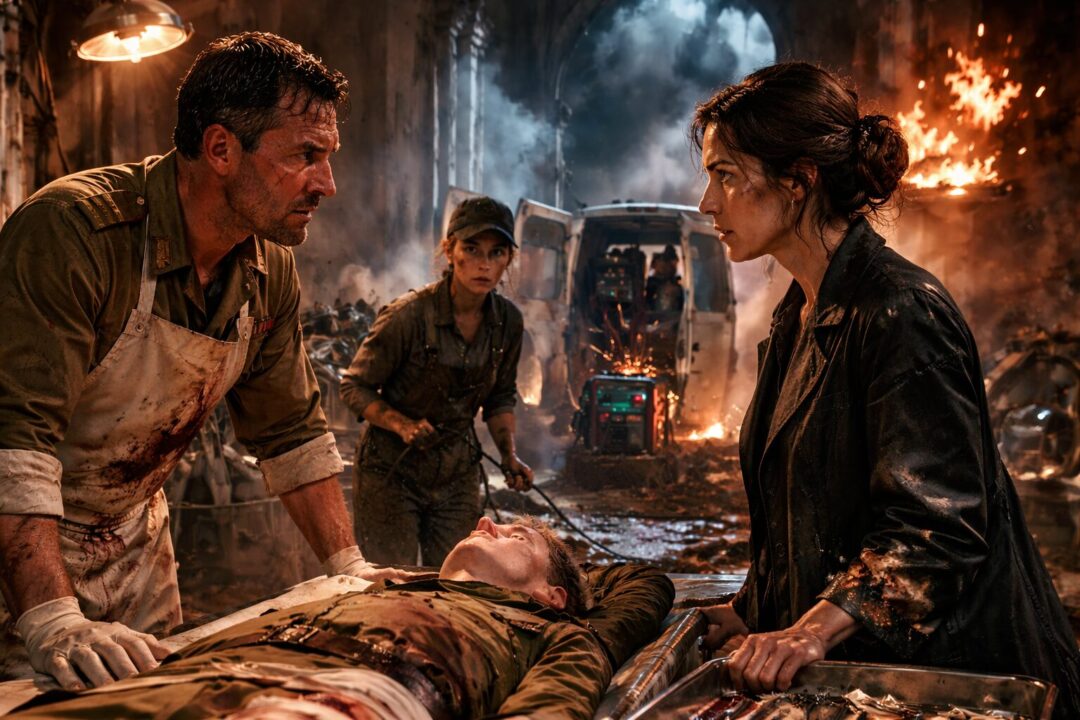
The Van That Refused Blindness
Part I — The Cut
Major Adrien Vale had already marked the young lieutenant’s leg with iodine when the truck arrived.
The tent shivered with artillery. Mud sucked at boots. Somewhere outside, a mule screamed once and then stopped. Inside, the lieutenant lay white-faced on a stained table, his hands locked around a strap while an orderly held the lantern higher. The shell fragment was somewhere above the knee. The swelling was rising. Dawn would bring another wave of wounded, and if Adrien waited too long, the boy would die with both legs attached.
“Chloroform,” Adrien said.
The orderly uncorked the bottle.
Then a woman’s voice came through the flap, sharp enough to cut canvas.
“You do not cut until I can see.”
No one in the tent moved for a second. Adrien turned, irritated before he was even curious.
She stood in the entrance in a dark coat powdered with road dust, her hair pinned badly as if it had lost a fight hours ago. She was older than the young officers and younger than fatigue made her look, with a face too gaunt for comfort and eyes that did not ask permission from rooms like this. Behind her, beyond the flap, sat an ugly van with its rear doors open and cables spilling out like exposed nerves. Its engine coughed once and died.
A girl climbed down after her—thin, oil-streaked, cap pulled low, arms already full of equipment.
Colonel Brissot appeared behind them, wet to the shoulders and in no mood to explain himself.
“This is Doctor Marianne Curel,” he said. “The unit I mentioned.”
Adrien stared at him. “You mentioned a theoretical nuisance.”
Brissot ignored that. “You will give her ten minutes.”
“I don’t have ten minutes.”
“You have my order.”
Adrien looked back at the lieutenant. The boy had heard enough to know what word had been hanging over him. Amputation changed men before it changed their bodies. Fear had already reached his face.
“Please,” the lieutenant whispered, though to whom he meant it, Adrien could not tell.
Marianne Curel stepped closer to the table. Her coat smelled faintly of rain and machine oil. “What is his name?”
“Lieutenant Luc Renard,” an orderly said.
She nodded once, as if names mattered even here. “Lieutenant Renard, I have brought an X-ray apparatus. If the fragment has missed the artery and the joint can be spared, the leg may still be spared.”
Adrien let out a tired, dangerous laugh. “If. If. If. We are not in a lecture hall.”
“No,” she said. “You are in the exact place where ignorance becomes irreversible.”
That landed hard enough that even Brissot looked away.
Adrien’s hands were already gloved. Blood had dried in the creases of his cuffs from the last three men. “And if your machine stutters? If your exposure blurs? If we lose the window because you wanted certainty where speed would do?”
Her eyes flicked to his stained apron, to the saw on the tray, then back to his face.
“Speed is not mercy,” she said. “Not when you are cutting blind.”
For one instant he wanted her gone with the force of a physical need.
Then the lieutenant made a sound no grown man should have to make, a broken little breath that dragged everyone back to the table.
Adrien stepped away.
“Ten minutes,” he said. “And if he worsens, I cut.”
The girl moved like someone who had been waiting all day for permission she was afraid of. She and Marianne began lifting equipment from the van: a portable generator, a coil of cable, a plate wrapped in cloth. The thing looked absurd in the tent—half science, half salvage. Not military enough for the army, not sturdy enough for the front. A machine built by refusal.
Adrien watched despite himself.
“What’s your name?” he asked the girl.
“Léonie Armand.”
“How long have you been doing this?”
“Long enough.”
“She means three months,” Marianne said without looking up.
Léonie shot her a wounded glare.
Adrien almost smiled. Almost.
The generator coughed, rattled, caught. For a moment the tent held two kinds of urgency: the old one of blood loss, and this new, humming one that asked everyone to wait for an answer they might not get.
Marianne bent over Luc’s leg with precise hands. “Hold him steady.”
Adrien moved in before anyone else could. If the boy died while they played at precision, he wanted to feel it happen himself.
Luc’s fingers found his sleeve.
“Will I keep it?” the boy asked.
Adrien should have said what surgeons said. We will do what we must. Instead he heard Marianne’s voice beside him, calm in a way that was almost cruel because it left no room for panic.
“We are going to find out,” she said.
The exposure took only seconds.
The waiting took much longer.
Léonie carried the plate to the van, jaw tight. Marianne followed. Rain hissed on canvas. Outside, artillery rolled low and steady like something enormous turning over in its sleep.
Adrien stood with one hand on the lieutenant’s shoulder and felt the entire tent hanging on strangers and chemistry.
Then Marianne came back with the developed image in her hand.
She held it to the lantern.
Everyone leaned.
Even Adrien.
The fragment sat ugly and clear above the knee, but not where he had feared. Close enough to maim. Not close enough to justify panic. The artery route was visible. The joint might be spared.
Marianne looked up at him.
“Now,” she said softly. “You may cut with knowledge.”
Adrien stared at the plate, then at the saw waiting useless on the tray.
Around them, the war went on making its endless argument for speed.
Inside the tent, the shape of one answer had changed.
And before he could stop himself, Adrien said the most dangerous thing a man like him could say in front of his own hands.
“Get me the finer instruments.”
Part II — Proof of Use
By sunrise the van had become impossible to ignore.
It sat outside the aid station caked in mud, rattling when it idled, one headlamp cracked, its rear compartment crowded with wires, plates, and boxes of chemicals that smelled sharp enough to wake the dead. Men coming in on stretchers stared at it the way they stared at priests—unsure whether it could save them or only pronounce something final.
Adrien told himself it was still a nuisance.
Then the second case kept an arm because of it.
Then the third died anyway.
And the fourth lost his leg with full clarity, which was somehow worse than blindness because now everyone knew exactly why it had to happen.
By midmorning Adrien had stopped calling the apparatus theatrical. He had also stopped forgiving it.
Marianne never asked for gratitude. That made her harder to dismiss. She did not hover after a good result, did not flinch after a bad one. She worked with a severe focus that made praise look irrelevant. Between exposures she mixed chemicals, recalibrated angles, and wrote notes in a pocket ledger already buckling from damp.
Léonie moved around her like a wire drawn taut—hauling crates, restarting the generator, wiping plates dry with hands gone gray at the knuckles. Once, under shellfire, she climbed half under the van to hammer something back into place while muttering that the axle would betray them all before the Germans did.
“You don’t scare easily,” Adrien said when she emerged.
She shoved wet hair off her forehead. “No.”
A shell landed somewhere farther off. The ground trembled under them.
Léonie swallowed, too fast.
Adrien noticed. He said nothing.
The cases kept coming.
A private with his forearm shredded. Marianne imaged it, and Adrien saw bone fragments laid out like spilled porcelain. He cut less than he would have.
A cavalryman with his pelvis shattered. The image proved surgery would only prolong his dying. Adrien hated her most when she was right in that direction.
A sapper no older than Léonie with metal lodged in his ankle. That one should have been easy. But the plate blurred on the first attempt, and Adrien felt vindicated so sharply it almost shamed him. Marianne looked at the result, expression unreadable, and simply said, “Again.” The second image was clean. The ankle stayed.
Every success injured Adrien in a place he had no language for.
He had not become decisive because he loved force. He had become decisive because indecision killed, and once a man had listened to someone die while he hesitated, he never forgave softness again. Yet the van stood outside and kept suggesting that some of his certainty had been made not of wisdom, but of scarcity. Not enough time. Not enough transport. Not enough light. Not enough proof.
By afternoon, Marianne found him washing blood from his hands in a basin gone pink.
“You resent the machine,” she said.
“I resent its timing.”
“It arrived late.”
“Everything arrives late.”
She studied him for a beat. “But not too late for Lieutenant Renard.”
He dried his hands harder than necessary. “One limb spared does not make a doctrine.”
“No,” she said. “Repeated limbs spared might.”
“You speak as if bodies exist to prove your point.”
“And you speak,” she said, “as if urgency excuses the price of not knowing.”
He turned on her then, quiet enough that no one else heard.
“You think I enjoy what I do? You think I amputate because I am impatient?”
Her face did not soften. He disliked her for that and trusted her more because of it.
“I think,” she said, “you have had to call necessity mercy for so long that you no longer hear the difference.”
For one ugly second he saw another tent, another night. A farm boy with a crushed lower leg and no imaging, only swelling and guesswork and blood. Adrien had cut fast. The boy had lived. Weeks later an orderly from the rear hospital sent word that the fracture line had been higher than they feared. The knee might have been saved.
Might.
That word had lived under Adrien’s ribs ever since.
He looked away before his face could answer for him.
“What do you want from me, Doctor?”
“Less contempt,” she said. “And when the image is useful, use it.”
“That all?”
“For today.”
She left him with the basin water trembling.
Toward evening the shelling eased for one dangerous hour. Men smoked where they could. Someone laughed too loudly. Far off, wagons groaned in the road.
Adrien found Marianne by the van checking a connector with a small wrench. In the fading light she looked less like a famous scientist and more like a woman who had simply refused comfortable irrelevance.
“Why are you here?” he asked.
She did not pretend to misunderstand. “Because I was tired of reading reports that said ‘limb removed’ as if the sentence had no weather around it.”
“That is not why a person comes this close to artillery.”
“My husband is dead,” she said, still working. “My laboratories remained. My lectures remained. My reputation remained. It all began to feel indecent.”
The bluntness of it made him still.
She tightened the connector. “And because if a thing can move toward suffering and does not, then its value is ornamental.”
Léonie, sorting plates nearby, had gone very quiet.
Adrien said, “You make it sound simple.”
“It is not simple. It is merely clear.”
Before he could answer, a runner arrived from headquarters, panting.
“Orders from Colonel Brissot. Major offensive at dawn. Forward routes may collapse. The mobile unit is to prepare to move closer to the line if called.”
Léonie looked up. “Closer?”
Marianne was already mentally gone, recalculating distance and load.
Adrien felt the night around them tighten.
Dawn would bring more than wounded.
It would bring a test none of them had asked for.
Part III — The Church of Broken Light
They moved before midnight.
The roads near the forward trenches had become a churned black artery of wagons, runners, mules, and stretcher teams sliding in mud. Twice the van nearly stalled. Once Léonie had to jump down into shellwater up to her calves and jam a wrench into a whining housing while Marianne held a lantern and Adrien watched the dark fields for the next flash.
The church appeared at last through smoke and rain, its bell tower half gone and its nave lit by surgical lamps hung from ropes where saints had once been.
This was the new aid point. A village church turned into a place where men arrived in pieces and left lighter.
Inside, pews had been shoved aside for stretchers. The floor was a mosaic of old stone, candle wax, mud, and blood. The altar cloth had become bandage stock. A crucifix leaned cracked against a wall, Christ tilted and still watching.
“Charming,” Léonie muttered.
Adrien almost laughed. It came out as breath.
The first new cases arrived before they were fully set.
A corporal with chest fragments—no time.
Two brothers from the same company, one screaming, one silent—too much time, not enough means.
Then, near dawn, orderlies carried in a captain clutching a leather field notebook to his chest with both hands as if it were a child.
“Engineer officer,” one orderly said. “Captain Julien Morel. Route section. Needs to speak to command. Leg hit by shell burst.”
Julien’s boot had been cut away. The knee and lower thigh were swollen grotesquely, the trouser leg stiff with black blood and road grit. He was gray with pain but still trying to keep the notebook dry.
Adrien bent over the wound and felt the situation immediately: bad placement, uncertain depth, ruin waiting under skin.
Marianne was already beside him. “Image first.”
Adrien nodded before remembering he was still supposed to resist her.
The exposure took place in the side chapel because it was the only corner dark enough to manage the plate. While Léonie worked the van and chemicals, Julien kept one hand on the notebook.
“That can come away,” Adrien said.
“No,” Julien said.
“It can and it will if you keep twitching.”
“It contains route corrections.” His voice was hoarse but steady. “If the northern bridge is gone, the withdrawal changes.”
Marianne looked at the notebook, then at him. “Let him keep it until the plate is done.”
Julien turned his head toward her properly then, and something in his face changed through the pain.
“You,” he said.
She frowned. “Captain?”
“I know your face.”
“I doubt that.”
“I attended a lecture in Paris. Before the war.” His breath hitched. “You demonstrated the instrument with your hands black from radium salts and said knowledge that stays in salons is only vanity with manners.”
Léonie glanced up, startled. Adrien looked from one to the other.
Marianne’s expression did not alter much, but the air around her did.
“That sounds like something I might have said when I was younger,” she said.
Julien gave the smallest, pained smile. “I wrote to you after. About village schools and practical science. You answered.”
Now even Léonie had stopped pretending not to listen.
Julien tapped the notebook weakly. “I kept the letter.”
Adrien saw Marianne’s composure shift, just slightly, like metal under heat.
The plate developed.
Léonie carried it in, and this time she was not trying to look fearless. “It’s clear,” she said.
Marianne held the image to the lamp.
Adrien stepped close beside her.
The shrapnel sat near the knee joint in a position that made the whole leg feel like a dare. Too hasty a cut, and they would take what might be saved. Too delicate a salvage, and they could tear the artery or lose the man to time and blood.
Julien watched their faces and understood enough.
“If you take it,” he said, eyes on Adrien, “will I still be able to walk at all?”
“With a prosthetic, perhaps.”
“That is not what I asked.”
Adrien did not answer.
Julien looked at Marianne now. “And if you try to keep it?”
She did answer. “You may die of the attempt.”
He nodded once. That was the war in one motion: the receipt of bad options.
An orderly arrived then, splattered with mud. “Colonel wants the route notebook immediately.”
Julien tightened his grip. “Not until I confirm the last mark.”
Adrien would have taken it from him. Marianne put a hand on the orderly’s sleeve instead.
“One minute.”
After the man left, Julien opened the notebook with shaking fingers. A folded paper fell partly loose from the back cover. Marianne saw her own handwriting before she saw the words.
Knowledge must travel toward need.
Just one line, scorched at the edge by time and use.
For the first time since Adrien had met her, Marianne looked unguarded.
Julien noticed and gave a grim little laugh. “I kept that one because it sounded less beautiful than the others.”
“You kept a letter through this?” Léonie asked, unable to help herself.
Julien closed the notebook. “Some people need saints. I kept instructions.”
Adrien felt it then—not romance, not sentiment, but danger of a different sort. The case was no longer only difficult. It had become personal to the one person in the room who most worshipped method.
And personal conviction had a way of dressing itself as objectivity.
Outside, the guns restarted.
Inside the ruined church, the war narrowed to one leg, one notebook, one old sentence returning at the worst possible time.
Part IV — What Mercy Costs
The shell that changed everything landed behind the church.
The blast shook dust from the fractured ceiling and punched one of the lamps dark. Somewhere in the nave a horse screamed from the road, and men shouted that the east wall had taken damage. The generator in the van coughed like a drowning man.
Léonie ran for it.
Adrien grabbed the operating tray before it skidded. Marianne steadied Julien with both hands while stone grit rained over them.
Then came the smell.
Not blood. Wiring.
Léonie was back within seconds, face pale under grime. “The tube housing took the shock. I can still draw power, but it’s bad. Very bad.”
“Can you make another exposure?” Marianne asked.
Léonie hesitated.
That alone frightened Adrien more than the shelling.
“Answer.”
“One,” she said. “Maybe. If the tube doesn’t crack. If the feed holds. If the generator doesn’t drop.”
Too many ifs. The word was back, spreading.
Colonel Brissot strode in through smoke and prayer, ducking under a hanging rope. “You have fifteen minutes. We may have to clear this place.”
Julien tried to push himself up. “The notebook—”
Brissot took it from him without ceremony. “You’ve done your part, Captain.”
That hit Julien harder than pain. Adrien saw it at once. Useful until he could no longer stand. Then divisible from the work.
Brissot looked at the image plate. “Decision, Major?”
Adrien heard himself answer with the old voice, the practical voice that had kept men alive and haunted him later. “Amputate above the knee. Fastest chance of survival under evacuation conditions.”
Julien shut his eyes.
Marianne said, “No.”
Brissot turned. “Doctor, this is now military triage.”
“This image shows a salvage path.”
“It shows risk,” Adrien snapped. “A narrow one.”
She faced him fully. “Narrow is not nonexistent.”
“Narrow is a grave if we miss.”
“And blind certainty is a grave you stop feeling responsible for.”
The words cracked between them.
Brissot had no patience left. “I did not bring you here to start a religion. Decide.”
Léonie appeared in the doorway, one hand blackened with grease. “I can force the power feed.”
Marianne wheeled toward her. “No.”
Adrien looked from one to the other. “Force what?”
Léonie swallowed. “There’s a bypass. We use the reserve coil directly. It might give one sharper exposure.”
“Might,” Adrien said.
“It could also burn the tube out completely,” Marianne said. “Or flood the compartment. Or expose anyone standing near it to far more than is safe.”
Léonie met her gaze and did not back away. “You taught me the configuration. For emergencies.”
“I taught you what not to do.”
“Yes,” Léonie said. “And now it is exactly the thing we need.”
Marianne stared at her.
The church seemed suddenly too full of every earlier argument. Evidence. Speed. Pride. Usefulness. Future soldiers none of them had seen yet. One wounded captain lying under all of it, frightened enough to be quiet.
Adrien bent over Julien’s leg again, feeling the heat in the swollen flesh, the terrible uncertainty just beyond the first image’s gift. He could amputate now and likely save the man. He could also spend the rest of his life wondering whether he had amputated because it was right or because it was simpler to bear.
He hated Marianne for giving that question a face.
“What are you choosing?” he asked her.
She did not answer at once. For the first time, Adrien saw her not as a woman of facts but as a woman trapped beyond them. If she risked the apparatus and destroyed it, men tomorrow and next week and next month would lose its use. If she saved it by yielding now, Julien would lose the leg under the protection of prudence.
Outside, another blast hit. Somewhere in the nave someone shouted, “Fire!”
Brissot said, “Enough.”
Julien opened his eyes and looked at Marianne, then Adrien. “Do not keep it for my vanity,” he said. “If the leg is gone, the leg is gone.”
That should have made it easier.
Instead it stripped the decision naked.
Adrien heard himself say, rougher than he meant to, “Saving one man at the cost of many later may just be vanity wearing mercy’s coat.”
Marianne flinched as if he had struck exactly where she was weakest.
Léonie spoke into the silence. Her voice shook. “Or maybe protecting the machine because it has a future is just another way of sacrificing the person in front of you.”
No one answered her because she was too young and too right.
Then Marianne inhaled once, hard enough to be visible.
“Do it,” she said.
“To the feed?” Léonie asked.
“Yes.”
Brissot swore under his breath.
Adrien stared at Marianne. “If this fails—”
“It may,” she said.
“That is not an answer.”
Her eyes met his, stripped now of superiority, stripped almost of certainty.
“No,” she said. “It is not. It is only the truth.”
That changed something between them. Because now she was standing where he always stood—inside a decision that could not be made clean.
Adrien looked at Julien.
The captain gave a tiny nod. Not brave. Simply consenting to the only dignity left to him.
“All right,” Adrien said. “One more image.”
The church was burning at the far transept by the time they began.
Part V — The Last Exposure
Léonie worked the bypass with hands that would not stop trembling.
She crouched by the van’s open rear compartment, jaw clenched, feeding cable into a configuration Marianne had once shown her only to forbid. The reserve coil whined. Blue sparks spat once, then disappeared. The smell of hot dust and ozone thickened.
“I’m afraid,” she said suddenly, not looking at either of them.
Marianne was beside her at once. “Good,” she said. “That means you still know what this is.”
It was not comfort. It was better.
Léonie nodded and kept working.
Inside the church, Adrien positioned Julien’s leg with brutal care while an orderly held the lamp and another tried to beat back smoke from the side aisle with a canvas sheet. Julien bit through a strip of leather and made one strangled sound when the knee was turned.
“Stay with me,” Adrien said.
“I dislike you,” Julien gasped.
“That means you are lucid.”
Marianne slid the plate under the leg. Her sleeves were rolled. Her hands were steadier than his felt.
“Ready,” Léonie called from the van.
“Everyone back,” Marianne said.
No one was truly far enough back.
The exposure cracked through the church like a white secret.
For one suspended moment the world became all edge: broken pews, blood on stone, Adrien’s scar, Marianne’s profile cut in light, Julien’s hand clawed around nothing.
Then darkness rushed in again.
Léonie did not move for a heartbeat. Then she lunged for the developing tray.
“Come on,” she whispered. “Come on.”
The church was burning more visibly now. Smoke rolled in low ribbons under the rafters. Brissot was shouting for evacuation carts. Somewhere outside, a teamster was trying to turn horses in a yard filling with wounded.
Adrien stood over Julien with all patience stripped away.
If the plate was unreadable, he would cut. There would be no third chance. Not for the image. Not for the leg. Not for any of them.
Léonie emerged with the plate in both hands.
“It held.”
Marianne took it.
Adrien stepped close enough that their shoulders touched.
The image was not perfect. It was better than enough.
The fragment sat lodged just where Marianne had believed, ugly and near disaster, but with a line—a narrow, truthful line—by which the artery could be spared if the extraction was exact.
Adrien saw the route.
He also saw how little room there was to fail.
“Well?” Brissot demanded.
Adrien did not look up. “I can do it.”
Brissot stared. “Can, or should?”
Adrien heard the old answer waiting in him and stepped around it.
“Both,” he said.
Marianne exhaled once, almost soundlessly.
Then the van gave a final metallic crack from the yard, like a bone breaking.
Léonie went white. “The tube.”
“Leave it,” Marianne said.
That cost her. Adrien heard the cost.
He scrubbed in with water already gone gray. Marianne stood opposite him, handing instruments before he asked. There was no more argument left between them, only the terrible intimacy of shared risk. Julien drifted under anesthetic, not fully under, his face twitching whenever pain found a path through.
Adrien opened the wound.
Outside, the church bells—what remained of them—gave one useless iron groan as another shell struck nearby.
He worked deeper.
The fragment appeared, then vanished behind blood. Marianne adjusted the lamp with one wrist while pressing gauze with the other. Her coat sleeve burned at the cuff from a stray ember; she did not notice.
“Here,” she said quietly. “No—left. There.”
He saw it then. Not because she replaced his judgment, but because she had taught him where not to lie to himself.
He extracted the metal.
For one terrible second nothing happened.
Then the blood flow changed.
Not gone. Not flooding.
Julien’s leg remained attached to him.
Adrien closed what he could close and bound what could be bound. Not whole. Never whole. But his.
When he finally stepped back, his shoulders felt twenty years older.
“He keeps it,” he said.
Léonie made a sound halfway between a laugh and a sob.
Then an orderly burst in coughing. “Major, fire’s in the north aisle. We have to move.”
They did.
Julien went out on a stretcher, notebook already gone to command, leg bandaged thick, one hand hanging over the side as if he still expected to reach for something he’d been forced to relinquish.
Léonie stumbled toward the van.
Marianne caught her by the arm.
“No.”
“The plates—”
“No.”
For a second Léonie looked like a child. Then she swallowed it down.
They made it into the square as flames climbed through the church roof and sparks drifted over the mud like burning insects. Behind them, Marianne’s van sat listing to one side, smoke leaking from its compartment. The feed cable had fused. Fire had caught somewhere under the rear housing.
Adrien turned in time to see Marianne stop.
It was only a machine. An ugly, improvised, rattling, insufficient thing.
It had also been her argument made visible.
She watched it burn without moving.
Léonie stood beside her, crying silently and furious about it.
Adrien did not touch either of them. Some griefs should not be interrupted.
The van gave one final collapse inward, flames licking through the frame.
Marianne’s face did not change.
Only her voice did, when she finally spoke.
“Good,” she said, though not to the fire. “It was used.”
Part VI — What Remains
Weeks later, the war had moved enough that the rear hospital felt almost civilized.
Not safe. Never safe. But farther from the constant shaking. Windows still existed here. Water came in basins without mud in it. Men learned which cries belonged to first dressing changes and which to letters from home.
Adrien crossed the courtyard between wards just after dawn and stopped without meaning to.
Three new imaging vans stood near the intake line.
None looked exactly like Marianne’s. They were cleaner, sturdier, more military in their proportions. But their doors stood open to the same purpose. Young operators moved between them with plates tucked under their arms. Orderlies had begun speaking of exposures and fractures as if the vocabulary had always belonged here.
A line of wounded men waited beside the vans, anxious and hopeful in equal measure.
Not because war had grown merciful.
Because blindness had been made slightly harder to defend.
Adrien found Marianne in the rehabilitation ward.
She looked smaller out of the front. More human, less like an intrusion. The singe had finally been cut from one side of her hair. Burn marks still traced one cuff of her dark dress. She was standing by a window, reading some report with the concentrated annoyance of a woman who still expected machinery and institutions to disappoint her on schedule.
He held out the folded paper.
“I believe this belongs to you.”
She took it and recognized the old letter at once. The edge was more scorched than before. Julien must have tucked it back into the notebook after all those years of carrying it.
“For a moment,” she said, “I thought the war had learned to return things.”
Adrien almost smiled. “Do not become superstitious.”
She opened the letter but did not yet read it. “How is he?”
“As difficult as a man can be with a cane.” Adrien glanced toward the far end of the ward. “He insists on walking more than permitted.”
Marianne looked.
Julien was between the parallel bars, one hand white-knuckled on the rail, the other gripping his cane. The bad leg trembled with every inch. He moved like a man negotiating with a body he had not forgiven and no longer wished to lose. Each step hurt. Each step was still a step.
Not whole.
Not ruined.
He looked up then and saw them. He did not wave. He only inclined his head, once, with an awkward dignity that belonged to survivors and men who had nearly been reduced to function.
Marianne folded the letter again with care that was almost reverence and almost embarrassment.
“I was wrong about one thing,” she said.
Adrien waited.
“I thought the machine had to survive for the work to matter.”
He looked back toward the courtyard, where orderlies were already moving a new plate into place while a young surgeon leaned over it, learning.
“It did survive,” he said. “It simply became plural.”
That made her laugh, once, softly and without defense.
Léonie burst in from the corridor before the quiet could settle too deeply. She was carrying a box of fresh plates and still walked as if every doorway were too slow for her. She had grown no less thin. She had only become more certain in the way frightened people sometimes do after discovering fear doesn’t kill them.
“They’ve assigned me to train two more operators,” she announced. “Both boys. Both useless. One thinks wires obey him if he shouts.”
“Do they?” Adrien asked.
“Not unless they are French.”
Marianne shook her head. “Be kind.”
“I am kind,” Léonie said. “I have not killed either of them.”
She caught sight of the letter in Marianne’s hand and fell quiet.
Julien took another step between the bars. Slower now. Careful. The cane clicked against the floor.
Adrien felt, with a strange and unwelcome clarity, the shape of what had changed.
Not the war. The war remained itself.
Not medicine entirely. Men would still be cut too soon and too late and for reasons no apparatus could solve.
What had changed was smaller and more dangerous than progress. A new standard had entered the room. A harder question. A thing future surgeons would have to live with once they knew that some ignorance had been optional.
Marianne seemed to feel it too.
She tucked the letter into her pocket. “There will be resistance,” she said.
“There already is,” Adrien replied.
“Yes.” Her eyes went to the courtyard vans. “But now resistance must work harder.”
Léonie snorted. “Good.”
Julien reached the end of the bars and stood there breathing hard, one hand trembling on the cane. A nurse moved toward him. He waved her back and turned on his own, imperfectly, stubbornly, beautifully enough.
Adrien looked at Marianne then.
No apology passed between them. No grand statement. Nothing so tidy.
Only the knowledge that on one burning night, each of them had stepped out of the safety of their own certainties and found the other standing there too.
It was not love. It was not peace.
It was rarer than either at the front.
Respect paid for in flesh.
Outside, another van door swung open.
Inside, Julien took another painful step.
And Marianne, watching him, pressed her fingertips once against the folded letter in her pocket as if to confirm that the sentence she had written years ago had finally reached the place it was meant for.
Knowledge must travel toward need.
Now it had.
And it would keep going without asking who first carried it there.