The Weight He Threw Away
Part I — Dust on the Bag
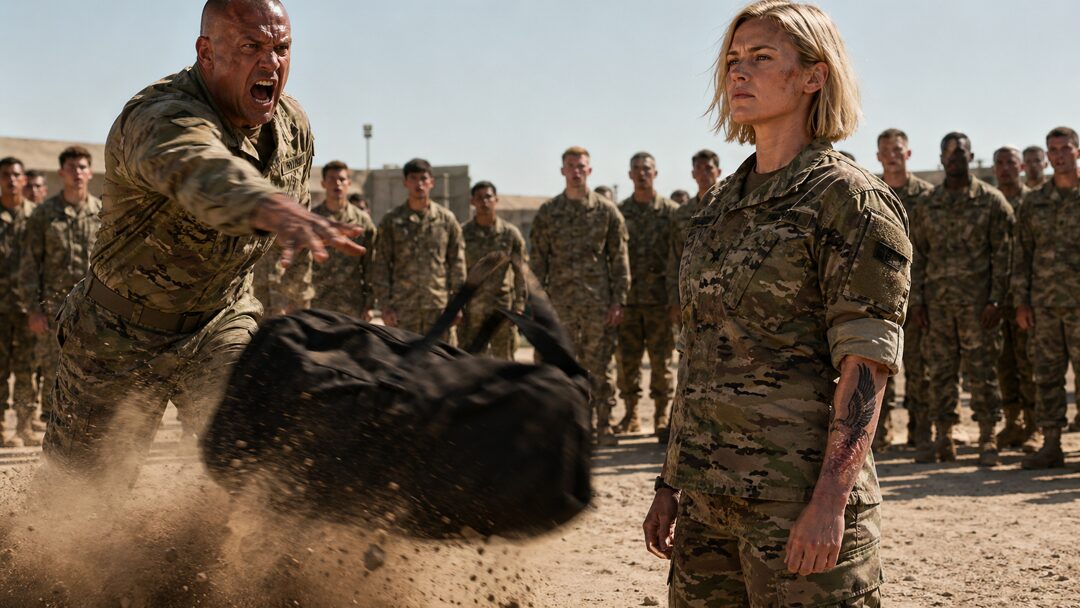
The gear bag hit the dirt so hard the recruits in the front rank flinched.
It skidded once, rolled against Captain Mara Venn’s boot, and stopped there with dust rising off its black canvas seams. For a second no one breathed. Forty soldiers stood in formation under the white heat of the training yard, eyes locked forward, throats dry, sweat running down their collars.
Master Sergeant Calder Holt stood over the bag like he had killed something.
“This,” he said, loud enough for the farthest recruit to hear, “is what broken soldiers carry when command lets sentiment outrank discipline.”
Mara did not bend down.
She did not look at the recruits.
She looked at the dirt on the bag.
Then she looked at Holt.
He was built like the field itself—broad, sun-burned, hard-packed, with a shaved head and hands that were always tightening around something. Straps. Buckles. Rifles. Other people’s silence.
The recruits knew his reputation before they knew his voice. Holt made soldiers out of soft bodies. Holt broke excuses. Holt had trained officers who now commanded companies, convoys, entire border sectors.
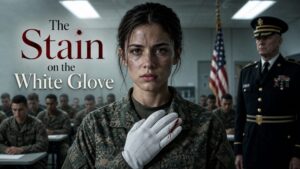
And Captain Venn had arrived three days ago with a medal on her record, a scar on her arm, and a quiet that made everyone uneasy.
Private Niko Saye watched from the second row.
He was supposed to stare past her shoulder at nothing. That was what recruits did when senior instructors decided to destroy someone in public. They became furniture. They became fence posts. They became dust.
But Niko looked.
He saw Mara’s blonde hair cut blunt at her jaw. He saw the clean line of her uniform, precise without vanity. He saw her hand hanging loose by her side, close to the thrown bag but not touching it.
Not scared.
Not angry.
Worse.
Still.
Holt took one step closer to her. “Captain Venn has been assigned to observe today’s readiness inspection. Observe. Not instruct. Not correct. Not infect this platoon with whatever she carried back from Glasshouse.”
A few recruits shifted at the name.
Operation Glasshouse was not taught in detail. It moved around the base as a half-story, a closed file with teeth. A failed extraction. Three dead. Citations issued. Survivors reassigned.
Mara’s face did not change.
Holt pointed at the bag. “Repack it. Leave my field.”
The word my landed harder than the bag.
Mara’s gaze slid from his face to the line of recruits and back again. She gave no speech. She made no show of outrage. She only lifted her left hand and began rolling back her sleeve.
The motion was slow enough to make the whole yard lean toward it.
Cloth folded once.
Then again.
A scar appeared first, pale and raised along her forearm.
Then the tattoo: three small coordinates inked in dark blue, and below them, a broken wing.
Holt’s jaw flexed.
Niko saw it. So did others. Something in the master sergeant had changed before Mara even spoke.
She rested her bare forearm against her side.
Then, evenly, she said, “Pick. My. Gear. Up.”
The words were not loud.
They did not need to be.
They moved through the formation like a wire pulled tight.
Holt stared at her.
For the first time since the bag left his hand, he looked less like a man punishing weakness and more like a man who had stepped on a buried mine.
“This is my field,” he said.
Mara’s eyes stayed on him. “Then you should know what you threw on it.”
His nostrils flared. “You are not in command here.”
“No,” Mara said. “But that bag contains inventory not cleared for public handling. If you want to use it as a lesson, open it. Name each item.”
The recruits waited.
The dust kept rising.
Holt did not reach for the bag.
Mara let the silence expose him.
Niko felt something crawl under his ribs. He had seen men shout before. He had seen men win arguments by being bigger, louder, older, striped with rank. But he had never seen a person take power by refusing to move.
Holt’s voice dropped. “Careful, Captain.”
Mara looked down at the bag again.
“When I am careless,” she said, “people die.”
No one in formation moved.
Holt’s face hardened, but his eyes went briefly to her tattoo.
Coordinates.
Broken wing.
Something remembered.
Something he wanted buried.
A vehicle door slammed beyond the barracks. Boots crossed gravel. The recruits did not turn, but Holt did.
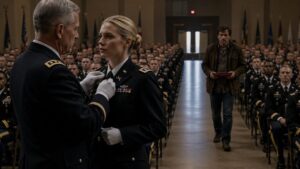
Colonel Anika Rusk entered the yard with two staff officers behind her and no hurry in her stride. Her iron-gray hair was pinned so tightly it looked painful. Her uniform was immaculate. Her eyes took in the bag, Mara’s sleeve, Holt’s posture, and the watching platoon in one quiet sweep.
“Master Sergeant,” she said.
Holt straightened. “Colonel.”
“Captain Venn.”
Mara did not salute. Neither did Holt. Not yet. The moment had not decided what it was.
Rusk stopped beside the bag.
For a second Niko thought she might pick it up herself.
Instead she looked at Mara.
“My office,” she said.
Mara rolled her sleeve down.
The tattoo vanished.
The bag stayed in the dirt.
And Niko understood, with a recruit’s sudden animal certainty, that no one had thrown a bag at Captain Venn by accident.
Part II — The Closed File
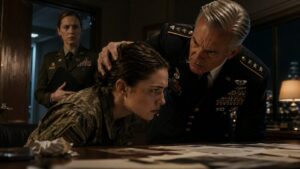
Colonel Rusk’s office was cool enough to feel like a different country.
Mara stood in front of the desk with her hands at her sides while Rusk read a folder she already knew by heart. The blinds were half-closed. Outside, Holt’s voice carried faintly across the yard, rebuilding order one bark at a time.
Rusk did not offer Mara a chair.
“You were instructed to observe,” she said.
“I observed.”
“You challenged a senior instructor in front of a platoon.”
“He threw military property into the dirt.”
Rusk looked up. “That is not why you challenged him.”
Mara said nothing.
The colonel closed the folder. On its tab, in black block letters, was written: GLASSHOUSE, OPERATIONAL REVIEW.
Some words did not need volume to become threats.
“Holt filed a readiness concern before you arrived,” Rusk said. “His assessment was that your presence in a live training environment could confuse recruits about command discipline.”
“He means I remember what he said on the radio.”
“He means,” Rusk corrected, “that after Operation Glasshouse, you became fixated on Specialist Ellery Dace’s recovered belongings.”
Mara’s fingers curled once, then relaxed.
Rusk saw it.
The colonel saw everything. That was part of the problem.
“The file is closed,” Rusk said. “The dead have citations. Their families have letters. The living have assignments.”
“Does the file include Holt’s last radio order?”
Rusk was silent too long.
Mara almost smiled. Almost.
Rusk placed both hands flat on the desk. “You are decorated, Captain. You are also under review. That combination gives you less protection than you think.”
“I’m aware.”
“If you challenge Holt publicly again, you will lose the only reason you were permitted on this base.”
Mara’s eyes shifted to the window, toward the yard she could not see from here.
“The recruits,” she said.
“And the bag,” Rusk added.
There it was.
Not gear. Not evidence. Not property.
The bag.
Rusk lowered her voice. “Do not mistake restraint for permission. Specialist Dace’s effects remain under command authority until final transfer.”
“To archives.”
“To the Army.”
“He was already in the Army.”
The sentence left Mara before she could soften it.
Rusk’s face did not change, but something old moved behind her eyes. Irritation, maybe. Or recognition.
“You think I do not know what it costs to leave people behind?” Rusk asked.
Mara met her gaze. “No, ma’am. I think you know exactly what it costs. That is why you keep asking other people to pay it quietly.”
For a moment the air-conditioning seemed too loud.
Then Rusk reopened the folder.
“You are dismissed.”
Mara saluted.
Rusk returned it.
Neither woman looked relieved.
Outside, the platoon had been released to water and shade. Niko stood near the equipment racks with a clipboard he had been given after Holt caught him watching too closely.
“Inventory duty,” Holt had snapped. “Since your eyes are so hungry, feed them numbers.”
So Niko counted helmets, straps, med packs, practice tourniquets, dummy radios, and waterlogged sandbags.
He did not count the black gear bag.
It had been moved to the equipment bay, set on a metal table under a humming light.
No one touched it.
By evening, the yard turned orange and the barracks settled into the restless quiet of men and women too tired to sleep cleanly. Niko should have finished inventory and left.
Instead, he heard water running.
He followed the sound to the back of the bay.
Captain Venn stood alone at the table, cleaning dust from the bag with a damp cloth.
Not scrubbing.
Not polishing.
Cleaning, like dirt had no right to stay.
Niko froze.
Mara did not look up. “Private Saye.”
His stomach dropped. “Ma’am.”
“You were assigned inventory, not haunting.”
“I was just—”
“Watching,” she said.
He swallowed. “Yes, ma’am.”
She wrung the cloth into a bucket. Dust turned the water brown.
Niko should have left. A smarter recruit would have left. His brother would have told him to leave. His brother, Jonas, who had come home from deployment with both legs and no laugh, would have said: When officers are quiet around a thing, don’t stand near the thing.
But Niko looked at the bag.
There was a faded seam inside the open strap.
A name had been stitched there in block letters, worn pale by weather and handling.
DACE, E.
“That isn’t yours,” Niko said before he could stop himself.
Mara’s hand paused.
“No.”
The bay hummed.
Niko felt the room shrink around that single name.
“Who was he?”
Mara folded the cloth once. “A soldier who kept asking whether anyone was coming back for him.”
The words were simple.
That made them worse.
Niko thought of Jonas sitting at their mother’s kitchen table, holding a coffee mug until it went cold, staring at the backyard fence like it had given him orders.
“Was he abandoned?” Niko asked.
Mara turned then.
Not angry.
Not kind.
Tired in a way no recruit had earned the right to see.
“Words like that,” she said, “are decided by people who were not there.”
Niko looked down.
On the table beside the bag sat three things removed from its outer pocket: a cracked field compass, a folded strip of cloth stained brown at one edge, and a small photograph sealed in plastic. He could not see the picture clearly. Only the shape of a young man’s grin and someone’s hand lifted beside him, blurred by sun.
Mara put the photograph back.
Niko noticed she did not look at it for long.
“Why keep it?” he asked.
Her answer came after a long moment.
“Because they kept the report.”
Niko did not know what to say to that.
The bay door opened behind them.
Holt stood in the doorway.
His gaze went first to Niko, then to Mara, then to the bag.
“Private,” he said, “you are very confused about where you are allowed to be.”
Niko snapped straight. “Master Sergeant.”
“Out.”
Niko moved.
As he passed Holt, he heard the master sergeant speak low enough that only Mara was meant to catch it.
“You keep putting that boy near ghosts, Captain, and you’ll make one of him too.”
Mara’s reply followed Niko into the dark.
“You already tried that once.”
Part III — One Voice on the Radio
The next morning, Holt found Mara before formation.
The yard was empty except for heat, dust, and the long shadows of obstacle frames. Mara was checking medical training kits at the edge of the field, each clasp opened and closed with the same steady pressure.
Holt stopped five feet from her.
No recruits.
No colonel.
No audience to dominate.
Without them, he looked older.
“You think I enjoyed that order?” he asked.
Mara closed another clasp. “I think you survived it.”
His mouth tightened. “So did nineteen others.”
She looked up.
There it was. The number he carried like a shield.
Nineteen breathing men.
Holt stepped closer. “Glasshouse was collapsing before we reached the relay station. North route burned. South route mined. Air support scrubbed. We had wounded already bleeding into their boots. Dace was cut off, and every minute we waited gave the ridge another shot at us.”
Mara listened.
That was what disturbed him most.
She always listened as if every word could be entered into evidence.
“You know what triage is,” Holt said. “You know better than anyone.”
“I know triage.”
“Then stop dressing it up as murder.”
Mara’s eyes sharpened, but her voice stayed level. “I zipped three bags after Glasshouse. Don’t tell me what I dress.”
Holt looked away first.
Only for a second.
But it happened.
Mara picked up a practice bandage and rolled it tight. “You made a battlefield decision. I never denied that.”
“You’ve denied it every day since.”
“No. I denied the lie after.”
Holt’s jaw flexed.
Mara stepped toward him now, not enough to threaten, only enough to make him stop using distance as rank.
“You did not order withdrawal after Dace died,” she said. “You ordered withdrawal while he was still transmitting.”
Holt’s face went hard. “You think one voice on a radio outweighs twenty breathing men?”
“No,” Mara said. “I think you made the choice and then punished everyone who remembered it.”
That landed.
He did not shout.
For once, he did not shout.
His hands moved at his sides as if searching for straps to tighten. “You weren’t carrying the whole unit.”
“I was carrying the radio.”
“Then you heard what I heard.”
“Yes.”
“You heard him slipping.”
“Yes.”
“You heard the ridge fire closing.”
“Yes.”
“You heard men beside you begging me to move.”
“Yes.”
His voice cracked into anger then, because anger was easier ground. “Then don’t stand there with clean hands.”
Mara looked at her palms.
Sun-browned. Scarred at the knuckles. Steady.
“My hands aren’t clean,” she said. “That’s why I don’t throw other people’s dead into the dirt.”
The first recruits began appearing at the far edge of the yard.
Holt saw them.
The mask returned, fast and practiced.
“Live field exercise at 0900,” he said. “You will observe.”
Mara picked up the medical kit.
Holt turned away.
Then stopped.
“Captain.”
She waited.
“If you cannot tell the difference between a training casualty and a memory, you will remove yourself from my field.”
Mara’s grip tightened once around the kit handle.
Then loosened.
“I know the difference,” she said.
Holt did not look back.
“Prove it.”
By 0900, the recruits were sweating through a simulated extraction drill on the lower training range. Dust stuck to their necks. Their rifles were unloaded training pieces; their radios were dummy units; their panic, however, was real enough.
Niko had been assigned to Second Squad.
He kept his eyes forward.
He failed.
He saw Mara at the edge of the range, arms folded, sleeve down over the tattoo.
He saw Holt watching her more than the recruits.
That was when he knew the drill was not for them.
“Contact left!” Holt barked.
The squad dropped, moved, shouted, reorganized. The exercise was rough but controlled until Holt pointed at Niko.
“Saye. You’re hit. Down behind the barrier.”
Niko obeyed, dropping behind a low concrete wall thirty yards from his squad. Dust filled his mouth.
“Leg wound,” Holt called. “Separated casualty. Squad leader, continue objective.”
Second Squad hesitated.
Their leader, Corporal-in-training Jessup, looked from Niko to the target marker ahead.
“Continue objective,” Holt repeated.
Jessup’s throat worked. “But casualty recovery—”
“Objective first. Move.”
Niko lay on his back, staring at the sky.
His heart had begun to hit too fast.
This was pretend.
The dust was pretend. The wound was pretend. The training rifle across his chest was pretend.
But Mara had gone completely still.
Holt’s voice cut across the range. “Captain Venn, do you have a correction?”
Every recruit heard the trap.
If Mara intervened, Holt would say she had broken the exercise because she could not bear the echo.
If she stayed silent, Niko would be left in the dirt.
Not really.
But enough.
Mara walked onto the range.
Slowly.
Holt’s mouth tightened with satisfaction.
She did not look at him.
She looked at Jessup. “State your mission objective.”
Jessup blinked. “Secure the marker and extract personnel, ma’am.”
“Personnel includes whom?”
Jessup’s eyes flicked to Niko.
“Everyone assigned to the squad.”
“Is the casualty outside the mission?”
“No, ma’am.”
Holt stepped in. “The squad leader has been given an order.”
Mara did not turn. “Then he should understand it.”
The recruits stared at Jessup.
Mara’s voice remained calm. “Does abandoning your casualty preserve the mission, or hide the fact that the mission plan failed?”
Jessup looked trapped.
Niko could hear his own breathing in the dust.
Holt’s voice sharpened. “This is not a debate hall.”
“No,” Mara said. “It is a field. People die when soldiers learn slogans instead of judgment.”
Holt moved toward her. “You are contaminating the exercise.”
“No. I’m asking whether they know what they are obeying.”
The squad was silent.
Then Niko, still lying behind the barrier, spoke before fear could stop him.
“Are we training to leave him,” he called, “or training to tell ourselves we had no choice?”
The yard went dead quiet.
Niko knew immediately that he had crossed a line.
But no one laughed.
No one corrected him.
Even Jessup stared at the ground as if the dirt had asked the question first.
Holt’s face flushed dark.
“Exercise terminated,” he snapped. “Everyone on your feet.”
Niko stood.
His knees shook.
Mara looked at him once.
Not with approval.
With warning.
Truth was not a medal.
It was weight.
And now he had touched it.
Part IV — The Name Inside the Strap
Colonel Rusk arrived before the recruits finished forming up.
No one had called her in front of Niko. That meant someone had called her before the drill even began. Or she had been waiting for it to go wrong.
That frightened him more.
Rusk crossed the range with her staff behind her and stopped between Holt and Mara.
“What happened here?” she asked.
Holt answered first. “Captain Venn undermined a live exercise and invited recruits to question lawful command decisions.”
Mara said, “Master Sergeant Holt designed a drill to reenact a casualty abandonment from a closed operation.”
Rusk’s eyes moved to Niko.
He wanted to disappear into his boots.
“Private Saye,” she said, “were you instructed to act as casualty?”
“Yes, ma’am.”
“Did Captain Venn instruct you to disobey?”
“No, ma’am.”
“Did Master Sergeant Holt?”
Niko’s throat tightened.
The whole formation waited.
Holt’s stare pressed against the side of his face.
Niko thought of Jonas again. His brother at the kitchen table, saying nothing for so long that silence became another family member. Niko had joined the Army to understand what had taken him. Now he was beginning to.
“He instructed the squad to continue the objective,” Niko said. “Ma’am.”
Rusk held his gaze one second longer.
Then she turned to Mara. “You will surrender Specialist Dace’s effects immediately.”
The words changed the air.
Until then, most recruits had only guessed.
Now they knew the bag had a name attached to it.
Mara’s face did not move. “No, ma’am.”
Holt made a sound under his breath.
Rusk’s voice dropped. “Captain.”
“With respect,” Mara said, “no.”
“There are consequences to refusing a direct order.”
“Yes, ma’am.”
“Do not make a martyr of yourself over a bag.”
Mara’s gaze sharpened. “I’m not the one who made him small enough to fit in one.”
No one moved.
Rusk’s face went very still.
Holt stepped toward the equipment table at the edge of the range, where the black bag sat waiting after morning inventory. Perhaps he meant to end the scene by force. Perhaps he only needed his hands on something again.
Either way, the movement looked too much like yesterday.
The same man.
The same bag.
The same field.
But the recruits were not the same witnesses now.
They knew the name.
Holt reached for the strap.
Mara’s voice stopped him.
“If you want to take it,” she said, “pick it up correctly.”
His hand hovered.
“Read the name,” she continued. “Then say what happened at the relay station.”
Holt turned.
His face had gone hard in the old way, but the hardness was working harder now.
Rusk said, “Captain Venn, enough.”
Mara did not look at her.
Holt said, “You do not get to put a battlefield on trial in front of children.”
“They are soldiers,” Mara said. “You keep saying that when you want obedience.”
Holt’s eyes flashed. “You want the truth?”
“No,” Mara said. “I want you to stop being afraid of one piece of it.”
That was the line that reached him.
Not because it was loud.
Because it was exact.
Holt looked back at the bag.
The black canvas still held dust in the seams no matter how much Mara had cleaned it. The strap lay twisted open, and from where Niko stood, he could see the pale stitching inside.
DACE, E.
Holt saw it too.
His hand closed around the strap, then froze.
For a moment, his face lost rank, lost anger, lost the practiced contempt he used like armor. He looked older than forty-six. He looked like a man hearing a voice through bad radio static.
Mara stepped closer.
The recruits seemed to breathe as one.
Her voice came softer than it had the day before.
“Pick. My. Gear. Up.”
This time, it did not sound like a challenge.
It sounded like a burial detail.
Holt’s hand tightened.
The bag lifted slowly from the table.
Not by one strap.
Both hands.
Under the weight.
No one spoke.
Holt looked at the name stitched inside the canvas, and when he finally opened his mouth, the words came out rough.
“Specialist Dace transmitted after the station was marked lost.”
Rusk’s eyes closed for half a second.
Mara did not move.
Holt swallowed.
“That was not included in my final field note.”
That was all.
No apology.
No confession big enough to clean the ground.
No speech to make the recruits forgive him.
But the sentence stood in the field like a door forced open.
Niko felt the meaning before he understood the procedure. The report had not only been incomplete. It had been shaped. A living voice had been filed under lost station. A choice had been made, and then the record had been taught to look away.
Mara’s face changed only slightly.
It was not victory.
Niko knew that at once.
Victory would have looked lighter.
This looked like hearing a name spoken from underwater.
Rusk turned to her staff officer. “Record that statement.”
Holt looked at her sharply.
Rusk’s expression gave him nothing.
“Ma’am,” the officer said, shaken.
“Now,” Rusk said.
The staff officer wrote.
The recruits watched.
Holt still held the bag.
For once, he did not seem to know where to put his hands.
Mara reached out.
Not to take it.
To steady the bottom where the canvas sagged.
For one breath, both of them held the weight.
Then Holt let go.
Part V — What the Living Carry
Captain Mara Venn was removed from field instruction before dinner.
The official language was temporary reassignment pending review.
The unofficial language moved faster: Venn had challenged Holt; Holt had admitted something; Rusk had opened a supplemental note; nobody knew what it meant; everybody knew it meant something.
By morning, the recruits had a new block added to their schedule.
After-Action Ethics: Communication Failure During Casualty Extraction.
No one said Dace’s name on the printed sheet.
Everyone knew whose absence had written it.
Holt still ran drills. He still corrected posture, timing, grip, spacing. His voice still crossed the yard like thrown gravel. But something in him had lost the pleasure of impact.
He did not touch anyone’s gear.
When a recruit dropped a pack crooked in formation, Holt stared at it for a long second.
Then he said, “Fix it.”
That was all.
Colonel Rusk did not apologize to Mara. She did not call her brave. She did not offer comfort disguised as respect.
She signed the transfer order herself.
At the motor pool, under a sky the color of hot metal, Mara loaded one duffel into the back of a transport truck. The black gear bag sat beside her boot.
Clean now.
Mostly.
Dust still lived in the seams.
Niko found her there with his cap in his hands and no permission to be anywhere near her.
Mara did not look surprised.
“You have a talent for being where discipline says you shouldn’t,” she said.
“Yes, ma’am.”
“That is not always a virtue.”
“I know.”
“Do you?”
He looked toward the training yard.
Second Squad was forming near the obstacle frames. Jessup had overloaded his pack again. Another recruit noticed and stepped behind him, lifting the bottom so Jessup could tighten the strap before Holt saw.
A small thing.
A nothing thing.
Except yesterday, Niko might have watched and stayed still.
Mara followed his gaze.
For the first time since he had met her, something in her face eased.
Not much.
Enough.
Niko looked at the bag. “Was it worth losing the field?”
Mara bent and picked it up.
Both hands first.
Then she settled the strap over her shoulder.
The weight pulled her slightly to one side, but she adjusted without complaint.
“I didn’t lose it,” she said.
Niko waited.
Mara nodded toward the recruits.
“They heard.”
Across the yard, Holt barked an order. The squad moved. Jessup’s pack stayed secure.
Niko looked back at Mara’s sleeve. It had ridden up as she lifted the bag. The coordinates showed again, dark over the scar. The broken wing pointed toward her wrist.
“What are the numbers?” he asked.
For a moment he thought she would not answer.
Then she said, “A place we stopped calling a place.”
The truck engine coughed awake.
Mara climbed into the passenger seat with Dace’s bag held close against her knees, not hidden, not displayed.
Before the door shut, Niko stepped back and saluted.
This time, he did not do it because she was an officer.
Mara returned the salute.
The truck rolled out past the training yard, past the racks, past the field where a bag had struck dirt and made forty soldiers flinch.
Niko watched until it reached the gate.
He imagined Specialist Ellery Dace as a name in a strap, a voice on a radio, a photograph sealed in plastic, a soldier made small by paperwork and large again by one person refusing to let him disappear quietly.
The truck turned.
For an instant, sunlight caught the dusty seams of the bag through the open window.
Then it was gone.
Behind Niko, Holt shouted for the platoon to reset.
Niko turned back with the others.
He lifted his pack.
He checked the strap of the recruit beside him.
And when the order came to move, he moved carrying more than he had been issued.