Three Oranges
Part I — The Question on the Table
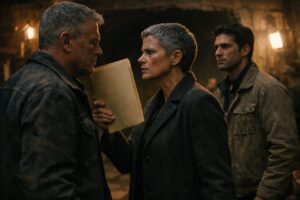
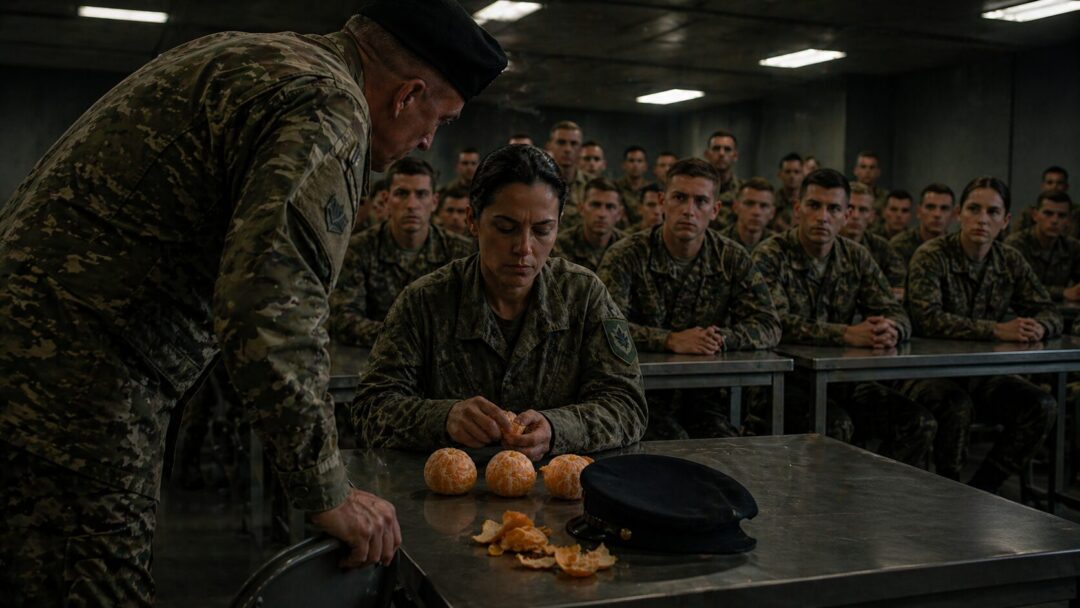
Mara Venn had peeled two oranges before Colonel Rusk put his hand on the back of her chair and asked, loud enough for the whole mess hall to hear, “How many did you leave behind?”
The room went so quiet that someone’s fork struck a tray and sounded like a dropped shell casing.
Mara did not look up.
Her thumbs worked under the skin of the third orange, finding the seam, pulling the peel back in one clean strip. The fruit was small and bruised from the crate by the serving line. Its oil shone on her fingertips. In front of her, two peeled oranges sat beside a pile of rind, arranged with the care of something counted.
Beside them sat Rusk’s black service cap.
He had placed it there himself when he leaned over her. Not tossed. Not dropped. Placed. The way officers placed things when they expected the world to organize itself around them.
“Sergeant Venn,” he said, bending closer. “I asked you a question.”
Mara’s field jacket was old enough that the elbows had gone pale. Her dark hair was pulled tight at the back of her head. On her left shoulder, above the seam, a faded patch showed a glass-green branch stitched through a circle of gray.
Most of the recruits knew that patch.
Everyone at Fort Vale knew it, even if they pretended they did not.
Operation Glass Orchard had become one of those stories soldiers told carefully. Never first. Never in full. Never when a senior officer was listening.
Mara Venn had gone in with a unit.
Mara Venn had come out alone.
That was the part everyone knew.
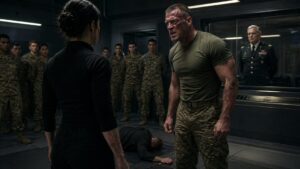
Colonel Harlan Rusk stood behind her with his broad chest nearly touching her shoulder. He wore fresh camouflage, polished boots, and the blank, hard face of a man who had never had to raise his voice twice. His forearms were heavy with muscle. His hair was clipped so close it looked carved into his skull.
He looked around the dining hall and smiled without warmth.
“You all know why Sergeant Venn has been reassigned to training command?”
No one answered.
Rusk straightened, one hand still hooked over the back of Mara’s chair.
“This morning she was scheduled to lecture you on survival ethics.” He let the words hang, then gave a short laugh. “I thought we might improve the lesson.”
Across the room, Private Jonah Ellis stopped chewing.
He was three weeks into training, still young enough that his uniform seemed to wear him instead of the other way around. He sat at the end of the nearest table, narrow-faced and alert, watching Mara’s hands because her face gave him nothing.
She was not pale.
She was not shaking.
She was peeling the orange as if Rusk were weather.
“That’s what makes Sergeant Venn useful,” Rusk said. “She is a living lesson. Talent without loyalty. Instinct without obedience. Survival without honor.”
A few recruits looked down at their trays.
One man near the drink machine shifted, then stopped when Rusk’s eyes moved toward him.
Mara separated the final orange from its peel. She placed the peel beside the others.
Three oranges. Three skins. Rusk’s cap.
Jonah did not understand why that made the room feel worse.
Rusk leaned down again.
“How many?”
Mara’s thumb pressed lightly into the orange.
A drop of juice beaded on her knuckle.
She said nothing.
Rusk smiled wider.
“You see that?” he asked the recruits. “That is discipline when it serves herself. Not when it serves the mission. Not when it serves the wounded. Herself.”
Mara lifted one segment from the orange and set it apart from the rest.
It was such a small movement that it should not have mattered.
But it did.
Jonah saw Corporal Dane Ilya watching from the wall near the exit. Dane had a shaved head, a scar cutting pale through his jawline, and the stillness of someone who had already decided not to be noticed. His arms were folded across his chest. His eyes were on the oranges.
Not on Rusk.
On the oranges.
Rusk saw it too.
His hand came forward and picked up one of the curled peels.
Mara flinched.
It was barely anything. A breath caught and gone. Her shoulders stayed level. Her face did not change. But Jonah saw it, and once he saw it, the whole room changed shape around that tiny break.
Rusk held the peel between two fingers.
“This is what she does,” he said. “She peels fruit for ghosts.”
Mara looked up then.
Only at the peel.
Not at him.
Rusk’s smile thinned.
“Tell them, Sergeant. Tell these recruits about Glass Orchard. Tell them how men bled in dust while you sat with your rations and waited for a cleaner way out.”
Mara extended her hand.
Quietly.
The gesture was not pleading. It was not afraid.
It simply said: give it back.
For the first time since entering the hall, Rusk seemed annoyed.
He dropped the peel onto the table.
Mara picked it up and placed it with the others, aligning the broken edge to the curve it had come from.
That was when Jonah understood one thing with absolute certainty.
Whatever the official story was, it had missed something important.
Part II — Survival Ethics
Rusk began walking.
He moved between the tables like the room belonged to him because, in every practical way, it did. Recruits sat straighter before he reached them. Conversations died before his boots arrived. Even the cooks behind the serving counter kept their eyes down.
“Private,” he said, stopping beside a broad-shouldered recruit two seats from Jonah. “What does a soldier owe the chain of command?”
The recruit swallowed. “Obedience, sir.”
“Louder.”
“Obedience, sir.”
Rusk nodded as though accepting a tribute.
He turned to another. “What does a soldier owe the wounded?”
The second recruit looked at Mara before he answered, which was a mistake.
Rusk’s jaw shifted.
“The wounded,” the recruit said quickly, “are not abandoned, sir.”
“Correct.”
Mara separated another segment of orange.
Jonah watched her line the segments in a crescent near the cap. She was building something small and exact while Rusk built a gallows around her.
Rusk turned again.
“What does a soldier owe the truth?”
No one answered fast enough.
He let the silence embarrass them.
Then he stopped in front of Jonah.
Jonah felt his stomach tighten.
Rusk’s shadow covered his tray.
“Private Ellis, is it?”
“Yes, sir.”
“What does a soldier owe the truth?”
Jonah knew the correct answer was not complicated. It was printed in manuals, carved into speeches, painted on walls near administrative buildings.
But across the table Mara’s hands had stilled.
The third orange sat open beneath her fingers.
Jonah said, “A soldier owes the truth to the mission, sir.”
Rusk studied him.
It was not the answer he wanted. It was close enough to be dangerous.
“To the mission,” Rusk repeated. “Not to himself?”
“No, sir.”
“Not to his feelings?”
“No, sir.”
“Not to whatever private little story helps him sleep?”
Jonah’s throat dried.
“No, sir.”
Rusk turned back toward Mara.
“Do you hear that, Sergeant? Three weeks in, and he understands what you forgot.”
Mara’s gaze remained on the orange.
Rusk returned to her chair and bent low again, his voice dropping but not enough to become private.
“You were given a signal chain. You were given extraction orders. You were given coordinates. You were given authority to relay, not interpret. And when wounded men needed you, you decided you knew better than command.”
Something moved in Dane’s face.
Not a lot.
Just enough.
Jonah saw the scar on his jaw pull tight.
Mara wiped juice from her thumb with the side of her finger.
Rusk noticed.
“Still nothing?” he asked. “No defense? No confession? No names?”
Mara lifted one orange segment and held it for a moment.
Jonah expected her to eat it.
She did not.
She placed it beside the cap.
Rusk gave a hard laugh.
“You remember fruit, but not men.”
Several recruits looked away.
The line was cruel enough that even obedience could not make it comfortable.
Mara looked at Rusk’s cap. Its brim touched the first orange segment.
“Move your cap,” she said.
Her voice was low.
The room heard it anyway.
Rusk’s face changed. Not anger first. Surprise.
Then anger.
“What did you say?”
Mara looked up at him. Her eyes were dark and dry.
“Move your cap.”
Someone near the back inhaled too sharply.
Rusk leaned forward until his hand was flat on the table. The cap did not move.
“You are in no position to tell me where to put anything.”
Mara held his gaze.
For one second, no one in the mess hall seemed to breathe.
Then Rusk straightened and turned the moment outward, reclaiming the room.
“This is why she is here,” he said. “So you can see what happens when a soldier survives the wrong way.”
The wrong way.
The words went into Mara like a blade that had found an old wound.
Her face still did not change.
But her fingers closed once around the edge of her unit patch.
Jonah saw it.
So did Rusk.
He stepped closer.
“That patch should have been stripped off you the day they dragged you out of the valley.”
Mara’s hand fell away.
“Then why wasn’t it?” Jonah asked.
He did not mean to say it aloud.
The words came out before his fear could catch them.
The hall froze.
Rusk turned slowly.
Jonah felt all the blood leave his face.
“What was that, Private?”
Jonah wanted to take it back. Wanted to become one of the quiet bodies in the room. Wanted the floor to open beneath his boots.
But the question was already alive.
He looked at Mara’s shoulder.
“If she left them,” he said, each word thinner than the last, “why is she still wearing their unit patch?”
The silence after that was different.
The first silence had belonged to Rusk.
This one did not.
Mara’s hand paused above the last orange segment.
Rusk’s voice came out too fast.
“Shut your mouth.”
Jonah looked down.
“Yes, sir.”
“I did not invite analysis from a recruit.”
“No, sir.”
“You think a patch means innocence?”
“No, sir.”
“You think you understand a field report because you noticed thread on a jacket?”
“No, sir.”
Rusk’s anger was controlled, but control had seams. Jonah could hear them beginning to split.
Mara spoke before Rusk could continue.
“A soldier can survive the wrong thing,” she said, “and still be ordered to stand straight.”
The words did not defend her.
They made the room colder.
Rusk’s head turned back toward her.
Mara looked at Jonah, not the colonel.
“Some orders don’t end when the mission ends.”
Jonah did not understand.
But Dane did.
At the wall, the corporal unfolded his arms.
Part III — The Patch That Shouldn’t Be There
Rusk saw Dane move.
It was a small shift, but in a room built on rank, small shifts could become mutiny if they happened at the wrong time.
“Corporal Ilya,” Rusk said.
Dane stopped.
“Sir.”
“You look like you have something to add.”
“No, sir.”
“Good.”
Dane’s eyes dropped, but not in submission. More like someone looking down at a grave.
Rusk turned back to Mara.
“You want to talk about orders that don’t end?” he said. “Fine. Let’s talk about Glass Orchard.”
A chair creaked.
No one else moved.
Rusk planted one hand on the table near his cap.
“Three chances,” he said. “That is what the review found. Three chances to relay extraction. Three chances to correct course. Three chances to save your unit.”
Mara’s expression remained still.
Rusk tapped the table once.
“First: you ignored command coordinates.”
Tap.
“Second: you broke radio protocol.”
Tap.
“Third: you delayed emergency relay.”
His finger stopped beside the oranges.
“Three failures.”
Mara looked at the finger.
Rusk dragged one of the orange segments toward him with the side of his hand.
This time Mara’s hand moved fast.
She caught his wrist.
Not hard.
Not violently.
Just enough to stop him.
The mess hall changed again. The recruits drew in around the moment without moving.
Rusk stared at her hand on his wrist.
Mara released him.
“Don’t use them for that,” she said.
His face reddened.
“For what?”
“For counting the dead.”
The line landed so quietly that it seemed to travel under the tables instead of through the air.
Jonah felt it in his ribs.
Rusk’s anger sharpened into something brighter.
“Then what are they for?”
Mara said nothing.
Rusk laughed once, too loud.
“You hear that? She’ll correct my arithmetic, but she still won’t answer.”
Mara picked up the segment he had moved and returned it to its place.
Rusk leaned over her again, but this time the motion did not feel like dominance. It felt like a man trying to press a lid back down on boiling water.
“How many, Sergeant?”
Mara looked at the three peeled oranges.
Her eyes flicked once to the cap.
Then to the recruits.
Then to Dane, who stood at the wall with his jaw tight enough to hurt.
“You don’t want that answer in this room,” she said.
Rusk smiled through his teeth.
“I decide what this room hears.”
“No,” Mara said. “You decide what you can order.”
A sound went through the recruits. Not a gasp. Not speech. The collective recognition that a line had been crossed and no one knew who would pay for it.
Rusk lowered his voice.
“You are very close to forgetting where you are.”
Mara looked around the mess hall. At the young faces. At the trays. At the hands pretending not to tremble. At Jonah Ellis, who had asked one clean question and now looked as if he wished truth came with instructions.
“I know where I am,” she said. “That’s the problem.”
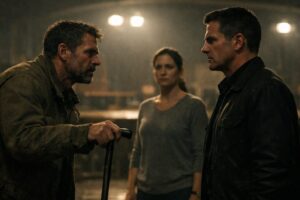
Rusk slammed his palm on the table.
The oranges jumped.
His cap shifted half an inch.
“Everyone out.”
No one moved.
The order had been clear.
The obedience did not come.
Rusk looked up.
“I said out.”
Chairs scraped, but slowly. A few recruits stood. Others watched Dane.
Dane looked at the floor.
Then he did the first brave thing Jonah had ever seen that did not look brave at all.
He did not move.
The recruits noticed.
Rusk noticed.
Mara noticed last.
Her expression softened for less than a heartbeat, and then it was gone.
Rusk’s voice turned dangerous.
“Corporal.”
Dane lifted his eyes.
“With respect, sir,” he said, “this is still survival ethics.”
The words were mild.
Their effect was not.
Rusk stared at him as if Dane had struck him in the mouth.
Mara reached for the oranges.
One by one, she placed them in a row beside Rusk’s cap.
First orange.
Second orange.
Third orange.
The mess hall watched the arrangement become a sentence.
Rusk’s cap sat at the end like a period.
Mara folded her hands.
“You can send them out,” she said, “and the report stays buried.”
Rusk did not blink.
“Or,” she said, “you can finish the lesson.”
Jonah had never heard someone threaten a colonel so softly.
He had also never seen a colonel look afraid.
Only for a moment.
But there it was.
Part IV — Glass Orchard
Rusk recovered by force.
That was the only way to describe it. He pulled his anger back over his fear like a uniform jacket.
“You think classified grief makes you special?” he said. “You think because you learned to whisper, you became honorable?”
Mara’s eyes stayed on the oranges.
“No.”
“Then answer the question.”
The room waited.
Rusk pointed at the first orange.
“How many did you leave behind?”
Mara did not answer.
He pointed at the second.
“How many men died because you wanted to be clever?”
Still nothing.
He pointed at the third.
“How many ghosts do you peel fruit for?”
Mara closed her eyes.
Only then did the past enter the room.
Not as a flashback anyone could see. Not as a story she wanted to tell. It came in fragments, pulled by the smell of citrus oil and steam from cafeteria trays.
A cracked radio hot against her cheek.
A valley of gray dust.
A medic with blood in his teeth saying, “Sergeant, don’t send them here.”
Three oranges in a torn ration net.
Not enough water.
Not enough time.
One orange divided between shaking hands because sugar kept men awake when pain tried to drag them under.
Command repeating coordinates that could not be right.
Mara hearing the same calm voice give the same order three times.
Relay extraction.
Relay extraction.
Relay extraction.
And beyond the ridge, where command said safety waited, the drone feed glittered with heat signatures that should not have been there.
An orchard of glass.
That was what someone had called the valley after the shelling burned the sand until it shone.
Operation names were cruel that way. They made poetry out of places where people screamed.
Mara opened her eyes.
The room was still there.
Rusk was still waiting.
So were the recruits.
So was the cap.
“How many?” Rusk demanded.
Mara touched the first orange.
“One,” she said.
The word moved through the room like a fuse taking flame.
Rusk’s expression shifted. He expected confession now. He wanted it. He needed it.
Mara touched the second orange.
“Two.”
Jonah felt his hands curl against his knees.
Mara touched the third.
“Three.”
Rusk leaned in, triumphant.
“There it is.”
Mara looked at him.
“No.”
The triumph stalled.
Mara moved the first orange slightly away from the cap.
“Three orders,” she said. “The first came through at 0417. Relay extraction coordinates to the medevac team. I refused.”
Rusk’s mouth tightened.
Mara moved the second orange.
“The second came at 0419. Same coordinates. New authentication. I refused.”
Dane’s head lowered.
Mara moved the third.
“The third came at 0420. Direct command override.”
Rusk’s voice cut in. “You are not authorized—”
“You asked.”
Two words.
They stopped him harder than shouting would have.
Mara looked at the recruits.
“I refused because the coordinates were false.”
No one moved.
Even the kitchen had gone still.
“The ridge was occupied,” Mara said. “The relay chain was compromised. If I transmitted those coordinates, the medevac team would have flown into a kill box.”
Rusk stepped toward her.
“That was never established.”
Mara looked up at him.
“It was established by the three soldiers who came home.”
Jonah’s skin went cold.
The story everyone knew shifted under his feet.
Mara’s voice did not rise.
“I broke protocol. I delayed relay. I used the old emergency channel and gave them a wrong approach on purpose. It bought three minutes.”
She looked at the oranges.
“Three minutes was enough.”
Rusk’s face had gone hard in a different way now. Less anger. More calculation.
“That is a partial account of a classified operation.”
“It’s the part you made public when you called it cowardice.”
He stepped closer, lowering his voice. “Careful.”
Mara gave him the first almost-smile Jonah had seen from her.
It was not warm.
“I have been careful for eleven months.”
That line did what anger had not done.
It entered the room and stayed there.
Jonah looked at Mara’s patch.
Glass branch. Gray circle.
Not a decoration.
Not a trophy.
A wound she had been ordered to wear quietly.
Rusk turned away from her and faced the recruits.
“This is exactly what I warned you about,” he said. “A soldier can wrap disobedience in noble language after the fact. She can make hesitation sound like judgment. She can make failure sound like sacrifice.”
Dane spoke from the wall.
“Sir.”
Rusk’s head snapped toward him.
Dane’s voice was steady, though his scar had gone pale.
“Sergeant Venn’s emergency relay reached my support station.”
Rusk went still.
Mara looked at Dane then.
Really looked.
Dane swallowed.
“We logged the three-minute delay,” he said. “We logged the change in approach. We logged survivors.”
Rusk’s voice became very quiet.
“You logged what you were cleared to log.”
“Yes, sir.”
“Nothing more.”
Dane held his gaze.
“No, sir.”
It was not a rebellion.
It was worse for Rusk.
It was confirmation.
The room did not need the classified report. It had seen enough in the spaces between what could and could not be said.
Rusk turned back to Mara.
His face was controlled again, but the control had become brittle.
“You let the official record call you a coward,” he said.
Mara looked at the oranges.
“No.”
Rusk narrowed his eyes.
Mara said, “I let it call me disciplined.”
The line hurt because it was not entirely true and not entirely false.
Even Rusk seemed to feel that.
Part V — Three
Rusk wanted one more victory.
Jonah could see it the way he had seen Mara flinch over the orange peel. The colonel needed one last piece of the room back. One last command obeyed. One last answer shaped the way he wanted it.
He placed both hands on the table and leaned down until his face was close to Mara’s.
“Final time, Sergeant.”
Mara did not move.
“How many?”
The room waited for the number it already knew and still did not understand.
Mara looked at the first orange.
“Three orders I refused.”
She looked at the second.
“Three minutes I bought.”
She looked at the third.
“Three soldiers who lived because I let you teach everyone else I had failed.”
No one breathed.
Rusk’s face emptied.
Not of anger.
Of certainty.
Mara’s voice softened, and that made it worse.
“Do not ask me to count the dead for your lesson.”
For a moment, there was no rank in the room.
Only a woman seated at a metal table, a commander standing above her, three oranges between them, and a group of young soldiers learning that honor did not always arrive in a clean uniform.
Jonah wanted someone to say something.
No one did.
That was the point, maybe.
Some truths did not need applause. Some truths would have been cheapened by it.
Rusk straightened slowly.
His cap remained on the table.
For the first time since Jonah had entered Fort Vale, Colonel Rusk looked like a man separated from the object that made him complete.
He reached for it.
Mara’s hand moved first.
She did not touch the cap.
She took one orange segment and placed it just against the brim.
The gesture was small enough to be deniable.
It was also impossible to miss.
Rusk stopped.
His jaw flexed.
Then he picked up the cap, leaving the orange segment behind.
“Mess is dismissed,” he said.
No one moved until Dane did.
He stepped away from the wall, not toward Mara, not toward Rusk, but toward the door. The recruits followed the permission in his movement because they could not follow the colonel’s voice anymore.
Chairs scraped.
Trays lifted.
Boots moved carefully, as if noise itself had become disrespectful.
Jonah stayed seated too long.
He knew he should go. He knew that remaining would make him visible again. But something pale lay on the floor near Mara’s boot.
Her unit patch had come loose.
Maybe when Rusk grabbed the chair. Maybe when her hand touched it. Maybe the stitching had been failing long before the room finally noticed.
Jonah bent and picked it up.
The patch felt softer than he expected.
Worn thin at the edges. The glass-green branch nearly rubbed away in places. Not an emblem preserved for display, but something carried through weather, sweat, dust, and accusation.
Mara was gathering the orange peels.
Not quickly.
Not dramatically.
She placed the skins together in one small pile, as if even scraps deserved order.
Jonah stepped closer.
“Sergeant.”
She looked at him.
Up close, she looked younger than he had expected and older than anyone should. There were faint lines at the corners of her eyes. Her face was calm, but not empty.
Jonah held out the patch.
“It came loose.”
Mara looked at it in his hand.
For one second, Jonah thought she would refuse it.
Then she took it.
Their fingers did not touch.
“Thank you, Private.”
He should have left.
Instead he heard himself ask, “What was the third soldier’s name?”
Dane, halfway to the door, stopped.
Mara’s hand closed around the patch.
The mess hall had almost emptied. Rusk stood near the far exit, his cap under one arm, his back turned but his shoulders rigid. He could hear them.
Mara looked at the three oranges.
One had been broken into segments.
One remained whole and peeled.
One sat near the place where Rusk’s cap had been.
“He gets to keep that for himself,” she said.
Jonah lowered his eyes.
“Yes, Sergeant.”
He understood then, not completely, but enough.
Truth was not the same as possession. Just because a room had forced a story open did not mean it owned every name inside it.
Mara tucked the patch into her jacket pocket instead of pressing it back onto her shoulder.
That, more than anything, made Jonah’s throat tighten.
She picked up the peels.
Then she paused.
One peeled orange remained on the table.
She left it there.
Not for Rusk.
Not for the recruits.
For the space between what could be said and what had to be carried.
Part VI — What Silence Leaves Behind
By evening, everyone at Fort Vale had heard something.
No one had heard the same thing.
Some said Sergeant Venn had confessed. Some said she had exposed a compromised command line. Some said Colonel Rusk had backed down. Others said he had simply chosen not to discipline her in public.
Soldiers were good at making rumors out of restraint.
Jonah did not repeat any version.
When asked, he said only, “I was in the mess hall.”
That was enough to make people stop pressing.
At 1900, he found Mara outside the training building, standing beneath the overhang while rain moved across the parade ground in silver lines. She had changed out of the worn field jacket. Her uniform now looked correct, almost severe. The unit patch was not on her shoulder.
For a moment he wondered if she had finally let it go.
Then he saw the edge of it in her hand.
She was holding it folded against her palm.
Jonah almost turned around.
She spoke without looking at him.
“If you have another question, Private Ellis, decide first whether you need the answer.”
He stopped.
The rain hit the roof hard enough to cover the first breath he took.
“I don’t,” he said.
Mara looked at him then.
It was the right answer, or at least not the wrong one.
Jonah stood beside her with enough distance to remain respectful.
Across the parade ground, recruits moved in formation through the rain. Their boots struck pavement in uneven rhythm. Someone shouted cadence. Someone fell half a step behind and caught up.
Everything continued.
That felt unfair.
“Will anything happen to him?” Jonah asked.
Mara looked out at the rain.
“You still think truth makes things clean.”
He felt embarrassed.
“Yes, Sergeant.”
“No,” she said. “You think it because you should. Hold on to it as long as you can.”
That was not comfort.
It was closer to a warning.
Jonah watched the rain blur the lights.
“Why didn’t you say it before?”
Mara’s fingers tightened around the patch.
There were many answers she could have given. Classification. Command. Survivors. Families. Politics. Orders that did not end when the mission did.
She chose none of them.
“Because the dead are not evidence,” she said.
Jonah had no answer to that.
None was wanted.
After a while, Corporal Dane crossed the yard toward them. He stopped several feet away, rain darkening his uniform shoulders.
“Sergeant,” he said.
Mara nodded once.
Dane looked as if he had carried a sentence all day and found it heavier each hour.
“I should have said something before.”
“Yes,” Mara said.
He flinched.
She did not soften it.
Then she added, “But you said it today.”
Dane looked down.
For a moment, the three of them stood under the same narrow shelter, separated by rank, age, guilt, and rain.
Then Dane reached into his pocket and took out an orange.
Small. Bruised. Taken from the mess crate, probably.
He placed it on the ledge beside Mara.
“I didn’t know what else to do,” he said.
Mara looked at the fruit.
Something moved through her face that Jonah could not name.
Not forgiveness.
Not grief exactly.
Recognition, maybe.
She picked up the orange and turned it once in her hand.
Then she gave it back to Dane.
“Peel it for someone living,” she said.
Dane’s eyes shone, but he nodded.
“Yes, Sergeant.”
He left first.
Jonah followed a minute later, because he sensed Mara needed the rain more than company.
At the steps, he looked back.
Mara stood alone under the overhang, the old patch still in her hand. She did not put it on. She did not throw it away.
She simply held it.
The next morning, Colonel Rusk’s cap was back on his head, his voice back in the yard, his command still intact in all the ways paperwork cared about.
But the recruits listened differently.
When he asked what a soldier owed the chain of command, they answered.
When he asked what a soldier owed the wounded, they answered.
When he asked what a soldier owed the truth, Jonah felt the room remember a metal table, three oranges, and a woman who had refused to let the dead become a lesson.
Mara never told them the third soldier’s name.
No one asked again.