The White Strip
Part I — The Case
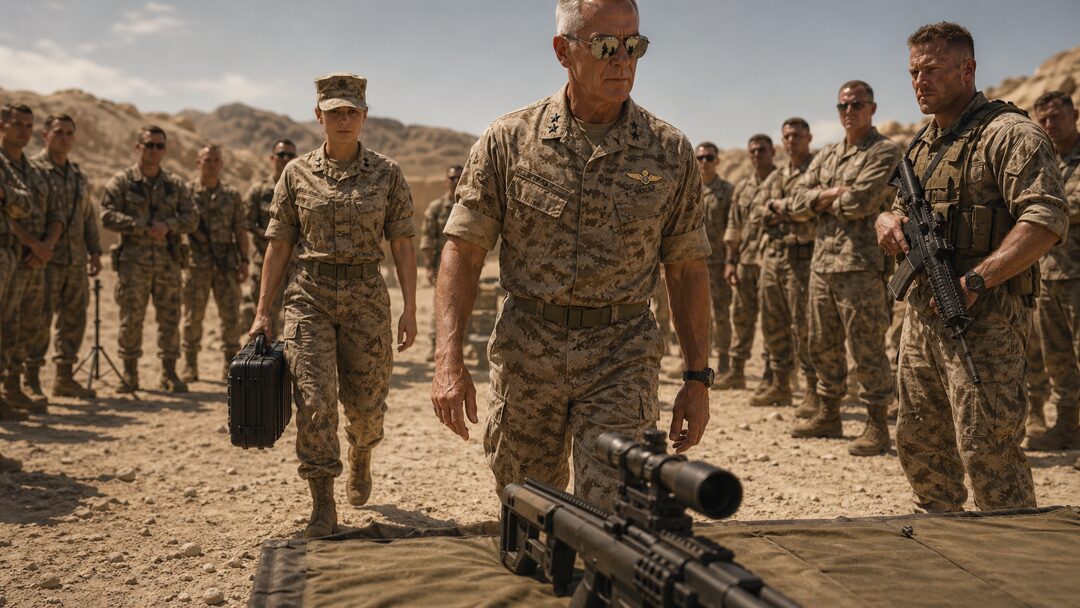
By the time Sergeant Mara Vale reached the sniper mat, half the platoon had already decided she was going to miss.
They stood in a loose half-circle under the hard desert sun, rifles slung, sleeves rolled, faces shaded by helmets and suspicion. The wind scraped sand across the range in thin, restless sheets. At the center of it all lay the rifle, already assembled, already pointed down a lane so long the target looked like a rumor.
Mara walked behind Colonel Elias Rusk with a black hard case in her right hand.
Rusk did not look back to see if she followed. He did not need to. Men followed him. Careers bent around him. He was tall, silver-haired, and immaculate in a way that made even dust seem reluctant to touch him. His mirrored sunglasses reflected the range, the soldiers, the rifle, and Mara’s small dark shape behind him.
Someone in the half-circle muttered, “Command really wants that headline.”
Another voice, lower: “Cold-bore qualification? In front of everyone?”
A third, almost amused: “She asked for equal standards.”
Mara heard all of it.
She gave them nothing.
Her hair was cut close and dark beneath her patrol cap. Her sleeves were rolled with exactness. Her face had the stillness of someone who had learned not to waste movement. Not on heat. Not on insult. Not on men waiting for her hands to shake.
Rusk stopped beside the prone station.
The rifle lay on its bipod, long and dark against the tan mat. The spotting scope stood to one side. A range monitor flickered beneath a shade hood. Far downrange, the target shimmered in heat distortion.
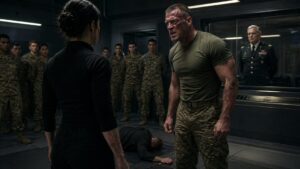
Rusk turned to the platoon.
“Sergeant Vale will take one cold-bore shot,” he said. “No warm-up. No correction. No second round.”
The muttering stopped.
“One shot,” he repeated, “will determine qualification.”
Captain Dane Holt shifted his weight near the front of the group. He was broad-shouldered, sunburned, and built like he trusted only things he could carry, fire, or outrank. The rifle at his chest looked less like equipment than an extension of his contempt.
“With respect, sir,” Holt said, in the tone men used when they meant none, “that is not how we’ve run final qualification.”
Rusk’s head turned a fraction.
His sunglasses caught Holt’s face and gave nothing back.
“It is today.”
Holt’s jaw worked once. “For her.”
“For the shot,” Rusk said.
The distinction hung there, sharp and useless.
Mara set the black case beside the mat. The latch clicked under her thumb.
That small sound carried farther than it should have.
Rusk looked downrange. “Target is marked under grid designation Hill Four-Seventeen.”
Mara’s fingers paused on the second latch.
Not long.
Half a breath.
No one in the platoon noticed.
Rusk did.
Mara lifted her eyes to him. “Is this a qualification, sir?”
The desert wind dragged sand between them.
Rusk’s mouth barely moved.
“Depends what you hit.”
For the first time, the men behind her were quiet for a reason other than discipline.
Mara opened the case.
Inside, foam compartments held range tools, a folded shooting glove, a data card, and a cloth scope cover faded from sun and use. At one corner, initials had been stitched in uneven tan thread.
O.P.
A younger soldier near the back leaned forward before he could stop himself.
Holt saw it too.
His expression changed. Not softened. Sharpened.
“That Pike’s?” he asked.
Mara did not answer.
She took the scope cover out with two fingers, the way someone might lift a letter from a grave.
Holt gave a humorless breath. “You brought Corporal Pike’s cover to a qualification?”
Mara threaded it carefully over the edge of the scope and then removed it again, checking the fit. Her movements were slow, exact, almost tender.
Holt stepped closer. “That supposed to make this harder to question?”
Still, Mara said nothing.
The silence angered him more than denial would have.
Rusk watched both of them. The lenses of his sunglasses hid everything except the fact that he was watching.
Holt looked from Mara to the rifle, then to Rusk.
“Sir, with respect, she froze on Hill Four-Seventeen.”
Mara’s hand stilled on the cloth.
“She froze,” Holt said, louder now, because the platoon was listening and he wanted them to. “Pike died beside her. And now we’re pretending one clean shot on a range fixes that?”
Mara folded the scope cover once.
Then she placed it beside the rifle.
No one moved.
Rusk said, “Proceed, Sergeant.”
Mara lowered herself to the mat.
Part II — Hill Four-Seventeen
The ground was hot through the fabric of Mara’s uniform.
She settled behind the rifle and placed her cheek against the stock. The world narrowed in the old way: shoulder, breath, bone, glass, distance. Around her, men became shapes. Voices became pressure. Heat became a thing to ignore.
Then Rusk spoke again.
“Confirm your position on Hill Four-Seventeen.”
Mara did not lift her head. “Observation ridge north of the road.”
“Distance to primary target?”
“Classified after-action record has it at nine hundred and eighty meters.”
“That is not what I asked.”
The platoon heard the edge in his voice.
Mara adjusted the rear bag beneath her hand. “My range was nine hundred and sixty-two.”
A few men glanced at one another.
Rusk said, “Why the discrepancy?”
“Heat distortion. Angle. Bad coordinates from command.”
Holt gave a short laugh. “Now the coordinates were bad.”
Mara’s eye stayed near the scope.
Rusk kept his gaze on her. “Why did you disobey the order to relocate?”
Mara’s jaw tightened once.
Dust against her teeth.
Static in her ear.
Pike’s voice, too young and too close: Don’t move yet. Something’s wrong.
She blinked and the range returned.
“Did not have a clear lane,” she said.
“You reported a clear lane before the first contact.”
“Conditions changed.”
Holt stepped around the side of the mat so she could see his boots near her peripheral vision.
“Conditions changed,” he repeated. “That’s a clean way to say you hesitated.”
Mara slid the bolt back, checked the chamber, and closed it.
Metal clicked.
No one breathed loudly after that.
Rusk looked to the range officer. “Wind?”
“Variable,” the range officer said. “Left to right, light gusting. Recommend hold until it steadies.”
Rusk nodded once.
The delay should have been a mercy.
It was not.
Mara kept her body aligned behind the rifle and let the waiting enter her muscles without owning them. Her breathing slowed. The dust smell changed in her memory.
Hill Four-Seventeen had smelled like hot stone and diesel.
Pike had been beside her, tapping numbers into a small notebook with fingers that always moved too fast when he was scared. He was twenty-four and tried to hide it by grinning at the wrong times. His sandy hair had stuck to his forehead under his helmet. His cheek had been striped with dust.
Command had said the ridge below them was empty except for armed movement.
Pike had said, “No. Wait.”
She had hated him for that word in the moment.
Wait was heavy.
Wait could kill.
Wait could save the wrong person and lose the right one.
Rusk’s voice cut through the present. “What did you see before the order to fire?”
Mara swallowed once. “Movement.”
“What kind?”
“Unconfirmed.”
Holt snapped, “That’s not an answer.”
“It’s the only one I had.”
He came closer. “You always talk like that when someone asks where your spotter died?”
The wind shifted.
A scrap of range flag lifted, then dropped.
Mara’s finger rested straight along the rifle, nowhere near the trigger.
Rusk said, “Captain Holt.”
Holt did not step back. “No, sir. If she qualifies, she goes into a section with men who need to trust her. So let’s stop acting like everybody here doesn’t know the story.”
Mara looked through the scope for the first time.
The world jumped toward her.
Heat lines trembled. The target swam in and out of clarity. A dark silhouette stood at distance, flat and human-shaped, the kind of target meant to simplify what real life never simplified.
She made herself breathe.
In.
Hold.
Out.
The target sharpened.
And there it was.
Not center mass. Not the scoring rings. Not the head box.
Along the left edge of the silhouette, thin as a torn bandage, someone had painted a white vertical strip.
Mara’s breath stopped.
Not because she was afraid.
Because she remembered.
A strip of white cloth tied to the antenna of a civilian truck.
A flash behind a mud wall.
Pike’s hand closing over the scope.
No civilians, command had said.
Pike’s voice had cracked when he answered, There are now.
Mara lifted her head from the rifle.
Rusk was watching her.
Behind the mirrored glasses, she could not see his eyes. But she understood the target now.
He had not recreated a qualification.
He had recreated a lie.
Part III — The Mark They Left Out
Holt saw her lift her head and seized on it.
“She’s done,” he said. “Sir, she can’t even stay in glass.”
Mara looked at the white strip again without looking through the scope. She could see nothing from here, not really. Just shimmer. Just distance. But her body knew where it was.
Rusk crouched beside the mat.
For the first time, his voice dropped low enough that the platoon could not hear.
“I signed the report,” he said.
Mara did not look at him.
“That is not news to me, sir.”
“I signed the report that said you failed to engage a confirmed hostile.”
“You did.”
“I believed the transcript.”
“You chose to.”
A muscle moved near his jaw.
She expected reprimand. He did not give it.
“Six months ago,” Rusk said, “an archived drone still was recovered during a system review. Misfiled. Degraded. Almost useless.”
Mara stared downrange.
He continued, “It showed a convoy crossing behind the insurgent position. Civilian. White cloth marker on the lead vehicle. The same marker you reported verbally but refused to put in writing.”
Her throat tightened.
“I put enough in writing.”
“No,” Rusk said quietly. “You put enough to keep from lying. Not enough to make them tell the truth.”
The words landed harder than accusation.
Mara turned her face toward him then.
His sunglasses reflected her back at herself: prone in the dust, one cheek marked by the rifle stock, eyes too calm to belong to someone clean.
“You brought me here for a confession,” she said.
“I brought you here because formal channels failed.”
“You brought an audience.”
“I brought witnesses.”
“They think they’re here to watch me fail.”
“They are here to understand what failure looks like.”
Mara almost laughed. It would have been ugly, so she did not.
Rusk lowered his voice further. “The review board will not reopen Hill Four-Seventeen on an old drone still and my regret. They need corroboration from the surviving shooter.”
“You mean the surviving accused.”
“Yes.”
That honesty was worse than evasion.
Mara looked back at the target.
The white strip flickered at the edge of memory.
Pike had seen it first. He had not said civilian convoy right away. He had only gone still, the way young soldiers went still when training and conscience collided.
Mara had asked, “Confirm?”
He had whispered, “White marker. Left of the lane.”
Then command had cut in: Fire. Fire now.
The first shot was not hers.
The first shot came from below.
Stone jumped beside Pike’s head.
Then the ridge opened.
The memory narrowed to heat, shouting, dust, radio static, Pike’s shoulder slamming into hers. His hand had ripped the scope cover loose, then covered the glass.
Not yet, he had said.
Not there.
Mara had shoved his hand away.
Command had repeated the order.
Pike had grabbed the scope itself and twisted it off line.
“He was a corporal,” she said to Rusk. “No one was going to listen to him.”
“I am listening now.”
“You’re late.”
“Yes.”
The word had no defense in it.
That was the worst part.
Holt’s voice cut across the range. “Sir, if she needs counseling, she shouldn’t be behind that rifle.”
The old anger moved through Mara like a shadow.
Not hot.
Not wild.
Just present.
She pushed herself up on one elbow and looked at Holt fully.
He had expected her to avoid his eyes.
She did not.
“Say it,” she said.
The platoon went still.
Holt blinked once. “What?”
“You’ve been walking around it all morning. Say it clean.”
His mouth tightened. “You got Owen Pike killed.”
The name moved through the range like the snap of a flag.
Mara’s face did not change.
But something in her eyes did.
Holt seemed to notice too late.
“He took the scope off me,” Mara said, “before command could make me obey.”
No one spoke.
Not Rusk.
Not Holt.
Not the men who had come to watch a woman miss.
Mara looked back downrange.
“He died stopping the wrong shot.”
Part IV — One Shot
The desert became too quiet.
Even the men who had never liked silence did not break it.
Holt’s face had lost some of its color beneath the sunburn. For the first time since Mara arrived, his confidence looked like something he had set down and could not immediately find again.
“That wasn’t in the report,” he said.
“No,” Mara said.
“Why the hell not?”
She almost answered.
Because Pike deserved better than becoming a footnote in a command failure.
Because if she wrote it, men in clean rooms would carve his last act into blame diagrams.
Because she was twenty-seven now, but on Hill Four-Seventeen she had been younger in all the ways that mattered.
Because she had survived, and survivors were always asked to make sense for the comfort of people who had not been there.
Instead, she said, “Because the dead don’t get to defend themselves from paperwork.”
Holt looked away.
It was not apology.
Not yet.
But it was the first crack.
The range officer checked the wind again. His voice sounded too formal now.
“Wind settling. Left to right. Light.”
Rusk stood.
He did not touch Mara’s shoulder. He was smart enough for that.
“Sergeant Vale,” he said, aloud now, “you may stand down.”
The words startled the platoon more than the accusation had.
Mara turned her head slightly.
Rusk removed none of his hardness. “If you decline the shot, I will not mark this as a qualification failure.”
Holt looked at him sharply.
Rusk continued, “But the official record will remain what it is until someone with direct knowledge challenges it under oath.”
Mara looked at the rifle.
Then at the old cloth scope cover beside it.
O.P.
The letters had been stitched badly. Owen had done them himself during a long night when they were both too wired to sleep. He had claimed it was to keep other teams from stealing his gear. Mara had told him no one wanted his ugly sewing.
He had grinned and said, “You’ll miss it when I’m famous.”
She had rolled her eyes.
Then she had kept the cover after they shipped his body home.
For two years, she had told herself she kept it because nobody else would understand why it mattered.
Now she wondered if that had only been another way to keep the truth quiet.
Mara reached for the cover and touched the initials with her thumb.
Holt watched.
Rusk watched.
The platoon watched.
That had been the shape of her whole life since Hill Four-Seventeen: men watching, deciding, never knowing where to aim their judgment.
Mara slid back behind the rifle.
Her cheek found the stock again.
The world narrowed.
This time, there was no muttering.
Only breath.
Only heat.
Only glass.
Through the scope, the target leapt closer. The black silhouette wavered in the shimmer. The white strip appeared and disappeared at the edge, not important unless you knew it was everything.
Center mass would qualify her.
The white strip would tell the truth.
Her finger remained straight.
Her breathing slowed.
In the scope, the strip steadied.
Hill Four-Seventeen opened behind her eye.
Pike’s hand on the glass.
Command shouting fire.
The white cloth marker.
The convoy.
The dust.
Pike’s shoulder hitting hers.
His voice, not brave, not calm, but certain.
Not there.
Mara exhaled.
The range seemed to hold its own breath with her.
She placed her finger on the trigger.
Not quickly.
Not dramatically.
As if touching the edge of an old wound and choosing not to flinch.
Rusk stood behind her, unreadable.
Holt stood farther back, no longer sure what he wanted to see.
Mara did not aim at the center of the target.
She aimed at the thing everyone else had been trained to ignore.
The shot cracked across the desert.
Smoke kicked from the rifle.
Recoil moved through her shoulder and was gone.
For one second, no one said anything.
Then the target monitor flickered.
The range officer leaned in.
His mouth opened, but the words took a moment to find him.
“Impact confirmed.”
The men pressed closer without meaning to.
On the monitor, the target appeared in grainy magnification. The bullet had cut through the narrow white strip along the silhouette’s edge.
Not center mass.
Not a standard scoring hit.
A line through the mark that should not have been there.
A shot so precise it looked less like impact than accusation.
The range officer cleared his throat.
“White strip. Clean pass-through.”
No one cheered.
Cheering would have been too small.
Holt stared at the screen.
His mouth was slightly open, the old certainty gone from his face. Around him, the other soldiers wore the same stunned expression. Not amazement alone. Shame had a different weight. It lowered the chin. It changed the eyes.
Mara lifted her head from the rifle.
For a moment, she did not move.
The rifle lay in front of her. The target stood far away. The desert kept blowing sand across everything, indifferent and patient.
Then Rusk reached up and removed his sunglasses.
His eyes were pale, tired, and not as protected as they had been a moment before.
“Sergeant Vale,” he said, “the archive review will be reopened. With my signature.”
Mara looked at him.
That was all.
No thank you.
No forgiveness.
No salute beyond what the moment required.
Rusk accepted it like a man accepting a sentence he had written for himself.
Part V — What They Finally Saw
Holt stepped toward her, then stopped.
Mara rose from the mat and brushed dust from her sleeve. The movement was ordinary, almost irritatingly calm. It made the silence around her feel louder.
Holt’s voice came out lower than before.
“Vale.”
She turned her head.
For a second he looked like he might give her the apology everyone expected once shame arrived late enough to be obvious.
He did not.
Maybe he understood that sorry would try to make the moment about his regret instead of what she had carried.
Maybe he was only too proud.
Either way, he moved aside.
It was a small thing. A step. A clearing of space.
But the whole platoon saw it.
Mara bent and removed Pike’s scope cover from beside the rifle. The cloth was warm from the sun. She folded it along the worn crease, then folded it again, hiding the crooked initials inside like something private that had finally been witnessed and still deserved privacy.
The younger soldier who had recognized the letters stood near the back. He straightened when Mara passed. Not sharply. Not theatrically. Just enough.
Recognition, she thought, was quieter than applause.
It lasted longer too.
Rusk stood by the monitor, sunglasses in one hand, watching the image of the cut white strip as if it might still refuse him.
“You knew I would see it,” Mara said.
He looked over.
“You were the only one who could.”
“That doesn’t make what you did clean.”
“No,” Rusk said. “It makes it necessary.”
Mara closed the hard case. The latches snapped shut.
“Those aren’t the same thing, sir.”
Something in his face shifted.
Not argument.
Not denial.
The first honest thing after the shot may have been his silence.
Holt was still staring downrange. His rifle hung against his chest, suddenly just equipment.
Mara lifted the case.
It felt no lighter than when she had carried it in.
That surprised her, though it should not have.
Truth did not make the dead easier to carry.
It only changed who had to look.
As she walked back across the range, the men did not mutter. They did not clap. They did not call after her. Their silence had changed shape.
In the morning, it had been judgment.
Now it was room.
Mara kept walking behind no one this time.
The desert wind moved across the lane, over the mat, past the rifle, out toward the target where a white strip had been cut clean through.
Far behind her, Colonel Rusk put his sunglasses back on.
Then, after a moment, he took them off again.