The Medal He Tried to Remove
Part I — Borrowed From the Dead
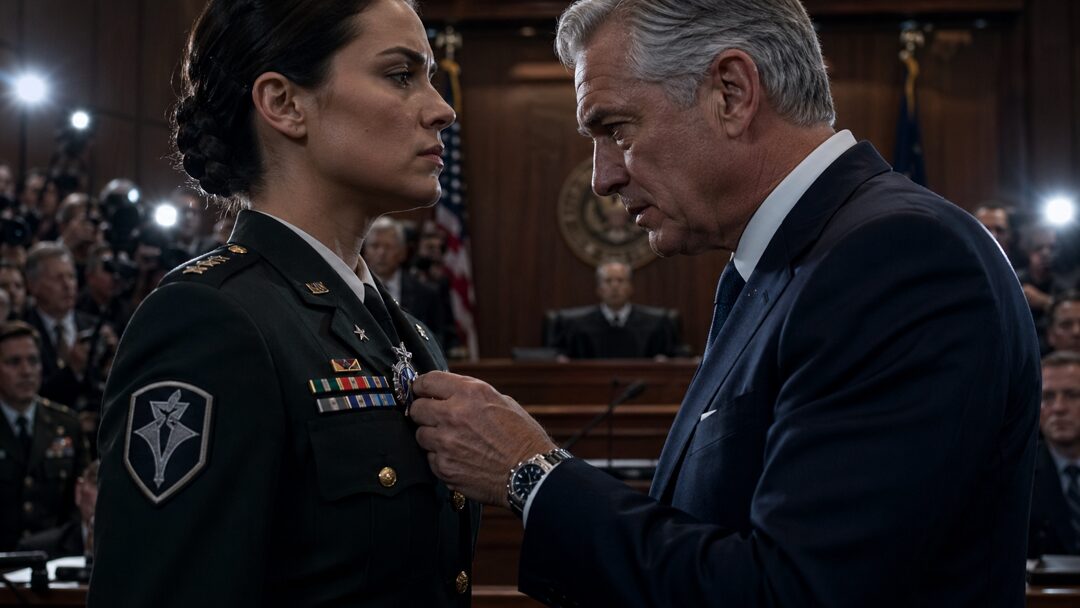
Senator Adrian Vale stepped close enough to touch Staff Sergeant Mara Kellan’s uniform before the judge had even finished speaking.
The courtroom went still.
Mara did not move.
Vale lifted one hand, slow and careful, as if performing a kindness for the cameras. His fingers found the Silver Star above her ribbons and straightened it by a fraction of an inch. The medal clicked softly against the bar beneath it.
Then he leaned in.
“Medals look heavier,” he murmured, “when they’re borrowed from the dead.”
Mara kept her eyes forward.
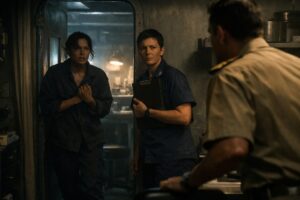
Behind her, Captain Elias Roane’s boots shifted once against the polished floor. It was the only sound in the room besides the low hum of fluorescent lights and the restless breathing of people who had come to hear why their sons, daughters, husbands, and children had burned in a convoy under a white evacuation flag.
Judge Calder looked over his glasses. “Senator Vale.”
Vale stepped back at once, his face smoothing into public courtesy.
“My apologies, Your Honor. Staff Sergeant Kellan’s commendation was crooked.”
No one laughed.
Not the press sitting shoulder to shoulder along the wall. Not the military legal counsel at the table. Not the families packed into the gallery. Not Denise Alvarez, who sat in the second row with a folded funeral program in both hands, staring at Mara as if hatred were the only thing keeping her upright.
Mara could feel Denise’s gaze.
She had felt it every morning of the hearing.
She had felt it before the hearing, too, in letters forwarded through official channels, in news clips, in committee transcripts, in the name of Denise’s son spoken by strangers who had learned to say it with practiced sorrow.
Private First Class Mateo Alvarez.
Twenty-two years old.
Radio operator.
Dead on Route Cinder with eleven civilians and one other American soldier.
Mara knew what his voice sounded like over static.
She knew what he had said at the end.
She had never told his mother.
Vale turned to the bench. He looked immaculate in a navy suit, his silver hair arranged with the discipline of a campaign poster. Every movement seemed designed for a room larger than the one he occupied.
“Your Honor, with the court’s permission, I’d like to demonstrate the contradiction at the heart of Staff Sergeant Kellan’s commendation.”
Mara did not look at him.
A lesser man would have sounded angry. Vale sounded wounded. That was his talent. He could turn accusation into mourning.
Judge Calder’s expression stayed flat. “Proceed carefully, Senator.”
“Always.”
Vale faced the jury box, though there was no jury. This was a federal wrongful-death hearing, part civil proceeding, part military review, part public ritual. Everyone knew the ruling would not bring back the dead.
Everyone had come anyway.
“Staff Sergeant Kellan was decorated for extraordinary courage during Operation Hearthline,” Vale said. “Specifically, for remaining at her post under fire and rescuing children from an evacuation convoy ambush.”
He paused, letting the phrase sit.
Rescuing children.
Mara’s hands remained at her sides.
“But the official mission log tells a different story,” Vale continued. “It shows she abandoned the assigned medical station seven minutes before the convoy was hit. It shows she refused a direct order to board the evacuation vehicle. It shows that while civilians and American personnel moved into the kill zone, Staff Sergeant Kellan remained behind with an enemy courier.”
A sound passed through the gallery. Not a gasp exactly. More like pain finding a new shape.
Roane moved half a step closer behind Mara.
Not touching her.
Almost.
Mara felt it anyway.
Two years earlier, that nearness had meant command. Move, Sergeant. Now. Get on the truck.
Today, it meant containment.
Hold the line. Say nothing more than you are ordered to say.
Vale’s eyes flicked to Roane, then back to Mara.
“And yet,” he said, “she wears a medal.”
The courtroom seemed to lean toward her chest.
Mara knew the weight of that small silver star. She knew its cold edge in the morning when she pinned it through the fabric. She knew the exact pressure required to secure the clasp. She knew how strange it was that metal could sit so lightly on cloth and so heavily on skin.
Judge Calder looked at her. “Staff Sergeant Kellan, you will have an opportunity to respond.”
“Yes, Your Honor,” Mara said.
Her voice surprised people. It always did.
They expected a decorated medic to sound either broken or defiant. Mara sounded calm.
Denise Alvarez’s fingers tightened around the funeral program.
Vale noticed.
Of course he did.
He smiled, just barely.
Part II — The Pictures He Chose
The first photograph showed a school bus burning sideways across a road.
Vale did not rush.
He placed the image on the overhead display and waited for the courtroom to absorb the black smoke, the torn metal, the blur of bodies made merciful by distance.
“This was Vehicle Three,” he said. “The civilian transport.”
Mara looked at the photograph because looking away would have been worse.
She remembered the smell before she remembered the fire.
Plastic. Diesel. Wet earth. Copper.
Someone in the gallery began to cry.
Vale let the crying continue for three seconds before he advanced the slide.
The second photograph showed a pair of blood-streaked gloves on a field stretcher.
“Staff Sergeant Kellan’s gloves,” Vale said. “Recovered near the abandoned aid point.”
Mara’s left wrist twitched.
The scar there was pale now, no wider than a thread. It had come from a torn piece of vehicle frame when she dragged a child from under the bus seats. It had bled into those gloves until the fingers became slick.
Vale did not mention that.
The third photograph appeared.
A child’s shoe.
Small. Blue. One strap torn.
The room changed.
Mara’s face stayed still, but something behind her ribs folded inward.
She knew that shoe.
It belonged to a boy named Sami who had refused to leave the safehouse without his older sister. He had been six, maybe seven. He had asked Mara if American trucks could outrun bad dreams.
Mara had told him yes.
It was the only lie she still heard in her own voice.
Denise Alvarez made a low sound in the gallery. Not for Sami, perhaps. Not specifically. But grief recognized grief faster than evidence did.
Vale turned from the screen to Mara.
For the first time, he saw what he had been waiting for.
A crack.
Not tears. Not guilt. Just one shallow breath that arrived half a second late.
He stepped closer.
“Do you recognize this item, Staff Sergeant?”
“Yes.”
“Was it found near Vehicle Three?”
“Yes.”
“Was Vehicle Three on the evacuation route your unit failed to secure?”
Mara paused.
Roane’s shadow stood behind her. The judge watched. The families waited.
“Yes,” Mara said.
Vale’s voice softened. “And while that vehicle was burning, you were where?”
“With a wounded man.”
“An enemy courier.”
“A wounded man,” Mara repeated.
Vale nodded as if she had given him exactly what he needed. “Let the record show that Staff Sergeant Kellan does not dispute remaining with an enemy courier while civilians under her protection were attacked.”
Mara looked at him then.
Not fully.
Only enough.
Vale held her gaze with the confidence of a man who had built a career on making silence look like confession.
He advanced the slide again.
The last photograph was blurred by motion. Mara kneeling in dust. One hand pressed against the side of a man’s neck. Her other hand holding a radio handset close to his mouth. Her face was turned downward, hidden by helmet shadow.
“In this image,” Vale said, “you are not at the convoy. You are not at your medical station. You are not with the civilians.”
Mara said nothing.
“Where are you?”
“At Checkpoint Lark.”
“And what was at Checkpoint Lark?”
Mara felt Roane behind her again, not moving this time.
“A wounded courier,” she said.
“Enemy-aligned.”
“Wounded.”
Vale gave a thin smile. “You are very careful with words.”
“No, Senator,” Mara said. “I’m careful with people.”
A murmur moved through the room.
Judge Calder tapped his pen once. “Order.”
Vale’s smile did not vanish, but it sharpened.
Denise Alvarez was still staring at the shoe on the screen, though Vale had already replaced it.
Mara wished, suddenly and uselessly, that she could turn around and say: Your son tried. Your son heard me. Your son carried the warning farther than I did.
But the warning was sealed.
The route change was sealed.
The audio was sealed.
The dead, somehow, were public.
Only the truth had been classified.
Vale returned to his table and lifted a folder.
“Operation Hearthline,” he said, “was meant to evacuate noncombatants during the collapse of the El Sarim ceasefire zone. Twelve civilians and two American soldiers died because of a deviation in field procedure. My committee report named that deviation plainly.”
He looked toward the gallery.
“Families deserve plain language.”
Denise lowered her eyes.
Mara knew that trick, too. Vale had built the sentence for the families, but aimed it at her.
Roane’s voice from two years ago stirred in her memory.
Do not make this worse, Kellan.
He had not meant the dead.
He had meant the living machinery around them.
Mara had obeyed him after the mission.
Not during it.
That was the part nobody in the room understood yet.
Part III — Seven Minutes
Vale called the mission log “merciless.”
He said it with almost reverence, as if documents were holy when they served him.
“Time stamp 14:07,” he read. “Staff Sergeant Kellan leaves Medical Point Two. Time stamp 14:10, convoy proceeds south toward Route Cinder. Time stamp 14:14, Captain Roane orders Staff Sergeant Kellan to board Vehicle One. Time stamp 14:15, order refused. Time stamp 14:17, first explosion.”
He closed the folder.
“Seven minutes,” he said. “That is the space between duty and disaster.”
Mara heard one of the mothers sob.
Denise did not.
Denise sat too still.
The still ones were always carrying the most.
Vale turned to Mara. “Why did you leave Medical Point Two?”
“I received information requiring verification.”
“What kind of information?”
“Route information.”
Vale looked toward the judge before Mara finished the second word.
“Your Honor, we are approaching classified operational material.”
Judge Calder leaned back. “Senator, you asked the question.”
“I asked why she abandoned her post. I did not ask her to speculate about protected routing intelligence.”
Mara almost smiled.
Not because anything was funny.
Because Vale had stepped on the edge of the thing he had buried and felt it move under him.
Judge Calder looked at Mara. “Answer only within the limits previously authorized.”
“Yes, Your Honor.”
Vale came back toward her. He carried himself with less warmth now.
“Let us keep this simple. Your medal citation says you remained at your post.”
“It says I remained under fire.”
“But the log shows you left the assigned medical station seven minutes before the convoy was hit.” He stepped closer. “So which is it, Staff Sergeant? Were you at your post, or was the citation written to cover what you abandoned?”
The courtroom held its breath.
Roane’s hand rose behind her.
Stopped.
Mara could sense it near her shoulder, hovering between command and pleading.
Vale’s gaze dropped to the Silver Star again.
He bent close as if reading the inscription.
“Seven minutes,” he whispered. Then, louder: “Why did you leave?”
Mara turned her head and looked directly at him.
“Because the convoy was already dead on your map.”
For the first time all morning, Vale did not answer.
The sentence hit the room unevenly. The reporters heard scandal first. The families heard insult. The military counsel heard danger. Roane heard the lock break.
Judge Calder set his pen down.
“Staff Sergeant Kellan,” he said slowly, “clarify that statement.”
Vale recovered. “Your Honor, objection. Speculation, and potentially classified.”
“Overruled for now. She will clarify within authorized boundaries.”
Mara kept her eyes on the judge.
“The convoy route was altered in the final hour,” she said. “My field team was not notified.”
Vale laughed once, quiet and controlled. “That is not established.”
“No,” Mara said. “It was hidden.”
Now the room heard it.
Roane shut his eyes.
Vale’s face did not change much. That was what made the change visible. His expression became too still.
Judge Calder turned to Roane. “Captain, approach.”
Roane stepped forward.
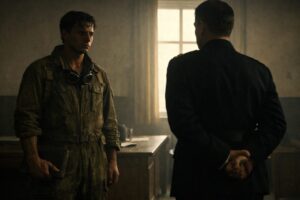
He looked taller beside Mara, rigid in dress uniform, hands clasped behind his back. His decorations were fewer than hers. His eyes looked older.
“You were Staff Sergeant Kellan’s commanding officer during Operation Hearthline?”
“Yes, Your Honor.”
“Did you order her not to discuss routing discrepancies after the mission?”
Roane’s jaw tightened. “Yes, Your Honor.”
A current moved through the gallery.
Mara did not look at him.
Judge Calder continued. “Why?”
“At the time, I believed the discrepancy originated within military command channels. The matter was sealed pending review.”
Vale cut in. “Which confirms that Staff Sergeant Kellan’s statement is outside the scope of this proceeding.”
Roane looked at him then.
For two years, Mara had seen Roane wear guilt like armor: polished, rigid, serviceable. But there was a difference between a man protecting a secret and a man realizing he had protected someone else’s lie.
Judge Calder asked, “Captain Roane, did Staff Sergeant Kellan obey your order not to discuss the discrepancy?”
Roane’s eyes shifted to Mara’s back.
“Yes,” he said. “After the mission.”
The words landed with more force than accusation.
After the mission.
Mara felt the gallery understand only part of it.
Vale understood all of it.
His mouth tightened.
He returned to his table and opened another file.
“Well,” he said, “if Staff Sergeant Kellan wishes to redefine obedience, the court should hear what obedience sounded like that day.”
Roane turned sharply.
Mara did not.
She had known the recording would come.
She had not known which cut.
Vale lifted a small drive between two fingers.
“This audio was recovered from convoy communications,” he said. “It captures the decisive moment.”
Mara watched the drive.
Not Vale.
The dead were inside it, or part of them.
A clipped part.
A part made useful.
Part IV — The Cut
The speakers crackled before the voices came through.
Static filled the courtroom first, harsh and dry.
Then Roane’s voice, younger by two years and roughened by dust.
“Kellan, get on the truck. That is a direct order.”
Mara heard her own breath in the recording.
She hated that most.
Not the fear. Not the chaos. The breath. Proof that she had still been alive between everyone else’s last moments.
“No, sir,” her recorded voice said. “Not while he’s breathing.”
The audio stopped.
Vale let the silence open.
It opened exactly where he wanted it to.
Someone in the gallery whispered, “Oh my God.”
Denise Alvarez stood halfway before catching herself on the bench in front of her. Her funeral program bent in her fist.
Vale turned toward her, then toward the judge.
“No further interpretation is necessary,” he said. “Captain Roane ordered her to board the evacuation truck. She refused. She stayed with an enemy courier while the convoy moved without medical support into an active threat zone.”
He walked back to Mara.
Again, too close.
This time his hand rose not to straighten the medal but to touch its lower edge, as if testing whether it might come loose.
Mara did not step back.
Vale whispered, “Still careful with people?”
Mara looked at his hand on the Silver Star.
Then at his face.
“Play the rest,” she said.
Vale’s fingers stilled.
The room felt it.
Judge Calder leaned forward. “Staff Sergeant?”
“There is more audio,” Mara said. “Play the rest.”
Vale stepped back. “Your Honor, the admitted excerpt is sufficient to establish refusal of command.”
“Then the remainder should not harm your position,” Judge Calder said.
Vale’s face hardened. “The remaining file may contain classified material irrelevant to this proceeding.”
Mara looked at the judge. “It contains the reason I refused.”
Roane moved.
Not much. One step. But this time, he came beside her line of sight instead of staying behind her shoulder.
“Your Honor,” he said, “the full file exists.”
Vale turned on him. “Captain—”
Roane did not look away from the bench. “I authenticated it this morning.”
The words stripped the room of air.
Judge Calder’s eyes narrowed. “You authenticated evidence and did not submit it?”
Roane swallowed. “Yes, Your Honor.”
“Why?”
His hands clasped behind his back so tightly the knuckles whitened.
“Because it implicates my delayed report. And because releasing it may expose operational material I was ordered to protect.”
Mara finally looked at him.
There was no apology in his face.
Not yet.
Only the terrible honesty of a man stepping into the blast he had avoided for two years.
Judge Calder sat back. “Staff Sergeant Kellan, if this file contains classified operational content, requesting its admission may expose you to separate proceedings.”
“I understand.”
“You may withdraw the request.”
Vale seized the opening. “A wise opportunity, Staff Sergeant. Medals can be revoked. Careers can be corrected. Public records can be amended.”
He said it like mercy.
Mara heard it as threat.
In the gallery, Denise Alvarez stared at her with red-rimmed eyes. There was anger there. But something else had entered it now.
Fear, maybe.
Not fear of Mara.
Fear that the hatred she had been carrying was about to lose its shape.
Mara looked at the bent funeral program in Denise’s hand. She could see Mateo’s photo on the front, creased across the chin. Young face. Nervous smile. Dress uniform too new on his shoulders.
Mara remembered his voice.
Sarge, I can relay it.
No, Alvarez. Hold.
I can relay it.
Then static.
Then his voice again, farther away.
Convoy Three, hold position—hold—
Mara looked back at Vale.
“The dead cannot be revoked,” she said.
No one moved.
Judge Calder held her gaze for a long moment.
Then he said, “Play the full recording.”
Part V — What the Static Kept
The recording began again.
Static.
Gunfire, distant but spreading.
Roane’s voice: “Kellan, get on the truck. That is a direct order.”
Mara’s voice: “No, sir. Not while he’s breathing.”
Then the part Vale had cut away.
A man coughing. Wet, shallow, fading.
Mara’s recorded voice, closer to the microphone: “Say it again. Grid?”
The wounded courier’s voice came like gravel dragged through blood.
“Cinder blocked… not Cinder… switch north… Lark… Lark to Ash…”
In the courtroom, someone stopped crying.
The recording continued.
Mara: “Confirm. Convoy route compromised. Repeat, Route Cinder compromised.”
Roane: “Source?”
Mara: “Courier from checkpoint relay. He has the correction.”
Roane: “Kellan, we cannot validate that.”
Mara: “Then hold the convoy until we do.”
Another voice cut in. Young. American. Mateo Alvarez.
“This is Convoy Three radio. Say again, Medical Two?”
Mara’s face changed then.
Only slightly.
Enough that Denise saw it.
Recorded Mara shouted over static: “Alvarez, hold movement. Route Cinder is blocked. Relay hold. Do you copy?”
Mateo: “Copy partial. Relaying now.”
Roane: “All vehicles, hold pending confirmation.”
For one second, in the courtroom, hope existed backward.
It was cruel.
Then another voice entered the recording.
Not military.
Calm. Male. Commercial radio discipline. Private security.
“Convoy units are to continue south. Route clearance confirmed. Maintain movement to Cinder.”
Roane: “Identify station.”
No answer.
Mateo: “Sir, we have conflicting—”
The private dispatcher overrode him.
“Maintain movement. Priority corridor must remain open. Proceed south.”
Mara: “Negative. Cinder is compromised. Hold the convoy.”
The wounded courier gasped. Mara said, “Stay with me.”
Then Mateo, louder now, young voice cracking under pressure: “Vehicle Three, hold position. Hold position. Medical says—”
The blast swallowed him.
A woman in the gallery screamed.
Not Denise.
Denise made no sound at all.
The recording dissolved into static, shouting, clipped commands, Mara calling for litter teams, Roane ordering a casualty count, someone praying in a language no one in the courtroom understood.
Then silence.
No one wanted to be the first to move after the dead had spoken.
Judge Calder looked down at the file in front of him.
Vale was staring at the speaker.
His mouth had opened slightly. Not much. Just enough to show that the face he had brought into the courtroom was no longer attached properly.
Mara knew that look.
Men wore it when a weapon misfired in their own hands.
Judge Calder’s voice was quiet. “The private transmission. Identify the source.”
Roane answered. “It was routed through Helix Vantage field security.”
A reporter inhaled sharply.
Vale’s old company had been called Helix Vantage before he sold his shares and ran for office on military accountability.
Judge Calder turned to Vale. “Senator.”
Vale’s lips moved once before sound came out. “Helix provided evacuation logistics support. That does not establish—”
“The dispatcher ordered the convoy forward over a military hold,” Judge Calder said.
Vale recovered a piece of himself. “We do not know who authorized that transmission.”
Mara spoke before the judge could.
“The route was kept open for a separate extraction.”
Vale looked at her.
This time, he did not step closer.
Mara continued, her voice steady enough to hurt. “Helix personnel were moving assets out of Ash Corridor. If the civilian convoy held, their corridor closed. If the civilian convoy moved, Route Cinder stayed clear long enough for their vehicles to pass north.”
“That is speculation,” Vale said.
“No,” Roane said.
The word was not loud.
It did not need to be.
Roane took a document from inside his folder. His hand trembled once before he controlled it.
“I filed a delayed report six weeks after the mission. It was returned for classification review and sealed. This morning, I compared the full audio with the contractor movement logs produced under subpoena.”
Vale’s face had gone pale under the courtroom lights.
Roane placed the document before the clerk.
“The timing matches.”
Mara looked at him.
For two years, Roane had been the man behind her shoulder.
Today, he had moved into the open.
Judge Calder read for a moment. The courtroom waited as if waiting could change the words.
Then he looked at Mara.
“Staff Sergeant Kellan. Explain your refusal.”
Mara did not look at Vale. She did not look at the press. She looked at Denise Alvarez.
“The courier had the correction,” she said. “He was the only living person at Checkpoint Lark who knew the route had been changed. If he died before I got the grid, the convoy would keep moving blind.”
Denise’s face crumpled, but she did not look away.
“I did not stay because he mattered more,” Mara said. “I stayed because he was the warning.”
A sob broke somewhere in the back.
Mara kept going.
“I sent the warning through Private Alvarez. He relayed it. You heard him relay it.”
Denise pressed the funeral program to her mouth.
Mara’s voice almost failed then.
Almost.
“The convoy did not die because he failed. It did not die because he was abandoned. It died because someone overrode the hold.”
Vale lowered himself into his chair.
Slowly.
As if his bones had become unfamiliar.
The man who had touched her medal could no longer look at it.
Part VI — Where He Can See It
Judge Calder did not shout.
That made the ruling worse for Vale.
He ordered the full recording admitted under seal pending redaction. He ordered the contractor communications referred for criminal review. He denied the motion to strike Mara’s commendation from the public record.
Then he looked at Senator Adrian Vale with the cold patience of a man naming damage without needing to decorate it.
“This court will not permit selected evidence to be used as a weapon against a witness while the complete record is suppressed.”
Vale stood as if he meant to object.
Nothing came.
His mouth opened. Closed.
The cameras caught all of it.
For once, he had no sentence ready for grief.
Mara felt no triumph.
Only a sudden, terrible tiredness.
The Silver Star was still pinned above her ribbons. Vale had not moved it far. A fraction of an inch. That was all.
But every person in the courtroom had watched him touch it like it belonged to him.
Now they watched him sit beneath the weight of what he had tried to cut away.
Court adjourned in fragments.
Reporters surged and were blocked. Lawyers gathered their papers too quickly. Families stood or stayed seated or folded into one another. Roane came to Mara’s side, then stopped just short of speaking.
For a moment, they were back at Checkpoint Lark.
Smoke. Static. An order between them.
“Kellan,” he said quietly.
She looked at him.
He had used her rank all morning. Staff Sergeant. Witness. Soldier.
Now he used her name without saying it.
“I should have filed it clean,” he said.
Mara could have offered mercy. She had been trained to stop bleeding, and guilt was only another kind of wound if you looked at it from the right distance.
But not every wound was hers to close.
“Yes,” she said.
Roane accepted it.
That was the first honest thing between them in two years.
A woman’s voice came from behind them.
“Staff Sergeant.”
Mara turned.
Denise Alvarez stood with the funeral program against her chest. Up close, she looked smaller than her anger had made her seem from the gallery. Her black dress was plain. Her eyes were wrecked. Her hands were steady.
Roane took one step back.
Not behind Mara.
Beside her, but far enough to leave the moment untouched.
Denise looked at the medal first.
Then at Mara’s face.
“My son,” she said. The words scraped. “Mateo.”
Mara nodded. “Yes, ma’am.”
“Did he hear you?”
The courtroom noise thinned around the question.
Mara could have answered many things.
She could have said Mateo was brave. She could have said he did his duty. She could have said he died trying. All of it would have been true, and all of it would have sounded like something printed on a folded flag.
So she gave Denise the only truth that belonged to her.
“Yes,” Mara said. “He heard. He relayed the warning down the line before the blast.”
Denise closed her eyes.
For one second, grief took the shape of relief.
Then it became grief again.
“Was he scared?”
Mara’s throat tightened.
She remembered Mateo’s voice cracking. She remembered him saying hold position as if obedience could stop fire. She remembered his courage arriving with fear still inside it.
“Yes,” Mara said. “But he kept talking.”
Denise nodded once.
A tear ran down her face, but she did not wipe it away.
She stepped closer.
Mara went still, the old instinct returning before she could stop it. People had reached for her uniform all morning. Vale had touched the medal like accusation. Lawyers had pointed at it. Cameras had swallowed it.
Denise lifted her hand.
She touched the Silver Star with two fingers.
Not to straighten it.
Not to test it.
Just to feel that it was there.
Mara did not breathe.
Denise’s fingertips trembled against the medal.
“Then keep it,” she said.
Mara’s eyes burned.
Denise looked up at her.
“Keep it where he can see it.”
No one in the room said anything worth remembering after that.
Outside the courthouse, the sky was the color of unpolished steel. Reporters called Mara’s name from behind barricades. Someone shouted a question about Vale. Someone asked if she felt vindicated. Someone asked if she still considered herself a hero.
Mara walked past them.
Roane walked beside her.
Not in front as command.
Not behind as control.
Beside her, where a witness walked when he had finally stopped guarding the wrong thing.
At the bottom of the courthouse steps, Mara paused.
For two years, she had thought the medal would feel lighter if the truth ever came out.
It did not.
It sat where Vale had touched it, where Denise had touched it, where the cloth pulled faintly under its weight.
Mara placed her palm over it once.
Not to hide it.
To hold it steady.
Then she stepped into the cold air, carrying what was hers and what never would be, while behind her the courthouse doors closed softly on the voices of the dead.