The Name He Wouldn’t Say
Part I — The Grip
Sergeant Caleb Holt’s fingers closed around Mara Vance’s upper arm hard enough that the whole platoon saw her sleeve twist.
He didn’t shove her. He didn’t need to.
He pulled her half a step closer in the red dust of the training yard, lowered his scarred face until his mouth was inches from hers, and said, loud enough for every recruit behind her to hear, “You are not built for soldiers’ work.”
A few men laughed.
Not loudly. Not bravely.
Just enough.
Mara felt the sound move through the line behind her like heat off asphalt. She smelled Holt’s coffee, old sweat, gun oil from the range. His hand was a vise around her arm. His thumb pressed into a place already sore from the rope wall.
She could have yanked away.
She could have told him to take his hand off her.
She could have given him the reaction he had been digging for since sunrise.
Instead, she looked straight at the pale scar near his right eye and said, “I heard you.”
The yard went quiet.
Holt blinked once.
It was the first time all morning Mara had seen him lose the rhythm of his anger.
Then his face hardened.
“You heard me,” he repeated, almost softly. “That attitude is why bodies get sent home in boxes.”
Something moved through Mara then.
Not fear.
Recognition.
But she buried it before it reached her face.
Holt released her arm as if her skin had burned him and turned on the platoon.
“Congratulations. Recruit Vance just bought you another full run. Obstacle course. Start line. Now.”
The groans came fast.
A few recruits swore under their breath. Someone behind her muttered, “Are you kidding me?” Another voice said, “Thanks, Vance.”
Mara kept her eyes forward.
The training yard at Fort Rellan looked empty from a distance, just dust, barriers, rope walls, tires, mud pits, and wooden beams baked pale by the sun. Up close, it felt like a place designed to strip names off people. Everyone became a last name, a number, a mistake waiting to be corrected.
Holt had learned Mara’s name on the first day.
Not because she was the slowest.
She wasn’t.
Not because she talked back.
She didn’t.
He had read the roster, reached her line, and paused.
Vance.
Just half a breath.
Then he had looked up at her face.
Since then, he had watched her like she had stolen something from him.
“Move,” Holt barked.
The platoon broke into motion.
Boots hit the dirt. Packs bounced. Someone shouldered past Mara hard enough to make her turn, but she did not answer that either. She joined the line and ran.
Her arm throbbed where Holt had grabbed it.
She did not look at the mark.
Looking made a thing real.
The first barrier came fast: waist-high timber, easy if your legs were fresh, cruel if they were shaking. Mara planted one boot, pushed up, and swung over. Her shoulder burned. The rope wall waited next, thirty feet of dust-stiff rope and splinters.
Holt’s voice followed her.
“Come on, Vance. Let’s see if quiet makes you strong.”
She climbed.
Her shoulder had been wrong since the third fall that morning, but wrong was not broken. Wrong was information. She adjusted her grip, pushed with her legs, and kept her breathing even.
Halfway up the wall, her right hand slipped.
A laugh rose below.
Mara locked her left elbow around the rope, caught herself, and hung there for one ugly second while dust slid down her sleeve.
The laugh died.
She climbed the rest of the way.
At the top, she swung over and dropped hard on the far side. Pain flashed white through her shoulder. Her knees almost buckled.
Almost did not count.
She ran.
At the mud trench, Recruit Luis Diaz was ahead of her, wiry and quick, his face drawn tight from exhaustion. He glanced back once as she crawled in behind him.
“You good?” he whispered.
Mara dragged herself under the wire. Mud filled one ear. “Run.”
Diaz did not ask again.
By the time the platoon finished the course, two recruits had vomited near the tire pit, one had blood on his chin, and everyone hated Mara a little more than they had ten minutes earlier.
Holt stood at the finish line with his arms folded.
He did not look at the men who had stumbled.
He watched Mara.
She came in fifth.
Not first. Not last.
Fifth, with one arm beginning to stiffen and dust turning to paste on her neck.
Holt’s jaw tightened, and Mara understood something with a clarity that chilled her more than his grip had.
He did not punish her when she failed.
He punished her when she didn’t.
Part II — The Patch
That night, the bruise bloomed purple beneath Mara’s sleeve.
She saw it in the dim reflection of the barracks window after lights out, a curved set of marks on her upper arm. Four fingers. One thumb. Proof of pressure.
She pulled the sleeve down.
Across the aisle, Diaz lay on his bunk with one arm over his eyes.
“You should report him,” he said quietly.
Mara turned her head.
The barracks was full of sleeping bodies and fake sleep. Nobody moved, but silence changed when people listened.
“Report what?” she asked.
Diaz lowered his arm. “You know what.”
“No, Diaz. Say it.”
He looked at the ceiling. “Never mind.”
That was the first kind of cowardice Mara had learned to recognize here. Not cruelty. Not agreement. Just the soft decision to survive by letting someone else stand alone.
She did not hate him for it.
That made it worse.
From beneath her mattress, she pulled out the small field notebook she had brought from home. It was technically allowed. Barely. No loose photographs, no sentimental displays, no personal mess. Holt had made that clear on the first inspection. But the notebook was plain black, corners worn, elastic strap stretched thin.
Her brother Eli had carried it through two deployments.
Most pages were not dramatic. Lists. Coordinates blacked out by someone else. Names reduced to initials. A sketch of a stray dog with one torn ear. A recipe for something called “desert eggs” that seemed to involve powdered coffee and regret.
On the inside back cover, under a layer of loose stitching, Mara had hidden the patch.
She had found it folded into the notebook two weeks after the funeral, after the last casserole had spoiled and her mother had stopped opening the curtains.
The patch was small, faded, and ugly: a black ridge line under a silver star, the thread fraying at the edge. Eli had never worn it in any of the official pictures. Not the one in dress uniform. Not the one the army sent with folded letters and polished words.
He had kept this one hidden.
That made Mara keep it hidden too.
She pressed her thumb against the ridge.
The memory came, brief and unwanted.
Eli at the kitchen table, home on leave, rolling a bottle cap between his fingers while Mara asked what the patch meant.
“Old unit thing,” he had said.
“That’s not an answer.”
“It’s the only one you’re getting.”
He had smiled when he said it. Tired smile. Big brother smile. The kind that locked a door and made it sound like a joke.
A bunk creaked.
Mara slid the notebook back under the mattress.
“Vance,” Diaz whispered.
She waited.
“Holt was in the Eastern Corridor.”
Mara’s hand stilled beneath the blanket.
Diaz’s voice was barely air. “My cousin processed transport logs after the ceasefire. Said Holt came back from some border extraction with half a team and a promotion he never talked about.”
Mara did not answer.
“There were names,” Diaz added. “He doesn’t say them. Nobody does.”
Mara looked toward the dark ceiling.
Bodies in boxes.
People who don’t come back.
Her surname in Holt’s mouth like a problem he recognized.
She slept badly.
At dawn, Captain Elise Sloane arrived at the yard before the platoon did.
That alone changed the air.
Sloane was not large like Holt. She did not need to be. She stood near the command post in pressed camouflage, silver-threaded hair tucked under her cap, hands clasped behind her back. Where Holt filled space, Sloane cut it. Her stillness had rank in it.
Holt noticed her before anyone else.
His shoulders squared.
“Final evaluation begins at 1900,” Sloane told the platoon after roll call. “Night Ridge Exercise. Twelve miles of broken terrain, simulated extraction, full load, radio dependency, casualty rotation. You will be tired. You will be cold. You will want permission to become less than you are.”
Her eyes moved over them.
“You will not receive that permission.”
No one breathed loudly.
Sloane turned slightly toward Holt.
“Sergeant Holt will supervise Red Team. I will observe.”
Holt’s mouth tightened at the word observe.
Mara saw it.
Sloane did too.
“Leadership,” Sloane continued, “is part of the evaluation.”
For a second, Holt looked less like a man in command than a man being reminded where command ended.
Then he barked orders, and the day began.
They spent the morning checking packs and equipment. Mara knelt beside her rucksack in the yard, counting weight, straps, battery blocks, cold rations. Her shoulder screamed each time she lifted anything above chest height.
She did not slow down.
Holt moved between recruits, snapping corrections.
“Strap tight. You planning to lose that in the dark?”
“Boot lace. Fix it before it fixes you.”
“Diaz, if you look at that compass like it owes you money one more time, I’ll make you eat it.”
Then he stopped beside Mara.
His shadow fell over her hands.
She did not look up.
“Still here,” he said.
“So are you, Sergeant.”
A recruit coughed like he had swallowed a laugh.
Holt crouched.
Up close, his rucksack sat beside his boots, old and heavily patched, different from the standard training gear. On the lower flap, half-hidden beneath a strap, Mara saw a black ridge line under a silver star.
The world narrowed.
Same dark thread.
Same ugly star.
Same hidden thing, worn openly by him.
Her fingers tightened on her own pack buckle.
Holt followed her gaze.
For the first time since he had grabbed her arm, he went still for a reason that had nothing to do with anger.
Mara looked up.
“My brother had one like that,” she said.
Holt’s face changed so quickly that anyone else might have missed it.
Mara didn’t.
The scar near his eye twitched. His mouth opened, closed. For half a second, she saw a man not shouting, not commanding, not performing hardness for a line of recruits.
Then he stood.
“Lots of men had lots of things,” Holt said.
“My brother’s name was Eli.”
“Pack your gear, Vance.”
“You knew him.”
“I said pack your gear.”
His voice had dropped. Not softer. More dangerous.
Mara rose slowly.
Holt leaned closer, but he did not touch her this time.
“You are walking into a machine you don’t understand,” he said.
Mara held his stare.
“Then teach me.”
His eyes went flat.
“No. I’m trying to get you out before it eats you.”
The words were so quiet she almost thought she had imagined them.
Then Holt turned and shouted at Diaz for a crooked strap.
Captain Sloane stood thirty yards away, watching both of them.
Part III — Night Ridge
The Night Ridge Exercise began under a sky without mercy.
No moon. No softness. Just cold air, black hills, and the sound of recruits learning how loud their own breathing could become.
Red Team moved in staggered file through scrub and loose rock, their headlamps covered with red filters. The scenario was simple because simple things hurt more when you were exhausted: reach the ridge, recover a simulated casualty, maintain radio function, return before dawn.
The radio battery rode in Mara’s pack.
Holt had assigned it to her himself.
No one missed that.
Diaz caught her eye when the load was distributed. His mouth tightened as if he wanted to say something useful and found nothing that wouldn’t make things worse.
The battery turned the pack into a stubborn animal. It dragged on Mara’s shoulders, pulled at her bruised arm, made every incline personal.
Holt walked along the flank.
“Keep spacing.”
“Eyes up.”
“Red Team, you move like this in real terrain, your mothers get flags.”
No one answered.
After the third mile, a recruit named Webb slipped on shale and nearly took two others down with him. Holt corrected him hard but briefly.
After the fifth mile, Diaz misread a marker and cost them seven minutes. Holt made him repeat the bearing and move on.
After the seventh mile, Mara caught herself with her bad arm on a steep washout and bit the inside of her cheek so hard she tasted blood.
Holt stopped the team.
“There it is,” he said.
Mara straightened.
The platoon halted behind her, grateful and angry at the same time.
Holt walked down the line until he stood in front of her.
“Battery pack off.”
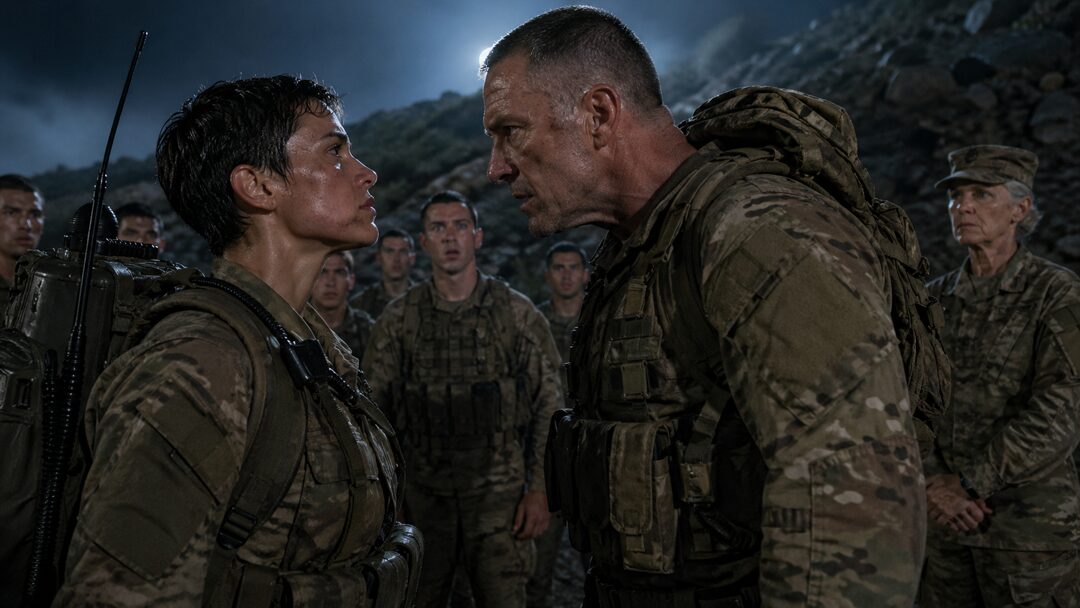
Mara wiped blood from the corner of her mouth with the back of one glove. “No, Sergeant.”
A low sound went through the team.
Holt’s head tilted.
“What did you say?”
“The radio fails without the battery.”
“You’re slowing the team.”
“I’ll keep pace.”
“You can’t.”
“I will.”
Holt stepped closer.
“Drop the pack, Vance.”
Mara felt every eye on her. The same heat as the yard. The same waiting. Only now the dark made everyone braver in their silence.
Her shoulder shook once.
She locked it down.
“No.”
Holt’s face twisted, not with surprise this time, but something almost like panic.
“That’s an order.”
“This is an extraction exercise,” Mara said. “The radio is part of the mission.”
“You don’t get to decide mission priority.”
“You assigned it to me.”
The words landed.
Diaz looked sharply at Holt.
Even Webb lifted his head.
Holt closed the distance in two strides and reached for her arm.
His fingers touched the same bruised place.
“Sergeant.”
Captain Sloane’s voice cut through the dark.
Everyone froze.
She had come up the slope behind them without a sound, two observers trailing at a distance. Her face was unreadable in the red wash of covered light.
Holt’s hand remained on Mara’s arm for one second too long.
Then he let go.
Sloane looked at the place where his hand had been.
Then at Mara’s face.
Then at Holt.
“Explain,” she said.
Holt straightened. “Recruit Vance is compromising team movement and refusing a direct order.”
“Was the order mission-sound?”
“She’s injured.”
“Did she request relief?”
“No.”
“Did the team lose radio function?”
“No, ma’am.”
“Then explain again.”
Holt’s jaw worked.
Mara stood under the weight of the pack and felt the battery pressing into her spine like a second heartbeat.
Sloane turned to her.
“Recruit Vance. Are you able to continue?”
“Yes, ma’am.”
“Is your judgment impaired?”
“No, ma’am.”
“Why refuse the order?”
Mara could have said because he wants me to fail.
She could have said because he grabbed me again.
She could have said because you saw it this time.
Instead, she looked at Holt.
“Because he told me to abandon the thing he made my responsibility.”
Sloane’s eyes sharpened.
That was when Holt said, “This is exactly how it starts.”
His voice was low, roughened at the edges.
Mara turned.
Holt was no longer looking at Captain Sloane. He was looking at Mara like the hill had disappeared and another night had replaced it.
“Little bit of pride,” he said. “Little bit of weight you think makes you noble. Then an order comes down from someone who won’t bleed for it, and you carry it anyway.”
Sloane’s expression tightened.
“Holt,” she warned.
But Mara heard the break in the air.
She understood that they were no longer talking only about the pack.
Diaz understood too. His eyes moved from Holt to Sloane and back again.
Mara adjusted the strap on her shoulder.
“Say his name,” she said.
No one moved.
Holt stared at her.
Sloane’s voice came colder. “Recruit Vance.”
Mara did not look away from Holt. “Say my brother’s name.”
“That is enough,” Sloane said.
“No, ma’am,” Mara said, and the word no shook through the line harder than any shout. “It isn’t.”
The night seemed to hold its breath.
Holt’s hands curled at his sides.
“Your brother has nothing to do with this exercise.”
“Then say his name.”
“Vance.”
“My name is Vance.”
Holt flinched.
Not much.
Enough.
Sloane stepped between them halfway, not blocking Mara, not protecting Holt, but claiming the space.
“This is not the place,” she said.
Mara finally looked at her.
The captain’s face was controlled, but there was something behind her eyes that had been there since morning. Not ignorance. Not surprise.
Memory.
“You signed the report,” Mara said.
Sloane did not answer.
That was answer enough.
The platoon shifted. A few recruits looked at one another. What had been a training failure had become something else, something older and heavier than any pack on the ridge.
Holt’s voice came out like gravel.
“You don’t know what you’re asking.”
Mara looked back at him.
“I’m asking you to say the name you’ve been punishing me for carrying.”
Part IV — The Name
For a long moment, the ridge gave them nothing but wind.
Holt stared at Mara as if he could still order the past back into its grave.
Then he laughed once.
It was not humor. It was a sound made by a man discovering there was nowhere left to stand.
“You want the name?” he said.
Mara did not move.
Holt looked toward Captain Sloane. “You want it said in front of them?”
Sloane’s mouth tightened. “Sergeant.”
“No, ma’am. She asked.”
His voice rose, not to shout, but to survive being heard.
“Eli Vance.”
Mara’s throat closed.
The name did not sound the way it had in her mother’s kitchen. It did not sound like Eli stealing fries off her plate, Eli singing badly in the truck, Eli telling her not to wait up because he would be home late.
In Holt’s mouth, the name sounded like a door being forced open.
“Corporal Eli Vance,” Holt said. “Brave. Stubborn. Too calm for his own good.”
Mara’s fingers tightened on her pack straps.
“He followed orders,” Holt continued. “He carried weight that wasn’t his because someone told him the mission needed it. He stayed with a radio pack during a retreat because without it, no one knew where we were. He did everything right.”
His eyes shone in the red light, but his voice stayed hard.
“And he still came home sealed.”
No one in the platoon moved.
Even the night seemed disciplined now.
Holt pointed at Mara’s pack.
“You think that battery proves something? You think pain makes you real? That’s what they tell you. Carry more. Bleed quiet. Call it honor.”
His face bent with anger, but the anger had lost its target.
“I watched your brother believe that.”
Mara felt the pack dragging her backward. Felt the bruise under her sleeve. Felt Eli’s notebook under her mattress miles away, thin pages full of things he had not said.
She had imagined this moment a hundred ways without admitting it.
In some versions, the man who knew Eli apologized.
In some, he told her Eli had not been afraid.
In the worst ones, he told her Eli had died for nothing.
Holt gave her none of those.
He gave her a warning shaped like a wound.
“You should go home,” he said. “Hate me if you want. But go home breathing.”
Something in Mara softened.
Not toward him.
Toward the truth that grief could make even cruelty believe it was mercy.
Then it hardened again.
Because understanding was not surrender.
She stepped closer.
The pack shifted; pain flared through her shoulder. She let it. She wanted the pain present. She wanted every person there to see what Holt had tried to make private.
“My brother was not a warning label,” she said.
Holt’s face changed.
Mara’s voice stayed level.
“You don’t get to use his death to make my life smaller.”
Sloane said nothing.
Mara turned slightly so the platoon could hear her without needing to lean.
“I didn’t come here because I think war is clean. I didn’t come here because I think a uniform makes grief useful. I came because after Eli died, every person who loved him started speaking around him like his name was a wound they could protect by not touching.”
Her eyes found Holt again.
“You did the same thing. You just called it discipline.”
Holt looked away.
It was the first time he had done that.
Mara felt her own fear rise then, quick and ugly. Not fear of Holt. Fear of needing these words and not being able to take them back. Fear that speaking would break the only strength she had trusted.
But silence had not saved her.
It had only made room for other people to decide what her pain meant.
She looked down at the bruise darkening beneath the edge of her sleeve. Four fingers. One thumb. A map of someone else’s control.
Then she looked at Holt.
“You don’t get to save me by breaking me.”
The line landed quietly.
That made it worse.
No one could pretend she had shouted from panic. No one could call it hysteria or attitude or loss of control. She had spoken like a soldier giving a true report.
Holt’s mouth opened.
Nothing came out.
Captain Sloane stepped fully into the space then.
“Sergeant Holt,” she said, “you are relieved from direct command of Red Team pending review.”
Holt turned toward her. “Captain—”
“That was not a request.”
His face went red, then gray.
For one second, Mara thought he might refuse. The whole ridge seemed to wait for it. But Holt had spent his life inside command. Even damaged, even furious, he knew the shape of an order.
He stepped back.
Sloane looked at one of the observers. “Take over supervision.”
Then she turned to Mara.
Her voice lowered, but not enough to become private.
“Recruit Vance, can you complete the exercise?”
Mara’s shoulder throbbed. Her legs trembled. Her throat felt scraped raw from words she had held too long.
“Yes, ma’am.”
Sloane held her gaze.
Not kindly.
Not cruelly.
Honestly, and that almost hurt more.
“Then complete it.”
Part V — Half the Weight
They finished the ridge without Holt’s voice behind them.
At first, that silence felt impossible.
The platoon moved cautiously, as if everyone expected him to reappear from the dark and punish them for breathing wrong. The observer assigned to Red Team gave only necessary instructions. No insults. No performances. No hands on anyone.
That made the exhaustion clearer.
By the ninth mile, Mara’s shoulder had become a separate animal, biting with each step. The radio battery dug into her spine. Her fingers had gone numb around the straps.
Nobody spoke about what had happened.
Not Webb.
Not the recruits who had laughed in the yard.
Not Diaz, who kept drifting closer and then away again like he was trying to decide what courage cost.
The simulated casualty point sat below the final rise: a weighted dummy half-covered by a tarp near a dry creek bed. They secured it fast, clumsy but functional, and began the last march toward base.
Mara bent to lift her share of the litter.
Her shoulder failed.
Only for a second.
Only enough that the litter tilted.
Webb cursed. “Hold it.”
Mara reset her grip before Holt’s voice could rise in her mind.
I will.
I will.
I will.
Then Diaz stepped beside her and took the front of the radio battery harness.
Mara looked at him.
He didn’t look back.
“Strap’s uneven,” he said.
“It’s fine.”
“It’s not.”
“I said it’s fine.”
Diaz finally met her eyes. His face was pale with fatigue. Mud streaked one cheek. He looked scared of her refusal, scared of being seen helping, scared of what kind of man he would be if he let go.
“Vance,” he said quietly. “Let me carry half the damn weight.”
The words were not pity.
That was why she allowed them.
Together, they adjusted the harness so the battery load split between them with an awkward cross-strap. It slowed them for twenty seconds. No one complained.
Mara felt the weight shift.
Not disappear.
Just shift.
That difference nearly undid her.
They walked.
The eastern sky began to pale near the last mile. Black turned blue. Blue turned gray. Shapes returned to the world one at a time: scrub brush, fence line, watchtower, the distant square geometry of the base.
Mara had expected dawn to feel like victory.
It did not.
It felt like consequence.
At the final checkpoint, Captain Sloane waited with a clipboard she did not look at. Holt stood twenty yards behind her, separated from the platoon by two observers and a silence no rank could cross.
He looked older in daylight.
Not harmless.
Never that.
But smaller than he had looked in the yard.
Red Team crossed the line at 0542.
Within standard.
Barely.
No one cheered. They were too tired, and maybe cheering would have been too simple.
Sloane dismissed the platoon to water and medical checks. Her eyes found Mara’s arm, the bruise now dark and undeniable.
“You will have that documented,” Sloane said.
“Yes, ma’am.”
“And your shoulder.”
“Yes, ma’am.”
The captain looked toward Holt, then back at Mara.
“There will be questions.”
Mara almost laughed.
There had always been questions. People just preferred the ones that did not cost anything.
“Yes, ma’am,” she said again.
Sloane held her there for another moment.
“I signed the report,” she said.
Mara went still.
Behind them, recruits moved slowly toward the water station, pretending not to listen. Diaz stood a few feet away with the radio harness still in one hand.
Sloane’s voice stayed controlled. “I believed then that naming every failure would damage the families more.”
Mara looked at her.
“And now?”
A small muscle moved in Sloane’s jaw.
“Now I think silence protects the living who can still be embarrassed.”
It was not an apology.
Maybe it was the closest a person like Sloane could come to one before breakfast.
Mara nodded once.
Not forgiveness.
Acknowledgment.
Across the yard, Holt looked at her.
For the first time, he did not look like he was trying to drive her away.
He looked like he wanted to say something and no longer trusted his own reasons.
Mara did not go to him.
Some distances were not hers to close.
Part VI — Inside the Jacket
The barracks smelled like wet socks, antiseptic, and bodies too tired to pretend they were made of discipline.
Mara sat on the edge of her bunk while a medic wrapped her shoulder and photographed the bruising on her arm. The flash made the finger marks look worse, more clinical, less like something she had survived and more like something that had happened to evidence.
When the medic left, the room stayed quiet.
That was new.
No muttered blame. No cheap jokes. No one saying thanks, Vance, like her name was a punishment.
Webb passed her a bottle of water without looking at her.
It was not much.
It was not nothing.
Diaz sat on the opposite bunk, elbows on knees, staring at the floor.
“You know,” he said, “I was going to help earlier.”
Mara unscrewed the bottle cap. “I know.”
He looked up, surprised.
She drank. The water tasted like metal and dust.
Diaz rubbed both hands over his face. “That makes it worse.”
“Yes.”
He gave a tired laugh without humor. “You always this comforting?”
“No.”
“Special occasion?”
Mara glanced at him. “You carried half.”
“At the end.”
“At the end counts.”
Diaz nodded slowly, as if accepting a sentence he had not known he needed.
When lights-out came again, Mara waited until the room settled. Then she reached beneath her mattress and pulled out Eli’s notebook.
Her hands moved carefully over the old cover.
For a moment, she thought of Holt saying Eli’s name on the ridge. Thought of how badly she had wanted it. Thought of how little it fixed.
A name could break silence.
It could not raise the dead.
She opened to the back cover and slid one finger under the loose stitching. The patch came free with a soft tug: black ridge, silver star, fraying edge.
Ugly little thing.
Heavy as bone.
For months, she had imagined wearing it where people could see. Not for attention. For proof. For Eli. For herself. For anyone who looked at her and saw only a recruit trying to inherit a man’s uniform.
But now, in the dark barracks, with her arm bruised and her shoulder wrapped and the future no cleaner than it had been yesterday, she understood something she had not understood before.
Not every promise needed witnesses.
Mara took a small sewing kit from her locker, the kind recruits used for emergency repairs. Her left hand was clumsy, her right shoulder stiff, but she worked slowly, threading the needle under the dim light near her bunk.
Diaz saw her from across the aisle.
He said nothing.
One stitch.
Then another.
She sewed the patch inside her jacket, beneath the left breast, where regulation would not display it and strangers would not question it. The needle pricked her finger once. A bead of blood rose. She wiped it away on the inside seam.
By the time she finished, dawn had become full morning beyond the narrow windows.
Outside, the base was already waking. Boots on gravel. Distant commands. Metal doors opening and closing. The machine had not stopped.
Mara held the jacket in both hands.
Then she put it on.
The patch rested where no one could see it.
Close enough to carry.
Hidden enough to belong to her.
At formation that morning, Holt was not there.
Captain Sloane stood in his place.
Her gaze moved across the platoon, over Webb, over Diaz, over Mara’s bandaged shoulder and squared stance.
“Training continues,” Sloane said.
No comfort. No grand speech. No promise that the institution had cleansed itself overnight.
Just that.
Training continues.
Mara felt the words settle.
Not as threat.
Not as triumph.
As fact.
Sloane’s eyes rested on her for half a second longer than regulation required.
Mara did not salute early. She did not smile. She did not look away.
Behind her, Diaz shifted into line. Beside him, Webb straightened his shoulders. Around her, the platoon stood in the same dust where they had once watched her be grabbed and said nothing.
The dust had not changed.
The base had not changed.
The dead had not returned.
But when the morning command came and the platoon moved forward, Mara moved with them.
Not because Holt had failed to break her.
Not because Sloane had finally seen.
Not because Eli’s name had been spoken aloud under a cold ridge sky.
She moved because her life had not been handed back to her.
She had taken it.
And inside her jacket, hidden against her heart, the old patch moved with every step.