The Meal Left at the Wall
Part I — The Coffee Stain
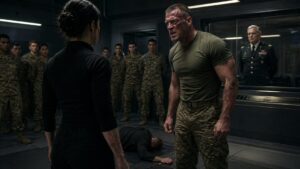
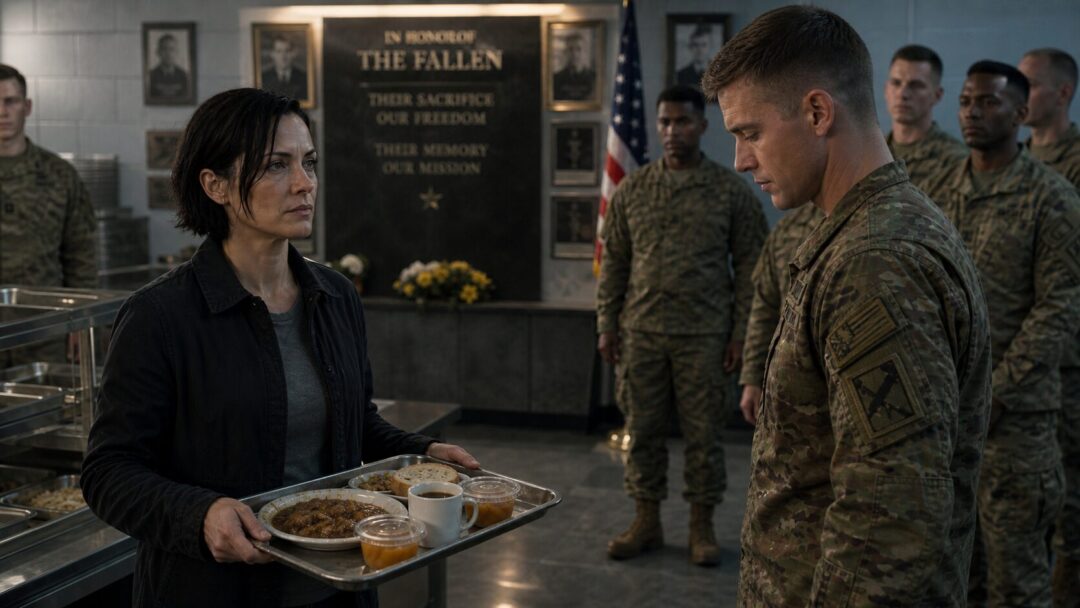
The whole mess hall watched when Corporal Dane Rusk took the white paper cup from his tray and poured hot black coffee over the woman’s food.
It happened fast.
One second, she was standing at the end of the serving line in a dark civilian field jacket, holding a metal tray with bread, stew, coffee, and two sealed fruit cups.
The next, coffee was running across the tray, dripping off the edge, soaking into her gray sleeve.
No one moved.
Not the soldiers seated shoulder to shoulder at the long tables.
Not the cooks behind the counter.
Not the lieutenant near the water dispenser, who saw the whole thing and suddenly became very interested in the floor.
The woman did not gasp.
She did not drop the tray.
She did not slap Dane, curse him, or ask him what was wrong with him.
She only looked down once, as the coffee crawled toward the two fruit cups, then lifted her eyes back to him.
That silence made the room worse.
Dane smiled like he had just won something.
“Sorry,” he said, loud enough for the nearest tables to hear. “Didn’t see you there.”
The woman’s jaw tightened.
Coffee dripped from her sleeve onto the concrete floor.
Dane leaned closer. He was young, twenty-four maybe, lean and sharp with a close-cropped head and a uniform he wore like armor. His hands were restless, his eyes too bright. The kind of soldier who looked for threats even in a cafeteria.
“War tourists get priority now?” he asked. “Contractors eat before the people who actually bleed?”
A few soldiers looked away.
A few kept watching.
That was worse too.
The woman’s face stayed still, but not empty. She looked like someone holding a door shut from the inside.
Her name was Mara Vale, though almost no one in that room knew it.
To them, she was just a civilian woman standing in the wrong place at the wrong time, with coffee on her sleeve and a ruined tray in her hands.
Mara lowered the tray to keep the liquid from spilling farther.
Then one of the fruit cups slid off the corner.
It hit the floor with a soft plastic crack.
She bent immediately.
That was the first thing that changed the room.
Not the coffee.
Not the insult.
The fruit cup.
Mara set the tray carefully on the nearest table and crouched to retrieve it, moving with a controlled urgency that made several soldiers look closer. She picked up the sealed cup, checked for a split in the plastic, and held it in her palm as though it mattered more than the sleeve, more than the mess, more than the humiliation.
Dane laughed once.
“You serious?” he said. “You’re worried about dessert?”
Mara stood.
She placed the fruit cup back on the tray beside the other one.
Then she said quietly, “That wasn’t mine.”
The words were so calm they almost disappeared beneath the clatter of trays and forks.
But Dane heard them.
His smile hardened.
“What, the food?” he said. “Relax. I’m sure command will reimburse you.”
Mara looked at him then.
Not with fear.
Not with anger, exactly.
With recognition.
Dane did not like it.
“You know,” he said, turning slightly so the room could hear, “some of us don’t get to fly in, collect hazard pay, write clean reports, and leave.”
The mess hall became very still.
Everyone knew what he was talking about.
No one said the name yet.
Operation Lantern had left a bruise on the base that had never fully faded. Four dead on a failed extraction. A convoy burned out beyond the ridge. A report nobody quoted unless they had to. A memorial wall outside the mess hall with names polished by hands that pretended not to tremble.
Mara’s fingers curled around the edge of the tray.
Dane saw the motion.
He thought it was guilt.
He stepped closer.
“My brother died out there,” he said. “Sergeant Ellis Rusk. Maybe you read his name in one of your files.”
Mara did not blink.
But something in her face moved inward.
Dane caught it.
His voice dropped, more dangerous now because it stopped performing.
“They said a medic left him.”
The mess hall did not breathe.
Dane pointed at the stained tray.
“So forgive me if I don’t feel bad about your lunch.”
Mara looked down at the tray again.
Bread dark with coffee.
Stew watered thin.
Two sealed fruit cups sitting clean at the edge, one dented from the fall.
Then she looked back at Dane.
“It still wasn’t mine,” she said.
Part II — The Name on the Wall
Lieutenant Grant appeared beside them with the stiff panic of a man trying to control a fire without calling it fire.
“That’s enough,” he said.
Dane did not look at him.
Mara did.
The lieutenant was young, clean-faced, and already sweating under the fluorescent lights. He glanced at her civilian jacket, at the stain on her sleeve, at the soldiers watching from every table.
“Ma’am,” he said, lowering his voice as if discretion had not already died in the room, “I think it’s best if you step outside.”
Mara’s eyes stayed on his.
“Why?”
The question was soft.
It landed hard.
Grant hesitated.
Dane gave a humorless laugh. “Because you’re making people uncomfortable.”
Mara turned her head slightly. “I am?”
Nobody answered.
That silence had rank.
It had a uniform.
It had been trained to stand at attention.
Grant cleared his throat. “This is a military dining facility. If there’s an issue, we can address it through proper channels.”
Mara looked at the coffee dripping from her sleeve.
“Proper channels,” she repeated.
The phrase did something to the air.
At the far end of the room, someone set down a fork too loudly.
Dane’s mouth twitched.
“You got something to say?” he asked her.
Mara lifted the tray.
The coffee had pooled in one corner. She balanced it with the care of someone carrying something breakable, though everything on it already looked ruined.
“I came to place this outside,” she said.
Grant frowned. “Outside where?”
Mara looked toward the mess hall doors.
Beyond them, across a strip of hard-packed dust and gravel, stood the memorial wall.
Everyone knew it.
Nobody looked at it during meals if they could help it.
A low stone wall. Bronze plaques. Names. Dates. A small shelf where soldiers sometimes left coins, unit patches, cigarettes, prayer cards, torn photographs, letters folded too many times.
Dane followed her gaze.
His face changed before he could stop it.
Mara saw.
So did half the room.
“You don’t get to touch that wall,” Dane said.
It came out raw.
Grant shifted. “Corporal.”
“No.” Dane pointed at Mara. “No, she does not get to walk in here, play civilian, take food off our line, and leave some fake little tribute like she knew him.”
Mara’s grip tightened on the tray.
Dane’s voice rose. “You didn’t know him.”
Mara said nothing.
That was the wrong answer.
Dane stepped close enough that Grant moved as if to block him, then thought better of putting hands on a grieving soldier in front of a crowd.
“You hear me?” Dane said. “You didn’t know my brother.”
Mara’s eyes moved from Dane’s face to the name tape on his chest.
RUSK.
For one second, the mess hall disappeared.
There was no fluorescent light.
No metal trays.
No coffee.
Only mud under her knees, smoke pressing low against the ground, and a man’s hand closing around her wrist with impossible strength.
Not yet.
She forced the memory down.
In the present, Dane was still waiting.
Mara said, “He was thirty-one.”
Dane froze.
The room sharpened.
Mara looked at the tray, not at him.
“He hated powdered eggs,” she said. “He traded them away unless someone made him eat in front of them.”
Dane’s jaw worked once.
Mara continued, voice steady. “He carried pepper packets in his left breast pocket because he said military cooks believed seasoning was a rumor.”
A soldier near the back covered his mouth.
Dane turned on him. “Shut up.”
The soldier dropped his eyes.
Mara should have stopped.
She knew she should have stopped.
But the coffee was spreading into the bread, and the fruit cup was dented, and Dane had said she did not know him.
“He had a glove missing,” she said. “Right hand. Said he lost it in a bet but nobody believed him.”
Dane stared at her.
His anger did not vanish.
It lost its footing.
Grant looked between them. “Ma’am, who are you?”
Mara opened her mouth.
Before she could answer, a voice from behind the crowd said, “Staff Sergeant Vale.”
The title cut through the mess hall like a rifle bolt sliding home.
Every soldier turned.
Colonel Abram Shaw stood near the center aisle, tall and silver-haired in pale camouflage, his face carved into the kind of control men mistook for certainty.
He had been there the whole time.
Watching.
Mara knew that before she saw him.
Of course he had been there.
Of course command had seen the spill before it became a problem.
Shaw walked forward slowly, and the room adjusted around him. Soldiers stood straighter without being told. Grant’s shoulders snapped back. Dane took half a step away from Mara before he seemed to realize he had moved.
Shaw stopped in front of her.
His gaze went first to the tray.
Then to her stained sleeve.
Then to her face.
“Staff Sergeant Vale,” he said again, quieter now.
Mara did not salute.
She was not in uniform.
She had earned that small freedom.
“Colonel Shaw,” she said.
The title changed Dane’s expression completely.
Not because he recognized Shaw.
Everyone recognized Shaw.
Because now he recognized Mara.
Not fully.
But enough.
Dane looked at her civilian jacket as if it had lied to him.
“You were Lantern,” he said.
Mara did not answer.
Shaw did.
“She was the medic on the second vehicle.”
Dane’s face went pale under the mess hall lights.
The room was no longer watching a woman get humiliated.
It was watching a mistake discover itself in public.
Part III — The Morale Version
Colonel Shaw turned toward Dane.
“Corporal Rusk,” he said, “you will step back.”
Dane did.
Barely.
His hands hung stiff at his sides. For the first time since the coffee spill, he looked young.
Shaw faced the room.
“Everyone return to your meals.”
No one did.
Orders could move bodies.
They could not always move attention.
Mara shifted the tray in her hands. Coffee ran toward her wrist.
Shaw saw it.
Something like regret crossed his face and disappeared before it could be named.
“My apologies,” he said, voice formal enough to belong in a report. “You should not have been treated this way.”
He extended his right arm.
Not a handshake exactly.
A soldier’s clasp. Forearm to forearm.
Recognition. Respect. Public correction.
The room waited for her to take it.
For one dangerous second, Mara wanted to.
Not because it would heal anything.
Because it would end the moment.
She could accept Shaw’s arm, let the room feel absolved, carry the ruined tray outside, place what was left of it by Ellis’s name, and leave before anyone asked her to bleed where they could see it.
She had survived years by knowing when to leave.
Instead, Mara looked at Shaw’s offered arm.
Then she looked at his face.
“Which Lantern report do they teach now?” she asked.
Shaw’s hand stayed extended.
The room heard every word.
Grant’s eyes widened.
Dane stared at Mara.
Shaw lowered his arm slowly.
“Staff Sergeant,” he said.
“That wasn’t an answer.”
His jaw tightened.
Mara kept her voice level. “Do they teach the report as filed, or the morale version?”
The mess hall changed again.
Not louder.
Lower.
As if the building itself had leaned closer.
Dane looked from Mara to Shaw. “What does that mean?”
Shaw did not look at him. “This is not the place.”
Mara almost smiled.
There was no humor in it.
“That’s what the letter said too.”
Shaw’s eyes flicked.
Dane caught that.
“What letter?”
Mara looked down at the tray.
The bread was gone soft and black in the center. The stew had thinned into brown water. The two fruit cups remained sealed.
She had managed that much.
Shaw stepped closer, lowering his voice. “Mara. Submit what you need to submit through channels.”
Through channels.
The words reached for her like hands.
She remembered the envelope returned in a brown interoffice sleeve. Her own handwriting on the front. Dane Rusk’s family name typed on a routing note. Three red words stamped across the top.
UNDELIVERED. COMMAND REVIEW.
She had opened it sitting in her car outside a veterans’ clinic, still in scrubs, with an old burn scar aching on her wrist like it knew what paper could do.
Inside was the letter she had written to Ellis’s mother.
And Dane.
And whoever had loved him enough to need more than a folded flag and a sentence about courage.
Mara looked at Dane.
“I tried to tell your family,” she said.
Dane’s throat moved.
Shaw said, “Careful.”
That single word broke something small and final.
Mara turned to him.
“No,” she said. “I was careful for seven years.”
No one moved.
Mara set the tray down on the nearest table.
The sound of metal on metal traveled across the room.
She removed the dented fruit cup and placed it upright beside the other one.
Dane watched her fingers.
They were steady.
That seemed to frighten him more than shaking would have.
Mara said, “Your brother did not die because I panicked.”
Dane swallowed. “Then how?”
Shaw said, “Corporal—”
“How?” Dane demanded, not taking his eyes off Mara.
Mara looked toward the mess hall doors, toward the wall she had come for.
Then back at Dane.
“Your brother ordered me to leave him.”
Dane flinched like she had struck him.
“No.”
“Yes.”
“No.” His voice cracked. “Ellis wouldn’t—”
“He did.”
“You’re lying.”
Mara accepted that without expression.
Dane stepped toward her again, but this time there was no swagger in it.
There was only a younger brother reaching the edge of the story he had used to survive.
“He wouldn’t tell someone to leave him.”
Mara’s face changed then.
Only a little.
Enough.
“He told me to leave because three others were still breathing.”
The room became impossibly quiet.
Not respectful yet.
Not clean.
Just quiet.
Mara’s eyes did not leave Dane’s.
“He was pinned under the axle housing. Left leg crushed. Pelvis broken. Bleeding inside. I had one tourniquet left and two men behind the second vehicle screaming my name.”
Dane’s lips parted.
Mara did not give him the battlefield.
Not all of it.
Not the smell.
Not the sound of metal cooling after fire.
Not Ellis’s teeth flashing white through mud when he smiled because he knew she was calculating impossible odds and needed him to make it easier.
She gave him only what mattered.
“He grabbed my wrist,” she said. “Hard enough to leave bruises. He said, ‘Vale, if you waste time making my death prettier, I’ll haunt you.’”
A sound moved through the room.
Not laughter.
Memory of it.
Dane looked down.
Mara touched the burn scar at her wrist without noticing.
“He asked if the mess hall still had stew on Thursdays,” she said.
Dane closed his eyes.
“He said, ‘Coffee. Bread. Stew. Two fruit cups.’”
Her voice thinned but did not break.
“Then he said, ‘Tell them I’m still picky.’”
Dane’s hand went to his mouth.
He turned away as if there were somewhere in that room to hide from the sentence.
There was not.
Mara looked at the tray.
“That was his meal,” she said. “Not mine.”
Part IV — The Letter That Came Back
Dane sat down because his knees seemed to make the decision before he did.
No one laughed.
No one whispered.
The mess hall had become too small for the number of people inside it.
Shaw stood with his hands behind his back, posture perfect, face unreadable except for the tightness around his eyes.
Mara knew that look.
Command sorrow.
It had limits.
It grieved what it could afford.
Dane’s voice came out low. “Why didn’t anyone tell us?”
Mara did not answer at first.
She looked at Shaw.
So did Dane.
That was the first time the room’s judgment turned away from her.
Shaw inhaled slowly.
“The official report stated Sergeant Rusk was unrecoverable under hostile fire,” he said. “It did not include all field dialogue.”
Dane stared at him.
“All field dialogue,” he repeated.
Mara’s mouth tightened.
There it was.
The language that cleaned blood off truth without touching either.
Dane stood again. “You mean his last words.”
Shaw’s eyes moved to him.
“I mean the report was written for operational clarity.”
Mara said, “It was written to avoid saying he was alive when I left.”
The line landed harder than any shout.
Shaw turned to her. “And to avoid making a dead sergeant’s family believe he was abandoned.”
“But they did believe that,” Mara said.
Shaw said nothing.
Dane looked between them, breathing too fast.
Mara could see his old story dying. Not peacefully. Not all at once. It clawed at him.
He needed her to be the villain because villains were easier to hold than unanswered orders.
“You wrote us?” he asked.
Mara nodded once.
“When?”
“Three weeks after I came stateside.”
Dane’s face tightened with something more painful than anger.
“We never got a letter.”
“I know.”
“How do you know?”
“Because it came back.”
Shaw’s expression changed.
Just enough.
Dane saw it.
Mara reached into the inside pocket of her field jacket.
Grant half stepped forward, then stopped, ashamed of himself.
Mara pulled out a folded envelope, soft at the edges from years of being carried and put away and carried again. It had been opened and resealed once. The paper had yellowed along the crease.
She did not hand it to Dane.
Not yet.
She placed it beside the ruined tray.
Dane stared at his family name written in her hand.
Rusk Family.
Below it, an old address.
Across the top, faded but visible, the red stamp.
UNDELIVERED. COMMAND REVIEW.
Dane looked at Shaw.
Every soldier in the room looked with him.
Shaw’s voice was quiet. “I was not the only officer involved in that review.”
Mara almost laughed.
Not because it was funny.
Because it was familiar.
Responsibility diluted until no one had enough of it to hold.
“But you were one of them,” she said.
Shaw did not deny it.
Dane touched the edge of the envelope as if it might burn him.
“What does it say?”
Mara’s eyes lowered.
“The truth,” she said. “As much as I could write without making your mother read a battlefield.”
Dane’s hand hovered over the paper.
He did not open it.
Not in front of the room.
That restraint was the first decent thing he had done all afternoon.
“I hated you,” he said.
Mara nodded.
“I know.”
“I didn’t even know your name.”
“I know that too.”
Dane looked at the coffee stain on her sleeve.
His shame came late.
That did not make it smaller.
“I poured coffee on his meal.”
Mara said nothing.
He looked at the fruit cups, one dented, one clean.
“He would’ve hated that,” Dane whispered.
This time, a faint sound did leave Mara.
Not a laugh.
Not quite.
“No,” she said. “He would’ve said you owed him two.”
Dane covered his face with both hands.
For a moment, he was not a corporal. Not a grieving younger brother. Not the man who had turned pain into a weapon because someone had handed him the wrong target.
He was just a boy standing too late in front of what he had done.
Shaw stepped closer to Mara.
His voice dropped so only she and Dane could clearly hear.
“Mara, let me handle this now.”
She looked at him.
There had been a time when she would have been relieved by that sentence.
A commander taking over.
A superior absorbing the blast.
A door closing.
But all she heard was another version of leave him.
Another version of not here.
Another version of later.
She looked at the envelope.
At the tray.
At Dane.
At the room full of soldiers who had watched a woman be shamed and waited for rank to tell them whether it mattered.
“No,” Mara said.
Shaw’s face hardened.
Not with anger.
With fear.
She understood that too.
Truth did not enter institutions quietly. It tracked mud across polished floors. It named people. It reopened files. It made young soldiers wonder what else had been cleaned for morale.
Mara lifted the tray again.
The ruined food shifted.
For a second, everyone thought she was leaving.
Instead, she walked to the center table in the mess hall and set it down where every person could see.
Then she picked up the dented fruit cup and placed it beside the envelope.
Her voice did not rise.
It did not need to.
“Sergeant Ellis Rusk,” she said. “Thirty-one years old. Squad leader. Operation Lantern. Final order given under fire.”
Dane stopped breathing.
Mara looked at him.
“Leave me and get the others out.”
The words did not echo.
They entered.
That was worse.
Part V — What the Room Chose
No one had ordered the soldiers to stand.
But one by one, some of them did.
Not all.
That mattered.
The story did not become clean just because truth had arrived.
A few soldiers stayed seated, frozen behind their trays, eyes down, as if shame required privacy. Others looked toward Colonel Shaw, waiting to see what courage was allowed.
Dane moved first.
He took his own tray from the table where he had left it. His food was untouched.
His hand shook as he picked up the sealed fruit cup.
For one second, he held it like he did not know what objects were for anymore.
Then he placed it beside the two on Mara’s tray.
Three fruit cups.
One dented.
Two clean.
He did not look at Mara when he said, “I don’t deserve to put that there.”
Mara answered, “No.”
The room tightened.
Then she said, “But he does.”
Dane’s face crumpled.
He nodded once, hard, and stepped back.
A soldier from the far table came forward with a piece of bread. He looked barely older than nineteen. He placed it on the tray and left without a word.
Then another brought coffee.
Not in a white paper cup.
In a metal mug.
He set it carefully away from the stain.
A woman with sergeant’s stripes added a sealed pepper packet. Her mouth trembled once before she pressed it flat.
Someone murmured, “He always had those.”
Someone else said, “Yeah.”
The room began to remember him in pieces.
Not speeches.
Pieces.
A glove missing.
Bad jokes.
Pepper packets.
Stew on Thursdays.
The way Ellis Rusk had once made half a convoy laugh by arguing with a radio that was not turned on.
Dane listened like a starving man being told his brother had not vanished after all.
Mara stood still beside the table.
She felt every added object as a weight leaving her and becoming heavier at the same time.
Grief shared was not lighter.
It was just no longer invisible.
Colonel Shaw had not moved.
Mara looked at him.
The room followed.
There it was again.
The power of attention.
Only now it did not belong to Dane.
It did not even belong to Mara.
It belonged to the truth sitting on a stained tray in the center of the mess hall.
Shaw removed his cap.
The gesture was small.
In that room, it was not.
He walked forward until he stood across from Mara, the tray between them.
His face had lost some of its command hardness. What remained looked older.
“The Lantern report was incomplete,” he said.
No one breathed.
Shaw looked at Dane.
“Your brother’s final order was omitted from the family summary and from the training version of the incident.”
Dane’s eyes were wet, but he did not wipe them.
Shaw turned slightly, addressing the room now.
“That omission allowed blame to settle where it did not belong.”
Mara looked down.
She had imagined this moment in uglier ways.
In courtrooms.
In offices.
In nightmares where nobody listened.
She had not imagined the smell of stew and coffee.
She had not imagined a room full of soldiers learning how silence sounded when it finally broke.
Shaw faced her.
“Staff Sergeant Vale,” he said, voice rougher now, “I failed to correct that.”
Mara’s throat tightened.
He extended his arm again.
This time, the gesture was not rescue.
It was not a performance of rank protecting rank.
It waited.
Mara looked at his hand.
Then at the tray.
Then at Dane, who stood beside his brother’s meal with his face open and ruined.
Mara clasped Shaw’s forearm.
His hand closed around hers.
The room did not cheer.
It would have been wrong if they had.
Instead, the soldiers stood in a silence that finally knew what it was for.
Mara held Shaw’s arm long enough for everyone to see.
Then she let go.
Dane stepped forward.
The apology was in his mouth. She saw it forming there, desperate and late.
She stopped him with a look.
Not cruelly.
Not kindly.
Just truthfully.
Some words existed to make the speaker feel cleaner.
She was not ready to carry those too.
Dane understood.
Or tried to.
He closed his mouth.
Mara picked up the tray.
It was heavier now.
Coffee.
Bread.
Stew.
Three fruit cups.
A pepper packet.
A returned letter.
And, finally, witnesses.
Part VI — The Wall at Dusk
Dane walked beside her to the memorial wall.
He did not ask if he could.
He simply followed at a careful distance, as though walking too close might become another kind of theft.
The sun had dropped low over the base, turning the dust gold in the harsh way evening did in places built for departure. Behind them, the mess hall doors stayed open. No one spoke loudly inside.
Mara carried the tray with both hands.
Her sleeve was still stained.
The coffee had dried dark along the gray fabric, stiff at her wrist. She could have rolled it up. She did not.
At the wall, she stopped in front of the plaque.
SERGEANT ELLIS RUSK.
The letters were clean.
Someone had polished them recently.
Dane stood behind her right shoulder, close enough to see, far enough not to claim the moment.
Mara lowered the tray onto the narrow shelf beneath his name.
The metal touched stone softly.
For seven years, she had done this alone when she could get access, or in memory when she could not.
Coffee.
Bread.
Stew.
Two fruit cups.
Tell them I’m still picky.
This year, there were three fruit cups.
A pepper packet.
A metal mug.
A letter that had finally reached the right hands, though not yet opened.
Dane stared at the envelope.
Mara saw him from the corner of her eye.
“You don’t have to read it now,” she said.
His voice was hoarse. “I don’t know if I can.”
“You can.”
He looked at her.
She kept her eyes on Ellis’s name.
“Just not all at once.”
Dane nodded.
A long silence passed between them.
There were many things he could have said.
I’m sorry.
I was wrong.
I didn’t know.
Please forgive me.
Mara was grateful he said none of them.
Not because they were false.
Because the dead deserved the first words.
Dane stepped forward.
He touched two fingers to his brother’s name.
For a moment, his face changed so completely that Mara could see the child he had been before grief gave him a uniform.
“He used to take both fruit cups from my tray,” Dane said.
Mara looked at him then.
Dane gave a broken half-smile.
“Said rank had privileges. He was sixteen.”
Mara almost smiled back.
Almost.
Behind them, Colonel Shaw stood in the doorway of the mess hall with Lieutenant Grant at his side. Shaw was speaking quietly, issuing orders that would become emails, calls, reopened files, angry meetings, corrected summaries, perhaps nothing enough.
But something.
Mara did not turn around.
She had spent too many years looking back at command.
This time, she looked at the wall.
Dane lowered his hand.
“Did he suffer?” he asked.
The question was a blade wrapped in cloth.
Mara could have lied gently.
She did not.
“Yes,” she said.
Dane closed his eyes.
Then Mara added, “But he was himself.”
Dane opened them.
“He was himself until the end.”
That was the mercy she could give.
Not a clean death.
Not a painless one.
A true one.
Dane took the envelope from the tray. He held it against his chest once, quickly, as if embarrassed by tenderness.
“I hated the wrong person,” he said.
Mara looked at the stain on her sleeve.
“You hated the person they left you.”
The words stood between them.
Neither of them touched them again.
At dusk, the base loudspeaker crackled somewhere far off. A vehicle engine turned over. The world continued with its usual disregard.
Mara remained at the wall until the light thinned and the bronze letters darkened.
Only then did she step back.
Dane stayed.
He did not ask her to stay with him.
That, too, was something.
Mara walked toward the gate alone.
Halfway there, she stopped beneath a security light and looked down at her sleeve.
The stain had dried into the fabric.
For a moment, she saw coffee.
Then mud.
Then Ellis’s hand around her wrist.
Leave me and get the others out.
For seven years, she had heard it as a sentence.
Tonight, for the first time, it sounded like what it had been.
An order.
A gift.
A wound no one had the right to make clean.
Mara rolled her sleeve down over the stain.
Not to hide it.
To carry it differently.
Behind her, at the memorial wall, Dane Rusk opened the letter his family should have received years ago.
Mara did not look back.
She kept walking until the base lights blurred behind her, until the night air cooled her face, until the meal he never ate was no longer hers alone.