The Portion Logged
Part I — The Plate Under the Dome
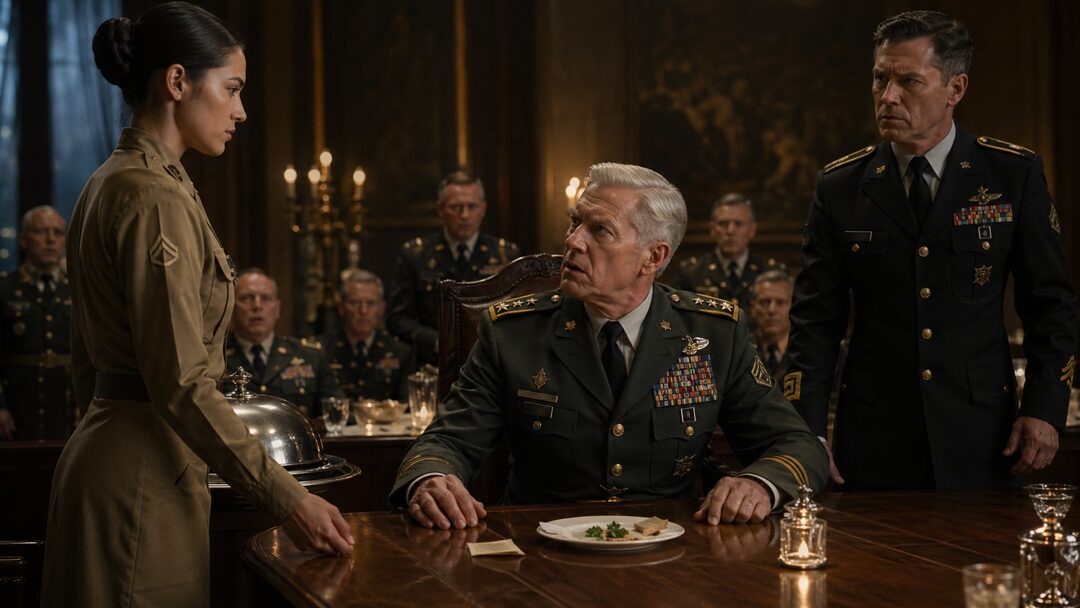
Mara Voss placed the silver dome in front of General Alder Venn with both hands steady, though every officer at the table was watching her now.
Founder’s Night had been running perfectly until then.
The white tablecloths were still uncreased. The brass candlesticks still burned in even rows down the center of the officers’ mess. Wine sat dark and untouched in crystal glasses. Every uniform in the room had been pressed so sharply it looked capable of cutting skin.
And at the head of the table, General Venn waited for the entrée everyone else had already smelled from the kitchen: rosemary beef, buttered roots, glazed onions, a sauce reduced for six hours by men and women who had eaten standing up behind the swinging doors.
Mara lifted the dome.
On the plate beneath it lay three wilted field greens and a ration cracker snapped cleanly in half.
The room lost its sound.
Not all at once. First the knife paused against a dish near the middle of the table. Then a chair creaked and stopped. Then the servers along the walls froze with platters in their hands, each one suddenly aware of their own breathing.
General Venn looked at the plate.
He was sixty-two, silver-haired, and dressed in a dark green uniform heavy with ribbons. The ribbons told the room what he had survived. The stars at his collar told the room what he could destroy. He had the kind of stillness men mistook for patience until it turned into punishment.
He did not look at Mara immediately.
That was worse.
He studied the greens, the broken cracker, the wide white emptiness around them. Then he lifted his eyes.
“Sergeant,” he said softly. “Is this supposed to be a joke?”
Mara’s tray rested against her left hip. Her tan uniform shirt was plain compared with the dress coats around her. No ribbons. No bright cords. Just a name tape, a service pin, and hair pulled into a knot so tight it had been aching since noon.
“No, sir,” she said. “This is the portion logged for Outpost Kestrel, day nineteen.”
The name moved through the room without anyone repeating it.
Kestrel.
Several officers looked down. One reached for his wine and failed to drink. A younger major at the far end blinked as if he had misheard.
General Venn did not move.
Colonel Ren Kade, seated two places to Venn’s right, did.
He pushed back his chair just enough for the sound to carry. Kade was forty-four, precise in his uniform, with tired eyes and a small scar at his chin. He had spent the first half of his career close enough to field dust to know its taste, and the second half close enough to power to forget he knew.
“Sergeant Voss,” he said, each word clipped, “remove the plate.”
Mara kept her eyes on the general.
“Report yourself after service,” Kade added.
Her fingers tightened once against the tray. Once, and no more.
“Would you like the dinner record corrected before or after the toast to logistical excellence, Colonel?”
Someone drew in a breath.
The kind of breath people take when a weapon appears in a room where no one is supposed to be armed.
Kade stared at her then. Really stared.
For the first time that night, his expression changed.
Not anger.
Recognition.
General Venn laid his hands on either side of the plate, careful not to touch it.
“Sergeant,” he said, “you are standing in the officers’ mess on Founder’s Night.”
“Yes, sir.”
“You are addressing senior command during a ceremonial dinner.”
“Yes, sir.”
“You understand that?”
Mara glanced at the plate.
Three greens.
Half a cracker.
Too small to be a meal. Too exact to be a mistake.
“Yes, sir,” she said. “That is why I brought the correct portion.”
The room remained silent, but it was no longer empty silence.
It had weight now.
It leaned toward her.
Part II — Logistical Excellence
The first course had gone out cleanly. Soup poured without spilling. Bread set to the left. Wine filled to the proper line. No one in the dining room had known Mara carried a second plate wrapped in linen beneath the service cart.
That was the only way it could work.
Ceremony had rules. Mara knew them better than most of the men seated at the table, because men with stars rarely learned the labor underneath a flawless evening. They knew where to sit, when to stand, when to raise a glass. Mara knew how long soup could sit before skin formed on it. She knew which colonel disliked pepper. She knew which general would send back coffee if the cup handle pointed wrong.
She knew how to disappear.
For eight years, disappearing had been part of her job.
Tonight, she had used it.
“Colonel Kade,” General Venn said without looking away from Mara, “take the sergeant aside.”
Kade’s chair slid back farther.
Mara did not move.
“Sir,” she said, “permission to complete service.”
Venn’s eyebrows lifted a fraction. “Denied.”
“The entrée before you is logged and accounted for.”
A few officers shifted. The word logged had done it. It was a small word, a dull word. A word from forms and supply sheets and boxes with numbers stenciled on them.
Mara had learned that dull words could cut deeper than dramatic ones.
Venn’s voice lowered. “This is not a field kitchen.”
“No, sir.”
“This is not a grievance office.”
“No, sir.”
“Then remove that from my table.”
Mara looked down at the plate again, as if confirming its contents.
“Three field greens. One half standard grain cracker. No protein supplement. No potable water issued at meal call.” Her eyes lifted. “Outpost Kestrel, day nineteen.”
Kade stepped toward her.
“Mara,” he said under his breath.
It was the first time he had used her name.
She turned just enough to look at him.
“Colonel?”
His face was controlled, but something behind it had started to slip. “Not here.”
That almost made her smile.
Not here was what men said when they meant not ever.
Around them, the other servers waited along the wall with plates of roasted meat cooling in their hands. The smell had become unbearable. Butter. Salt. Wine. Heat.
At the head table, General Venn looked down the length of the room.
“Ladies and gentlemen,” he said, his voice regaining the smooth public tone Mara had heard on memorial broadcasts, “there appears to be a service error. We will proceed.”
He lifted his wineglass.
A few officers moved to follow.
Mara spoke before the first glass rose.
“Sixteen tins short.”
The glass stopped halfway to Venn’s chest.
Mara’s voice remained quiet. It did not need to be loud. Quiet forced people to listen harder.
“Water tablets expired. Field oven never delivered. Medical glucose diverted to Forward Station Lark under emergency priority.” She paused. “Outpost Kestrel, day seventeen.”
Venn’s fingers tightened around the stem of his glass.
Kade closed his eyes for one second.
Only one.
But Mara saw it.
So did the younger major at the end of the table.
“Sergeant Voss,” Kade said, louder now, “you have been given an order.”
“I have.”
“Then obey it.”
Mara looked at the plates waiting in the servers’ hands. Rich meat, bright vegetables, shining sauce. The kitchen had worked since dawn. She had signed for every crate herself.
Then she looked back at the general’s plate.
“They obeyed, too.”
No one asked who she meant.
That was how she knew the room remembered.
Not the public version. Not the clean version printed in programs and carved into speeches.
But something.
A smell under the polish.
A sound behind a closed door.
Venn set down his wineglass.
“You are confusing grief with record,” he said.
Mara felt the words land exactly where he aimed them.
Grief. A private disorder. A family weakness. A woman standing where she should not, unable to accept what brave men accepted every day.
She let the word pass through her.
Then she said, “No, sir. The record is what confused grief with enemy shelling.”
The room changed again.
This time, even the candles seemed too loud.
Part III — The Name Voss
General Venn looked at her name tape then.
Not at her face. Not at the plate.
At the stitched black letters above her right pocket.
VOSS.
It took him a moment.
Mara watched the recognition assemble itself behind his eyes. It was almost gentle, the way a file came open in a man’s mind.
“Voss,” he said.
“Yes, sir.”
“There was a Corporal Voss at Kestrel.”
“My brother.”
The words came out clean.
They always did if she kept them short.
Elias had been twenty-two when he died. He had written home in blocky, slanted handwriting because he said cursive made him feel like he was pretending to be old. His last official letter had arrived two weeks after the Army delivered his effects. It said the food was bad but the jokes were worse. It said Mara should stop pinning her hair so tight because one day her eyebrows would surrender.
It did not say he was starving.
His effects had come in a dented tin: tags, a cracked watch, a folded scarf, and half a ration cracker wrapped in cloth.
Their mother had thought it was trash.
Mara had known better.
Venn leaned back slightly. “Corporal Elias Voss died during the evacuation, as I recall.”
“No, sir.”
Kade’s head turned sharply toward her.
Mara continued before anyone could stop her.
“Corporal Elias Voss died before evacuation. So did Sergeant Pell. Private Anwar. Specialist Briggs. Corporal Lane.” She did not look at the officers anymore. She looked only at the plate. “They were listed under enemy shelling because the shells came after.”
Venn’s face hardened. “You are making claims you do not have the rank to make.”
“I’m stating the order of events.”
“You were not there.”
“No, sir.”
“Then you will be careful.”
The warning was elegant. Almost kind.
Mara had heard men like Venn do that. Wrap a threat in concern and make the room grateful for his restraint.
Her brother had not had that luxury.
He had written his last ledger on waterproof supply paper because ordinary paper had gone soft from condensation in the bunker. Mara knew because she had held the strip in her hands until her fingertips remembered every crease.
“I wasn’t there,” she said. “But the convoy was.”
Kade’s jaw tightened.
Venn noticed.
Mara noticed Venn noticing.
That was the first real fracture.
Not in the story yet. In the room.
“The convoy,” Venn said slowly, “was delayed by operational conditions.”
“Twelve miles away.”
“Operational conditions.”
“Awaiting authorization.”
“That is enough.”
Mara heard movement behind her. Two military police from the side wall had stepped closer. Not quickly. Not dramatically. Just enough for everyone to understand the next stage of the evening.
Kade moved first.
“General,” he said, “allow me to handle this.”
“You had the opportunity.”
Kade’s mouth closed.
There it was.
Power reminding proximity that it was not power.
Mara almost felt sorry for him.
Almost.
Venn turned back to her. “You have mistaken ceremony for permission.”
“No, sir,” Mara said. “I mistook ceremony for witnesses.”
The line did not echo.
It fell.
Hard.
At the far end of the table, the younger major looked up from his hands.
Venn’s voice dropped so low Mara had to lean forward to hear it.
“And what exactly do you believe these witnesses have seen?”
Mara finally reached beneath the folded service towel on her tray.
Kade saw her hand move.
His face changed.
“Mara,” he said. “Don’t.”
She drew out a narrow strip of folded waterproof paper.
It was creased into four parts. The edges had softened with age and handling. The ink had faded in places but not enough.
Never enough.
“This,” she said.
Part IV — The Side Corridor
Kade caught her wrist before she unfolded it.
Not hard enough to bruise.
Hard enough to stop her.
The room inhaled again, and this time Venn let it. His expression settled into something almost satisfied. A sergeant resisting correction was dangerous. A sergeant producing unauthorized material at a ceremonial dinner was worse. But a colonel physically containing her made the hierarchy visible again.
“Side corridor,” Kade said.
Mara did not pull away.
Venn watched them both.
“Two minutes,” Kade said to the general. “Then she’s out of the room.”
Venn considered it. Then he nodded once.
Kade released Mara’s wrist and gestured toward the narrow service passage beside the portrait wall.
Mara walked first.
She did not look back at the table.
If she had, she might have seen several officers following the folded paper with their eyes. She might have seen one server press a fist against her apron. She might have seen Venn’s right hand hovering inches from the plate, unable to move it and unable to touch it.
In the side corridor, the air was colder. Pipes ran along the ceiling. The music from the dining room came through the wall as a muffled, embarrassed hum.
Kade faced her.
“What do you think happens next?” he asked.
Mara held the folded ledger against her palm. “That depends on you.”
“No. It depends on evidence, jurisdiction, command review, sealed inquiry boards, and whether General Venn decides to make your grief the story before your paper ever reaches a desk.”
“You rewrote the report.”
Kade flinched so slightly she might have missed it if she had not been waiting years to see it.
“I formatted the corrected version.”
“You rewrote it.”
“The first version disappeared.”
“Convenient.”
His eyes sharpened. “Nothing about Kestrel was convenient.”
For a moment, the corridor held them in the same narrow silence.
Mara saw him not as Venn’s aide, not as the polished colonel who knew when to stand and when to sit, but as a man who had once read the same numbers she had read. A man who had chosen a door and shut it behind him.
“You knew they were hungry,” she said.
Kade looked toward the dining room wall.
“Yes.”
The word was small.
It should have satisfied her.
It did not.
“You knew they were dying before the shells.”
His jaw worked once. “Yes.”
“And you still let them print evacuation casualties.”
“I told myself the truth would not bring them back.”
Mara almost laughed, but there was no air in her for it.
“That’s what everyone says when the truth would cost them something.”
Kade looked at her then, and for the first time that night, he looked older than forty-four.
“If you go back in there with that paper and no corroborating officer, he will bury you. He’ll call it tampering. Family fixation. Emotional instability. He’ll say you smuggled material into a ceremonial event because you couldn’t accept a combat loss.”
Mara unfolded the first crease of the ledger.
Kade stared.
The blocky handwriting was still visible.
Elias had never learned to make numbers beautiful. Only clear.
“I don’t need him to believe me,” Mara said. “I need him to deny it in front of people.”
Kade shook his head. “You don’t understand how this works.”
“I understand exactly how this works. That’s why I waited until there were witnesses, Colonel.”
The title struck him harder than his name would have.
He glanced at the paper again. “Where did you get it?”
“His effects tin.”
Kade’s face tightened.
Mara unfolded another crease. “The cracker was in the same tin. Wrapped around this.”
Kade said nothing.
“He saved half,” Mara said. “Not to eat. To send home.” Her voice almost shifted then, almost broke, but she held it. “Do you know what kind of hunger leaves food uneaten?”
Kade closed his eyes.
Mara stepped closer.
“My brother died believing a record could still matter.”
The music beyond the wall stopped.
Applause began in the dining room, hesitant at first, then fuller. Someone had resumed the program.
Venn was moving without them.
Kade opened his eyes.
“If you do this,” he said, “they will remove you.”
“I know.”
“You may lose your post.”
“I know.”
“Your pension.”
“I know.”
His voice lowered. “And if I speak, I lose more than that.”
Mara looked at him for a long moment.
Then she refolded the ledger once, not hiding it, only holding it together.
“No,” she said. “You lose what you kept by staying quiet.”
Kade had no answer for that.
From inside the dining room, General Venn’s voice rose, smooth and amplified by attention.
“To logistical excellence,” he said, “without which courage cannot become victory.”
Mara turned toward the door.
Kade did not stop her this time.
Part V — The Names Under the Numbers
When Mara stepped back into the officers’ mess, every eye found her.
Venn stood at the head of the table with his glass raised.
The plate remained before him.
Untouched.
That mattered. More than Mara had expected.
He could have ordered it removed. He could have covered it. He could have swept it to the floor and called for discipline.
But he had left it there.
A small white wound in the middle of the polished table.
Kade entered behind her.
Venn did not look at him.
“Sergeant Voss,” he said, and now the whole room could hear the edge beneath the velvet, “you are relieved of duty. You will surrender any unauthorized material and leave this room.”
Mara walked to the head table.
The military police moved in.
Kade lifted one hand.
They paused.
It was not much. Not defiance. Not yet.
But it bought her three seconds.
She used them.
Mara placed the folded ledger strip beside the plate.
Then she unfolded it.
The paper looked too small to carry the dead.
At first the room saw only columns. Dates. Portions. Initials. The plain bones of supply.
Then Mara turned it toward the officers closest to the head table.
Beneath the numbers were names.
Pell.
Anwar.
Briggs.
Lane.
Voss.
Not written ceremonially. Not written to be carved in stone. Written by a hungry corporal in block letters under a line that read: Day 19, morning issue.
Mara touched her brother’s name once.
Only once.
Venn’s face went still.
“That is not an official document,” he said.
“No, sir.”
“It is not verified.”
“No, sir.”
“It could have been written by anyone.”
Mara lifted her eyes.
“It was.”
The room seemed not to understand.
She looked down and read the line beneath the final list.
“If this reaches home,” she said, “tell them we were not beaten first.”
Her voice held.
Barely.
“We were forgotten first.”
No one breathed.
Not the servers. Not the officers. Not the guards.
Even Venn did not interrupt quickly enough.
The sentence stayed in the room.
It found every plate.
Every glass.
Every polished medal.
Then Venn set down his wine.
“This is emotional fabrication,” he said.
Kade moved.
It was small at first, just one step from behind Mara’s shoulder into the open space beside the head table. But in that room, at that table, one step had rank. One step had consequence.
“Colonel,” Venn said.
Kade looked at the ledger. Then at the plate. Then at the man he had served for four years.
His mouth opened, but no sound came.
Mara did not turn toward him.
She could not ask again.
If she asked, it would become pleading.
And Elias had not sent home a plea.
He had sent a record.
Kade took another step.
“The evacuation convoy was twelve miles southeast of Kestrel,” he said.
Venn’s eyes hardened.
Kade continued.
“Holding under Authorization Delay Code Seven-Three-Green.”
A murmur moved through the officers.
Not because everyone knew the code.
Because enough of them did.
Venn’s voice cut across the table. “Colonel Kade.”
Kade’s face had gone pale, but his voice steadied.
“Delay was maintained pending Founder’s Day address clearance. Command did not want to announce withdrawal from a symbolic outpost before the speech.”
The room split open without anyone moving.
There was before that sentence.
There was after.
Venn stared at Kade as if the colonel had removed his uniform in public.
“That is a mischaracterization.”
Kade swallowed. “No, sir.”
“Careful.”
“I was.”
The words came out flat. Worn. True.
“For three years,” Kade said. “I was careful.”
Mara felt the ledger beneath her fingers.
She did not feel victorious.
That surprised her.
For years she had imagined this moment as fire. As thunder. As Venn breaking, Kade confessing, the room recoiling from the truth.
But the truth did not roar.
It sat there beside three wilted greens and half a cracker, looking smaller than justice should.
General Venn turned to the military police.
“Remove her.”
This time, Kade did not lift his hand.
Mara had known he wouldn’t.
His courage had come late and cost him exactly one sentence so far. Hers would carry her out of the room.
The guards stepped beside her.
Mara folded the ledger carefully before they could touch it.
Venn extended his hand. “The document.”
Mara looked at him.
Then at Kade.
Kade said, “It should be entered into review.”
Venn did not blink. “The document.”
The younger major at the far end of the table stood.
His chair scraped loudly.
Everyone looked.
He seemed startled by his own body, as if his legs had made the decision before his mind could ruin it.
Then another officer stood.
Not many.
Three, then five.
Not enough to overthrow anything.
Enough to make the room difficult to tidy.
One of the servers began to cry silently against the wall.
Mara placed the ledger into Kade’s hand.
His fingers closed around it as if it burned.
The guards took Mara by the arms.
She did not resist.
As they led her from the head table, she saw Venn still standing behind the tiny plate.
He had all his medals.
All his rank.
All his command.
And still, for the first time that night, he looked like a man waiting for someone else to decide what his silence meant.
Part VI — A Clean Piece of Bread
They did not put Mara in a cell.
That would have made too much noise.
They put her in an administrative office with no windows, took her statement twice, asked who helped her, asked who had seen the ledger, asked whether grief had affected her judgment, asked whether she understood the seriousness of disrupting Founder’s Night.
She answered every question with the same calm that had carried the plate.
“Yes.”
“No.”
“I understand.”
“Outpost Kestrel, day nineteen.”
By dawn, she was relieved from mess duty.
By the end of the week, she was reassigned to a supply depot three states away. Not punished, officially. Not honored, certainly. Moved.
That was how institutions apologized when they did not want to kneel.
Colonel Kade did not contact her.
She heard his name once, two months later, in a clipped message from an old kitchen corporal who still knew which doors to stand near.
“Kade’s been removed from Venn’s staff,” the corporal said. “Temporary review assignment.”
“Is that good?” Mara asked.
The corporal laughed once, without humor. “It’s something.”
Something.
Mara had learned to distrust that word.
Still, something was more than nothing.
Three months after Founder’s Night, the official memorial page for Outpost Kestrel changed.
Not the headline.
Not the photographs.
Not the language about courage, hostile pressure, or final evacuation.
One sentence appeared in the middle of the casualty summary, so plain most people would read past it.
They endured preventable deprivation before evacuation failed.
Mara read it on her phone in the depot parking lot while rain tapped against the windshield.
She read it once.
Then again.
Then she put the phone face down on the passenger seat and sat with both hands on the steering wheel until her breathing returned to normal.
Preventable deprivation.
Not starvation.
Not abandonment.
Not forgotten.
But not enemy shelling either.
A wound in the record.
Small.
Real.
The next morning, a package arrived at the depot with no return address.
Inside was a white plate wrapped in brown paper.
Not the same one from Founder’s Night. That one had probably vanished into evidence, or storage, or some drawer where uncomfortable objects went to become harmless.
This plate was ordinary. Clean. Military issue.
On top of it lay half a ration cracker.
Mara knew before she unfolded the note.
Kade’s handwriting was tight, controlled, almost too neat.
I placed mine beside his after you left.
That was all.
No apology.
No confession.
No request for forgiveness.
Mara stood in the supply bay with the plate in her hands while forklifts beeped behind her and soldiers complained about inventory codes and someone laughed too loudly near the loading dock.
Life went on.
That was the cruelest part.
The dead stayed dead, and lunch still had to be signed for.
Two weeks later, Mara took leave.
Elias was buried under a government stone in a cemetery that kept its grass even and its flags fresh. Their mother had stopped visiting in winter because the cold made her hands lock. Mara went alone.
She wore civilian clothes.
That felt wrong at first.
Then it felt necessary.
She carried the white plate in a paper bag, wrapped in a dish towel. No greens. No cracker. No ledger. The original ledger was in review now, or evidence, or somewhere behind locked cabinets where men argued over language.
Mara had brought only bread.
A clean piece, torn from a fresh loaf at a bakery near the cemetery gates.
She stood before Elias’s grave for a long time.
The stone said his name. His rank. His dates.
Beloved son and brother.
A line the Army had not written.
The wind moved over the rows of graves, touching every flag the same way.
Mara knelt and set the plate at the base of the stone.
For a moment, she saw the dining room again: Venn’s hand beside the plate, Kade’s pale face, officers rising one by one, not enough, just enough.
Then she saw Elias at twelve, stealing the heel from a loaf before dinner and blaming the dog they did not own.
She almost smiled.
Almost.
“I got them to change one sentence,” she said.
The cemetery gave nothing back.
She placed the bread on the plate.
It looked too generous.
That hurt more than she expected.
Mara rested her hand on the top of the stone, fingers spread across the carved name.
There were many things she did not say.
That she was sorry.
That she was tired.
That Kade had spoken.
That Venn had not.
That one sentence was not enough and was still more than they had given him before.
Instead, she stood.
The bread remained white against the plate.
Small, clean, uneaten.
At the edge of the cemetery, her phone buzzed with a depot message about delayed shipments and revised inventory numbers. Mara silenced it without reading.
For once, nothing needed to be logged before she left.
She walked back through the rows slowly, the empty paper bag folded under one arm, the wind at her back, and behind her, on the grave of Corporal Elias Voss, the plate waited in the open where anyone could see it.