The Coat She Left Behind
Part I — The Seat No One Thought She Deserved
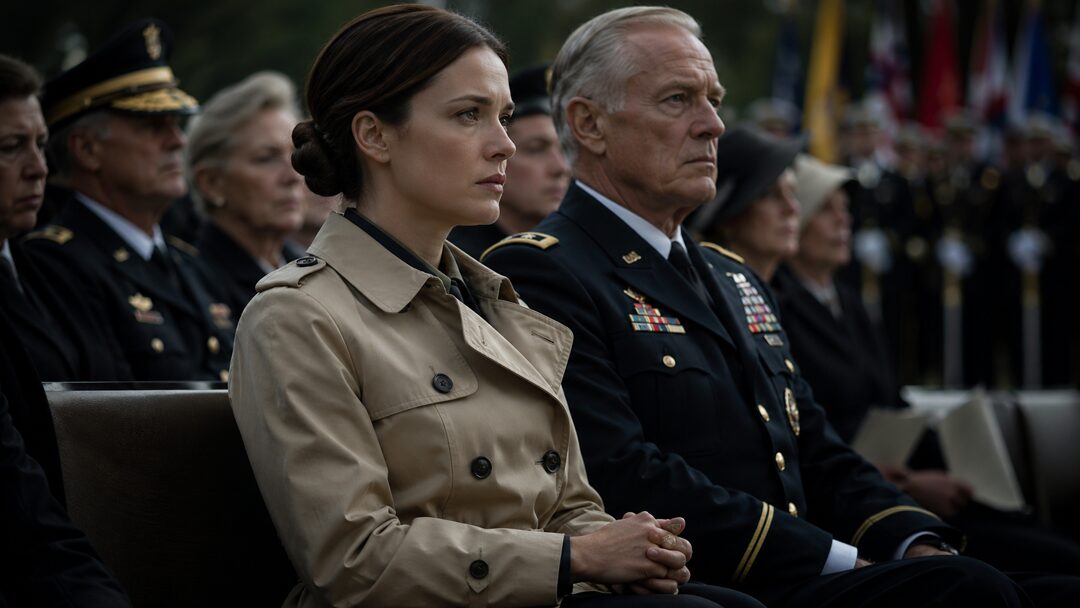
The woman in the beige trench coat was sitting in the wrong row.
Everyone could see it.
The first row at the Arlington memorial amphitheater had been reserved for generals, cabinet officials, surviving commanders, and the families of the dead. Every chair bore a small cream card with a name printed in black. Every uniform had been pressed until it looked carved. Every medal caught the morning light as if the sun had come there only to touch brass.
And then there was Eva Vale.
She sat between an empty aisle and retired General Marcus Hale, her dark hair pinned neatly at the back of her head, her hands folded in her lap, her coat buttoned to the throat.
No medals.
No dress blues.
No visible right to be there.
A few people had already noticed. Eva could feel it without turning her head: the quick glance, the pause, the quiet lean toward a spouse.
Who is she?
Why is she sitting with him?
General Hale did not look at them. He sat perfectly straight, a tall old man in formal uniform, silver hair combed back, chest heavy with decorations. His face had the controlled stillness of men who had spent a lifetime letting other people mistake silence for peace.
Eva kept both hands closed around a small round object hidden in her palm.
The coin was old now. The edge had worn smooth from years of being touched in the dark, in elevators, in hotel rooms, in hospital corridors, in the back row of briefings where no one said her name.
She had told herself she would not bring it.
Then she had dressed that morning, buttoned the trench coat over the uniform beneath it, and taken the coin from the drawer anyway.
A brass ensemble began warming up near the stone steps. Across the amphitheater, families of the fallen held framed photographs against their chests. Some had come with flowers. Some had come with children too young to remember the faces in the frames. Some had come with the stiff composure of people who had already cried in private and would not do it here.
At the center of the program, printed in formal blue ink, was the line everyone had come to hear:
PUBLIC RECOGNITION CEREMONY FOR OPERATION GLASS HARBOR
Seven years had passed.
Seven years since the embassy compound in Marovar collapsed into rain, smoke, screaming radio channels, and sealed reports.
Seven years since Eva learned that surviving could look, from a distance, exactly like betrayal.
General Hale leaned slightly toward her.
“You can still leave before it begins,” he said.
Eva looked ahead at the flags.
“No, sir.”
His mouth tightened. “You don’t owe them your peace.”
She almost smiled at that.
Peace had not visited her in years. It would have been rude to blame the crowd.
Before she could answer, a ripple moved through the first rows behind them. It was not applause. It was recognition sharpening into attention.
Eva heard heels on stone.
Measured.
Fast.
Angry.
General Hale’s eyes closed for half a second.
Eva did not turn.
She knew who it was before the woman spoke.
“General Hale.”
The voice was controlled enough to hurt.
Hale turned. “Claire.”
Claire Whitmore stood in the aisle wearing a cream blazer, her blonde hair secured in a low, precise bun. She looked like grief had been tailored for her: elegant, expensive, severe. Beside her stood her mother, one hand wrapped around a black clutch, the other holding a framed photograph of Colonel David Whitmore in dress uniform.
Behind them waited three donors from the Whitmore Foundation, pretending not to listen.
Claire’s eyes were not on Hale.
They were on Eva.
For one long second, Claire looked her over from the collar of her plain coat to the shoes beneath the chair.
Then she said, “What is she doing here?”
The people closest to them went still.
Eva kept her hands in her lap.
General Hale’s voice stayed low. “She was invited.”
Claire gave a short laugh. It was not amusement. It was something breaking its teeth on restraint.
“Invited by whom?”
“By me.”
Now Claire looked at him, and the old intimacy of rank, loss, and favors curdled in her face.
“This row is for family and command.”
“Yes.”
“She is neither.”
Eva felt the coin bite into her palm.
Hale said, “Claire, this is not the place.”
Claire’s eyes flashed back to Eva.
“That’s funny,” she said. “Because I thought this was exactly the place where people stopped pretending.”
Part II — The Daughter of the Hero
Eva had seen Claire Whitmore twice before.
The first time was on television, three months after Glass Harbor, standing beside her mother while Colonel Whitmore’s casket moved beneath a flag. Claire had been twenty-seven then, pale and rigid, holding herself so still that she looked less like a grieving daughter than a statue placed near grief to give it shape.
The second time was in a newspaper profile about the foundation she had built in her father’s name.
HONORING THE MAN WHO HELD THE LINE.
Eva had not finished the article.
She had folded it carefully, placed it in the trash, and then taken it out again five minutes later because throwing it away felt like cowardice.
Now Claire stood three feet from her in real life, and all the grief Eva had watched through screens had found a voice.
“Are you going to answer?” Claire asked.
Eva lifted her eyes.
“General Hale asked me to come.”
“That’s not an answer.”
“It’s the only one I can give you.”
Claire’s mouth tightened. “Still hiding behind powerful men.”
A woman in the second row inhaled sharply. A young captain near the aisle looked down at his program as if paper could save him from witnessing this.
Hale shifted in his chair. “Claire.”
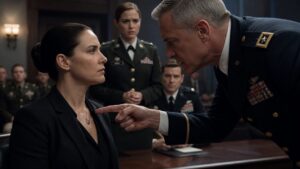
“No.” Claire’s voice rose just enough to carry. “No, I’m tired of everyone lowering their voice around this. My father’s name is on that program. The men who died with him are on that program. And she sits here like she belongs?”
Eva said nothing.
That made it worse.
Claire took another step closer.
“You left before the bodies came home,” she said. “You disappeared before the questions started. And now you show up in a civilian coat, in the front row, beside him?”
The donors behind her looked uncomfortable now. Her mother touched her arm.
“Claire,” she whispered.
Claire pulled gently away.
“Do not ask me to be polite to her.”
The first notes of the brass ensemble faded. A ceremony staffer in a dark suit hurried toward them, one hand lifted in a practiced gesture of concern.
“Ms. Whitmore,” he said quietly, “we’re about to begin.”
“Then she should leave before the names are read.”
The sentence landed hard.
Eva felt it in the faces turning toward her.
She had been stared at before. In hospitals. In airports. At a hearing she had never been allowed to discuss. In a grocery store when a veteran she recognized but who did not recognize her had said, “You people never tell the truth.”
But this was different.
Here, the dead were seated all around them in photographs and folded flags. Here, every accusation had witnesses.
And still she did not open her coat.
Not yet.
General Hale leaned toward her, so close his voice barely moved the air.
“Not yet.”
The coin shifted under Eva’s fingers.
Claire saw the whisper.
Her face changed.
“Oh,” she said softly. “So this is planned.”
Hale straightened.
Claire looked between them. “Another favor. Another closed door. Another version of Glass Harbor we’re supposed to accept because men with medals say so.”
“Sit down,” Hale said.
His tone had commanded rooms larger than this one.
Claire did not obey.
“My father doesn’t get to stand up and correct the record.” Her voice cracked on the word father, and she hated herself for it; Eva could see that too. “Someone should.”
For the first time, Eva almost spoke.
She almost said: Your father corrected it with his last breath.
But there were truths that could be used like weapons even when they were made of mercy.
So she stayed silent.
The staffer looked helplessly at Hale. Hale gave one small nod toward Claire’s seat.
Claire’s mother touched her arm again. This time Claire let herself be drawn back, but she did not look away from Eva as she returned to the family section.
The ceremony began with the national anthem.
Everyone stood.
Eva rose with them, the trench coat still closed over her uniform.
Claire watched her the entire time.
Part III — Glass Harbor
The first speaker called Operation Glass Harbor “an evacuation conducted under conditions of extreme uncertainty.”
Eva stared at the podium and heard rain.
Not the soft rain that fell over Arlington that morning in scattered mist, but Marovar rain, hard and warm and filthy, hammering broken concrete until it ran black through the embassy courtyard.
The speaker said, “When the coastal embassy fell under coordinated attack—”
Radio static burst behind Eva’s teeth.
Lower corridor compromised.
We still have wounded below.
Negative. Withdraw.
She tightened her hand around the coin until pain brought her back.
The amphitheater was clean. Stone. Flags. Programs folded in laps. A chaplain waiting near the microphone. Claire’s mother holding a photograph. General Hale breathing slowly beside her.
Not smoke.
Not the hallway.
Not Sergeant Bell with blood soaking the front of his medic vest, pressing one hand to a stairwell wall as if he could hold up the building by refusing to fall.
The speaker continued.
“Colonel David Whitmore’s leadership in the final hours of the operation allowed dozens of American personnel and allied civilians to reach extraction.”
Claire sat straighter.
Eva could see her from the corner of her eye. Claire had heard that sentence before. The whole country had. It had become the clean version. The version suitable for podiums and foundations and widows who needed to sleep.
Colonel Whitmore held the line.
Colonel Whitmore gave everything.
Colonel Whitmore brought them home.
All true, if truth were a room and you were willing to keep most of the doors locked.
Hale’s gloved hand rested on the program in his lap. His thumb had stopped moving.
Eva wondered if he was counting the locked doors too.
The chaplain came forward and read the first names.
Major Ethan Cross.
Sergeant Luis Bell.
Corporal Andrew Niles.
Names moved through the amphitheater like slow bells.
With each one, someone in the crowd lowered their head.
Eva lowered hers only once, when Bell’s name was spoken.
Rain again.
Smoke.
Bell’s hand gripping her sleeve.
“Ma’am,” he had said, though she had been twenty-five and looked younger, “don’t let them close it.”
Then the memory cut away before it could become more than she could carry.
The second official speaker was a deputy secretary with a controlled voice and polished grief. He spoke of classification review, delayed recognition, national gratitude. He used all the words institutions used when they wanted to sound human without admitting they had arrived late.
Then he paused.
The air shifted.
“Today,” he said, “for the first time, a portion of the final commendation from Operation Glass Harbor has been cleared for public release.”
A murmur passed through the crowd.
Claire turned her head slowly.
Eva did not move.
Hale closed his eyes.
The deputy secretary unfolded a page.
“For actions taken after command structure failed under catastrophic operational conditions…”
The words struck the amphitheater differently than all the others.
Not noble.
Not polished.
Failed.
Claire’s lips parted.
“No,” she whispered.
The deputy secretary continued.
“…a junior officer refused an evacuation order after determining that wounded personnel and civilian dependents remained trapped below the eastern wing. With communications degraded and hostile pressure increasing, this officer rerouted survivors through a flooded service corridor, recovered encrypted extraction materials from the damaged command post, and transmitted coordinates that enabled the final lift.”
The crowd stirred.
People looked at programs that did not contain this version.
Claire stood.
Her mother reached for her, but Claire had already stepped into the aisle.
“No,” she said again, louder now.
The deputy secretary stopped reading.
Claire faced the podium, then Eva, then Hale.
“My father gave everything in that building,” she said. “You don’t get to stand here seven years later and make his sacrifice smaller because some committee found new language.”
No one breathed.
Eva stood.
The motion was quiet, but every eye went to her.
The trench coat fell straight around her like a closed door.
Claire turned on her.
“Sit down.”
Eva’s voice was soft. “Your father did give everything.”
Claire stared at her.
“How would you know?”
Eva felt the answer rise.
Because I heard his voice break over the radio.
Because I disobeyed him.
Because he put this coin in my hand through a gap in the door and smiled like a man who knew exactly how much time he had left.
Because for seven years, I let you hate me rather than hand you the worst minute of his life.
She said none of it.
Hale rose beside her. Old, decorated, exhausted.
“Captain Vale earned the right to speak if she chooses.”
Captain.
The title spread through the rows like a match dropped into dry grass.
Claire’s face went still.
For the first time, doubt entered it.
Not belief.
Not yet.
But doubt was a crack, and all grief fears cracks.
The deputy secretary looked at Eva.
She gave one small nod.
He resumed.
“Captain Eva Vale, United States Army Intelligence Support Command—”
Claire stopped breathing.
Eva unbuttoned the trench coat.
Part IV — The Uniform Underneath
It took only three buttons.
That was what Eva would remember later.
Seven years of sealed reports, misdirected blame, survivor interviews in rooms without windows, nightmares with no sound, and the end of hiding required only three buttons.
She opened the coat and slipped it from her shoulders.
Underneath, her dress uniform was immaculate.
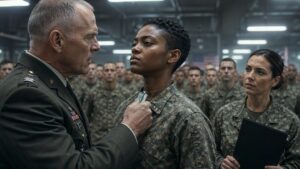
Dark fabric. Bright nameplate. Ribbons aligned with exacting care. Decorations that did not look borrowed because they had not been. They had been signed for, sealed away, delayed, argued over, approved, and finally sent to her in a narrow box with a letter written in language too formal to apologize.
The coat fell over the back of the chair.
The command coin slipped from her palm.
It struck the stone near her shoe with a small, clear sound.
Everyone heard it.
Claire looked first at the uniform.
Then at the medals.
Then at the name.
VALE.
Her face lost its anger so quickly it looked painful.
Eva bent to pick up the coin, but Claire moved first.
She crouched and lifted it from the ground.
For a moment, it lay in Claire Whitmore’s hand.
On one side was the worn insignia of Colonel David Whitmore’s unit. On the other was the phrase stamped shallow by use:
GET THEM HOME.
Claire’s thumb moved over the words.
She looked up.
“Where did you get this?”
Eva’s throat tightened.
The official at the podium waited. The whole amphitheater waited. Even the flags seemed still.
Claire rose slowly, coin in hand.
“Were you with him when he died?”
The question was no longer an accusation.
That made it harder.
Eva answered, “Yes.”
Claire’s eyes shone, but no tears fell.
“Was he brave?”
There were a hundred easier answers.
Yes, because the dead deserve mercy.
No, because the living deserve truth.
It’s classified, because institutions love doors.
Eva looked at Hale.
For seven years, he had been the man beside the locked door.
That morning, he did not whisper.
He did not stop her.
His face, lined and pale beneath the visor of his cap, said only one thing.
Choose.
Eva turned back to Claire.
“At the end,” she said.
The words moved through Claire like a blow she had asked for.
Eva took a breath.
Not for herself.
For the dead who had been turned into clean sentences.
“Your father ordered withdrawal when he believed the lower corridor was gone,” Eva said. “He thought there was no route left. He thought anyone below us was already lost.”
Claire’s hand closed around the coin.
Eva continued before cruelty could enter the silence.
“He was wrong.”
Rain.
Smoke.
Bell’s hand on her sleeve.
“I knew Sergeant Bell was alive. I knew there were civilians below the east stairwell. Two children. A translator. Three embassy staff. One Marine who couldn’t walk.”
Claire shook her head once, very small.
Eva’s voice stayed even.
“I disobeyed the order. I took two soldiers and went down.”
The amphitheater had become so quiet that Eva could hear a flag snap in the wind.
“Your father threatened to court-martial me over the radio.”
Claire flinched.
Eva saw the hurt and did not look away.
“He was afraid,” Eva said. “So was I. Everyone was.”
That sentence changed something.
Not enough to heal. Enough to stop the room from turning Colonel Whitmore into either marble or mud.
Eva went on.
“The east corridor flooded. The command post was hit. We lost comms twice. When we came back up, the power failed at the blast door. It was closing manually. Too heavy for one wounded man to hold.”
Her fingers curled once at her side.
“Colonel Whitmore saw us.”
She could see him again.
Not the portrait in Claire’s mother’s frame.
Not the immaculate officer from old interviews.
The real man.
Rainwater and dust streaking his face. Blood at his hairline. Eyes wild with the knowledge of what his own order had almost done.
Then the change.
A terrible, human, final change.
He had braced himself against the manual crank and pulled with both arms. The door had screamed. Someone had shouted that the charges were set. Someone else had screamed for him to move.
He did not move.
Eva had dragged Bell through first. Then the translator. Then the children. Then the Marine. Then the last of her two soldiers, half-conscious and coughing black.
Whitmore had looked through the narrowing gap.
He had smiled once.
Not like a hero in a painting.
Like a man asking forgiveness without having time to receive it.
“He held the door,” Eva said. “Long enough for us to pass.”
Claire’s mouth trembled.
Eva looked at the coin in her hand.
“He gave me that before it closed.”
Claire whispered, “Why?”
Eva’s answer came from seven years away.
“He said, ‘Get them home, Captain.’”
Claire closed her eyes.
The coin rested between both her palms now, as if it were something breakable.
Eva added, “He was afraid. Then he chose.”
No one in the amphitheater moved.
The clean version of Colonel David Whitmore had died quietly in front of them.
So had the cruel version Claire feared.
What remained was harder to love, but real enough to grieve.
Part V — What Honor Leaves Behind
Claire did not apologize.
Not then.
Some wounds are too stunned to form words.
She stepped toward Eva with the command coin held out in both hands.
For one impossible second, Eva thought Claire would keep it. She had the right, perhaps. It had been her father’s. It had his unit’s mark, his hand, his last words stamped into Eva’s memory if not into the metal.
But Claire placed it back in Eva’s palm.
Her fingers were cold.
“He gave it to you,” Claire said.
Eva closed her hand around it.
“Yes.”
Claire looked at the uniform again. At the medals she had mistaken for absence because Eva had hidden them under beige cloth. At the woman she had accused in front of widows, officers, children, and the names of the dead.
Her face folded, but she did not collapse.
That was its own kind of discipline.
She returned to her mother.
Mrs. Whitmore reached for her daughter’s hand, and Claire let her take it.
At the podium, the deputy secretary waited until the amphitheater steadied.
Then he finished the citation.
Eva heard her name spoken fully.
Captain Eva Vale.
For courage under catastrophic conditions.
For actions that preserved life after command continuity failed.
For transmitting the final extraction coordinates.
For bringing home survivors who would otherwise have been lost.
The sentences were official, polished, late.
They did not mention Bell’s blood on her sleeve.
They did not mention the translator singing to the children in a stairwell so they would not hear the door buckle.
They did not mention Colonel Whitmore’s eyes when he handed her the coin.
But they said her name.
For seven years, Eva had believed she did not need that.
Now, standing in uniform with every stare turned toward her, she understood something she did not like admitting.
Being seen did not bring back the dead.
But hiding had not honored them either.
When the final salute was called, the first row rose.
General Hale turned toward Eva.
He was supposed to face the flag.
Instead, slowly, he lifted his hand to the brim of his cap and saluted her.
Not as a superior.
Not as the man who had told her when to wait, when to speak, when the world was ready for its ration of truth.
As a witness.
As a man late to a door he should have opened sooner.
Eva returned the salute.
His hand shook before he lowered it.
After the ceremony, people moved carefully around her, as if the truth had changed the width of the aisle. Some nodded. Some looked away. One woman Eva did not know touched her arm and whispered, “My son was on that lift.”
Eva could not answer that one.
She only nodded because if she tried to speak, the day might finally get inside her.
The brass ensemble packed their instruments. Programs lay abandoned on chairs. The flags kept moving in the light wind.
Eva stood by the front row and folded the beige trench coat over the back of the chair where she had sat. She did not put it on.
Hale came beside her.
“I should have let the record open sooner,” he said.
Eva looked at the coat.
“Yes, sir.”
He absorbed that like a punishment he had earned.
Then he said, “You never needed my permission.”
Eva turned the coin once in her hand.
“No,” she said. “But I waited for it anyway.”
That hurt him more than anger would have.
Claire approached after everyone else had learned to look busy.
Her mother waited several yards away, still holding the photograph of Colonel Whitmore. In the picture, he remained flawless. Square-jawed. Decorated. Untroubled by his own humanity.
Claire stopped in front of Eva.
The cream blazer that had looked so sharp an hour earlier now seemed too thin for the morning.
“I hated you,” she said, “because it was easier than not knowing.”
Eva’s throat tightened.
“I know.”
Claire looked toward the empty podium, then down at Eva’s closed hand.
“Did he suffer?”
Eva could have answered.
She could have given the cruel details. The merciful ones. The exact shape of the last seconds. The smoke. The heat. The way his voice had changed.
Instead she said, “Not here.”
Claire nodded once, accepting both the boundary and the promise inside it.
“Could I hear the rest one day?”
Eva looked at her.
Not as the woman who had accused her.
Not as the daughter of the man who had almost left people behind.
As someone standing at the edge of a truth that would hurt more before it helped.
“One day,” Eva said.
Claire’s eyes filled at last.
She did not wipe them quickly enough to pretend they were not there.
Eva stepped past her.
She walked down the aisle in full uniform, the command coin in her hand, the morning light catching the decorations she had not worn for anyone else’s approval.
Behind her, the beige trench coat remained folded on the front-row chair.
For the first time in seven years, Eva did not feel the urge to go back for it.