The Compass Under the Ice
Part I — The Hand on Her Wrist
The first mistake Sergeant Cole Rusk made was touching Mara Vale in a room full of witnesses.
The second was thinking she had come alone.
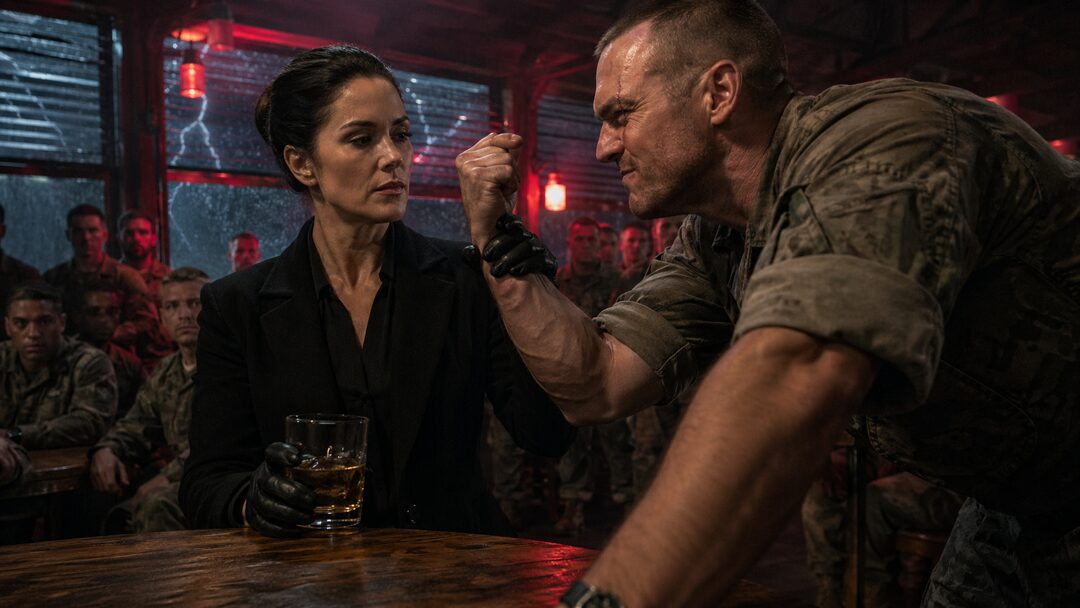
He caught her wrist at the end of the bar, his fingers closing hard around the one bare place between her black sleeve and leather glove. Around them, the soldiers of the 9th Rescue Company went quiet in uneven pieces. Laughter died first. Then glass against wood. Then the low thunder of the storm pressing against the blast shutters of Camp Meridian.
Mara did not look at Cole’s face.
She looked at his hand.
Then she looked at the bourbon in front of her, still untouched, two cubes of ice turning slow circles in the amber.
“You’ll want to let go before the ice melts,” she said.
Cole’s grin widened because he thought the room belonged to him.
It always had.
He was broad through the shoulders, drunk enough to be cruel, sober enough to know exactly who he was hurting. A pale scar split one eyebrow. His sleeves were rolled to the elbows though the underground bar was cold, and the smell of rain-soaked canvas and sour whiskey came off him in waves.
“Listen to that,” he said, turning his head so the others could hear. “The desk ghost gives orders now.”
A few soldiers laughed because they had been trained to laugh before thinking.
Mara sat still.
Her dark hair was pulled back so tightly it made her face look sharper than it was. She wore no uniform, only a black civilian coat over a plain dark shirt. One leather glove remained on her left hand. Her eyes were tired in a way no drink could fix.
Cole tugged once on her wrist.
“Stand up,” he said. “Let everybody get a good look at the woman who got Arlen Shaw killed.”
The name moved through the bar like a lit match.
Mara’s fingers flexed once around the glass.
Not enough to lift it. Not enough to spill it.
At the far tables, men from the 9th sat under red emergency lamps, their faces half cut by shadow. The bar itself had been built from rough boards salvaged from shipping crates, nailed into the concrete belly of a half-buried outpost near a disputed border. Every man in the room carried a weapon, a scar, or a story he preferred told by someone else.
Mara had all three.
Cole leaned closer.
“What, no report to file?” His voice dropped, ugly with confidence. “No clearance to hide behind? They should’ve cashiered you harder.”
Mara finally looked at him.
“Last warning.”
That amused him most of all.
He jerked her wrist upward, using his size and the room and the old shape of power to make her stand.
Mara rose because he pulled.
Then she turned.
It was not dramatic. That was what made it terrible.
She stepped in instead of away, rotated under his grip, and used the force he had given her as if he had handed her a loaded weapon. His elbow locked. His shoulder followed. His breath left him in a wet grunt as she folded his arm across the grain of his own strength.
The bourbon glass remained in her other hand.
Cole’s boots scraped the floor.
Someone cursed.
Mara drove him forward, not with rage, not with flourish, but with the efficient precision of a woman who had already measured the table. His chest hit first. Then his cheek. The whole wooden slab jumped under him, cards skidding, an ashtray rattling, a bottle tipping and rolling to the edge before a corporal caught it.
Mara’s drink did not spill.
Not one drop.
Cole lay bent over the table, one arm pinned high behind him, his face turned sideways against sticky wood. His breath came hard through his teeth. The room stared at the woman in black standing over their favorite war story.
Mara took a calm sip of bourbon.
That was when several soldiers reached for their sidearms.
Not fully. Not enough to draw.
Enough to confess themselves.
Mara saw every hand.
She released Cole, reached inside her coat, and placed a black credential wallet on the bar.
The sound it made was small.
The silence after it was not.
The nearest lieutenant leaned forward, then froze. The seal caught the red light: Joint Military Review Authority. Beneath it, temporary field command authorization signed by the Defense Inspectorate.
A name in block letters.
CAPTAIN MARA VALE.
Someone whispered, “Jesus.”
Mara set her glass beside the credential.
“No,” she said. “Not him.”
Cole pushed himself up slowly, humiliation flooding his face before recognition drained it pale.
“You’re not—”
“Disgraced?” Mara asked.
No one answered.
“Former?” she said.
Still no one.
“Alone?”
The storm struck the shutters hard enough to make the emergency lamps flicker. Red light blinked over her face, over Cole’s bent arm, over the credential lying open like a blade.
A door behind the bar opened.
Major Danton Pierce stepped into the room in an immaculate uniform, silver at his temples, an old burn mark dragging along the edge of his jaw. He had the calm of a man used to entering any space as its final authority.
Then he saw Mara.
For the first time that night, someone other than Mara understood where the battlefield was.
“Mara,” Pierce said.
She lifted the glass again but did not drink.
“Major.”
His eyes moved from her face to Cole, from Cole to the credential, from the credential to the room of suddenly sober men.
“You should have come to the tribunal office.”
“I did,” Mara said. “It was empty.”
Pierce’s mouth tightened.
“The hearing is tomorrow.”
“No,” Mara said. “The paperwork is tomorrow.”
The storm rolled overhead like artillery.
Mara closed the credential wallet with two fingers.
“The testimony starts now.”
Part II — The Room That Could Not Leave
Pierce tried to empty the bar with one sentence.
“Everyone back to quarters.”
For half a second, it almost worked. Men straightened. Chairs scraped. Habit was faster than conscience.
Mara did not raise her voice.
“Any member of the 9th Rescue Company who leaves this room during an active emergency review will be logged as refusing field testimony under blackout conditions.”
The chairs stopped scraping.
Pierce looked at her the way commanders look at faulty equipment right before deciding whether to repair it or destroy it.
“You don’t have authority to detain my company in a bar.”
Mara tapped the credential once.
“I have authority to secure witnesses during communications blackout. The perimeter failure locked the base. The storm killed external relay twenty minutes ago. Every man here was logged on entry.”
A private near the dartboard swallowed.
Cole, still hunched near the table, muttered, “You set this up.”
Mara looked at him.
“No. The storm did. I just arrived on time.”
That line did something to the room. Men who had been drunk enough to enjoy humiliation were now sober enough to understand procedure when it carried teeth.
Pierce stepped closer.
“You came here for revenge.”
Mara’s face did not change.
Cole seized on it, grateful for a familiar weapon. “That’s all this is. Arlen died under Major Pierce’s command, and you couldn’t stand that the report said what everyone already knew.”
Mara turned toward him.
“What did it say?”
Cole’s jaw worked.
“That he broke formation.”
“Say the rest.”
“He exposed the team.”
“The rest.”
“He panicked.”
There it was.
The word they had drunk around for three years. The word men had lowered their voices before using, not because they doubted it, but because part of them feared they did not.
Mara’s hand tightened around the glass. Just once.
Then she released it.
“Lieutenant Arlen Shaw’s after-action record states he broke formation at 0213 hours near Ridge Seven, compromised extraction, and was killed by enemy fire before the withdrawal.” She looked from face to face. “That record contains four lies in one sentence.”
Pierce said, “Careful.”
Mara ignored him.
“The rescue beacon changed location three times. The medic’s log was edited after upload. Six minutes are missing from the helmet-feed archive. And the after-action report lists Arlen as dead before his biometric tag went dark.”
The men did not speak.
They knew what rumor sounded like. They knew what grief sounded like.
This was neither.
This was a map.
Cole wiped blood from his split lip with the back of his hand. “You don’t know what that valley was.”
“No,” Mara said. “I know what you made of it afterward.”
That landed harder.
Pierce moved between them without appearing to hurry.
“Captain Vale has been away from active field intelligence for three years,” he said to the room, voice steady and reasonable. “She was removed from review channels after an unauthorized data breach. She lost someone. She has carried that loss into a place where many of you have lost people too.”
It was expertly done.
Not cruel. Worse than cruel.
Balanced.
Men who had been ready to fear Mara were invited to pity her instead. Men who feared the evidence were given permission to call it grief.
Mara almost smiled.
“You always were good at making a knife look like a bandage.”
Pierce’s eyes hardened.
She reached into her coat again.
This time, Cole flinched.
Mara removed a small metal compass and placed it beside the credential. It was dented at the lid, scorched along one edge, the hinge packed with dried gray clay.
No one laughed now.
Cole stared at it like she had set a living thing on the bar.
“This was returned with Arlen’s personal effects,” Mara said. “The report says he died on Ridge Seven in the burn line. Ash, shale, no water source within two kilometers.”
She turned the compass slightly with her gloved hand.
“The hinge contains river clay from the extraction valley.”
Pierce said nothing.
“Not ash,” Mara said. “Not ridge soil. River clay.”
The storm pressed harder against the shutters.
A soldier near the back whispered, “How would that—”
Pierce cut him off. “Contaminated transport.”
Mara looked at him.
“Three years,” she said. “That is the answer you prepared?”
Pierce did not blink.
“That is the answer that fits.”
“No,” Mara said. “That is the answer that survives first contact with people who don’t want to know better.”
Cole’s breathing had changed. Shallow now. Angry, but no longer simple.
Mara turned to him.
“You were the last soldier recorded near Arlen’s position.”
“I was pulling wounded.”
“You carried two men out.”
“Damn right I did.”
“You also carried Arlen’s service tag in your pocket for three months.”
The room changed.
It did not move. It changed anyway.
Cole’s face opened before he could close it.
Pierce’s head turned toward him.
Mara saw the truth pass between them like a signal flare.
There are facts that accuse.
There are facts that beg.
This one did both.
Cole’s voice came rough. “Who told you that?”
“No one.”
“Then you don’t know what you’re talking about.”
Mara picked up the compass.
“I know you didn’t log it. I know it wasn’t in his effects. I know you kept it until you were transferred to Meridian, and then suddenly it appeared in a sealed return envelope with no chain-of-custody signature.”
Cole looked at Pierce.
Just once.
Mara saw it.
So did half the room.
Pierce’s voice went quiet. “Sergeant.”
Cole looked down.
That was the first crack.
Mara set the compass back on the bar.
“Now,” she said, “tell me why a coward gave you his name before he died.”
Part III — The Missing Six Minutes
The base siren began as a low mechanical groan, then climbed into a steady warning note that made every man in the bar turn toward the ceiling.
Not attack.
Every soldier knew the difference.
Weather breach. Perimeter failure. Lockdown until dawn.
The red lamps deepened, washing the room in the color of old blood.
Mara did not look up.
“Good,” she said.
Pierce’s jaw flexed. “Good?”
“No one can pretend they have somewhere better to be.”
Outside the shutters, the storm hammered Camp Meridian flat. Inside, the 9th Rescue Company stood around the woman they had mocked and the commander they had followed through hell.
Mara opened a field tablet and slid it onto the bar.
“Operation Lantern,” she said. “Let’s tell it correctly.”
No one moved.
So she began with the version they loved.
“Twenty-seven civilians marked for extraction from the valley settlement. Liaison team trapped near Old Checkpoint Road. Enemy pressure closing from the east. Air support denied due to cross-border escalation risk. Convoy under mortar fire. Major Pierce assumes ground command after Captain Ellery is wounded. Sergeant Rusk pulls two casualties from a burning transport.”
Cole stared at the table.
Mara looked at him. “That part is true.”
His shoulders shifted, as if truth hurt more when it did not erase guilt.
She continued.
“0213 hours. Lieutenant Arlen Shaw, attached intelligence liaison, allegedly breaks formation. Rescue beacon migrates north. Withdrawal proceeds. Shaw listed killed by enemy fire at Ridge Seven. Company returns with nineteen civilians, six wounded soldiers, and one dead hero narrative.”
Pierce said, “Enough.”
Mara looked at him.
“We haven’t reached the missing part.”
A young corporal spoke before he could stop himself. “There were no kids in the report.”
Every eye went to him.
He looked terrified of his own sentence.
Mara’s gaze softened by a degree.
“No,” she said. “There weren’t.”
Pierce turned slowly. “Corporal Miller.”
But the name had already done its damage.
Mara tapped the tablet. A map appeared, blue lines over black terrain.
“The evacuation convoy stopped here.” She pointed. “Old Checkpoint Road. The official route bypassed the drainage culvert beneath the checkpoint because the structure was marked collapsed.”
“Because it was,” Pierce said.
“Not fully.”
He gave a dry laugh. “You weren’t there.”
“No,” Mara said. “Arlen was.”
That was the first time she said his name without armor around it.
Not Lieutenant Shaw.
Arlen.
Cole closed his eyes.
Mara touched the screen again. A still image loaded from a corrupted helmet feed: dark concrete, mud, the white blur of something small near the edge of a light beam.
A child’s hand.
Nobody breathed.
“Arlen did not break formation to run,” Mara said. “He changed course because he saw movement under the checkpoint.”
Pierce’s voice stayed controlled. “A shadow on a corrupted frame does not justify disobeying withdrawal orders.”
“No,” Mara said. “The medic’s erased triage note does.”
She opened another file.
The text was incomplete, time-stamped, partially overwritten.
FOUR MINORS. DEHYDRATED. ONE UNRESPONSIVE. CULVERT ACCESS POSSIBLE. NEED—
The rest was blank.
A chair scraped backward.
Someone whispered a curse that sounded like prayer.
Cole’s face had gone gray.
Mara watched him.
“You saw him reach it.”
He shook his head once.
“You saw him.”
“I saw a lot of things.”
“Not that.”
His mouth twisted. “You think you can walk in here with a coat and a badge and make that night sit still? It doesn’t. It moves every time you look at it.”
Mara’s voice dropped. “Then let it move in the right direction.”
Cole slammed a fist onto the table, but the sound had no power now. “He disobeyed.”
“Yes.”
“He could’ve gotten us all killed.”
“Yes.”
That stopped him.
Mara did not rescue Arlen from the hard part.
The room felt it.
She looked at Pierce. “Compassion does not make an order safe. I know that.”
Pierce’s expression shifted, almost approving.
Almost.
“Then you understand,” he said. “The valley was collapsing. We had wounded. No air cover. Enemy movement inside ten minutes. Every second your fiancé spent chasing ghosts put living men at risk.”
“They weren’t ghosts.”
“They were unreachable.”
“Not to him.”
Pierce stepped closer, lowering his voice in a way meant to sound private though the whole room heard it.
“If I had turned the convoy around, I might have lost every man here. Every civilian already loaded. Every wounded soldier Rusk dragged out. You want to put that on a scale, Captain? Then have the courage to weigh both sides.”
For the first time that night, Mara had no immediate answer.
That was Pierce’s gift and poison. He could make brutality sound like arithmetic. He could stand in front of abandoned children and count the rescued until the room called him honest.
Some men looked relieved.
Not because they believed him completely.
Because they needed to.
Mara looked at the compass.
The hinge still held the clay.
“Cole,” she said.
He did not look up.
“What did Arlen say when he gave you the tag?”
Pierce spoke first. “He didn’t give him anything.”
Mara did not take her eyes off Cole.
“What did he say?”
Cole’s hands curled into fists.
The old anger rose in him, searched for somewhere to go, found no target strong enough to hold it.
Finally, he said, “He was at the culvert.”
The words came out broken.
Mara closed her eyes for half a second.
No more.
Cole swallowed.
“He had mud up to his knees. There was fire in the trees behind him. I told him the convoy was moving. I told him Pierce would leave him.”
Pierce’s face hardened.
Cole kept going because stopping now would be worse.
“He took off his tag and shoved it at me. Told me if they needed someone to blame…” His voice failed, then returned smaller. “He said make sure she gets the compass.”
Mara’s fingers went very still on the bar.
The room waited for grief.
She gave them procedure.
“Why didn’t you report that?”
Cole looked at her then. His eyes were wet, furious, ashamed.
“Because by morning, the report already knew what it wanted.”
Part IV — The Commander’s Offer
Pierce moved before the room could turn fully against him.
“Archive,” he said sharply.
The word snapped two technicians near the back into motion by reflex. One of them stopped halfway to the locked equipment cabinet, looking from Pierce to Mara.
There it was again.
The old command against the new authority.
Mara placed the credential flat on the bar.
“Open it.”
Pierce gave a short, humorless laugh. “A temporary wallet and a dead man’s compass do not put you in command of my archive.”
No one laughed with him.
That mattered.
Pierce noticed.
So did Mara.
She stepped around the bar, close enough now for him to see the exhaustion under her control.
“I am invoking temporary field command authority over all Lantern-related evidence held at Camp Meridian,” she said. “You may refuse. Your refusal will be logged in front of every witness present.”
Pierce’s eyes searched the room.
He found men avoiding him.
He found Cole staring at the compass.
He found his story losing oxygen.
“Open it,” he said at last.
The technician unlocked the archive cabinet with shaking hands. The system took too long to boot. The silence stretched so tightly that the storm seemed distant.
Mara did not fill it.
That was worse.
The six missing minutes appeared as a damaged helmet-feed file recovered from a backup fragment. The screen flickered, stuttered, then stabilized into green-black night vision.
Breathing filled the bar speakers.
Running.
Mud.
A soldier’s gloved hand pushing through reeds.
Then Arlen Shaw’s voice, distorted by static but unmistakably calm.
“Checkpoint culvert not collapsed. Confirm movement inside. Hold beacon at road marker four.”
Mara’s face changed before she could stop it.
Not much.
Enough.
Cole saw and looked away.
On the screen, light swept across concrete. Small faces flinched from it. A woman’s arm shielded two children. Someone coughed weakly in the dark.
Nineteen rescued had been the number in the newspapers.
No one had printed the number left behind.
Arlen’s voice again. “Civilians alive. Multiple minors. Need stretcher support.”
Static cracked.
Then Pierce’s voice cut through the recording.
“Negative. Convoy is withdrawing.”
Arlen: “Say again?”
“Withdraw to Route North. Beacon team, shift signal to ridge position.”
The bar went so quiet the recording sounded too loud.
Arlen’s breathing changed.
“Major, beacon shift will pull extraction away from civilians.”
Pierce’s reply came cold through three years of buried file corruption.
“That is the order.”
Someone in the room said, “No.”
Maybe one man.
Maybe all of them.
On the feed, the beacon marker changed.
A small blinking signal moved away from the culvert.
Away from Arlen.
Away from the children.
Toward Ridge Seven.
Mara did not look at Pierce.
Not yet.
The recording continued. Arlen turned back toward the culvert. The camera caught his hand gripping the compass, thumb rubbing once over the dented lid as if choosing direction by touch.
Then Cole’s younger voice, panicked and close: “Shaw! We go now!”
Arlen: “Get them out.”
Cole: “I can’t carry this.”
Arlen: “Then carry the part you can.”
The image lurched. A service tag flashed in Arlen’s hand.
Cole’s present face collapsed around the memory.
Then the feed broke into snow.
Six minutes ended.
The archive room returned to red light and living breath.
Mara finally turned to Pierce.
“Arlen was not killed by enemy fire at Ridge Seven.”
Pierce’s voice was low. “We don’t know what killed him.”
“You knew what didn’t.”
His silence answered.
She touched the tablet again and brought up the biometric log.
“His tag went dark twelve minutes after withdrawal. In the valley. Not on the ridge.”
Pierce said, “He made his choice.”
“And you made yours.”
“Yes,” Pierce said, suddenly fierce. “I did.”
The room recoiled not from the admission, but from the force behind it.
He turned on them, on all of them.
“You think you wanted me to turn back? You think you wanted command to gamble your lives on a culvert we could not clear under fire? Rusk, you had two wounded men bleeding into your sleeves. Miller, you were nineteen and crying so hard you couldn’t reload. Henson had shrapnel in his neck. The convoy had civilians in the trucks already. Children too. Do you remember them? Or do only the ones we lost count now?”
No one answered.
Pierce looked at Mara.
“And you. You want a villain because grief is easier when it has a face. Fine. Use mine. But don’t stand there pretending Arlen’s conscience was free. He risked everyone’s survival to save people he could not reach.”
Mara absorbed it.
Not because it was right.
Because it was not entirely false.
That was the cruelty of it.
Pierce stepped closer and lowered his voice again, but this time it was not for the room. It was for her.
“I can correct his record.”
Mara went still.
Pierce saw the opening and pressed.
“Posthumous commendation. Official amendment. Lieutenant Arlen Shaw did not panic. He died attempting aid under extreme conditions. His name cleared. Your pension restored. Your clearance reinstatement permanent.”
Cole looked up sharply.
Pierce did not.
“No court-martial,” he said. “No national scandal. No families watching their sons called cowards for surviving. No widows learning that medals were pinned over a grave of lies.”
Mara stared at him.
“All I have to do is let you keep yours.”
Pierce’s expression did not soften.
“All you have to do is accept that the truth does not need to destroy everyone to honor one man.”
For a moment, the offer hung there, beautiful in the way a locked door can be beautiful to someone freezing outside it.
Arlen’s name restored.
Mara’s disgrace reversed.
The dead given a cleaner sentence.
The living spared.
It was almost mercy.
That was what made it dangerous.
Mara looked down at the bourbon. The ice had melted thinner now, water loosening the drink, changing it without asking permission.
She picked up the glass.
Everyone watched.
She could have drunk. She could have chosen the quiet correction and called it wisdom. She could have taken Arlen’s name back from the machine and left the rest buried beneath medals and weather and time.
Instead, she set the glass down untouched.
“No,” she said.
Pierce’s eyes closed briefly.
Mara reached into the inside pocket of her coat.
“There’s one more file.”
Pierce looked at the tablet.
Fear crossed his face so fast some men missed it.
Mara did not.
“This was transmitted on an old intelligence channel twelve minutes after withdrawal,” she said. “It never reached me. My clearance was revoked the next morning.”
Her voice remained steady.
Only her hand betrayed her, hovering a fraction too long over the play command.
Then she pressed it.
Part V — Don’t Make It Clean
At first there was only static.
Then breathing.
Not the frantic breath from the helmet feed. Slower. Exhausted. Controlled because there were people nearby who needed calm more than truth.
Arlen Shaw’s voice filled the bar.
“Lantern field report. Unconfirmed transmission. Lieutenant Arlen Shaw, attached liaison. Time stamp… uncertain. Relay compromised.”
Mara looked at the floor.
No one else moved.
“Coordinates follow,” Arlen said.
He gave them clearly.
Not a love letter.
Not a goodbye.
A report.
“Culvert beneath Old Checkpoint Road intact enough for shelter. Civilians alive at time of convoy departure. Count estimated eleven. Four minors visible. One infant. Two adult female, one elderly male, injuries unknown. Water present but contaminated. Enemy movement east ridge, distance closing.”
The room broke one face at a time.
A soldier covered his mouth.
Miller sat down hard in a chair.
Cole stared at nothing, lips parted.
Arlen continued, voice thinning but precise.
“9th Rescue Company withdrew north under Major Pierce command. Beacon shifted away from culvert prior to final extraction. I am remaining with civilians until alternate contact or enemy arrival.”
Static swallowed him for two seconds.
Then he returned.
“If command receives this, dispatch any unit still able to move. If no unit can return, record that civilians were alive when convoy left.”
That sentence did more damage than accusation.
It did not say murderer.
It did not say coward.
It simply placed the living where the story had put emptiness.
Mara’s jaw trembled once.
She stopped it.
The recording crackled.
When Arlen spoke again, he sounded closer to the microphone, as if he had turned his face away from the others.
“Mara.”
Her name was barely above a whisper.
The room seemed to understand that they had become intruders.
No one looked away.
Maybe they could not.
“I don’t know what they’ll tell you,” he said. “I know what reports become when everybody needs sleep.”
A small sound came from Mara’s throat, too quiet to be a sob.
“I made a choice,” Arlen said. “So did they. Don’t let them turn this into a clean story.”
Static rose.
His voice faded under it.
Then, softer still:
“Find north.”
The message ended.
No one spoke.
The red lights hummed. Rain battered steel. Somewhere in the base, the lockdown siren clicked off and reset.
Mara kept her eyes on the tablet.
She had spent three years hunting for a final word and received coordinates.
She had wanted love to come back.
Instead, duty had.
That hurt worse because it was him.
Pierce stood very still.
His command had survived investigations, memorials, speeches, medal ceremonies, and the gratitude of people who needed a hero more than a record.
It did not survive Arlen’s tired voice refusing to hate simply enough.
Mara closed the file.
“Sergeant Rusk,” she said.
Cole flinched as if struck.
She opened the review recorder on the tablet and placed it on the table between them.
“State your name and rank.”
Pierce said, “Cole.”
The old command cracked like ice under weight.
Cole looked at him.
For three years, Pierce had been the man who got him out. The man who told him survival was not shame. The man who gave shape to nightmares so they could be endured.
Then Cole looked at the compass.
At the service tag memory.
At Mara’s bare wrist, still reddened where his hand had closed around it.
He stepped forward.
“Sergeant Cole Rusk,” he said, voice raw. “9th Rescue Company.”
Mara did not look triumphant.
“Were you present during Operation Lantern?”
“Yes.”
“Did you hear Major Danton Pierce order the rescue beacon shifted away from Lieutenant Shaw’s position?”
Cole’s eyes shone.
“Yes.”
Pierce’s face did not move.
Mara’s voice remained even.
“Did Lieutenant Shaw panic?”
Cole swallowed.
“No.”
“Did he break formation to flee?”
“No.”
“Why did he break formation?”
Cole looked around the room as if asking someone to stop him.
No one did.
“He found civilians alive under the checkpoint.”
The words entered the record.
They entered the room.
They entered whatever remained of the men who had lived beside the lie.
Another soldier stood.
Miller.
“I can confirm the beacon shift,” he said, shaking.
Then Henson.
Then the technician who had opened the archive.
Not all at once. Not cleanly. Not bravely in the way stories prefer.
One by one, like men stepping into cold water.
Pierce watched them with an expression that was not surprise.
It was loss.
Not of innocence.
Of control.
Mara picked up the glass at last. The ice had nearly vanished. The bourbon was watered down, thin and warm from waiting.
She held it for a moment beside the black credential.
Then she turned it over.
The drink spilled across the bar, a quiet amber stream running around the credential wallet, over old scratches in the wood, dripping onto the concrete floor.
No one mistook it for waste.
Mara set the empty glass down.
Pierce looked at it, then at her.
“You think this makes him clean?” he asked softly.
Mara’s answer came without heat.
“No.”
That was the only mercy she gave him.
And perhaps the only truth broad enough to hold them all.
Part VI — Morning Without Salutes
Dawn arrived without ceremony.
It came gray and thin through the reinforced slits above the blast shutters after the storm finally moved east. The emergency lamps clicked off one row at a time, leaving the bar uglier in ordinary light. Spilled liquor. Muddy boot prints. A blood smear where Cole’s lip had marked the table.
The investigators reached Camp Meridian just after 0600.
They did not storm the bar. They entered with sealed cases, tired eyes, and the quiet disappointment of people who already knew the world could do this.
Major Danton Pierce was escorted out without handcuffs.
That mattered too.
He walked straight-backed between two officers, uniform still immaculate, jaw marked by the old burn, face arranged into the last dignity available to him. At the doorway, he paused.
For a moment, Mara thought he might speak.
To defend himself.
To confess.
To tell her that command had no clean hands, that dead men make easy judges, that history always asks for courage from people who did not have to spend it in real time.
But Pierce only looked back at the room he had once owned.
Then he left it.
The men did not watch him go like followers.
They watched like survivors realizing the shelter had been part of the fire.
Cole remained by the table.
He looked smaller in daylight. Not weaker. Just reduced to human size.
Mara was putting the compass back into her coat when he approached.
Every step cost him.
He held out a metal service tag on a broken chain.
Arlen Shaw.
For three years, the name had been carried by the wrong man.
Mara stared at it but did not take it immediately.
Cole’s voice was low. “I kept it because giving it back would make the lie real.”
Mara looked at him.
“It was real whether you returned it or not.”
He nodded once, the words landing where they were supposed to.
“I know.”
She took the tag.
The metal was warmer than she expected.
For one dangerous second, memory tried to become a place: Arlen at her kitchen table, turning that compass between his fingers; Arlen laughing quietly when it stuck; Arlen saying old instruments had better manners than new systems because they admitted when they were lost.
She closed her hand around the tag until the edge bit her palm.
Cole looked at the compass half hidden in her other hand.
“I don’t deserve anything from him.”
“No,” Mara said.
He accepted that.
She held the compass out anyway.
Cole stared at it.
“What is this?”
“A burden.”
His eyes lifted to hers.
“Testify with it in your pocket,” she said. “So you remember where you were supposed to point.”
Cole’s face tightened as if she had struck him again, but this time he did not hide behind anger.
He took the compass.
His hand shook.
Not much.
Enough.
Mara turned toward the door.
No one saluted.
That would have been too simple. Too neat. A gesture men could use to feel forgiven by the shape of respect.
Instead, they moved aside.
One by one, the soldiers of the 9th Rescue Company cleared a path between the tables and the door. They did not look proud. They did not look absolved.
They made space.
Mara walked through it with Arlen’s tag in her fist and one glove still on.
Outside, Camp Meridian smelled of wet metal and torn earth. Morning light spread across the outpost, dull and honest, showing every dent the red lamps had hidden.
Behind her, the bar remained open.
Not as a place of victory.
As a room where silence had finally failed.
Mara stepped into the gray dawn and did not look back until she reached the threshold.
For three years, she had imagined the truth as a door that would open and give something back.
It had opened.
It had given her Arlen’s voice, his coordinates, his last refusal to become useful to a lie.
It had not given him back.
She stood there, breathing the cold air, the empty glass still behind her, the taste of untouched bourbon nowhere on her tongue.
Then she walked on.
Not healed.
Not triumphant.
North.