The Silence After the Tray Fell
Part I — The Mess on the Floor
The tray hit the dining hall floor hard enough to make every fork stop moving.
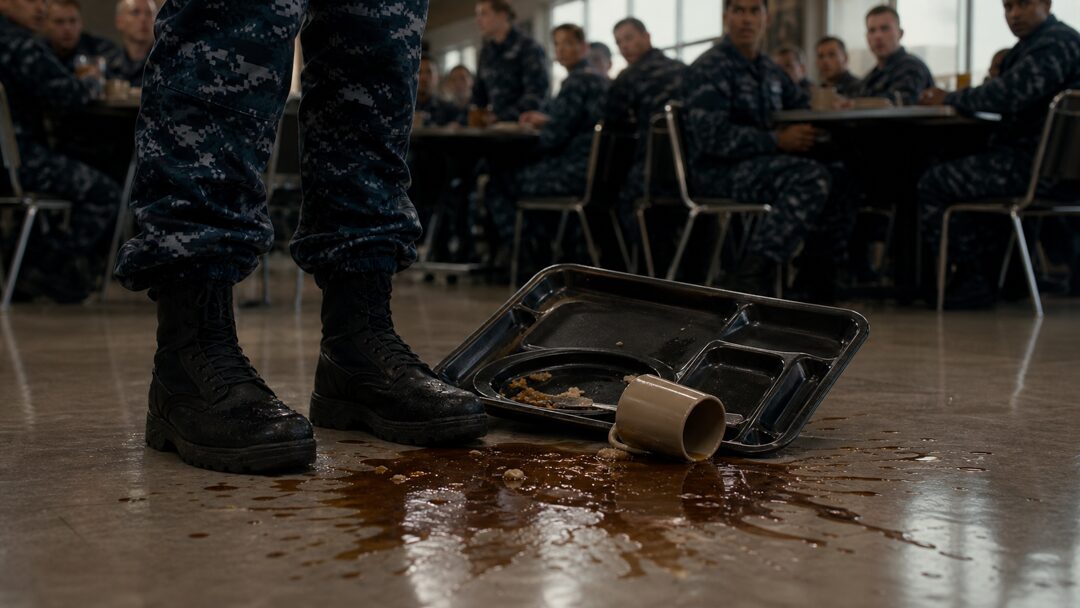
Coffee burst across the white tile. Eggs slid under the table. A plastic cup rolled in a slow, stupid circle between two pairs of boots. For half a second, the sound seemed louder than anything a room full of soldiers could make.
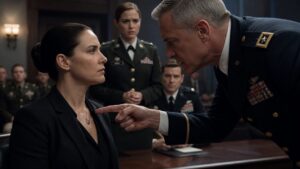
Then Staff Sergeant Michael Hayes stepped into Petty Officer Sarah Bennett’s face and shouted, “People died because you followed the book.”
Sarah did not move.
Not back. Not sideways. Not even a flinch.
The whole dining hall went still around them.
Three tables of camouflage uniforms turned their heads. A private near the drink machine froze with one hand on the soda lever. Someone’s chair scraped once, then stopped. At the far end of the room, Sergeant Major Robert Collins lowered his coffee cup without drinking from it.
Sarah stood beside the fallen tray in her dark blue digital uniform, hands at her sides, hair pinned so tightly it made her face look even more controlled than it was. Her lunch remained on the table behind Michael: an untouched sandwich, an apple, a folded napkin she had lined up with the edge of the tray before the crash.
She had been eating alone, as usual.
Michael had not even given her time to stand.
He had come across the dining hall like a man who had been looking for a door to kick open and had finally found one.
“You going to stand there like you don’t hear me?” he said.
His voice filled the room. Too loud. Too raw. Too close.
Sarah looked at him.
That was all.
Michael’s jaw worked. His eyes were red, though whether from anger or sleeplessness, no one could tell. He was broad through the shoulders, his camouflage sleeves rolled tight against his arms. He had missed a strip along his jaw shaving that morning. His right hand kept rising toward his chest, then dropping again, as if there was something there he wanted to protect or tear out.
“You sign a form,” he said, stepping closer, “and then men die on a road they should never have been on. That’s all it is to you, right? A line on a report?”
Someone whispered, “Hayes.”
No one else moved.
Sarah’s eyes flicked once to the coffee spreading over the tile.
Brown liquid, moving fast.
For a moment, it was not coffee.
It was dust-dark blood running into cracked earth. It was a medical kit flipped open beside a wheel, gauze spilling like torn white flags. It was Daniel Price’s glove lying palm-up under a tire track.
Sarah blinked once.
The dining hall came back.
Michael saw the blink and mistook it for guilt.
“There it is,” he said. “You do remember.”
Sarah’s throat moved. Her voice, when it came, was low enough that the people at the back had to lean in.
“That is not what happened.”
Michael gave a short laugh with no humor in it.
“That is exactly what happened.”
Across the room, Sergeant Major Collins set his cup down.
He did not stand.
Not yet.
Sarah noticed anyway.
She had learned to notice Collins before he moved. Overseas, that had saved time. Here, it only made the room smaller.
Michael jabbed a finger toward her chest, stopping just short of touching her uniform.
“You had the map. You had the route clearance. You had the authority to say no. And you signed.”
Sarah kept her eyes on his.
Behind Michael, the private at the soda machine let the cup overflow. Soda ran over his hand. He did not look down.
“Say his name,” Michael said.
Sarah said nothing.
Michael’s face changed.
The rage did not leave. It narrowed.
“Say his name.”
A fork clattered somewhere behind them.
Sarah’s hands stayed still.
Michael leaned in until only inches separated them.
“Corporal Daniel Price,” he said. “Twenty-four years old. Knew everybody’s birthday. Could fix a radio with tape and a prayer. He trusted you. Say his name.”
Sarah’s mouth tightened.
Not enough for most people to see.
Michael saw it.
“Say it.”
The dining hall waited.
Sarah looked past him, just for a second, to Collins.
Collins’s face was unreadable.
That was the worst part.
In a room full of witnesses, only two people understood the danger of what Michael was asking for.
Only one of them was being shouted at.
Part II — The Name He Carried
Six months earlier, the same dining hall had roared when the convoy unit came home.
Boots on chairs. Paper banners taped crookedly to the walls. Someone had smuggled in a cake too large for the table, and Daniel Price had cut slices with a plastic knife like he was performing surgery.
Sarah had stood near the coffee urn then too, holding a paper cup she never drank from.
Daniel had found her anyway.
“You always look like you’re waiting for bad news,” he had told her.
“I usually am.”
He had grinned at that. Crooked. Young. Too young, maybe, though everyone looked young before the road took something from them.
“Then I’ll stand here,” he said. “Balance the room.”
She had almost smiled.
That was the memory that came first, not the explosion. Not the dust. Not the radio screaming.
Daniel with frosting on his thumb, asking if analysts ever danced.
Now Michael said his name like an accusation.
“Daniel Price,” he repeated. “You can say everything else. You can quote policy. You can write statements. But you can’t say his name in front of the people who carried him back?”
Sarah’s gaze returned to Michael.
“I remember Corporal Price.”
Michael’s eyes flashed.
“Remember?”
The word cracked across the room.
“You remember him? That’s what he gets?”
Sarah felt the eyes on her. Young soldiers. Senior enlisted. A few civilians from base administration who had come in for lunch and now looked trapped between hunger and shame.
She knew what they saw.
A man in grief. A woman in silence.
A dead corporal’s name hanging between them.
And a tray on the floor that nobody dared pick up.
Michael’s right hand rose again toward his chest pocket. This time his fingers pressed flat over the fabric, brief and hard.
Sarah saw the edge of folded paper there.
He had been carrying something.
Not a challenge coin. Not a phone. Paper, worn from being handled too many times.
Her stomach tightened.
Michael followed her eyes and dropped his hand.
“No,” he said. “You don’t get to look at that.”
Sarah said nothing.
“You had your chance to read what he left behind when you wrote him into a report.”
A murmur moved through the dining hall.
Collins finally shifted in his chair.
Sarah heard the chair leg scrape.
She did not look at him again.
Michael did.
For the first time since the tray fell, his focus broke from Sarah’s face.
“What?” Michael called across the room. “You going to stop me now, Sergeant Major?”
Collins’s voice was level. “Lower your voice, Staff Sergeant.”
Michael smiled, but it looked like pain learning to show teeth.
“My voice is the problem?”
Collins did not answer.
Sarah felt the room tilt slightly.
That was Michael’s first mistake.
Not shouting. Not even blaming her.
Looking at Collins.
Because suspicion, once given a direction, could move faster than command.
Michael turned back to Sarah.
“You refused the change,” he said. “Tell them. Tell all of them. The north service road was open. Martinez called it in. We could’ve moved off the exposed route before the ridge. You told us to hold.”
Sarah’s pulse touched the inside of her wrists.
The north service road.
Martinez’s voice in her headset, thin through static.
Unknown clearance. Possible civilian traffic. No confirmation. Awaiting command.
Then Collins, behind her, not on the recorded channel.
Keep them on Route Glass.
His voice quiet. Certain.
Too certain.
Sarah had turned halfway in her chair. “Sergeant Major, we don’t have updated clearance.”
His eyes had not left the wall screen.
“Keep them on Route Glass.”
“Sir—”
“That is the route.”
Then the blast.
No. Not then.
Minutes later.
Long enough for blame to find a timestamp.
Long enough for a signature to look like a decision.
Michael was still talking.
“You sat in a room with screens and air-conditioning while my men were out there waiting for permission to live.”
The line hit harder than the shouting.
Several heads lowered.
Sarah absorbed it.
She had absorbed worse.
Sometimes discipline was just where you put your hands so no one could see them shake.
“That is not what happened,” she said again.
Michael laughed under his breath.
“You keep saying that like it means something.”
“It does.”
“Then say what happened.”
Sarah looked at him.
She saw grief under the rage now. Not soft grief. Not clean grief. The kind that had gone sour from being held too long in one place.
“I can’t discuss operational details in a dining hall.”
“There it is,” Michael said, throwing a hand out toward the room. “Procedure. Always procedure.”
Sarah’s voice stayed low. “No. Responsibility.”
He stepped closer.
“You don’t get to use that word.”
The room held its breath.
Sarah did not step back.
Michael’s voice dropped too. That made it worse.
“He was my cousin.”
The sentence landed differently than anything before it.
Not louder.
Heavier.
A few soldiers looked up sharply. One woman at the nearest table put a hand over her mouth.
Sarah already knew.
Of course she knew. It had been in the casualty packet, in the family notification notes, in the small cruel box that turned blood into administrative relationship.
Cousin. Emergency contact: mother. Secondary family liaison: Staff Sergeant Michael Hayes.
But hearing him say it in the dining hall changed the weight of the room.
Michael’s eyes were wet now. He hated that, Sarah could tell. Hated the betrayal of it.
“He was seventeen when he started following me around asking about enlistment,” Michael said. “My aunt begged me to talk him out of it. I didn’t. I told her the Army would make a man out of him.”
His lips trembled once.
Then hardened.
“And then you signed the order that left him on that road.”
Sarah could have let him keep that version.
It was the version everyone understood.
A signature. A road. A body.
Simple things were easier to mourn.
But Collins had gone very still at his table.
And Sarah was suddenly tired in a way that had nothing to do with sleep.
Part III — The Order Before the Ink
“I signed the movement confirmation,” Sarah said.
The dining hall seemed to lean toward her.
Michael’s eyes sharpened. “Say it louder.”
“I signed the movement confirmation.”
“There it is.”
“But I did not choose the road.”
Michael’s mouth opened, ready to throw the next accusation.
Nothing came out.
Sarah watched the information strike him and fail to enter.
People in pain often protected the shape of their pain.
Michael shook his head. “Don’t.”
“You wanted me to say something,” Sarah said. “Now listen.”
Collins stood.
One clean motion.
Not rushed. Not angry. Controlled enough to make the air tighten.
“That’s enough,” he said.
The room recognized command before it understood meaning.
Chairs shifted. Shoulders straightened. A few soldiers looked down at their trays as if eye contact had become dangerous.
Michael did not turn around.
Sarah did.
Collins stood beside his table, uniform crisp, boots polished, his coffee untouched. He looked exactly as he had looked in the operations room six months earlier. Square jaw. Calm hands. A man built out of chain of command and acceptable risk.
“Petty Officer Bennett,” Collins said. “You will stop talking.”
There it was.
Not Hayes.
Not the man shouting in her face.
Her.
Michael noticed.
His head turned slowly toward Collins.
The room noticed too.
Silence changed texture when people began to understand they were hearing more than a personal argument.
Sarah felt that change like pressure against her skin.
Collins took one step forward. “This is not the place.”
“No,” Sarah said softly. “It wasn’t the place overseas either.”
A current moved through the room.
Michael looked back at her.
“What does that mean?”
Collins’s voice lowered. “Bennett.”
Sarah did not raise hers.
“You’re angry at the only person in this room who can absorb it without breaking,” she told Michael.
His face tightened.
“That supposed to make you noble?”
“No.”
“Then what?”
She looked at the spilled coffee again.
It had reached the edge of Michael’s boot.
“Ask yourself why you never questioned who gave the verbal command before there was anything for me to sign.”
Michael stared at her.
His anger was still there, but now it had lost its footing.
“What verbal command?”
Collins said, “Staff Sergeant Hayes, stand down.”
The words were correct.
The timing ruined them.
Michael turned fully toward him.
For the first time, he looked less like a man attacking and more like a man realizing the wall had a door in it.
“You knew?” Michael asked.
Collins’s expression did not change.
“Enough.”
Michael’s hand went again to his chest pocket.
This time he did not hide it.
His fingers curled over the folded paper inside, pressing as if to keep it from burning through the cloth.
“You told me the route was hers,” he said.
Collins did not answer.
Sarah felt something inside her begin to slip.
Not control. Not yet.
Something beneath control.
A seam.
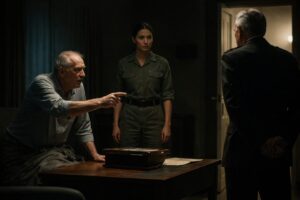
She remembered Collins in the operations room after the blast, standing behind her chair while the feed cut in and out.
Write what happened.
“I need the full sequence,” she had said.
“You have it.”
“We need to include the verbal—”
“You have the written sequence, Bennett.”
“Sir, Martinez called in—”
“You will enter the confirmed route authorization.”
His hand had rested on the back of her chair.
Not threatening.
Worse.
Settled.
As if the weight of command could become part of the furniture.
Later, in the temporary medical station, Daniel Price had still been alive when she reached him.
Barely.
She had not known he could see her until his fingers closed around her sleeve.
His glove was torn. Blood had dried into the seam between his thumb and palm.
“Ma’am,” he whispered.
“Don’t talk.”
“Did we get them out?”
Sarah had looked toward the second vehicle. Smoke. Shouting. A medic dragging someone by the straps.
“Yes.”
She had lied because sometimes mercy came before accuracy.
Daniel’s mouth moved.
She leaned closer.
“Get the rest home,” he said.
Not blame.
Not road.
Not why.
Get the rest home.
Then his hand loosened.
Now, in the dining hall, Michael’s voice broke through memory.
“Tell me,” he said.
Not shouting now.
Worse than shouting.
“Would he be alive if you had disobeyed?”
The room did not breathe.
Sarah looked at him.
That question had lived inside her for six months.
It had sat across from her at breakfast. It had followed her into showers. It had waited by her bunk and whispered when the lights went out.
Would he be alive?
If she had pushed harder.
If she had refused.
If she had recorded Collins’s verbal order.
If she had broken chain.
If she had been braver before she needed to be composed.
Her mouth opened.
For one dangerous second, she almost answered him like a person instead of a uniform.
I don’t know.
The truth was cruel because it was incomplete.
Then her eyes dropped to the floor.
Coffee spread around the overturned tray, carrying crumbs and egg yolk in thin brown streams.
She saw the medical kit again.
White gauze in red dust.
Daniel’s glove.
The boy who had asked if analysts danced.
Sarah closed her mouth.
When she lifted her eyes, they were wet but steady.
“No,” she said.
Michael flinched as if she had struck him.
“No?” he whispered.
“No,” Sarah said. “I will not let you turn his last breath into that question.”
Part IV — What Daniel Said
Collins moved fast then.
“Petty Officer Bennett, you are relieved from this room.”
It was such an odd order that no one obeyed it.
Not Sarah. Not Michael. Not the private with soda still drying on his hand.
Collins took another step. His command presence had always been a clean thing. It filled rooms without spilling over. Now it looked too polished for the mess around him.
“Walk away,” he said.
Sarah looked at him.
For six months, she had walked away from tables, from conversations, from people who stopped talking when she entered. She had walked away from Michael in hallways when his stare followed her like a thrown object. She had walked away from Daniel’s name because every time someone said it, she felt Collins’s hand on the back of her chair.
Write what happened.
She had written what could survive review.
Not what survived inside her.
Michael’s voice came out hoarse.
“What did he say?”
Sarah did not look away from Collins.
“He didn’t blame me,” she said.
Michael’s breathing changed.
“He didn’t blame the road,” Sarah continued. “He didn’t blame the order. He didn’t ask why.”
Michael swallowed.
The paper in his pocket crackled under his hand.
Sarah turned back to him.
“He asked if we got the others out.”
Michael’s face opened with pain so sudden it looked almost young.
“And then he told me to get the rest home.”
A woman at the nearest table lowered her head.
Somebody breathed out like they had been hit.
Michael stared at Sarah as though she had taken something from him and given back something heavier.
“That’s not in the report,” he said.
“No.”
“Why?”
Sarah’s eyes moved to Collins.
The answer did not need force.
It needed precision.
“Because dead men could not argue with it.”
Collins’s jaw tightened.
Sarah faced him fully now.
The room watched her turn.
For months, Collins had been the still point in every conversation. The one people glanced toward before speaking. The one whose silence gave shape to everyone else’s.
Now every eye followed Sarah instead.
“I signed your order,” she said.
Collins did not move.
Michael did.
Just a small shift backward.
Like the floor had dropped an inch beneath him.
Sarah’s voice remained quiet. That made it carry.
“I signed your order because the convoy was already committed, because the radio log was incomplete, because you told me the route was confirmed, and because afterward you needed one clean line of responsibility.”
Collins said, “Careful.”
Sarah nodded once.
“Yes.”
That word held more than agreement.
Careful was what she had been. Careful with names. Careful with records. Careful with survivors who needed a story they could bear. Careful with Daniel’s mother, who wrote one letter asking if he had been brave and received an answer filtered through three offices. Careful with Michael, who wanted a villain because grief without a face was too large to carry.
Careful had become another word for silent.
Sarah looked at Michael.
“You were right about one thing,” she said. “I hid behind procedure.”
His face tightened.
“But not to save myself.”
Then she turned back to Collins.
“I will not let you use me to keep him quiet anymore.”
No one spoke.
The dining hall had been silent before, but that silence had been fear and curiosity.
This silence was recognition.
Collins looked at Sarah for a long moment. His face did not collapse. Men like him did not collapse in public. His authority did not vanish; it thinned. It became visible as something made, maintained, defended.
He adjusted his cuffs.
It was a small movement.
Too small for shame, maybe.
Too formal for innocence.
“Report to my office in thirty minutes,” he said.
Sarah did not answer.
Collins looked around the room. Whatever he saw there made him stop before saying anything else.
No one saluted.
Not because they had forgotten.
Because the moment to command had passed, and everyone knew it.
Collins picked up his coffee cup from the table, seemed to realize it was empty or cold or useless, and set it back down.
Then he walked out.
His boots crossed the tile beside the spilled coffee.
He did not step in it.
Sarah noticed that too.
Michael remained in front of her, but he was no longer close enough to crowd her.
For the first time since the tray fell, there was space between them.
He looked at the door Collins had used.
Then at Sarah.
His mouth worked around words that did not come.
Sarah waited.
She had been waiting for six months. Another few seconds cost almost nothing.
“I thought,” Michael began.
He stopped.
Whatever he had thought was too small now.
Too clean.
He looked down at the mess on the floor.
The eggs. The coffee. The tray on its side.
His ears had gone red.
The room began to move at the edges. Not fully. Just enough to show that bodies remembered how. Someone set down a fork. Someone pulled back a chair and then thought better of it.
Michael crouched.
The movement startled people more than the shouting had.
He picked up the tray first.
Slowly.
Awkwardly.
His hands were built for rifles, rucks, straps, doors, grief. They looked clumsy gathering spilled napkins from tile.
Sarah watched him without expression.
He stacked the cup on the tray. Then the plastic lid. Then the ruined sandwich wrapping that had fallen from her table when he hit it with his hip. His fingers stopped near the coffee spreading under her boot.
“You don’t have to,” Sarah said.
Michael did not look up.
“Yeah,” he said. “I do.”
Part V — The Letter Before the Road
No one applauded.
That would have ruined it.
The dining hall did not break into justice. It did not become a movie, or a trial, or a battlefield where the right flag finally rose.
It remained a room full of people who had seen too much and understood too late.
Michael carried the tray to the trash. He came back with a handful of brown paper towels from the dispenser near the drink station. The private moved out of his way without being told.
Sarah still stood beside her table.
Her sandwich waited where she had left it.
The apple had rolled against the metal napkin holder. The folded napkin had stayed aligned with the tray’s old position, absurdly neat beside all that damage.
Michael knelt again.
He pressed paper towels into the coffee. They darkened immediately.
For a moment, his shoulders shook.
Only once.
Then he got control of himself.
Sarah looked away.
Some mercies were not meant to be witnessed.
A corporal from the nearest table started to stand.
Michael shook his head without looking at him.
The corporal sat back down.
The room gave Michael the work.
He wiped the floor in slow passes until the coffee became a stain, then a damp shine, then almost nothing. He gathered the towels and stood.
Sarah expected him to leave.
Instead, he reached into his chest pocket.
The folded paper came out soft at the edges. It had been opened and closed too many times. One crease had nearly torn through.
Michael held it in both hands.
For a second, his face hardened again, and Sarah thought he might read it aloud. Might make one last weapon out of Daniel’s handwriting.
But he did not.
He set the letter beside her untouched lunch.
Carefully.
Like it was heavier than paper.
“He wrote this before the road,” Michael said.
Sarah looked at it.
Her name was not on the outside.
No one’s was.
Just a fold, a crease, a thumb-worn corner.
“What is it?” she asked.
Michael stared at the letter instead of her.
“Something he gave me before we rolled out. Said if anything happened, I could decide who needed it.” His mouth twisted. “I decided wrong for six months.”
Sarah did not reach for it.
Not yet.
Michael seemed to understand.
“He mentions you,” he said.
That hit harder than it should have.
Sarah’s hand moved before she stopped it.
Michael saw that too.
“He said you looked like you were always waiting for bad news.”
Despite everything, Sarah almost laughed.
It came out as breath.
Michael’s eyes lifted then.
For the first time, he looked directly at her without aiming anger.
“He said you made him check the straps twice. Said it annoyed him.” His voice caught. “Said it probably meant he’d live longer.”
Sarah closed her eyes.
Just once.
When she opened them, the dining hall had blurred at the edges.
Michael looked back down.
“I’m not asking you to forgive me.”
“Good,” Sarah said.
The word was not cruel.
It was honest.
Michael nodded as if he deserved it.
Then he said, “I needed somebody to have done it.”
Sarah’s throat tightened.
There it was.
The thing beneath all the shouting.
Not innocence. Not apology. Not absolution.
Just the ugly shape of grief, finally spoken without armor.
“I know,” she said.
Michael looked at her sharply.
She did not soften it.
“That does not make it right.”
“No.”
“It just makes it human.”
His face broke in a quiet way.
Not enough for the room to feed on. Enough for Sarah to see.
He stepped back.
The space between them widened into something neither of them knew how to cross.
At the doorway, two military police appeared, summoned by someone at some point. They paused as if uncertain whether they had arrived before or after the thing they were meant to stop.
Sarah almost smiled at that too.
Almost.
Michael looked toward them, then toward Sarah.
“I’ll go,” he said.
No one ordered him to.
That mattered.
He walked past the tables with his hands open at his sides. Soldiers watched him go, but not the way they had watched him shout. The anger had left him smaller. Or maybe grief, once uncovered, simply took up less room than rage.
At the door, he stopped.
Without turning around, he said, “His mother asked if he was brave.”
Sarah’s fingers touched the back of the chair.
“She should know he was kind,” she said.
Michael stood still.
Then he nodded once and left.
The military police followed him into the hall, not touching him.
After that, sound returned slowly.
Not conversation.
Not yet.
Just the scrape of a chair. The hum of the drink machine. The distant clatter from the kitchen. Someone breathing through their nose as if they had forgotten how to do it quietly.
Sarah sat down.
The act felt larger than standing had.
She sat in the same chair, at the same table, in front of the same untouched lunch, with Daniel’s folded letter beside her apple.
No one came over.
For once, she was grateful.
She rested both hands flat on the table.
They were steady now.
Across the dining hall, Sergeant Major Collins’s abandoned coffee cup remained on his table. No one touched it. It sat there like evidence no report would ever fully contain.
Sarah looked at the letter.
She did not open it.
Not because she was afraid.
Because some words deserved a room smaller than this one.
A private near the drink station finally mopped up the soda he had spilled. Someone at the nearest table began eating again, slow and quiet. The dining hall resumed, but it did not return.
That was the difference.
Before, the silence had belonged to Michael’s rage.
Then it had belonged to Collins’s command.
Now it belonged to Sarah.
Not as victory.
Not as revenge.
As space.
She picked up the apple, turned it once in her hand, and set it back down.
Then she placed two fingers lightly on Daniel’s letter, holding it still beside her lunch.
Outside the high windows, afternoon light fell across the tile where the coffee had been. The floor was clean now, but not untouched.
Sarah sat there until her breathing evened.
For the first time in six months, she did not walk away.