The Coin Beneath the Table
Part I — The Floor Beneath Honor
The first thing Sergeant Mara Ellis heard when Brigadier General Harlan Voss saw her was the silence.
Not the music. Not the clink of crystal. Not the polite laughter of senators, donors, officers, widows, and men with medals bright enough to catch the chandeliers.
Just the silence that fell when a powerful man decided someone did not belong.
Voss stopped in the middle of his toast.
His glass remained lifted. His smile remained shaped for the cameras. But his eyes had found Mara near the service doors, standing half in shadow in a plain dress uniform with no invitation badge and one ribbon missing from her left breast.
For three seconds, no one else understood.
Then Voss lowered his glass.
“Well,” he said, his voice carrying easily through the ballroom. “I see we have mistaken this evening for an open grievance session.”
Every head turned.
Mara kept her hands at her sides. Her right hand, the burned one, twitched once and went still.
The National Military Foundation had rented the grand ballroom of the Whitcomb Hotel for its annual honors dinner. White tablecloths. Gold chairs. Cameras near the back wall. A string quartet on a low platform. On the stage, behind the head table, hung an enormous banner:
SERVICE REMEMBERED. SACRIFICE HONORED.
Voss stood beneath those words as if they had been written for him.
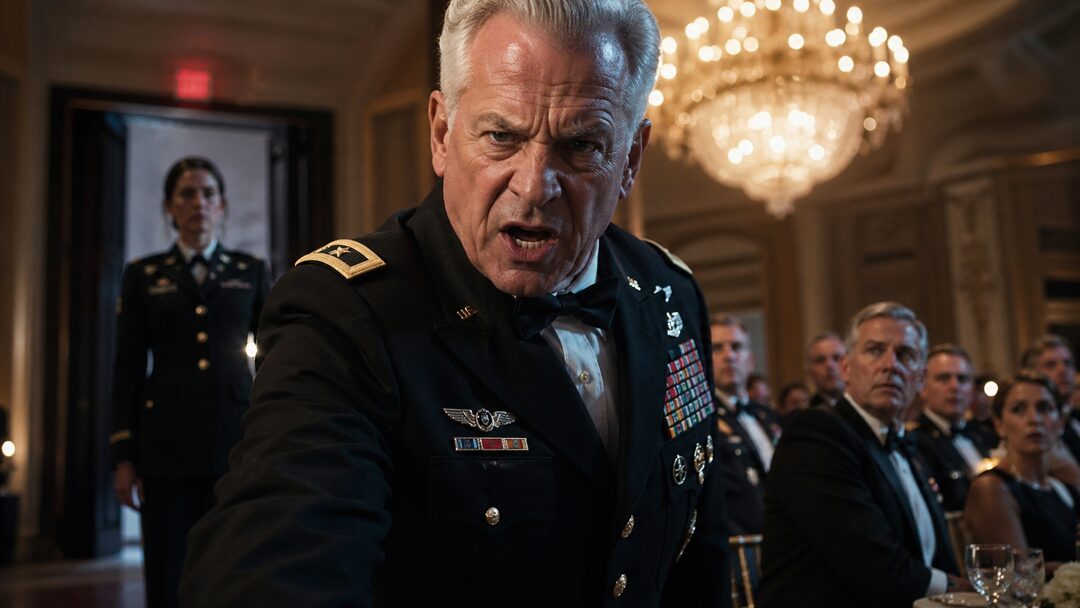
He was sixty-two, tall, silver-haired, immaculate. His uniform looked less worn than installed. Medals lay across his chest in bright, disciplined rows. The largest of them had been awarded after Operation Lantern Ridge.
Mara knew because she had watched the ceremony from a hospital bed.
Voss took one step down from the platform.
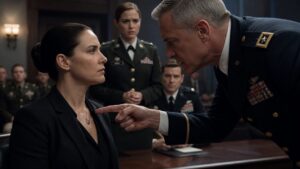
“Sergeant Ellis,” he said. “Though I believe you forfeited the right to be called that.”
A murmur moved through the room.
Mara felt it touch her skin.
There were generals at the front tables, defense contractors near the center, donors near the aisle, Gold Star families seated where the cameras could find them. Several younger officers turned sharply when they heard her name. Lantern Ridge was still taught in leadership seminars. It was a lesson about discipline. About the danger of emotional decision-making under fire.
It was also a lie.
Mara did not move.
Voss came closer, each step measured, public, controlled.
“You were not invited,” he said.
“No, sir.”
The word sir scraped her throat.
“This is an evening for honor.”
“Yes, sir.”
His jaw tightened.
“And you thought you would come here in uniform, uninvited, to turn it into another performance of victimhood?”
The silence changed shape.
Before, it had been startled. Now it was hungry. People wanted to know what she had done. They wanted the room to explain her before she could explain herself.
Mara looked past Voss to the head table.
Deputy Secretary Elias Grant sat beside an empty dessert plate, a silver pen clipped inside his jacket pocket. His expression had gone careful. Men like Grant never looked shocked unless they meant to reveal something.
He knew her name.
Not from the newspapers. Not from the discharge file Voss had fed to the right people.
From somewhere deeper.
“Sergeant Ellis,” Voss said softly, “leave this room.”
Mara took one step forward instead.
The room breathed in.
Voss’s hand closed around her arm.
It happened fast after that.
His grip tightened. She pulled back. A chair leg caught her heel. The chair toppled sideways, hitting another with a crack that sounded like a rifle in the polished room.
Mara fell.
Her shoulder struck first, then her hip, then her burned hand hit the marble floor hard enough to send pain white through her eyes.
Someone gasped.
Someone whispered, “My God.”
Above her, Voss looked down.
For one raw second, Mara was no longer in the Whitcomb Hotel. She was on the floor of a field station with dust in her mouth and blood drying under her fingernails, trying to stand while Captain Lena Ortiz shoved something into her vest and said, “Stay alive. That’s an order.”
Then something metal slipped from Mara’s jacket pocket.
It spun once across the marble.
A dull, blackened coin rolled beneath the edge of a white tablecloth and settled near Voss’s polished shoe.
Voss saw it.
Mara saw him see it.
His face did not change for the room. Not fully. But the eyes betrayed him first.
The anger split open.
Fear looked out.
Mara did not get up.
She reached beneath the table.
Part II — The Smallest Medal in the Room
The coin was cold against Mara’s fingertips.
For years, it had lived in the hidden pocket of every coat she owned. It had slept under her pillow in the VA housing unit. It had sat on the edge of sinks while she washed nightmares from her face. It had burned against her palm during interviews where men asked whether she was sure she remembered correctly.
She had not planned to drop it.
She had planned to place it on the head table herself.
But the floor had always had a strange way of finding her.
Mara curled her fingers around the coin and brought it into the light.
Blackened brass. One edge dented. A burn scar along the back filled with a hard blue resin that caught the chandelier glow. On one side, barely visible under soot and time, was the emblem of Field Surgical Team Seven: a lantern crossed with a scalpel.
Voss took a step toward her.
“Do not,” he said.
It was the first honest thing he had said all night.
Mara raised the coin.
The room leaned without moving.
To most of them, it must have looked like nothing. A souvenir. A keepsake from some unit that no longer existed. The ballroom glittered with official honors; every table had someone wearing silver stars, bronze stars, campaign ribbons, command badges. Compared to all of that, the coin was a ruined little circle of metal.
But Deputy Secretary Grant stood.
He did it before he had decided to.
His chair scraped back from the head table, loud enough to make the cameras swing toward him. Voss’s head turned sharply.
Grant looked at the coin, then at Mara.
“Mara Ellis,” he said.
Not Sergeant. Not former Sergeant.
Just her name, said like a file he had once closed and never stopped hearing.
Mara pushed herself up on one elbow. Pain bit through her wrist. She let the room see it. She let them see Voss standing above her, decorated and dry-eyed, while she sat on the floor with a coin in her burned hand.
“Deputy Secretary Grant,” she said. Her voice came out steadier than she felt. “Do you still keep the names of the dead in your briefcase, sir?”
A faint sound moved through the tables.
Grant’s mouth tightened.
“Or did you leave them in the archive?”
Voss’s face hardened.
“That is enough.”
“No,” Mara said. “It wasn’t enough then either.”
Voss turned to the room, suddenly calm in the way dangerous men became calm when they needed witnesses to doubt someone else.
“Ladies and gentlemen, I apologize. Sergeant Ellis has a documented history of instability following Lantern Ridge. She assaulted a superior officer during debriefing. She made accusations that were investigated and dismissed. Her own discharge record—”
“You mean the one your office edited?” Mara asked.
His gaze snapped back to her.
A senator near the head table shifted in his chair. One of the Gold Star mothers near the aisle pressed a hand to her mouth. At the rear of the ballroom, a young lieutenant glanced at the patch on Mara’s shoulder and looked away as if the fabric itself might accuse him.
Lantern Ridge was a cautionary tale.
Everyone in uniform knew the version approved for classrooms.
An evacuation corridor under ceasefire pressure. A medical unit that disobeyed withdrawal orders. A commander who preserved the line and saved hundreds by refusing to risk a second breach.
Four dead because discipline broke.
One survivor who came home damaged.
Voss had been awarded for the part where he chose the many over the few.
Mara had been discharged for insisting the few had still been alive.
Voss bent closer. His voice lowered, but the microphones caught enough.
“You are embarrassing yourself.”
Mara looked at his medals.
“No,” she said. “I did that in a hospital bed when I signed your statement.”
For the first time, he went still.
Grant heard it. His eyes narrowed.
Mara stayed where she was.
A waiter had frozen near the wall with a tray of untouched champagne. The string quartet had stopped playing without being asked. The cameras from the foundation livestream were still on. Somewhere in the room, someone had taken out a phone.
Voss looked toward the security detail.
“Remove her.”
No one moved at first.
That was the first crack.
Mara lifted the coin higher.
“This belonged to Captain Lena Ortiz,” she said.
The name hit the room differently.
Not everyone knew it. But Grant did. So did two colonels at the head table. So did a young major near the aisle, whose face had gone pale.
Mara continued.
“Field Surgical Team Seven. Lantern Ridge. She was my commanding medic.”
Voss laughed once, coldly.
“A sentimental object does not rewrite an operation.”
“No,” Mara said. “But an authentication code does.”
And with her thumb, she turned the damaged rim toward the light.
Part III — The Names They Left Behind
The engraving was small enough that half the room could not see it.
That made it worse.
People began to rise from their chairs, not fully standing, just lifting enough to see what Voss clearly did not want them to see. The ballroom lost its formal shape. It became a crowd around a wound.
Mara held the coin between two fingers.
“Emergency confirmation sequence. Three letters, six numbers, stamped along the rim after the second shelling. Lena did it with a cautery tip because our printer was dead.”
Voss spoke quickly.
“Anyone could engrave a coin after the fact.”
“You said you’d never seen it.”
His mouth closed.
The line landed harder than shouting would have.
Mara saw Grant look at Voss. Saw him understand the same thing she had seen on the floor: Voss had recognized the coin before she said what it was.
Grant stepped away from the head table.
“General,” he said, “let her speak.”
Voss turned on him. “With respect, Mr. Secretary, you have no idea what she is attempting to do.”
Grant did not blink.
“I have some idea.”
That was the second crack.
Mara pushed herself to her knees. Her hand shook. She hated that. She hated that the room could see pain in her body before it could hear truth in her mouth.
But Lena had once told her that pain was not weakness. It was just the body refusing to lie.
So Mara let her hand shake.
“The official report says Field Surgical Team Seven disobeyed a withdrawal order,” Mara said. “It says we stayed behind because Captain Ortiz lost situational discipline. It says General Voss sealed the extraction corridor after our team went silent.”
Voss’s voice cut in. “That is correct.”
“No,” Mara said. “That is convenient.”
A rustle moved across the tables.
Mara looked at the banner behind him.
SERVICE REMEMBERED. SACRIFICE HONORED.
She almost laughed. It would have sounded wrong, so she swallowed it.
“We received the withdrawal order at 0417,” she said. “We requested confirmation at 0419 because the south triage hall still had wounded civilians and two American personnel who could not walk. We received confirmation to abandon them at 0422.”
Voss’s face was stone.
“Command decisions are not made by medics in collapsed buildings.”
“No,” Mara said. “But medics are the ones who hear people asking not to be left there.”
For one moment, the ballroom was gone again.
Lantern Ridge returned in pieces.
Lena Ortiz with her sleeves rolled past her elbows, field goggles pushed into her hair, both hands inside a boy’s torn jacket while dust fell from the ceiling.
Corporal Webb laughing because the power had gone out and he was holding a flashlight in his teeth.
Specialist Nadir counting morphine in a voice that trembled only on the numbers.
Samira Vale, the interpreter, translating prayers for a woman who had lost too much blood to understand any language but touch.
And Voss’s voice over the radio, clean and distant:
Seal the corridor. Preserve the line.
Mara had screamed into the handset until Lena took it from her.
Then Lena had looked at her with the terrible calm of someone already making a decision.
“Ellis,” she had said, “you don’t get to die just because it would be easier.”
In the ballroom, Mara touched the coin with her thumb.
Grant was watching her now, not as a disturbance.
As a witness.
Mara turned to him.
“You saw a redacted file.”
The room shifted toward Grant.
His face did not change, but his hand went to the silver pen in his jacket pocket.
“I saw many redacted files,” he said.
“This one had four missing names.”
Grant said nothing.
Mara’s throat tightened.
“You signed off because the ceasefire was fragile. Because a public command failure would have reopened negotiations. Because four dead people and one unstable medic were easier to manage than a general with blood on his order.”
Voss snapped, “You do not speak to him that way.”
Mara looked at him.
“I spoke to you properly for years. It didn’t bring anyone back.”
Grant lowered his eyes.
That silence told the room more than denial would have.
Mara saw it spread: the discomfort, the calculation, the first private rearranging of loyalties. Some people still wanted Voss’s version. It was cleaner. It came with medals. It did not ask anyone at a dinner table to feel responsible for the dead.
Voss sensed the shift and attacked the only place he could.
“Tell them the rest,” he said. “Tell them what you told investigators.”
Mara’s stomach dropped.
Voss smiled without warmth.
“Tell them you blacked out before the final transmission.”
Grant looked back at her.
The room waited.
Mara could have defended herself. Could have explained trauma, blood loss, smoke inhalation, concussion. All of it true. None of it the truth he meant.
Instead she nodded.
“I lied.”
A sound went through the ballroom, small and ugly.
Voss seized it. “There.”
“I lied,” Mara said again, louder, “because I was twenty-four years old, burned, half-deaf, and sitting across from three officers who had already written the ending. I said I blacked out because I knew what happened to enlisted women who accused decorated men without proof.”
Voss’s smile thinned.
Mara looked down at the coin.
“And because I was ashamed I lived.”
The room did not know what to do with that.
Neither did Voss.
Mara’s voice dropped.
“Lena pushed me into the last vehicle. Webb was still breathing. Nadir was still calling out medication counts like someone would answer. Samira was holding pressure on a wound with her bare hands. I lived because someone better than me decided I had to.”
No one spoke.
The truth had entered the room without asking permission.
Part IV — Blue Resin
Voss recovered first.
He had built a career on recovering first.
“You have grief,” he said, “and grief deserves compassion. But grief is not evidence.”
It was almost beautiful, the way he did it. Turned cruelty into structure. Turned abandonment into command necessity. Turned the dead into tragic weather.
Mara had once feared that voice.
Now she only recognized it.
“No,” she said. “Grief is not evidence.”
She turned the coin over.
The back of it was uglier than the front. Burned almost black, gouged near the edge, sealed with a streak of hardened blue resin that had dried in a crooked crescent.
“This is.”
Voss’s eyes flicked to Grant again.
Too fast.
Grant saw it.
Mara saw Grant see it.
The room felt the shift even before anyone understood why.
Mara held the coin out toward Grant. “Field surgical resin. Blue batch. Medical sealant. We used it to patch scanner casings when the clamps broke. Lena sealed this inside a damaged med scanner before she shoved it into my vest.”
Voss said, “This is absurd.”
“Then ask why the recovered inventory list from Lantern Ridge included four blue resin kits,” Mara said. “And ask why the public report included three.”
Grant went very still.
For the first time all night, he looked older than his suit.
Mara did not look away from him.
“You saw it, didn’t you?”
His answer took too long.
“I saw an inventory discrepancy.”
“A discrepancy,” Mara repeated.
The word tasted like dust.
Grant’s face tightened.
“At the time, I was told it was a clerical error.”
“And that was enough?”
He did not answer.
Mara stood then.
Slowly.
Her hip screamed. Her wrist felt full of glass. A young captain near the second row stepped forward as if to help her, then stopped when she shook her head.
She needed to stand by herself.
Not because she was strong.
Because she had spent too many years being described as broken by men who needed her broken.
Voss had lost the comfortable height advantage. That angered him more than anything she had said.
“Military police,” he ordered.
Two uniformed guards near the door looked at Grant.
Not Voss.
That was the third crack.
Grant did not give an order.
The whole ballroom waited inside that hesitation.
Mara walked toward the head table.
Every step felt longer than the hallway out of Lantern Ridge. She passed donors who leaned away from her. Officers who would not meet her eyes. A widow wearing her husband’s miniature wings on a chain. A young lieutenant whose lips moved silently around the words Field Surgical Team Seven as if he had just realized history had been taught to him with missing teeth.
At the head table, Voss’s medals lay bright under the chandelier glow. He had removed one earlier for the foundation photographer to capture. It sat beside his folded speech, polished and large, an official piece of courage.
Mara placed the blackened coin beside it.
The sound was small.
Metal against linen.
It should not have been enough to change a room.
It did.
Voss looked at the coin beside his medal as if she had put a body there.
Mara straightened.
“Captain Lena Ortiz,” she said.
No one moved.
“Corporal Daniel Webb.”
The young major near the aisle closed his eyes.
“Specialist Amir Nadir.”
Grant’s jaw worked once.
“And Samira Vale.”
A woman at the back whispered, “Who is that?”
Mara heard her.
So did Grant.
Mara turned slightly, not toward the woman but toward the whole room.
“Civilian interpreter. Twenty-six. She had no uniform, so they left her out of the casualty count.”
The banner behind Voss seemed obscene now.
Service remembered.
Sacrifice honored.
Mara looked at Voss.
“You didn’t just seal a corridor. You sealed their names out of the record.”
Voss’s voice came low and dangerous.
“You have no idea what command costs.”
Mara almost smiled.
“No, sir. I only know what obedience cost.”
That line stayed in the air.
Even Voss did not touch it.
Part V — The Voice in the Scanner
Deputy Secretary Grant moved to the head table.
He did not reach for the coin. Not yet.
He stood across from Voss, with the blackened challenge coin between them and Voss’s medal beside it. The contrast was so sharp it felt staged by someone crueler than either of them.
Grant’s voice was quiet.
“Did you know they were alive when you gave the order?”
The ballroom held its breath.
Voss looked around the room before answering. Mara saw him calculate who still belonged to him. The older generals. The contractors. The donors. The men and women whose careers had been built on never confusing doubt with duty.
Then he lifted his chin.
“I knew we were losing the corridor,” he said. “I knew a breach would collapse the ceasefire. I knew hundreds could die if we held for a handful we could not retrieve.”
Grant did not move.
“That is not what I asked.”
Voss’s eyes cooled.
“A commander chooses the many over the few.”
Mara reached into her jacket.
Voss saw the motion and stepped forward.
“Do not make this worse.”
She looked at him.
“You already did.”
She pulled out a small, cracked data wafer sealed in a clear evidence sleeve. It was old, scratched, marked in faded ink. For years it had been nothing but weight. Not enough for the men who wanted clean files. Too damaged, they said. Too corrupted. Too incomplete.
But incomplete was not the same as silent.
Mara placed it next to the coin.
“This was embedded in the scanner file tied to the resin batch,” she said. “Most of it is corrupted. Enough survived.”
Grant stared at it.
“How did you get that?”
“Lena gave it to me.”
Voss said, “Impossible.”
Mara looked at him.
“You keep saying that about people who survived you.”
A phone camera near the back caught the line. Mara heard the faint digital chirp before someone silenced it.
Grant’s face had gone pale, but he nodded once.
“Play it.”
Voss turned on him. “Mr. Secretary—”
“Play it.”
Mara’s fingers shook as she took out her phone. Not from fear now. From the nearness of Lena’s voice.
For years, Mara had listened to the file only in the dark.
Never all of it. Never twice in one night.
She connected the wafer through a small reader clipped to her phone. The ballroom speakers did not carry it; the sound came from her device, thin and damaged and human.
Static first.
Then a burst of alarm tones.
Then Lena Ortiz, broken by interference but unmistakable.
“—south hall still has wounded. Repeat, wounded alive. Need corridor held six minutes.”
A crackle.
Someone in the ballroom began to cry. They tried to hide it and failed.
The recording jumped.
Lena again, closer this time. Breathing hard.
“Ellis, listen to me. If they bury this—”
More static. A crash in the background. A man shouting for pressure. Samira’s voice, faint, translating something soft.
Then Lena, clear enough to cut bone.
“Make them say our names.”
Mara stopped the recording.
She could not play the rest.
The room did not need the rest.
Voss stood very still.
Whatever legal defense he might have built still existed somewhere beyond the ballroom. Lawyers would come. Statements would be issued. Committees would choose words soft enough to survive television.
But in that room, at that table, beside that coin, he had already lost the only thing he had ever worshiped.
The story.
Grant turned toward the foundation staff near the cameras.
“Cut the livestream.”
Too late.
Half a dozen phones were already up. The senator at the head table removed his napkin from his lap and stood. He did not look at Voss as he left.
Then the young major near the aisle stood.
Not dramatically. Not with a speech.
He simply stood.
A lieutenant followed.
Then another officer.
It was not rebellion.
It was refusal.
Refusal to remain seated in the room where the dead had finally been named.
Voss looked at them with contempt at first, then disbelief. He had commanded men through dust and fire, through briefings and ceremonies, through the obedient architecture of rank. He had forgotten that silence was not loyalty. Sometimes it was only waiting for one person to stand first.
Grant looked to the military police.
“Escort General Voss to the side room. No press. No statements. Not from him. Not yet.”
Voss’s face darkened.
“You are making a mistake.”
Grant’s reply was almost too quiet to hear.
“I made it years ago.”
The guards moved.
Voss did not resist. Men like him rarely did when the room could see them. He adjusted his jacket, straightened one medal with two fingers, and walked as if he had chosen the direction.
When he passed Mara, he paused.
“You think this will free you?”
Mara looked at the coin beside his medal.
“No,” she said. “I think it frees them from you.”
For the first time all night, he had no answer.
Part VI — Start With Their Names
The service hallway outside the ballroom smelled of coffee, floor polish, and overworked air-conditioning.
Mara sat on a low metal bench beside stacked crates of folded table linens. No chandeliers here. No cameras. No banner. Just beige walls, a humming soda machine, and the muffled chaos of a banquet trying to decide what it had become.
She sat because she chose to.
That mattered.
Her hip hurt. Her burned hand had swollen across the knuckles. Her uniform was creased where she had hit the floor. Somewhere inside the ballroom, officials were making phone calls that would turn into statements by morning. Somewhere else, Voss was probably saying command necessity to anyone still willing to confuse it with innocence.
Mara closed her eyes.
For the first time in years, the coin was not in her pocket.
The absence felt like a wound and a relief.
The hallway door opened.
Deputy Secretary Grant stepped out carrying two things: the blackened challenge coin and Voss’s polished medal. He looked at the medal in his left hand as if unsure why he had brought it, then slipped it into his jacket pocket like evidence that embarrassed him.
The coin he held carefully.
He stopped a few feet from Mara.
“I owe you an apology,” he said.
She opened her eyes.
“No,” she said. “You owe them a record.”
The line hit him where she meant it to.
He nodded.
For a moment, neither of them spoke.
Inside the ballroom, a woman began sobbing. Not loudly. Not performatively. The sound slipped through the door and vanished.
Grant looked down at the coin.
“I did see the discrepancy,” he said. “The resin kits. The missing interpreter. The timing gap. I asked for clarification.”
Mara said nothing.
“I was told it had been resolved.”
“And you wanted to believe that.”
He did not defend himself.
“Yes.”
That was all.
Not enough. But true.
Mara looked at the wall across from her. There was a scuff mark near the baseboard shaped almost like a country on a map. For years she had wondered whether truth would feel like fire when it came out. Instead, it felt like exhaustion.
Grant stepped closer and held out the coin.
She did not take it.
Her hand stayed on her knee.
For five years, that coin had been Lena’s last order. Mara had carried it like proof, like punishment, like a small hard heart that beat only when she was trying not to sleep.
If she took it back, would it become a burden again?
If she left it with Grant, would it disappear into another drawer?
Grant seemed to understand enough not to rush her.
“The review will be reopened,” he said. “Publicly.”
Mara almost laughed.
Publicly.
As if the dead cared about press access.
But then she saw Lena again, not in the last recording, not in the smoke, but the way she had been before everything collapsed: crouched beside a child with a bandage between her teeth, snapping at Mara to stop apologizing and hand her the clamp.
Lena had never wanted worship.
She had wanted work done right.
Mara reached for the coin.
Her fingers closed around the damaged edge, the blue resin, the old burn, the tiny engraved code. It was warm now from Grant’s hand.
That surprised her.
For so long, it had felt cold.
She pressed it once to her chest.
Not like a medal.
Like a hand over a wound.
Her eyes closed before she could stop them. A breath left her, rough and quiet. When she opened them again, Grant was watching her with something like shame and something like respect.
Mara gave him the smallest smile.
It was not forgiveness.
It was not peace.
It was the first expression her face could make after putting down a weight and realizing some of it would always remain.
Grant said, “Sergeant Ellis—”
“Mara.”
He accepted the correction.
“Mara,” he said. “Where do you want us to start?”
She stood.
Slowly, because pain was still pain. Because dignity did not make the body forget the floor. Because no truth, however public, could turn back a sealed corridor.
But she stood.
The coin rested in her palm.
She looked toward the ballroom door, where the sound of people talking had become urgent, frightened, alive. A room built to honor sacrifice had finally been forced to learn what one sacrifice had cost.
Mara looked back at Grant.
“Start with their names,” she said.
Then she walked down the service hallway, away from the chandeliers, carrying the coin openly for the first time.