The Snake They Buried
Part I — The Man on the Mat
Corporal Dean Rusk hit the mat so hard that every soldier in the room stopped breathing.
One second, he had been smiling for the crowd, rolling his shoulders, calling the new staff sergeant “ma’am” in a tone that made the younger recruits laugh.
The next second, his boots were in the air.
His back slammed down first. Then his pride.
Staff Sergeant Mara Venn stepped away from him before the sound finished traveling through the room.
She did not raise her hands. She did not smile. She did not look around to see who had watched.
She only adjusted the hem of her olive training shirt and lowered her eyes, as if the worst part of the fight had not been hurting him.
The worst part had been being seen.
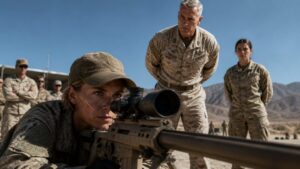
Dean lay there for a moment, blinking at the ceiling lights. The gym smelled of rubber mats, sweat, old concrete, and the metallic heat of bodies packed too close together. Soldiers stood along the walls in loose formation, some in camouflage pants and tan shirts, some with towels around their necks, all of them suddenly quiet.
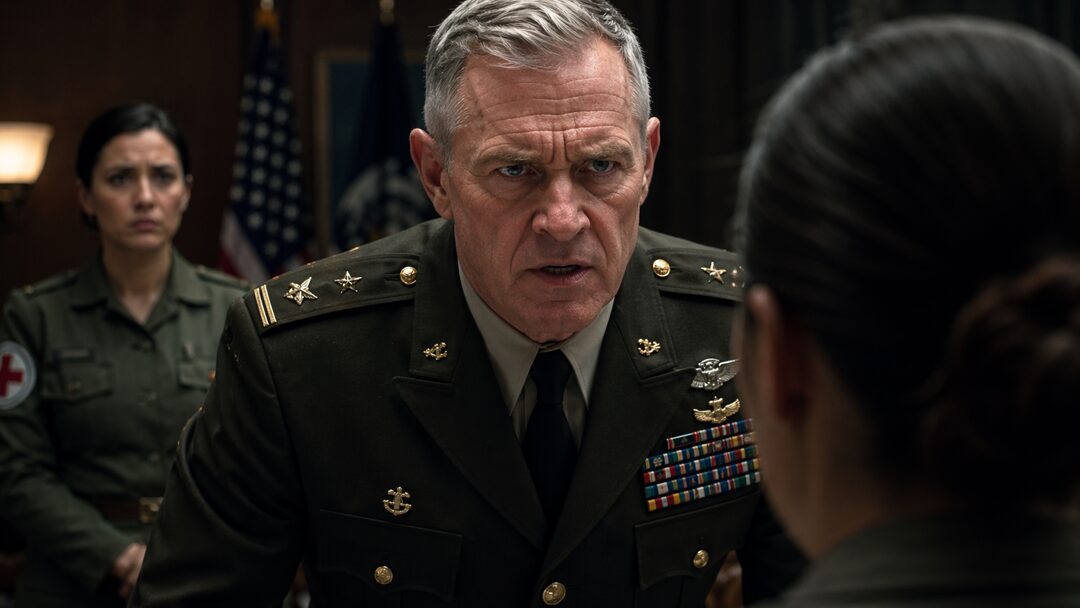
At the edge of the mat, Lieutenant Colonel Harlan Vale watched with his hands clasped behind his back.
His face gave nothing away.
That was what people respected about Vale. His calm could make a room straighten itself.
Dean rolled to one side and pushed himself up.
A few soldiers tried not to smile. One failed.
Dean heard it.
His neck flushed red.
“Lucky catch,” he said.
Mara looked at him once.
Not sharply. Not even with annoyance.
With warning.
“Let it go,” she said.
The room changed around those three words.
They were too quiet to be a challenge, too plain to be fear. They landed somewhere worse for Dean: mercy offered in public.
He wiped his mouth with the back of his hand and gave a hard laugh.
“You hear that?” he said, looking at the others. “New instructor drops one throw and thinks she’s my chaplain.”
No one laughed this time.
Mara shifted her weight back half a step.
It was the smallest movement, but Vale saw it. Not retreat. Preparation.
“Corporal Rusk,” Vale said. “Stand down.”
Dean turned toward him. “Sir, with respect, she caught me off guard.”
“With respect,” Vale said, “you were the one talking.”
A few eyes dropped. That was almost a joke, coming from Vale.
Dean’s jaw tightened.
He had built his place in the unit with noise, muscle, and the kind of confidence that worked best when no one tested it. He was broad through the shoulders, shaved clean, quick to volunteer, quicker to make smaller soldiers feel small. Ten minutes earlier, he had thrown a nineteen-year-old recruit named Pike three times and bowed to the room like he had won a prize.
Mara had stepped onto the mat only after Pike got up holding his ribs.
She had not asked for attention.
That made Dean hate the attention she got.
“Again,” he said.
Vale’s eyes narrowed. “That was not a request you get to make.”
Mara spoke before the commander could finish.
“It’s fine.”
Vale looked at her then, and for the first time since she had transferred to the base six weeks earlier, something like irritation crossed his face.
“No,” he said. “It is not.”
Dean smiled.
He thought Vale was protecting her.
That was his mistake.
Mara turned her head just enough to see Vale out of the corner of her eye. “One more, sir.”
Her voice was level.
Vale studied her.
She was not tall. She did not carry herself like the men and women who wanted a room to know they were dangerous. Her dark hair was tied tight against the back of her head. A thin scar cut near her left eyebrow and disappeared when the light hit her face wrong. Her body looked built from restraint: compact, quiet, exact.
Vale should have said no.
Years later, he would remember that he almost did.
Instead, he gave one curt nod.
Dean stepped back, rolled his shoulders again, and smiled like the first fall had been a clerical error.
Mara did not move.
The soldiers along the wall leaned in without meaning to.
Lena Ortiz stood near the medic bag at the back, arms crossed, eyes fixed on Mara. She was small and alert, with a medic patch on her sleeve and a cheap braided bracelet tucked under the cuff at her wrist. She had been watching the whole session like she watched everything: as if survival was a subject she could study hard enough to pass.
Dean charged.
Not cleanly. Not smart.
Angry.
Mara waited.
He came in with force, trying to crowd her, trying to make size matter. His hand reached for her shoulder. His other arm swung across, heavy and fast.
Mara slipped inside the movement.
For half a second, they were chest to shoulder, too close for most people to see what happened.
Then Dean’s momentum turned traitor.
Mara pivoted, caught his balance before he knew he had lost it, and drove him down with the same calm she might have used to close a door.
He hit the mat again.
This time the sound was uglier.
Mara dropped one knee beside his ribs, controlled his wrist, and stopped.
Not because she could not finish.
Because she could.
Dean stared up at her, breathing hard, face bright with shame.
“Enough,” she said.
A faint tearing sound cut through the silence.
Mara’s sleeve had split at the shoulder.
The fabric pulled open where Dean’s hand had grabbed her, exposing the upper curve of her arm.
At first, the soldiers saw only black ink.
Then the shape resolved.
A snake.
Not a decorative snake. Not a clean barracks tattoo earned on a weekend dare.
It coiled around her upper arm in dark, worn lines, its head angled downward as if it were guarding something beneath the skin.
The room became too still.
Someone whispered, “What the hell is that?”
Mara released Dean and stood.
Her hand went to the torn sleeve.
Too late.
Lieutenant Colonel Harlan Vale had seen it.
His face lost color so quickly that Lena noticed before she understood why.
Vale took one step forward.
Then another.
His voice came out low.
“Clear the room.”
No one moved.
Vale did not raise his voice.
“I said clear the room.”
Boots shifted. Soldiers gathered towels, water bottles, pride. They moved toward the doors in uneasy lines, glancing back at Mara’s arm as if the tattoo might move if they looked long enough.
Dean sat up slowly.
He had wanted a crowd.
Now he had something worse.
A secret with witnesses.
Part II — The Name He Buried
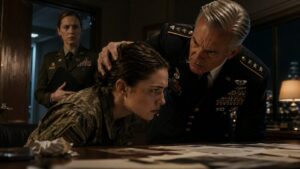
Mara pulled the torn fabric over her arm and stepped off the mat.
Vale waited until the last soldier crossed the threshold.
“Rusk,” he said.
Dean froze near the door.
“Sir?”
“Out.”
Dean looked between them. His embarrassment had sharpened into suspicion.
“Did I miss something?”
Vale’s eyes did not move. “You are about to miss several things if you do not leave.”
Dean swallowed the rest of whatever he wanted to say and walked out.
The door shut behind him.
The gym felt larger empty.
Mara bent to pick up the roll of tape she had brought with her. Her fingers were steady. Vale watched them as if he expected them to shake.
“They told me the transfer came from Fort Bragg,” he said.
“It did.”
“They told me you had twelve years in and no disciplinary record.”
“I don’t.”
“They told me your name was Mara Venn.”
She looked at him then.
“It is.”
Vale’s face tightened.
“That is not the name I buried.”
The sentence should have filled the room.
Instead, it seemed to take air out of it.
Mara set the tape on the bench. “You didn’t bury me.”
Vale did not answer.
“You left me,” she said.
His jaw worked once. “You were listed as killed in hostile territory.”
“Listed,” Mara said. “That was neat of you.”
He flinched at that more than she expected.
For a second she saw the younger man inside him, the one who had stood over a radio in a dim command room and listened to people die through static.
Then he was gone.
The commander returned.
“You should not be here,” Vale said.
“I filed a lawful transfer.”
“You know what I mean.”
“Yes,” Mara said. “I usually do.”
Vale turned away, then back. He was measuring exits that had nothing to do with doors.
“How many people have seen that mark?”
“Enough now.”
“You had it covered.”
“I had a shirt on.”
“Don’t do that.”
“Do what?”
“Pretend this is ordinary.”
Mara stepped closer. Not much. Enough.
“Nothing about being buried alive in paperwork is ordinary, sir.”
His eyes hardened at the rank.
The word had been a blade because she had made it one.
Outside, voices passed in the hallway. Low, excited, hungry. Rumor was already learning how to walk.
Vale heard it too.
“You understand what happens if this spreads,” he said.
Mara’s laugh was almost soundless. “To me?”
“To everyone.”
“There it is.”
His face sharpened. “You think this is simple.”
“No. I think you do.”
Vale looked toward the door, then back to her arm, now covered but not erased.
“The operation prevented a wider conflict from becoming public,” he said.
Mara stared at him.
There were sentences people built because they could not stand inside the truth.
That was one of them.
“You rehearsed that,” she said.
“I lived with it.”
“No,” Mara said. “You lived after it.”
Vale’s control slipped again.
Not far.
Only enough.
Black Snake had never been an official unit name. Officially, they had been a cross-border recovery element attached to a regional stabilization command. Officially, they had moved under temporary classification. Officially, most things were not what they were called by the people ordered to survive them.
But the six soldiers who went in knew what they called themselves.
Black Snake.
Because snakes moved low. Because snakes did not announce themselves. Because one of them, Sergeant Amos Dyer, had drawn the patch in a notebook during three days of dust and waiting: a black snake wrapped around a broken radio tower.
Mara had hated the drawing.
Then she had worn it.
Then she had carried it out under her shirt while Amos did not come out at all.
Vale’s voice lowered. “Mara.”
She hated how he used her name like proof he was human.
“You gave the final withdrawal,” she said.
“There was no viable recovery path.”
“There was a child.”
His eyes flickered.
So he remembered.
Good.
“There was an interpreter who had saved thirty-two American soldiers by turning on the people who raised him,” Mara said. “There was his daughter hiding under a sink because everyone brave enough to help us had been killed.”
“That is not what the mission became.”
“That is exactly what the mission became.”
“You disobeyed an order.”
“And you called it death so nobody had to call it abandonment.”
Vale’s mouth closed.
For the first time, he looked old.
Not weak. Not sorry enough.
Just old.
Mara took the tape from the bench and wrapped it once around the torn sleeve, fastening the fabric back over her arm.
“You want to know why I came here?” she asked.
Vale did not answer.
“You are sending another unit through the same intelligence chain.”
His eyes sharpened. “That deployment is not your concern.”
“It is if Lena Ortiz is on it.”
At the name, Vale went still.
Mara saw the calculation before he hid it.
“You knew,” she said.
“I know the roster.”
“No. You knew who she was.”
Vale looked toward the mat, where Dean’s sweat still marked the vinyl.
“She was a child,” he said.
“She still is, compared to the people making decisions over her head.”
“She enlisted.”
“So did I.”
“That does not give you authority to interfere.”
Mara stepped toward him again, and this time he did not like it.
“I did not come back for revenge,” she said. “If I had, you would have seen me sooner.”
“Then why?”
“Because they are about to teach her to trust the same kind of order that killed them.”
For a while, neither of them spoke.
Then Vale said the thing that proved he had learned nothing.
“You need to leave this alone.”
Mara looked at him, and all the quiet in her became colder than anger.
“I tried that,” she said. “You made a file out of me.”
Part III — One of the Dead
By evening, the whole base had seen the tattoo.
Dean Rusk took the photo himself.
He had caught Mara in the moment after the second fall, sleeve torn, black snake exposed, face turned half away. The picture should have made her look vulnerable. Instead, it made her look like someone interrupted while carrying a grave.
Dean posted it in a private unit chat with a caption:
Guess staff sergeant has secret snake powers.
He expected laughter.
For three minutes, he got it.
Then an older supply sergeant replied with one word.
No.
Then another message appeared.
Where did you get that photo?
Dean stared at his phone.
Someone added a skull emoji.
Someone else typed:
That’s Black Snake.
The chat stopped being funny.
By 1900, soldiers were whispering in the dining facility. By 2000, two veterans from logistics had gone quiet when Mara walked past. By 2100, someone Dean barely knew stopped him outside the barracks and said, “You better hope that picture is fake.”
Dean laughed because he did not know what else to do.
“What, she famous?”
The man looked at him like he was stupid in a way that might get people killed.
“She’s dead.”
Dean’s smile went away.
“What?”
The veteran pointed toward Dean’s phone.
“That mark belonged to a team that didn’t come back.”
Dean looked down at the photo again.
For the first time, he noticed her expression.
Not fear.
Recognition.
Like the room had become a place she had already survived once.
Across the base, Lena Ortiz sat alone behind the clinic with her phone in both hands.
She had been sent the image five times by people asking if she knew anything.
She did not.
That was the problem.
The tattoo had pulled something loose inside her.
Not memory exactly.
A shape.
A smell of wet concrete. A woman’s shirt pressed against her face. A hand over her mouth, not cruelly, but to keep her quiet. A whisper in a language she had forgotten before she learned English properly.
Breathe small.
Lena touched the braided bracelet at her wrist.
Her adoptive mother had told her it came from before. Before America. Before paperwork. Before the family that chose her.
Before had always been a locked room.
Now a black snake had appeared on someone else’s skin, and the lock had clicked.
She found Mara in the motor pool after lights-out inspection.
Mara was alone beside a row of vehicles, checking straps that did not need checking. The floodlights cut hard shadows across her face.
Lena stopped ten feet away.
“You knew me.”
Mara did not turn immediately.
When she did, her expression did not change enough to comfort anyone.
“Yes.”
The word hit harder because it did not dodge.
Lena’s throat tightened. “How?”
Mara looked past her once, making sure they were alone.
“You were four.”
Lena took one step back without meaning to.
The number entered her body before the meaning did.
“No,” she said.
Mara said nothing.
“That’s not an answer.”
“No.”
“Then give me one.”
Mara’s eyes moved to the bracelet.
Lena saw it and pulled her sleeve down over it.
Too late.
Mara’s face changed.
Only a little.
Enough to hurt.
“You still have it,” Mara said.
“My mother said it was mine.”
“It was.”
Lena hated the softness in her voice.
“Don’t do that.”
“What?”
“Talk like you’re allowed to miss me.”
Mara absorbed the line without defending herself.
That made Lena angrier.
All her life, people had been careful with the beginning of her story. Doctors, adoption workers, teachers, her parents. They gave her safe words. Complicated region. Emergency placement. No surviving immediate family. Classified conflict.
Safe words were still walls.
Now this woman stood in front of her with the wall tattooed on her arm.
“Were you there?” Lena asked.
“Yes.”
“When my parents died?”
Mara looked down.
Lena’s hands curled.
“Say it.”
Mara’s voice was quiet. “Yes.”
The floodlights hummed.
Somewhere beyond the fence, a truck backed up with a long, thin beep.
“My father?” Lena asked.
“He was already gone when we reached the building.”
“My mother?”
Mara closed her eyes once.
That was the answer before the answer.
“She kept you hidden,” Mara said. “She made me promise not to let them take you back through the front.”
“Who is them?”
Mara shook her head. “Not tonight.”
Lena laughed once, sharp and ugly. “You don’t get to decide that.”
“I know.”
“No, you don’t.” Lena stepped closer. “You showed up here, watched me train, watched me put my name on deployment forms, and said nothing.”
“I was trying to stop the orders.”
“You were trying to control my life.”
Mara looked at her then, and the pain in her face was not dramatic.
It was disciplined.
That made it worse.
“I was trying not to make your life belong to what happened,” Mara said.
“It already does.”
The words landed between them.
Lena hated that they were true.
Mara reached into the pocket of her field jacket.
Lena stiffened.
Mara withdrew a folded piece of cloth, worn at the edges, black thread faded gray where fingers had touched it too many times.
A patch.
A black snake wrapped around a broken radio tower.
Lena stared at it.
“That was his?” she asked.
“Amos Dyer’s,” Mara said. “He gave it to me before we split. Said if I got out, someone should remember we had a name before they made us a mistake.”
Lena did not touch it.
“Why show me?”
“Because you asked for the truth.”
“This isn’t all of it.”
“No.”
“Why not?”
“Because all of it would only give you more ghosts.”
Lena’s eyes burned.
“I get to choose my ghosts.”
Mara’s mouth tightened.
For a second, she looked like someone standing in a tunnel again, water to her knees, a child in her arms, the radio dead, the order already given, the way out too small for everyone.
“I carried you through drainage water for half a mile,” Mara said. “You bit my shoulder because you were scared. Amos stayed behind to draw fire. Your mother gave me that bracelet and told me your name twice, because she was afraid the world would rename you.”
Lena stopped breathing.
“Mara—”
“I did not come here so you would thank me,” Mara said. “Do not do that.”
“Then why?”
Mara looked toward the dark line of the barracks.
“Because the people who buried us are still teaching young soldiers how to mistake silence for discipline.”
Lena looked down at the patch.
Her anger had not left.
It had found a deeper place to stand.
“What do you want from me?”
“Nothing.”
“That’s a lie.”
Mara nodded once.
“Yes.”
Lena waited.
“I want you alive long enough to decide who you are without them deciding what you’re allowed to know.”
Lena swallowed hard.
It was the first thing Mara had said that did not sound like defense.
Behind them, a door opened.
Both women turned.
Dean Rusk stood at the edge of the motor pool, phone in hand, face pale in the floodlight.
He had heard enough to know he had not heard nearly enough.
Mara’s eyes went to him.
Dean lowered the phone slowly.
“I didn’t know,” he said.
Mara’s voice was flat. “You didn’t ask.”
Part IV — The Patch on the Table
The inquiry was not called an inquiry at first.
It was called a personnel review.
Then a command climate assessment.
Then an administrative clarification.
By morning, everyone knew it was about the snake.
Mara sat at one end of the conference table with her hands folded. Her torn shirt had been replaced by a fresh uniform blouse buttoned to the throat. The tattoo was covered.
That made everyone look at the sleeve.
Vale sat opposite her, polished and still, a man built entirely out of rank. Two officers from division command joined by secure screen. A legal adviser sat near the wall. Dean Rusk waited in a chair by the door, no longer broad in the room. Lena stood beside the medic liaison, jaw tight, bracelet hidden under her cuff.
Vale began with procedure.
He always did.
“Staff Sergeant Venn’s transfer record contains irregularities that require review before she continues instructional duties.”
Mara did not move.
One of the screen officers glanced down. “Irregularities?”
“Unreported trauma history. Possible identity conflict. Classified exposure through unauthorized dissemination.”
Dean stared at the floor.
The word unauthorized had found him.
Vale continued. “Given yesterday’s incident, I have concerns about Staff Sergeant Venn’s suitability for active training environments.”
Mara looked at him then.
Not angry.
Worse.
Interested.
The legal adviser asked, “Do you dispute that, Staff Sergeant?”
Mara’s voice was calm. “Yes.”
“On what grounds?”
“On the grounds that I am alive.”
No one spoke.
Vale’s face hardened.
Mara turned toward him. “Would you like to dispute that, sir?”
The question moved through the room like a wire pulled tight.
Vale leaned back slightly. “No one is disputing your physical survival.”
“Yesterday you told me I was not the name you buried.”
Dean looked up.
The division officers looked at Vale.
Vale’s expression did not change, but something in him braced.
“I was speaking imprecisely.”
Mara nodded. “Then speak precisely now.”
The legal adviser shifted. “Staff Sergeant—”
“No,” Mara said.
It was not loud.
It stopped him anyway.
She kept her eyes on Vale.
“Repeat the final withdrawal order.”
Vale’s hands remained still.
“What?”
“Repeat it.”
“This is not the forum for classified operational review.”
“You reviewed me as trauma. Review the order that made me dead.”
One of the officers on the screen said, “Colonel Vale?”
Vale’s eyes flicked to the screen, then back to Mara.
“It was a lawful command decision under unstable conditions.”
“That is not the order.”
“Mara.”
She leaned forward a fraction.
The room felt the movement like the start of a fall.
“Do not use my name to soften your report.”
Dean’s face changed.
So did Lena’s.
Because that was the moment they understood this was the same fight from the mat.
Only this time Vale was the one losing balance.
Mara spoke again.
“What did you tell us when the north route failed?”
Vale said nothing.
“What did you tell Amos Dyer when he reported civilians in the lower level?”
His throat moved.
“What did you tell me when I said there was a child?”
The room had become painfully quiet.
Vale looked suddenly furious, but the fury had nowhere clean to go.
“I told you,” he said slowly, “to withdraw to the marked extraction point.”
“And when I said not everyone could reach it?”
He closed his mouth.
Mara waited.
No one rescued him.
Finally, Vale said, “I ordered all remaining personnel to abandon non-mission variables and withdraw.”
Lena’s face went white.
Non-mission variables.
Mara did not look at her.
If she had, she might have stopped.
Instead, she reached into her pocket and placed something on the table.
A small folded cloth.
The room did not understand it yet.
Lena did.
She stepped forward before anyone could stop her.
“Mara,” she said.
Mara looked up.
Lena took the patch from the table and unfolded it with careful fingers.
The black snake appeared.
Not tattooed now. Stitched.
Worn. Real. Smaller than rumor. Heavier than any medal in the room.
Lena placed it flat in the center of the table.
“My mother was not a variable,” she said.
No one moved.
“My father was not a variable.”
Vale shut his eyes.
Just once.
When he opened them, he looked older than he had the day before.
The screen officer spoke carefully. “Colonel Vale, is that patch connected to the unofficial designation of the recovery element lost during Operation Harrow Gate?”
Vale did not answer.
Mara said nothing.
Dean looked at the patch like it had crawled out of his phone and become a body.
The officer repeated, “Colonel?”
Vale’s command voice came back weakly, like a uniform taken from storage.
“The official report stated all members of the element were killed in hostile territory.”
“That is not what was asked.”
Vale stared at the patch.
For years, he had lived inside the shape of the sentence he finally had to break.
“The report was incomplete,” he said.
The room changed.
Not dramatically. Not loudly.
But everyone felt the floor move.
Vale continued, each word dragged out of a place he had sealed.
“Staff Sergeant Mara Venn survived. One civilian child survived. The operation’s failure was concealed to prevent exposure of authorization issues and command misjudgment during a disputed border action.”
The legal adviser stopped writing.
The division officers looked at each other.
Lena’s eyes filled, but she did not cry.
Mara did not look victorious.
That bothered Dean most.
He had thought victory looked like making someone else small.
Mara looked like someone who had just opened a door and found the dead still waiting on the other side.
Vale turned to her.
“I believed,” he said, then stopped.
Mara waited.
Maybe she hated him.
Maybe she had spent years trying not to.
“I believed containment was responsibility,” he said.
Mara’s face did not soften.
“That is what people call fear when they have rank.”
Vale took the sentence like he deserved it.
Maybe he did.
The officer on the screen ordered Vale relieved pending formal investigation before the room had fully processed the confession. Procedure returned because procedure always did. People stood. Chairs scraped. The patch remained on the table between them, smaller than the damage it had done and smaller than the damage it had named.
Vale rose slowly.
For one suspended second, he and Mara stood across from each other like soldiers on opposite sides of the same grave.
“I did not know you lived,” he said.
Mara looked at him.
“You knew you left.”
He had no answer for that.
Some truths do not need more words.
They only need witnesses.
Part V — How to Fall
Dean found Mara outside the training gym two evenings later.
He had a bruise along his jaw where the mat had made its argument. He stood with his hands at his sides, trying to look formal and failing.
Mara stopped walking but did not help him begin.
He deserved that.
“I’m sorry,” he said.
It came out rough. Too small for what he had done. Maybe too late to matter.
Mara looked at him until he wanted to look away.
He did not.
“I thought it was about me,” he said.
“That was your first mistake.”
His mouth tightened.
A month ago, he would have made a joke.
Now he only nodded.
“I deleted the photo.”
“It already did what it did.”
“I know.”
“No,” Mara said. “You know it made trouble. That is not the same thing.”
Dean swallowed.
Behind the gym doors, the building hummed with old lights and empty space.
“I wanted them to laugh at you,” he said.
Mara waited.
Dean forced himself to finish.
“Then they looked at you like I was the joke.”
For the first time, something almost like approval touched her face.
Not forgiveness.
Recognition of a clean sentence.
“Respect is not the same as witnesses,” she said. “Learn that before the next war teaches it for you.”
Dean nodded once.
It was not redemption.
It was a start small enough to be real.
After he left, Mara stood outside the gym for another minute.
A staff car had taken Vale away that morning. No ceremony. No public disgrace. Just a man in a pressed uniform stepping into the back seat while three soldiers pretended not to watch.
Mara had been offered formal recognition by a colonel whose face she did not know.
She declined before he finished the sentence.
He looked offended.
Then confused.
Then relieved, because people preferred heroes who wanted the correct things.
Mara did not want a medal.
Medals turned pain into something polished enough for strangers to touch.
She entered the gym.
The lights flickered once overhead.
Lena Ortiz was alone on the mat.
She had removed her boots and was practicing a hip turn badly, over and over, jaw clenched in concentration. The braided bracelet was visible now. She had stopped hiding it.
Mara stood by the wall.
“You’re dropping your shoulder,” she said.
Lena froze.
Then she exhaled like she had been expecting Mara and resenting that expectation.
“I know.”
“No, you don’t. If you knew, you’d stop doing it.”
Lena turned.
Her eyes were tired. Not soft.
Good, Mara thought. Softness was not the same as healing.
“You refused the ceremony,” Lena said.
“Yes.”
“Why?”
Mara walked onto the mat. “Because ceremonies are where people clap so they don’t have to listen.”
Lena looked down, then back up.
“Are you leaving?”
The question cost her something. Mara heard it.
“No.”
Lena’s face did not change fast enough to hide the relief.
Mara gestured toward her stance. “Again.”
Lena reset her feet.
This time, she was worse.
Mara stepped behind her and corrected the angle of her elbow.
Lena went still when Mara’s sleeve shifted.
The tattoo showed.
Only part of it. Black ink at the edge of fabric. A curve of the snake’s body.
Lena looked at it for a long moment.
“Does it still hurt?” she asked.
Mara could have said no.
She could have said tattoos healed.
She could have said skin forgot faster than people did.
Instead, she gave Lena the truth she could carry.
“Only when people call it history.”
Lena nodded slowly.
She did not apologize for surviving.
Mara did not ask her to.
After a moment, Lena said, “Teach me the throw.”
“No.”
Lena blinked. “Why not?”
“Because you don’t know how to fall.”
“I know how to fall.”
Mara raised an eyebrow.
Lena sighed. “Fine. Teach me how to fall.”
Mara stepped back and lowered herself to the mat first.
Not as a demonstration of dominance.
As proof.
“You don’t fight the ground,” she said. “That’s how you break. You learn where the impact is going, and you give it somewhere to go that isn’t your spine.”
Lena watched closely.
“Sounds like more than falling.”
“It usually is.”
Mara showed her once.
Then again.
Lena tried and landed too stiffly.
Mara corrected her.
Again.
The mat struck Lena’s arm, shoulder, hip. Each time, she got up angry. Each time, she got up faster.
After the fourth fall, she stayed on her back, staring at the ceiling.
Mara stood over her, and for a second the room held the shape of the first fight: one soldier down, one standing, impact still echoing.
But this time no one had been humiliated.
This time the fall was not a defeat.
Lena turned her head toward Mara.
“Did you teach me this before?”
Mara’s throat tightened.
A drainage tunnel flashed through her mind. Water. Concrete. A child slipping in her arms. A small body too frightened to cry loudly. Mara whispering, Breathe small, breathe small, because bullets found noise.
“No,” Mara said.
Then, because silence had already stolen enough, she added, “I carried you. That’s different.”
Lena accepted that.
Not easily.
But truly.
She got up again.
“Show me.”
Mara took her stance across from her.
No crowd watched from the walls. No commander waited to turn truth into paperwork. No embarrassed man mistook domination for strength.
Only two soldiers stood on a black mat under tired lights, learning what to do with impact.
Mara reached for Lena’s wrist, slow enough to let her feel the motion.
“First,” she said, “you survive the fall.”
Lena nodded.
“And then?”
Mara saw the patch on the table. Amos’s grin in dust. Vale’s face breaking around the truth. Dean’s apology, too small and still necessary. A mother’s shaking hands tying a cheap bracelet around a child’s wrist so the world would not rename her completely.
The snake on Mara’s arm rested under her sleeve, no longer hidden, not exactly free.
“Then,” Mara said, “you decide what kind of strength you want to stand up with.”
Lena moved.
Mara let her.
This time, when the mat took the weight, it did not sound like burial.
It sounded like practice.