Where He Was Allowed to Stand
Part I — The Sealed Stone
By the time Mara Vale reached the square, the rain had already turned the paving stones black.
The statue was still covered, a tall shape beneath dark canvas, ringed by guards in dress uniform who stood too straight for a morning this cold. Beyond them rose the clean new facade of the Valedran Military Academy—glass, pale stone, brass letters, the kind of building that wanted history to believe it had been built by peace instead of after war.
Mara stopped at the cordon and looked down.
The plinth had been sealed overnight.
Fresh mortar. Fresh polish. A square of stone too newly finished against the older granite around it.
“What’s under his feet?” she asked.
The nearest guard did not answer.
He was young enough to have been born after the ceasefire. He looked at her black coat, her service pin, the scar on her wrist, and then looked past her as if silence were part of his orders.
Mara asked again. “That seal wasn’t there yesterday.”
This time a different voice answered.
“For the integrity of the installation.”
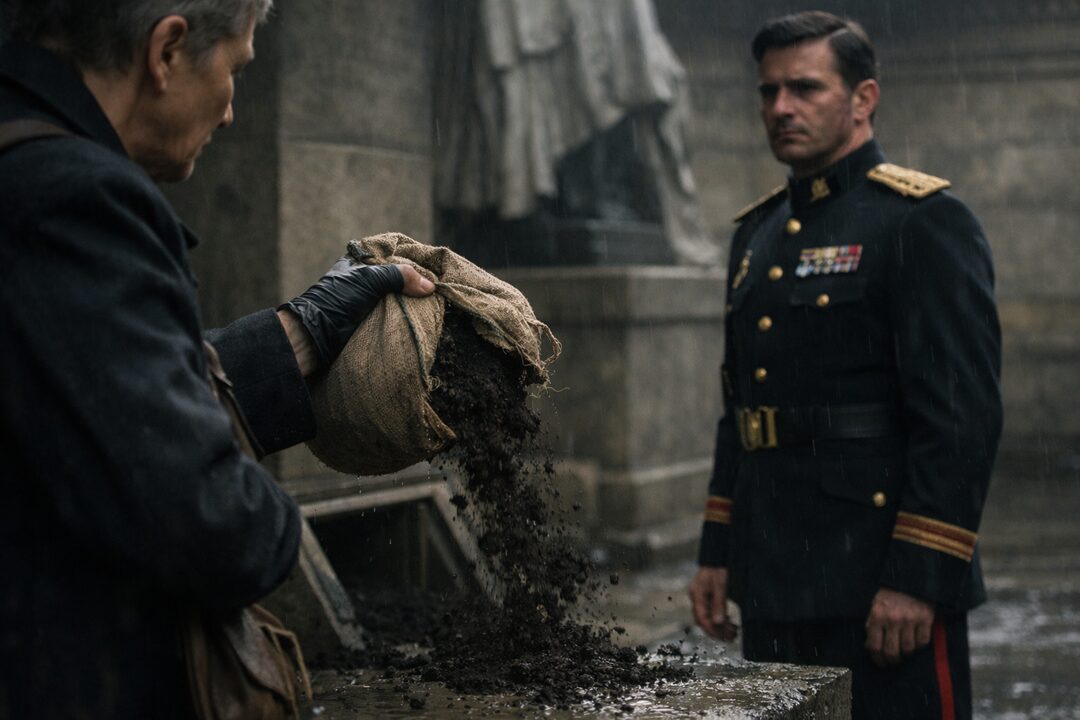
Colonel Tomas Aer walked toward her through the rain with the measured calm of a man who had been rehearsing his face for weeks. His ceremonial uniform was immaculate. Silver braid. Dark collar tabs. One pale burn mark on the angle of his jaw, half-hidden unless he turned. He stopped just outside her reach.
“Major Vale,” he said.
“Retired.”
“Your government still prefers the title.”
“My government also prefers answers.”
His gaze dropped once to the sealed plinth, then returned to her. “The unveiling begins in four hours. There are security protocols.”
Mara let the words sit between them.
This was the former enemy capital. Every window seemed too clean. Every uniform pressed too sharply. And in the center of it all, under black canvas and rain, stood the statue of General Ilya Soren—the man who had once said he would never again set foot on Valedran soil as long as he lived.
Now the Valedrans were unveiling him outside their own academy.
Father of modern peace, the invitation had called him.
Mara had read the words three times before the flight and hated them more each time.
“You know what people back home are calling this,” she said.
Tomas’s expression hardly moved. “Several things, I assume.”
“Desecration. Theft. Historical laundering.”
“Diplomacy tends to acquire uglier names before it acquires better ones.”
She almost laughed at that, except she could not stop seeing the wet black seam around the statue’s base.
He followed her gaze.
“Please don’t make a scene before the scene,” he said quietly.
That almost did make her laugh. “You think I came here to be difficult?”
“I think you came here because if anyone at this ceremony can tell the difference between honor and insult, it is probably you.”
It was the first honest thing he had said.
Mara looked past him at the covered bronze. She had served under Soren for eleven years. Treated boys with their legs gone. Carried morphine through shellfire. Watched him make decisions men called ruthless because they did not understand restraint was sometimes the crueler burden. She had seen him stand over a map for twenty hours without removing his gloves because the hand he kept hidden had never healed right after the winter campaign.
And she had heard the oath with her own ears.
Never again.
Not on their ground.
The rain slid off the canvas in slow black lines.
“What’s under his feet?” she asked one last time.
Tomas held her eyes.
“Not the wrong thing,” he said.
Then he stepped aside as a convoy pulled into the square, and all the muscles along Mara’s back tightened at once.
Because the man getting out of the second car had Soren’s face, minus the discipline.
Lio Soren was taller than his father had been, with dark hair fallen loose in the rain and a coat he wore like a refusal. He saw the statue, saw the academy behind it, and his mouth changed shape in a way Mara recognized instantly.
Not grief.
Offense.
He crossed the square without greeting anyone.
“Mara.”
“Lio.”
He kissed the air beside her cheek and then looked straight at the covered bronze. “Tell me this is still a joke.”
“It appears to have acquired uniforms, press access, and diplomatic observers,” she said. “So probably not.”
His laugh was short and ugly. “They put him here? Here?”
Tomas approached with two aides behind him. “Mr. Soren.”
Lio turned.
There were men who knew how to hide contempt inside civility. Lio had never been one of them.
“You’re the one arranging this?”
“I’m the one trying to keep it from collapsing.”
“My congratulations on your ambition.”
Tomas took the blow without flinching. “Your father’s memory deserves better than a public disaster.”
Lio took one step closer. “My father spent half his life making sure your government never got to use him. And now you’re unveiling him in front of your cadets like he belonged to your curriculum.”
“He belongs to history.”
“No,” Lio said. “That’s exactly the problem. He belonged to us. Then to the dead. History is what people say when they want the sharp parts filed down.”
The rain kept falling.
No one in the square moved.
Mara could feel the ceremony already beginning, even with hours left before the speeches. Not the official one. The real one. The one made of old injuries walking around in modern clothes.
Then Lio glanced down and saw the fresh seal around the plinth.
His eyes narrowed.
“What did you do?” he asked.
For the first time, Tomas looked almost human.
“Nothing,” he said, “that was meant as disrespect.”
Lio stared at him for one dangerous second too long.
Then he said, “If this turns into theater, Colonel, I will tear the curtain down myself.”
And Mara believed him.
Part II — The Man Inside the Monument
The delegation room overlooked the square.
It smelled faintly of coffee, wet wool, and polished wood—government hospitality with all the warmth trained out of it. Mara stood by the window and watched technicians adjust microphones near the covered statue. Every few minutes someone crossed in front of the plinth and glanced down at the sealed base as if checking a wound.
Tomas entered without ceremony and closed the door behind him.
“You should not have brought him into the square like that,” Mara said.
“He is his father’s son. There was no bringing.”
“He’ll blow this apart.”
“Perhaps. But his attendance prevents ten other kinds of disaster.”
Mara turned from the window. “You speak as if this is logistics.”
“For men in uniform, logistics is usually where morality goes to hide.”
That line sat between them longer than it should have.
She looked at him more carefully then. The perfect posture. The small old burn on the jaw. The stillness of someone who had trained his body not to volunteer anything. There was a tension in him she had not seen in the square. Not fear exactly. More like a man holding up a wall from the wrong side.
“You knew Soren,” she said.
“Everyone in Valedran knew General Soren.”
“That’s not what I asked.”
He did not answer at once.
Instead he moved to the sideboard, poured two coffees, and offered one. Mara left it untouched.
Outside, the rain weakened to a gray mist. Workers uncovered rows of chairs. Press vans lined the avenue. Peace always arrived with barriers and designated entrances.
“You were there,” Mara said.
“Where?”
“When he made the oath.”
“No.”
It came too fast.
She let him hear that in the silence.
Tomas set his own cup down. “I know the official record.”
“The official record is filth.”
A brief flicker crossed his face. Agreement, maybe. Or shame.
Mara looked back out at the square, but what she saw was another place entirely: a frozen roadside years earlier, the prisoner exchange after the final winter offensive, the smell of diesel and blood and wet canvas. Soren standing in mud dark as liver, one glove off, damaged hand white in the cold. Waiting for the convoy that was supposed to carry the wounded through.
Only it never came.
Not in time.
His wife, Dr. Elara Soren, had stayed back with the most critical cases. She had been told the route was guaranteed. She had been told a ceasefire corridor meant something.
By dusk, three of the wounded were dead.
By nightfall, so was she.
Mara had found Soren after midnight, standing where the exchange line had been marked into the earth.
He had looked at the ground beneath him as if it had acquired a voice.
“Never again,” he had said.
Not shouted. Not declared.
Spoken like a verdict.
“I was there when the vow became a myth,” Mara said. “People remember the patriotism because it is easier to print. They don’t remember the bodies.”
Tomas’s jaw tightened at the word bodies.
“That is precisely why the ceremony matters,” he said.
“No. That is why it’s dangerous.”
Before he could answer, the door opened and Lio came in without knocking.
He had changed nothing—not the wet hair, not the unbuttoned coat, not the expression that made every room feel smaller.
“Good,” he said. “You’re both here. Saves time.”
Tomas straightened. “If this is about press placement, it has already been—”
“It’s about my father.”
“That has been established.”
Lio gave him a long look. “You talk like a man trying to survive a report.”
“I am trying to survive today.”
“Same thing, probably.”
Mara stepped in before the line could harden into something worse. “What do you want, Lio?”
He reached into his coat pocket and took out a folded program. It was already damp and soft at the edges.
He slapped it onto the table.
Mara looked down.
At the center, beneath the academy crest, was a line from the speech draft that had already been circulated to select officials:
General Ilya Soren, whose postwar vision helped lay the foundations of mutual respect between former enemies.
Lio gave a quiet sound that might have been laughter if it had not carried so much disgust.
“He spent his postwar life refusing every Valedran invitation put in front of him. He returned medals. He walked out of reconciliation councils. He wouldn’t even accept joint photographs. And this”—he tapped the program—“is what they’ve turned him into.”
“Not turned,” Tomas said. “Interpreted.”
“That is just a cleaner word for theft.”
The room went still.
Mara had expected anger from Lio. What she had not expected was how familiar it felt. Not because she agreed with all of it. Because she remembered being young enough to believe the dead could still be defended by force.
Tomas looked from Lio to Mara and back again.
“There are factions in this city that want the ceremony to fail,” he said. “Not because they respect your father. Because they want proof that peace is humiliation. There are factions in your country that want the same proof for opposite reasons. If this event collapses, both sides will feed on it for years.”
Lio folded his arms. “Then let them. Better an honest collapse than a polished lie.”
“Honest?” Tomas said, too quietly. “You think honesty belongs naturally to collapse?”
Mara felt something shift.
Not a confession. Not yet.
But something too personal in the way he said it.
Lio heard it too. His face sharpened.
“Why do you care so much?” he asked.
Tomas held his gaze and gave the kind of answer men gave when the true one cost too much.
“Because I was assigned to.”
Lio looked at Mara as if to say there, you see?
Then his eyes dropped.
To the satchel at her feet.
Old canvas. Repaired strap. Brass clasp dulled by years. Soren’s field medic satchel, the one she almost never let out of her sight.
“You brought that?” Lio asked.
“I always do when people start making speeches about your father.”
He stared at the bag for a moment. Something in his face changed and closed again.
Then he said, “If this turns ugly, I’m not helping any of you save it.”
He left before either of them could answer.
The room felt larger after he was gone and somehow worse for it.
Tomas moved toward the window. “He hates the monument,” he said.
“He hates being left with it,” Mara said.
Tomas nodded once, as if that cost him something.
Below them, workers were adjusting the ropes around the covered bronze.
Mara looked again at the sealed base.
“What is under his feet?” she asked.
Tomas said nothing.
That was answer enough.
Part III — Beneath the Bronze
She found it because she stopped waiting for permission.
By early afternoon the square had filled with officials, military aides, journalists, and the kind of invited guests whose real purpose was to be seen approving the right thing. Mara knew how ceremonies worked. They created distraction in layers.
So while an orchestra rehearsed the first bars of the anthem and a television host stood under an umbrella recording solemn introductions, Mara walked behind the statue where the maintenance access had been curtained off.
The lock on the service hatch was new.
The mortar at the plinth’s rear seam was still soft enough to mark with a thumbnail.
Inside the storage recess beneath the outer stone, she found splinters from broken crate wood and a cloth sack torn open at the edge.
Dark earth spilled from it in a thick, unmistakable line.
Not Valedran gray grit. Not the pale crushed stone used in city landscaping.
Real soil. Dense and black and smelling faintly, impossibly, of wet fields after spring thaw.
Mara crouched there with dirt on her fingers and felt something cold move through her.
Home.
Not metaphorically. Literally.
She heard Tomas behind her before he spoke.
“I hoped,” he said, “you would wait until after the ceremony.”
She rose slowly, turning with the torn sack in her hand.
For the first time all day, his composure had cracked. Not much. But enough. His face had the exhausted look of a man who knew the truth could no longer arrive on his own terms.
“You imported soil.”
“Yes.”
“For a statue.”
“For him.”
“Without telling anyone.”
“Because telling people transforms symbols into weapons before they can become meaning.”
Mara stared at him.
Then she looked past him, through the narrow gap in the curtains, toward the square where the covered bronze stood above rows of officials and folded umbrellas.
“He still doesn’t stand on your ground,” she said.
Tomas did not answer.
He did not need to.
The fact of it was already moving through her—first as shock, then as a painful, reluctant admiration, then as anger.
“Do you think that makes this clean?” she asked.
“No.”
“Do you think this repairs anything?”
“No.”
“Then what exactly do you think you’ve done?”
He took a breath, slow and deliberate.
“There was an orchard,” he said.
Mara said nothing.
“It was late in the war. Our withdrawal had collapsed. We had wounded boys in a shattered irrigation trench. Your artillery had the range. The retaliation order was being argued over open radio. Your commander came forward himself.”
Something in Mara’s spine tightened.
“He saw us,” Tomas said. “Not strategically. Actually saw us. A lieutenant with half his face burned. A conscript holding his own intestines in his coat. A medic trying to keep both alive with field dressings soaked through. He asked how many wounded. Our captain lied. He knew he was lying. He canceled the strike anyway.”
Mara could see it now, because Soren had always had that terrible capacity for refusing the easy vengeance that would have made everyone around him feel simpler.
“He spared your unit,” she said.
“He spared boys we had already trained to call him a butcher.”
The words landed hard.
Mara looked down at the dark soil against the stone floor.
“So you built a loophole,” she said.
Tomas shook his head. “No. I built the only form of respect available to me.”
“And wrapped it inside a diplomatic spectacle.”
He accepted that too easily. “Yes.”
Her anger rose precisely because his answer was not evasive enough.
“You had no right,” she said. “That vow was made over his wife’s death. Over men left to rot while both governments negotiated language. It was not a piece of cleverness for you to preserve.”
His face changed then. Just once. A flash of pain, quickly mastered.
“I know what it was made over.”
“Do you?”
“I know enough to know that putting him here on bare Valedran stone would have been a desecration.”
The word struck cleanly because it was hers.
Mara gripped the torn sack tighter. “You do not get to decide how our dead are carried.”
“No,” he said. “But I can decide whether my side pretends not to understand the wound we made.”
That should have moved her.
Instead it made her furious.
Because it was too close to the truth, and because truth from the wrong mouth always sounded like theft before it sounded like grace.
“You think the right amount of imported dirt redeems history?”
“I think gestures matter when power has spent decades making injury abstract.”
Footsteps sounded outside the curtain.
Before either of them could move, the fabric shifted and Lio stepped in.
He took in the open hatch. The torn sack. The dirt on Mara’s hand.
Then he looked at Tomas.
“What did you do?”
No one answered quickly enough.
Lio bent, touched the spilled earth with two fingers, rubbed it between them, and went very still.
“Where is this from?”
Tomas said, “The Soren estate still keeps the lower north field uncultivated. The shipment was legally transferred through—”
Lio actually laughed then, a sharp disbelieving sound. “You stole dirt from my father’s land for a statue in your capital?”
“I requested it through the cultural ministry.”
“You requested my father’s grave-language through paperwork?”
Mara stepped toward him. “Lio—”
But he had already rounded on both of them.
“This is what you people do,” he said, voice low and shaking. “You turn pain into ceremony and call it understanding.”
“That is not what this is,” Tomas said.
“Then what is it?”
Tomas opened his mouth.
Lio cut him off.
“No. Don’t. Let me guess. Reconciliation. Complexity. Shared memory. All those words men use when they are too cowardly to say what something cost.”
Mara should have stopped him. Instead she heard herself say, “Your father would have hated being simplified into a slogan.”
Lio turned to her so fast it felt like a blow.
“You think I don’t know that?”
His voice dropped. Became more dangerous because it got quieter.
“He regretted that oath.”
The words stunned the room.
Mara stared at him. “No.”
“Yes.”
“He lived by it.”
“He got trapped inside it.” Lio’s throat moved once. “When I was nineteen, he told me he wished he had chosen his words better. Not because he forgave them. Because the whole country fell in love with the sentence and forgot the bodies behind it.”
Mara’s grip loosened on the sack.
Lio looked at the spilled soil and then at Tomas with naked contempt.
“You preserved the line,” he said. “Did you preserve the dead too?”
No one answered that.
Because no one could.
Outside, the orchestra stopped mid-phrase. Somewhere in the square a microphone gave a brief howl of feedback.
The ceremony was less than an hour away.
And for the first time, Mara no longer knew whether the statue was an insult, an act of reverence, or both.
Part IV — The Letter He Never Sent
The scandal broke twenty-three minutes before the unveiling.
It started with a journalist from a nationalist channel shouting a question no one had prepared to answer.
Then came the cameras swinging toward the plinth.
Then the security men moving too fast, which always confirms everything.
By the time Mara reached the side corridor behind the square, she could hear the argument spilling through the academy walls in waves—press voices, clipped commands, someone demanding legal authority, someone else demanding the event be suspended immediately.
Inside a briefing room, Tomas stood at the center of three civilian officials and two generals while a communications aide read statements off a tablet with the panic of a man trying to stop water with paper.
“Foreign contamination of state ceremonial grounds—”
“Do not use that phrasing.”
“Then what phrasing would you prefer, sir? Symbolic sub-foundation irregularity?”
One of the generals turned on Tomas. “Did you authorize this?”
“Yes.”
“Without ministry approval?”
“Yes.”
“You understand you may have made continuation impossible.”
Tomas’s answer came without heat. “Continuation was impossible the moment you tried to honor him without understanding what you were honoring.”
The room went silent.
Mara had never seen a career end in such a calm voice.
A minute later, he was relieved of ceremonial command.
No shouting. No theatrics. Just a formal statement and the removal of a folder from his hands.
Lio, who had wanted from the start to break the event open, watched the whole thing from the doorway with his jaw clenched so hard she could see it jump.
Afterward, he followed Mara into a side archive room where staff had dumped boxes of historical materials meant for the press display—maps, copied orders, photographs, museum labels no one would now have time to arrange.
He shut the door behind them.
“Well,” he said. “There’s your honest collapse.”
Mara turned on him. “Is that what you want?”
“I wanted them stopped.”
“Even now?”
He didn’t answer.
That was answer enough.
The room was full of cardboard and old paper and the smell of dust pulled suddenly into air. On the nearest table lay a stack of reproductions from Soren’s field archive, brought for the ceremony to humanize him for the audience. Mara almost laughed at that. Humanize him. As if he had needed their captions.
Then she saw it.
A weathered map case she recognized instantly.
Old leather. Cracked strap. A repair stitched by hand near the buckle.
Her breath caught.
She crossed the room and opened it.
Inside were copies of campaign notes, two folded maps, and between them a paper worn soft from repeated handling, folded so many times the creases were almost white.
Mara knew before she opened it.
Soren had carried letters like some men carried talismans—written in moments when sleep would not come, then never sent, as if the act of writing was all he trusted.
She unfolded the page.
The first line was in his hand.
Elara,
The rest of the room disappeared.
She read standing up.
I do not hate their soil. I hate the lie buried in it.
I hate the sentence men use when they have left the wounded too long and need to survive themselves after: necessary.
I stood today where they told me the corridor had held. It did not hold. The ground keeps no record except blood, and even that darkens and disappears.
If I say I will never stand here again, I know what they will hear. They will hear defiance and call it strength. Perhaps they need that. Perhaps I do too. But what I mean is smaller and worse.
I mean there are places where failure is built into the earth after enough men agree not to look down.
One day they may remember my anger and forget you. If that happens, then even grief will have been made useful.
Mara stopped reading because the words had begun to blur.
Lio took the letter from her more gently than she would have expected. He read it fast, then again slower.
When he looked up, his face had changed.
Not softened. Broken into a more honest shape.
“He never showed me this,” he said.
“No.”
“He told me enough that I knew the oath wasn’t what people said. But not this.”
Mara leaned against the table. The satchel at her feet suddenly felt heavier than canvas had a right to feel.
Outside, the argument was still moving through the building like weather.
Lio stared at the letter.
“I wanted them exposed,” he said. “All morning, that’s what I wanted. Let them choke on the hypocrisy.”
“And now?”
He swallowed once. “Now if the ceremony dies here, they’ll say the problem was the insult. The imported soil. The scandal. Not the reason any of it mattered.”
Mara looked at him.
This was the turn. The real one. Not in the square, not under the plinth. Here. In a room full of papers no one had meant to become urgent.
“If it continues,” she said, “you may be the only person in this city who can stop them from lying about him.”
Lio gave a humorless smile. “That sounds suspiciously like a request.”
“It is.”
“For what?”
“For courage your father would have recognized.”
He looked away.
For a moment she saw the boy he must have once been, standing just outside every room where his father was being saluted, waiting for the man beneath the legend and rarely finding him.
Then he said, “If I do this, I’m not saving their ceremony.”
“No,” Mara said. “You’d be correcting it.”
A knock sounded at the door.
Tomas entered without waiting for permission.
His jacket was unbuttoned now. The perfect administrative mask was gone. He looked, for the first time, like a soldier who had already understood the price of a decision and paid it anyway.
“The event will proceed,” he said. “With or without any integrity left in it.”
His eyes went to the letter in Lio’s hand. Then to Mara.
He understood without asking.
“Then we have very little time,” he said.
Lio looked at him for a long second.
“You’re finished, aren’t you?”
Tomas considered that. “Probably.”
“And you still want this statue unveiled?”
“I want the truth to survive the unveiling.”
No one spoke.
Then Mara bent, picked up the old medic’s satchel, and slung it over her shoulder.
She had not worn uniform since the funeral.
But there was still one in her garment bag upstairs.
“Give me ten minutes,” she said.
Part V — What the Ground Remembers
When Mara stepped back into the square, the rain had stopped.
Cloud light spread thinly over the academy facade. The cameras were in place. The officials were strained into composure. The military band sat rigid behind their music stands like men pretending nothing had happened.
Mara wore her old uniform jacket.
It was tighter through the shoulders than she remembered, the fabric stiffer from years of disuse, but when she fastened the final button she felt something align inside her—not peace, not pride, only readiness.
The crowd noticed.
So did the press.
So did Tomas, standing no longer at the center of the ceremony but off to one side, his authority already half-removed from him. He met her eyes once, then looked away.
The master of ceremonies began.
There were official words. There was language about healing, mutual respect, shared futures. There were phrases so polished they shed meaning as they fell. Mara let them pass through her.
Then Lio’s name was announced.
A murmur moved through the crowd.
He climbed the platform alone, the folded letter in his coat pocket. For one terrible second Mara thought he might tear up the prepared speech and walk off.
Instead he stood at the lectern, looked at the statue still hidden beneath the dark cloth, and said, without greeting anyone:
“My father did not spend his life becoming easier to display.”
The square went still.
Lio’s voice carried cleanly in the damp air.
“He did say he would never again stand on Valedran soil. You all know that line. Both our countries have used it for years. Some as pride. Some as proof he was unforgiving. Some as a story simple enough to survive textbooks.”
He looked toward the academy behind him.
“That line was never simple.”
No one moved.
Mara saw reporters lower their pens because the speech was no longer procedural.
“My mother died during a prisoner transfer on ground that had already been declared safe,” Lio said. “Wounded men died with her. My father stood in that place afterward and made a promise people later turned into a slogan. But what he was refusing was not reconciliation. And it was not merely your country.”
He paused.
“It was the idea that a place of abandonment could become ordinary to him.”
The words landed hard because they were plain.
Lio glanced once toward Mara. Then toward Tomas.
“He feared something else too,” he said. “He feared people would remember his anger and forget the dead beneath it.”
A flicker moved through the front rows. Unease. Recognition. Some people hearing the truth for the first time and resenting it already.
Lio stepped back from the lectern.
Then, before the officials could reclaim the ceremony, Mara walked forward.
The uniform altered the crowd’s reaction. It gave her the authority they would have denied her in a dark civilian coat. She climbed the platform carrying Soren’s old medic’s satchel and set it, gently, at the base of the covered statue.
You could feel the square lean toward the gesture.
“This belonged in the field,” she said. “Not in a museum.”
Her voice was not loud, but years of command spaces had taught it how to travel.
“I was there when General Soren made that oath. I was there when his wife died waiting inside a corridor that existed only on paper. I was there when the wounded asked for transport and were answered with delay.”
No one interrupted her.
“The statue stands today on soil brought from his homeland,” she said.
A wave of reaction passed through the square—sharp breaths, camera clicks, one official visibly closing his eyes.
Mara did not look at them.
“It was done in secret. It was done badly. It may yet be punished. But this much is true: memory without truth is decoration.”
That line seemed to strike even the people who hated it.
She stepped aside.
Tomas came forward last.
There was no podium for what he said. No script. No protection.
“I authorized it,” he said. “No one else.”
A voice from the press shouted, “As provocation?”
He looked toward the sound.
“As respect,” he said. “Though I understand why some of you cannot separate the two.”
Another reporter called, “Do you regret it?”
He could have saved himself then. Softened it. Hidden inside process.
He did not.
“I regret,” he said, “that my country needed the lesson.”
Then he reached for the cord.
For one suspended heartbeat, no one breathed.
The canvas fell.
Bronze caught the pale afternoon light.
General Ilya Soren stood with one hand behind his back and the other at his side, the damaged hand partially curled, exactly as Mara remembered. Not heroic in the cheap way statues often were. Not enlarged into false grandeur. Just still. Severe. Watching some horizon the sculptor had wisely refused to define.
Under him, the plinth looked ordinary if you did not know.
If you did know, it became unbearable.
Because he was here.
And he was not on their ground.
For a long moment, the square held.
Not applause. Not yet.
Just the shock of an image becoming more than one thing at once.
Then somewhere at the back, a veteran in an old republican service coat stepped forward, crouched at the barrier, and laid a small cloth packet at the base of the monument.
Soil.
No speech. No permission.
Just soil.
A Valedran man with campaign ribbons did the same with a folded note.
Then a woman placed a regimental badge against the stone.
The officials looked horrified. The guards uncertain. The cameras ravenous.
But no one stopped them.
And somehow that mattered more than the ceremony ever had.
Part VI — The Seam in the Rain
Tomas was removed from his post before nightfall.
There was no dramatic arrest. No handcuffs. Just an official communiqué, careful in tone and merciless in effect. Administrative review. Breach of protocol. Unauthorized symbolic alteration of state ceremonial grounds.
Mara read it in her hotel room and felt nothing simple.
For weeks, commentators fed on the event.
Some called it insult.
Some called it genius.
Some called it reconciliation at last.
Those were the worst ones.
Because reconciliation was too clean a word for what had happened in that square.
It had not been clean.
It had been public, compromised, painful, and true in pieces.
Which was closer to history than most monuments ever got.
The next morning, before her car to the airport arrived, Mara walked back to the academy alone.
The city was quiet with early rain. The plaza had been washed but not emptied. At the statue’s base, against all instruction, offerings had gathered overnight.
Handfuls of dark soil wrapped in cloth and paper.
A medic’s armband faded almost white.
Three letters in different hands.
A child’s drawing of a man in uniform standing under two flags neither fully touched him.
A Valedran unit patch placed beside a republican service ribbon.
No one had arranged them. That was what made them convincing.
Mara stood in the rain and looked up at Soren’s bronze face.
He no longer belonged fully to the myth that had fed on his anger.
But he had not been taken from it either.
He stood where contradiction had put him—honored by former enemies, defended by the wounded, corrected by his son, grounded by home.
The seam where the two soils met had darkened in the rain.
You could not see it from a distance.
Only up close.
Only if you knew to look.
She heard footsteps behind her and turned.
Tomas stood several yards away in a dark overcoat, no insignia, no ceremony left on him at all.
“I won’t keep you,” he said.
“You already did that yesterday.”
A faint acknowledgment crossed his face. “Fair.”
He came no closer.
The rain gathered on his shoulders.
“I wanted to say,” he began, then stopped and started again. “Your speech did not save me.”
“I know.”
“It saved the meaning.”
Mara looked back at the statue.
“That remains to be seen.”
“Yes.” He paused. “Still.”
She let the silence hold.
Then she said, “Did you ever decide whether what you did was respect or absolution?”
A hard question deserved the discomfort it caused. He took it without protest.
“No,” he said. “I suspect that is why I had no right to do it alone.”
That, too, was honest.
Mara nodded once.
When she turned again, he was watching the offerings at the base.
“They’ve started bringing their own soil,” he said.
“People like objects they can carry grief into.”
“Is that what this is?”
“It’s what it became.”
He absorbed that.
Then, after a moment: “Do you think he would have hated it?”
Mara looked at the bronze man, the old stillness captured in metal, the hand that had never healed right, the posture that gave away nothing unless you had known him long enough to read what restraint cost.
“He would have hated the speeches,” she said.
For the first time, Tomas smiled.
Small. Brief. Human.
“Yes,” he said. “I think so too.”
Her car turned into the avenue at the far end of the square.
Time to go.
Mara stepped closer to the monument and touched the satchel still resting against the stone. She had meant to take it back. Now she knew she would not.
Let them look at that instead of polishing only bronze.
Let them wonder why a medic’s bag belonged at the feet of a general.
Let them do the work.
When she walked away, she did not look back immediately.
Only at the edge of the square, with rain threading across her face and the city opening toward the road out, did she turn once more.
The statue stood dark against the morning, rain deepening the line where one ground met another.
A soldier above, two soils below.
Not forgiven. Not untouched. Not simple enough for either side to keep.
For the first time in years, Mara thought that might be the closest thing to honor the dead ever got.