Three More Seconds
Part I — The Open Core
The dosimeter at Elias Hale’s collar was chirping too fast.
Not loud. Not dramatic. Just fast enough to make every man in the containment building hear time as a living thing.
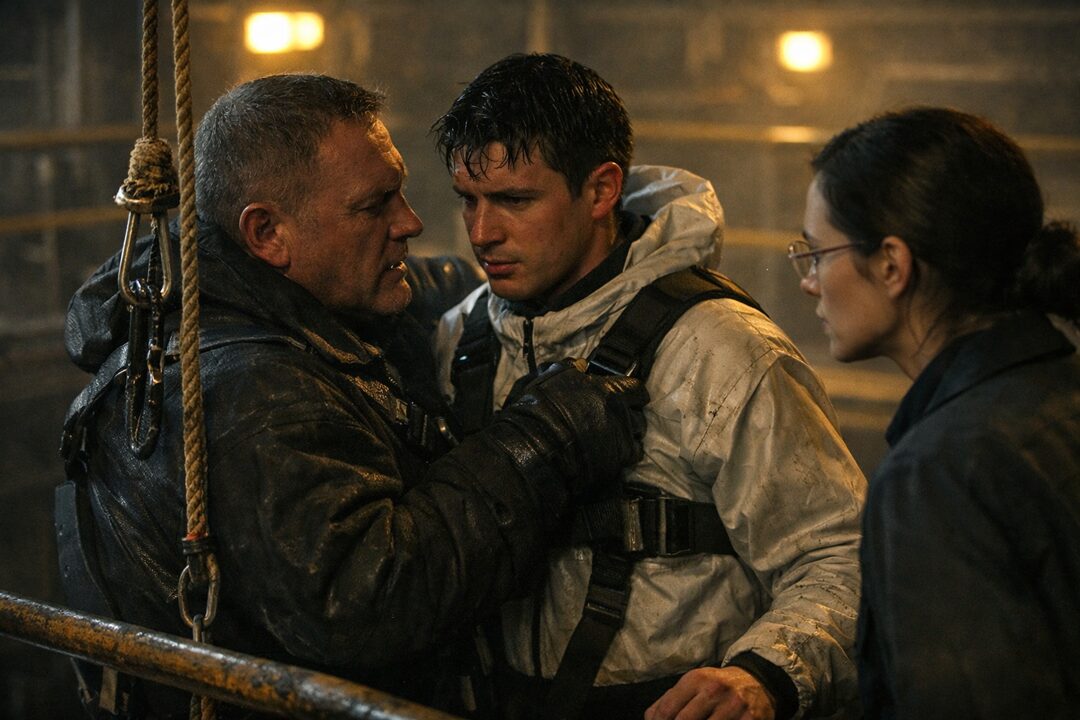
Above the open reactor chamber, a pulley harness swung gently in the cold air. Frost clung to the inside of the steel railings. The shutdown had killed most of the noise in the plant, but not all of it. Somewhere below them, metal kept ticking as it cooled unevenly. Somewhere deeper, something was still wrong.
A senior engineer from the station stood opposite Hale with his jaw clenched and both hands buried in his coat pockets. “Lieutenant, no one is requiring you to go down personally.”
Hale looked into the mouth of the chamber.
Then he peeled off his gloves.
Chief Petty Officer Tom Rainer swore under his breath. “Sir.”
“I need my hands to feel the bolts,” Hale said.
“That isn’t the part I’m objecting to.”
Hale flexed his bare fingers once in the freezing air. He was twenty-eight, lean enough that the harness looked too large for him, his dark hair damp at the temples from hours under the hood and mask. His face had the kind of order that made strangers trust him until they noticed his eyes. The eyes were tired. More than tired.
Across the platform, Dr. Mara Voss stared at his hands as if she hated what they meant.
“Then don’t turn this into a gesture,” she said.
Her voice was low, controlled, and more dangerous for it. She was pale from a day without sleep, glasses slipping down the bridge of her nose, a pencil still tucked behind one ear as though the mathematics might save them if she kept them close enough.
Hale didn’t answer her.
Below them, the chamber breathed out a dry medicinal smell through the venting system—ozone, hot dust, something metallic and wrong.
Twelve hours earlier, he had been on a different base with different problems. Now he stood over a damaged allied reactor with a mixed emergency team and a task no one wanted to name plainly: human entry dismantling.
By hand.
Lieutenant Simon Vale stepped forward before Hale could clip into the harness.
“Sir, I can take the next entry.”
Hale didn’t look at him. “No.”
“I know the sequence.”
“You know part of it.”
Vale flushed. Even under the yellow wash of emergency lighting, the color showed. He was twenty-four, quick, bright, handsome in a way that made his youth look like confidence until pressure hit it from the side.
Rainer moved in and caught the front strap of the harness before Hale could.
“This is how officers get themselves killed,” he said quietly. “For the story of it.”
The words hung there. No one in the building pretended not to hear them.
Hale finally looked at him.
Rainer’s face was weathered and set hard, but his grip on the strap was careful. His hands were thick with old scars, mechanic’s hands, the kind built for weight and heat and stubborn metal. He had followed Hale long enough to know the difference between duty and compulsion. He was afraid this was the second one dressed up as the first.
Hale said, “If I send someone else now, I’m asking him to work from my guesses.”
“You’ve been asking men to do that all day.”
“And I was wrong to.”
Voss’s gaze sharpened. Vale looked away first.
Hale took the strap from Rainer and fixed it into place himself. He checked the buckle once, then once again.
He said, almost to the empty chamber, “That final segment won’t come free if the angle’s off.”
“You don’t know that,” the engineer snapped.
Voss answered for him. “He does.”
That silenced the man.
The dosimeter chirped again. Another. Another.
Hale held out his hand. Voss hesitated, then gave him the scrap of paper she had drawn on three minutes earlier—a quick, tight sketch of the distorted inner assembly. One circle. Three marks. One small X.
“The third retaining collar sticks,” she said. “Not because it’s fused. Because it’s twisted.”
“I know.”
“No,” she said. “You modeled heat. You didn’t model shame.”
He looked up.
She was watching him with an expression he couldn’t bear just then. Not admiration. Not quite anger anymore. Something worse. Clarity.
“It was designed by careful men,” she said. “Careful systems fail ugly. That collar will resist exactly long enough to make you waste time proving you’re stronger than it.”
Rainer let out a breath through his nose. Vale went very still.
Hale folded the scrap once and slid it inside the chest pocket of his protective suit.
Then, with all of them watching, he said the one thing none of them expected.
“I am afraid.”
The room didn’t move.
Not the engineer. Not Voss. Not Vale.
Rainer’s hand fell away from the harness.
Hale clipped the line to the pulley ring and stepped to the lip of the chamber.
“Count clean,” he said.
And the thing that had been hovering over them all day finally took shape.
It wasn’t whether he was brave enough to go down.
It was whether he had any right not to.
Part II — The Men Sent First
At dawn, when they brought Elias Hale to Calder Station under armed escort and diplomatic courtesy, the first thing he noticed was the snow.
It had blown hard across the access roads and packed itself against the outer buildings in gray-white ridges. The plant rose out of it like something unfinished and offended by weather. Local personnel were already moving with the exhausted speed of people who had been running on adrenaline for too long.
A partial core event during maintenance testing. Shutdown incomplete. Internal distortion. Heat localized where it shouldn’t be. Mechanical retrieval uncertain. Human entry possible, but only in short windows.
That was how the senior administrator gave it to him.
Dr. Mara Voss gave it to him differently.
“You’ve been sent because your government thinks uniforms calm a disaster,” she said.
They stood in the station briefing room over a spread of diagrams, half the lights out to reduce load. Voss had not bothered with the small social lies that usually opened cooperation. No welcome. No thank you for coming. Just her finger pressed against a warped ring in the core assembly schematic.
“This is not a battlefield,” she told him. “If your people come in wanting a clean story about nerve and command, they will kill my staff.”
Hale met her stare. “Then let’s disappoint them both.”
That earned him half a second of silence, which in that room counted as progress.
Rainer arrived behind him with the rest of the detachment—a radiological emergency team trained for containment, retrieval, and work too dangerous to describe neatly in peacetime. Simon Vale came last, carrying his helmet under one arm, alert enough to look almost eager.
The first friction started before they had finished the first map.
Hale was given command because he was both naval officer and reactor specialist. That was true on paper. In the room, it meant he became the face of outside authority the instant things grew less theoretical. Voss resented it openly. The local engineers resented it more quietly. Rainer tolerated it because he trusted Hale more than he trusted a committee. Vale seemed almost relieved by it; if there had to be a line to follow, he preferred a sharp one.
The chamber lay beneath two containment decks. The maintenance event had damaged the inner assembly badly enough that automated tools were jamming on misalignment. Heat and contamination levels were climbing in irregular pockets. If they could not dismantle the damaged internals in sequence, cooling stability might fail again.
“So we send in teams,” Vale said, leaning over the schematic. “Timed entries. Loosen, tag, lift, rotate.”
Voss looked at him without warmth. “Yes. If by ‘send in teams’ you mean ‘lower human beings into a machine that is no longer shaped like its drawings.’”
Hale traced the distorted components with one finger. “How long?”
“Officially?” she said. “Long enough to remain useful. Actually? We don’t know.”
Rainer snorted. “That means no time at all.”
No one contradicted him.
By midmorning, the first entry plan was built.
Not elegant. Not safe. Just possible.
Each man would go in for seconds, not minutes. Each task would be reduced to one motion, maybe two. Loosen a retaining plate. Mark a warped collar. Attach a line. Cut a snag. Back out. Then the next body would take the next small piece of the chamber’s resistance.
Hale wrote each sequence by hand. He split jobs smaller and smaller until they felt less like operations than instructions whispered to a safecracker.
“Too conservative,” one of the local engineers said.
“Too human,” Voss corrected.
When the first entry team came back up, one of the men pulled off his mask and vomited on the platform before anyone could get a basin under him.
No one mocked him. That was how bad the chamber was.
Heat. Noise. Dust-like contamination drifting through beam light. Fittings that looked whole until a gloved hand touched them and found them soft at the edges. A pressure in the throat that had nothing to do with temperature.
The dosimeters had chirped so fast inside that the sound merged into one steady insect scream.
Hale made them decontaminate before he took their report.
He stood with a clipboard while the men were stripped, scrubbed, checked, and checked again. Water ran gray over the floor grates. One man shivered so hard two attendants had to steady his arms.
“Tell me the truth,” Hale said.
The first man said, “The truth is the chamber’s meaner than the model.”
The second said, “The lower ring is warped.”
The third swallowed twice before speaking. “You can smell it in there.”
Voss glanced up. “Smell what?”
He looked ashamed of the answer. “Hot metal. Burned dust. Something medicinal.”
“Fear,” Rainer muttered.
“No,” the man said, too quickly. “Not fear.”
But everyone heard what he meant. Fear had a smell once it mixed with plastic, sweat, and sealed air.
Hale cut the next exposure window by nine seconds.
An hour later, by six more.
He divided the sequence into smaller and smaller tasks until Rainer said, “You’re turning them into tools.”
Hale answered, “I’m trying to keep them alive.”
Rainer stepped close enough that only Hale could hear him. “Those aren’t opposites forever.”
Vale volunteered for the deeper entries first.
At first Hale thought it was youth. Then he understood it was something meaner and more familiar: the hunger to become the kind of man other people talked about afterward.
“I can hold longer,” Vale said after the third round.
“That is not the assignment.”
“I can still do it.”
“That,” Hale said, “is exactly why you won’t.”
Vale’s jaw tightened. “Because I want it too much?”
Hale looked back to the schematic. “Because the chamber doesn’t care what you want.”
But he felt the blow of the question after it landed.
Because wanting mattered. It always mattered. Not operationally. Morally.
By afternoon, the platform smelled of rubber, wet steel, chemical soap, and sickness. Men sat wrapped in blankets between entries, trying not to think about what had entered them and what had not yet had time to show itself.
And through it all, Hale remained very calm.
Too calm.
Rainer noticed first.
He always did.
Part III — The Wrong Kind of Courage
The fourth retrieval should have been the turning point.
Instead it was the moment the chamber turned against their plan.
A crucial segment came loose after two failed attempts. The lift line held. The ring rose six inches, eight, twelve—then twisted and caught against a deformed guide bracket no one had accounted for.
“Stop,” Voss snapped.
Too late.
Simon Vale was already below, clipped to the lower line, one boot planted against the chamber wall as he tried to lever the segment clear. Hale had sent him in for one task only: release and retreat.
But a thing half-freed is more dangerous than a thing untouched. Vale knew it. They all knew it.
“Back out,” Hale ordered into the speaking set.
Vale’s breathing came fast over the line. “It’s almost free.”
“Lieutenant—” Rainer began.
“Back out,” Hale said again.
Vale did not.
From the platform they could hear the metal straining. Not loudly. Just enough.
Voss was counting under her breath. Hale watched the sweep hand. One more second. Two. Three.
“Simon.”
A grunt. A clang. Vale cursed. The segment shifted but did not release.
His window was gone.
Rainer reached for the haul lever.
Hale caught his wrist. “Not yet.”
Rainer’s head snapped toward him.
Below them, Vale made a hard desperate sound and threw his weight sideways. The chamber gave him one mercy at the exact moment it had denied him every other one. The segment broke free.
“Now,” Hale said.
They hauled him up too fast and he hit the rim with one shoulder. By the time they got his mask off in decontamination, his lips were drained white and his hands wouldn’t unclench.
He was alive.
That was the clean part.
The rest wasn’t.
The station physician said exposure. Over-window and ugly. Not instantly catastrophic, not yet a sentence anyone could measure, but bad enough that the room around Vale changed when the numbers were read aloud.
He stared at the wall while they spoke over him.
Then, when the others had gone and Hale came to check him, Vale turned his head and said, “Did you like it?”
Hale stopped. “What?”
Vale’s face was slick with sweat. The confidence had gone out of it, leaving only youth and humiliation.
“The way they looked at you after,” he said. “When you stopped Rainer from pulling me early. The way they listen when you go quiet.”
Hale’s voice stayed level by force. “You disobeyed an order.”
“Yes.”
“You exceeded your window.”
“Yes.”
“And now you want this to be about me.”
Vale laughed once. It sounded close to breaking. “It already is.”
The room felt suddenly smaller.
Vale swallowed and looked straight at him. “You want men to admire you more than you want them to survive you.”
Hale said nothing.
Because anger would have been easy.
Because denial would have been cleaner.
Because the accusation touched something he had spent years training into obedience and never fully killed.
Vale turned his face back to the wall. “I thought if I held longer, it would mean something.”
“It does,” Hale said.
Vale’s eyes shut.
“It means you were scared of being ordinary,” Hale said. “That is not the same thing as being necessary.”
For the first time that day, Vale looked hurt by something other than radiation.
When Hale stepped out into the corridor, Rainer was waiting there.
“You don’t get to dismiss that because he’s young,” Rainer said.
“I’m not dismissing it.”
“Good.”
Rainer leaned against the wall, folding and unfolding his massive hands. “I have seen officers walk themselves into graves because they couldn’t stand the thought of someone else doing the hard part.”
Hale stared through the window into the decontamination room. Vale lay very still beneath the blanket.
Rainer said quietly, “A dead officer becomes a story. A living one has to keep answering for what he sent other men to do.”
It should have sounded like contempt.
It didn’t.
That was what made it hard to bear.
Later, near dusk, Voss found Hale in the instrumentation room with his sleeves rolled up and the latest exposure logs spread before him.
She closed the door behind her.
“There is another option,” she said.
He didn’t look up. “There always is.”
“This one might save your team.”
That made him lift his head.
She stood in the doorway like she had not decided whether saying it was courage or betrayal.
“We could flood and seal the chamber,” she said. “Abandon retrieval. Sacrifice the core and most of the station below deck. Stabilize by burial rather than recovery.”
Hale sat back.
It was not a fantasy. He could hear from her tone that it was technically real, morally real, and politically poisonous enough that no one upstairs wanted it spoken aloud.
“How long have you had that?” he asked.
“Long enough to know they won’t choose it.”
“Because it would cripple the site.”
“Because it would admit loss.” Her mouth tightened. “Because an allied government can survive damage more easily than it can survive humiliation.”
There it was at last.
Not just duty. Not just safety. Not just the chamber and its heat.
Reputation.
Continuity.
The polished sentence someone else would want at the end of this.
Hale looked back down at the logs.
“What are the numbers if we continue?”
“If you continue exactly as planned, worse.”
“If we adapt?”
She was silent long enough to tell him the truth before she said it.
“You may still hold it.”
May.
He heard Rainer before he saw him. Boots in the hall. A pause at the door.
“If you keep following orders from people who’ll never smell this place,” Rainer said, stepping inside, “then you’re spending men for a version of the story they can live with.”
Hale said, “And if I seal it?”
“Then maybe you save lives and bury careers.”
Voss added, “Including yours.”
He almost laughed at that, but the sound died before it formed.
His career.
Outside, the emergency siren gave a short corrective pulse and fell silent again.
Hale looked at the maps. At the revised chamber shape. At the missing segment they had freed. At the notes only he now fully understood, because every improvisation had altered the geometry.
The room had become too still.
Then he said what none of them wanted to hear.
“We’re not at the choice you think we are.”
Rainer’s expression darkened. “Meaning?”
Hale tapped the distorted inner ring with one finger.
“Meaning if that final obstructing section binds where I think it will, then the only person who knows the whole pattern is me.”
Part IV — The Scrap of Paper
Once Hale said it aloud, everyone began trying not to prove him right.
They re-ran the sequence twice.
Voss recalculated the angle of the final obstruction from the latest retrieval numbers. A local engineer proposed a modified lift head that jammed in testing before it touched the chamber. Rainer offered to take the last descent himself. Vale, pale and furious at his own weakness, tried to rise from the recovery cot and was ordered back down by two different men in two different ranks.
By midnight, the truth had become rude enough that no one could ignore it.
Rainer could work the hardware, but not the chain of tiny compensations Hale had layered into the plan after each failed entry. Voss knew the architecture, but not the altered chamber with today’s damage written into it. Vale was done whether he accepted it or not. The local staff were already too exposed or too unfamiliar.
The officer could remain above only by pretending his own knowledge was replaceable.
That, finally, was vanity.
Not going down. Not wanting to.
Pretending someone else should carry the shape of his decisions inside his body.
Hale stood alone for one minute in a side office and wrote three notes on station paper.
Two were operational.
One was not.
He folded them separately and left them under a wrench on the table.
When he came back to the platform, Rainer took the harness from the peg and began checking every strap with the expression of a man restraining himself from violence.
“You always pull these too tight,” Rainer muttered.
“They slip when they’re loose.”
“They don’t slip when I do them.”
Hale almost smiled. It hurt his face.
Across from them, Voss bent over a pad and redrew the chamber from memory. She worked fast, dark braid half undone, pencil carving the page in clipped strokes. When she finished, she tore off the sheet and crossed to him.
“The third collar,” she said again, marking the X. “Not fused. Twisted.”
He took the paper.
“If visibility goes,” she added, “you’ll want to force it from the left.”
“Why?”
“Because whoever built it trusted symmetry.” Her eyes lifted to his. “They never imagine failure arrives crooked.”
It was such a Voss sentence that even Rainer looked up.
Vale appeared then, still in station whites, face drained, one hand braced on the rail.
“You should be lying down,” Hale said.
Vale ignored that. His gaze went to the harness, then to Hale’s bare hands.
“Is it necessary?” he asked.
The question was not simple. It carried everything that had been said in the recovery room and everything that hadn’t.
Hale could have answered as an officer. He could have answered as an engineer. He could have answered as a man protecting a younger one from shame.
Instead he gave him the truth as cleanly as he could.
“Yes.”
Vale’s throat moved once. “Then don’t make it look easy.”
Rainer shut his eyes for half a second.
Voss turned away.
Hale stepped closer to Vale, close enough that no one else could pretend not to hear.
“It never was.”
Vale nodded like it hurt.
He went back without another word.
The final prep became quiet after that.
No speeches. No ritual. Only checks.
Harness.
Line.
Mask seal.
Dosimeter.
Secondary latch.
The paper in Hale’s chest pocket.
Rainer tugged the shoulder straps once more, too hard.
“If that line snags, I pull you whether you like it or not.”
Hale said, “If it snags before the final segment clears, you wait.”
Rainer’s jaw worked.
“Hale.”
It was the first time all day he had used his surname without rank.
“You wait,” Hale repeated.
Voss came to the edge of the chamber and stood beside him. The emergency lights flattened her face into planes of bone and shadow.
“I was wrong about one thing,” she said.
He looked at her.
“I thought uniforms only made lying easier.”
The dosimeter chirped twice between them.
She reached up and adjusted the speaking set at his throat with cold, precise fingers.
“Count aloud when you can,” she said. “I need to hear when your thinking narrows.”
“I thought you distrusted military myth.”
“I do.”
“Then why help me sound brave?”
Her mouth barely moved. “I’m helping you stay exact.”
For one unguarded second, he almost told her he was more afraid of the exactness than of the chamber.
Instead he only nodded.
He stepped to the lip.
Below him: heat, steel, the dark round throat of the reactor, and somewhere inside it the final obstruction that had turned this whole day from command into consequence.
Hale put one hand on the line.
Then he looked once at all of them—Rainer rigid at the winch, Voss at the comms, Vale watching from the far wall like a man being forced to learn the difference between witness and participant.
“I am afraid,” Hale said.
It landed harder this time because they knew what it cost him to say it.
And because it changed nothing.
Part V — Three More Seconds
The descent began with cold air and ended in heat.
Halfway down, Hale felt the chamber breathe around him. The protective suit stiffened at the joints. His own breath came back into his face in thin warm bursts. The dosimeter’s chirp accelerated until it ceased being separate sounds and became a constant needling presence in the ear.
“Ten feet,” Rainer’s voice said above him.
“Copy.”
“Eight.”
Below his boots, the damaged internal assembly emerged piece by piece through the haze—warped collars, twisted guides, metal carrying a dull stress sheen like bruised skin.
“Five.”
“I have it.”
His boots touched the lower grating.
At once the world became smaller than thought.
Heat.
Metal.
The slight drag in the air.
The awful knowledge that every second here stayed with him whether he survived or not.
Voss’s voice came through the speaking set, clipped and calm. “Forward two paces. Left hand on the support rib. The final segment is lower than it should be.”
He moved.
Inside the chamber, his body already knew the map better than his eyes. That was the strangest part. The hours above had written themselves into him. He knew where the distorted guide would catch a sleeve. He knew which rung flexed. He knew the location of the bent retaining collar almost before his glove touched it.
“Contact,” he said.
“Good,” Voss answered. “Check alignment before you pull.”
Hale braced one knee, set his shoulder, and felt for the collar.
She had been right. Not fused. Twisted.
He tried the release. Nothing.
Again.
Nothing.
“Status?” Rainer asked.
“Resisting.”
“Window at twenty-two seconds,” Voss said.
Hale changed angle. Forced from the left.
The collar shifted a fraction and bit again.
Not strength, he thought. Shape.
He could feel his pulse in his mouth. Sweat slid down his spine despite the cold outside the suit. He adjusted, found the notch, set two fingers deeper—
His glove caught on a torn edge.
For one stunned instant he only felt the tug.
Then the fabric ripped across the base of his thumb.
Air touched skin.
Not air, exactly. The chamber.
The knowledge of it hit before the pain did.
“Elias?” Voss said sharply. “Report.”
He should abort.
That was the clean answer. The correct answer. The answer he would have demanded from any other man.
He looked at the segment.
Half-loosened. Half-committed. The whole day balanced on a thing almost freed and not yet free.
“If I come up now,” he said, more to himself than to them, “we start from damage.”
“What?” Rainer barked.
“Window at twelve,” Voss snapped.
He slid his torn glove off the rest of the way.
Above him, Rainer made a sound like an oath strangled in the throat.
“Hale,” he said. “Up. Now.”
Hale put his bare hand on the collar.
Heat bit first. Then texture. The slight deformity Voss had drawn from memory. The mean little twist in the metal that had made it resist ordinary force.
There you are.
He set his fingers into the shape of it.
It felt horribly intimate, like touching the mechanism’s injury directly.
“Eight seconds,” Voss said, and for the first time her voice cracked.
Hale pulled.
Nothing.
He changed his wrist, drove the pressure sideways, and felt the collar answer with a tiny vicious movement.
“Six.”
“Sir—” Vale’s voice, distant and strained from above.
The segment shifted.
Not enough.
Hale gave up trying to preserve his skin and drove his thumb harder into the heated seam.
Pain flashed white.
Then the geometry broke.
The collar snapped loose.
“Free,” he said, but it came out as a rasp.
“Haul?” Rainer shouted.
Hale had one hand on the final segment now, one bare hand on the hot warped truth of the chamber, and in that instant he understood exactly how close failure still was. If they pulled him too early, the piece would snag. If it snagged, the chamber would take back everything.
He heard his own voice through a rush of blood and static.
“Wait.”
“Five—”
“Wait.”
“Elias—”
“Three more seconds.”
It was the worst order he had ever given.
Above him, he knew Rainer had his hand on the lever. Knew he was fighting the whole history of enlisted men obeying officers into death. Knew Vale was probably staring at the line like will alone could shorten time. Knew Voss was counting with the precision of a woman who hated every number.
One.
Hale turned the segment clear.
Two.
Metal scraped metal and came free into his arms.
Three.
“Now,” he said.
The winch slammed upward.
The chamber vanished in jerks and heat and noise. The freed segment banged against his thigh. His bare hand screamed. He hit the rim hard enough to see light burst across his vision.
Then cold air.
Hands.
Voices.
The line unclipped.
Rainer dragging him flat onto the platform.
Someone tearing off his outer glove.
Voss shouting for containment, for shielding, for a clean tray, for no one to touch the exposed hand with anything except wrapped gauze.
The dosimeter no longer chirped fast.
It screamed.
And somewhere below them, after a long suspended second that seemed to include the whole building, the reactor finally began to settle.
Not dramatically.
Not with triumph.
Just with a change in the deep sound of the station, as if a body that had been clenching all day had chosen, at last, to release its jaw.
Part VI — The Shape of the Story
The official language arrived before the shaking stopped.
Coordinated intervention. Successful stabilization. Disciplined multinational teamwork under severe conditions.
Hale heard pieces of it through fever, through the sting of decontamination, through the station physician trying to keep his voice neutral while discussing exposure and observation and the need for later examinations that no one in the room wanted translated into plain human fear.
Simon Vale survived and said very little.
Mara Voss stood through two report sessions and corrected any sentence that cleaned the chamber too much.
Chief Petty Officer Tom Rainer nearly got himself reprimanded for telling a visiting administrator, “If you want the polished version, write it without us in the room.”
Hale slept in fragments over the next two days. When he woke, the world came back in pieces: chemical soap, bandaged hand, the weightless nausea of fatigue, the memory of heated metal inside his palm.
On the third evening, Rainer came to see him with a folded paper.
“You left this under a wrench,” he said.
Hale looked at it and knew which one it was.
Rainer did not hand it over immediately.
“You could’ve made this easier on yourself,” he said.
“I doubt that.”
“I mean the note.”
Hale waited.
Rainer finally passed it to him.
It was the unsigned line he had written before the descent. Nothing grand. Nothing fit for citation.
Tell them I was afraid and went anyway.
Hale looked at the words for a long time.
Rainer said, softer now, “That’s the part they never know what to do with.”
Hale folded the paper again with his bandaged hand.
“They don’t have to.”
Rainer gave him a long, tired look. “No. But somebody should.”
Months later, when the commendation ceremony came, the room was warm and polished and full of men who had not heard the dosimeter in that chamber.
The citation praised calm leadership, technical excellence, personal gallantry. It used his full name. It made him sound clean.
Lieutenant Elias Carter Hale stood in dress uniform with his healed hand hidden neatly inside white gloves and accepted the medal while flashbulbs burst in the corners of the room.
He did not reject it.
That would have been another kind of performance.
From the second row, Rainer watched with a face like weathered stone. Voss, invited reluctantly and attending anyway, stood near the back in a dark coat and did not applaud until everyone else had finished.
Afterward, people shook Hale’s hand and called him brave.
He thanked them because there was no useful alternative.
Then the room thinned. The air turned easier to breathe.
He stepped into a side corridor lined with framed photographs of ships, reactors, men smiling beside machines they believed they understood.
For a moment he stood alone.
Then Voss appeared beside him.
“They made you look inevitable,” she said.
He gave a tired half-smile. “Better than accidental.”
“No,” she said. “Not better. Cleaner.”
He looked down at his gloved hand.
The skin beneath it still remembered.
Across the corridor, laughter rose from the reception room. Someone called his name. Someone else called him a hero as if it were a straightforward thing to be.
Voss followed his gaze and said, “Will you go back?”
“To reactor work?”
“To command.”
He thought of the chamber. Of Vale’s accusation. Of Rainer’s hand on the lever. Of the three seconds that had divided duty from myth by so little it still frightened him.
“Yes,” he said at last. “But not the same way.”
Voss studied him, then nodded once. She seemed to accept that as the only honest answer available.
When she turned to go, he said, “Mara.”
She stopped.
“Thank you for drawing it from memory.”
She looked at him over one shoulder. “You still think that paper saved you?”
“No.”
“What then?”
He thought of the torn glove. The twisted collar. The note under the wrench. The clean medal pinned over a messier truth.
He said, “It kept me exact.”
That almost made her smile.
She left him there with the noise of the reception behind him and the quiet ahead.
After a minute, Rainer emerged from the room and came to stand at his side without speaking. The corridor windows had gone dark with evening. Their reflections looked older than the men themselves.
Inside, his name was still being said in the polished past tense of public admiration.
Outside, beyond the glass, the world remained what it always had been—cold, unfinished, indifferent to the stories built after surviving it.
Rainer asked, “You going back in there?”
“In a minute.”
“You don’t have to stay for all of it.”
Hale looked at the closed doors.
The applause had stopped. The room was already moving on to other things.
“Yes,” he said quietly. “I do.”
Not because the medal meant the truth.
Not because the story was accurate.
But because living through a thing was different from escaping it. Because a man could refuse myth without refusing consequence. Because fear did not cancel duty, and duty did not make fear noble.
Rainer nodded as if he understood all of that without needing it said.
Together they stood one second longer in the corridor, between the clean version and the real one.
Then Hale straightened his jacket, flexed the hand no one could see, and went back inside.