The Man They Didn’t Keep
Part I — The Morning After the Upset
The morning after Elias Vance beat Leon Vale, the newspapers were still camped outside the wrong locker room.
A boy with a split lip and a gold future had become the story. The man who beat him sat alone on a wooden bench under a humming light, flexing a hand swollen to twice its size, while someone on the other side of the cinderblock wall shouted, “Leon, give us one more smile.”
Elias looked down at the blood dried in the creases of his knuckles and laughed once through his nose.
It hurt.
That was real enough.
The Marine gym smelled like old sweat, liniment, and wet canvas. His left eye was purple at the edge. His ribs felt cracked, though he knew they weren’t. He had taken the kid apart in ugly pieces the night before—timing, patience, punishment. Leon had been faster, prettier, louder. Elias had been the kind of fighter nobody built posters around. He waited. He broke rhythm. He made a room feel stupid for betting against him.
A reporter stuck his head in, saw the wrong face, and vanished again.
A minute later, the civilian promoter arrived.
He came in carrying a grin and a folder the color of money. “You don’t look like a man who just changed his life.”
“Maybe I didn’t,” Elias said.
The man laughed like that was modesty instead of uncertainty. “Son, you beat the future of American boxing in front of half the right people. He gets his shine back, you get your name. That’s how this works.”
Elias took the towel off his neck and wiped a line of blood from his eyebrow. “Does it?”
“It can.” The promoter held out the folder. “Televised rematch. A sponsor in Chicago already interested. You change that uniform, you could make real money before twenty-five.”
Before Elias could touch the folder, the door opened again.
Major Thomas Rourke did not look like a man who believed in good timing as a courtesy. He was exact even standing still—clean uniform, iron-gray face, eyes that never searched because they always arrived already decided.
“Vance.”
Elias stood automatically, despite the ribs.
Rourke looked at the folder in the promoter’s hand, then at Elias. “Transport changed. Your unit flies out tomorrow night, not next week. You’ll report by sixteen hundred.”
The promoter’s smile sharpened. “Major, with respect, this man has options.”
Rourke didn’t even glance at him. “Everyone does.”
It was a simple sentence. It made the room smaller.
When the promoter finally left the folder on the bench and went out muttering about wasted gifts, Rourke remained in the doorway.
“Sir,” Elias said, “if I requested separation—”
“You can request anything.” Rourke’s voice was dry as paper. “Men under you are already packing. I won’t stop you. But don’t lie to yourself about the shape of the choice.”
Elias said nothing.
Rourke’s gaze dropped briefly to Elias’s wrapped hands. “You fought well.”
That surprised him more than praise should have.
Then the major added, “The world likes a clean story. Don’t expect one.”
He left Elias there with the folder.
By noon, Nora found him still in the locker room.
She was twenty-two, practical to the bone, beautiful in a way that didn’t ask anybody to notice. She had pinned her hair back in a hurry and come straight from work. When she saw the folder beside him, she saw the future inside it before he had opened it.
“You won,” she said softly.
“I did.”
“And they still care more about him.”
“That too.”
She sat beside him and took his bad hand carefully, turning it over in both of hers. Her own hands were warm, a little rough from work, ring catching the light.
“Elias,” she said, “I’m pregnant.”
For a second the room disappeared.
The buzzing light. The folder. The shouting outside. All of it gone.
He looked at her face to see if she was afraid.
She was trying not to be.
He let out a breath that shook at the end. “You sure?”
She nodded, then gave him the smallest smile. “I didn’t come here to guess.”
He bowed his head, not from sadness, not from joy exactly, but because suddenly everything had become too heavy to hold upright. He took her hand and pressed it hard against his mouth.
Nora waited.
Then she looked at the folder. “What is it?”
He told her.
One televised rematch. Sponsorship. Money. A chance to stop being a Marine before the Corps took the best years and left the bones.
When he finished, she said nothing for a moment.
Then: “Do you want it?”
That was the only question that mattered, and the only one he could not answer cleanly.
“I don’t know.”
Nora studied him with the kind of patience that felt almost like pain. “I want you home alive. I want our kid to know you outside a photograph. I don’t care about famous.” She paused. “But I also know what it means when life opens one door just as another starts closing.”
He looked at the folder. Didn’t touch it.
Outside, somebody laughed too loud. Somebody else said Leon Vale’s name like it already belonged on banners.
Nora’s grip tightened around his hand. “If you stay because it’s right, I can live with right. If you stay because you don’t know who you are without being useful to somebody in a uniform, that’s different.”
He looked up at her.
She rarely said the worst thing first. That was how he knew she meant it.
That night he went home with the folder and laid it unopened on the kitchen table.
The next morning, he signed military papers instead.
He never signed the other ones.
But he didn’t throw them away.
Part II — Men Who Stay
By the time the war had a smell Elias could recognize blindfolded, Leon Vale was on magazine covers.
It happened fast on the civilian side of America. That was one of the things Elias learned early—how quickly one life could rise in bright rooms while another disappeared into heat and mud.
In-country, nobody cared who he had beaten.
That helped.
The jungle stripped men down to function. Could you carry weight. Could you move under fire. Could you keep your hands steady when someone else was coming apart. Elias could do all three. His boxing had changed shape, but not purpose. Timing became survival. Distance became instinct. Endurance became a kind of prayer said through the body.
The first time Daniel Cruz saw him pull a panicking lance corporal flat behind cover half a second before the tree line erupted, the kid looked at Elias the way boys looked at saints or champions—too much belief, not enough knowledge.
Daniel was nineteen, lean and quick and trying hard to disguise fear as energy. He was a corpsman with soft features and steady hands and the terrible openness of someone who had not yet learned what memory does to the living.
“You knew,” Daniel said afterward, breathing hard. “How’d you know?”
“I didn’t.”
“You moved before they fired.”
Elias shrugged. “Sometimes bodies tell on themselves.”
Daniel stared at him. “You really fought that Vale kid back home?”
“Everybody knows too much.”
“It’s not too much if it’s true.”
Elias checked his rifle, then started walking.
Daniel followed. “You could’ve gone pro, right?”
Elias didn’t look back. “You could’ve gone to medical school.”
Daniel laughed. “Not with my grades.”
“Exactly.”
It should have ended there, but the kid attached himself to Elias anyway.
At first it was practical. Daniel liked being near the man other men seemed to steady around. Then it became something else—admiration drifting toward myth. Elias recognized it because he hated how easy it was to accept when the days got bad.
The bad days came often.
Major Rourke moved through the field with the same controlled severity he had back at the locker room, except here the order in him looked less like discipline and more like the only wall against collapse. He was not cruel in the obvious ways. That made him harder to resist.
During a briefing in a ruined schoolhouse, maps pinned crooked against a blackboard, Rourke tapped a compromised ridge with a pen.
“We hold here six additional hours,” he said.
A captain frowned. “Sir, the position’s too exposed.”
“Command needs time south.”
“We’ll be trading men for time.”
Rourke’s face did not change. “That is sometimes the arithmetic.”
No one spoke after that.
Later, outside, Elias said quietly, “Sir, exposed is one thing. Trapped is another.”
Rourke lit a cigarette and looked out over wet green distance. “You think I don’t know the difference?”
“I think men hear the order the same either way.”
Rourke smoked for a moment. “Acceptable losses are not acceptable because they hurt less, Vance. They are acceptable because the alternative costs more somewhere else.”
Elias kept his eyes ahead. “To whom?”
Rourke answered without heat. “That is above both our pay grades.”
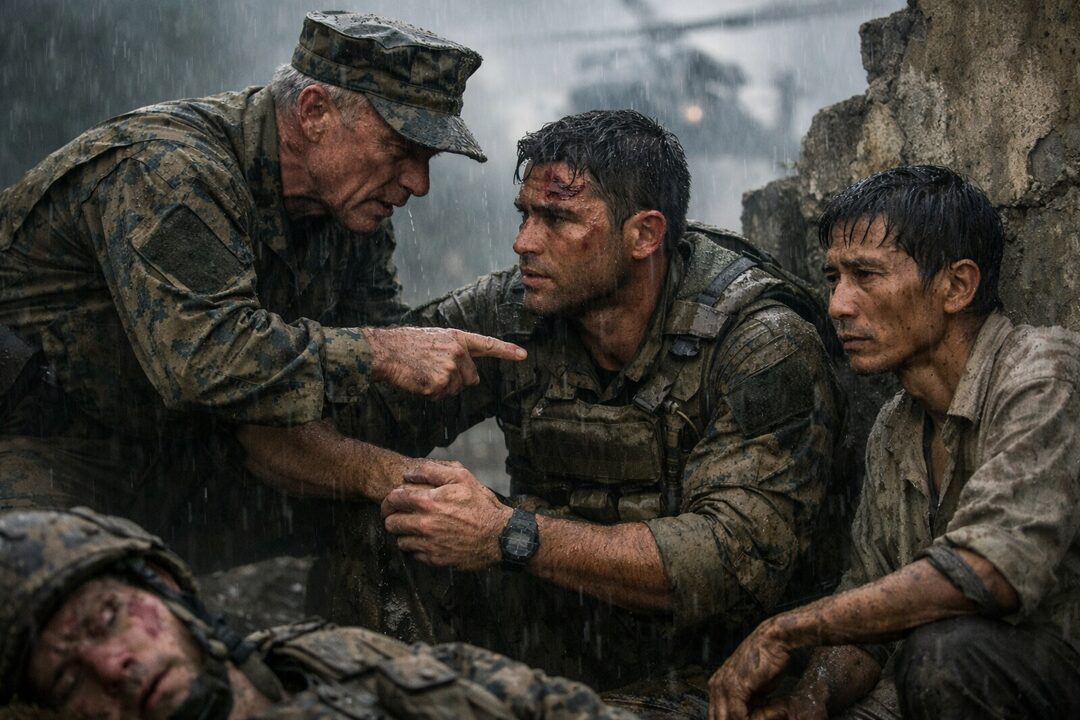
Six hours on the ridge became the longest day Elias ever carried intact.
Rain slicked everything. Mud swallowed boots. The air tasted metallic before incoming fire. Men shouted and vanished and reappeared bleeding. A marine named Tommy Wells—twenty, red-haired, always talking about a sister back in Ohio—grinned at Elias before first light and said, “You keep me breathing, Staff Sergeant, I’ll buy you a steak when we get stateside.”
Elias had answered, “Make it two.”
That was all. A throwaway line. An offhand promise.
Tommy died before noon with half his chest gone.
Daniel got hit later, low and ugly, and screamed only once. Elias found him twisted near the rocks, face gray with pain, hands trying uselessly to hold himself together.
“Don’t leave me,” Daniel gasped.
“I won’t.”
That, too, was a promise.
Elias dragged him through mud while rounds tore dirt around them. Daniel’s blood slicked both of them. At one point Elias slipped, hit the ground hard, and for one wild second thought: So this is the thing. This is where it cashes out.
But he got up.
He always got up.
When they finally made the rear line, Daniel was half-conscious and crying from fury more than pain.
“You came back,” he kept saying.
Elias wanted to tell him he hadn’t come back far enough.
When the citation came later, it called Elias “an exemplary model of composure and battlefield discipline.”
He read it once and folded it flat.
No mention of Tommy Wells.
No mention of the way Daniel had clutched his sleeve like a child.
No mention of the ridge itself, and what it had been asked to buy.
On leave months later, Nora opened the front door and saw the medal before she saw the new stiffness in his body.
He hugged her carefully, as if she were breakable. She hated that immediately.
At dinner he barely touched the food. Their apartment was small, clean, crowded now with baby things. Their daughter slept in the next room. Elias had missed the birth by twelve days.
He had sent flowers from another continent.
Nora cleared the plates in silence, then turned in the kitchen and said, “Are you going to tell me what happened over there?”
He leaned against the counter. “No version of it helps.”
“That’s not an answer.”
“It’s the answer I’ve got.”
She looked at him for a long time. “Do you know what I’m afraid of?”
He didn’t.
“I’m afraid you stayed because the Marines asked something of you.” Her voice was steady, which made it worse. “And now you don’t know who you are when nobody is asking.”
He flinched. Barely. But she saw it.
Nora stepped closer. “I’m not asking whether you’re brave. I’m asking whether there’s anything left of you that isn’t just useful.”
He looked past her toward the doorway where their daughter slept.
When he finally spoke, his voice was flat. “I did what I was supposed to do.”
Nora’s expression hardened into sorrow. “That’s not the same thing.”
In the bedroom later, while he undressed, the old promoter’s contract slipped from a waterproof sleeve in his duffel.
Nora saw it before he could hide it again.
Neither of them mentioned it.
That silence stayed longer than the argument.
Part III — The Life Beside His Own
The second time Leon Vale entered their house, he came through the television.
Nora was folding laundry. Their daughter was old enough to ask why daddy walked like the floor had insulted him. Elias sat on the couch with one hand over his mouth while the screen filled with arena light and national adoration.
Leon had become exactly what the newspapers had promised—beautiful, quick-tongued, impossible to ignore. The commentator was talking about his rise, the mythology hardening in real time.
“There was one early amateur stumble,” the man on television said cheerfully, “against a Marine named Eli Vaughn or Voss, records vary, but since then—”
Nora stopped folding.
Elias did not move at all.
For a second the room felt airless.
Then the commentary rolled on. Leon smiled. The crowd roared. History corrected itself without ever needing to know Elias’s name.
That night the orders came.
Second deployment.
Nora read them standing under the kitchen light. She did not cry. She did not yell. She set the paper down and said, “You looked relieved.”
Elias stared at the table.
“I watched your face,” she said. “You weren’t angry. You weren’t even surprised. You looked like a man hearing the only language left he still understands.”
“That’s not fair.”
“No,” she said. “It’s not.”
He wanted to tell her she was wrong. Instead he said, “The unit needs me.”
Nora laughed once, softly and without humor. “That’s exactly what I mean.”
He left three days later.
On the second deployment, Daniel was different. Less talk, more precision. Still loyal, but the shine had come off his hero worship. That made Elias trust him more.
They had a local interpreter then, a thin man in his thirties named Minh who spoke in careful, formal English and carried himself with the alert dignity of someone who knew everyone around him thought he was replaceable. He had a wife somewhere south and a son he had not seen in months. Elias knew that because Minh once showed him a folded photograph while they waited for a convoy.
“Your boy?” Elias asked.
Minh nodded.
“He looks stubborn.”
Minh almost smiled. “Then he will survive us.”
Daniel laughed at that. Minh tucked the photo away.
Weeks later, during a lull after a ruined mission briefing, Daniel was looking for bandages in Elias’s waterproof pouch when he froze.
“What?”
Daniel held up the old contract.
It was soft at the folds now, worn white at the edges from years of being carried where nobody could see it. Tucked behind it were Nora’s letters and a yellowed clipping from Leon Vale’s first major title win.
Daniel looked from the paper to Elias. “You kept this?”
“Put it back.”
“You said you never cared.”
“I said no such thing.”
Daniel hesitated. “Then why—”
“Put it back, Cruz.”
Daniel did, but the air had changed.
Some truths did not need finishing.
The mission went bad before dawn two days later.
A narrow village road. Bad intelligence. Too much confidence on command’s side. Fire from the tree line, then from behind, then the sick realization that the map had promised a shape the world had refused to keep.
Men dropped fast.
Daniel was hit first—shrapnel, deep in the thigh and lower side. He went down hard and white-faced. Minh took a round through the abdomen while trying to drag another man into cover.
The evac window was tight.
The helicopter pilot came through on comms with the kind of clipped urgency that meant there was no room for morality, only sequence.
“One litter now. One.”
Daniel was bleeding out. Minh was pale and conscious and trying not to make a sound.
Major Rourke crouched behind a wrecked wall, rain streaking mud down his sleeves. “Cruz goes first.”
Minh heard the English. He understood enough. His eyes moved to Elias and held there.
“He gave us the route,” Daniel said through his teeth. “We can’t leave him.”
Rourke’s voice hardened. “We triage by strategic value. The corpsman lives.”
Minh said in careful, broken words, “No problem. Go. Go.”
It was not bravery. It was humiliation made polite.
Elias looked at Daniel. Then at Minh. Then at Rourke.
There are moments when the body chooses before the mind can make peace with it. He moved toward Minh first.
Rourke caught his arm. “That is an order.”
Elias pulled free.
He got Daniel onto the first litter anyway—did it fast, with the brutal efficiency of someone refusing false choices even while trapped inside one. Then he hauled Minh up under the shoulders and started dragging him toward a secondary path through the ditch line, aiming for a fallback extraction point no one had confirmed was still viable.
Daniel was shouting something. Rourke was shouting something else. The helicopter thunder erased both.
Minh’s blood soaked Elias from chest to knee.
Halfway to the ditch, Minh whispered, “My son.”
“You tell him yourself,” Elias said.
Minh gave the faintest shake of his head. “No.”
The fallback point never fully existed. It was a possibility on paper, which was close enough for command and useless to the dying.
By the time they reached partial cover, Minh was slipping.
He gripped Elias’s sleeve with surprising strength. “Remember,” he said.
“I will.”
“My name.”
Elias bent closer.
“Minh Tran.”
Elias repeated it.
Again.
Minh made him say it a third time before the hand on his sleeve loosened.
The official account called the operation a tactical recovery under adverse conditions.
It praised Major Rourke’s command stability and Staff Sergeant Vance’s discipline under fire.
Discipline.
When Rourke handed Elias the paper weeks later, neither of them pretended that word belonged there.
“You disobeyed me,” Rourke said.
“Yes, sir.”
“And because you did it in a way history finds flattering, they will decorate it.”
Elias said nothing.
Rourke studied him with a fatigue that made him look older than rank. “Men like you are useful, Vance. You break rules only where the story can still absorb you.”
Elias folded the citation once.
“Is that what you tell yourself?” he asked.
Rourke’s mouth tightened. “It’s what lets the machine keep moving.”
“And what lets the men keep moving?”
Rourke didn’t answer.
That was answer enough.
Part IV — The Thing That Stayed
Years passed the way hard years do—unevenly, then all at once.
Leon Vale became more than a boxer. He became a country talking to itself in one man’s face. There were commercials, tributes, magazine covers, then documentaries about the legend while the legend was still alive enough to enjoy them.
Elias retired from the Marines with a body that still looked strong from a distance and hurt in private from the moment he woke.
Nora stayed.
That fact was not small.
Their marriage did not mend in any shining way. It settled into something leaner, more functional, almost tender in places where both of them stopped demanding perfect translation. They raised their daughter. Paid bills. Shared rooms. Sometimes, late, Nora would sit beside him without asking questions, and that was the nearest thing to peace either of them knew how to name.
He took a job at a municipal rec center and trained teenagers who thought his old scars were just part of being old.
He taught them how to move their feet before their hands. How to breathe after getting hit. How to hold guard when tired. He never mentioned Leon Vale.
Once, a boy with too much swagger said, “Coach, you ever fight anybody real?”
Elias wrapped the kid’s hands tighter than necessary and said, “Enough.”
The infection started so small nobody respected it.
A cut near the ankle. Then swelling. Then heat. Elias ignored it because pain had become background noise years earlier. He distrusted hospitals, paperwork, waiting rooms, all the bureaucratic theater of asking for help after a life built on not asking.
By the time Daniel found him in the VA system, Elias had a fever and the stubborn blankness of a man trying to outlast his own body.
Daniel was no longer nineteen. He had gone solid with age. The old openness was still there, but tempered now, disciplined. He walked into the ward carrying coffee and worry.
“You look terrible,” he said.
Elias, sweating through the sheet, managed, “You say the sweetest things.”
Daniel pulled up a chair. “The doctor says you should’ve come in sooner.”
“The doctor and I have a philosophical disagreement.”
“About what?”
“Whether I’m the sort of thing worth fixing.”
Daniel went very still.
On the television bolted in the corner, a tribute segment was running. Leon Vale again—older footage, younger footage, the nation keeping what it loved in circulation. Somebody on the program called him irreplaceable.
Nora arrived during the second segment.
She had aged beautifully in the severe way some women do—nothing softened, everything clarified. She took one look at Elias and anger flashed across her face before fear covered it.
“You did this on purpose,” she said quietly.
“No.”
“You neglected it on purpose, then.”
He didn’t answer.
Daniel stood to give her the chair. She didn’t sit.
For a while the room held the three of them and the television’s borrowed glow.
Then Nora said, “I used to think the worst thing that happened to you was the life you didn’t take.”
Elias stared at the blanket.
“The boxing. The money. The part where the world might’ve known your name.” Her voice trembled once and recovered. “Then I thought it was the men you lost.”
Daniel looked at her, then at Elias.
Nora stepped closer to the bed. “But that’s not it, is it?”
He closed his eyes.
On the television, the broadcaster was saying Leon Vale had transcended sport. That some men became larger than memory itself.
Elias let out a tired breath. “Turn it up.”
Daniel frowned. “What?”
“Turn it up.”
He did.
Leon’s face filled the room. Bright. Certain. Kept.
Elias listened until the segment ended. Then he said, very calmly, “That’s what winning looks like when the audience is large enough.”
Nora sat down at last.
Daniel leaned forward. “Elias.”
For a moment it seemed like he might retreat again. He had spent a lifetime doing that—taking the hardest thing inward and calling it endurance.
Instead he opened his eyes and looked at Daniel first.
“Tommy Wells,” he said.
Daniel didn’t speak.
“Ohio. Red hair. Talked too much. I told him I’d get him home.” Elias swallowed. “I don’t say his name because the order came from above and I carried it out below, and if I say his name then I have to admit that obedience and guilt were roommates the whole time.”
The room went silent except for the monitor.
Then Elias looked at Nora. His voice roughened. “It wasn’t fame. That hurt, but not the way you thought. I carried that contract because I wanted proof there had been another life once. That’s all.”
Nora’s face crumpled and steadied at the same time.
Elias looked past both of them, toward something neither could see. “What stayed was smaller and worse. It was becoming useful enough that people stopped asking who I was. Useful enough that every hard thing done through me got called honor. Useful enough that surviving started to feel like my only job.”
Daniel’s eyes filled, but he kept still.
Elias turned back to him. “Minh Tran.”
Daniel nodded once, hard.
“Say it.”
“Minh Tran.”
Again.
“Minh Tran.”
Elias’s breathing hitched. “Remember Tommy Wells. Remember Minh Tran. Remember the ridge we were told to hold because somewhere else mattered more. Remember that some men disappear not because they were small, but because what they gave was spent in rooms that don’t keep names.”
No one moved.
Then he said the one thing Daniel would carry longer than anything else:
“I didn’t want applause. I wanted witness.”
Nora put her hand over Elias’s. For the first time in years, he turned his palm upward and held on.
He died two days later, before dawn, while the hospital was quiet enough to pretend mercy was part of the design.
Part V — What the World Keeps
When Leon Vale died years later, the country mourned in high definition.
Networks ran retrospectives. Former opponents cried on cue and off it. Old footage returned with the glow memory gives only the famous. Daniel watched part of one segment from his office, then switched it off when a commentator referred to “the only meaningful losses that shaped Leon’s legend.”
Meaningful.
That word stayed under his skin all afternoon.
So he wrote.
Not a speech. Not a public correction. Not the kind of angry piece that turns the dead into props for the living. Just a brief essay in a Sunday magazine—long enough to tell the truth, short enough that it might actually be read.
He wrote about the night a Marine named Elias Vance beat Leon Vale before the world knew what Leon would become.
He wrote that the upset mattered, but not for the reason people like. Not because fame had narrowly missed the wrong man. Because it revealed, early and clean, that public greatness and actual weight are not measured on the same scale.
He wrote that Elias had chosen service, yes, but service had not ennobled everything it touched. It had used him, marked him, depended on him, and called the bargain honor when language ran out. He wrote that Elias carried an unsigned contract through two deployments like a folded map to a country he never entered. He wrote that Elias was not a saint. He was stubborn, withholding, difficult to love cleanly, and still capable of mercy when strategy had narrowed everyone else into categories.
Daniel included two names the public had never heard: Tommy Wells. Minh Tran.
He made sure they were spelled right.
When the essay ran, it traveled modestly, which felt appropriate. Not viral. Not consecrated. Just read, passed hand to hand, clipped, remembered.
Nora read it alone at her kitchen table.
She finished, took off her glasses, and sat very still for a long time.
Then she went to the hall closet and brought down the small memorial box she had never fully organized because grief resented neatness.
Inside were Elias’s service ribbons, faded but exact.
His old boxing wraps, stiff with age.
And the contract, still unsigned.
She laid it beside the ribbons and touched the fold with one finger.
For years she had thought that paper meant absence. The life he had failed to choose. The road that took him away from her before he even left.
Now it looked different.
Not like regret.
Not like proof of a mistake.
More like evidence that a person can live two lives at once—the one he entered, and the one he kept carrying in silence.
Outside, children were yelling in the street.
Somewhere at the rec center, a kid was probably standing wrong in a ring and hearing, in memory, a gravel-rough voice say, “Your feet first. Pride after.”
Nora closed the box carefully.
She did not cry then.
She only sat with her hand resting on the lid, feeling the shape of what the world had missed and what, finally, had been named.
Forgotten, she thought, was not the same as lesser.
It never had been.