The Tags He Tried to Take
Part I — The Name on the Chain
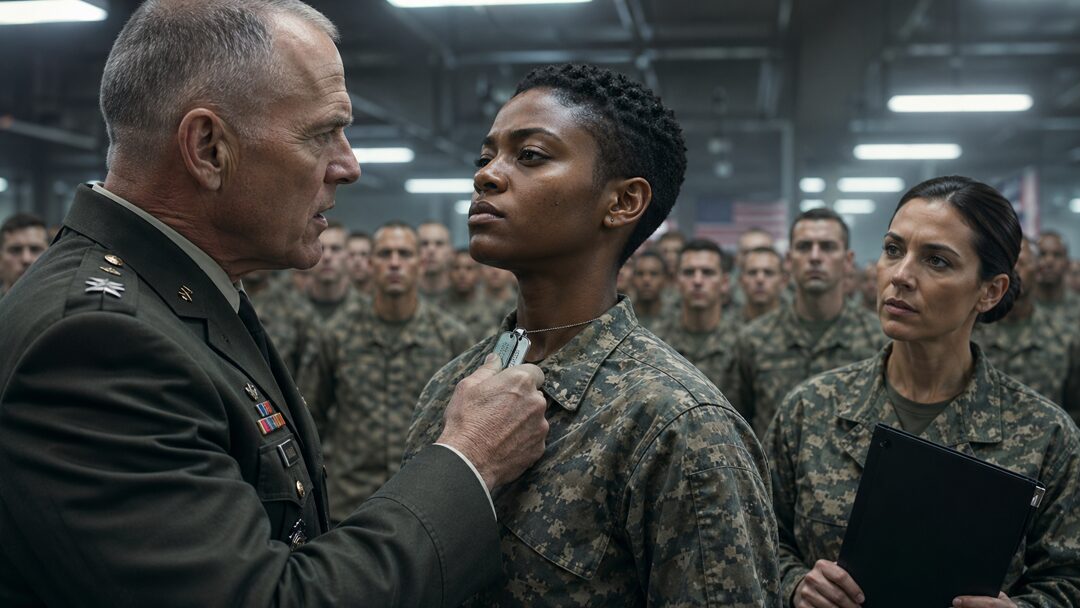
Colonel Harlan Voss stopped in front of Private Lena Cross because of a sound no one else heard: the faint double-click of metal beneath her uniform.
The formation hall went still around them.
Three hundred recruits stood shoulder to shoulder under white fluorescent lights, boots aligned on painted floor lines, eyes fixed forward. No one breathed loudly. No one shifted. Final inspection before deployment qualification was not a ceremony. It was a test of whether a body could become part of a larger machine without showing where it hurt.
Voss had been moving down the front rank with quiet precision.
He corrected a collar with two fingers.
He tapped mud from a boot with the toe of his polished shoe.
He told one recruit his shave looked like “a civilian apology.”
Then he reached Lena.
She stood at attention with her chin level, shoulders square, hands pressed flat against the seams of her trousers. Her uniform was immaculate. Her boots had taken two hours. Her close-cropped hair showed no loose edge under her patrol cap.
Still, Voss did not move on.
His eyes dropped to the center of her chest.
Lena felt the old chain warm under her shirt, where it lay beneath her own regulation tags. She had tucked it deep before dawn. She had checked it twice in the bathroom mirror. She had told herself no one would notice.
Voss noticed.
His hand came up without warning.
Two fingers hooked into the collar of her undershirt and drew the second chain out into the light.
The tags slid free and struck each other once.
A small sound.
A terrible one.
The recruit beside Lena stiffened. Somewhere in the second row, someone swallowed.
Voss held the tags between them. The chain stretched from his hand to Lena’s neck, not tight enough to choke, but close enough to remind every person in the room who had authority over her body.
He read the engraving.
His face changed so little that only someone standing inches away would have seen it.
Lena saw it.
The hardness did not disappear. It cracked.
Then it sealed again.
Voss lifted the tags higher.
“Private Cross,” he said.
“Yes, sir.”
“Explain why you are wearing a dead man’s identification.”
Lena kept her eyes forward.
The metal was cold now. It hung outside her shirt in front of everyone, swinging slightly from Voss’s hand.
“Sir, those are mine to carry.”
His jaw tightened.
“They are not yours. They are not issued to you. They are not authorized on this uniform.” He turned one tag with his thumb, exposing the name. “And unless the Army has started decorating deserters, this name has no place in my formation.”
The hall seemed to pull inward.
Voss read it aloud.
“Sergeant Isaiah Cross.”
No one moved.
Lena’s throat tightened, but her voice came out steady.
“My father, sir.”
The chain stopped swinging.
Voss stared at her, and for the first time since he had entered the hall, his inspection became something else.
Not routine.
Not discipline.
Recognition.
He stepped closer.
“Remove them.”
Lena heard the order enter the room and settle over every uniform behind her.
She had imagined this moment in a hundred ways. In most of them, she had been braver. In some, she had been louder. In one, she had ripped the tags from Voss’s hand and made him look at her father’s name until his eyes gave way.
In the real moment, her fingers did not move.
“No, sir.”
The silence after that was worse than shouting.
Voss lowered his chin.
“Private, I am giving you one chance to correct yourself.”
Lena’s mouth was dry.
The tags were still in his hand.
Her father’s name was still between his fingers.
“No, sir,” she said again.
This time, softer.
This time, impossible to miss.
Part II — The Man They Buried Wrong
Voss did not raise his voice. He did not need to.
“Who told you that you had the right to wear the tags of a man who ran from his post?”
A breath went through the formation. Not sound exactly. More like the room flinched.
Lena’s eyes stayed forward, but the words struck somewhere old.
She saw her mother’s kitchen table. A dented coffee tin. A folded flag that had arrived without a ceremony, without a chaplain, without an officer willing to stand on their porch and say what kind of death Sergeant Isaiah Cross had died.
Her mother had placed the tin in front of Lena on her eighteenth birthday.
“Don’t wear anger like jewelry,” she had said.
Then she had opened the lid anyway.
Inside were the tags, a photograph, and one strip of cloth darkened at the edge by something Lena had never asked about.
“No one gave me permission, sir,” Lena said. “My mother kept them.”
Voss’s eyes sharpened.
“In what capacity?”
“In a coffee tin, sir.”
Something passed over his face again.
Lena saw it and held on.
“With a flag,” she added. “The one nobody presented.”
Captain Mara Ellis stepped out from the side of the formation before Voss could answer.
She was compact and exact, her dark hair pulled tight beneath her cap, inspection folder held against her ribs. Her voice remained professional, but it had a warning edge.
“Colonel, disciplinary action can be handled after inspection.”
Voss did not look at her.
“This is inspection.”
“With respect, sir, the formation is set for certification at thirteen hundred.”
“With respect, Captain,” Voss said, still watching Lena, “your recruit is wearing unauthorized identification belonging to a disgraced soldier. I intend to know why.”
Ellis went still.
The word disgraced moved through the room without being repeated.
Voss lifted the tags until they were level with Lena’s mouth.
“Tell them,” he said.
Lena did not understand.
“Sir?”
“You brought his name into my formation. Tell them what he did.”
Her hands pressed harder against her trouser seams.
Ellis said, “Colonel.”
Voss cut the air with one finger.
“Private Cross. Tell this formation why Sergeant Isaiah Cross is not on the memorial wall.”
Lena felt every recruit behind her waiting.
She knew the official version. Every child of shame learns the official version before they learn how to defend against it.
“During Operation Night Glass,” she said, “near the Marrow River checkpoint, Sergeant Cross abandoned an evacuation convoy after receiving a retreat order. Seven soldiers died. Twelve civilians were reported dead or missing. His body was not recovered.”
Voss’s expression gave nothing away.
“And?”
Lena swallowed.
“His name was removed from the memorial list. His family received no full honors.”
Voss let the tags drop slightly. They struck each other again.
“And yet you wear him.”
The sentence cut cleaner than anger.
Lena finally turned her eyes to him.
“Because that is the story you kept.”
Voss did not blink.
Behind him, Captain Ellis looked at Lena for the first time not like a commander watching a recruit, but like a woman recognizing a cliff edge.
Voss leaned in.
“What did you say?”
Lena’s heart hammered once, hard.
Then she stepped off the safe road.
“My father went back for the civilians,” she said. “The last transport was full of children. He disobeyed the retreat order because they were still at the east stair. His final transmission was cut off, but a veteran found a recording years later. My mother heard enough.”
Voss’s face hardened.
“Enough to build a bedtime story?”
Lena’s voice stayed controlled, but something in it sharpened.
“Enough to know he was still calling coordinates when the convoy crossed the bridge.”
“Stop.”
The order cracked through the hall.
Lena stopped.
Voss held the tags so tightly his knuckles paled.
For a moment, no one spoke.
Then Ellis’s eyes dropped to his hand.
Not to the name.
To the edge of the tag.
There was a tiny notch filed into the metal. Crude, uneven, almost invisible unless the light struck it from the side.
Ellis took one step closer.
“Colonel,” she said quietly.
Voss noticed where she was looking.
His fist closed around the tags.
Too fast.
Lena saw it.
And suddenly she understood.
He had not pulled the tags out because they offended regulation.
He had pulled them out because he knew them.
Part III — Metal Remembered
“Private Cross,” Voss said, “you will surrender those tags now.”
Lena did not move.
“They are evidence in a disciplinary matter.”
“They are my father’s.”
“They are unauthorized property.”
“They are the only thing that came home.”
Voss’s eyes cut into hers.
“That man did not come home because he chose not to follow an order.”
Lena’s hands trembled once. She forced them still.
“My father used to say paperwork could get lost,” she said. “Metal remembered.”
The words left her before she could stop them.
Voss’s face emptied.
Ellis heard it too.
Her gaze returned to the filed notch.
“What does the mark mean?” she asked.
Voss answered before Lena could.
“Nothing.”
The speed of it made the lie visible.
Ellis held her folder tighter. “Sir.”
Voss turned at last. “Captain, remove Private Cross from formation.”
Lena’s chest tightened.
“Sir—”
“Now.”
Ellis gave the order with less force than Voss would have used, but it still had rank behind it.
“Private Cross, step out.”
The walk from the front rank to the side of the hall was only twelve paces. Lena counted all twelve because counting kept her face from changing.
One.
Her father’s tags lay in Voss’s fist.
Two.
Her own tags felt too light without them.
Three.
Three hundred soldiers watched without watching.
At the wall, Ellis stopped beside her.
Voss remained in front of the formation with the tags in his hand, his back straight, his medals bright under the lights. He looked like a man carved from the institution itself.
Ellis lowered her voice.
“You understand what refusing a direct order can do to your career?”
“Yes, ma’am.”
“You may not have a career after today.”
“Yes, ma’am.”
Ellis studied her. “Is that what you came here for?”
Lena almost said no.
Instead she told the truth.
“Part of me did.”
Ellis’s expression did not soften, but it changed.
Lena looked past her to the front of the hall, where Voss was speaking to a sergeant major in low tones. Her father’s tags flashed once between his fingers.
“I joined because I wanted to stand inside the thing that called him a coward,” Lena said. “I wanted it to look at my face.”
Ellis looked toward Voss.
“Revenge is a bad reason to wear a uniform.”
“So is shame.”
The words landed between them.
Ellis did not answer immediately.
Then she said, “Stay here.”
Voss left the formation hall through the side door.
The room did not relax after he was gone. It tightened in a different way.
Lena stood against the wall, still at attention, feeling the absence at her chest where the old chain had been. It was strange how quickly a body could feel robbed of weight.
Across the hall, recruits stared forward so hard they seemed afraid their eyes might betray them.
Lena wondered how many had already decided her father was guilty.
She wondered how many had fathers of their own buried under cleaner words.
Behind the side door, Colonel Voss walked alone down a narrow administrative corridor lined with framed unit photographs. Fifteen years of faces watched him pass. Men and women in desert light, in rain, in dress uniforms, in hospital beds, smiling because photographs did not know what happened afterward.
His office was small for his rank. No family pictures. No clutter. A locked cabinet behind the desk.
He opened it with a key he had not used in six years.
The packet inside was gray, sealed in a plastic sleeve, marked with old classification stamps and newer review labels.
OPERATION NIGHT GLASS.
He placed Isaiah Cross’s tags beside it.
For several seconds, he did not touch either.
Then he opened the packet.
The smell of old paper rose like dust from a grave.
There were maps. Redacted statements. Casualty summaries. A convoy diagram reduced to boxes and arrows, as if fear could be made neat after the fact.
At the bottom was a transcript page.
Most of it was blacked out.
One line remained visible.
Voss read it once.
Then again.
He had known the line existed.
That was not the same as seeing it beside the tags.
Last truck through. Cross holding east stair.
Voss closed his eyes.
For a moment, he was twenty-seven again, bleeding from the scalp, half-deaf from mortar fire, screaming an order he would spend the rest of his life calling lawful because lawful was easier than early.
Retreat.
Fall back.
Leave the stair.
Then Isaiah Cross’s hand on the back of his vest, dragging him hard enough to tear fabric.
“Move, Lieutenant.”
“I gave an order.”
“And I heard children.”
Voss opened his eyes.
His office was silent.
The tags lay on his desk, catching the fluorescent light.
Metal remembered.
He hated the sentence because it was true.
Part IV — The Line They Left Unread
When Voss returned, the hall seemed to know before he spoke that something had shifted.
He carried the gray packet under one arm.
The tags hung from his other hand.
Lena was still against the wall. Ellis stood near her, not blocking her, not defending her, but close enough to make it clear she had not abandoned the moment to rank.
Voss stopped in the center aisle.
“Captain Ellis.”
“Sir.”
“Resume formation.”
Ellis hesitated only long enough for Lena to notice.
Then she turned.
“Private Cross, return to formation.”
Lena stepped back into the front rank.
The space beside her seemed wider than before.
Voss faced her again. The tags were no longer stretched from her neck; he held them loose now, coiled in his palm.
“You claim Sergeant Cross stayed behind to assist civilians.”
“I don’t claim it, sir. I believe it.”
“Belief is not record.”
“No, sir. But records are written by people who survive.”
That one hit him.
Voss looked away first.
Only for a second.
Enough.
He opened the packet and removed a page.
Ellis’s eyes went to it.
“Sir, is that an after-action transcript?”
Voss did not answer.
Lena’s pulse climbed.
“May I read it?”
“No.”
The answer came too sharply.
Ellis stepped forward. “Colonel, if that document is relevant to disciplinary action—”
“It is not your decision.”
“With respect, sir, you made this public.”
The hall held its breath again.
Voss turned slowly toward her.
“Be careful, Captain.”
Ellis did not look away.
“I am trying to be.”
The line drew a small fracture through the room.
Lena saw something then: Ellis was afraid too. Not of Voss as a man, but of what it meant to stand in front of authority and suggest that obedience had limits.
Voss lowered the transcript.
“There is a review board arriving at thirteen hundred,” he said. “This formation will be certified or it will not. Private Cross can be written up for insubordination, removed from the deployment class, and processed according to regulation.”
Lena heard the door closing.
He was offering the room a return to order.
A clean path.
A quiet burial.
Then Ellis said, “And Sergeant Cross?”
Voss’s eyes moved to her.
“What about him?”
“How many civilians survived the crossing?”
Voss said nothing.
The silence answered too much.
Lena’s throat burned.
“My mother heard a recording,” she said. “A man came to our apartment when I was nine. He had one arm and wouldn’t sit down. He said my father was on the radio until the bridge went. He said the Army told him not to repeat it because confusion dishonored the dead.”
Voss’s face was stone.
“He cried in our hallway,” Lena said. “He was the only soldier who ever cried for us.”
The formation did not move, but the room changed.
Some stories enter a crowd and make every person responsible for how they listen.
Voss looked down at the page in his hand.
Then he said, “Your father disobeyed a lawful order.”
Lena’s voice was quiet.
“Did he save them?”
Voss did not answer.
“Did he save you?”
The question struck the room like a dropped weapon.
Voss looked up.
Lena knew before he spoke.
She knew from the way his medals seemed suddenly too bright. From the way his fingers curled around the transcript. From the way his face held anger like a man holding a door shut against smoke.
“Yes,” Voss said.
The word was almost nothing.
But it was enough to turn the story.
Ellis stared at him.
Lena felt the floor shift under her boots.
Voss drew a breath.
“I was a lieutenant at Marrow River. Convoy command was fragmented. Communications were failing. The east stair was compromised. Sergeant Cross refused a retreat order.”
He stopped.
Lena’s eyes stung. She did not blink.
“He carried me out,” Voss said. “After I froze.”
The confession was not clean. It came through his teeth, each word dragged from somewhere armored.
Lena whispered, “And you called him a coward.”
Voss’s jaw tightened.
“I did not write the final finding.”
“But you lived inside it.”
That landed harder than shouting would have.
Voss’s eyes cut to hers.
For a moment, he looked like he might crush the tags in his hand.
Instead he opened his fingers.
The metal lay there.
Small.
Dull.
Unforgiving.
Ellis looked at the transcript page.
“What does it say?”
Voss did not move.
Lena stepped forward half an inch before stopping herself.
“Is his name so dangerous,” she asked, “that even the dead need permission to stand at attention?”
No one in the hall forgot that sentence.
Not Voss.
Not Ellis.
Not the recruits who would repeat it later in whispers, then in barracks rooms, then in places where official stories went to weaken.
Voss stared at Lena for a long time.
Then he folded the transcript once, carefully, and placed it back into the packet.
“Return to formation,” he said.
Lena was already in formation.
Everyone knew it.
So did he.
Part V — Because No One Else Would Carry Him
At thirteen hundred, the review board arrived to find the formation still standing.
Three senior officers entered through the rear doors with clipboards and polished faces. They expected boots, posture, readiness, numbers. They expected the kind of inspection that ended with signatures and a short speech about excellence.
They did not expect Colonel Harlan Voss standing in the center of the hall with a dead sergeant’s dog tags in his hand.
Captain Ellis stood at the side with the gray packet.
Private Lena Cross stood in the front rank, eyes forward, throat raw, chest empty except for her own issued tags.
The board halted near the door.
“Colonel Voss?” one of them asked.
Voss ignored him.
He walked straight to Lena.
The hall returned to the first silence.
The same two people.
The same object.
A different weight.
Voss lifted the tags, but this time he did not pull them against her body. He held them in the space between them.
“Private Cross,” he said.
“Yes, sir.”
His voice was flat, formal, dangerous because it trembled beneath the discipline.
“Why are you wearing these?”
There it was again.
The original question.
But it no longer meant what it had meant that morning.
Lena looked at the tags.
Her father’s name sat in the light.
ISAIAH CROSS.
The letters had been stamped into cheap military metal fifteen years earlier, before history had teeth, before a retreat order, before children on a stairwell, before a bridge, before a young lieutenant learned that surviving could become its own kind of guilt.
Lena raised her eyes.
“Because no one else would carry him.”
The room did not breathe.
Voss closed his eyes once.
When he opened them, he turned to the formation.
“Sergeant Isaiah Cross did not abandon his post.”
The words moved across the hall like something alive.
No one interrupted him.
“He remained at the Marrow River checkpoint after an evacuation error left civilians exposed near the east stair. He disobeyed my retreat order.”
Voss paused.
His medals rose and fell with his breath.
“But he did not disobey his oath.”
Lena’s vision blurred.
She held herself still.
Voss continued, and each sentence seemed to remove a piece of armor from him.
“The official record of Operation Night Glass was incomplete. I knew it was incomplete. I was young. I was afraid. Later, I was decorated. Then promoted. Then expected to become the kind of man who did not reopen old wounds.”
His voice lowered.
“But wounds do not close because the living find them inconvenient.”
One of the review officers stepped forward. “Colonel, this is not the proper—”
Voss turned.
“It became proper when I made the accusation in front of this formation.”
The officer stopped.
Voss faced Lena again.
He held out the tags.
Not by the chain.
Not dangling.
Both hands.
Like something being returned from the dead.
Lena looked at them, then at him.
She thought she would feel triumph.
She did not.
She felt anger, yes. Grief, yes. A fierce, aching relief that almost broke her open.
But triumph was too clean a word for a father still dead and a mother still widowed and fifteen years of silence still sitting in every room of her childhood.
She reached out.
Her fingers brushed Voss’s palm as she took the tags.
His hand was cold.
For one second, neither of them moved.
He said, so quietly only she and Ellis could hear, “He saved my life.”
Lena closed her fist around the metal.
“I know.”
That was all she gave him.
Not forgiveness.
Not absolution.
Not hatred either.
Just the truth, returned without decoration.
Ellis stepped forward with the transcript page.
“For the record,” she said, her voice steady, “the surviving line from the final transmission reads: ‘Last truck through. Cross holding east stair.’ I am entering this packet as relevant to a correction of findings.”
The board officer looked at Voss.
Voss nodded once.
“Do it.”
The sound that followed was not applause. Soldiers did not break formation for a feeling.
But something changed in the posture of the room.
The silence no longer pressed Lena down.
It stood with her.
Part VI — The Weight That Remained
Lena was not removed from the deployment class.
No one apologized to her in a way that fixed anything.
The inquiry into Operation Night Glass reopened with sealed packets, interviews, delayed signatures, and men who suddenly remembered that their memories had always been complicated. The Army moved slowly because institutions often did. They corrected in language before they corrected in spirit.
But one week later, in a smaller formation under the same fluorescent lights, Sergeant Isaiah Cross’s name was read aloud among the fallen.
Not quickly.
Not as a clerical correction.
Aloud.
Lena stood in the front row with her own tags resting against her chest. Beneath them, on the older chain, lay her father’s.
The two sets made different sounds when she breathed.
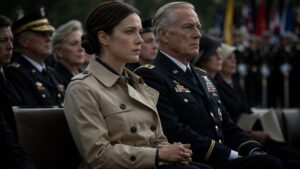
Her mother had driven six hours for the ceremony and sat in the back beside Captain Ellis. She wore a navy dress and held the dented coffee tin in her lap, though it was empty now. Her hands never stopped touching the lid.
When Isaiah’s name was spoken, she did not cry.
She closed her eyes.
That was worse.
Across the hall, Colonel Voss stood without his commendation ribbon.
Only a few people noticed.
Lena noticed.
Captain Ellis noticed too.
Later, Ellis would sign the corrected statement as witness. Voss would leave the missing ribbon in an envelope for the review board, along with a written declaration that said less than a confession and more than a defense. He would not ask Lena to read it.
She would not ask.
After the ceremony, the hall emptied slowly.
Boots faded into corridors. Voices returned in cautious fragments. Someone laughed too loudly near the doors, then stopped, ashamed of ordinary life arriving too soon.
Lena remained where she was.
Her mother came to stand beside her.
For a long moment, neither of them spoke.
Then her mother reached out and touched the old tags through Lena’s uniform.
“Are they heavy?” she asked.
Lena looked down.
They were.
They had always been.
But the weight had changed.
Before, they had pulled downward, toward shame, toward argument, toward the need to prove a dead man worthy of his own name.
Now they rested differently.
Not lighter.
Truer.
“Yes,” Lena said.
Her mother nodded.
“Good.”
Across the hall, Voss stopped near the exit. For a second, Lena thought he might come over.
He did not.
He looked at her mother, then at Lena, then lowered his eyes once in something too formal to be apology and too human to be nothing.
Then he left.
Lena watched the door close behind him.
She did not forgive him.
Not that day.
Maybe not ever.
But forgiveness was not the only shape truth could take.
Sometimes truth was a name spoken in a room that once refused it.
Sometimes it was a daughter standing where her father had been erased.
Sometimes it was metal against the chest, cold at first, then warmed by the body that chose to carry it.
Lena slipped one finger under the two chains.
Her own tags.
His tags.
For fifteen years, the Army had made her father a silence.
Now, at last, silence had to make room.
She stood a little longer beneath the bright lights, breathing with the weight of both names against her heart.