The Rope in the Dark
Part I — Black Water
Charles Jackson French came up choking in a sea that tasted like fuel.
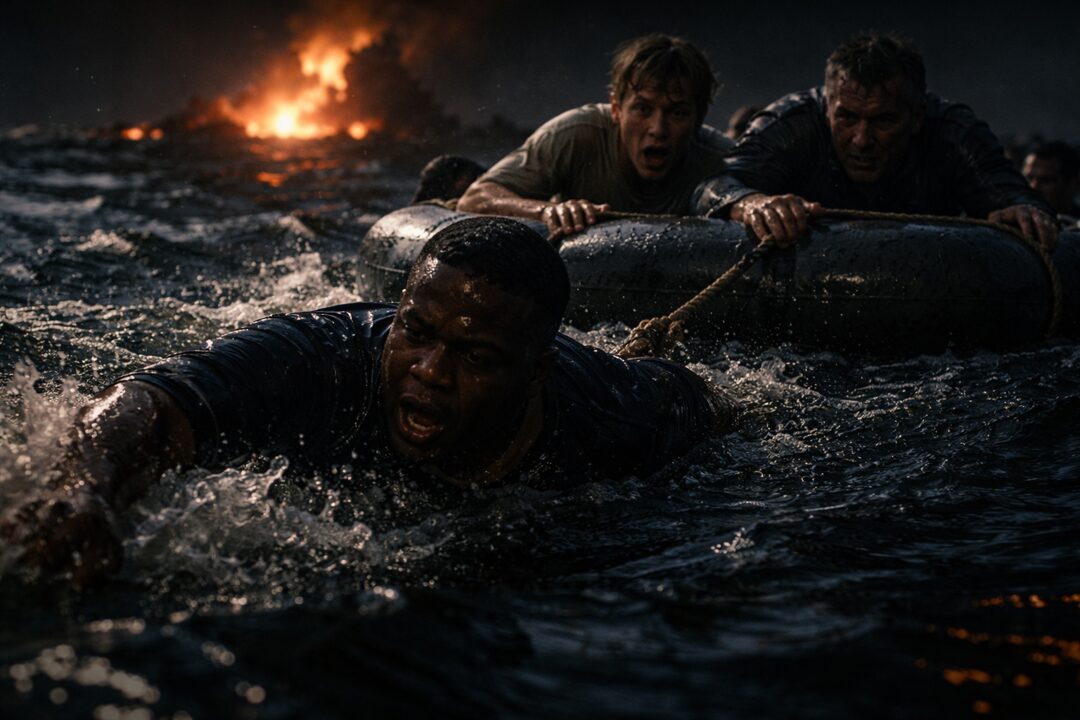
For one blind second he did not know where the sky was. The water was warm in patches, cold in others, and everywhere it carried bits of the ship with it—wood, oil, cloth, something sharp that scraped his shoulder as he kicked. Then he saw flame.
Not the whole ship. What was left of it.
The Gregory was no longer a place a man could stand. It was a wound in the dark, tilted and breaking apart, fire crawling over metal while voices rose and vanished between the waves. The night had turned every direction into the same thing: black water, orange light, men calling for help.
French dragged in one hard breath and heard somebody shout, “Raft! Over here—”
He turned.
A low life raft rocked thirty yards away, then forty as the current caught it. Bodies were piled on it wrong, not sitting but slumped, folded, hanging half over the edge. One man was trying to paddle with a board. Another had his hand pressed to his side and kept slipping.
No engine. No light. No chance.
French wiped oil from his eyes and began swimming toward them.
He passed a floating crate. Passed a cap. Passed a man who was face-down and still. Another sailor surfaced nearby, gasping, but caught a scrap of wreckage and drifted the other way. French looked once, then looked back at the raft.
That was the shape of the problem. Those men were hurt, and the sea was taking them.
By the time he reached the raft, someone grabbed his wrist with both hands, more panic than welcome. The raft dipped under the added weight of contact and lurched so hard one of the wounded men cried out.
“Easy,” French said, coughing seawater. “Easy.”
He hooked an arm over the side and took them in.
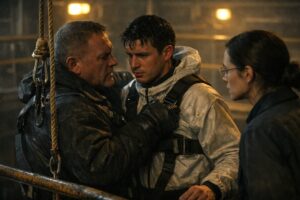
There were too many of them. Burned faces. A leg bent wrong. One sailor with blood matting half his hair. Another so pale in the flicker from the burning ship that he already looked like a ghost. A young kid with eyes too wide to blink. At the back, half propped against the rubber edge, an officer with one sleeve dark to the shoulder and torn insignia still pinned to what remained of his shirt.
The officer’s voice came out thin but practiced. “How many?”
Nobody answered.
“How many of us?”
“Too many,” somebody muttered.
The raft gave another sickening dip.
A broad-faced chief with a split lip and a ruined leg braced both hands on the side and snarled at the nearest man, “Sit still unless you want to drown us all.”
The kid whispered, “Are there sharks out here?”
The chief turned on him immediately. “Don’t start.”
But the question was already in the raft with them.
French looked past their shoulders. The current was carrying them away from the burning ship, out into the open dark. That should have felt like escape. It didn’t. It felt like being erased.
A man near the bow said through gritted teeth, “We’re not making it till morning like this.”
The officer shut his eyes once, then opened them. “We keep together. We conserve strength. We wait to be found.”
Nobody said what all of them knew. The raft had no proper paddle. Half the men on it could barely hold their heads up. Waiting was another word for drifting.
French’s hand brushed a loose length of line trailing from the raft.
He looked at it.
Then he looked at the men again.
Not one of them asked him to do it. That came later, in pieces. But the need was already there, plain as the rope in his palm.
The officer saw what French was looking at. “You thinking of towing?”
French did not answer immediately. He was measuring distance, current, weight, his own lungs still burning from the water. He was measuring how long a body could keep being a body after it stopped belonging to itself.
The chief stared at him. “That raft’s carrying near fifteen.”
French nodded once.
The young sailor said, almost angrily, “Nobody can pull that.”
French looked at him. The boy could not have been twenty.
“Nobody else is moving it,” French said.
For a moment there was only the crackle of distant fire and the slap of waves against rubber.
Then the chief lifted the line with his good hand and passed it to him.
No speech. No ceremony. Just rope.
French looped it once around his waist, pulled it tight, and tied the knot low against his hip.
The officer watched with a strange expression—fatigue, disbelief, something else not yet ready to name itself.
“French,” he said, reading the stitched name still clinging to the other man’s soaked shirt. “If you do this, don’t waste breath talking.”
French gave the smallest nod.
He drew one breath, leaned forward into the dark sea, and pulled.
At first the raft barely answered him.
It felt like trying to drag the ocean by hand.
Part II — The Weight of Fifteen Men
The first real movement came with pain.
The rope went taut and bit into French’s waist so hard he thought, with a quick flash of irritation more than fear, that he had tied it badly. He adjusted with one hand, kicked harder, and felt the raft shift behind him—not much, just enough to know it was no longer drifting free.
“Christ,” someone breathed.
French kept his face turned toward the dark ahead. He settled into the plain arithmetic of it: pull, breathe, kick, pull again.
Behind him, the raft found a rhythm it had not had before. Not smooth. Never smooth. But movement.
The officer’s voice carried over the water. “Easy on the sides. Keep your weight centered.”
The chief added, “And if any man starts praying too loud, do it inside his own skull.”
A few of them laughed. Not because it was funny. Because the sound proved they were still men and not yet cargo.
The kid spoke again a few strokes later. “You really think there are sharks?”
The chief barked, “Vale.”
So that was his name. Vale.
The boy swallowed. “I was only asking.”
French said nothing. He did not need the answer any more alive in the raft than it already was in his own mind.
The sea in daylight might have been one thing. Here it was almost abstract. Black swells. Flashes of broken fire far behind. The raft’s soft drag. The breathing of injured men trying to stay quiet and failing. Somewhere in the distance, something boomed—a delayed explosion, or metal finally surrendering to water.
French counted strokes because counting gave time walls.
At fifty he switched his breathing.
At a hundred he changed the angle of his kick.
At one-fifty his shoulder cramped and released.
The raft rode heavy. Every wave undid a little of what he earned. Every man on it was part of the pull, and each injury made him heavier in the only way that mattered.
He thought, not for the last time: just get them to the next minute.
The officer began counting too.
Not loudly. Just enough to be heard. “Twenty-three. Twenty-four. Twenty-five.”
He sounded like a man trying to create order with whatever was left of him.
French let the numbers stand.
They passed debris. Once, a plank bumped the raft and sent two men jerking up in panic. The chief cursed them back down. One sailor vomited weakly over the side and then apologized three times. Another had to be shaken awake every few minutes because slipping into sleep felt too much like slipping away.
French learned their voices before he knew their faces.
There was Vale, young and frightened and trying not to let it show.
There was Chief Nolan Pierce, who spoke like a man driving nails with his mouth.
There was Lieutenant Harper Cole, clipped and precise even while blood was drying down one arm.
There were the others—groans, whispers, muttered prayers, one man who kept asking for morphine, another who whispered his wife’s name like he was testing whether he still had a future.
French swam.
The rope sawed deeper.
The current argued with him. The sea did not care that he had chosen a direction. It kept offering him all the other ones.
After a while Cole called, “French.”
French raised one hand without turning.
“You tell me if you need a change.”
French almost laughed. A change to what?
Instead he said, “Keep them awake.”
A pause.
Then Cole: “You heard him. Nobody goes quiet on me.”
Pierce snorted. “Listen to that. Whole Navy’s hanging off one man’s belt and the lieutenant still thinks he’s running the meeting.”
Cole did not answer.
But something in the raft shifted at the line. Not mutiny. Not mockery. Just the beginning of a fact no one liked.
Rank floated in the water with everything else. The rope had become the chain of command.
The hours did not announce themselves. They accumulated.
French’s world narrowed to bite, drag, salt, and breath. Sometimes a wave lifted him high enough that he could see farther into the dark—nothing there, nothing there, nothing there. Sometimes a trough swallowed everything and he felt as if he were towing the raft through a tunnel with no ceiling.
Once something brushed his calf.
Quick. Muscular. Gone.
His whole body clenched around it. For one terrible instant he nearly kicked backward hard enough to jolt the line. Then he forced himself still.
Do not give it shape, he told himself.
Behind him, Vale said, “What was that?”
French kept swimming.
Pierce answered before anyone else could. “Fish.”
Vale’s voice tightened. “Big fish?”
Pierce said, “You want me to measure it?”
Another strained laugh rippled across the raft. Shorter this time.
French was grateful for the chief then. Hard men had their uses. Sometimes mercy looked like bluntness.
“French,” Cole called again after a long stretch. “Can you hear me?”
“Yes.”
“Good.”
It was a stupid exchange. It mattered anyway.
The rope burned through his soaked clothes and into skin. He adjusted the knot once more and felt it grind raw flesh when he did. There would be no comfortable way to do this. That comfort had passed with the ship.
One of the men on the raft began crying without sound. French could tell by the hitch of his breathing. Nobody mocked him. Even Pierce left it alone.
The silence afterward was worse.
French had seen men disappear before. Not only by dying. By becoming part of the work, part of the machinery, part of the room. A hand that served food. A back that lifted. A name read only when needed. He had grown used to that kind of invisibility because getting angry at it every day was too expensive.
In the water, it came back to him in a hard, almost funny way.
Now every man on that raft knew exactly where he was.
He pulled.
And they followed because they could do nothing else.
Part III — What the Dark Hides
After enough time, fear got ragged.
It did not leave. It simply lost the energy to remain sharp. It spread through the raft in different forms—irritation, muttering, prayer, stubborn silence.
Vale kept asking what time it was as if any of them owned time out there.
Pierce finally told him, “It’s the middle of hell and shut your mouth.”
Vale actually did, for nearly ten minutes.
Then one of the wounded men started trying to untie the bandage around his own thigh because the pressure hurt too much, and Cole had to stop him one-handed. Another swore he saw a light. There was no light. One sailor began apologizing to nobody in particular for being heavy.
“Stop that,” French said without turning.
The man did not seem to hear.
French said it louder. “You hear me? Stop saying sorry.”
The raft went quiet.
The man whispered, “I can’t help it.”
French dragged in breath enough for one more sentence. “Then help by staying on.”
That held.
Later, when Cole’s voice had gone thin from keeping count, Pierce took over. His count was rougher, less exact, but somehow easier to believe.
“Thirty-eight,” the chief muttered. “Thirty-nine. Forty. You quit before fifty, French, I’ll haunt you.”
French managed, “That a threat?”
“It’s a promise.”
A few men laughed again, and this time the laughter lasted long enough to feel almost human.
Then came the moment that changed the temperature of the raft.
It began with Cole asking for a name.
Not a prayer. Not an order. Just a name.
The sailor nearest him, his face striped with dried blood, said, “Miller.”
“State?” Cole asked.
“Missouri.”
Another answered before being asked. “Hobbs. Alabama.”
One by one, through pain and darkness, they began naming themselves as if reporting to a roll call no one had meant to survive long enough to hear. States. Cities. Farms. One man said he had a daughter with hair so pale it looked white in summer. Another had never seen the ocean before the war and sounded offended by it still.
When it reached Vale, the boy said, “Eddie Vale. Tulsa.”
Pierce grunted. “Figures.”
“What’s that supposed to mean?”
“Means you sound like Tulsa.”
Vale, absurdly, smiled. French could hear it.
Cole said, after a pause, “French.”
Charles did not answer at first. He was listening to the sea. Listening for anything that might become catastrophe.
Cole said it again. “French. Where’re you from?”
“Omaha.”
Pierce let out a low breath. “Nebraska. Lord help us. We got a farm boy towing the Navy.”
“No farm,” French said.
“That right?”
“No.”
He left it there. That should have been the end of it.
Instead Vale said, tentative and strange, “I seen you before.”
French kept swimming.
“In the galley line,” Vale went on. “Or carrying stores. Around ship. I don’t know.”
Pierce said, “That because he was there, genius.”
“No, I mean—” Vale stopped. Started again. “I mean I seen him. But I didn’t.”
The words hung between them.
Cole did not rush to save the boy from them. Neither did Pierce.
French’s jaw tightened. The rope cut deeper. The sea kept rising and falling under him like a breath too large to belong to any living thing.
Finally Vale said, softer, “I didn’t know your first name till just now.”
There it was.
Not a confession big enough for church. Just a wound showing itself.
French could have answered a dozen ways. Could have made it easier on the boy. Could have made it harder too.
Instead he said, “You can keep Miller awake?”
Vale blinked. “What?”
“Miller. He’s fading.”
Vale turned instantly. “Hey. Hey, Miller, look at me. You don’t sleep yet, all right? Tell me your little girl’s name again.”
The raft moved on.
No speech. No forgiveness. Just work.
But after that, the men listened to French differently.
Cole’s counting grew less like command and more like accompaniment. Pierce’s curses covered worry more often than contempt. And Vale watched French’s head and shoulders in the water as if trying to understand how a man could keep reducing himself to motion and still remain human.
An hour later—maybe less, maybe more; time had broken into fragments—another sailor cracked.
His name was Hobbs from Alabama. He had been quiet too long, which should have been warning enough. Suddenly he began saying, “Cut it.”
Nobody answered, thinking they had heard wrong.
“Cut the line,” Hobbs said again. Louder this time. “Cut him loose. He’s wasting himself.”
Pierce snapped, “Shut up.”
Hobbs shoved weakly at the raft edge. “You cut him loose and maybe he makes it. You keep us on him and all of us drown.”
Vale said, “Don’t say that.”
“It’s true.”
Cole tried to sit straighter and nearly blacked out for it. “Hobbs.”
Hobbs ignored him. “French!”
Charles turned his head enough to hear better.
“Cut it,” Hobbs said, voice breaking. “You hear me? Cut the damn rope.”
For the first time all night, French stopped counting strokes in his head. The words hit harder than the sea had.
Not because Hobbs was wrong about the burden. Because part of Charles had already said it to himself.
The waves slapped against his face. The line pulled at his waist. Fifteen wounded men behind him. Open water ahead. Black everywhere else.
“French,” Hobbs said again, almost pleading now. “Save yourself.”
Charles looked forward into the dark and answered with the only truth he had room for.
“No.”
Hobbs made a raw sound in his throat. “You don’t owe us this.”
Charles kicked harder and said, “Maybe not.”
Then, after another pull, “Still doing it.”
That line settled into the raft like iron.
Pierce let out a breath that was almost a laugh and almost grief. “Well,” he said hoarsely. “There’s your answer.”
But Hobbs was not the only one near breaking.
A few minutes later another man, feverish and half-delirious, loosened his own grip and tried to roll backward into the sea, mumbling that he was making them heavy. Vale screamed. Pierce caught the man’s collar with both hands and nearly went over with